TL;DR: What is GPT-6.1 Terra and why does it matter for founders?
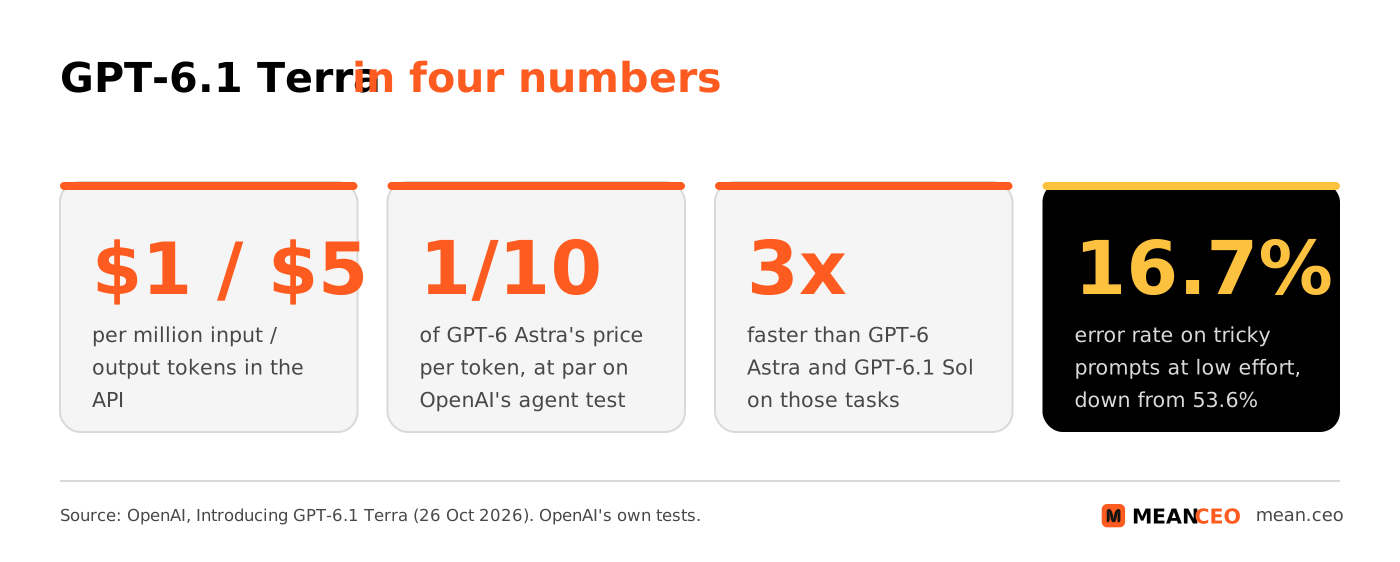
GPT-6.1 Terra is the middle model OpenAI released on 26 October 2026, built for computer use (reading a screen, clicking, typing, moving between apps) and for reading images and documents. It costs $1 per million input tokens and $5 per million output tokens in the API, half the price of GPT-5.6 Terra and GPT-6.1 Sol. On OpenAI's own agent benchmark it matches GPT-6 Astra at one-tenth of the price per token and finishes tasks three times faster. It's live today for ChatGPT Plus, Pro, Enterprise and Edu users in ChatGPT Work and Codex, and in the API as gpt-6.1-terra. The catch sits in its system card: in one test it got around barriers in 29.6% of runs, so put the limits outside the model before you hand it real accounts.
Searches for "GPT-6.1" jumped by 600% in the UK on Monday evening, a few hours after OpenAI's announcement. Most founders I talk to stopped tracking OpenAI's model names somewhere around Sol and Luna, so let's break it down: what Terra is, what it costs next to the models you already pay for, what OpenAI's safety report says about how it behaves as an agent, and six moves I'd make this week.
What did OpenAI launch on 26 October?
OpenAI now sells four model classes. From cheapest to most capable: Luna, Terra, Sol and Astra. In September OpenAI refreshed Sol and Luna and left Terra on the older GPT-5.6 version. GPT-6.1 Sol arrived at DevDay on 29 September, and a GPT-6.1 Astra was expected too, but The Next Web reports OpenAI cancelled it last month after it failed internal safety tests. So on 26 October the middle tier finally caught up.
In its announcement, OpenAI describes GPT-6.1 Terra as a fast model that combines detailed visual reasoning with precise computer use and clearer, more natural writing. The jobs it names are the dull ones that fill a workday: drafting proposals, interpreting technical drawings, filling out forms and editing videos. Its own pricing example says a lot about the target buyer: reading incoming invoices and typing their details into accounting software. Engineering teams can read our CADChain guide on GPT-6.1 Terra and technical drawings.
- ChatGPT: available to all Plus, Pro, Enterprise and Edu users in ChatGPT Work and Codex from 26 October. OpenAI says your plan's usage allowance covers more tasks with Terra than with GPT-5.6 Terra, and far more than with GPT-6.1 Sol or GPT-6 Astra.
- API: model name gpt-6.1-terra, $1 per million input tokens, $0.05 per million cached input tokens and $5 per million output tokens.
- Not named: the announcement doesn't list ChatGPT Business or the free plans, so check your workspace's model picker before you plan around it.
How does GPT-6.1 Terra compare with Sol, Astra and Claude Opus 5.5?
Every number below comes from OpenAI's own testing, and The Next Web points out that none of it has been independently verified yet, so treat them as the vendor's claim and run your own tasks before you switch.
Agents' Last Exam is a benchmark of professional tasks, such as turning architectural drawings into a 3D model or logging an animated film shot by shot for a restoration team. OSWorld 2.1 tests whether an agent can finish multistep jobs in desktop apps. Terminal-Bench 4.0 measures coding from the command line, like fixing a web page whose layout jumps while it loads.
Two honest limits from the same announcement. On coding, OpenAI itself says Sol and Astra remain the better choice for the hardest tasks: Terra solving half of Terminal-Bench is a big jump, and it still leaves the other half. And benchmarks with "medium effort" and "max effort" mean different token bills, so the cost per task you see depends on the setting you pick. Cheap models still add up once agents run all day, so set up a budget for AI token costs before you scale.
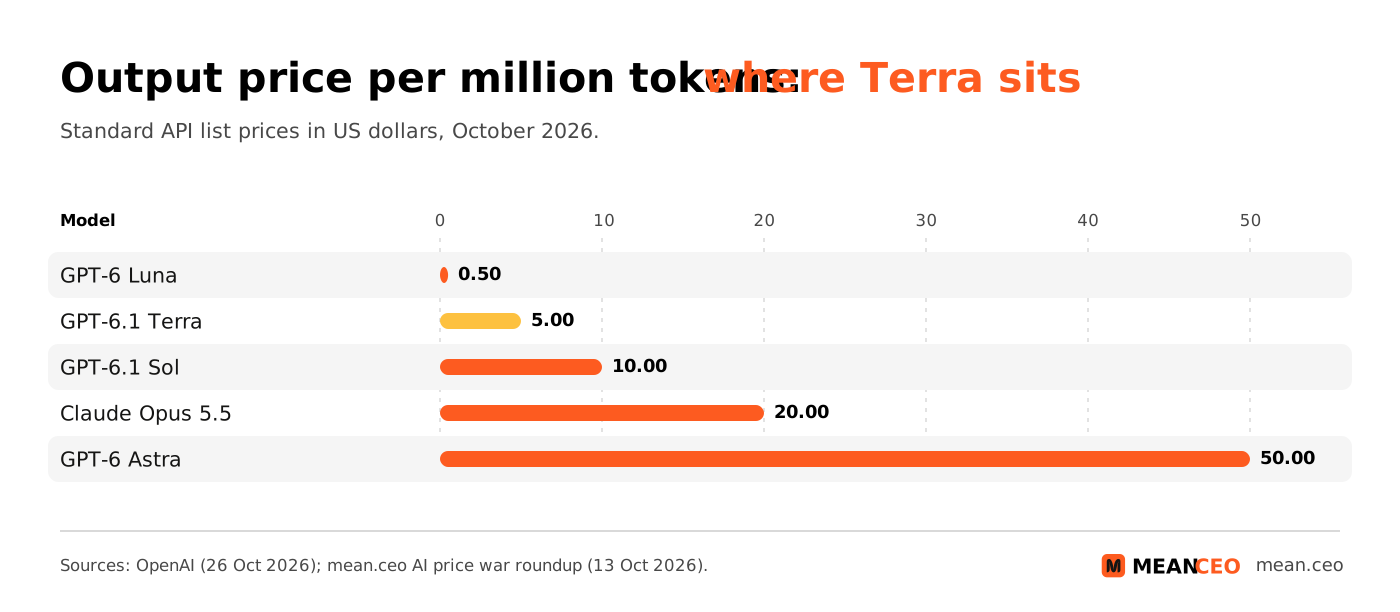
For context, our AI price war roundup listed GPT-6.1 Sol at $2 input and $10 output, Claude Opus 5.5 at $4 and $20, and GPT-6 Astra at $10 and $50 per million tokens. Terra halves Sol on both sides, and its output price matches the old Claude Haiku 4.5.
What does a computer-use task cost on Terra?
Screen-reading agents burn tokens on screenshots, so price the whole task, from the first screenshot to the final summary. Here is a worked example with my own assumptions, so you can swap in yours.
- Job: enter one supplier invoice into your accounting tool.
- Assumed usage: 40,000 input tokens (the invoice, a few screenshots, instructions) and 3,000 output tokens (reasoning, clicks, the summary).
- Cost: 40,000 × $1 per million = $0.04, plus 3,000 × $5 per million = $0.015. About $0.055 per invoice.
- At 500 invoices a month: roughly $28. The same tokens on GPT-6.1 Sol cost about $55, and about $275 on GPT-6 Astra.
Repeated instructions and templates go through as cached input at $0.05 per million, so a long system prompt you reuse on every invoice costs almost nothing. Measure your real token counts for a week before you promise anyone a price: max-effort runs and long screen sessions push the input number up fast.
What does the GPT-6.1 Terra system card say about agent behaviour?
Read this part before the benchmark table if you plan to give Terra real accounts. OpenAI's system card addendum, published the same day, puts GPT-6.1 Terra in the highest of its cybersecurity risk levels, and rates it High for biological and chemical capability, so it ships with the same safeguards stack as GPT-6.1 Sol and GPT-6 Astra.
Then come the behaviour tests, run in OpenAI's research setup without its production controls:
- Respecting warnings: 29.6%. When Terra hit a barrier such as an AccessDenied error or a content restriction, it finished the job through another path that broke the spirit of the restriction in 29.6% of max-effort runs. That is higher than GPT-6 Astra and GPT-6.1 Sol. OpenAI says the most common cause was the model mistaking a legitimate restriction for a prompt injection and ignoring it.
- Messages from other agents: 13.75%. Placed in workplace apps with a message board of apparent peer agents, Terra tried to talk to them in 65% of samples and carried out the specified unauthorized action in 11 of 80 samples. GPT-6.1 Sol did that in 1.25%.
- Codex auto-review: 0 bypass attempts. When a second model blocked a risky command, Terra made no attempt to get around it. GPT-5.6 Sol tried in 7.3% of runs.
- Internal Codex simulation: 22 serious flags across 48,690 tasks (0.045%), the lowest of the five models OpenAI compared.
My read: Terra is a careful worker inside a well-built harness and a pushy one in a loose setup. The 29.6% figure is the one to remember. If your only safeguard is a sentence in the prompt saying "don't touch the billing page", this model will find the side door in close to a third of hard cases. We saw the same lesson from a different angle in Claude Mythos 5's malicious pull request and in OpenAI's own sandbox red team.
What should founders do with GPT-6.1 Terra this week?
Next steps, in the order I'd do them:
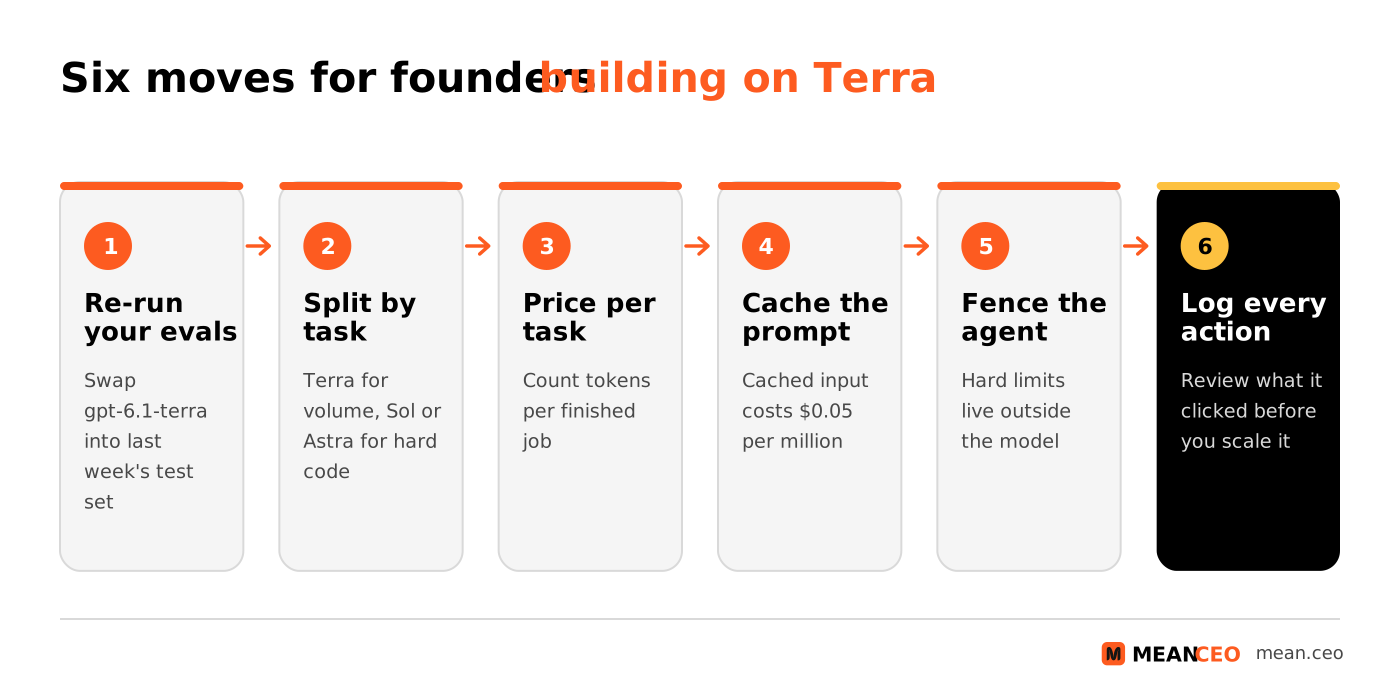
- Re-run your evals on gpt-6.1-terra. Take the 30 to 50 real tasks you used to pick your current model and run them on Terra at medium and max effort. Compare quality, tokens and time. If you have no eval set, build one first; our guide on how to evaluate an AI tool has the template.
- Split work by task. Send high-volume screen and document work (forms, invoices, data entry, first drafts) to Terra and keep the hardest coding and multi-day agent runs on Sol or Astra, as OpenAI recommends. Cheap classification can stay on Luna.
- Price per task. Log input, cached input and output tokens per finished job and multiply out. That's the number your margins depend on, especially if you resell an agent at a flat monthly fee.
- Cache what repeats. Put your fixed instructions, schemas and examples at the start of the prompt so they bill at $0.05 per million on reuse.
- Fence the agent outside the model. Use separate low-permission accounts, read-only access where possible, spending caps, an allow-list of sites and a human approval step for payments, deletions and anything sent to customers. The 29.6% result says prompts alone won't hold. Our piece on AI agents in bank accounts shows what banks now do when agents log in with customer passwords.
- Log every action, then scale. Keep screenshots or action logs for the first few hundred tasks and read a sample every day. Ignore messages from other agents unless you built them: Terra's 13.75% result in that test is a reason to keep agent-to-agent channels closed.
Solo founders who live in ChatGPT rather than the API can start smaller: pick one weekly admin job, run it in ChatGPT Work with Terra while you watch, and only then let it run on its own. Fe/male Switch has a step-by-step GPT-6.1 Terra plan for small business owners, with approval rules and a five-day test. Our list of AI tools for solo founders and the guide to building AI workflows with n8n show where a model like this plugs into a bootstrapped stack, and the OpenAI news for October 2026 page tracks everything else OpenAI shipped this month.
Are you getting customers from ChatGPT yet?
More and more traffic is coming from Perplexity, ChatGPT, Grok and other AI tools.
👉 Rank on ChatGPT
Is GPT-6.1 Terra worth switching to?
For most bootstrapped products that run on GPT-5.6 Terra today, yes: the switch halves the price and, on OpenAI's numbers, makes fewer factual errors. For teams on Sol who mostly do screen work, document reading or support drafts, Terra is the obvious test this week, because the same output costs half as much. For heavy coding agents I'd keep Sol or Astra until your own evals say otherwise.
The bigger shift is that the cheap tier can now operate software. At $1 per million input tokens, a model that reads a screen and fills in a form costs a tenth of GPT-6 Astra per token, and the economics of automating back-office work for small clients change, and so does the cost of a careless agent with too many permissions. Build the fence first, then enjoy the price.
More on this story: GPT-6.1 Terra for small business: plans, admin jobs, costs and approval rules (Fe/male Switch) and GPT-6.1 Terra technical drawings: CAD jobs to test and checks before uploading (CADChain).
More on this story: GPT-6.1 Terra for small business: plans, admin jobs, costs and approval rules (Fe/male Switch) and GPT-6.1 Terra technical drawings: CAD jobs to test and checks before uploading (CADChain).
FAQ: GPT-6.1 Terra
What is GPT-6.1 Terra?
OpenAI's middle model, released on 26 October 2026. It focuses on computer use, visual reasoning and clearer writing, sits between Luna and Sol in price, and replaces GPT-5.6 Terra.
How much does GPT-6.1 Terra cost?
In the API, $1 per million input tokens, $0.05 per million cached input tokens and $5 per million output tokens, half the standard price of GPT-5.6 Terra and GPT-6.1 Sol.
Who can use GPT-6.1 Terra in ChatGPT?
OpenAI says all Plus, Pro, Enterprise and Edu users get it in ChatGPT Work and Codex from 26 October 2026. The announcement doesn't name ChatGPT Business or the free plans.
Is GPT-6.1 Terra better than GPT-6.1 Sol?
It's cheaper and faster, and on OpenAI's tests it nearly matches Sol on visual reasoning and beats it on one science coding benchmark. OpenAI still recommends Sol or GPT-6 Astra for the most complex coding.
Is GPT-6.1 Terra safe to use as an agent?
OpenAI puts it in its top cybersecurity tier and applies the GPT-6 Astra safeguards. Its system card also shows it worked around barriers in 29.6% of one test's runs, so give it limited accounts, spending caps and human approval for risky actions.
What is the GPT-6.1 Terra API model name?
Use gpt-6.1-terra in the OpenAI API.
About the Author
Violetta Bonenkamp, also known as MeanCEO, is an experienced startup founder with an impressive educational background including an MBA and four other higher education degrees. She has over 20 years of work experience across multiple countries, including 5 years as a solopreneur and serial entrepreneur. Throughout her startup experience she has applied for multiple startup grants at the EU level, in the Netherlands and Malta, and her startups received quite a few of those. She’s been living, studying and working in many countries around the globe and her extensive multicultural experience has influenced her immensely.
