
TL;DR: what changed in AI pricing this month?
On 7 October 2026, Anthropic launched Claude Haiku 5.5 at $0.10 per million input tokens and $0.50 per million output tokens, 90% cheaper than Haiku 4.5 for prompts up to 100,000 tokens. It also halved Sonnet 5.5's cache-read price and started giving Max and Team subscribers $100–$500 a month in free API credit. OpenAI's GPT-6.1 Sol, launched on 29 September, costs a fifth of GPT-6 Astra, and Mistral's 1-trillion-parameter Large 4, trained in Europe, is in preview at a 50% discount. For a small AI app, the monthly bill for a capable model can now be under $10. Here's what each model costs and how to cut your bill.
If you build with AI, your biggest variable cost just dropped again. In two weeks, Anthropic, OpenAI and Mistral all made capable models much cheaper, and Anthropic started handing out free API money to people who already pay for Claude.
Here's what changed, what it costs to run a real workload on each model, and the small print that matters. For OpenAI's new agents, see OpenAI's always-on agents launch without Europe.
Claude Haiku 5.5: 90% cheaper
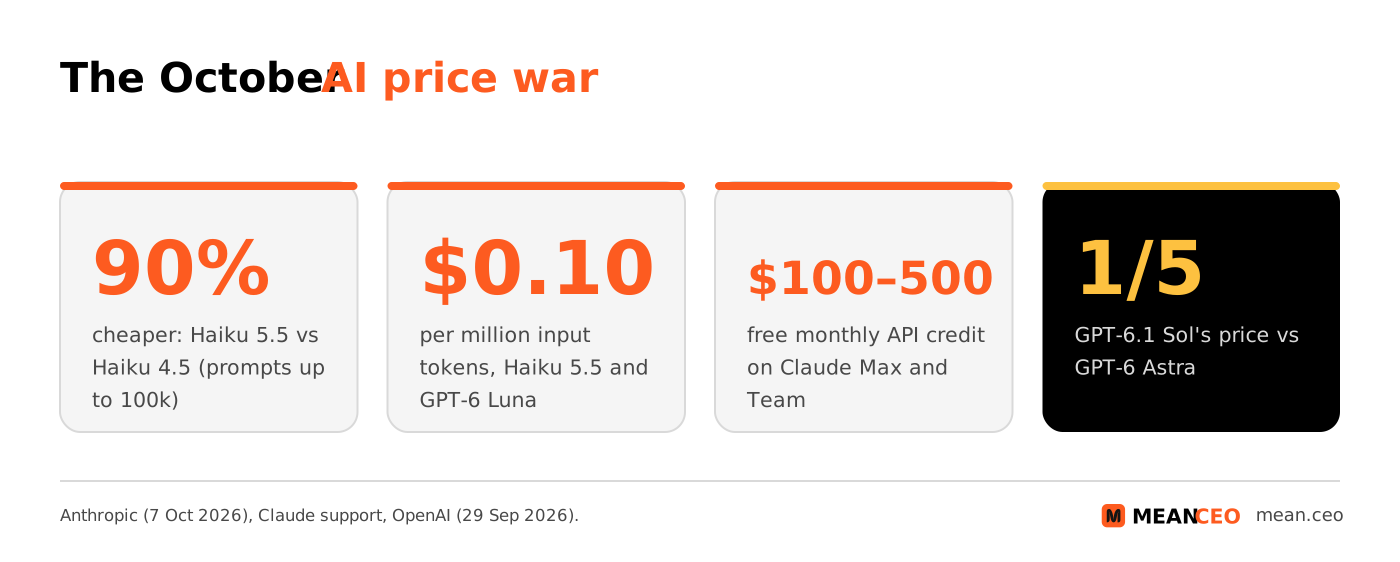
Anthropic released Claude Haiku 5.5 on 7 October 2026. The price, per million tokens:
- Prompts up to 100,000 tokens: $0.10 input and $0.50 output, against $1 and $5 for Haiku 4.5.
- Prompts over 100,000 tokens: $0.50 input and $2.50 output, 50% cheaper than Haiku 4.5. The whole request is billed at the higher rate, and cached tokens count towards the 100,000.
- Overall, Anthropic says Haiku 5.5 costs around 75% less to run, because about 90% of Haiku 4.5 requests were under 100,000 tokens.
It isn't just cheaper. On the OSWorld 2.1 computer-use benchmark, Haiku 5.5 scored 72.4%, against 15.7% for Haiku 4.5 and 48.9% for OpenAI's GPT-6 Luna, according to Anthropic. It has a 1-million-token context window, up to 128,000 output tokens and, for the first time in a Haiku model, an adjustable effort setting. One catch: its new tokenizer produces about 30% more tokens than Haiku 4.5 for the same text, so real savings are a little smaller than the headline.
Cheaper Sonnet caching and free API credit
Anthropic also cut the price of cache reads for Sonnet 5.5 from $0.20 to $0.10 per million tokens, which it says reduces the cost of Sonnet 5.5 on most agentic tasks by around 20%. And it now gives some subscribers a monthly API credit:
The credit works with any Claude model through the API, the Console, Managed Agents and the Agent SDK. It doesn't cover interactive Claude Code, extra usage, or Claude through AWS, Google Cloud or Microsoft. It doesn't roll over: unused credit expires at the end of each billing cycle.
OpenAI, Google and Mistral
- OpenAI GPT-6.1 Sol (29 September): $2 input, $0.10 cached input and $10 output per million tokens, pitched by OpenAI as "near-Astra intelligence for a fifth of the price". GPT-6 Astra costs $10 and $50; the small GPT-6 Luna costs $0.10 and $0.50, the same as Haiku 5.5.
- Mistral Large 4 (6 October): a model with about 1 trillion parameters, 52 billion active per request, trained on 3,800 NVIDIA Grace Blackwell GPUs in Mistral's own European data centres and covering more than 160 languages. In public preview it lists at $1.36 input and $4.18 output, currently at a 50% sale price of $0.68 and $2.09. Mistral says it will release the weights by the end of October.
- Google Gemini: the cheapest models remain very low, with Gemini 2.5 Flash-Lite at $0.10 input and $0.40 output. Gemini 3.8 Flash is on a promotional price of $0.75 and $3.75 until the end of 2026, and doubles from January, according to Google's pricing page.
Batch processing is 50% cheaper on Claude's API. For the full list, including cache-write prices, see Claude's pricing page and each provider's documentation.
What it costs to run a small AI app
Take a typical small product: 30 million input tokens and 6 million output tokens a month, for example a chatbot or document tool with steady daily use. At list prices, with no caching:
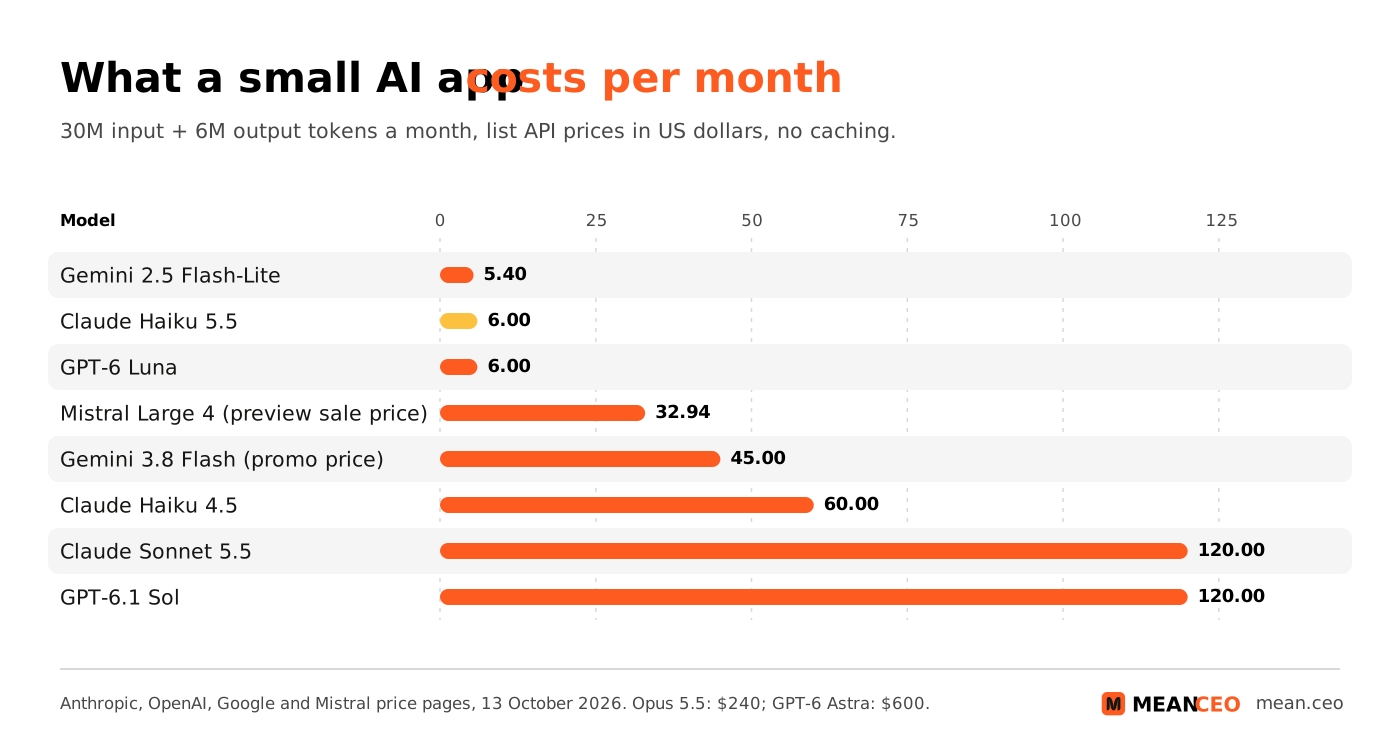
The same workload costs $240 on Claude Opus 5.5 and $600 on GPT-6 Astra. If 80% of your Sonnet 5.5 input is cached, its bill falls to about $74. And for a founder on Claude Max 5x, the $100 monthly credit covers most of the Sonnet scenario.
What this means for you
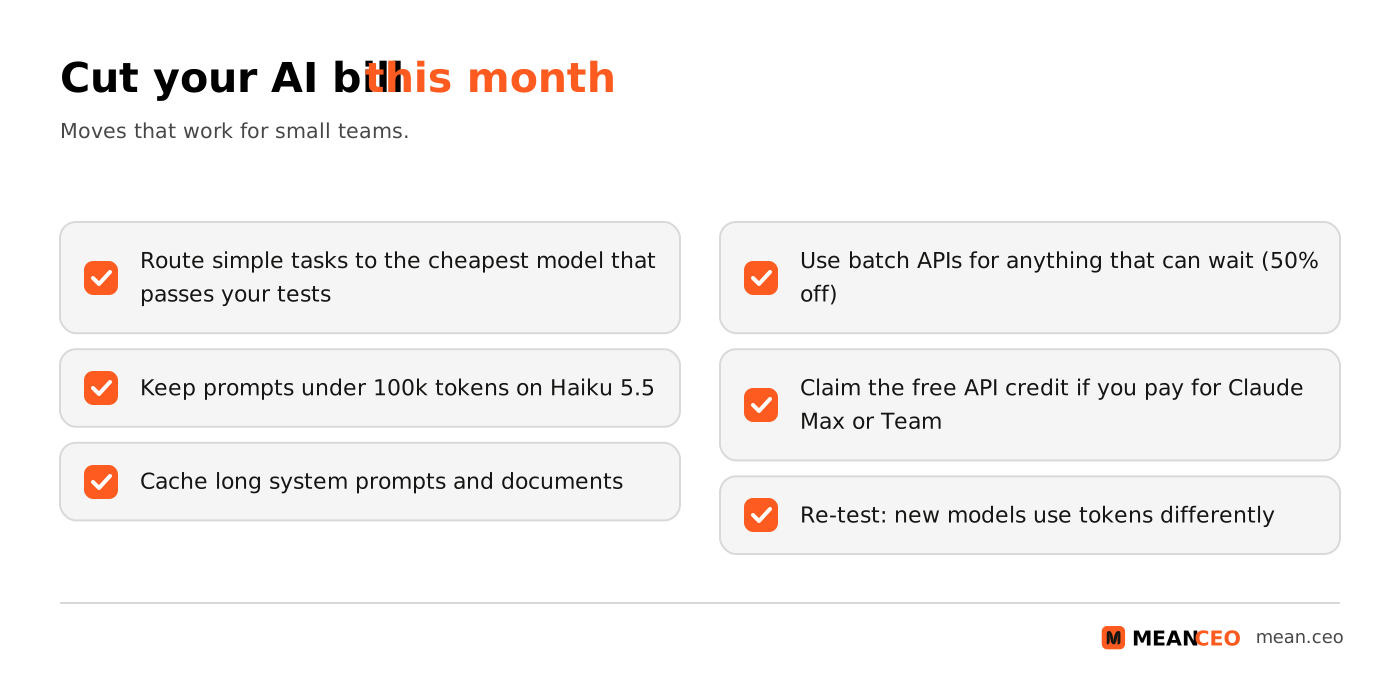
- Re-run your model choice. Tasks you gave to a mid-size model six months ago may now run well on Haiku 5.5 or GPT-6 Luna for a tenth of the price. Test on your own examples; see how to evaluate an AI tool.
- Route by difficulty. Use a small model for classification, extraction and drafts, and a larger one only when it fails. Workflow tools make this easy; see building AI workflows with n8n.
- Claim your credit. If you already pay for Claude Max or Team, link a Console organisation and use the monthly API credit before it expires.
- Watch the small print. Haiku 5.5's low price applies to prompts up to 100,000 tokens, its tokenizer uses more tokens, Gemini's promo prices end, and Mistral's sale price has no end date shown.
- Consider a European model. Mistral Large 4 was trained in Europe, and open weights would let you self-host under EU rules, once the weights and licence are published.
For the bigger picture, see our Anthropic Claude news for October 2026, OpenAI news for October 2026 and our list of AI tools for solo founders.
Are you getting customers from ChatGPT yet?
More and more traffic is coming from Perplexity, ChatGPT, Grok and other AI tools.
👉 Rank on ChatGPT
FAQ: AI model prices in October 2026
How much does Claude Haiku 5.5 cost?
$0.10 per million input tokens and $0.50 per million output tokens for prompts up to 100,000 tokens, and $0.50 and $2.50 above that. It launched on 7 October 2026.
Is Claude Haiku 5.5 really 90% cheaper?
Yes for prompts up to 100,000 tokens, compared with Haiku 4.5. Above that it's 50% cheaper, and Anthropic estimates around 75% lower costs overall. Its tokenizer uses about 30% more tokens.
Do Claude subscriptions include API credits?
Max 5x includes $100 a month, Max 20x $200, and Team $20 per Standard seat or $100 per Premium seat, capped at $500. Credits expire each billing cycle and don't cover interactive Claude Code.
How much does GPT-6.1 Sol cost?
$2 per million input tokens, $0.10 cached and $10 output, about a fifth of GPT-6 Astra's price.
What is the cheapest capable AI model in October 2026?
Claude Haiku 5.5, GPT-6 Luna and Gemini 2.5 Flash-Lite all cost about $0.10 per million input tokens. Which is best depends on your task, so test them on your own examples.
Is Mistral Large 4 open source?
Mistral says it will release the weights by the end of October 2026. The licence hadn't been published when we checked.
About the Author
Violetta Bonenkamp, also known as MeanCEO, is an experienced startup founder with an impressive educational background including an MBA and four other higher education degrees. She has over 20 years of work experience across multiple countries, including 5 years as a solopreneur and serial entrepreneur. Throughout her startup experience she has applied for multiple startup grants at the EU level, in the Netherlands and Malta, and her startups received quite a few of those. She’s been living, studying and working in many countries around the globe and her extensive multicultural experience has influenced her immensely.
