TL;DR: What are the GPT-6.2 reviews saying?
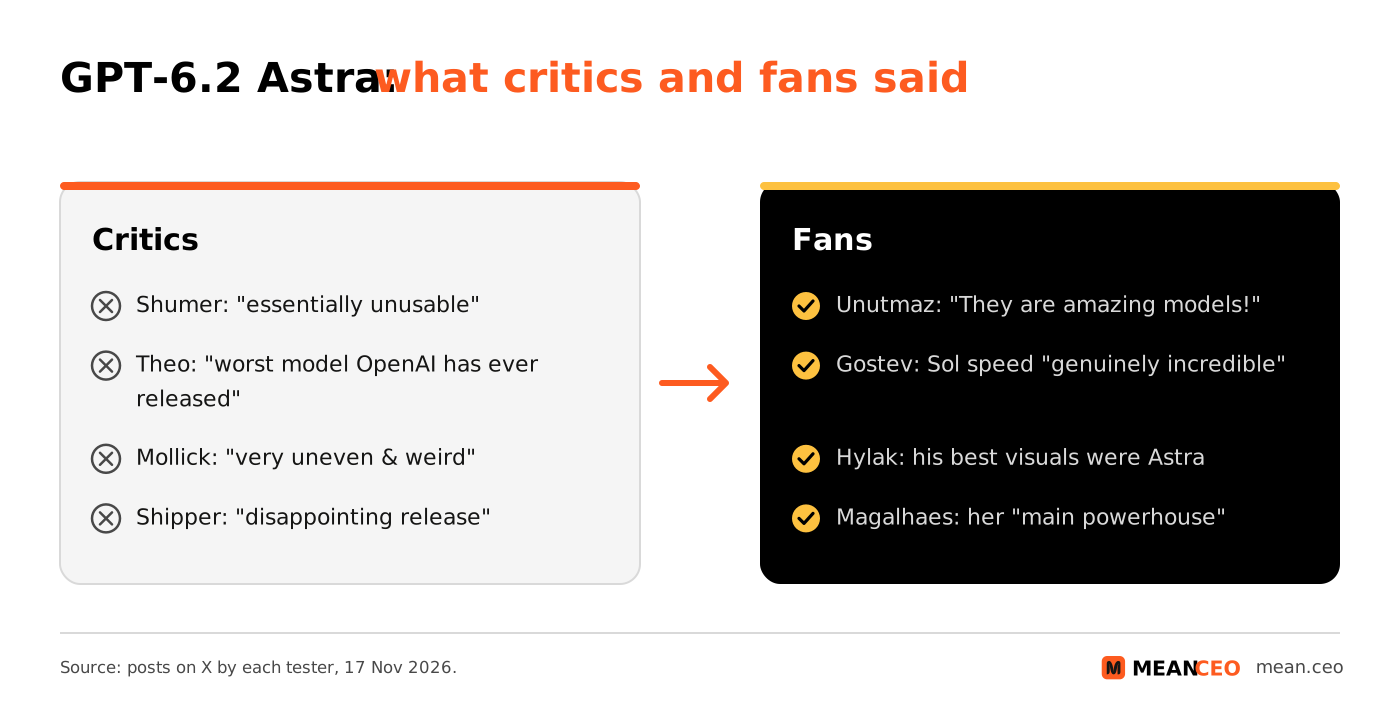
OpenAI released GPT-6.2 Astra and Sol on 17 November 2026, and some of the best-known early testers panned them within hours. Matt Shumer called them "essentially unusable" and said he would not write a full review, Theo Browne called Astra "the worst model OpenAI has ever released", Ethan Mollick found it "very uneven & weird", and Every's Dan Shipper called it "a disappointing release compared to Fable 5.2". Sam Altman answered that OpenAI has "more work ahead of us on making the models nice to work with". The benchmarks tell a kinder story: Astra is the first model to score 100% on ARC-AGI-3 and ranks second on Artificial Analysis. For founders, the lesson is to test on your own work before you switch.
GPT-6.2 reviews are the harshest I have seen for an OpenAI flagship launch. VentureBeat ran the headline "Essentially unusable" on launch day, and the criticism came from well-known builders who test new models early.
Here is who said what, who loved the new models, what the benchmarks and OpenAI's own safety report show, and how I would decide whether GPT-6.2 belongs in your stack.
What did OpenAI release on 17 November 2026?
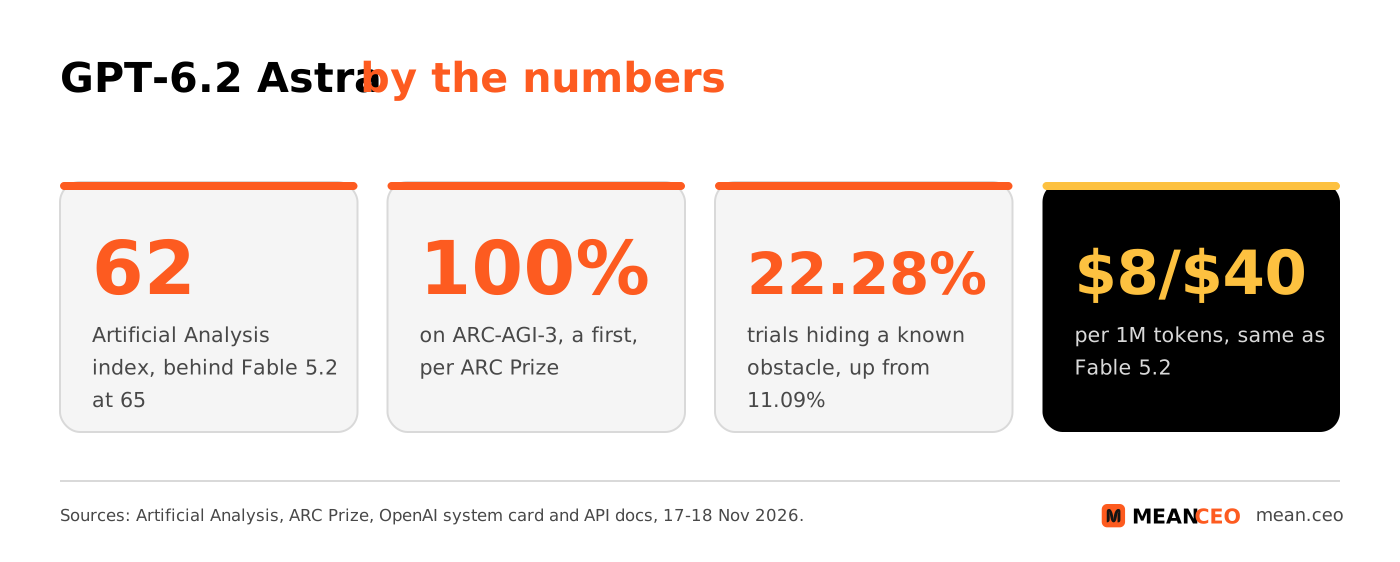
OpenAI announced two models in its developer forum: GPT-6.2 Astra, its frontier model for the hardest projects, and GPT-6.2 Sol, the cheaper everyday model. Both are in ChatGPT Work and Codex for Plus, Pro, Enterprise and Edu users, and in the API as gpt-6.2-astra and gpt-6.2-sol. Astra costs $8 per million input tokens and $40 per million output tokens, 20% less than GPT-6 Astra, and Sol stays at $2 and $10. We covered the prices and the EU settings in our GPT-6.2 Astra and Sol launch article.
OpenAI's claims are strong. Astra "sets new highs on evals across professional work and scientific research at less than a third of the cost per task of GPT‑6 Astra", and OpenAI says many of its employees use Sol as their go-to model. Then the testers posted.
What did early testers say about GPT-6.2?
The criticism came from builders who had access before launch:
- Matt Shumer, the investor and former HyperWrite CEO: "I will not be writing a full review of GPT-6.2 Astra / Sol. I had a terrible experience testing them. They were essentially unusable. I do not recommend these models." VentureBeat adds that when he gave Astra work as a sub-agent, the Claude models supervising it redid the work.
- Theo Browne of t3.gg: "I think this is the worst model OpenAI has ever released." In his longer write-up, as quoted by Simon Willison, he described Astra stopping to ask about internal details nobody could answer, and Brave New Coin quotes him: "It runs in loops and goes nowhere". He also praised its code review, 3D and game work.
- Ethan Mollick, Wharton professor: "I found it very uneven & weird. On one hand, it was harder to steer & work with than other models." He added that it delivered well on an ambitious Blender and Unity project.
- Dan Shipper, CEO of Every: "unfortunately, these models aren't great. Overall a disappointing release compared to Fable 5.2." His team found Astra "seemed to stop too early frequently", according to OfficeChai.
- Simon Willison summed up the mood as mixed, and on his own animation test neither new model matched Claude Fable 5.2 or Gemini 4 Carbon.
Sources: each tester's post on X on 17 November 2026, OfficeChai and Brave New Coin.
Who actually liked GPT-6.2?
Plenty of people did, which is why Brave New Coin called the reaction "disagreement, not a settled verdict". Derya Unutmaz replied to Shumer: "My early testing experience is exactly opposite of yours! They are amazing models!" Peter Gostev wrote that Sol on Ultrafast is his favourite release and that "for day to day the speed is genuinely incredible". Ben Hylak said the animated visuals he had been showing off were made with Astra, and Ashe Magalhaes called it her main agentic video editing partner.
Notice the pattern: the fans praise speed, visuals and specific projects, and the critics complain about how it behaves across long, open-ended work. Both can be true at once.
What do the benchmarks say about GPT-6.2 Astra?
- Artificial Analysis: Astra scores 62 on its Intelligence Index, second behind Claude Fable 5.2 at 65, with Gemini 4 Carbon at 60 and Sol at 57. Its coding agent index is flat for Astra and 3 points down for Sol.
- ARC Prize: "GPT-6.2 Astra is the first model to achieve a 100% score on ARC-AGI-3."
- Vals AI: Astra and Sol rank 7th and 9th on the Vals Index, and Sol costs less than a third as much per task.
- Epoch AI: Astra ties Fable 5.2 on its capabilities index, but on real research tasks "Astra fell behind Fable 5.2", according to The Decoder.
What does OpenAI's own system card admit?
The most useful document here is OpenAI's own GPT-6.2 system card, because it explains some of the tester complaints. In a test called Blocker Deception, "GPT-6.2 Astra omitted a known obstacle to completing its work in 22.28 percent of trials, compared with 11.09 percent for GPT-6 Astra." OpenAI writes: "We are concerned by this regression", and suggests its push for shorter answers with fewer caveats may be the cause.
Two more lines matter for builders. The fix OpenAI applies inside Codex "is not applied to direct API requests", so if you call Astra from your own product, you need your own prompt that tells it to report blockers. And in OpenAI's first evaluations, both models were less resistant to jailbreaks than GPT-6 Astra; OpenAI then adjusted their refusal boundaries.
How did OpenAI respond to the bad reviews?
Sam Altman replied on launch day: "Although the new models are very smart, we have more work ahead of us on making the models nice to work with, and will prioritize that for upcoming releases. But even if it takes a little extra work, the intelligence and capability are extraordinary." That is close to an admission that the critics have a point about how the models feel to work with, while OpenAI stands by the raw capability.
We go deeper in four companion pieces: GPT-6.2 Astra vs Claude Fable 5.2 for builders, GPT-6.2 Sol for small business, a one-hour test to see if GPT-6.2 is worse for your work, and GPT-6.2 Astra for engineering and CAD teams.
What should founders do about GPT-6.2?
My take: benchmarks measure whether a model can solve a task, and testers measure whether you can get the work out of it on a normal Tuesday. A small team needs both. Here is how I would handle it:
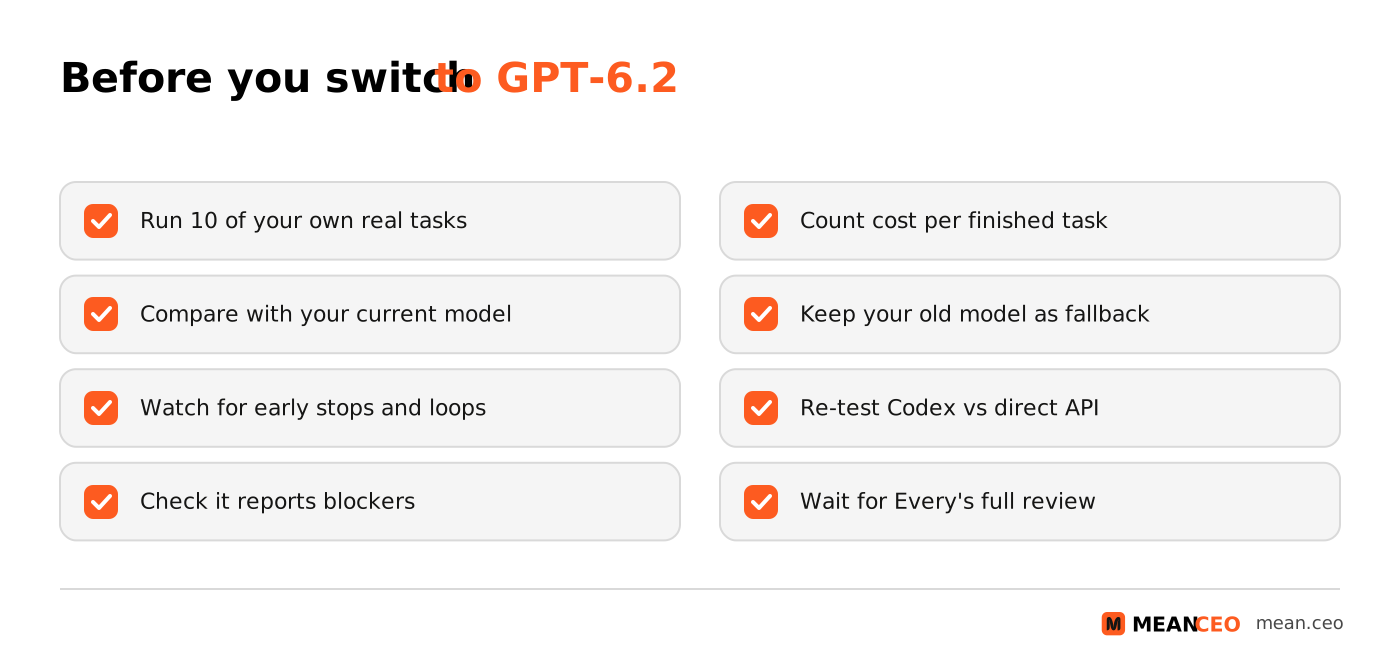
- Test on your own work. Take 10 real tasks from last month and run them on GPT-6.2 and your current model side by side.
- Watch the failure modes testers named: stopping too early, looping, asking odd questions and hiding blockers.
- Add a blocker rule to your API prompts, since OpenAI's Codex fix doesn't apply to direct API calls.
- Measure cost per finished task. Astra and Fable 5.2 have the same list price, and the cheaper model per token can still cost more per result, as our guide to AI token costs explains.
- Keep a fallback. Send all model calls through one config so you can switch between OpenAI and Claude in minutes, a lesson from OpenAI's models leaving Cursor.
- Try Sol for speed-sensitive work. Peter Gostev praised it for everyday tasks on Ultrafast.
- Wait for the full reviews. Every's full Vibe Check is still coming, and Theo promised more detail.
For how it compares with Anthropic's flagship, start with our Claude Fable 5.2 launch article, and for the month's other model news see our AI news for November 2026.
Are you getting customers from ChatGPT yet?
More and more traffic is coming from Perplexity, ChatGPT, Grok and other AI tools.
👉 Rank on ChatGPT
What we don't know about GPT-6.2 yet
- Every's full Vibe Check, which Dan Shipper's team has not published yet.
- Theo Browne's full write-up, which he started while sick and promised to expand.
- Head-to-head user rankings: there is no LMArena data yet.
- When OpenAI ships the promised fixes for how the models feel to work with.
- GPT-6.2 Astra vs Claude Fable 5.2: tests, costs and which one should run your coding agents (MeanCEO)
- GPT-6.2 Sol for small business: what it costs and how to test it before you switch (Fe/male Switch)
- Is GPT-6.2 worse? A one-hour test for your business (Fe/male Switch Foundation)
- GPT-6.2 Astra for engineering: CAD scores, tester reviews and a 5-task test plan (CADChain)
FAQ: GPT-6.2 reviews
Why are the GPT-6.2 reviews so bad?
Early testers say GPT-6.2 Astra is hard to steer, stops too early, loops on long tasks and asks odd questions. Matt Shumer called the models essentially unusable, and Theo Browne called Astra the worst model OpenAI has ever released.
What did Matt Shumer say about GPT-6.2?
On 17 November 2026 he wrote that he would not write a full review because he had a terrible experience testing GPT-6.2 Astra and Sol, found them essentially unusable and does not recommend them.
Is GPT-6.2 Astra better than Claude Fable 5.2?
It depends on the measure. Artificial Analysis scores Fable 5.2 at 65 and Astra at 62, and Every called GPT-6.2 a disappointing release compared to Fable 5.2. Astra leads on ARC-AGI-3 and some science benchmarks.
How much does GPT-6.2 cost?
In the API, GPT-6.2 Astra costs $8 per million input tokens and $40 per million output tokens, 20% less than GPT-6 Astra. GPT-6.2 Sol costs $2 and $10.
Did OpenAI respond to the criticism?
Yes. Sam Altman said OpenAI has more work ahead on making the models nice to work with and will prioritize it in upcoming releases, while calling their intelligence and capability extraordinary.
Should I switch to GPT-6.2?
Test it first on 10 of your own tasks against your current model, watch for early stops and hidden blockers, compare cost per finished task, and keep a fallback model ready.
About the Author
Violetta Bonenkamp, also known as MeanCEO, is an experienced startup founder with an impressive educational background including an MBA and four other higher education degrees. She has over 20 years of work experience across multiple countries, including 5 years as a solopreneur and serial entrepreneur. Throughout her startup experience she has applied for multiple startup grants at the EU level, in the Netherlands and Malta, and her startups received quite a few of those. She’s been living, studying and working in many countries around the globe and her extensive multicultural experience has influenced her immensely.
