TL;DR: What is happening with AI agents and bank accounts?
AI agents in bank accounts became a headline on 22 October 2026, when Axios reported that major US banks are finding unvetted third-party AI agents inside customer accounts, some of them acting without clear instructions from the customer. JPMorgan Chase and Charles Schwab say on the record that they block outside agents that log in with a customer's password. Wells Fargo goes further on paper: from 24 November 2026, anything an AI agent does with your login counts as done by you, and agent use is "AT YOUR OWN RISK". For founders building agents, the message is clear: password logins and screen scraping are on the way out, and customer-approved connections with a human approving every payment are the way in.
Developing story. Last updated 24 Oct 2026, 10:17 CEST. The White House AI adviser calls most of this customers sharing logins and wants banks to offer agents read-only access; Canada's RBC and BMO are warning customers too. We'll update this article as the banks, the CFPB and the FCA publish more.
Searches for "ai agents accessing financial accounts" passed 5,000 in the US within a day, with "jpmorgan wells fargo ai account activity" rising next to it. The trigger was one scoop, and behind it sits a month of bank executives telling investors they won't let outside agents act inside their systems.
Here is what is confirmed, what rests on unnamed sources, who carries the risk when an agent moves money, and what I'd change today if I were building an AI agent that touches anyone's finances.
What do we know so far about AI agents inside US bank accounts?
Update 24 Oct, 10:17 CEST: The White House AI adviser, David Sacks, weighed in on X, as CBS News reported on 23 October. He split "user-authorized agents (Muse, Instinct, Grokbot, etc.)" from truly rogue agents, said most of the activity in the Axios story comes from customers sharing their logins, which "may violate bank terms", and called it "in no way cyberattacks". His proposal: banks give agents read-only access, while full write access with a customer's credentials "is a different risk category". Chase repeated its line to CBS: "Customers should not give their username and passwords to anyone." Canada's banks are saying the same. RBC chief executive Dave McKay told Bloomberg News on 20 October that blocking Meta's Muse is "something I'm thinking about, absolutely", and the next day BMO chief executive Darryl White told the Toronto Global Forum: "Don't give your banking username and password." CBC News has both. Still no named agent, no confirmed customer loss and no CFPB guidance.
Update 23 Oct, 14:27 CEST: Wells Fargo is now on the record: a spokesperson told the Daily Caller News Foundation on 22 October that "Wells Fargo has taken steps to block unauthorized agents from accessing customer accounts." The same day the Comptroller of the Currency, Jonathan Gould, who oversees national banks, said on Fox Business that "the banks have been all over this for months now", according to American Banker. The host asked him twice whether customers would get their money back if an unauthorised agent moved it, and Gould didn't say how such cases would be resolved. Morgan Stanley told American Banker it has "not observed any instances of unauthorized or rogue AI agents". Two more bank chiefs had spoken on their 15 October earnings calls, per PYMNTS: PNC's William Demchak called agent transactions inside accounts "incredibly unsafe" and said laws shifting liability would be needed, and U.S. Bancorp's Gunjan Kedia said the bank hasn't come across third-party agents moving customers' cash. No agent has been named and no customer loss confirmed so far.
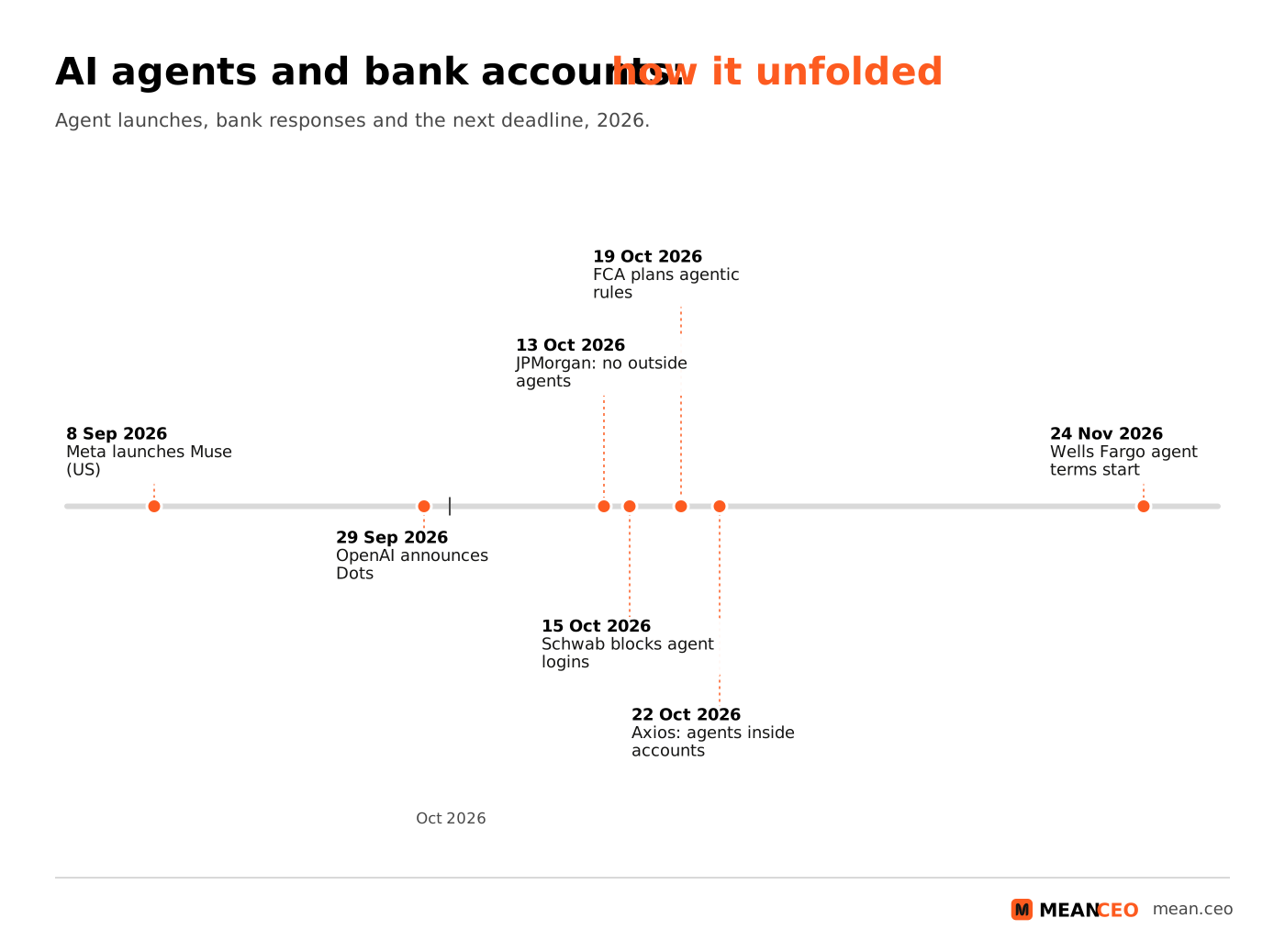
The Axios scoop published on the morning of 22 October says some major US banks are aware of unauthorised third-party AI agents accessing customer accounts. According to its sources, some agents contacted bank call centres or appeared to act independently of what the user asked, and many banks can't tell an agent working for the customer from one going rogue. Axios describes banks running "day after" scenario planning for what happens when something goes wrong.
Two things matter for reading this correctly. Every claim about agents inside accounts comes from unnamed sources, and none of the reports names which agent product was spotted. No outlet has reported a confirmed customer loss caused by an AI agent, and the follow-up coverage notes these cases don't necessarily involve hackers breaking in. The agents get in the ordinary way: customers hand them their username and password.
Which banks are blocking AI agents, and what did each one say?
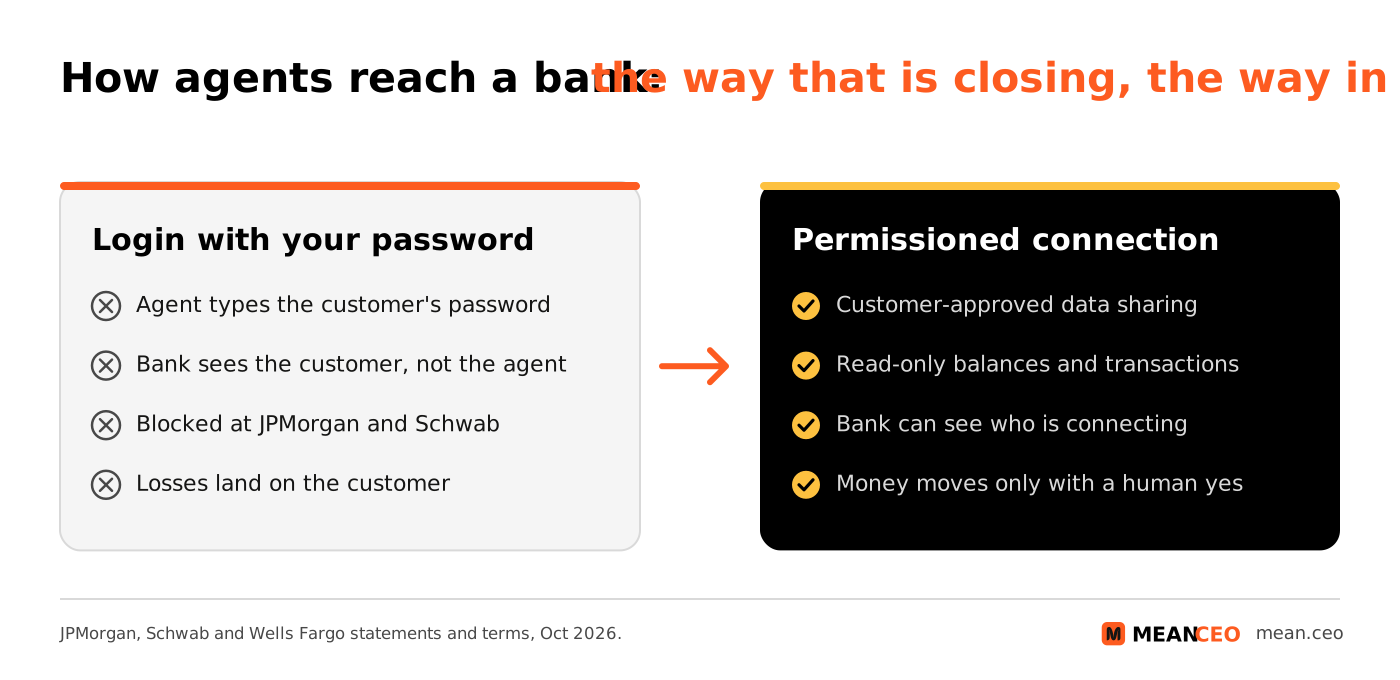
JPMorgan was the first to say it plainly. A spokeswoman told CNBC: "Because it is not safe, we do not permit third parties to access accounts by obtaining customers' banking credentials and logging in on their behalf." On the 13 October earnings call, CEO Jamie Dimon said the bank won't let "just any outside agent" in, warned "you don't want rogue agents, and there could be thousands of them", and told customers "there's a liability transfer". CFO Jeremy Barnum put it in one line: if customers give their credentials to an agent and it does something they don't want, "that's going to be on them".
Schwab CEO Rick Wurster said the firm is "blocking unauthorized agents who try to log in on behalf of clients", and per American Banker Schwab points clients to its own assistant, Charley, and doesn't let outside AI connections move money.
What does the Wells Fargo AI agent clause say?
Wells Fargo's updated Online Access Agreement takes effect on 24 November 2026 for anyone who keeps using its online or mobile banking. It adds a new Section 15 on third-party AI agents, a topic the current version doesn't mention at all. The parts that matter:
- Your login means your instruction. If you let an agent in with your credentials, its instructions and transactions "are deemed to have been initiated and authorized directly by you, without further verification", unless law or regulation says otherwise.
- Your risk. "Your use of any AI Agent is AT YOUR OWN RISK." You answer for the agent's unintended actions and for it going beyond the authority you gave it.
- No monitoring by the bank. Wells says it does not monitor or review what agents do, transactions included.
- Revoke and keep proof. To stop an agent you revoke its authorisation, keep evidence of that, and stay responsible until you tell the bank.
- Registration and blocking. Wells may require customers to "register your AI Agents with us", change its API access, and block or limit any agent.
- Delegates count too. Transactions by a delegate's AI agents count as authorised by you, "including those you did not want or intend".
Wells CEO Charlie Scharf sounded calmer on the earnings call, calling fears of agents moving deposits en masse "completely overdone". The contract is where the bank's real position sits, and it pushes the risk to the customer.
Who pays if an AI agent moves money the wrong way?
In the US, the starting point is Regulation E, the rule behind the Electronic Fund Transfer Act. Its definition of an unauthorised transfer excludes transfers by "a person who was furnished the access device to the consumer's account by the consumer", and the official interpretation says a consumer who gives someone access and authority is "fully liable" when that person goes beyond it, until the bank is told.
The friendly liability caps you may know ($50 if you report within two business days, up to $500 later, unlimited after 60 days) apply to transfers you did not authorise. Whether an AI agent counts as "a person" you gave your login to has not been tested: we found no ruling and no regulator guidance on it. Read together with the Wells Fargo terms and Barnum's comment, the direction is plain. Hand an agent your password and the bank will treat its mistakes as yours.
Which AI agents are banks worried about?
CNBC's report on JPMorgan names Meta's Muse and Instinct as the kind of outside agents in question, though JPMorgan itself isn't quoted naming any product. Here is where the main consumer agents stand:
- Meta Muse launched in the US on 8 September 2026 for adults, through its own app or WhatsApp, and runs on a dedicated virtual machine that can open a browser and fill out forms. Bank stocks fell as it topped the download charts, on fears customers would let it move cash to higher-yield accounts.
- OpenAI Dots, announced on 29 September, gives ChatGPT Pro and Business Premium users always-on personal agents. We covered how OpenAI's always-on agents launched without Europe.
- Instinct is an invitation-only text-message concierge from Spear Street Technology, valued at $10 billion in September, per CNBC.
- Anthropic's Claude Duet, a US research preview since 21 October, asks before it pays for anything and lists moving money between accounts as off-limits even with your approval. Our Claude Duet explainer covers the rest.
Banks have two worries on top of security. One is liability, as above. The other is money: Apollo's chief economist Torsten Slok has warned that agents could shift household cash from accounts paying about 0.1% to ones paying 3.3% to 5%, a cost banks would feel on $1.6 trillion of non-interest-bearing deposits, according to a Financial Times report relayed by other outlets. We track the month's agent launches in our AI agents news for October 2026.
What should founders building AI agents do now?
If your product reads or moves anyone's money, the banks have just told you which designs they will block. Here's what I'd do this week:
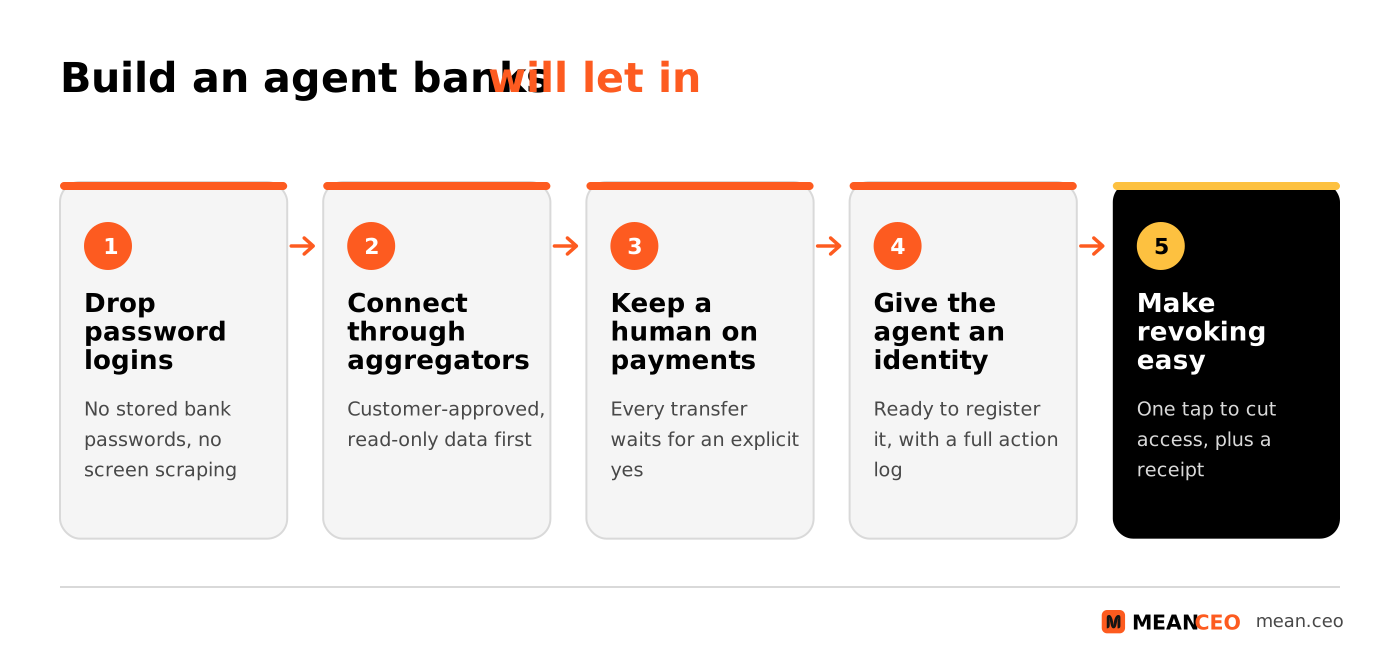
- Stop storing bank passwords. JPMorgan calls credential sharing and screen scraping "not secure" and blocks it where it can. Any feature built on a customer's bank password is a feature a bank can switch off overnight. Our guide on building security into a startup covers the credential basics.
- Start read-only, through a customer-approved connection. JPMorgan still allows read-only data through open-banking providers such as Plaid. Balances and transactions cover most of what a finance agent needs to be useful.
- Make every payment a human decision. Bank of America wants the human in the loop before money leaves an account, and Anthropic designed Duet the same way. Show the exact amount, payee and account, and wait for a clear yes.
- Pay through card networks, never through a login. Visa has offered Intelligent Commerce since April 2025, letting agents buy within limits the consumer sets. One-time virtual cards keep the real card number out of the agent's hands.
- Prepare for agent registration. Wells Fargo has reserved the right to make customers register their agents. Give your agent a stable identity and keep a full log of what it did and when, so a customer can show their bank exactly what happened.
- Build the revoke button and the receipt. Wells asks customers to revoke an agent and keep evidence. Give users one place to cut access and a dated confirmation they can forward to the bank.
- Tell users the truth about liability. Put it in your sign-up flow: if they connect a bank with their own login, the bank will treat the agent's actions as theirs. Clear terms build the trust fintech lives on; our piece on designing for trust in fintech has more.
- Watch the UK and EU rules. The FCA said on 19 October it will build "a trusted framework for agentic finance", covering agent identity, delegated authority, accountability and execution. If you sell in Europe, design for those four now. Our sister site explains what PSD2 and the UK rules say about AI agents and bank accounts in Europe.
What if you use AI agents for your own company's money?
The same rules apply to you as a customer. On Fe/male Switch we go through who pays when an AI agent moves your money, with a safe setup for small business owners. Keep the bank password to yourself, give agents read-only data through your accounting tools, keep transfers as a manual step, and use one-time virtual cards for anything an agent buys. If a freelancer or assistant manages your banking, check what tools they connect: Wells Fargo counts a delegate's agent as you. The Ogi Networks breach showed how one forgotten login becomes the client's problem, and our vendor management guide helps you ask suppliers the right questions.
Are you getting customers from ChatGPT yet?
More and more traffic is coming from Perplexity, ChatGPT, Grok and other AI tools.
👉 Rank on ChatGPT
What don't we know yet?
- Confirmed losses. No report so far documents a customer losing money because of an AI agent.
- Scale. Axios gives no numbers. Schwab says its blocks are "not many"; nobody else has published a figure.
- Which agents. No bank or report has named the products found inside accounts.
- Start dates. When Morgan Stanley, Citi and Bank of America began their restrictions.
- The regulators. The CFPB's open-banking rule (Section 1033), which would set how customers share data with third parties, is on hold while the agency reconsiders it, and a federal court has barred its enforcement in the meantime. No US regulator has issued guidance on AI agents and bank logins. The Comptroller of the Currency said on 22 October that banks have prepared for months, and didn't say whether customers get their money back.
- Liability in court. Whether Regulation E treats an AI agent like a person you handed your login to.
FAQ: AI agents and bank accounts
Are AI agents accessing bank accounts without permission?
Axios reported on 22 October 2026, citing unnamed sources, that major US banks found unvetted third-party AI agents in customer accounts, some acting beyond what users asked. No confirmed losses have been reported, and the agents get in with the customer's own login.
Does JPMorgan Chase block AI agents?
Yes. JPMorgan blocks outside agents that log in with customers' banking credentials. Read-only data sharing through open-banking providers such as Plaid still works, and the bank gave no timeline for letting agents act on accounts directly.
What have US regulators said about AI agents in bank accounts?
Very little so far. The Comptroller of the Currency, Jonathan Gould, said on 22 October that banks have been preparing for rogue agents for months, and he didn't answer whether customers would be repaid after an unauthorised agent transfer. The CFPB has issued no guidance, and its open-banking rule is on hold. The clearest signal from Washington so far comes from the White House AI adviser, David Sacks, who wants banks to give customer-authorised agents read-only access and treat full account control with a customer's password as a separate, higher risk.
What changes at Wells Fargo on 24 November 2026?
Its updated Online Access Agreement adds a section on AI agents. Actions an agent takes with your login count as authorised by you, agent use is at your own risk, and Wells may block agents or require you to register them.
Who is liable if an AI agent makes a wrong transfer?
Under Regulation E, transfers by someone you gave your login to are treated as authorised, and you are fully liable if they exceed the authority you gave until you notify the bank. Whether that covers AI agents hasn't been tested, and bank terms like Wells Fargo's put the risk on the customer.
Can Claude Duet or Meta Muse move money from my bank account?
Anthropic says moving money between accounts is off-limits for Claude Duet even with your approval, and it asks before any purchase. Muse connects to banks with read-only access, according to reports, and is not allowed to move money without the account owner's permission.
How should a startup build an AI agent that banks accept?
Skip password logins and screen scraping, use customer-approved read-only connections, keep a human approval on every payment, use card-network tools or one-time virtual cards for purchases, log every action, and make revoking access easy.
About the Author
Violetta Bonenkamp, also known as MeanCEO, is an experienced startup founder with an impressive educational background including an MBA and four other higher education degrees. She has over 20 years of work experience across multiple countries, including 5 years as a solopreneur and serial entrepreneur. Throughout her startup experience she has applied for multiple startup grants at the EU level, in the Netherlands and Malta, and her startups received quite a few of those. She’s been living, studying and working in many countries around the globe and her extensive multicultural experience has influenced her immensely.
