TL;DR: Are AI token costs going up or down?
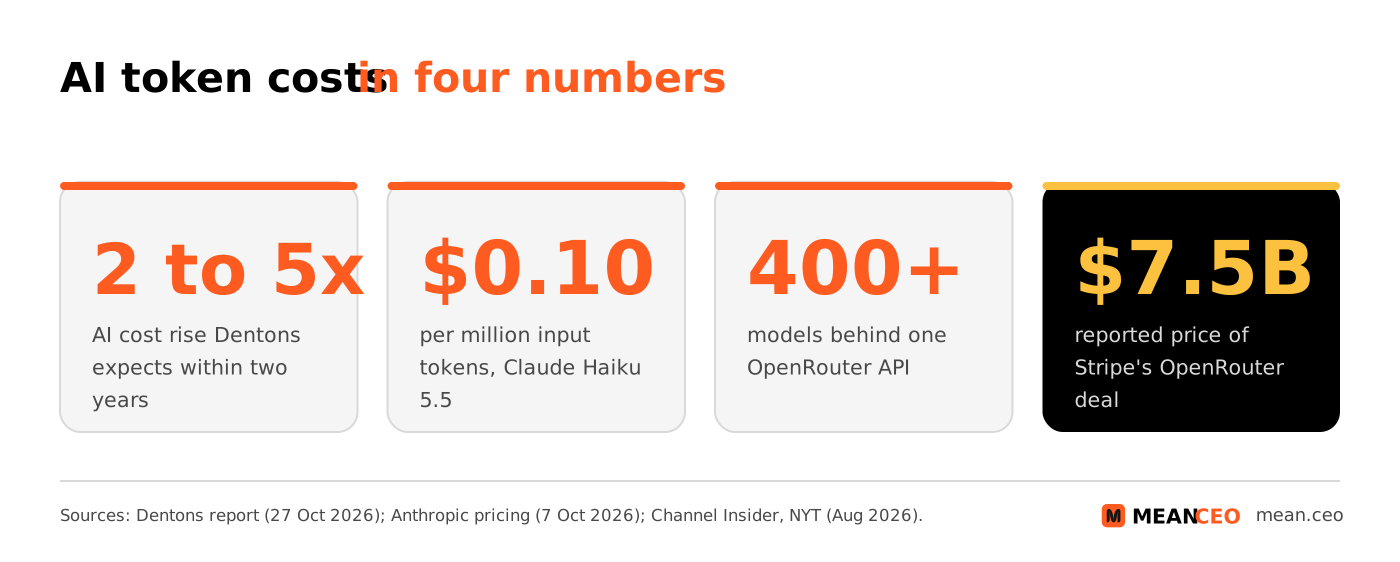
Both. The price per token keeps falling, and a Dentons report published on 27 October 2026 still warns of a "cost cliff": Dentons' Cornelius Grossmann expects the move from flat licence fees to token-metered pricing to raise AI costs two- to fivefold within two years. Usage grows faster than prices fall, and agents burn tokens around the clock. Meter spend per feature, match each job to the cheapest model that passes your tests, cap your agents and give the bill an owner.
AI token costs are the line item nobody in the room could forecast, according to the lawyers interviewed for a new Dentons report on AI in in-house legal teams. The report made news in Ireland for its finding that AI-generated legal correspondence now floods companies with complaints and GDPR requests; our sister site covers that side. Its fourth chapter matters even more to tech founders, because it describes what happens to a company's budget when every employee and every agent pays per token.
What did the Dentons report say about AI token costs?
The report, From AI Adoption to AI Advantage, by Dublin partners Carlo Salizzo and David Kirton, rests on interviews with legal leaders at eir, Flipdish, Gilead Sciences, IMRO, Mastercard, Uniphar and Wayflyer; RTÉ counts ten companies in the US, UK and Ireland. Its executive summary lists token-metered pricing as one of five themes, with a forecast from Cornelius Grossmann, Dentons' Global Head of Solutions Development: a rise in AI costs of two- to fivefold within two years. He calls it a coming "cost cliff" and adds: "we'll probably hire people to monitor AI cost in a big law firm. And others may need to do that too, because it could bankrupt you if you don't pay attention."
The interviewees describe the same pressure from the buyer's side:
- Mastercard's Jessica Williams wants vendors to give her budget controls: "I'm going to have three or four people who are AI geniuses and they're going to burn through tokens", plus light users and automated agents, and she has to turn that mix into "a predictable budget line".
- eir's general counsel Sorcha Nic Mhurchú fears "a treadmill of just paying more fees", because the vendors have to justify their huge investment, and says eir's CFO watches rising licence and token costs closely.
- Wayflyer's Deirdre MacCarthy expects a year of work on how companies manage token spend, using cheaper mid-level models for most tasks and the deep-reasoning ones only where they earn it. She rules out a hard monthly cut-off as the answer.
- Flipdish's Máire Neary warns against "AI for AI's sake" once a team faces "a high LLM bill".
Why do AI bills rise when token prices fall?
Unit prices are dropping fast. In our October 2026 AI price war roundup Claude Haiku 5.5 launched at $0.10 per million input tokens, 90% below Haiku 4.5 for prompts up to 100,000 tokens, and GPT-6.1 Terra brought computer use down to about $1 per million tokens. Grossmann's forecast still holds, for three reasons the report points at:
Uniphar's senior counsel Sergey Kinchin gives a concrete example from Claude Cowork: point the agent at a SharePoint link or a whole directory and "it goes off trying to find it, checking if it's the right thing, checking permissions, and that's a multiplier on the final cost." His fix is to attach the files first. Scoping a task well has become, in his words, "almost project management skills".
Who is building the tools to manage token spend?
Payments companies saw the problem early. Stripe agreed in August 2026 to buy OpenRouter, which sends each request to one of more than 400 models from over 80 providers based on cost, speed and reliability, for a price the New York Times put at $7.5 billion, as Channel Insider reported. Stripe has also launched a Token Billing product, and CEO Patrick Collison calls tokens "the central currency for companies building with AI". MacCarthy names this wave of model-routing tools in the Dentons report as the next thing legal and finance teams will buy.
For a startup, the lesson cuts both ways. Your own AI spend needs the same controls a bank wants, and if you sell an AI product, your customers' finance teams will soon ask you for per-user caps, usage reports and predictable plans. Our Anthropic S-1 risk factors article shows the model makers themselves warn that limits and prices can change.
How do you budget AI token costs in a startup?
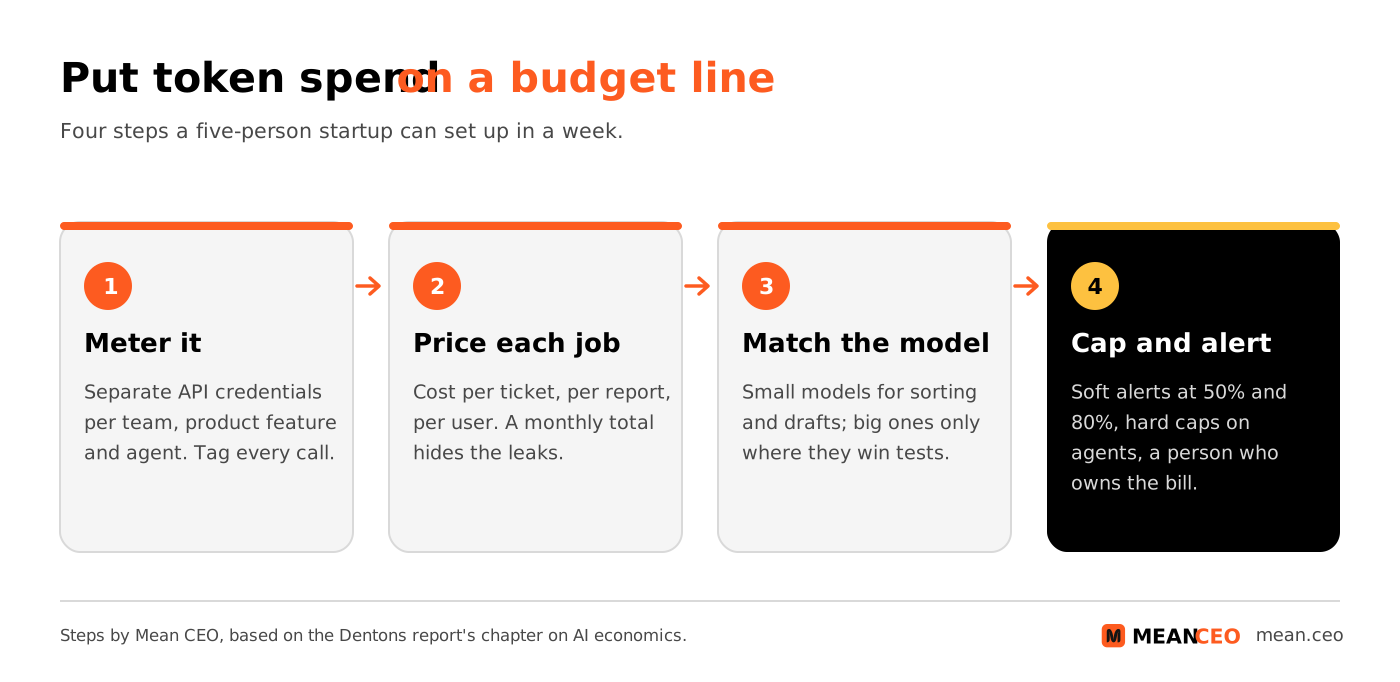
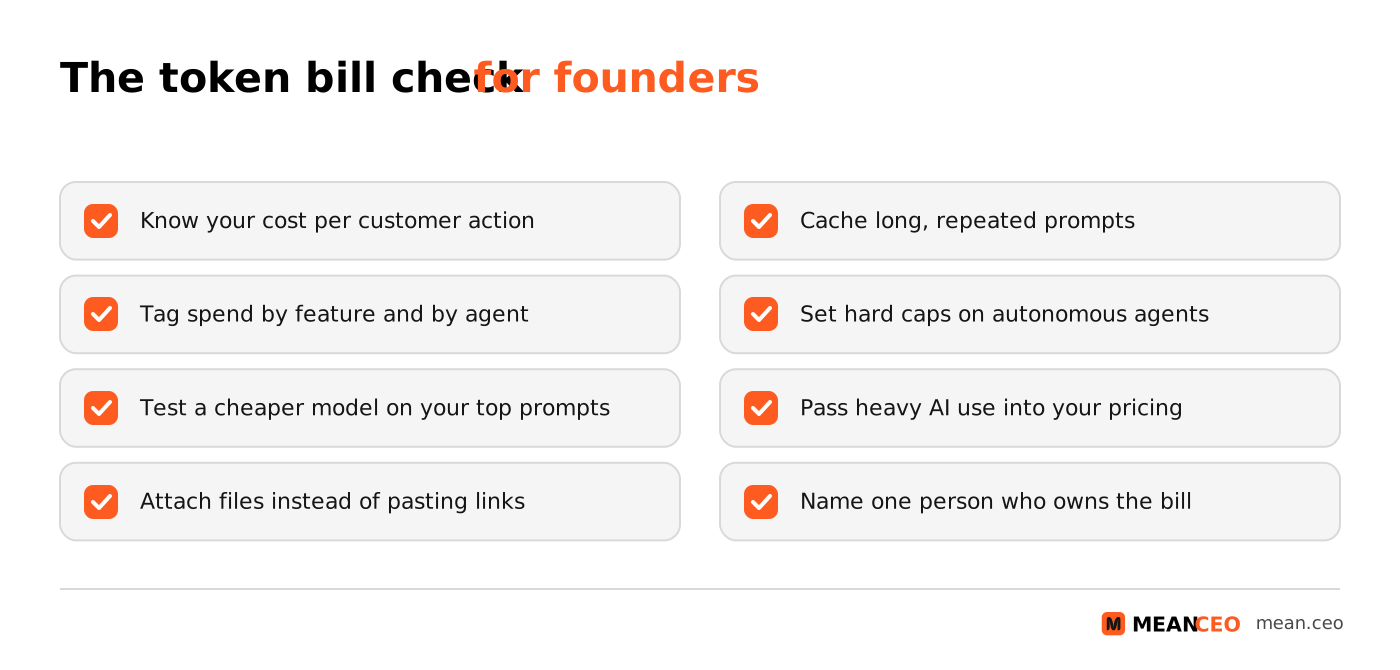
- Meter everything. Give each product feature, internal team and agent its own API credentials or project, so the invoice splits by source. One shared credential hides the culprit.
- Calculate cost per action. Divide spend by support tickets answered, reports written or active users. That number belongs in your pricing model and your board deck.
- Test cheaper models first. Run your 20 most common prompts through a small model and a large one, score the answers, and keep the large model only where it wins.
- Cut wasted tokens. Attach files instead of links, trim system prompts, cache long repeated context and stop agents from re-reading whole folders.
- Cap the agents. Set hard daily limits on autonomous jobs and soft alerts for people. MacCarthy is right that a blunt monthly cut-off for staff stops real work mid-task.
- Give the bill an owner. Grossmann expects big law firms to hire AI cost monitors; in a startup one founder or the CTO reviews it every week.
- Price it in. If your product calls models on behalf of customers, put usage tiers or fair-use limits in your plans before a heavy user turns a margin negative.
Can you prove the AI spend pays off?
Nobody in the report could do it cleanly. Gilead's Rebekah Dobson points out that companies never measured their work before AI arrived, so there is no baseline to compare against, and Mastercard's Williams notes that a task sometimes takes longer with AI than without it. IMRO's CTO Eamonn Murray says IMRO tests tools first and buys only when the benefit is clear. A startup can do better than a multinational here, because the work is smaller: record today's time per task and cost per ticket before you switch on the next AI tool, then compare after a month.
Security belongs in the same review. A leaked API credential turns into someone else's token bill, as the Railway and LiteLLM breaches showed, so rotate credentials and set spend caps on every provider account. For lean teams, our bootstrap tool stack for a first product lists cheaper options.
What this means for you
- Expect total AI spend to grow even as per-token prices fall, and plan next year's budget with Grossmann's two- to fivefold range as the stress case.
- Split spend by source this week: feature, team, agent.
- Run a model bake-off on your top prompts every quarter, because prices move monthly.
- Write token use into your pricing before customers find the heavy-use loophole.
- Prepare for customers' questions on caps and usage reports if you sell AI features to companies.
- Watch the routing layer. Stripe's OpenRouter deal makes model switching part of payments infrastructure.
Are you getting customers from ChatGPT yet?
More and more traffic is coming from Perplexity, ChatGPT, Grok and other AI tools.
👉 Rank on ChatGPT
FAQ: AI token costs
What are AI token costs?
The fees AI providers charge per token, a small chunk of text of roughly three quarters of a word, for the input you send and the output a model writes. Bills grow with every prompt, file and agent step.
Will AI costs go up?
Per-token prices keep falling, but Dentons' Cornelius Grossmann expects the shift to token-metered pricing to raise organisations' AI costs two- to fivefold within two years, because usage grows faster.
What is the Dentons AI report?
From AI Adoption to AI Advantage, published on 27 October 2026 by Dentons partners Carlo Salizzo and David Kirton, based on interviews with in-house legal leaders at companies including eir, Mastercard and Wayflyer.
How can a startup cut AI token costs?
Meter spend per feature, test smaller models on your most common prompts, attach files instead of links, cache repeated context and put hard caps on autonomous agents.
Why did Stripe buy OpenRouter?
OpenRouter sends each AI request to one of more than 400 models based on cost, speed and reliability. Stripe agreed to buy it in August 2026, for about $7.5 billion according to the New York Times, as part of its push into AI billing.
Should I cap my team's AI use?
Cap agents with hard daily limits and give people alerts instead of a blunt monthly cut-off, which Wayflyer's legal chief says doesn't work.
About the Author
Violetta Bonenkamp, also known as MeanCEO, is an experienced startup founder with an impressive educational background including an MBA and four other higher education degrees. She has over 20 years of work experience across multiple countries, including 5 years as a solopreneur and serial entrepreneur. Throughout her startup experience she has applied for multiple startup grants at the EU level, in the Netherlands and Malta, and her startups received quite a few of those. She’s been living, studying and working in many countries around the globe and her extensive multicultural experience has influenced her immensely.
