TL;DR: What is changing with ChatGPT and Codex usage limits?
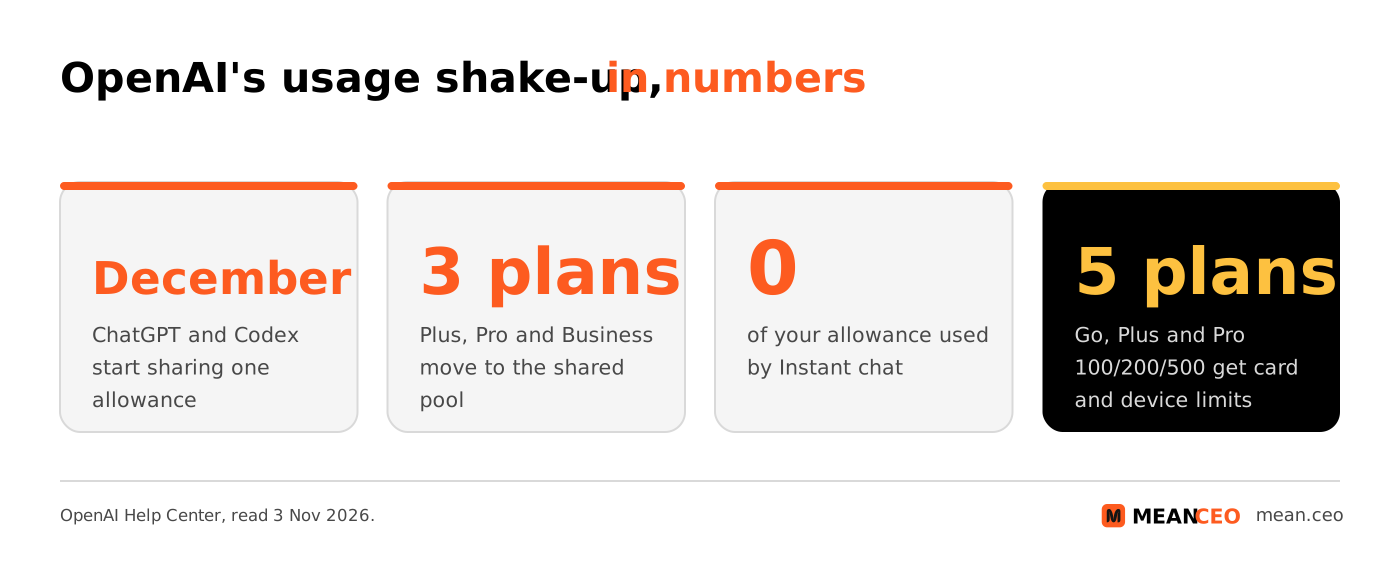
OpenAI says that starting in December, Plus, Pro and Business plans will have one usage allowance shared across ChatGPT and Codex, measured in tokens. Advanced models and complex tasks use more of it, and Instant chat doesn't use it at all. OpenAI has also started limiting how many paid subscriptions can sit on one payment card or one device. If you code with Codex and think with ChatGPT on the same plan, those two now compete for one budget. Take a baseline of your usage now, move quick questions to Instant and keep scripted jobs on an API key.
If you're a solo founder on a $20 or $100 ChatGPT plan, you probably treat it as two tools: a thinking partner for strategy, copy and research, and a coding agent that ships your product. Until now, a long research session didn't eat into your coding time. From December, it will.
OpenAI announced the change quietly, in a help article that appeared over the weekend, along with a second article on new card and device limits. Here's what's changing, what OpenAI still hasn't said, and how to protect your build time.
What happened
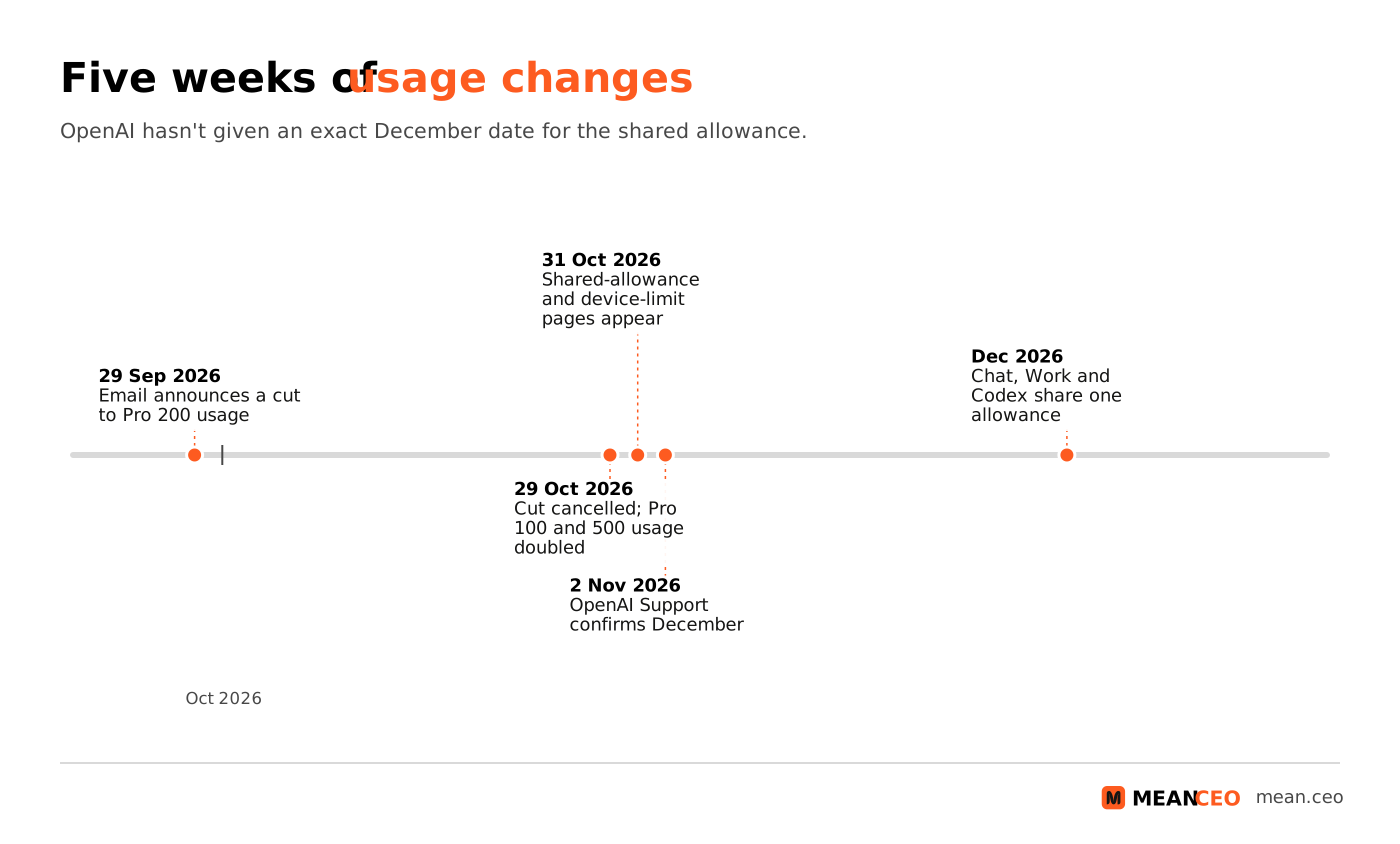
By Saturday 31 October 2026, OpenAI had published a help article on ChatGPT and Codex usage limits. Its first line: "Starting in December, Plus, Pro, and Business plans' usage allowance will be shared across ChatGPT and Codex as we bring the agentic capabilities of Work into the main ChatGPT experience."
The article says usage will be "measured in tokens" and that how much you use "will depend on the model you choose and the task you ask it to do." Two lines matter most:
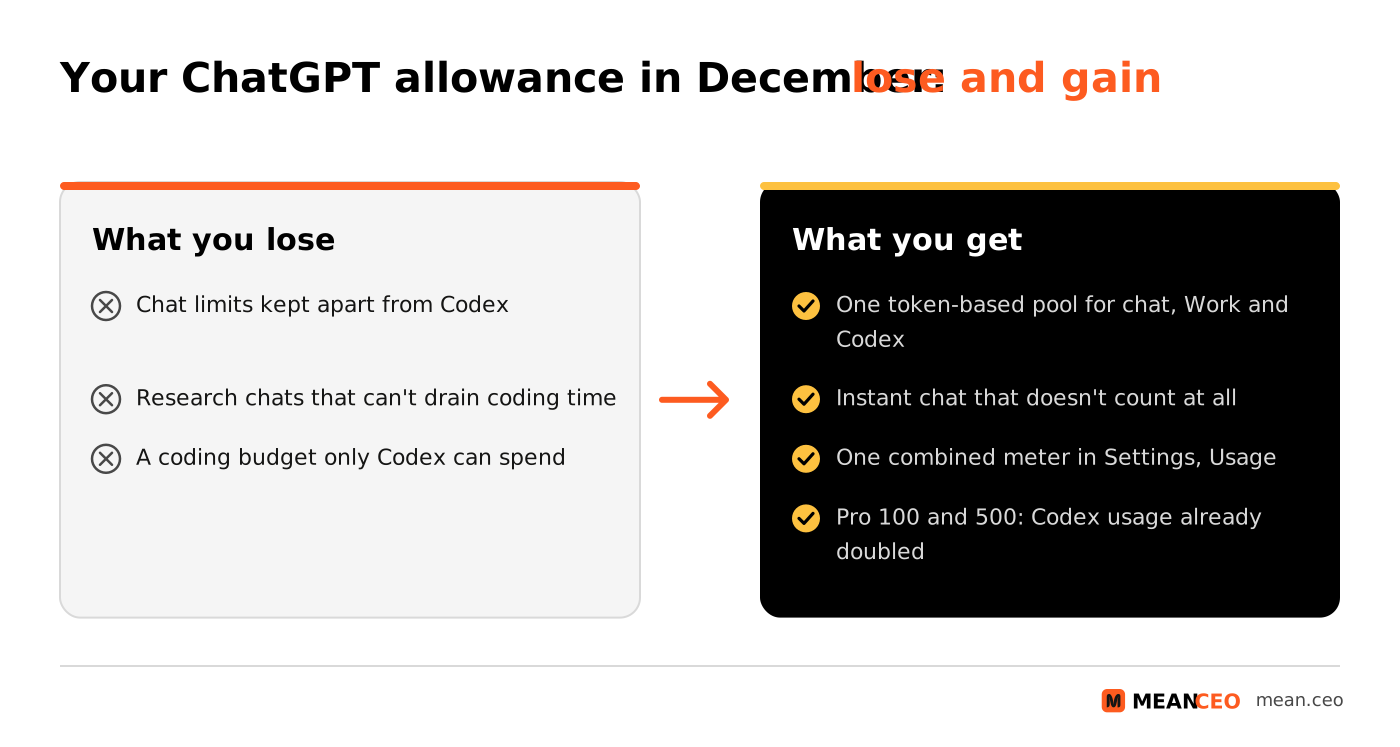
- "More advanced models and complex tasks generally use more of your allowance. Instant chat will not draw from your usage."
- "We expect most users won't need to wait for their usage to reset more often than they do now."
You'll see your combined remaining usage and reset times in Settings → Usage. When you hit the limit, you can wait for the reset, upgrade, or buy credits. On 2 November, OpenAI Support confirmed it on the company's community forum: "The announcement confirms shared allowances for Plus, Pro, and Business starting in December."
Around the same time, OpenAI added a second help article on card and device limits. "If too many subscriptions are associated with the same payment card or device, ChatGPT may block a new subscription purchase." It also limits how many paid accounts you can use on one device. OpenAI hasn't published the actual numbers.
Status: this is OpenAI's own announced plan, not a rumour. What's missing is detail: no exact December date, no allowance sizes per plan, and no explanation of how a chat token is weighed against a Codex token.
What actually changes in December
Some of this is already shared. OpenAI's Codex pricing page says "ChatGPT Work and Codex share usage." What's new is that ordinary ChatGPT conversations join that pool. Today, OpenAI's Pro plan page says the weekly GPT-6 Pro message limits in chat "are separate from your Work and Codex allowance." From December, a long thinking-model chat and a Codex refactor draw from the same tank.
For context, here's how much Codex you get today. On Plus and Standard Business, OpenAI estimates 15 to 160 local messages per five hours with GPT-6.1 Sol, 35 to 285 with GPT-6.1 Terra and 350 to 3,000 with GPT-6 Luna, and says "Pro plans currently have no five-hour limit." These are estimates, not fixed limits, and weekly limits apply on top.
Sources: OpenAI Help Center and Codex pricing page, read 3 November 2026. "Not named" means OpenAI's shared-allowance article doesn't mention the plan.
There's good news inside the timing too. On 29 October, OpenAI cancelled a Pro 200 cut it had announced on 29 September and gave Pro 100 and Pro 500 "twice their previous Work and Codex allowance". "Plus usage is unchanged." The catch: a bigger pool shared by more products doesn't automatically mean more finished work. A Pro $100 user warned in a GitHub issue on the Codex repository on 2 November that for heavy users the shared pool "could amount to a massive de facto price increase". OpenAI itself says on the Pro page: "A larger allowance does not guarantee twice as many completed tasks."
The card and device limits: the end of account stacking
If you've been running two or three cheap Plus accounts to dodge limits, this is aimed at you. The limits apply to Go, Plus, Pro 100, Pro 200 and Pro 500. "ChatGPT Free and ChatGPT Business, Enterprise, and Edu workspace plans do not count toward the limit."
- Blocked purchase. Checkout can say: "Too many subscriptions associated with this card or device. We can't complete this purchase." OpenAI stresses this is different from a bank decline.
- Blocked sign-in. You can see "Device limit reached" at sign-in, or be signed out after a later check, "even if the purchase went through and the account worked at first."
- No way to pay around it. "Buying credits or resetting usage won't clear a card or device restriction." Signing out of one account doesn't guarantee another becomes eligible.
- Shared cards count. A shared household card or a public device can hit the limit even when each person uses their own account.
Subscriptions bought before the limits took effect can continue under what OpenAI calls an existing-subscription exception. If you get the device warning, there's a cancel-and-refund option for ChatGPT and Google Play purchases, but paid access ends immediately. Apple purchases go through Apple. The Decoder's take on 1 November was that OpenAI is pointing people to credits and resets instead, options it called "generally more expensive than an additional subscription."
For a small team, the clean answer is a Business workspace: seats there don't count toward the device limit, and Business is already part of the shared allowance.
Your options when the shared allowance runs out
OpenAI lists three ways out: wait, upgrade or buy credits. Plus and Pro users can also buy an instant reset. Read the small print before you click, because the options behave very differently:
Sources: OpenAI Help Center and Codex pricing page, read 3 November 2026.
The API key route is underrated. OpenAI's pricing page calls it "Great for automation in shared environments like CI" and says all users can run extra local chats with an API key at standard API rates. If you already activated the free API credits we covered in our post on ChatGPT Pro API credits, this is where they pay off. Just watch the bill: our analysis of why AI token bills keep rising shows how fast agent usage adds up.
How this compares with Claude, and why limits keep moving
OpenAI isn't alone in reshaping plans. Anthropic renamed Max 20x to Claude Ultra at the end of October: $200 a month for "10 times the Pro plan's usage every week", with no five-hour limit for verified accounts. Claude Max costs $100 and gives five times Pro usage every five hours and every week. Both already share one weekly limit across all models, with a separate weekly limit for Fable. For what Ultra’s $200 really buys, and why its weekly limit was always 10x Pro rather than 20x, read our guide to the Claude Ultra plan.
The pattern is clear. AI subscriptions are moving from "unlimited-ish chat" to metered budgets, and the vendor sets the meter. Anthropic's own IPO filing lists changing rate limits as a business risk, as we explained in our breakdown of the S-1 risk factors. When the supplier can change what your $20 buys in a help-centre update, you need a plan B, not loyalty.
The Europe angle
OpenAI's announcement doesn't say whether December timing differs by region, and it doesn't mention Europe at all. For web subscriptions, OpenAI bills the EEA in euros and the UK in pounds, and says "Localized prices may differ from a conversion of the U.S. price." Buyers in the EEA may also be asked for Strong Customer Authentication at purchase or renewal.
Two practical points for European founders. First, the paid reset's availability varies by account, "including your plan and billing country", so don't assume you'll see the same options as an American colleague. Second, if your company card pays for several team members' personal Plus plans, that's exactly the setup the card limit can block. Move the team to a Business workspace before you need a new seat.
What this means for you
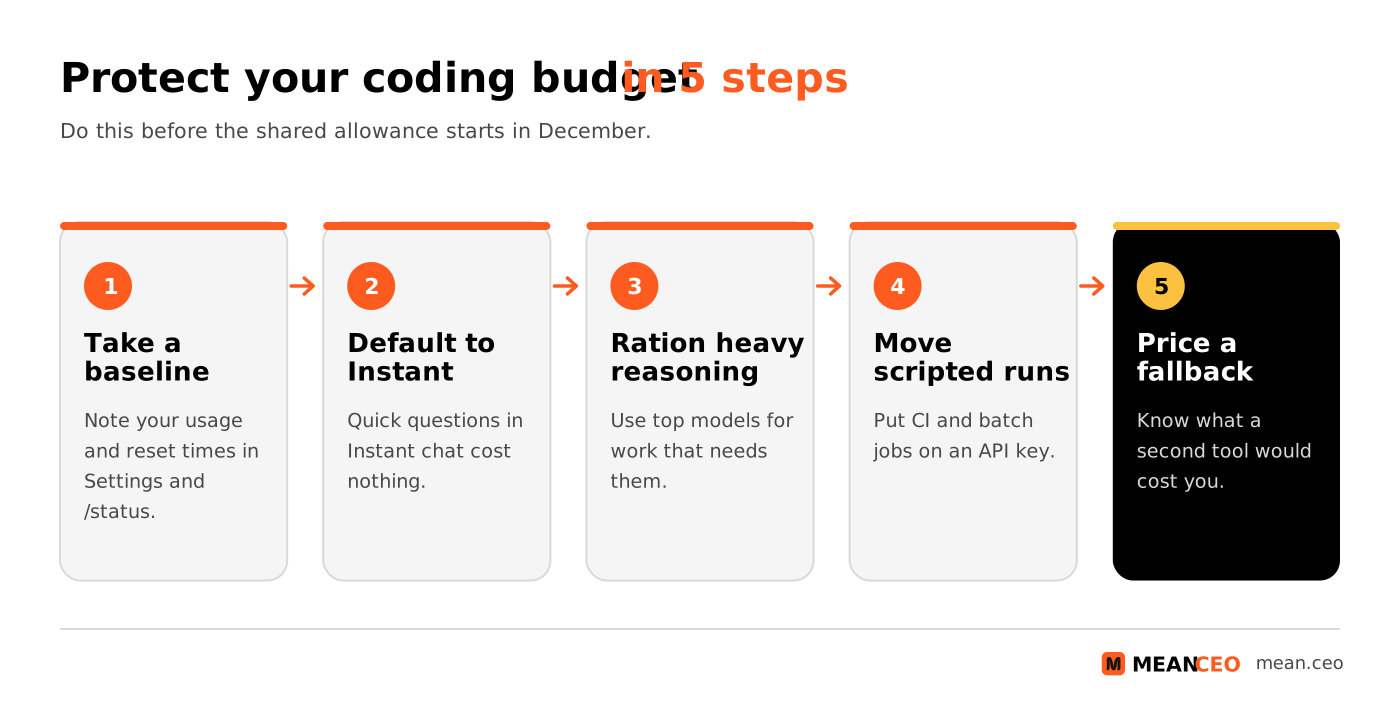
- Take a baseline now. Note your usage and reset times in Settings → Usage, and run /status in the Codex CLI during a normal week. In December you'll know at once whether the shared pool is smaller for you.
- Make Instant your default for quick questions. It's the one thing OpenAI says won't draw from your allowance. Save the thinking models for real problems.
- Split heavy research from heavy coding days. If you plan architecture in ChatGPT and build in Codex, both now drain one tank. Batch them so one doesn't starve the other mid-sprint.
- Move scripted and CI work to an API key. Predictable jobs belong on metered API billing, not on your subscription. Our guide to evaluating AI tool ROI helps you decide what's worth paying for.
- Stop stacking personal accounts. Several paid accounts on one card or laptop can now be blocked or signed out. For a team, use Business seats.
- Price a fallback before December. Know what Claude Max or Ultra, or another coding tool, would cost you for one month. Our AI tool stack for solo founders lists alternatives, and we track every change in our AI news for November 2026.
The reaction from paying users has been loud. A forum thread titled "Please Keep ChatGPT and Codex Usage Limits Separate in December 2026" had 131 posts and 691 likes by 3 November. One user, PZA, wrote: "If OpenAI decides to combine them anyway, a real-time usage dashboard must be available before the change takes effect." OpenAI Support's reply in another thread was that it will "pass along" the feedback, with no promise of a timeline.
My take: one pool is simpler, and for most founders who mainly chat, it may even feel like more. But if Codex is how you ship, you just lost the wall that protected your build time from your thinking time. OpenAI's "most users" line doesn't cover heavy builders, and those are exactly the people reading this. Measure now, keep an API key ready, and never let one vendor's help-centre update decide whether your product ships this week.
Are you getting customers from AI search yet?
More and more traffic is coming from Perplexity, ChatGPT, Grok and other AI tools.
👉 Rank on ChatGPT
FAQ: ChatGPT and Codex shared usage limits
When do ChatGPT and Codex start sharing one usage limit?
OpenAI says "Starting in December" 2026 for Plus, Pro and Business plans. It hasn't given an exact date, and OpenAI Support only repeated "December" on its forum on 2 November.
Does Instant chat use up my Codex allowance?
No. OpenAI's help article says "Instant chat will not draw from your usage." More advanced models and complex tasks use more of the shared allowance.
Are Free and Go plans affected by the shared allowance?
OpenAI's announcement only names Plus, Pro and Business. Go is affected by the new card and device limits, and Free isn't.
How many ChatGPT subscriptions can I have on one card or device?
OpenAI hasn't published a number. It says ChatGPT may block a new purchase if too many subscriptions are tied to the same card or device, and it limits paid accounts per device. Business, Enterprise and Edu workspaces don't count.
Is a paid instant reset better than buying credits?
It depends on timing. A reset restores your 5-hour and weekly usage at once but pulls next week's allowance forward and restarts your weekly clock, and OpenAI generally doesn't refund it. Credits only kick in after your included usage and are non-refundable except where the law requires.
Can I avoid the shared limit by using Codex with an API key?
Yes, for local work. With an API key, Codex in the CLI, SDK or IDE is billed at API prices instead of your subscription. You lose cloud features such as GitHub code review and Slack, and you pay per token.
About the Author
Violetta Bonenkamp, also known as MeanCEO, is an experienced startup founder with an impressive educational background including an MBA and four other higher education degrees. She has over 20 years of work experience across multiple countries, including 5 years as a solopreneur and serial entrepreneur. Throughout her startup experience she has applied for multiple startup grants at the EU level, in the Netherlands and Malta, and her startups received quite a few of those. She’s been living, studying and working in many countries around the globe and her extensive multicultural experience has influenced her immensely.
