TL;DR: What is Gemini 4 Carbon and can founders use it yet?
Gemini 4 Carbon is the model Google announced on 28 October 2026, two weeks after Gemini 4 Argon, and Google calls it its strongest model yet, built for long coding jobs and cyber defense. It tops the independent Artificial Analysis Intelligence Index at 59, one point ahead of Claude Opus 5.5. Cyber defenders got it first. Since 10 November 2026 any developer on the paid tier of the Gemini API can call it as gemini-4-carbon in Google AI Studio and Android Studio, and Google AI Ultra subscribers can try it in AI Studio and Antigravity. It costs $2 per million input tokens and $10 per million output tokens until 30 November 2026, then $4 and $20 from 1 December. There is no free tier.
Last updated 14 Nov 2026, 10:45 CET. Gemini 4 Carbon opened to paying developers on 10 November; we updated access, model ID, context window and price dates from Google's own pages.
Searches for "Gemini 4 Carbon" jumped 200% in the US and Germany on Wednesday, and most founders asked the same thing: can I call it from my app tonight? On launch day you couldn't; since 10 November you can, on the paid API. Here is what Google announced, which benchmarks come from outside testers, what Carbon costs next to Argon, GPT-6 and Claude, and how to test it before you switch.
What did Google announce on 28 October?
In its announcement, Google pitches Gemini 4 Carbon at two jobs. The first is long engineering work: Google says its teams have seen Carbon run for days on one task, finding and patching subtle bugs across large codebases. The second is cyber defense, the full cycle of finding a vulnerability, proving it can be exploited and writing the fix.
The rollout copies Argon's, which went to cyber defenders on 30 September and to every developer on 13 October:
- 28 October: a subset of cyber defenders.
- Next: more partners in Google DeepMind's Fairwind Program, which serves governments, hospitals, telecoms, energy and finance networks, big platforms and academic security labs. Google runs background checks on every applicant.
- 10 November: developers on the paid Gemini API tier (Google AI Studio, Android Studio) and Google AI Ultra subscribers in AI Studio and Antigravity, per Google's developer post. That took 13 days, the same gap as Argon.
- Alongside: the US government's voluntary pre-release testing of new models.
A typical SaaS startup can't apply its way in. Companies that don't qualify for Fairwind are pointed to CodeMender, Google's code security agent, running on public models. The same day, Google did open one door to small teams: the Connected Apps Platform preview, which lets startups with an API apply to put an MCP app inside Gemini and Search.
How does Gemini 4 Carbon compare with Argon, GPT-6 Astra and Claude Opus 5.5?
Google's blog post compares Carbon only with Argon. The rivals appear on the Google DeepMind model page, where Google ran most Gemini tests itself and took rival scores from OpenAI's and Anthropic's own reports. The rows measured by outside scorekeepers are the ones I trust most. Benchmarks measure known tasks, and earlier that week OpenAI and Anthropic went further: their research models produced proofs that refute the Exponential Time Hypothesis, a 27-year-old assumption in computer science. Since 12 November 2026, Carbon also has a cheaper sibling: Gemini 4 Hydrogen, which costs $1.50 per million input tokens and has a free tier, while Carbon's own launch price doubles on 1 December. On 18 November Google launched a cheaper sibling adapted from Carbon, and our guide to Gemini 4 Neon compares prices across all four Gemini 4 models.
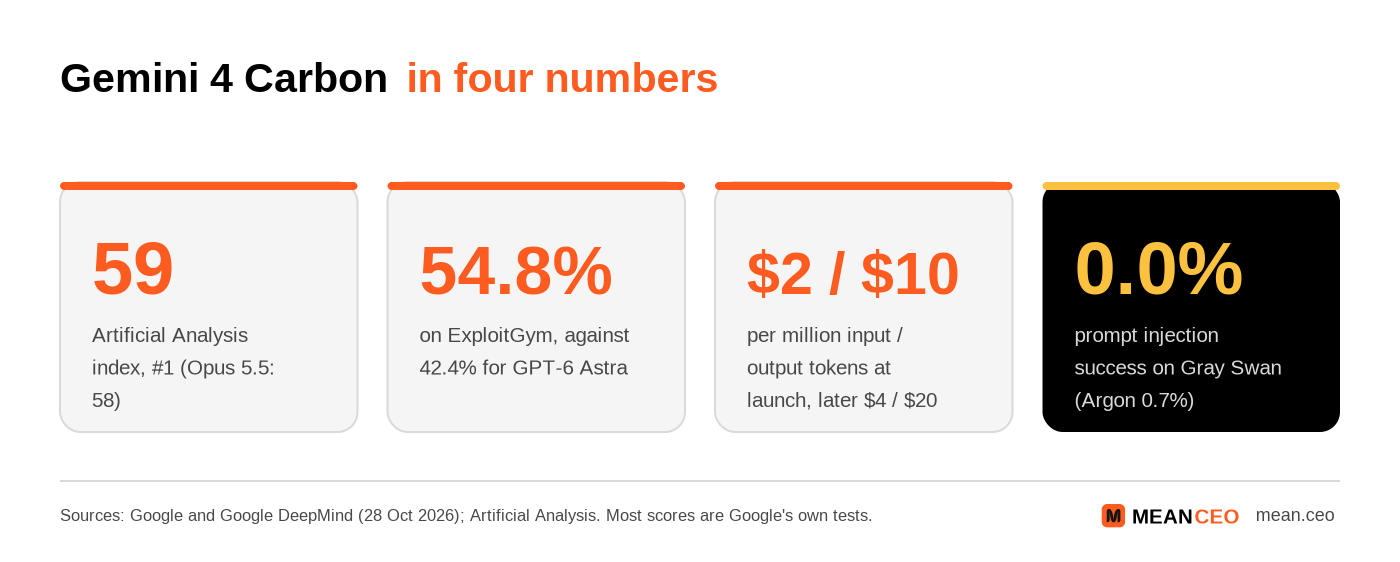
On the independent Artificial Analysis index, Carbon leads Opus 5.5 by one point, a tie for any product decision. On security work it pulls clearly ahead, with 54.8% on ExploitGym against 42.4% for GPT-6 Astra. And it loses two rows: GPT-6 Astra and Opus 5.5 score higher on FrontierSWE 2, and Opus 5.5 leads OSWorld 2.1 by almost six points.
What does the cybersecurity focus mean for founders?
The upside first. Google says Carbon more than doubles Argon's success rate at writing secure code, scored 0.0% attack success on Gray Swan's prompt injection test (Argon: 0.7%) and makes about half as many unsupported claims as Argon.
Then the catch: defenders go first, by design. A model that writes working exploits for over half of ExploitGym's tasks helps attackers just as much, so Google handed it to vetted security teams for 13 days before anyone with a credit card. Now that it is on the paid API, run your own security review with it on your own code before someone else points it at your product. We saw the agent side of this risk in Claude Mythos 5's malicious pull request. If you are picking a public model for daily work instead, our Gemini vs ChatGPT comparison for startup operations lists current API prices.
What will Gemini 4 Carbon cost?
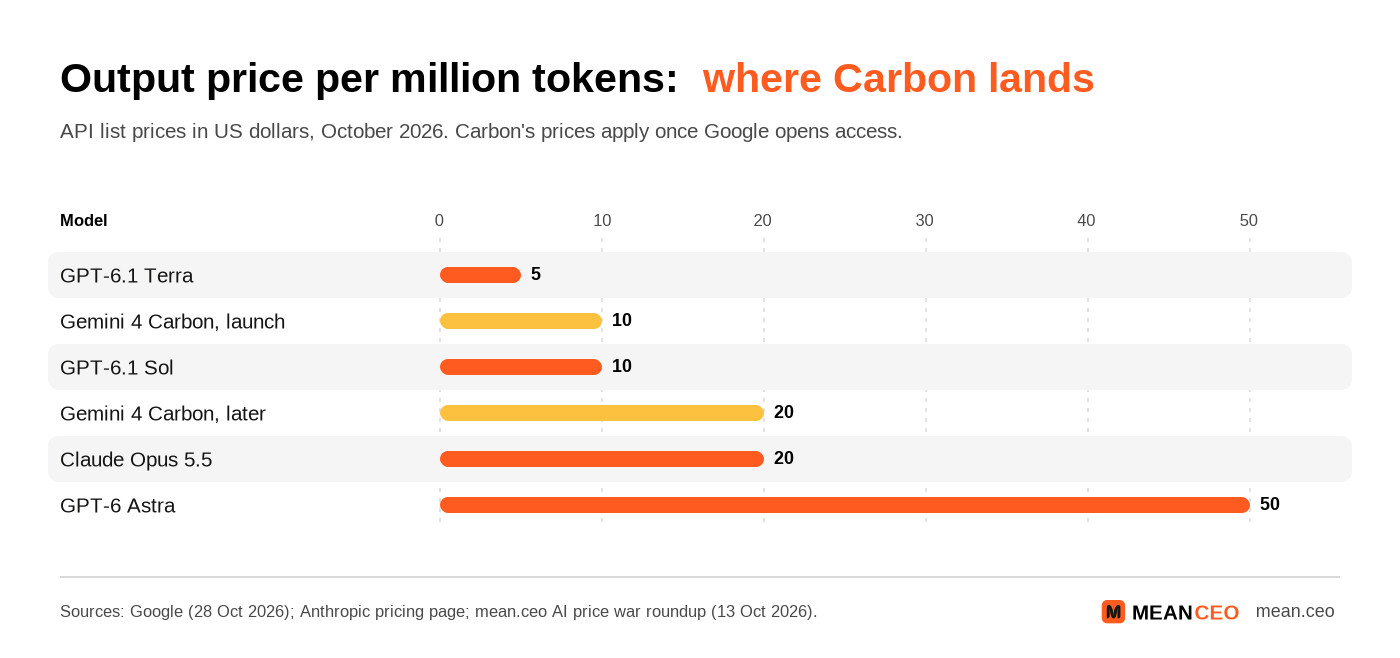
Carbon costs the same as Argon: $2 per million input tokens and $10 per million output tokens through 30 November 2026, then $4 and $20 from 1 December 2026. Cached input costs $0.10 per million tokens until 30 November and $0.20 after (implicit caching only), and the Batch API halves every price. Thinking tokens are billed as output. Source: Google's Gemini API pricing page.
In real money: a coding agent using 20 million input and 4 million output tokens a month costs $80 on Carbon until 30 November, $160 from 1 December (the same as Opus 5.5) and $400 on GPT-6 Astra. Google bills Carbon's and Argon's thinking tokens as output, so plan on the higher number. Our pieces on AI token costs and the October AI price war cover cheaper models for routine work.
What do we know so far about Gemini 4 Carbon?
- Update 14 Nov, 10:45 CET: on 10 November Google made Carbon generally available on the paid Gemini API as gemini-4-carbon, with a 1,048,576-token context window shared by input, thinking and output, 65,536 output tokens by default and up to about 1 million with long decode. It reads text, images, audio, video and PDFs and writes text. Sources: the Gemini API changelog and model page.
- Announced: 28 October 2026 by Koray Kavukcuoglu, Google's Chief AI Architect.
- Independent rank: #1 on the Artificial Analysis Intelligence Index v5.0 with 59.
- Access: cyber defenders from 28 October, paid Gemini API and Google AI Ultra from 10 November. No free tier.
- Price: $2 and $10 per million tokens until 30 November 2026, $4 and $20 from 1 December.
- Safety: Argon's stack of training, misuse filters, prompt-injection defenses and chain-of-thought monitoring.
Open questions
- Vertex AI and Workspace. Google's 10 November post names AI Studio, Android Studio and Antigravity. It gives no date for Vertex AI or Workspace.
- Europe. Google's announcement names no regional limits for Carbon. The paid Gemini API's list of available regions includes every EU country we checked (Belgium, Germany, Ireland, Malta, the Netherlands), so test a call from your own EU account before you promise it to customers.
- The unnamed rival. Google's Chrome team says Carbon wrote high-quality patches more than 10 times better than "another lab's large frontier model".
Timeline
- 30 September 2026: Gemini 4 Argon goes to cyber defenders in the Fairwind Program.
- 13 October 2026: Argon opens to developers worldwide at $2 and $10 (our Argon launch coverage).
- 26 October 2026: OpenAI releases GPT-6.1 Terra at $1 and $5.
- 28 October 2026: Google announces Gemini 4 Carbon for cyber defenders.
- 10 November 2026: Carbon opens on the paid Gemini API and for Google AI Ultra subscribers.
- 30 November 2026: the introductory price of Argon and Carbon ends.
- 1 December 2026: both move to $4 and $20 per million tokens.
What should founders do now that Gemini 4 Carbon is open?
Next steps, in the order I'd do them:
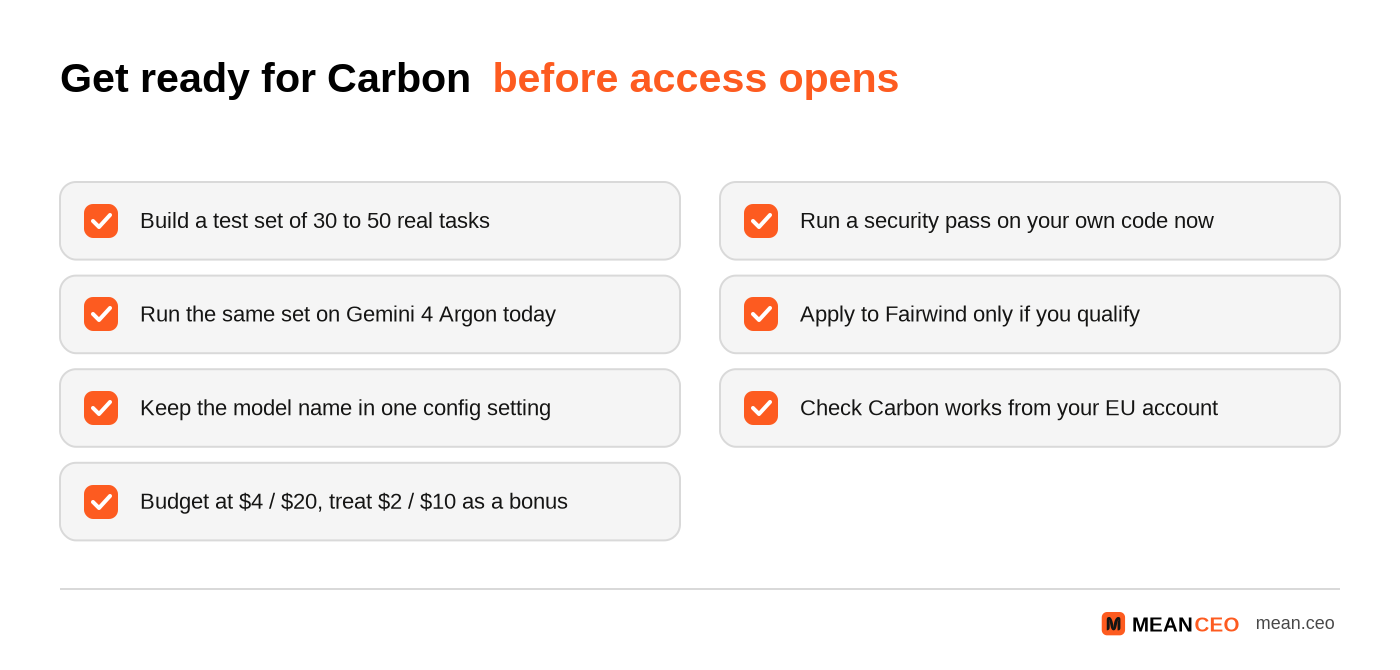
- Build a test set first. Pick 30 to 50 real, messy tasks: a bug that took a day to find, a database migration, a security review.
- Run it on Argon and Carbon side by side. They cost the same, so the only questions are quality and speed. Swap the model name to gemini-4-carbon and compare.
- Keep the model switchable. Put the model name, price and a fallback in one config setting, so moving between Carbon, Argon, Claude or GPT takes one change.
- Budget at the full price. Plan with $4 and $20, because the $2 and $10 price ends on 30 November.
- Run a security pass on your own code now. Point a public model at your login, payments and file-upload code, then run Carbon on the same code and compare the findings.
- Apply to Fairwind only if you qualify, meaning you run security for a hospital, bank, telecom or public body.
- Check Europe. Confirm Carbon runs from your EU account before you promise it to customers.
Are you getting customers from ChatGPT yet?
More and more traffic is coming from Perplexity, ChatGPT, Grok and other AI tools.
👉 Rank on ChatGPT
Is Gemini 4 Carbon worth switching to?
For security products and teams running coding agents for hours, yes: it leads the independent index, beats every rival Google lists on exploit and patch tests, and costs a fifth of GPT-6 Astra's output price. For routine work, Argon costs the same and answers faster with fewer tokens per turn, so test both on your own tasks before you switch everything.
The bigger shift is the release pattern. Google's last two frontier models reached cyber defenders before developers, with US government testing in between. Plan for the strongest models to reach small teams after banks, governments and big platforms, and keep a better model one config change away.
FAQ: Gemini 4 Carbon
What is Gemini 4 Carbon?
Google's newest and, by its own account, strongest model, announced on 28 October 2026, built for long coding tasks and cyber defense.
Can I use Gemini 4 Carbon now?
Yes, if you pay. Since 10 November 2026 it is on the paid tier of the Gemini API (model ID gemini-4-carbon) in Google AI Studio and Android Studio, and Google AI Ultra subscribers can try it in AI Studio and Antigravity. It isn't on the free tier.
How much does Gemini 4 Carbon cost?
$2 per million input tokens and $10 per million output tokens until 30 November 2026, then $4 and $20 from 1 December. Thinking tokens count as output, and the Batch API costs half.
Is Gemini 4 Carbon better than Claude Opus 5.5 and GPT-6 Astra?
It scores 59 on the Artificial Analysis index against 58 for Opus 5.5 and 57 for GPT-6 Astra, and leads on cybersecurity tests. Both rivals beat it on FrontierSWE 2.
What is the Fairwind Program?
A Google DeepMind program giving vetted security teams at governments, infrastructure operators, big platforms and academic labs early access to its strongest models.
Is Gemini 4 Carbon available in the EU?
Google's announcement names no regional limits, and the paid Gemini API's list of available regions includes the EU countries we checked. Test a call from your own EU account first.
About the Author
Violetta Bonenkamp, also known as MeanCEO, is an experienced startup founder with an impressive educational background including an MBA and four other higher education degrees. She has over 20 years of work experience across multiple countries, including 5 years as a solopreneur and serial entrepreneur. Throughout her startup experience she has applied for multiple startup grants at the EU level, in the Netherlands and Malta, and her startups received quite a few of those. She’s been living, studying and working in many countries around the globe and her extensive multicultural experience has influenced her immensely.
