TL;DR: What is Gemini 4 Neon?
Google launched Gemini 4 Neon on 18 November 2026, the middle Gemini 4 model between Hydrogen and Carbon. It costs $3 per million input tokens and $15 per million output tokens and has no free tier. It costs more than Carbon and Argon until 30 November and 25% less from 1 December, when they move to $4 / $20. You get it in the paid Gemini API, Antigravity and the Gemini app on Google AI Pro and Ultra.
Gemini 4 Neon is the fourth Gemini 4 model to reach Google's API in five weeks, after Argon on 13 October, Carbon on 10 November and Hydrogen on 12 November. Google posted the announcement at 21:00 UTC (22:00 CET) on Wednesday 18 November, and searches for "gemini neon" in the US, Germany and France jumped half an hour later.
For builders, the story is the price table: Carbon and Argon still sell at $2 / $10, and on 1 December they double in price. Here is what changes and which Gemini 4 model I would build on in December.
What did Google launch on 18 November 2026?
In Google's launch post, Koray Kavukcuoglu, SVP at Google DeepMind and Google's Chief AI Architect, introduced Neon as a model "bringing frontier-level intelligence with fast end-to-end task completion across complex software engineering, knowledge work, and science workflows." The Gemini API changelog lists gemini-4-neon as generally available (GA) on the paid tier the same day.
Google describes the family in one line: "While Carbon tackles your hardest, long-horizon projects and Hydrogen handles fast everyday execution, Neon balances depth and efficiency." The Neon model card adds that "Gemini 4 Neon is adapted from Gemini 4 Carbon", and Google publishes no parameter count. The specs that matter for a product:
- Context window: 1,048,576 tokens, shared by input and output, with up to 65,536 output tokens by default and 1,048,576 with long decode.
- Inputs and output: text, images, audio, video and PDF in, text only out.
- Thinking levels: low, medium, high (the default) and xhigh.
- Tools: code execution, computer use, function calling, file search and grounding with Google Search and Maps.
How much does Gemini 4 Neon cost compared with Argon, Carbon and Hydrogen?
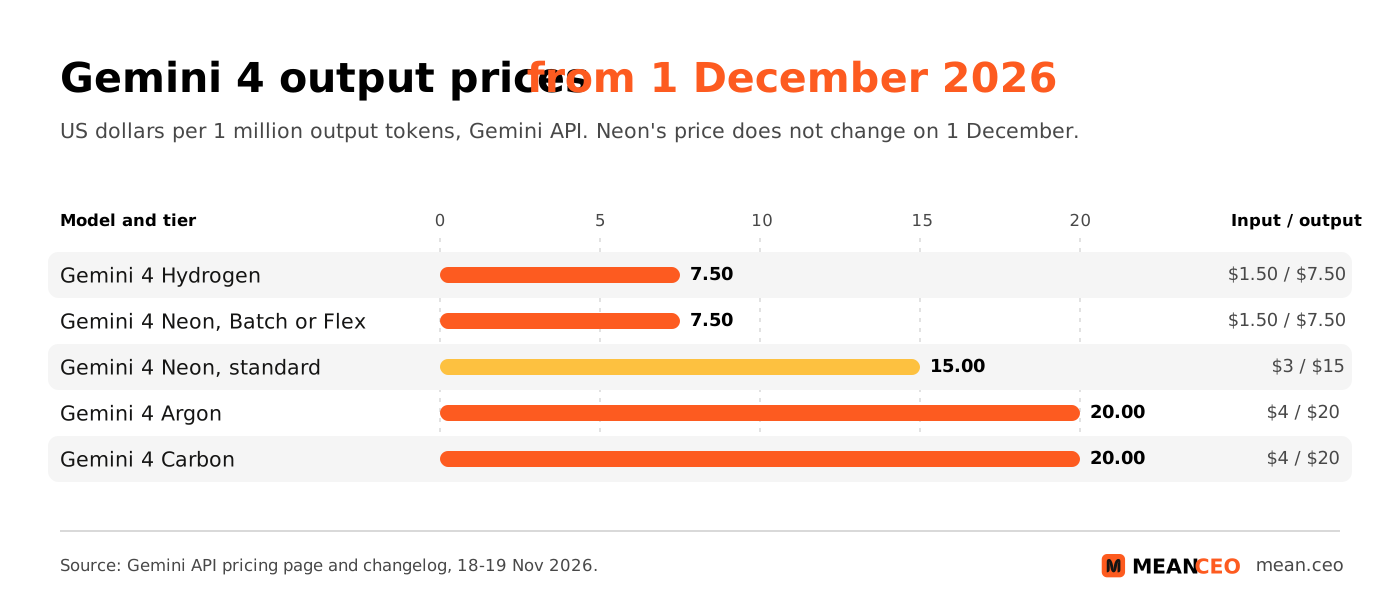
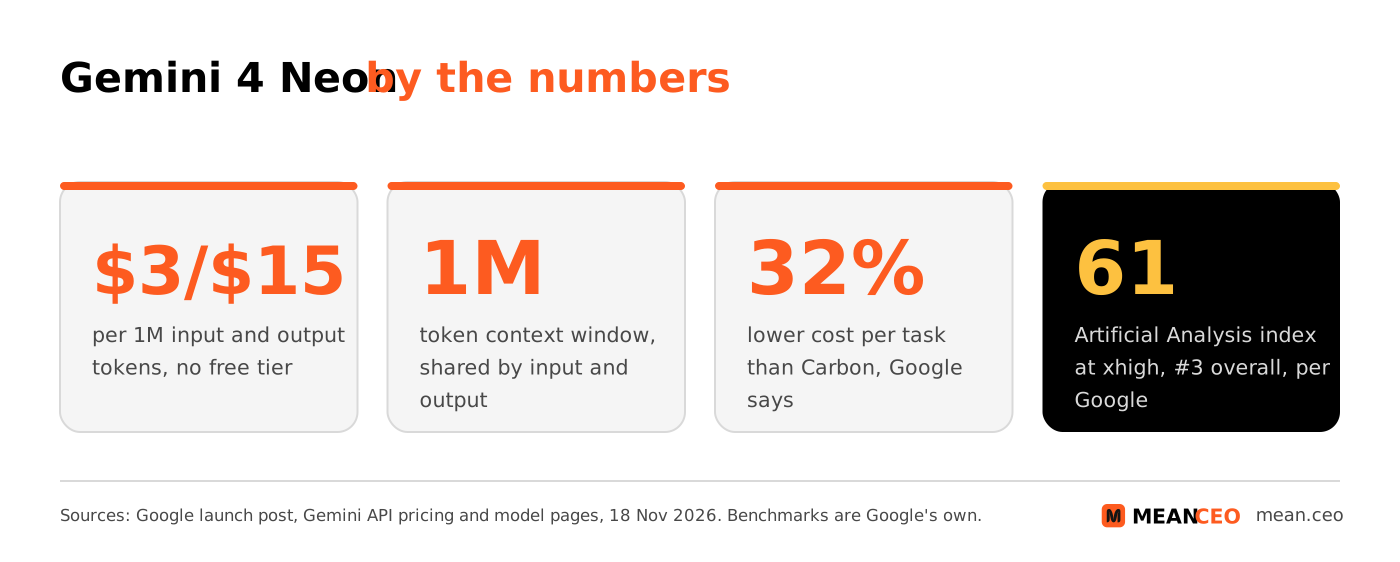
The Gemini API pricing page lists Neon at $3 per million input tokens and $15 per million output tokens, thinking tokens included. Cached input costs $0.15, a 95% discount, and Batch and Flex halve the price to $1.50 and $7.50.
Prices per 1 million tokens on the standard tier, from Google's Gemini API pricing page and changelog.
Read the dates carefully. Until 30 November, Neon costs 50% more per token than Carbon and Argon. From 1 December it costs 25% less than both, at twice Hydrogen's price. If Argon or Carbon runs in your product today, that work doubles in price in under two weeks.
Google also claims that at its default high thinking level Neon has "a 32% lower cost per task than Carbon" and "roughly 50% to 80% lower cost per task than top competing frontier models." Those are Google's own numbers, so measure cost per task on your own jobs, as our guide to AI token costs explains.
Where can you use Gemini 4 Neon, and is it available in Europe?
Google's wording: "Gemini 4 Neon is rolling out today in the Gemini API in Google AI Studio, Gemini for business (via API and model dropdown), for paid Google AI Pro and Ultra subscribers in Google Antigravity, and for Pro and Ultra subscribers in the Gemini app."
- Gemini API and AI Studio: paid tier only, also in Android Studio.
- Gemini app and Antigravity: AI Pro and Ultra subscribers pick Neon from the model drop-down.
- Free plan and AI Plus: no Neon. Google's Dutch subscriptions page lists only Hydrogen for Free and AI Plus (€4.99 a month) and Neon under AI Pro (€21.99 a month).
- Vertex AI: unconfirmed. Neon was missing from Google's Vertex AI models page on 19 November, though Digital Trends reports it in the Vertex docs for verified customers.
- EU and UK: the Gemini API regions page lists the Netherlands, Germany, France, the UK and the other EU states, and Google names no EU exclusion.
9to5Google and Notebookcheck report that Neon replaces Argon and Gemini 3.1 Pro in the Gemini app for AI Pro subscribers. Google has not confirmed that.
What do Google's benchmarks claim for Gemini 4 Neon?
Every number below comes from Google's launch post, so read it as the vendor's own scorecard until independent tests land:
- Artificial Analysis Intelligence Index: 61 at xhigh, #3 overall, "just behind larger, slower models".
- Artificial Analysis Coding Agent Index: #1 with 58.6, plus 65.2% on Terminal-Bench 4.1.
- Vals Index: #2 at 70.9%.
- Andon Labs Vending-Bench 2, a long simulation of running a business: #1 with $16,843.
- Zapier AutomationBench: #1 at 56.3%.
Digital Trends reports Artificial Analysis scores of 61 for Neon, 59 for Claude Opus 5.5 and 57 for GPT-6.2 Sol, and says Neon trails Opus 5.5 on Terminal-Bench 4.1 and FrontierCode 2.0. Its caveat: "Those are Google's own benchmarks". After this week's mixed GPT-6.2 reviews, I weigh testers on real work above any leaderboard.
What is Gemini 4 Neon for cyber?
Gemini 4 Neon for cyber is "rolling out to trusted defenders in the coming days as part of the Fairwind Program", the same defenders-first path Carbon took on 28 October. Google reports 90.5% on SEC-bench Pro and 70.7% on CWE-bench v2, "a 3.4% uplift over Carbon". The model card says a cyber uplift risk "cannot be ruled out". Security startups should build on standard Neon until Fairwind access arrives.
Which Gemini 4 model should founders build on?
My rule after reading the price pages: pick by job, then check the December price.
If your team already pays for Google AI Pro, test Neon in the Gemini app and Antigravity first at no extra cost. Outside Google, Neon competes with Claude Fable 5.2 and GPT-6.2, so run all three on the same tasks.
How does a Neon orchestrator with Hydrogen subagents cut costs?
In Antigravity, Neon can act as "a fast, high-judgment Orchestrator directing parallel Hydrogen subagents". Copy that split in your own product: one Neon call plans and judges, and Hydrogen calls do the repeated steps in parallel.
The maths is simple. Every million output tokens your subagents write costs $7.50 on Hydrogen, $15 on Neon and $20 on Carbon from 1 December. Moving repetitive steps such as reading files or summarising pages to Hydrogen halves their per-token price against an all-Neon agent and cuts it by 62.5% against an all-Carbon agent in December.
What does Gemini 4 Neon mean for you before 1 December?
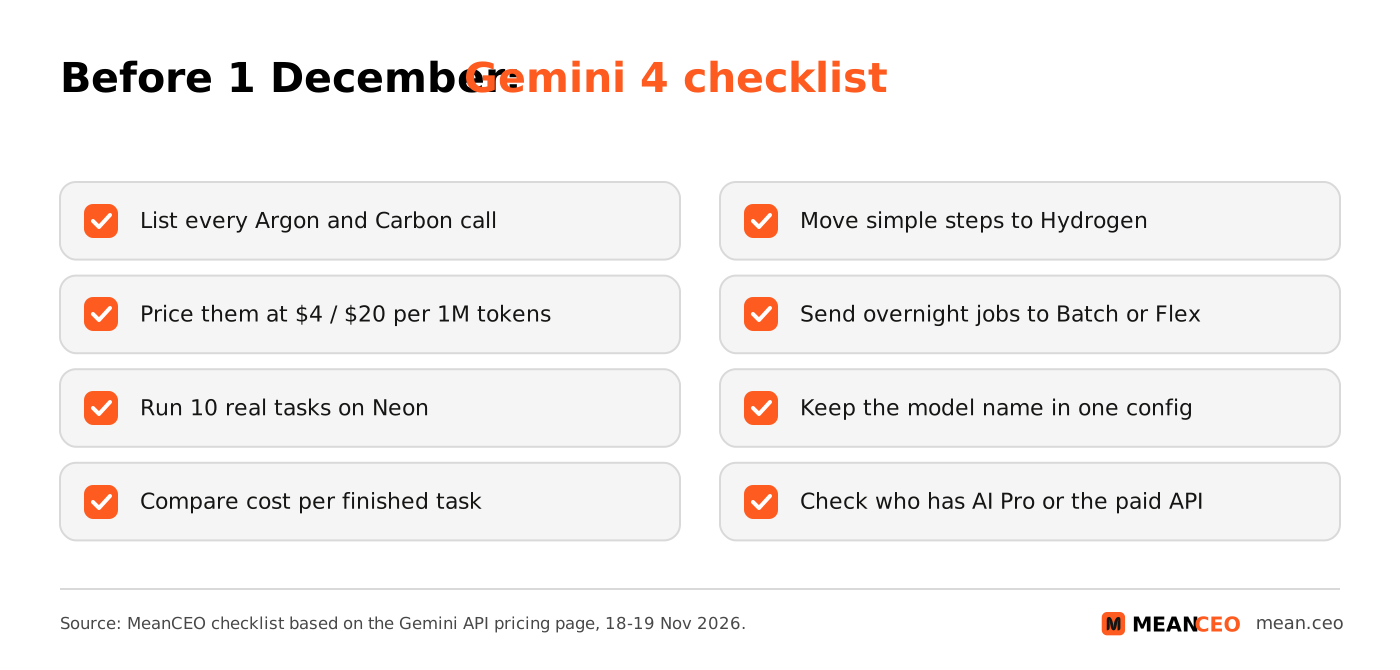
Here is how I would handle the next twelve days:
- List every Argon and Carbon call in your product and price it at $4 / $20 per million tokens to see your December bill.
- Run 10 real tasks on Neon at the default high thinking level, next to your current model.
- Compare cost per finished task, since a cheaper token price says little about the final bill.
- Move simple, repeated steps to Hydrogen and keep Neon as the orchestrator.
- Send non-urgent jobs to Batch or Flex at $1.50 / $7.50.
- Keep the model name in one config value so you can switch in minutes, a lesson from OpenAI's models leaving Cursor.
- Check your plans: free and AI Plus users don't get Neon in the app, so your team needs AI Pro, Ultra or the paid API.
Are you getting customers from ChatGPT yet?
More and more traffic is coming from Perplexity, ChatGPT, Grok and other AI tools.
👉 Rank on ChatGPT
Running a small business on the Gemini app rather than the API? Our sister site asks whether Google AI Pro is worth €21.99 now that it includes Neon. And if you work in 3D, Blended BORIS explains how Blender MCP works and how to try Google's Blender demo safely.
What we don't know about Gemini 4 Neon yet
- Speed and size: no tokens-per-second figure or parameter count yet.
- Vertex AI availability and regions.
- Free users, AI Plus and Search AI Mode: whether they will ever get Neon.
- Argon in the app: whether its exit is official.
- Neon for cyber: the start date and the full Safety & Security Report.
FAQ: Gemini 4 Neon
What is Gemini 4 Neon?
Gemini 4 Neon is Google's middle Gemini 4 model, launched on 18 November 2026 and adapted from Gemini 4 Carbon. Google pitches it for coding, agents, knowledge work and science.
How much does Gemini 4 Neon cost?
$3 per million input tokens and $15 per million output tokens in the Gemini API, or $1.50 and $7.50 on Batch and Flex. It has no free tier.
Is Gemini 4 Neon cheaper than Gemini 4 Carbon?
From 1 December 2026, yes: Carbon moves from $2 / $10 to $4 / $20, which makes Neon 25% cheaper per token. Google also claims a 32% lower cost per task.
Can I use Gemini 4 Neon for free?
No. You need Google AI Pro, Ultra or the paid Gemini API. Gemini 4 Hydrogen is the free option.
Is Gemini 4 Neon available in Europe?
Yes. The Gemini API covers the EU and the UK, and Google's Dutch subscriptions page lists Neon under AI Pro at €21.99 a month. Vertex AI availability is unconfirmed.
Does Gemini 4 Neon replace Gemini 4 Argon?
Google has not said so. 9to5Google and Notebookcheck report it replaces Argon in the Gemini app for AI Pro. In the API, Argon stays and moves to $4 / $20 on 1 December.
About the Author
Violetta Bonenkamp, also known as MeanCEO, is an experienced startup founder with an impressive educational background including an MBA and four other higher education degrees. She has over 20 years of work experience across multiple countries, including 5 years as a solopreneur and serial entrepreneur. Throughout her startup experience she has applied for multiple startup grants at the EU level, in the Netherlands and Malta, and her startups received quite a few of those. She’s been living, studying and working in many countries around the globe and her extensive multicultural experience has influenced her immensely.
