TL;DR: Did AI really disprove the Exponential Time Hypothesis?
On 26 and 27 October 2026, OpenAI and Anthropic each published a proof, found by their own AI models, that the Exponential Time Hypothesis (ETH) is false. ETH, proposed by Russell Impagliazzo and Ramamohan Paturi in 1999, says the classic 3-SAT puzzle needs exponential time. Both papers give a deterministic algorithm that beats that bound, and both come with machine-checked proofs in the Lean language. The three researchers leading the open review say their role is no certification, and no flaw had been reported by 2 November. For your product nothing changes today: Anthropic's paper says the algorithm only beats brute force on formulas with more than 10^108 variables, and OpenAI told TechCrunch it is reasonably confident no encryption breaks follow.
Developing story. Last updated 2 Nov 2026, 07:45 CET. Still no verdict; follow-up results and independent Lean reruns are now coming in (see the update below). We'll update this article as the review group led by Impagliazzo, Paturi and Ryan Williams publishes its findings.
Searches for "AI impacts theoretical computer science" jumped 600% in the US on 29 October, three days after the two releases, as expositions, a factoring follow-up and fresh commentary from leading theorists piled up. Here is what each lab claimed, who is checking it, why your SAT solver and your encryption stay as they are, and the lesson that matters for founders who build on AI.
What did OpenAI and Anthropic announce?
OpenAI went first. Its paper "The Exponential Time Hypothesis is False", credited only to "OpenAI" and dated 17 October (revised 25 October), went public in the company's math repository on Monday 26 October at 20:35 UTC, together with two other claimed results in math and physics. The repository update says a working group led by Impagliazzo, Paturi and Ryan Williams will examine the proof, and that OpenAI released everything at once at the group's request. OpenAI describes the material as raw research data from an unnamed internal model, rather than polished papers.
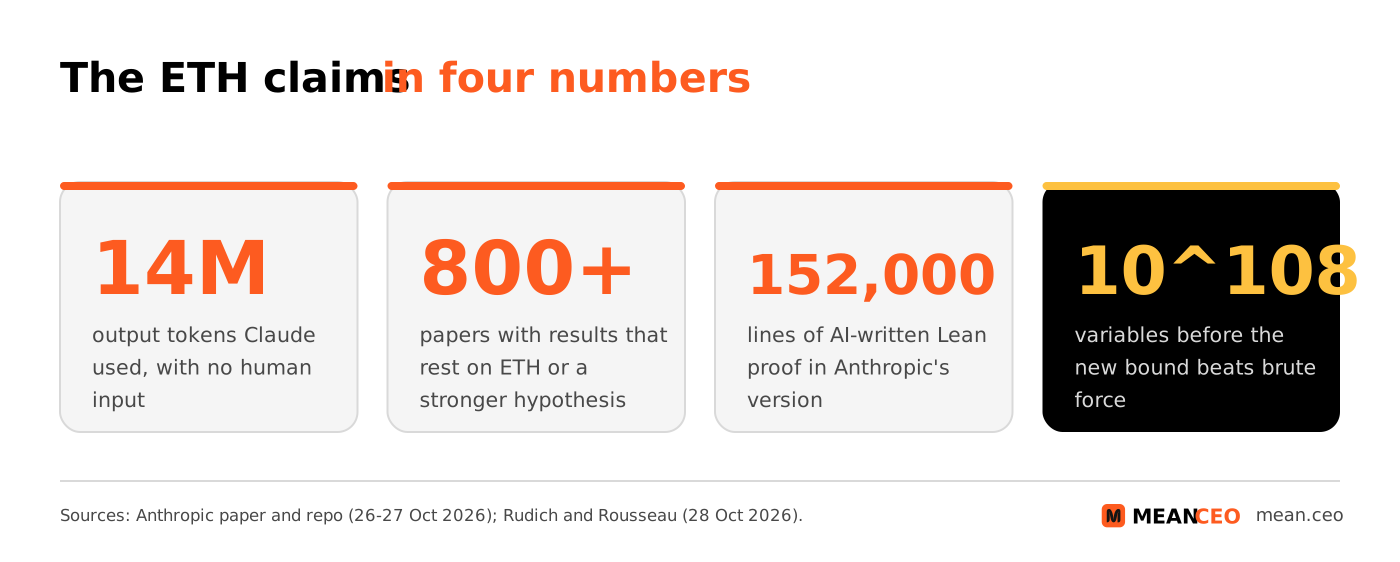
Anthropic followed about 6.5 hours later, at 03:07 UTC on 27 October, with "A 2^o(n) Time Algorithm for 3-SAT", credited to "Claude / Anthropic". The paper says an internal Claude research model found the algorithm on 16 October, using 14 million output tokens and no human input, and that Anthropic researchers then worked with Claude on the write-up. Its GitHub folder holds the paper and a Lean 4 proof written by AI models.
Both papers claim the same thing in slightly different forms: a deterministic algorithm that counts every solution of a 3-SAT formula (and of any k-SAT formula) in time 2^O(n log log n / √log n), where n is the number of variables. That growth is slower than 2^(δn) for every fixed δ, which is exactly what ETH ruled out. Both papers say the result also refutes the stronger version, SETH.
What is the Exponential Time Hypothesis, in plain words?
3-SAT is a list of rules, each about three yes-or-no switches, and the question is whether some setting of the switches obeys every rule. With n switches there are 2^n settings to try. The best earlier deterministic algorithm needed about 1.328^n steps. ETH said that number can be squeezed but never pushed below some 2^(δn), so 3-SAT stays exponential.
Researchers built a lot on that floor. Claude's literature search, reported in Anthropic's paper, found more than 800 papers that prove at least one result only under ETH or a hypothesis that implies it. ETH is a stronger claim than P ≠ NP, so its fall leaves the famous P vs NP question open. Scott Aaronson wrote on his blog that he raised his personal odds of P = NP from 3% to 5%, and Ryan Williams told TechCrunch that every computer scientist should "put a little more weight on the plausibility of P = NP".
Has anyone checked the proofs?
Machines have, people are starting. Lean is a proof assistant: if it accepts a proof, every logical step follows from the stated definitions. Anthropic's proof passed Lean's kernel and two independent checkers using only Lean's three standard axioms. The catch sits in the definitions themselves. Anthropic's own README warns that "no machine checks that this file says what the paper says", and the paper adds that the Lean code was written by AI, reviewed by other instances of the same models, and read by no person so far. OpenAI's Lean version checks a slightly weaker bound than its paper states, which Lance Fortnow also points out.
The human review is open to everyone. In a message to the theoretical computer science community, Impagliazzo and Paturi (UC San Diego) and Williams (MIT) wrote that "Our involvement should not be taken as certification of the claim". They set up a shared folder for notes and corrections, a feedback form and a virtual meeting before the end of 2026, and they want new norms for AI-made breakthroughs, including credit for the people who check and explain them. Scientific American reports that OpenAI will fund a conference on the result.
Early signs favour the claim. Fortnow wrote on his blog that it is "safe to assume now that the exponential-time hypothesis is toast", while adding that he hasn't verified the proof himself. Williams told TechCrunch that parts of OpenAI's proof are routine and two or three parts look "alien". One caution from the same month: OpenAI withdrew three earlier manuscripts on 7 October after a sign error.
Does this break encryption or speed up SAT solvers?
No. The labs say so themselves. Anthropic's paper calls the result purely asymptotic: in n alone, its bound beats plain 2^n search only once a formula has more than 10^108 variables, and for typical formulas with five clauses per variable the crossover sits beyond 10^10,000. Brute force is already hopeless at 100 variables, so real solvers never meet the new algorithm. Fortnow adds that it covers k-SAT only: Subset Sum and the travelling salesman problem get nothing new.
On encryption, Williams asked OpenAI's science lead Dan Roberts directly, and OpenAI said it had checked and was reasonably confident no breaks follow. A follow-up posted on 28 October by Isaac Rudich and Louis-Martin Rousseau of Polytechnique Montréal applies the same counting engine to factoring, the math behind RSA. All its ideas came from Claude agents, and the authors call the algorithm "galactic": it beats none of the classical factoring methods.
What do we know so far, as of 2 November?
- Update 2 Nov, 07:45 CET: still no verdict, and no flaw reported. On 1 November Mohan Paturi opened a thread on the review blog where researchers can announce results that follow from the refutation, and the first follow-ups are arriving: Aparna Gupte (MIT) keeps a spreadsheet of the cryptography-related algorithmic consequences, and Bernardo Subercaseaux and Carmen Strassle say they are writing a note showing that the result also speeds up simulation of nondeterministic time. Independent replication has started as well. In the review blog's Lean Replications thread, one participant reports rerunning both Lean proofs locally: both were accepted, and Anthropic's proof passed two independently written Lean kernels. The same participant read both statement files by hand, the step no machine can do, and published the logs. That is one person's report, and the review group hasn't confirmed it.
- 26 Oct: OpenAI publishes its proof with Lean files; the review group posts its message to the community.
- 27 Oct: Anthropic publishes Claude's paper and Lean proof; it lands on the Hexagon preprint server under CC BY 4.0.
- 28 Oct: Fortnow's post; a UC San Diego note looks at a weaker version, "Weak ETH", which the new results leave standing; the AI-generated factoring follow-up appears.
- 29 Oct: Ryan O'Donnell (Carnegie Mellon) updates an exposition of OpenAI's proof, written "through interaction with LLMs"; Quanta Magazine reports that both labs have refuted the hypothesis; Aaronson sums it up as ETH being "slightly false".
- 30 and 31 Oct: the review blog opens a thread for local Lean reruns; a participant reports that both proofs compile and that two independent Lean kernels accept Anthropic's.
- 1 Nov: the review group invites follow-up results; work on cryptography consequences and on nondeterministic time is announced.
- Flaws reported: none so far.
What we don't know yet
- The verdict. The review group hasn't published findings or a date for its virtual meeting.
- Whether the Lean statements match the papers. Only people can confirm that the definitions mean what the papers claim.
- How OpenAI's model found it. OpenAI's repository says most of its results used about three hours of ChatGPT Pro thinking compute on average, without a figure for this one.
- How two labs landed on it in the same week. Anthropic dates its discovery to 16 October; nobody has explained the overlap.
- How far the bound goes. Williams doesn't think OpenAI's algorithm is the best possible, and the Weak ETH floor is still open.
Timeline
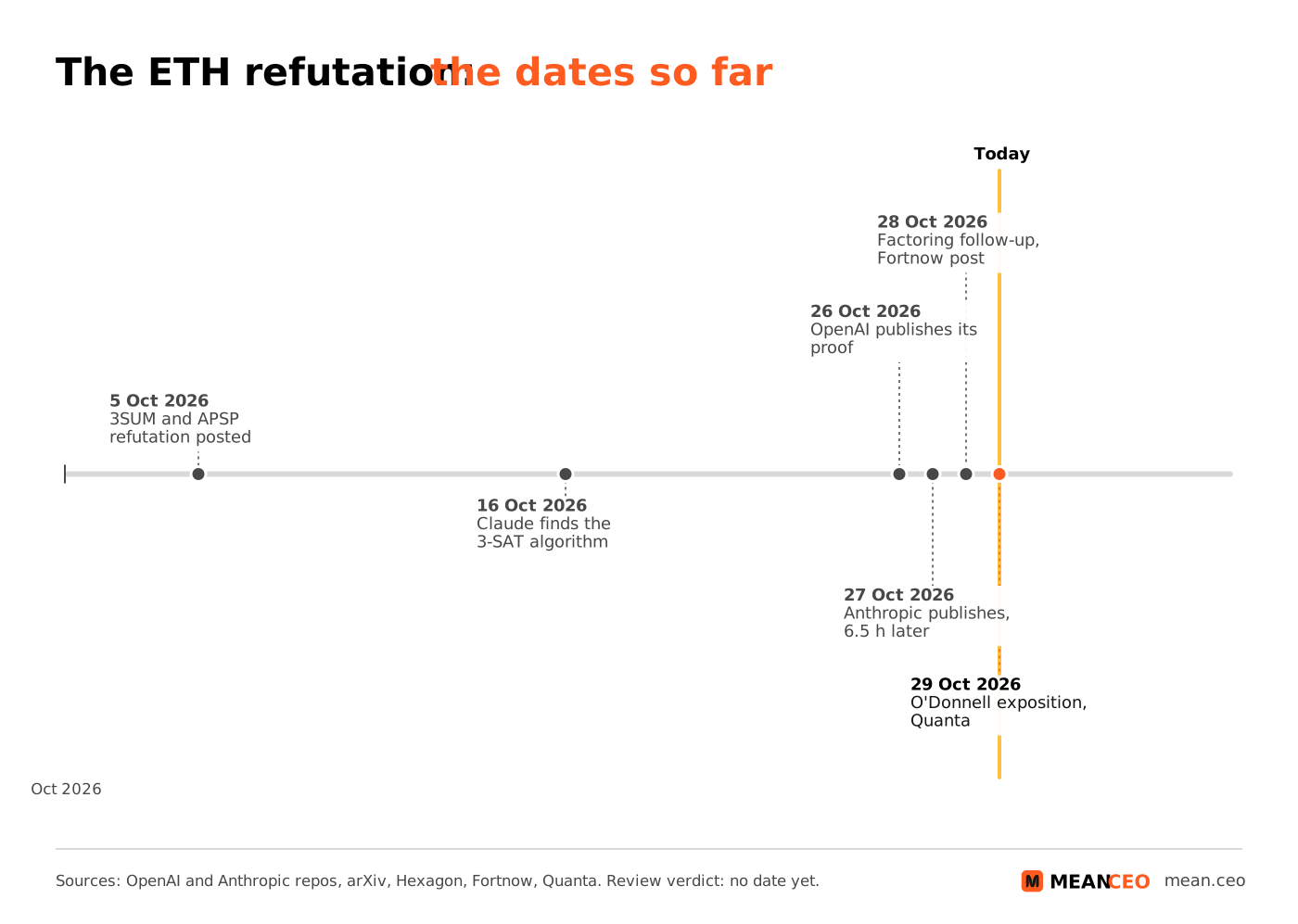
- 1999: Impagliazzo and Paturi propose ETH at the IEEE CCC conference.
- 5 October 2026: Josh Alman and Virginia Vassilevska Williams post a paper refuting the 3SUM and APSP hypotheses; Aaronson writes that the decisive idea came from an Anthropic model.
- 16 October 2026: Anthropic's internal Claude model finds the 3-SAT algorithm.
- 26 October 2026: OpenAI publishes; the review group goes public.
- 27 October 2026: Anthropic publishes.
- 28 and 29 October 2026: expositions, the factoring note, Fortnow's and Quanta's coverage.
- 30 October to 1 November 2026: independent Lean reruns and the first follow-up results are announced on the review blog.
- Before the end of 2026: the review group's planned virtual meeting.
What does the ETH news mean for founders building on AI?
Next steps, from the most urgent to the most strategic:
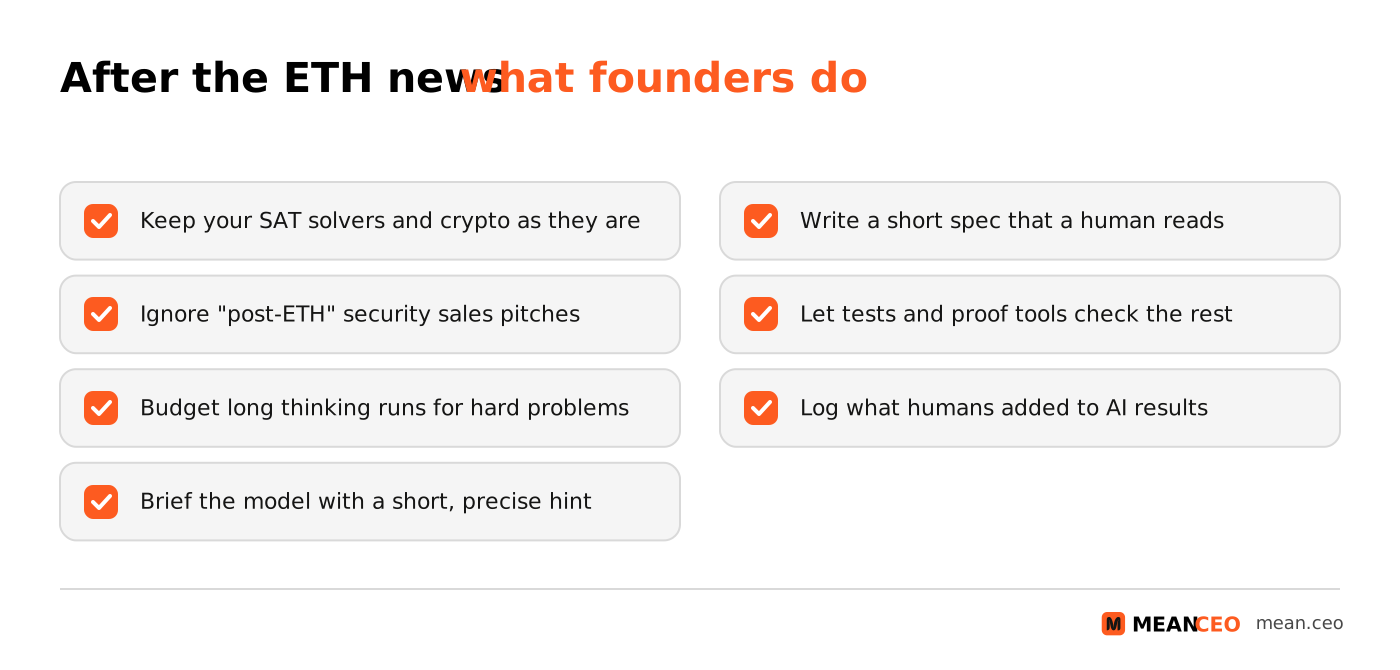
- Change nothing in your stack. SAT solvers, schedulers, verification tools and encryption libraries keep working exactly as they did on 25 October. A vendor selling "post-ETH security" is selling fear.
- Budget for long thinking runs. Claude spent 14 million output tokens on this result. At the public Claude Opus 5.5 rate of $20 per million output tokens, that much output costs about $280. The internal research model isn't for sale, so read the $280 as a sense of scale. Our guide to AI token costs shows how to plan that spend.
- Brief the model tightly. Anthropic's README says Claude Opus 5.5 at high effort can rederive the refutation from a six-line hint. On your own hard problems, a short, precise description of the idea gets you further than a long, vague prompt.
- Make checking your bottleneck on purpose. Nobody has read Anthropic's 152,000 lines, so the whole weight rests on a short statement file a person can read. Do the same with AI-written code: keep a short spec, tests and types that a human reviews line by line, and let machines check the rest. The Claude Mythos pull request showed why unread AI output is a risk.
- Record who did what. These papers are credited to "Claude / Anthropic" and "OpenAI", without human names. If your team uses AI to find algorithms or designs, log the prompts, the human choices and the checks, because ownership questions follow the money. Our CADChain guide to AI-generated inventions explains who owns AI-found algorithms and designs under patent, copyright and trade secret law.
- Follow the open review for the verdict. The verdict will come from the open review and its planned meeting. Until then, treat "AI proved X" claims from any lab as strong evidence awaiting human sign-off, including OpenAI's, which pulled three papers earlier this month.
Are you getting customers from ChatGPT yet?
More and more traffic is coming from Perplexity, ChatGPT, Grok and other AI tools.
👉 Rank on ChatGPT
Is this a breakthrough or hype?
For theory, it is a huge result if it holds: a 27-year-old assumption behind hundreds of papers falls to two AI models in the same week. Aaronson expects nearly all earlier results that assumed ETH to be salvageable, and Fortnow stresses that the gain covers k-SAT only.
For business, the bigger story is the speed. AI research models now produce results that take experts days to unpack, and the checking system built for human authors is straining: Williams called OpenAI's October proof releases a "DDOS attack on mathematicians". Expect the same pattern in engineering: AI output arrives faster than teams can review it, so the founders who win design their review step first. For the wider month, see our Anthropic news for October 2026 and OpenAI news for October 2026 roundups, and what the Anthropic S-1 risk factors say about building on Claude.
FAQ: the Exponential Time Hypothesis and AI
What is the Exponential Time Hypothesis?
A conjecture by Russell Impagliazzo and Ramamohan Paturi from 1999: 3-SAT on n variables can't be solved in 2^(δn) time for some fixed δ above zero, so it needs exponential time.
Did AI really disprove the Exponential Time Hypothesis?
OpenAI's and Anthropic's models produced proofs that Lean accepts, and no flaw has been reported. An open review led by Impagliazzo, Paturi and Ryan Williams hasn't reached a verdict yet.
Does this mean P = NP?
No. ETH is a stronger claim than P ≠ NP, and both papers' algorithms still take more than polynomial time. P vs NP stays open.
Does refuting ETH break encryption?
No break is known. OpenAI told TechCrunch it is reasonably confident none follow, and an AI-found factoring algorithm based on the result beats none of the classical methods.
Who found it first, OpenAI or Anthropic?
Anthropic dates Claude's discovery to 16 October and OpenAI's paper is dated 17 October. OpenAI published first, about 6.5 hours before Anthropic.
How does AI impact theoretical computer science?
In October 2026 AI models helped refute three long-standing hypotheses (3SUM, APSP and ETH) and wrote machine-checked proofs. Researchers are now drafting rules for credit and review of AI-made results.
About the Author
Violetta Bonenkamp, also known as MeanCEO, is an experienced startup founder with an impressive educational background including an MBA and four other higher education degrees. She has over 20 years of work experience across multiple countries, including 5 years as a solopreneur and serial entrepreneur. Throughout her startup experience she has applied for multiple startup grants at the EU level, in the Netherlands and Malta, and her startups received quite a few of those. She’s been living, studying and working in many countries around the globe and her extensive multicultural experience has influenced her immensely.
