TL;DR: What is Google's Connected Apps Platform, and can European founders use it?
On 28 October 2026, Google opened a preview of its Connected Apps Platform. You connect a remote MCP server (or an Android app through AppFunctions), register it in a new Google Connected Console, and choose whether it appears in the Gemini app, in Google Search's AI Mode, or both. Users then call it by name, like @YourApp, inside the chat. Until now, getting in meant working closely with Google; now there's a self-service sign-up, opened in phases. The catch for Europe: in Search, Connected Apps currently work only in AI Mode in the US, in English. In the Gemini app, availability varies by app, and some already work wherever Gemini does. If your startup has an API, this is the cheapest new distribution channel Google has opened in years. Apply now, build small, and target Gemini first.
For 25 years, the deal with Google was simple: publish pages, rank, get clicks. On Wednesday Google added a second deal. Bring it a tool, and it will put your product inside the answer.
The same afternoon, Alphabet told investors that AI Mode makes less money per search than classic search, and Google announced ads in AI Mode for ten more countries. Put together, Search is turning into a place where apps and ads sit inside the conversation, and fewer users click through to websites. Here's what launched, what you need to build, what works in Europe today, and what I'd do this week.
What happened
On 28 October 2026, Google product leads Chips Mistry (Search) and Mai Lowe (Gemini app) announced the preview of the Connected Apps Platform, described as "a unified way for more app developers to bring their capabilities directly into Gemini and Search." Google's pitch: "build once and reach high-intent users across both Search and the Gemini app."
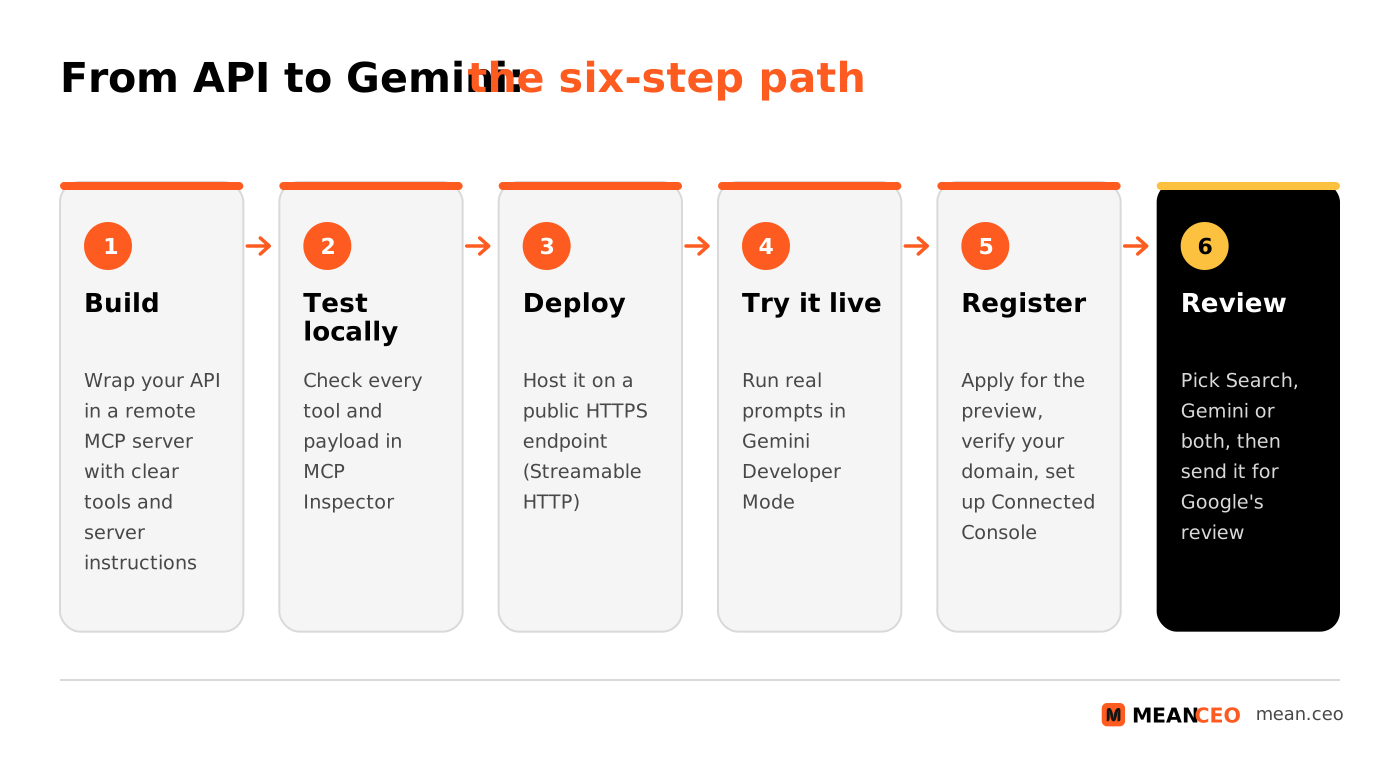
Here's how it works. Developers connect a cloud-hosted MCP server, or an Android app through Android's AppFunctions APIs. They then register, test and submit the app in the new Google Connected Console. Before review, they choose whether it goes live in Search, the Gemini app, or both. Once it's live, the console shows traffic, latency and error rates, and the app gets a verified logo and signed-in accounts.
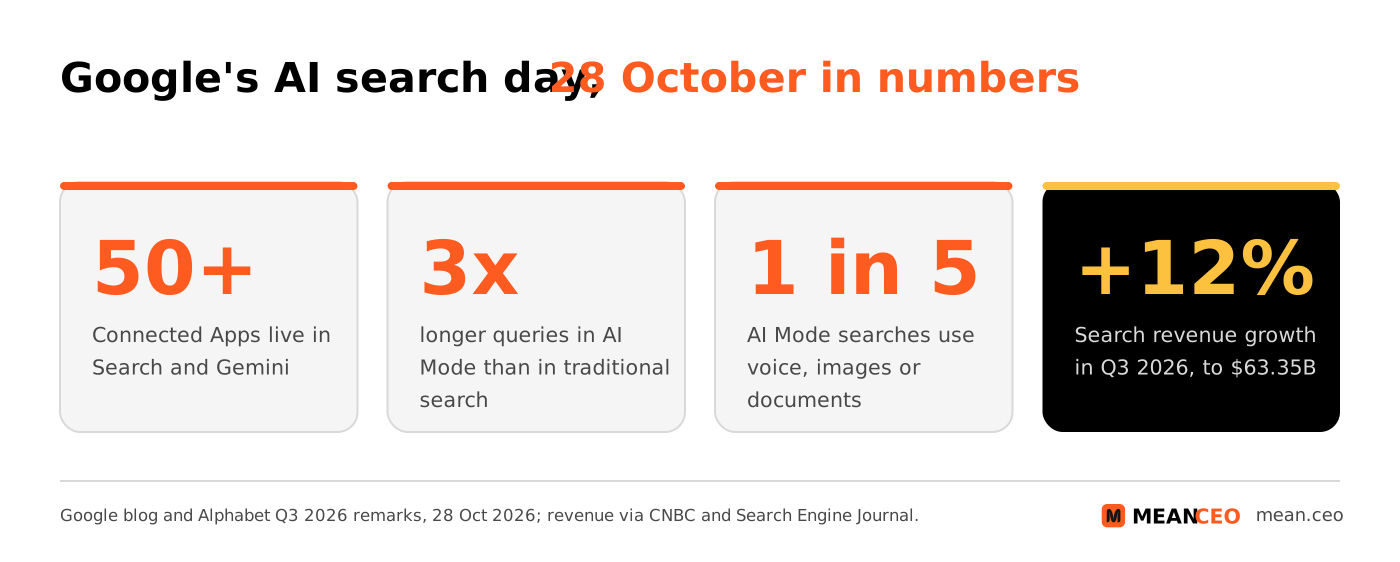
Connected Apps themselves aren't new. More than 50 already run across Search and Gemini, from productivity to event tickets and fitness. Adobe, Experian, Localiza and Peloton are live in Gemini and will reach Search "in the coming weeks", and Calm is launching in both. What's new is the door: as 9to5Google put it, until now building one "required working closely with Google." Now there's a sign-up form and self-service onboarding, with access opened "in phases" and "more developers, markets, and Google products over the coming months."
Google also wants AI agents everywhere it operates. In his Q3 2026 remarks, Sundar Pichai said "Agents will operate as a unifying layer across our products", with agentic features moving beyond Search and the Gemini app to Chrome, Android and Workspace. If you've followed Anthropic's Agent Skills move to the Linux Foundation, the pattern is familiar: MCP and skills are becoming the standard way AI assistants plug into products, and Google has now built a storefront on top.
What you need to build
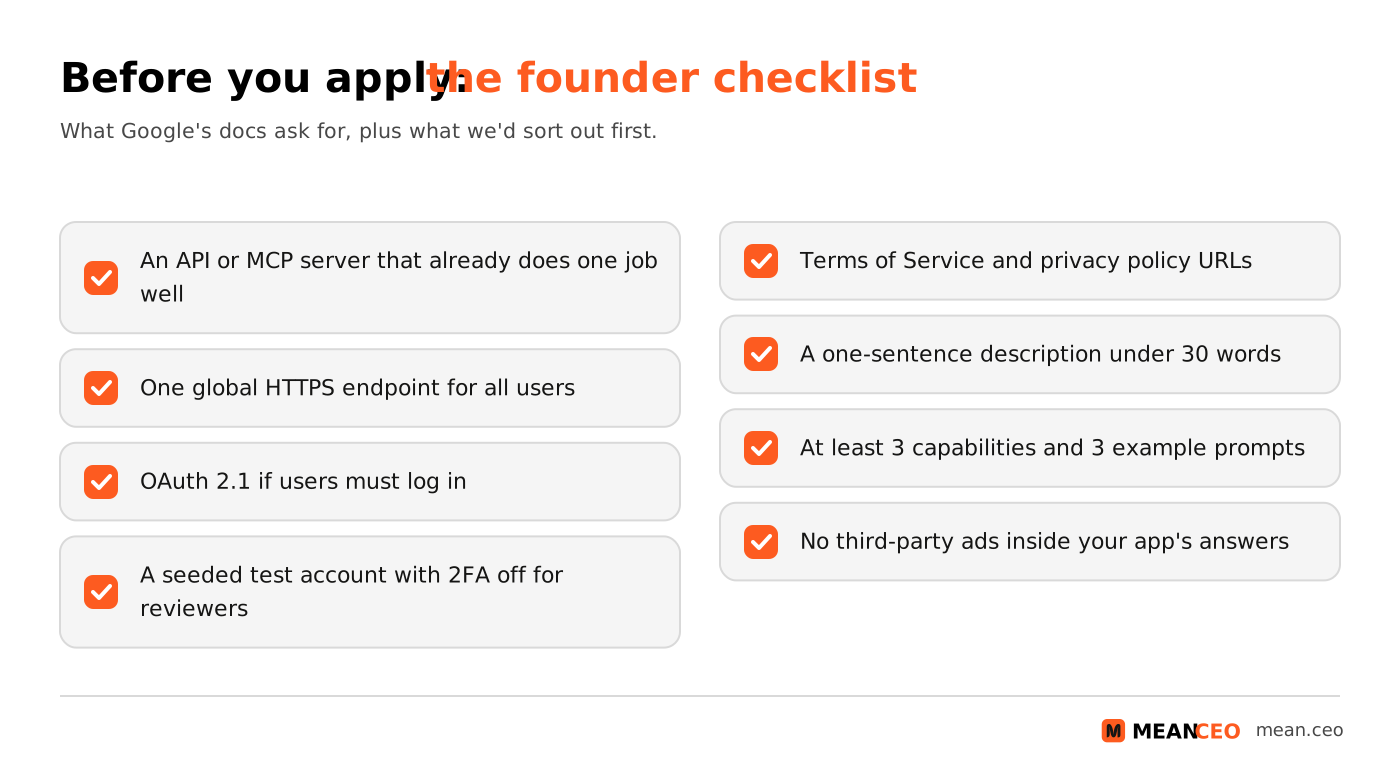
The developer docs, last updated on 27 October, are specific. Here's what the prerequisites page and the registration guide ask for.
Source: Google Connected Apps Platform docs, read 29 Oct 2026. Requirements may change during the preview.
Testing happens in Gemini Developer Mode, which has an event log, tool schemas and a simulator for date, time and location. Users can call your app with @YourApp or simply by naming it in a question, and it then "remains in context for relevant user prompts in the session." One more rule worth knowing: users have to connect your app to their Google account first, so being listed doesn't mean anyone will see you.
Google hasn't published any fee or revenue share in the pages we read. Don't assume it's free forever, but nothing in the current docs asks you to pay.
The rules that will shape your app
Google's Connected Apps policy is short but strict. Two rules matter most for small teams:
- No ads. "Connected App partners must not serve any third party advertising content or promotional material through their integrations." Your own branding is fine. Affiliate-style answers or sponsored slots inside your tool's results are not.
- No clones. Apps must not "create multiple Connected Apps with highly similar functionality" or copy other apps without adding value. Ten near-identical apps for ten niches is out; one app that does a real job well is in.
- No tricks with the model. The policy bans "overly broad or deceptive capability descriptions" written to make the model pick your app over another one. Write tool descriptions for accuracy, not for keyword stuffing.
- Reliability counts. Apps that "consistently return errors, crash, timeout" are prohibited, so the error rate in your console is now a ranking factor in all but name.
The contrast with the rest of Search is striking. Two days earlier, Google updated its guide to preventing user-generated spam to cover "Hosting platforms and tools that let users publish shared pages, generated content, or web apps", and told them to apply noindex or a robots.txt block "by default" to pages made for sharing or utility. If you ship pages from an AI app builder, expect more of them to drop out of the index. Run your own site through our technical SEO checklist for startup websites so the pages you want found are on your own domain and indexable.
Where it works: the Europe angle
This is where European founders need to read the small print.
Sources: Google Search Help, Gemini Apps Help and Google Ads blog, 28–29 Oct 2026.
The Search help page is blunt: Connected Apps in Search are "currently available in AI Mode in the US, in English." The Gemini app is more open. Google's own list shows apps such as Adobe, Canva, Picsart, VistaPrint and Wix available in all countries where both Gemini and the partner's app are supported, while many others are marked US only, English only. Since developers choose countries, languages and products for each version, nothing stops a European startup from launching in Gemini first and adding Search when Google opens more markets.
Two details deserve care. First, the single global endpoint: Google says "Separate data center URLs are not supported." If you promise EU clients that their data stays on EU servers, check how a request from Gemini reaches your server and what it carries before you list the app. Second, your app will act for signed-in users, so update your privacy policy and records for the new data flow.
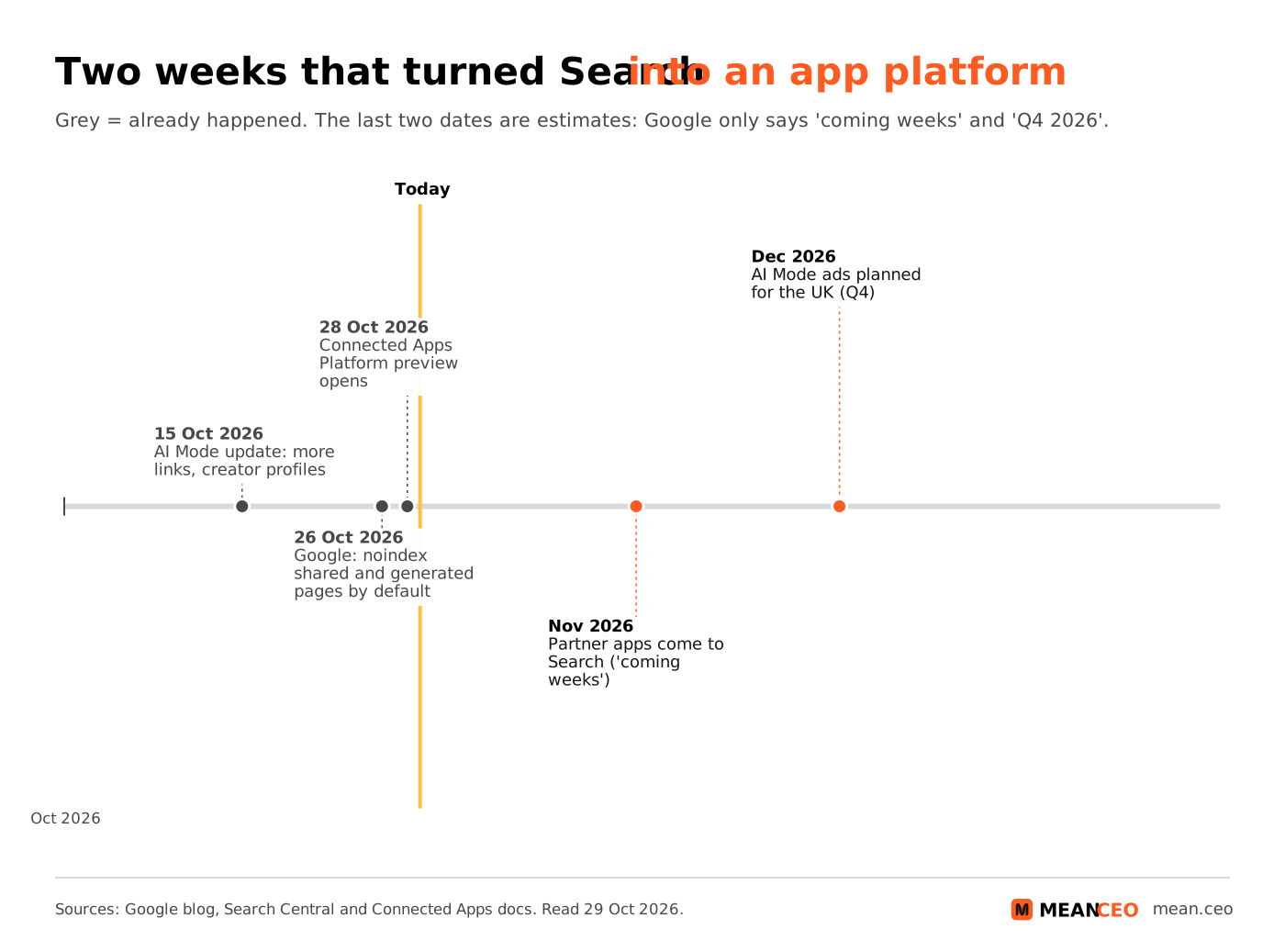
Meanwhile, ads in AI Mode are spreading. Google is scaling them in Australia, Canada, India, Kenya, Malaysia, New Zealand, Nigeria, Pakistan, the Philippines and Singapore, plans Brazil, Mexico and the UK in Q4 2026, and is launching "multiturn ads" on follow-up questions in the US. Google says click-through rates are "already similar between sponsored and organic product list items within AI Mode", based on its own US data. According to Search Engine Journal's report on the earnings call, all existing Search, Shopping and Performance Max campaigns are eligible by default.
Why Google is doing this now
Follow the money. Alphabet's Search revenue grew 12% to $63.35 billion in Q3 2026, slower than the 19% and 17% of the two previous quarters, and essentially flat on Q2, according to CNBC and Search Engine Journal. Chief business officer Philipp Schindler named lower monetisation in AI Mode as one reason, alongside currency moves and category trends such as retail. Pichai, for his part, said query growth is "the highest it's been in the last five years" and that AI Mode queries are on average three times longer than traditional searches.
Longer, task-like questions are hard to answer with ten blue links and easy to answer with a tool. Apps and ads inside AI Mode are how Google plans to earn from them. For you, it means two things: more of the journey happens inside Google, and the businesses that get picked are the ones that can do something, not just say something. We saw the same shift in Google's 15 October AI Mode update and in this month's AI search traffic studies, where AI tools sent little traffic but converted well.
Reactions from the SEO world, as reported by Search Engine Roundtable, were enthusiastic. Marie Haynes wrote: "You can now build apps (using MCP) that can be used directly inside Google Search and Gemini." Google's John Mueller, speaking for himself, called it "still extremely early" but said "the mix of standardized interface / MCP + Search opens up a lot of possibilities." For the model side of Google's busy Wednesday, see our story on Gemini 4 Carbon, and for everything else, our Google Gemini news for October 2026.
What this means for you
- Apply for the preview this week. Access opens in phases, and early apps get the attention while the catalogue is small. Applying costs you a form.
- Ship one sharp tool, not a wrapper. Pick the job users already come to you for, such as "check my order", "build my invoice" or "find a slot", and expose that well. Google's policy rewards distinct, reliable apps and bans clones.
- Target Gemini first if you sell in Europe. Search is US-only for now. Gemini lets you choose countries and languages per version, so start where your customers are and add Search later.
- Treat tool descriptions like SEO copy, honestly. The model decides when to call you from your server instructions and tool descriptions. Clear, specific wording wins; inflated claims break the policy.
- Keep your website strong anyway. Being an app inside Google doesn't replace being found. Our guide on how to rank on Google with zero backlinks still applies, and our SEO news for October 2026 tracks the rest of the month's changes.
- Watch your error rate. The console shows latency and errors, and failing apps are banned. Put monitoring on your MCP endpoint before you send it for review.
Are you getting customers from AI search yet?
More and more traffic is coming from Perplexity, ChatGPT, Grok and other AI tools.
👉 Rank on ChatGPT
FAQ: Google's Connected Apps Platform
What is Google's Connected Apps Platform?
A developer platform, opened in preview on 28 October 2026, that lets companies bring their apps into the Gemini app and Google Search's AI Mode. Developers connect a remote MCP server or an Android app through AppFunctions, then register, test and submit it in Google Connected Console.
Is the Connected Apps Platform available in Europe?
Partly. In Search, Connected Apps currently work only in AI Mode in the US, in English. In the Gemini app, availability varies by app: some work in every country where Gemini and the partner's app are supported, others are US only. Developers choose countries and languages for each version.
How do users find a connected app?
They call it with @AppName or by naming the app in a question in Gemini or AI Mode. Users have to connect the app to their Google account first, and it then stays in context for related prompts in that session.
Does Google charge for Connected Apps?
The announcement and developer docs we read on 29 October 2026 mention no fees and no revenue share. That could change after the preview, so check the Connected Apps Terms of Service before you build your business around it.
Can I show ads inside my connected app?
No. Google's policy says partners must not serve third-party advertising or promotional material through their integrations. Your own branding is allowed.
What do I need before I apply?
A public HTTPS MCP server using Streamable HTTP, one global endpoint, domain verification through a .well-known file, OAuth 2.1 if users log in, Terms of Service and privacy policy URLs, a description under 30 words, at least three capabilities and three example prompts, and a seeded test account for Google's reviewers.
About the Author
Violetta Bonenkamp, also known as MeanCEO, is an experienced startup founder with an impressive educational background including an MBA and four other higher education degrees. She has over 20 years of work experience across multiple countries, including 5 years as a solopreneur and serial entrepreneur. Throughout her startup experience she has applied for multiple startup grants at the EU level, in the Netherlands and Malta, and her startups received quite a few of those. She’s been living, studying and working in many countries around the globe and her extensive multicultural experience has influenced her immensely.
