TL;DR: What is Claude Fable 5.2?
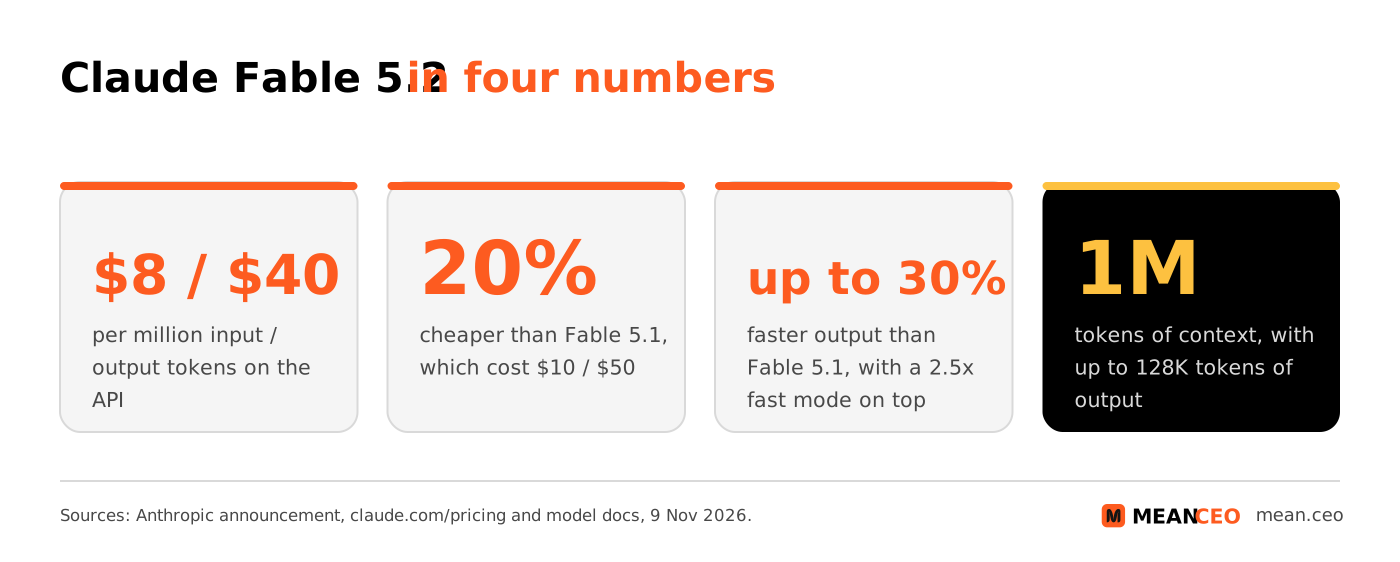
On 9 November 2026 Anthropic released Claude Fable 5.2, its strongest generally available model, together with Claude Mythos 5.2, the same model without some cyber and biology safeguards, which only vetted organisations get. Fable 5.2 costs $8 per million input tokens and $40 per million output tokens, 20% less than Fable 5.1, and writes up to 30% faster. It tops Anthropic's own agentic coding test at 49.1%, but Anthropic still tells most users to start with Opus 5.5, which costs half as much. On Max and Ultra plans Fable can use up to half your weekly limit; Pro lists it as paid with usage credits.
Claude Fable 5.2 went live on Monday, and within hours "fable 5.2" was trending on Google in the US, the UK, the Netherlands, Germany, France and Belgium. Founders want two answers: is it worth twice the price of Opus 5.5, and can I use it on my plan? Here is what Anthropic launched, what the numbers say, where the model gets blocked, and how I would decide whether your startup should switch.
What did Anthropic release on 9 November 2026?
Anthropic's launch post introduces two names for one model:
- Claude Fable 5.2 is the public version. It ships with safety classifiers for cybersecurity and biology, which is why Anthropic can offer it to everyone, on the Claude apps, Claude Code and the API.
- Claude Mythos 5.2 is "the same underlying model" without certain cyber and biology safeguards. Access runs through Anthropic's Cyber Verification Program and Life Sciences Verification Program. Claude Enterprise customers also get it inside Claude Security, the code-scanning product.
For developers the model ID is claude-fable-5-2. The models overview lists a 1M-token context window and up to 128K tokens of output per request. Anthropic says Fable 5.2 is available on all platforms, including Amazon Web Services, Google Cloud and Microsoft Azure, and AWS confirmed it is live on Amazon Bedrock. Apps and Claude Code run it at Medium effort by default.
The launch also has a business backdrop. CNBC notes that this is Anthropic's first frontier release since CEO Dario Amodei called for slowing the pace of AI development in September, and it lands while Anthropic prepares an IPO that could come as soon as next week. Anthropic's head of product management for research, Dianne Penn, told CNBC: "We called for pacing, not pausing." We covered the filing itself in Anthropic's S-1 in numbers.
How much does Claude Fable 5.2 cost?
Fable 5.2 is cheaper than the model it replaces and still the most expensive Claude on the menu. These prices come from claude.com/pricing:
Batch processing halves the price, and US-only inference costs 1.1 times the standard rate. Fast mode speeds up token generation by up to 2.5 times at double the price, on Claude Code, the Claude Platform, Google Cloud and Microsoft Foundry. If you followed the October AI price war, the pattern holds: the top model just got cheaper, and the gap to the daily-driver model stays at 2x. Fable 5 and Opus 5 cost $10 and $5 per million input tokens; Fable 5.2 and Opus 5.5 cost $8 and $4.
Which Claude plans include Fable 5.2?
For launch week Anthropic adds extra Fable usage: eligible paid plans get one to three Fable limit resets depending on how long they've subscribed, and the launch post says Fable is included for up to 50% of weekly limits for Pro plans and standard Team seats. Max also comes with $100 a month in API credits and Ultra with $200. We explained what Ultra's limits really buy in Claude Max 20x is now Ultra.
How good is Claude Fable 5.2 on benchmarks?
Anthropic says Fable 5.2 is "a step above Opus 5.5 in almost all the capabilities we evaluated". All scores below come from Anthropic's own table, with safeguards on, and no outside lab has reproduced them yet:
Two details worth reading twice. Google's Gemini 4 Carbon still wins AutomationBench, the business-workflow test, and on the AA-Briefcase knowledge-work test Opus 5.5 keeps a slightly higher Elo rating (1,800 against 1,785). The biggest jump is in long, messy work: on the Remote Labor Index Fable 5.2 nearly doubles Opus 5.5. Our coverage of Gemini 4 Carbon explains the Google side of that race.
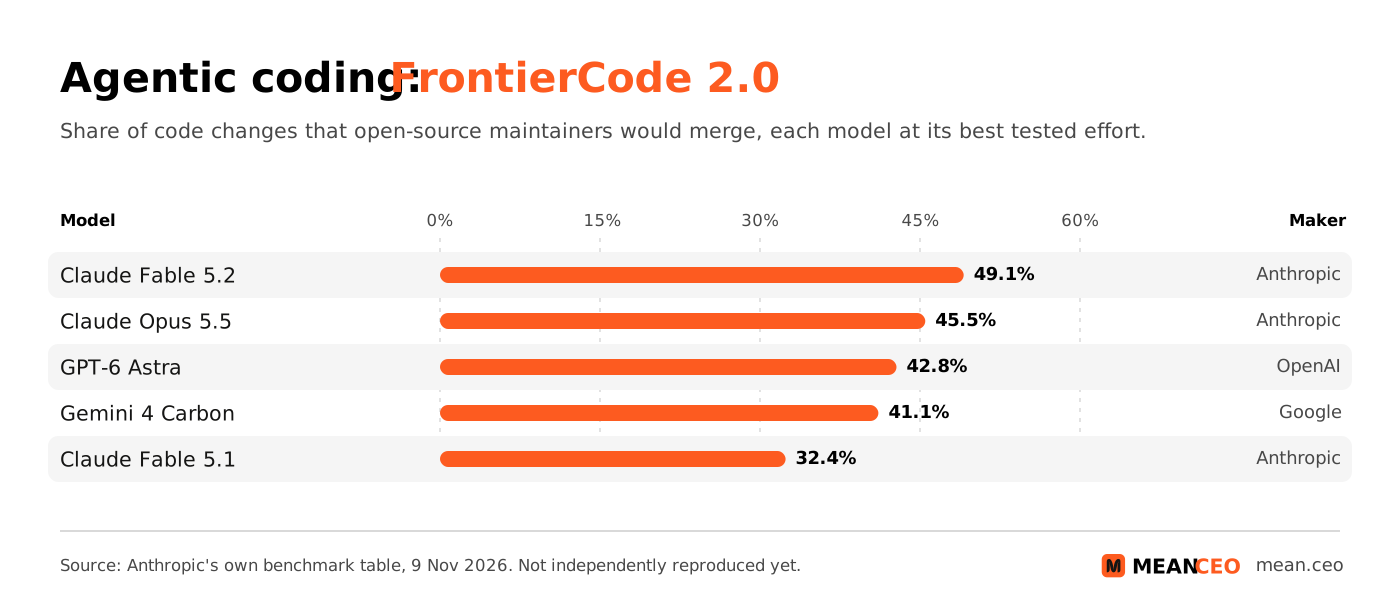
The more useful number for a founder is cost per finished task. Anthropic says Fable 5.2 at High effort scored 45.3% on FrontierCode, level with Opus 5.5's best score, for roughly half the cost per task. On Humanity's Last Exam, Fable 5.2 at Low effort matched Opus 5.5's top score for less than a tenth of the cost. So the expensive model can end up cheaper per result, because it needs fewer tokens and fewer retries.
What can Claude Fable 5.2 build?
Anthropic's demos lean hard on long, unattended agent work:
- An operating system from an empty folder. One engineer asked Fable 5.2 to design a prototype OS. It coordinated more than 1,000 subagents for eight days and produced a system that boots on a laptop, with drivers, file storage, windows, a login screen and an installer.
- A Python-to-Rust migration. A team of agents running an earlier version moved a production service to Rust; it now starts about 26 times faster.
- Fermat's Last Theorem in Lean. 1,000 Fable 5.2 agents formalised the proof in 30 hours. Opus 5.5 with the same setup finished 26% in 18 hours.
- Three working hardware devices from a one-paragraph prompt, with circuit boards, 3D-printed enclosures and software, built with the board maker Diode. If you build hardware, read what Claude Fable 5.2 means for CAD and PCB design before you upload design files.
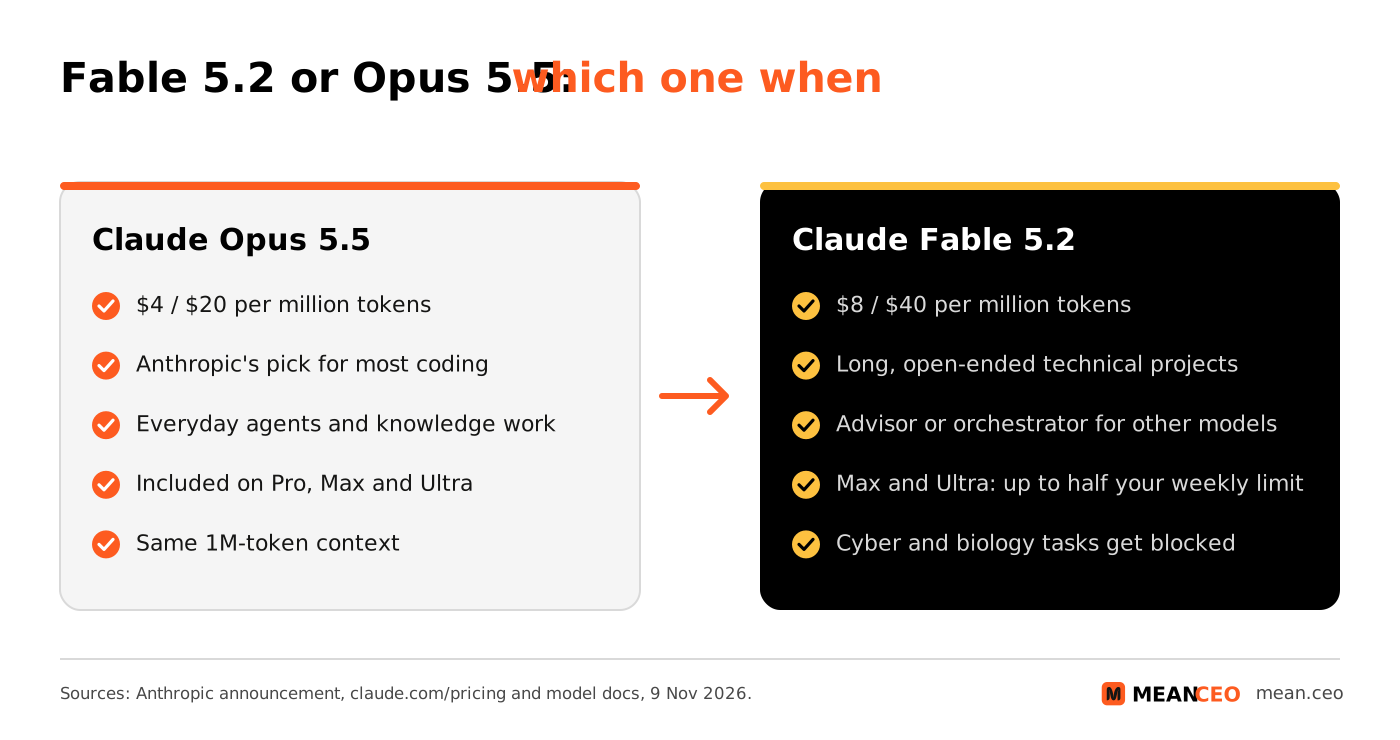
Anthropic also says more than 90% of the changes merged into its own main codebase are now written by Claude, with human guidance. Fable 5.2 can act as an Advisor, where Haiku, Sonnet or Opus consult it on hard problems, or as an Orchestrator that hands simpler work to smaller models. That second role is the one I'd test first: one expensive brain planning, many cheap models doing.
Where will Claude Fable 5.2 block you?
Fable 5.2 blocks high-risk cyber work, including penetration testing, exploit generation and binary-based vulnerability work, plus most research biology. A blocked query doesn't fail: in Anthropic's apps you get an answer from Opus 4.8 for cybersecurity and Opus 5 for biology instead. Anthropic counted about 55% fewer unnecessary blocks than Fable 5.1. On Amazon Bedrock the switch is not automatic: AWS says retrying a declined request on the other model is your code's job.
Data handling matters too. Anthropic monitors a window of usage for these models and keeps 30-day retention for safety monitoring for most customers. Zero data retention needs Enterprise Frontier Safeguards, now in private beta with Bridgewater, Salesforce and Stripe. If you build security tools, read our story on Claude Mythos for why Anthropic keeps the unfiltered model behind a verification wall, and check the Claude Code secrets leak before you hand any agent your repos.
What does Claude Fable 5.2 mean for founders?
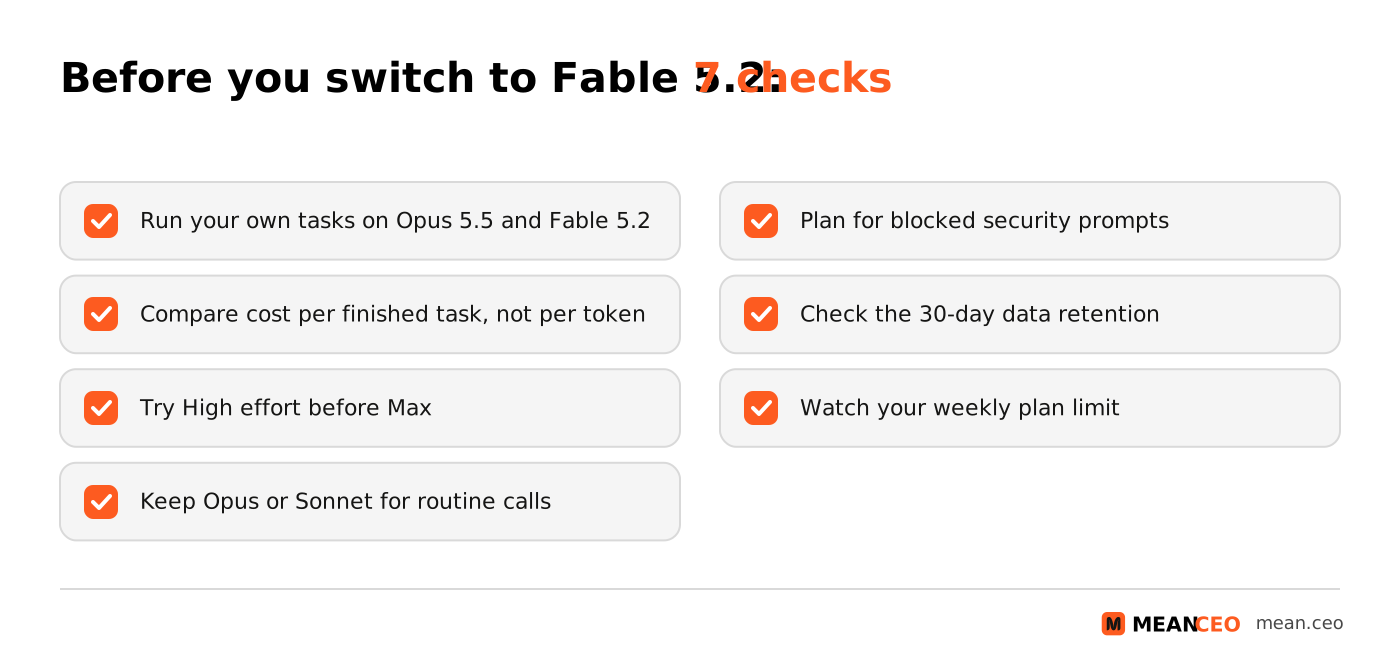
Next steps, in the order I'd take them this week:
- Keep Opus 5.5 as your default. Anthropic says so itself, and Opus costs half as much per token. Move a job to Fable only when Opus at high effort keeps failing it.
- Test on your own work, not on charts. Pick three tasks your team does every week, run them on both models and count finished tasks and dollars, not tokens.
- Start at High effort. Anthropic's own data shows Fable at High matching Opus 5.5's best coding score for about half the cost per task. Max effort is for the hardest jobs only.
- Use Fable as the planner. Let Fable 5.2 orchestrate and let Sonnet 5.5 or Haiku 5.5 do the volume work. Revolut showed how much a cheaper default saves in its self-hosted GLM switch.
- Plan for blocked prompts. If your product touches security testing, expect Fable to hand those queries to Opus 4.8, and build the retry yourself on Bedrock.
- Check your data rules. 30-day retention for safety monitoring is the default. If clients' contracts forbid that, ask about Enterprise Frontier Safeguards before you send their data.
- Budget the weekly limit. On Max and Ultra, Fable can take up to half your weekly usage. Use this week's free resets to test, then decide whether Pro's usage credits or Max fits your team.
For every Claude launch, price change and outage this month in one place, see our Claude news for November 2026. And if you want to see where AI pushes the limits of research, our piece on the Exponential Time Hypothesis claims shows what happens when models start producing proofs people have to check.
Are you getting customers from ChatGPT yet?
More and more traffic is coming from Perplexity, ChatGPT, Grok and other AI tools.
👉 Rank on ChatGPT
FAQ: Claude Fable 5.2
When was Claude Fable 5.2 released?
Anthropic released Claude Fable 5.2 and Claude Mythos 5.2 on 9 November 2026. Fable 5.2 is generally available in the Claude apps, Claude Code and the API, and on Amazon Web Services, Google Cloud and Microsoft Azure.
How much does Claude Fable 5.2 cost on the API?
$8 per million input tokens and $40 per million output tokens, 20% less than Fable 5.1. Fast mode costs $16 and $80, batch processing halves the price, and the model ID is claude-fable-5-2.
What is the difference between Claude Fable 5.2 and Mythos 5.2?
They are the same underlying model. Fable 5.2 has cybersecurity and biology safeguards and is open to everyone. Mythos 5.2 has some of those safeguards removed and is only for vetted organisations in Anthropic's Cyber and Life Sciences Verification Programs.
Is Claude Fable 5.2 better than Opus 5.5?
On most of Anthropic's own benchmarks, yes, with 49.1% against 45.5% on FrontierCode 2.0. Anthropic still recommends starting with Opus 5.5 for most coding and knowledge tasks, because it costs half as much, and moving to Fable for the hardest, open-ended work.
Can I use Claude Fable 5.2 on the Pro plan?
The pricing page lists Fable on Pro as paid with usage credits. During launch week Anthropic says Fable is included for up to 50% of weekly limits on Pro and standard Team seats. Max and Ultra include Fable for up to half the weekly limit, and the Free plan has no Fable.
What happens when Claude Fable 5.2 blocks a request?
High-risk cybersecurity requests are answered by Opus 4.8 instead, and blocked biology requests by Opus 5. On Amazon Bedrock the fallback is not automatic, so your code has to retry on the other model.
About the Author
Violetta Bonenkamp, also known as MeanCEO, is an experienced startup founder with an impressive educational background including an MBA and four other higher education degrees. She has over 20 years of work experience across multiple countries, including 5 years as a solopreneur and serial entrepreneur. Throughout her startup experience she has applied for multiple startup grants at the EU level, in the Netherlands and Malta, and her startups received quite a few of those. She’s been living, studying and working in many countries around the globe and her extensive multicultural experience has influenced her immensely.
