TL;DR: Are OpenAI's models leaving Cursor?
Yes, most likely this week. OpenAI is ending its contract to supply models to Cursor after SpaceX bought the coding tool, with a proposed shutoff date of Thursday 12 November 2026. OpenAI says the date still has to be confirmed by both companies, and that Cursor may end access sooner. After the shutoff you can still use GPT in Cursor's local Chat and Agent with your own OpenAI API key, through the Codex extension, or through a gateway such as Amazon Bedrock or Azure. But your own key won't reach Tab, Auto, Cloud Agents, Automations, the CLI or the API. If any of those run on GPT today, pick a new model before Thursday.
If you write code with Cursor, check your model picker today. In two days, a big part of it may go dark.
OpenAI announced in August that it would stop supplying its models to Cursor, and its proposed shutoff date is this Thursday, 12 November. For most founders the fix takes ten minutes. For anyone who built cloud agents or automations on GPT, it takes a bit of planning. Here's what happens, what still works, and what the split says about building your company on one AI tool.
What happened
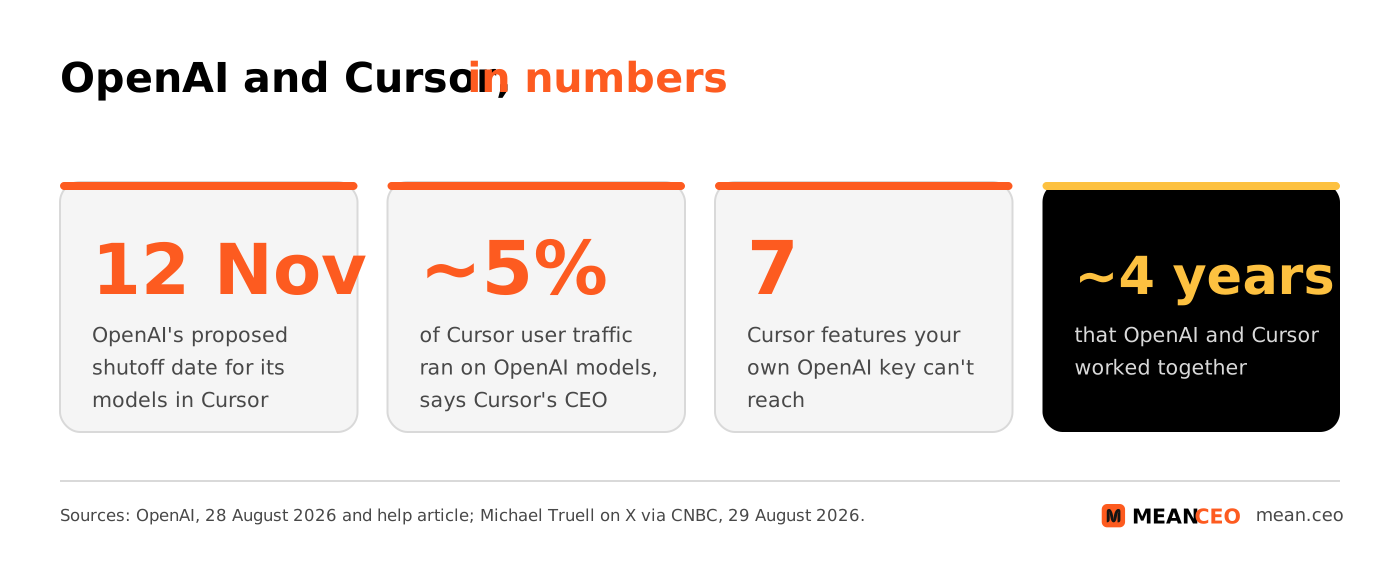
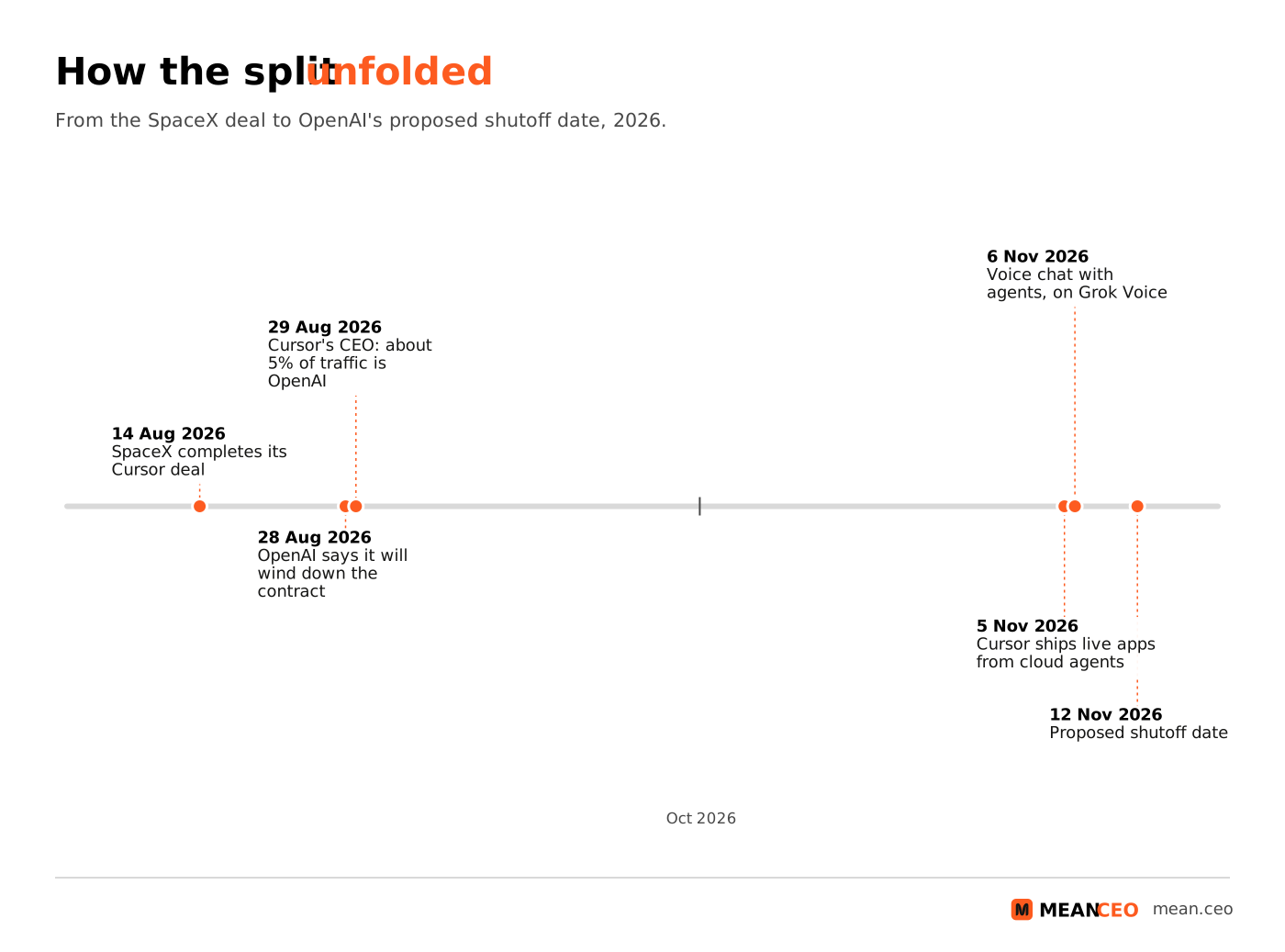
On 14 August 2026, Cursor announced that it had "officially been acquired by SpaceX". Two weeks later, on 28 August, OpenAI published "Our decision on Cursor following its acquisition by SpaceX". It said it had told SpaceX "that we intend to wind down our contract providing OpenAI models to Cursor, with a proposed shutoff date of November 12, 2026."
OpenAI's reason was blunt: "we cannot be confident that SpaceX will use our technology within our terms of service, based on our experience with Elon Musk's companies violating contracts." It said its agreement with Cursor gives it "a limited time window to cancel it after a change of control", and that it was giving "the maximum notice provided by our contract". It also said it will not provide future models to Cursor, naming its upcoming model, Astra. The two companies had worked together for "nearly four years".
Cursor CEO Michael Truell answered on X, as CNBC reported on 29 August: "OpenAI models serve about 5% of Cursor user traffic, and we're speaking with the OpenAI team to resolve this." He added that Cursor had "trusted their platform to be neutral infrastructure for our business." CNBC also quoted a post by Elon Musk on X: "I couldn't care less."
Since then, nothing public has changed. OpenAI's help article on using its models in Cursor, last updated in late October, still says: "We have proposed a transition period of November 12, 2026." It also says "Cursor may choose to end access sooner" and "We will share the official termination date as soon as it is confirmed between both companies." As of 10 November, Cursor's model list still shows GPT-5.6 Sol, Terra and Luna, with no end date, and Cursor hasn't published a blog post or changelog entry about the change. So Thursday is the date to plan for, but it isn't final.
What still works after the shutoff
OpenAI lists three ways to keep using its models inside Cursor. All three only cover local work in the Cursor desktop app:
Sources: OpenAI help article 20001506 and Cursor's model docs, checked 10 November 2026.
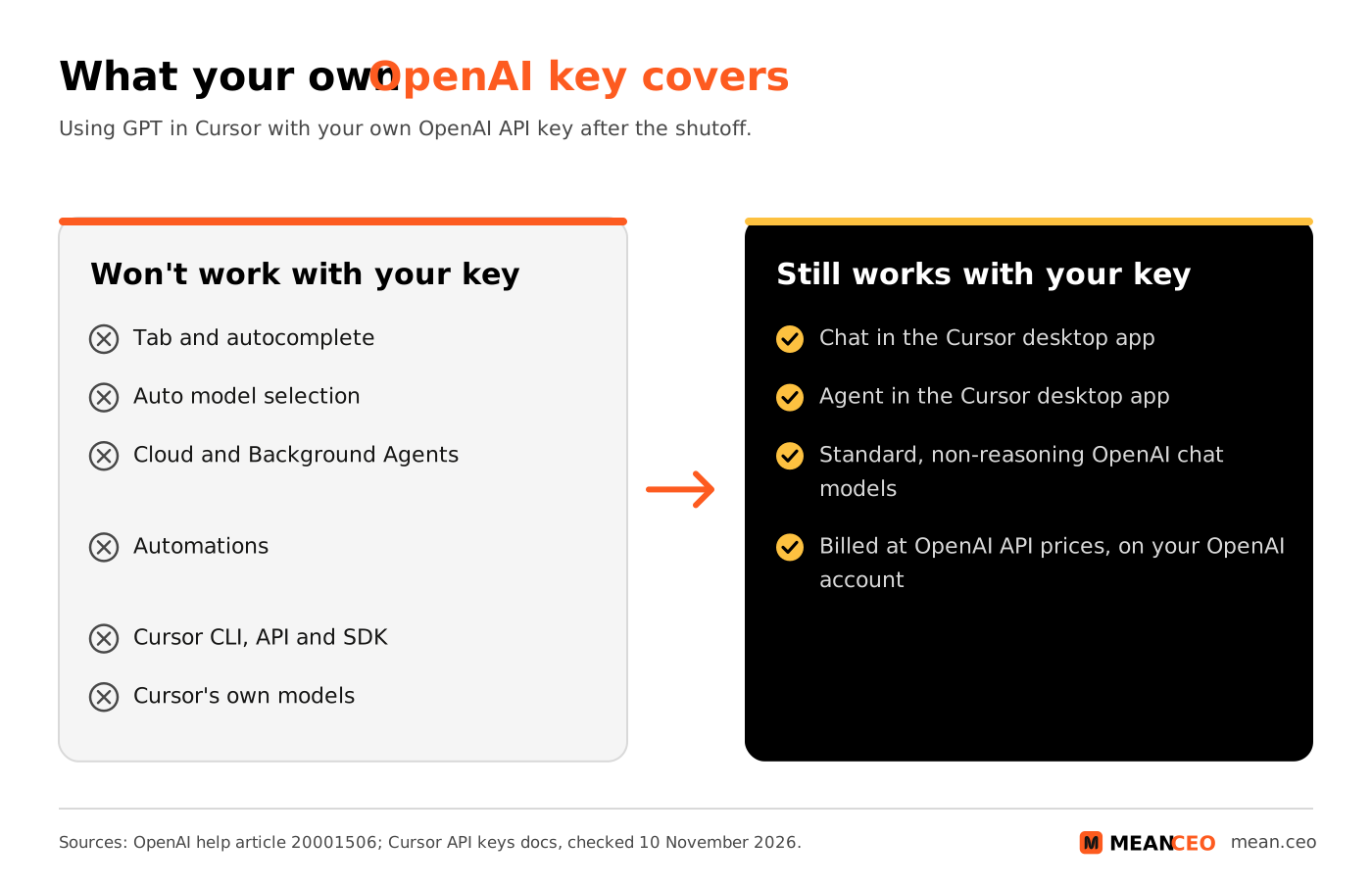
Read the small print before you rely on your own key. OpenAI's help article says Cursor doesn't support your own key in Tab, Auto, Cloud or Background Agents, Automations, the Cursor CLI, or Cursor's API and SDK. Cursor's own docs go further: for OpenAI, your key covers "Standard, non-reasoning chat models" only. And "A ChatGPT subscription does not include OpenAI API usage", so a ChatGPT Plus plan doesn't pay for an API key.
The Codex IDE extension is the other route. It installs in VS Code, Cursor and Windsurf, and it runs as a separate agent next to Cursor's own. A ChatGPT Plus plan at $20 a month includes it. Keep in mind that OpenAI says ChatGPT and Codex will share one usage allowance from December, so heavy coding will eat into your chat limits too. We track updates in our Codex news for November 2026.
Cursor is now sold as part of an X subscription
The bigger change for most solo founders may be the price list. Cursor is now sold by X Subscription Corp, in one plan with Grok and X. Paid plans include a weekly pool of usage for Cursor's own models, Grok and Composer. Third-party models such as Claude, Gemini and GPT aren't part of that pool: on Premium and up, you pay their API list price from prepaid credit.
Source: cursor.com/pricing, checked 10 November 2026. Prices exclude VAT. Older Cursor plans such as Pro and Pro+ "keep working as they are" for existing customers.
In Cursor today, GPT-5.6 Sol costs $4 per million input tokens and $20 per million output tokens on the new plans, paid from prepaid credit. For comparison, Anthropic just cut the price of its top model: Claude Fable 5.2 came out on 9 November and is already in Cursor's model list.
What Cursor shipped the same week
Cursor didn't spend the week before the deadline standing still. On 5 November its changelog announced "Build Live Apps in Cursor": a cloud agent can now build an app, set it up and put it online behind a link. Cursor's apps documentation says it provisions a Postgres database automatically, puts private and team apps behind Cursor sign-in, and lets users on individual plans share apps publicly. When an app needs secrets, Cursor asks for them, and "The agent never sees the values."
Four checks run before every publish, even with the AI security review switched off: they block secrets written into files, block credential files, leave out .env files and remove source maps. That's a direct answer to the kind of mistake behind the Claude Code secrets leak we covered yesterday. Apps are "available on all paid plans with access to cloud agents", which on the new price list means Premium and up. The docs don't say where apps are hosted or what hosting costs.
On 6 November came voice chat with agents: you can talk to an agent in a live call and hear its progress. It runs on Grok Voice, and "With Privacy Mode on, voice chat runs with zero data retention." Put together, Cursor is moving into the space of Lovable, Replit and Bolt, and leaning on its new owner's models while OpenAI leaves. Our Cursor news for November 2026 follows each release.
The European angle: data and contracts
If you sell to European customers, check where your code and prompts go after you switch. Cursor's privacy and data governance page says only US-only data residency can be enrolled in today, for Enterprise customers. "EU + UK inference-only coverage is available on request. Broader EU support and additional regions are in active development."
Bringing your own key changes the picture too. Cursor's docs say your key is sent with every request through Cursor's servers, and "If your team relies on Zero Data Retention, use Cursor's built-in models instead." Each route (your own key, the Codex extension, a gateway) puts a different company between your code and the model. Under the GDPR (Adopted), the companies that process personal data for you should be covered by a data processing agreement and listed in your records. If your repos hold customer data, update that list when you change the route.
What this means for you
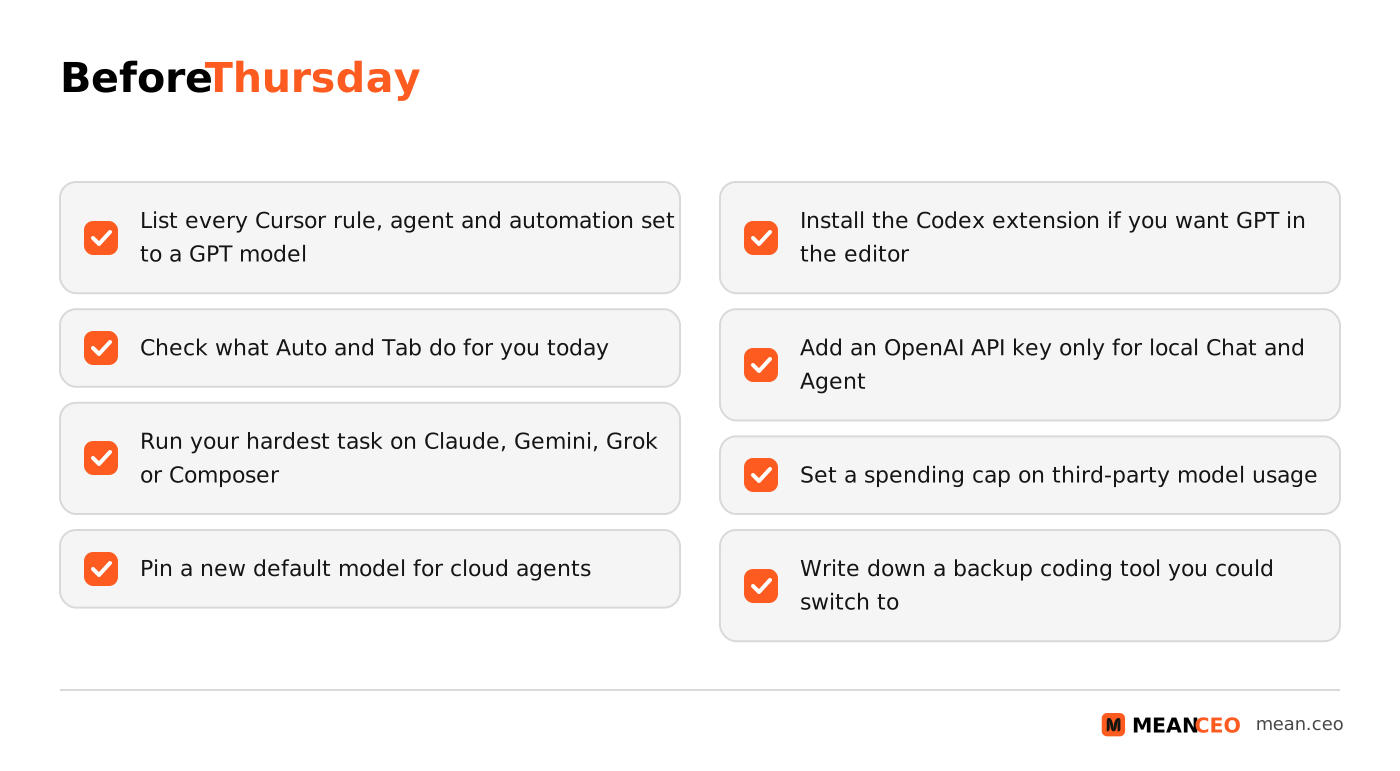
- Find everything that runs on GPT. Look at your Cursor rules, cloud agents, automations and any CLI scripts. Your own key won't rescue the ones that run outside local Chat and Agent.
- Test a replacement on your own work. Take your hardest recent task and run it on Claude, Gemini, Grok or Composer before Thursday, not after. Benchmarks don't tell you how a model handles your codebase.
- Pick the cheapest route that covers what you use. If you only chat with GPT in the editor, your own API key is enough. If you want an OpenAI agent, the Codex extension inside Cursor is simpler. If you need GPT in cloud agents, you need a different tool.
- Set spending caps. On the new Cursor plans, third-party models are billed by usage. A busy week with an agent can cost more than the plan itself.
- Don't build on one model, or one tool. Replit switched Replit Agent's default to OpenAI in October, and Revolut moved its engineers to a self-hosted model to cut costs. Keep your prompts, rules and tests portable so a switch takes an afternoon, not a month.
- Read the extension list, too. Installing the Codex extension means adding another agent with access to your code. After the tampered Claude Code extension on Cursor's marketplace last month, install only from the official publisher.
Analysts saw this coming in August. "Enterprises can no longer assume that a model available through an AI coding platform today will always remain available," Pareekh Jain of Pareekh Consulting told CIO. "Acquisitions, contracts, competition or regulation can change this."
My take: this isn't really a story about GPT. It's about who owns the tools we build our companies with. A year ago, a coding editor felt like neutral ground: you picked the best model, and the editor didn't care. Now Cursor belongs to SpaceX, sells through an X subscription and leans on Grok, while OpenAI pushes its own Codex. Every AI tool you depend on is also a bet on its owner's next fight. That's fine, as long as you know it. Keep your rules and prompts in plain files you control, test a second model every month, and know which tool you'd move to tomorrow. Bootstrapped founders can't afford a week of lost speed because two billionaires stopped talking.
Are you getting customers from AI search yet?
More and more traffic is coming from Perplexity, ChatGPT, Grok and other AI tools.
👉 Rank on ChatGPT
FAQ: OpenAI's models leaving Cursor
When do OpenAI's models leave Cursor?
OpenAI's proposed shutoff date is Thursday 12 November 2026. Its help article says the official date still has to be confirmed by both companies and that Cursor may end access sooner, so plan for this week.
Why is OpenAI leaving Cursor?
SpaceX bought Cursor in August 2026. OpenAI said it "cannot be confident that SpaceX will use our technology within our terms of service", citing its experience with Elon Musk's companies, and used a contract clause that lets it cancel after a change of control.
Can I still use GPT in Cursor with my own API key?
Yes, in Cursor's local Chat and Agent. Cursor says OpenAI keys cover standard, non-reasoning chat models, and your key won't work in Tab, Auto, Cloud or Background Agents, Automations, the CLI or the API. Usage is billed to your OpenAI API account.
Does my ChatGPT subscription cover GPT in Cursor?
Not through an API key: OpenAI says a ChatGPT subscription doesn't include API usage. But a ChatGPT plan does let you use the Codex IDE extension inside Cursor, which runs as a separate agent.
Which models will Cursor still offer?
Cursor's model list includes Claude (Sonnet 5.5, Opus 5.5, Fable 5.2, Haiku 5.5), Gemini, Grok and its own Composer 2.5. On the new X Subscription plans, Grok and Composer use the included usage, and other models are billed at API prices.
Is Cursor still a good choice for European founders?
It can be, but check data handling. Cursor offers US-only data residency to Enterprise customers today and EU and UK inference-only coverage on request. Whatever route you choose, add the provider to your GDPR records. Our report on Revolut's self-hosted coding model shows one way to keep code in-house.
About the Author
Violetta Bonenkamp, also known as MeanCEO, is an experienced startup founder with an impressive educational background including an MBA and four other higher education degrees. She has over 20 years of work experience across multiple countries, including 5 years as a solopreneur and serial entrepreneur. Throughout her startup experience she has applied for multiple startup grants at the EU level, in the Netherlands and Malta, and her startups received quite a few of those. She’s been living, studying and working in many countries around the globe and her extensive multicultural experience has influenced her immensely.
