TL;DR: What did Revolut do with its AI coding tools?
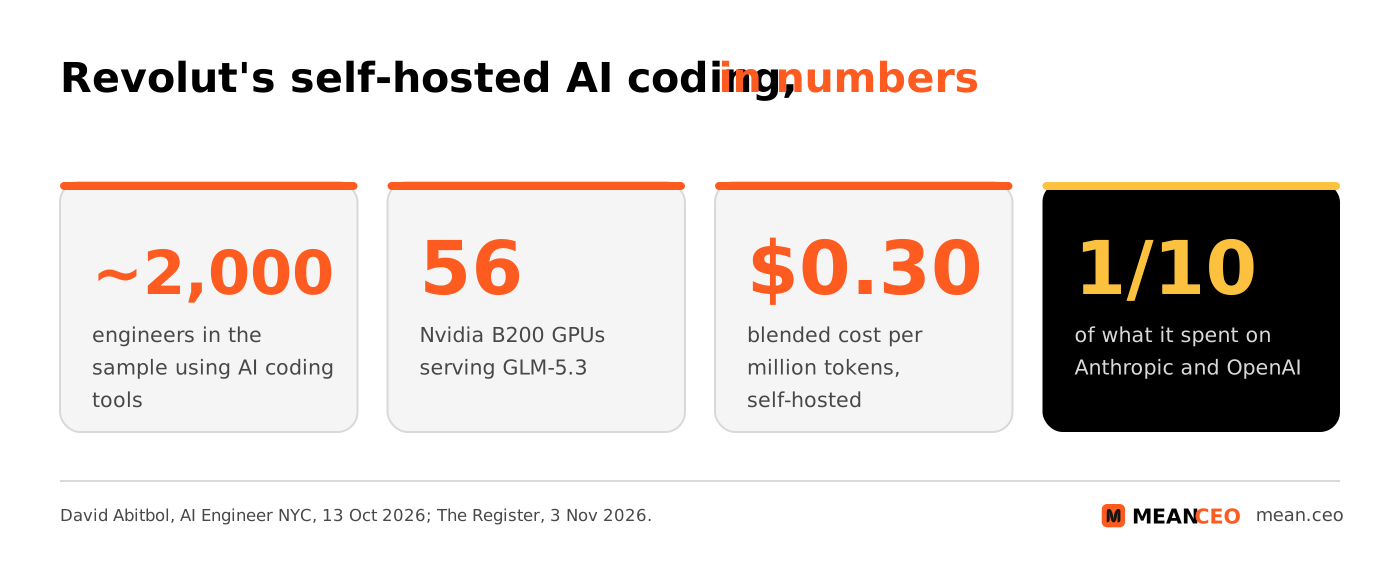
Revolut made a self-hosted open-weight model, Z.ai's GLM, the default AI coding model for its engineers, and kept Claude Code and OpenAI's Codex only "as exception". Its AI operations lead, David Abitbol, said the company serves GLM-5.3 on 56 Nvidia B200 GPUs for a sample of about 2,000 engineers, at a blended cost of 30 cents per million tokens, and that "our invoice is one-tenth of what we were spending on Anthropic and OpenAI". The Register reported it on 3 November 2026. You don't need 56 GPUs to use the lesson: rationed tokens cost you more than tokens do, and open models are now good enough for most daily coding work.
If you pay for Claude Code or Codex, you know the feeling. You save your tokens for the hard bug and do the boring work yourself. Revolut, which Abitbol calls Europe's largest private company, had the same problem at a much larger scale, and it decided to stop paying per token.
Its answer was to run a Chinese open-weight model on GPUs it controls and make the frontier models the exception. Here's what Revolut actually did, which numbers you can trust, what it costs you to copy it on a startup budget, and where the risks are.
What happened
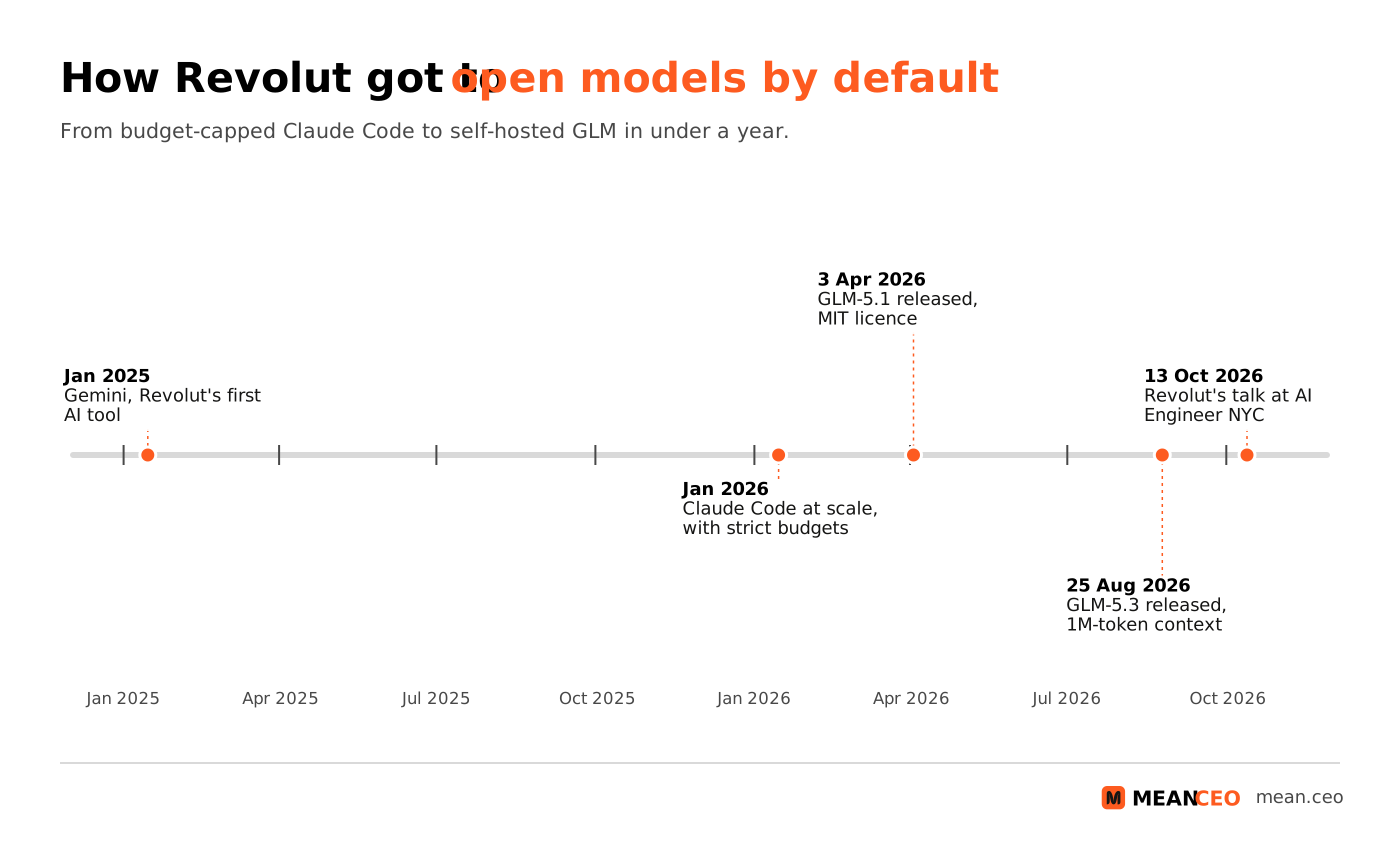
On 13 October 2026, David Abitbol, who leads AI operations at Revolut, gave a short talk called "Shipping like a startup, regulated like a bank" at the AI Engineer conference in New York. On 3 November, The Register reported that Revolut had cut "its AI coding inference costs by roughly 90 percent by making self-hosted models its default instead of relying primarily on commercial services like Claude." The story then spread on Hacker News and LinkedIn.
The key facts from the talk and the article:
- The model. Revolut started with GLM-5.1 and moved to GLM-5.3, both open-weight models from the Chinese lab Z.ai. It serves GLM-5.3 on 56 Nvidia B200 GPUs. "To serve 2,000 engineers, we roughly need 56 B200," Abitbol said.
- The cost. "Self-hosting GLM, our blended cost of token is 30 cents per million. And so our invoice is one-tenth of what we were spending on Anthropic and OpenAI."
- The tools. Engineers reach the model through OpenAI-compatible endpoints, from tools such as OpenCode and the Codex app, according to the talk.
- The frontier stays. "We keep using Codex, Claude Code," Abitbol said, "but we keep them as exception." GLM is text-only, so a router sends image work to models like Gemini or GPT Luna, The Register reported.
Status: this is Revolut's own account from one conference talk. Revolut hasn't published a blog post or a separate company statement, and all numbers are self-reported.
Why Revolut switched: rationed tokens were the real cost
The interesting part isn't the GPUs. It's why Revolut started looking. Revolut first brought in Gemini in January 2025 and launched Claude Code at scale in January 2026, Abitbol said in the talk. "We were highly skeptical about the cost of AI. We were seeing engineers spend $1,000 a month, $10,000 a month with not so much ROI, and so when we launched it we launched it with strict budget limits," Abitbol said.
Those limits changed how people worked. Engineers saved their tokens for the hardest coding tasks. Once tokens were cheap, they used AI for the work around the code, and that's where Abitbol says the biggest gains came from: debugging, Jira tickets and Confluence pages. "When you have unlimited tokens, you're free to do that," he said. "You no longer have to save your tokens for the end of the quarter or the most difficult task."
Revolut reports a 60% improvement in coding time and a 70% improvement in lead time across its AI coding rollout. Treat those numbers with care: the conference's own talk page notes that the internal comparison "does not isolate the model change from other causes."
This is the same squeeze we described in our analysis of why AI token bills keep rising: prices per token fall, but agent workloads grow faster. Revolut's fix was to swap a variable bill for a fixed one. In Abitbol's words: "The billing is flat, we don't have any bill shock at the end of the month, and the frontier is the exception."
Sources: David Abitbol's talk at AI Engineer NYC (13 October 2026) and The Register (3 November 2026).
Why 30 cents isn't the price you'll pay
Be careful with the headline number. The $0.30 is Revolut's blended internal cost per million tokens: what its own GPUs cost divided by the tokens its 2,000 engineers push through them. It's not a price anyone sells, and it's not split into input and output like the vendors' list prices.
Here's what the public API prices look like. On Z.ai's pricing page, GLM-5.3 costs $1.40 per million input tokens and $4.40 per million output tokens. Anthropic's pricing lists Claude Opus 5.5 at $4 and $20, and Sonnet 5.5 at $2 and $10. OpenAI's pricing lists GPT-6.1 Sol at $2 and $10, GPT-6.1 Terra at $1 and $5, and GPT-5.3 Codex at $1.75 and $14.
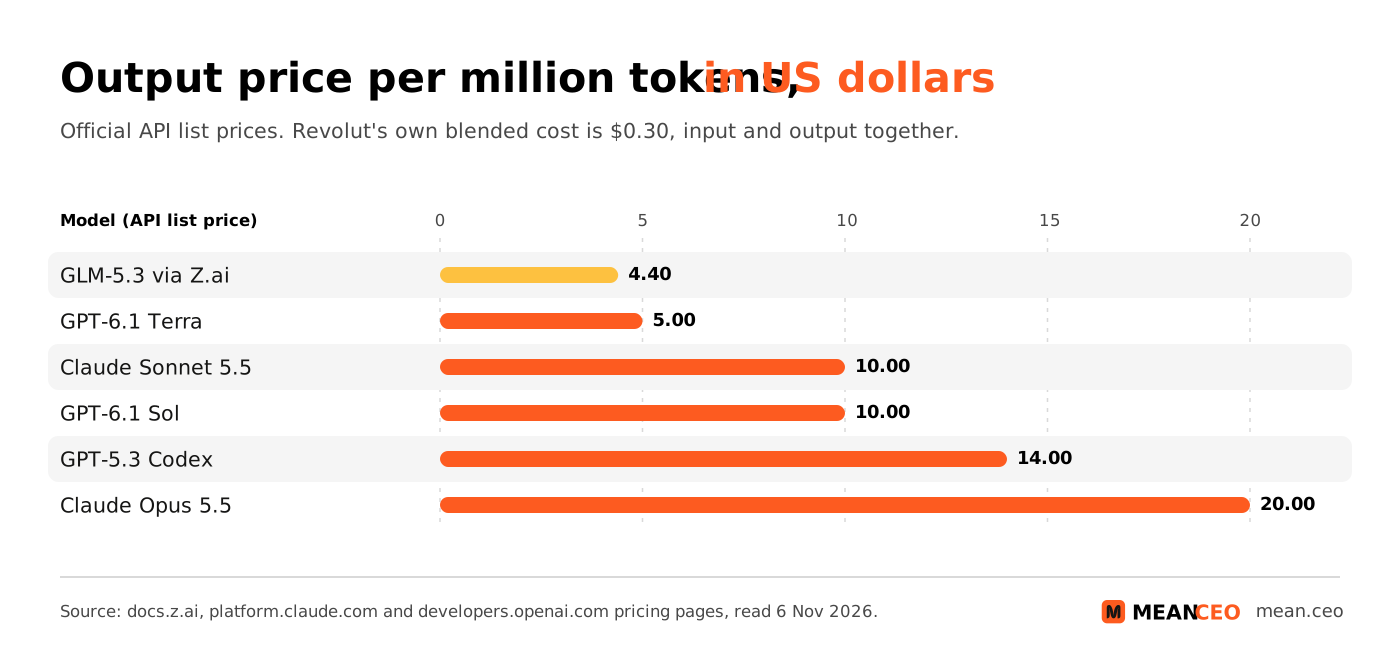
Sources: official pricing pages of Z.ai, Anthropic and OpenAI, read 6 November 2026; Revolut's figure from the AI Engineer NYC talk. Standard prices, before caching and batch discounts.
So a small team can't get 30 cents. What it can get is a hosted open model that's several times cheaper per output token than the top closed models, with no GPUs to run. The 30 cents only shows up at Revolut's scale, where 56 GPUs stay busy all day. A 56-GPU cluster sitting idle for a five-person startup would cost far more than any subscription.
What you need to know about GLM
GLM-5.1 went up on Hugging Face on 3 April 2026 under the plain MIT licence, with about 754 billion parameters, according to its model card. The Register reports that only about 40 billion are active for each token, and that the weights alone need roughly 380 GB of GPU memory. GLM-5.3 followed on 25 August 2026, with a one-million-token context window.
The licence changed with 5.3. The GLM-5.3 License is MIT-style, but adds one condition: if a company runs a "Model as a Service" business and its group revenue tops $10 billion over any 12 months, it "must pass Z.AI's security review before using the Software or its derivative works for any commercial purpose." That won't touch a bootstrapped startup. It's still a reminder to read the licence of every open model you build on, because they change between versions, as Mistral's did with Large 4.
Two tuning lessons from the talk apply to anyone running a model. First, "Long context is a scam," Abitbol said. "Even though you can serve one million tokens, 256 [thousand] is really what you need." Second, Revolut got its biggest gains by tuning the GPUs it already had, with NVFP4 quantization and split prefill and decode, not by buying more.
The China question
GLM comes from a Chinese lab, and Revolut is a regulated bank. Abitbol's view, as The Register reports it, is that the main privacy and security worry is using Chinese models through APIs running out of China. When the weights run on-premises or on regional cloud servers, he says, there's really nothing to worry about. "You're just getting the weights and putting them on a US-based service," he said in the talk.
He also described the controls that make this acceptable to a regulator: "because we're an EU-regulated bank, we fall under the most strict regime in terms of compliance." Agents run in sandboxes with tight command rules, for example "allow grep but not gradle". That, he said, gives "confidence to your regulator that it's not an autonomous agent". The talk page notes these comments describe Revolut's own situation, not general legal advice.
Not everyone is convinced. Hirundo, a company that sells AI safety tools, published its own test on 3 November using GLM-5.3-Flash through OpenRouter, not Revolut's setup. It reported that account-recovery code was 28% more likely to be open to takeover when the repository named Revolut than when it named WeBank, a Chinese digital bank. That's a vendor's study, not peer-reviewed, but it's a good reason to keep code review strict whatever model writes the code.
There's also a supply risk. China has drafted export controls on its biggest AI models, as we covered in our post on China's AI export rules. Published open weights are exempt in that draft, but rules can change. And in October, Cohere said Alibaba's Qwen model tried to upload a file to a Beijing cloud bucket during an agent test, which we wrote up in our post on the Qwen upload incident. Self-hosting doesn't remove the need for a sandbox.
What this means for you
- Measure what rationing costs you. If you or your team skip AI for debugging, tickets and docs to save tokens, that's lost time. Track weekly token spend and the tasks you don't hand to AI because of limits. Our guide to evaluating AI tool ROI helps you put a number on it.
- Don't self-host at startup scale. Revolut's 30 cents depends on 2,000 engineers keeping 56 GPUs busy. For a small team, a hosted open model through an OpenAI-compatible API gives you most of the saving with none of the operations work.
- Make cheap the default, frontier the exception. Point your everyday coding tool at an open model for routine work, and keep Claude or GPT for the hard problems and image tasks. If you're weighing plans, our breakdown of the Claude Ultra plan and our post on the ChatGPT and Codex shared limit show what the subscriptions now include.
- Check where the model runs. Abitbol's rule was simple: the weights can come from anywhere, but your code and data should only go to servers in places you trust. Ask any API provider where it hosts the model and whether it keeps your prompts.
- Sandbox every coding agent. Allow-list the commands it can run and review its pull requests like a junior's work. That applies to Claude and GPT too.
- Keep a switchable stack. Tools that speak the OpenAI-compatible API let you change models in minutes. Our AI tool stack for solo founders lists options, and we track every change in our AI news for November 2026.
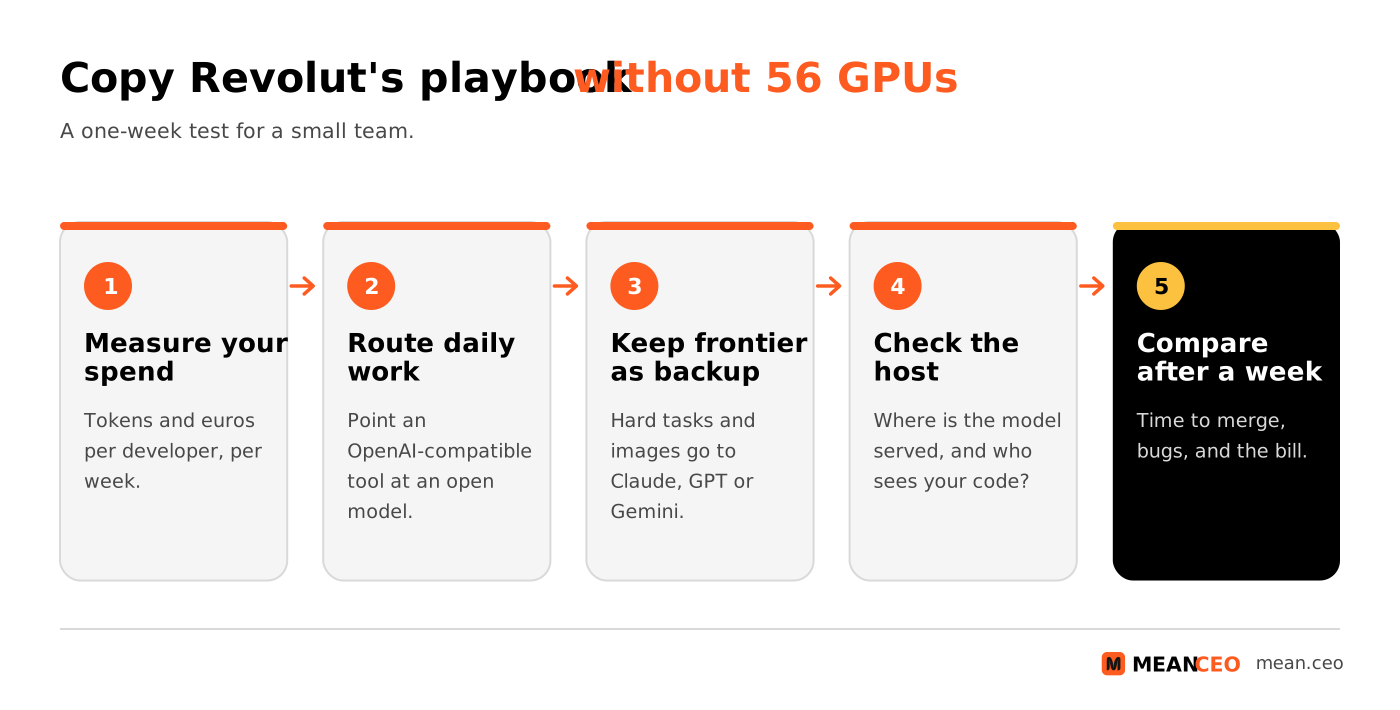
My take: the most useful line in this story isn't the 90%. It's that Revolut's engineers were saving tokens "for the end of the quarter". If a company worth billions rationed AI, your startup probably does too, and that hidden tax is bigger than your subscription. You won't rent 56 GPUs. But you can do what Revolut did at small scale: make a cheap model the default, keep the best model for the hard 10%, sandbox both, and check the bill after a month. Open models have caught up enough that paying top prices for every keystroke is now a choice, not a necessity.
Are you getting customers from AI search yet?
More and more traffic is coming from Perplexity, ChatGPT, Grok and other AI tools.
👉 Rank on ChatGPT
FAQ: Revolut, GLM and self-hosted AI coding
Did Revolut stop using Claude Code?
Not completely. Revolut made self-hosted GLM its default AI coding model and keeps Claude Code and OpenAI's Codex "as exception", according to its AI operations lead David Abitbol. Image tasks go to models like Gemini or GPT Luna.
Which model does Revolut use for AI coding?
GLM-5.3 from the Chinese lab Z.ai, after starting with GLM-5.1. It serves the model on 56 Nvidia B200 GPUs for a sample of about 2,000 engineers.
How much did Revolut save on AI coding?
Abitbol said its invoice is one-tenth of what it spent on Anthropic and OpenAI, with a blended cost of 30 cents per million tokens. The Register describes it as a cut of roughly 90%. These are Revolut's own figures.
How much does GLM-5.3 cost through an API?
On Z.ai's own API, GLM-5.3 costs $1.40 per million input tokens and $4.40 per million output tokens, according to its pricing page on 6 November 2026. GLM-5.3-Flash costs $0.15 and $0.50.
Is GLM open source?
The weights are open. GLM-5.1 uses the MIT licence. GLM-5.3 uses its own licence that is MIT-style but requires Model as a Service companies with more than $10 billion in group revenue to pass Z.AI's security review before commercial use.
Is it safe for a European startup to use a Chinese open model?
It depends on where it runs and what it can touch. Revolut's view is that the main risk is calling APIs hosted in China; it runs the weights on servers in trusted regions and sandboxes its agents. Review the code it writes as strictly as any other code.
About the Author
Violetta Bonenkamp, also known as MeanCEO, is an experienced startup founder with an impressive educational background including an MBA and four other higher education degrees. She has over 20 years of work experience across multiple countries, including 5 years as a solopreneur and serial entrepreneur. Throughout her startup experience she has applied for multiple startup grants at the EU level, in the Netherlands and Malta, and her startups received quite a few of those. She’s been living, studying and working in many countries around the globe and her extensive multicultural experience has influenced her immensely.
