TL;DR: What do the numbers in Anthropic's public S-1 tell founders?
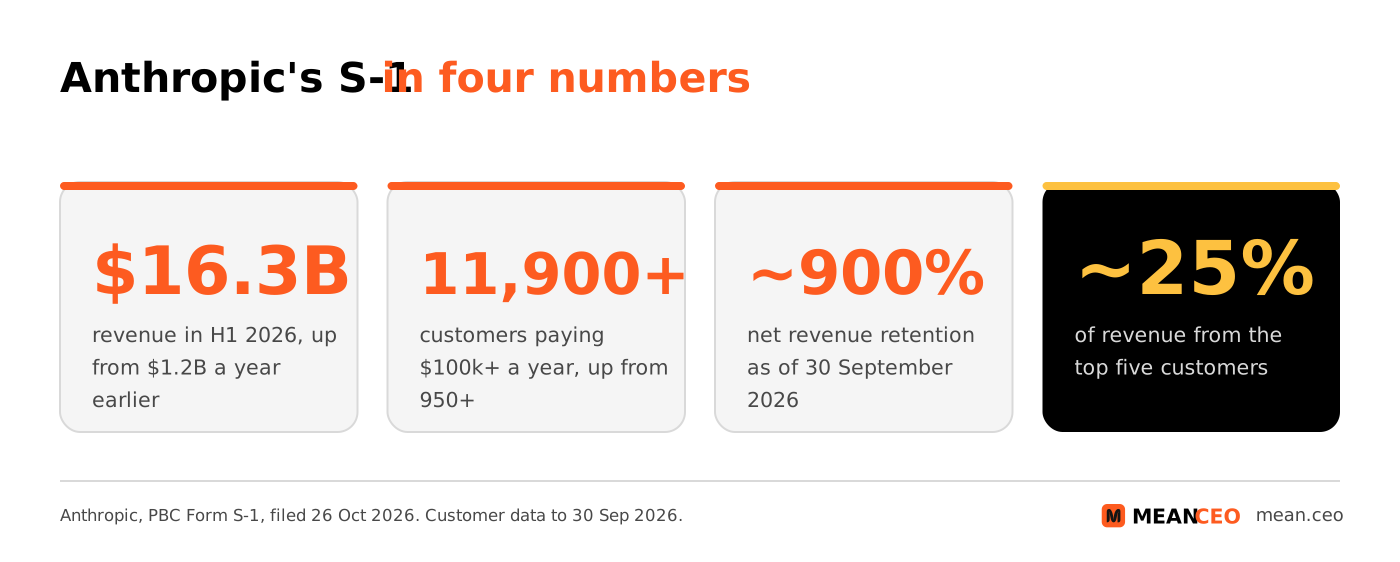
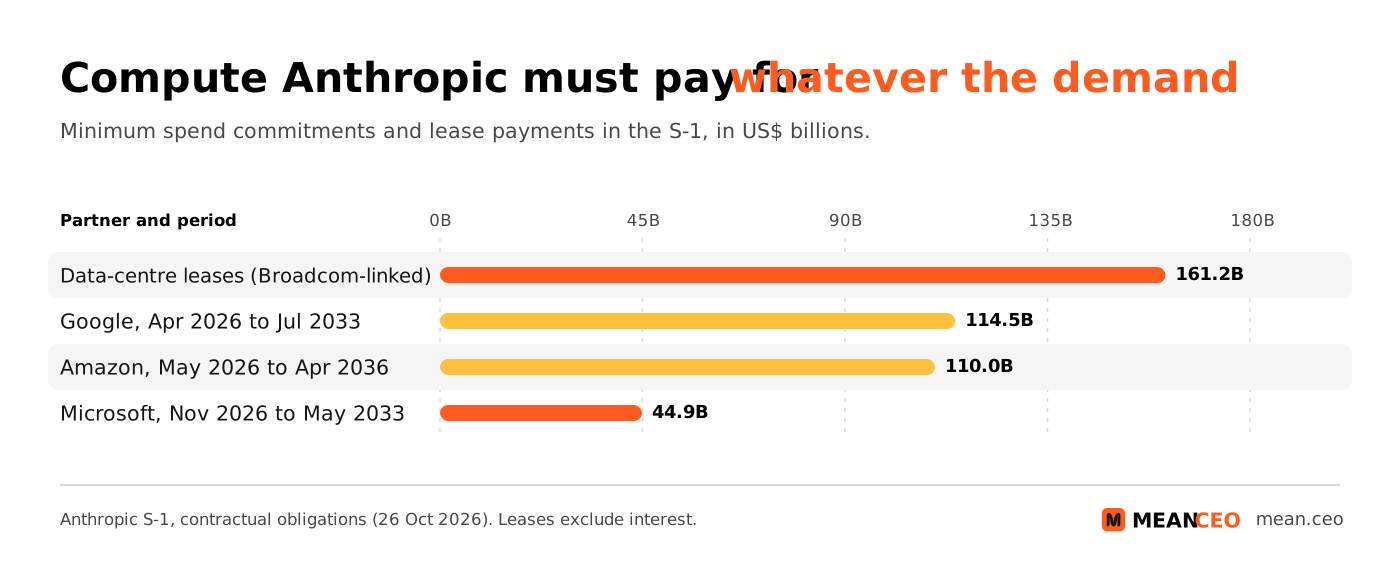
On 26 October 2026, Anthropic filed its public S-1 to list on Nasdaq under the ticker ANT. It made $16.3 billion in revenue in the first half of 2026, up from $1.2 billion, and more than 11,900 customers now pay it $100,000 or more a year, up from more than 950. The filing also says "a significant portion" of its customers are startups and tech companies that may cut spending in a downturn, that newer models cut the cost per task by about 25% to 40%, and that Anthropic has committed to more than $400 billion of compute and data-centre payments (our sum of the S-1 figures). For founders on Claude, that adds up to a supplier that needs your usage, will keep cutting prices to win it, and can't afford to lose you to cheaper models.
A week ago we wrote about the leaked draft of Anthropic's IPO filing, and yesterday we went through the S-1 risk factors that matter if you build on Claude: rate limits, model retirement, compute limits and the rest. This piece is about the other half of the filing, the numbers.
Who pays Anthropic, how much, from where, and what it has promised to spend tell you more about where Claude's prices and products are heading than any launch post. Here's what the public filing adds, what it means for startups that build on Claude, and what I'd do this week.
What happened
On Monday 26 October 2026, Anthropic, PBC filed its Form S-1 registration statement with the US Securities and Exchange Commission. It has applied to list its Class A shares on the Nasdaq Global Select Market under the symbol "ANT". The price range and share count are still blank. The cover lists 22 banks, led by Goldman Sachs and Morgan Stanley.
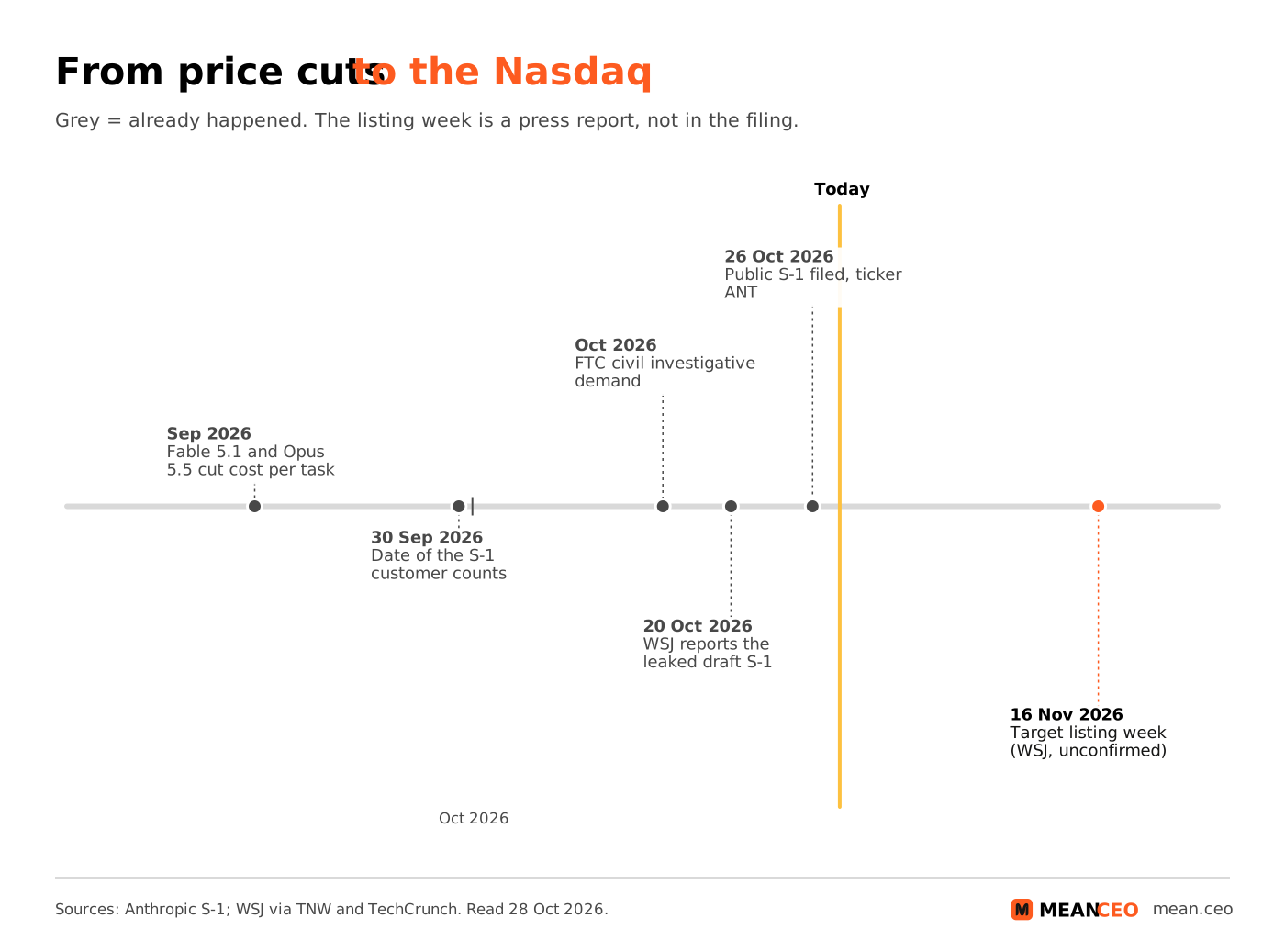
The filing does not give a date or a valuation. According to TNW, which cites the Wall Street Journal, Anthropic aims to list in the week of 16 November and could raise $100 billion or more at a valuation of $1.5 trillion to $2 trillion. TNW says it has not verified that report, so treat those numbers as press reports, not facts.
This is the follow-up to our story on the leaked draft S-1. Two things changed. The headline numbers from the leak, $16.3 billion of first-half revenue and an $80.7 billion net loss, are now confirmed. And the public version adds details the leak didn't have: customer counts, revenue by region, the exact compute commitments and the wording of the risks. The governance is new too: a single Class F share, issued to a company owned by the seven co-founders, will carry 50.1% of the votes, and our sister site looks at what Anthropic's founder-control structure teaches startup founders.
The numbers that matter
Source: Anthropic S-1, 26 Oct 2026. The 28% is our calculation from the S-1 revenue table, which splits revenue by the customer's billing address.
Three details stand out for builders. First, the business is profitable at the operating level now: Q2 showed an 8% operating margin, and the huge net loss is almost all a change in the value of convertible notes and similar instruments, not cash burned on running Claude. Second, the customer base is broadening. In the S-1's words, "Approximately 79% of our revenue came from customers outside of our top five customers for the three months ended September 30, 2026, up from approximately 64% for the three months ended March 31, 2026." No single customer is above 10%.
Third, Anthropic itself is cautious about the curve: "We do not expect our revenue will continue to grow at comparable rates, and we cannot assure you that it will continue to grow at all." A company that needs to fill this much committed compute will keep fighting hard for your usage. That usually means more price cuts and more products.
Startups are named as a risk
Here's the line most founders will notice: "A significant portion of our customer base consists of startups and technology-oriented enterprises that may be more sensitive to adverse macroeconomic conditions and may reduce or delay spending during a downturn."
Put simply, Anthropic's revenue depends a lot on companies like yours. That cuts both ways. It means startups matter to Anthropic, which is why you see credits, cheaper models and fast product releases. It also means that when money gets tight, Anthropic expects startups to cut first, and it plans its business with that in mind.
The filing also shows how much Claude Code is worth to Anthropic. In the three months to 30 September, Claude Enterprise users who didn't use Claude Code spent less than $75 a month on average, "while the top 5% of Claude Enterprise users who used Claude Code spent approximately 20 times that amount." Coding agents are where the money is, so expect most new features, and most pricing experiments, to land there first.
Who pays Anthropic: the customer tiers
The public filing breaks out customers by how much they spend a year. It gives a year-earlier comparison only for the $100,000 tier.
Source: Anthropic S-1, 26 Oct 2026. Tiers are based on trailing 12-month revenue.
Add the net revenue retention of about 900% and the picture is clear: most of the growth comes from existing customers using far more Claude, not from new logos. That is exactly how a startup's AI bill grows too, one agent feature at a time.
The risk section explains how Anthropic plans to keep that usage. It says it has changed and may change "usage limits, rate limits, or model and product capabilities", may move to "outcome or task-based pricing", and "may from time to time compete with enterprise software and application companies in select categories." We unpacked each of those in our S-1 risk factors breakdown.
The good news: cost per task keeps falling
The S-1 also puts numbers on the price war. "With the release of Claude Fable 5.1 in September 2026, we reduced the cost of typical workloads by approximately 25% compared to Fable 5, with savings of up to 45% for complex coding and highly agentic tasks." And with Opus 5.5 "that same month, we reduced customers' cost per task by approximately 40% compared to Opus 5." Anthropic says the savings came from a mix of lower prices and better efficiency, and that it kept its margins.
It also admits that cheaper rivals matter. The S-1 warns that customers may "shift usage to lower-priced models", and that open-weight models may take part of the market "for certain use cases". That's your leverage. We tracked how fast prices are moving in our report on the October AI price war, and the S-1 suggests it isn't over.
The Europe angle
- About 28% of revenue comes from outside the US. The S-1 splits revenue only into United States and International, by billing address, so there's no Europe figure. It says Anthropic has "international offices in Europe and Asia-Pacific" without naming countries.
- EU rules are listed as risks. The filing names "the EU AI Act, NIS2, the EU Digital Services Act, the UK Online Safety Act 2023, and the EU Data Act" among rules that "often provide for substantial penalties". All five are Adopted laws. The S-1 also notes that the AI Act requires providers of general-purpose AI models with systemic risk to report serious incidents "without undue delay to the AI Office".
- Data retention is a live issue. The S-1 says its safety framework "has required and may continue to require monitoring and retention incompatible with ZDR for certain model classes", where ZDR is zero data retention. Anthropic says this has led some customers "to migrate to other providers". If you promise European clients that their prompts are never stored, check which models and contracts that promise actually covers.
- Europeans can buy in. The offering includes public offerings in "certain member states of the European Economic Area", Switzerland and the UK, with a separate European retail prospectus. The filing doesn't name the EEA countries. This is not investment advice; read the prospectus if you're curious.
The S-1 also discloses that "In October 2026, the FTC issued a civil investigative demand to us seeking information about our consumer protection, data protection, and privacy practices, as well as the safety and security of our products." That's a US probe, but it touches the same data questions European clients ask you about. Our story on Claude API user profiles covers how Anthropic can now act on one of your end customers instead of your whole account.
The VC payday is a separate story. TechCrunch reports that at the $965 billion private valuation no venture firm holds 5%, and that Amazon is likely the biggest winner. For every other Anthropic update this month, see our Anthropic and Claude news for October 2026.
What this means for you
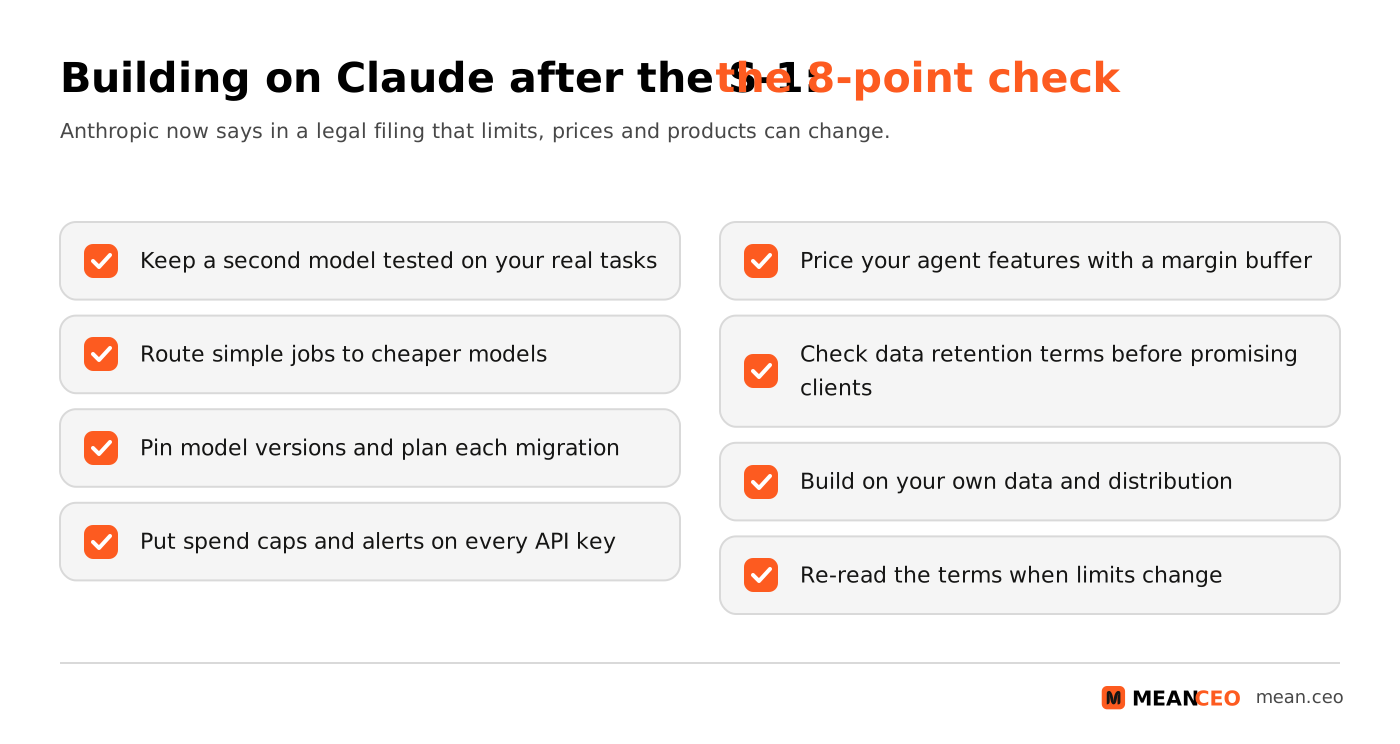
- Keep a tested plan B. A supplier with $16.3 billion of half-year revenue will still change limits and products to fit its own plans. Run your real prompts on a second model every month and keep the results, so switching is a config change. Our guide to evaluating AI tools has a scoring sheet. Replit's switch to OpenAI as its default shows how quickly a big customer can move.
- Route by job. If cost per task drops 25% to 40% with each release, the cheapest setup is several models: a small one for simple steps, a frontier one only where it earns its price.
- Re-run your cost maths every release. A 40% cheaper task can turn a loss-making feature into a profitable one. Recalculate your unit costs whenever Anthropic ships a new model, and pass part of the saving on if a rival is pricing you out.
- Price agent features with a buffer. If Anthropic moves to outcome or task-based pricing, your costs per customer can jump or fall. Don't sell unlimited agent runs at a flat price you can't adjust.
- Build what Anthropic won't. "Select categories" will most likely mean broad, horizontal tools like coding, office work and chat. Your own customer data, a niche workflow and a distribution channel are much harder for a platform to copy.
- Follow Claude Code closely. That's where Anthropic makes the most from each user, so changes to its limits and pricing will likely show up there first.
Are you getting customers from AI search yet?
More and more traffic is coming from Perplexity, ChatGPT, Grok and other AI tools.
👉 Rank on ChatGPT
FAQ: Anthropic's S-1 numbers
When did Anthropic file its public S-1?
On Monday 26 October 2026. Anthropic, PBC applied to list its Class A shares on the Nasdaq Global Select Market under the ticker ANT. The price range and the number of shares are still blank in the filing.
When will Anthropic go public?
The filing gives no date. TNW, citing the Wall Street Journal, reports a target of the week of 16 November 2026 and says the timing could change. TNW did not verify the report.
What does the S-1 say about startups?
It says "a significant portion" of Anthropic's customers are startups and technology-oriented enterprises that may cut or delay spending in a downturn. That makes startups both important to Anthropic and a revenue risk it has to disclose.
How many customers does Anthropic have?
The S-1 doesn't give a total. As of 30 September 2026, more than 11,900 customers paid Anthropic $100,000 or more over the previous 12 months, up from more than 950 a year earlier. More than 1,900 paid $1 million or more and about 250 paid $10 million or more.
How much revenue does Anthropic make?
$16.3 billion in the first half of 2026, up from $1.2 billion a year earlier, and $11.6 billion in Q2 2026 alone. About 80% comes from usage-based fees and 20% from subscriptions. The first-half net loss of $80.7 billion is mostly a $72.4 billion accounting charge.
Did Anthropic cut Claude prices?
Yes, per task. The S-1 says Claude Fable 5.1 cut the cost of typical workloads by about 25% versus Fable 5 (up to 45% for complex coding and agentic tasks), and Opus 5.5 cut cost per task by about 40% versus Opus 5.
About the Author
Violetta Bonenkamp, also known as MeanCEO, is an experienced startup founder with an impressive educational background including an MBA and four other higher education degrees. She has over 20 years of work experience across multiple countries, including 5 years as a solopreneur and serial entrepreneur. Throughout her startup experience she has applied for multiple startup grants at the EU level, in the Netherlands and Malta, and her startups received quite a few of those. She’s been living, studying and working in many countries around the globe and her extensive multicultural experience has influenced her immensely.
