TL;DR: Which Anthropic S-1 risk factors matter if you build on Claude?
Anthropic's public IPO filing of 26 October 2026 spends about 90 pages on risk factors, and a handful of them describe things that can happen to your product: usage and rate limits that change, older models retired, Fable 5 and Mythos 5 switched off for every customer in June 2026 under US export rules, demand that outruns compute, a March 2026 outage, Anthropic competing with its own SaaS customers, and an estimated 5% to 7% of revenue coming from customers who broke the usage policy. Some contracts include IP indemnity with no cap. Read them as a vendor-risk list, keep a second model tested and get your terms in writing.
The Anthropic S-1 risk factors are the most honest document Anthropic has ever published about what can go wrong for the people who build on Claude. Here is what happened with the Anthropic IPO filing, the numbers and the founder-control structure, on our sister site. This piece reads the risk section the way a CTO reads a vendor contract: what can break, what has already broken, and what to change in your stack this month. A week ago we covered the leaked draft of Anthropic's IPO filing; the public version now lets us quote the company's own words.
Which Anthropic S-1 risk factors touch your product?
Can Anthropic change your rate limits or retire your model?
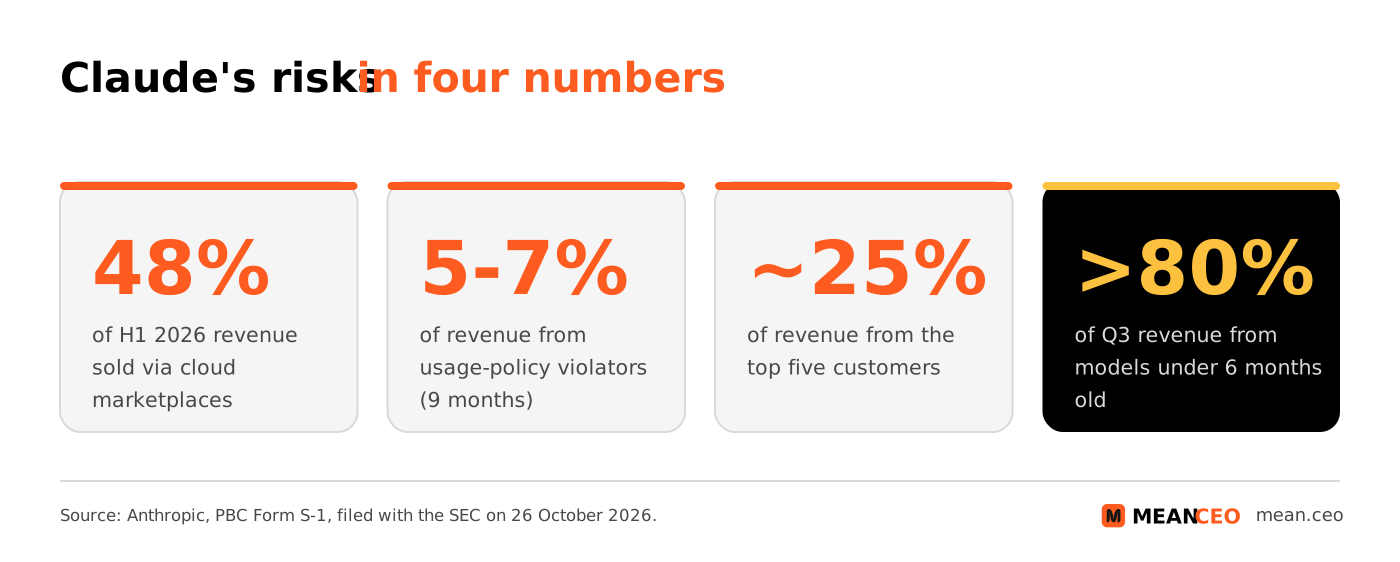
Yes, and the filing says it has done the first already. In its words: "We have also changed, and may in the future change, usage limits, rate limits, or model and product capabilities", and some of those changes led to "claims that our disclosures regarding model access or capabilities were inadequate or misleading." The S-1 also mentions several proposed class actions alleging that Claude subscription plans were marketed in a misleading way. Subscriptions come with usage limits that reset over short periods, so anyone running a business on a Pro or Max seat instead of the API is on the terms Anthropic can adjust most easily.
On retirement, the filing lists "accelerated or forced deprecation" as a risk that can cause customer losses and disputes, and it adds a twist: safety, alignment and model welfare considerations "may lead us to limit or delay the deprecation of older models". What it doesn't contain is a notice period. And customers move fast anyway: models released in the six months to 30 September made up over 80% of third-quarter revenue. If your prompts are tuned to one model version, plan every migration as a release of its own, with a regression test set.
What happened when export rules switched off Fable 5 and Mythos 5?
This is the risk factor nobody outside Anthropic was talking about. In June 2026 the US Department of Commerce imposed worldwide export restrictions on Fable 5 and Mythos 5. Anthropic says it "disabled Fable 5 and Mythos 5 for all of our customers" to comply, while its other models kept running. Both came back after Anthropic updated its safeguards with the US government and the restrictions were lifted, and the filing warns that similar controls "could recur, could remain in place longer, or could extend to additional models or capabilities."
If your product calls the top model tier, that's a single point of failure you can't negotiate away. Keep a fallback on a lower tier or another vendor that you've actually tested, and don't promise customers a specific model by name in your contract. China is moving the same way with its own draft export controls on its biggest AI models, so open-weight Chinese models carry a version of this risk too.
Is there enough compute for every Claude customer?
Not always, by Anthropic's own account. The S-1 says the company has "consistently operated in a compute-constrained environment where customer demand exceeds available compute" and that it has "significantly underestimated" its compute needs before. Most compute is booked 12 to 18 months ahead, and short-term top-ups cost more per unit. In March 2026 a fast jump in usage and compute constraints contributed to an outage and periods of degraded performance, and the filing names new model launches and deployments as other causes of interruptions.
The filing gives no availability percentage and no service-credit terms. So build as if peaks will hurt: log every 429 and 529 error, queue non-urgent jobs, and send overflow to a second model. The Revolut outage caused by a Google Cloud power failure showed what one provider's bad day does to a product with no plan B.
Why do AWS, Google and Microsoft matter so much to Claude?
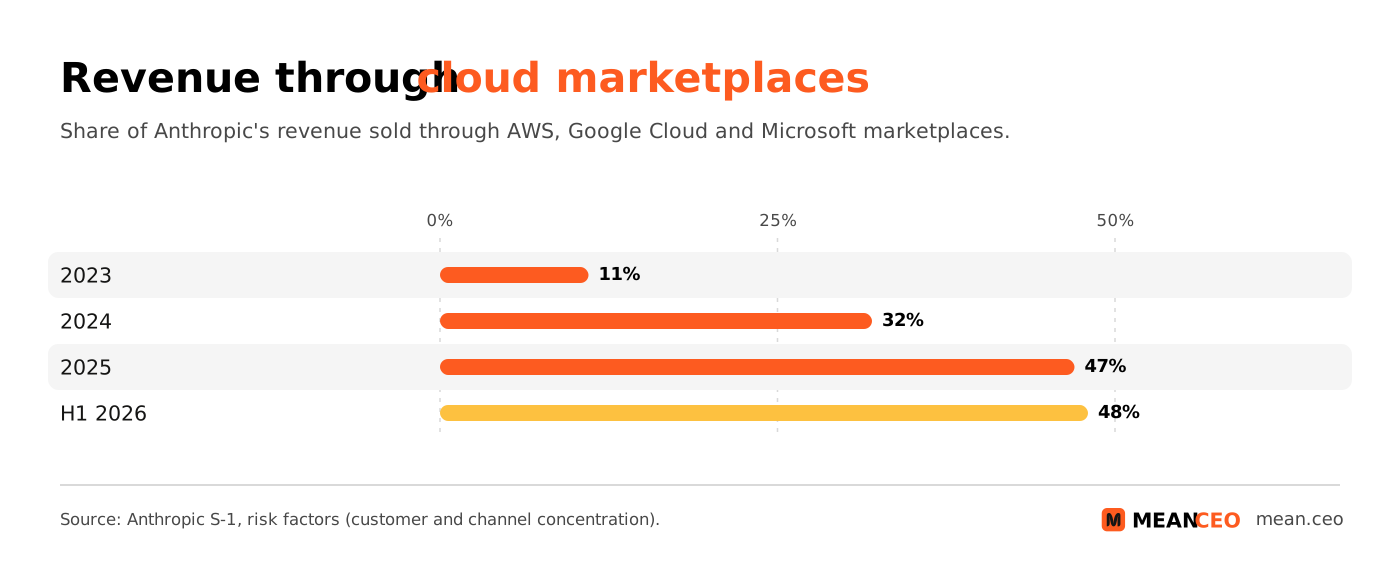
Anthropic relies on Amazon, Google and Microsoft for compute, and the same three companies sell Claude through their marketplaces, buy it for their own products and compete with it. The S-1 says that position gives them "visibility into our pricing and commercial terms" and may affect their incentives on pricing, compute allocation and service quality. Customers on Bedrock, Vertex AI or Azure get the same service as on Anthropic's own API, and there is no option to download and host Claude yourself. For you, buying through a cloud marketplace mostly changes billing and credits, while the model behind it and its limits stay Anthropic's.
Does Anthropic compete with its own customers?
It says so directly: it competes, and may increasingly compete, with some of its own customers, and "this risk is particularly acute with software-as-a-service and other software companies". Claude Code and Claude Cowork already cover coding and office work that many startups sell as wrappers. The filing also shows how much value sits there: Claude Enterprise users who didn't use Claude Code spent under $75 a month on average, while the top 5% of users who did spent about 20 times that. If your product is a thin layer over a Claude feature, assume Anthropic sees the same demand data you do. Customers notice too: Replit made OpenAI its default over Claude this month.
How strict is Anthropic's usage-policy enforcement now?
Stricter than a year ago. Anthropic estimates that customers violating its usage policy or commercial terms brought in 5% to 7% of revenue in the nine months to 30 September 2026, says it stepped up enforcement in August and September, and expects that share to fall. When it finds such use, it seeks to restrict or terminate the customer's access, and it admits banned customers may re-register under new accounts. Identity checks also differ by access channel.
Two consequences for builders. First, a gray-zone use case that works today can lose access tomorrow, so read the usage policy against your actual product. Second, your end users are your risk: if one of them abuses your Claude-powered feature, your account takes the hit. Anthropic's new per-user ban option in the Claude API helps here, as long as you pass user identifiers and verify sign-ups yourself.
Who pays if Claude's output infringes someone's copyright?
Anthropic settled the Bartz copyright class action for $1.5 billion, approved in July 2026, and authors who opted out are now suing individually. Music publishers are suing over song lyrics, and Reddit has sued too. The S-1 also says "certain of our agreements require us to defend and indemnify the counterparty, without a cap on our liability" against claims that models or outputs infringe. It doesn't say which customers or plans get that, so ask for IP indemnity in writing before you build a content product on Claude.
Data retention has a catch as well. A large share of traffic runs under Zero Data Retention terms, where Anthropic keeps only classifier scores, but the safety framework "may continue to require monitoring and retention incompatible with ZDR for certain model classes", and the filing says this pushed some customers to other providers. Its Enterprise Frontier Safeguards, launched in September 2026, store that monitoring data in the customer's own cloud account under the customer's keys. Check which terms apply to the model you call.
What does the S-1 say about Claude prices?
Prices go down per task, and the pricing model may change. Claude Opus 5.5 cut customers' cost per task by about 40% against Opus 5, and Fable 5.1 cut typical workloads by about 25%, up to 45% for complex coding and agentic tasks, through a mix of lower prices and models that do the same work with less compute. The filing also warns that Anthropic may move to "outcome or task-based pricing", that agentic products are "structurally more compute-intensive", and that open-weight models put pressure on prices. Our AI price war roundup tracks what that pressure has already done to list prices.
If you charge flat fees for agent features, model your margin per task, because agent loops burn far more tokens than chat. For the revenue, customer and compute numbers behind these risks, see Anthropic's S-1 in numbers.
What does the S-1 say about the EU AI Act?
Anthropic lists the EU AI Act's duties for general-purpose AI models: technical documentation, EU copyright compliance and published training-data summaries, plus evaluations, risk controls and serious-incident reporting to the AI Office for the largest models, which the Act treats as the riskiest. It warns that non-compliance could cause "interruptions in the availability or performance" of its products and delay new ones, and it names laws that may require customer data to stay in a set territory. The filing names no EU data-residency product. If your customers need EU-only processing, check which region your cloud marketplace setup runs in.
What should founders building on Claude do now?
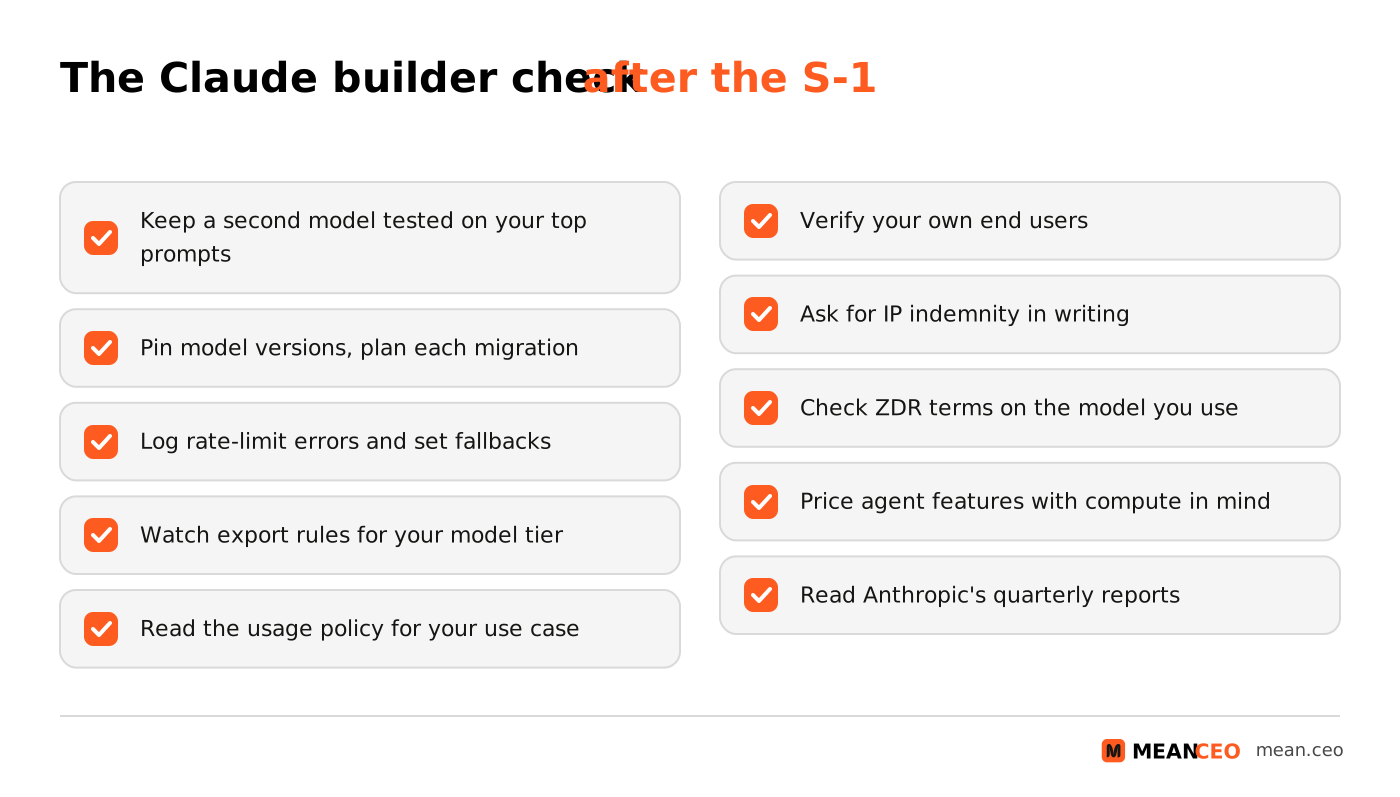
Next steps. Treat the risk section as a free vendor audit and act on it:
- Keep a second model tested on your top 20 prompts, from another vendor or a lower Claude tier, and switch on a flag.
- Pin model versions and handle each upgrade as a release with a regression test set, since new models carry most of Anthropic's revenue within six months.
- Log rate-limit and overload errors, queue anything that can wait and send overflow to your fallback.
- Watch export rules if you depend on the top model tier, and keep model names out of your customer contracts.
- Read the usage policy against your product, especially for security, biology, chemistry, surveillance or anything automated at scale.
- Verify your own end users and pass user IDs, so one abuser doesn't cost you the whole account.
- Ask for IP indemnity and data-retention terms in writing, model by model. Our guide to vendor management for lean teams has the contract questions.
- Price agent features on cost per task, with room for both price cuts and a move to outcome-based pricing.
- Treat Anthropic's suppliers as your suppliers. The S-1 says breaches have reached its third-party service providers, and the Cathedral test showed how.
- Read the quarterly reports. After listing, Anthropic must publish numbers and risks every quarter; the Anthropic news for October 2026 page tracks the rest.
None of this says Claude is a bad bet. More than 11,900 customers paid Anthropic $100,000 or more over twelve months, and the filing reports net revenue retention of about 900% (excluding Pro and Max subscribers). It says Claude is a supplier with published risks, and the full S-1 on the SEC site is worth an evening of your time. The filing can still change in later amendments before listing.
Are you getting customers from ChatGPT yet?
More and more traffic is coming from Perplexity, ChatGPT, Grok and other AI tools.
👉 Rank on ChatGPT
FAQ: Anthropic S-1 risk factors
Where can I read Anthropic's S-1 risk factors?
In the Form S-1 that Anthropic, PBC filed with the US Securities and Exchange Commission on 26 October 2026. The Risk Factors section starts on page 26 of the prospectus and is free to read on the SEC's EDGAR site.
Did Anthropic ever switch off a Claude model for everyone?
Yes. In June 2026 the US Department of Commerce imposed worldwide export restrictions on Fable 5 and Mythos 5, and Anthropic disabled both for all customers. They were re-deployed after Anthropic updated its safeguards and the restrictions were lifted.
Can Anthropic change Claude's rate limits?
Yes. The S-1 says Anthropic has changed, and may change again, usage limits, rate limits and model or product capabilities, and that some changes led to claims its disclosures were inadequate or misleading.
Does Anthropic promise a notice period before retiring a model?
The S-1 contains no deprecation schedule or notice period. It names forced deprecation as a risk and says safety and model welfare reasons may delay some deprecations.
Does Anthropic indemnify customers for copyright claims?
Some agreements require Anthropic to defend and indemnify the customer, without a cap, against claims that its models or outputs infringe. The filing doesn't say which customers or plans get these terms.
How much of Anthropic's revenue comes through AWS, Google and Microsoft?
About 48% in the first half of 2026, up from 11% in 2023, sold through the cloud marketplaces of the three providers.
About the Author
Violetta Bonenkamp, also known as MeanCEO, is an experienced startup founder with an impressive educational background including an MBA and four other higher education degrees. She has over 20 years of work experience across multiple countries, including 5 years as a solopreneur and serial entrepreneur. Throughout her startup experience she has applied for multiple startup grants at the EU level, in the Netherlands and Malta, and her startups received quite a few of those. She’s been living, studying and working in many countries around the globe and her extensive multicultural experience has influenced her immensely.
