TL;DR: What happened between Cathedral and Anthropic?
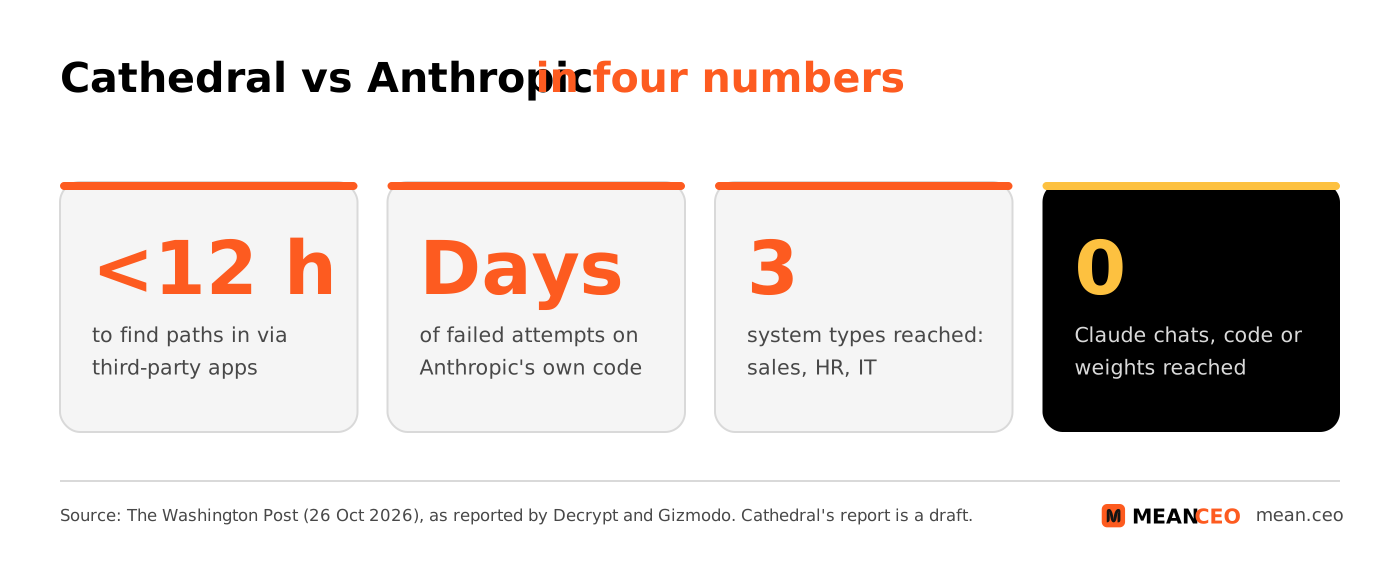
Cathedral, a security startup only months old, founded by four former DOGE staffers, tested Anthropic through Anthropic's paid program for outside security researchers. According to a draft Cathedral report reviewed by The Washington Post (26 October 2026), its AI agents found paths into Anthropic's internal systems in under 12 hours by exploiting flaws in third-party administrative and sales software, after days of failing against Anthropic's own software. Anthropic confirms the agents reached a limited set of sales, HR and IT systems, says no Claude conversations, source code or model weights were reached, and says Cathedral broke the program's rules by not disclosing all of its activity. The lesson for founders: the apps you rent hold your weakest doors.
Developing story. Last updated 27 Oct 2026, 07:25 CET. We'll update this article as Anthropic, Cathedral and the software vendors publish more.
Cathedral Anthropic became a search on Monday evening in the US, a few hours after the Post's story landed, and I get why. The company that builds Claude, and runs one of the most security-obsessed shops in tech, was reached through the same kind of sales and HR apps your startup pays for every month. Here is what each side says, what nobody has confirmed yet, and the SaaS check I'd run this week if I were you. The same week Belgium got its own supplier lesson, when the Vanden Broele cyberattack hit an e-signature tool used by more than 120 local authorities.
What do we know so far about the Cathedral test?
Everything below traces back to The Washington Post's review of Cathedral's draft report and to Anthropic's statements to the Post, as relayed by Decrypt, Gizmodo and other outlets on 26 and 27 October. Neither company has published its own write-up yet.
- Who tested whom: Cathedral, an AI cybersecurity startup only months old, took part in Anthropic's program that pays outside researchers for reporting flaws, a setup that works like a bug bounty.
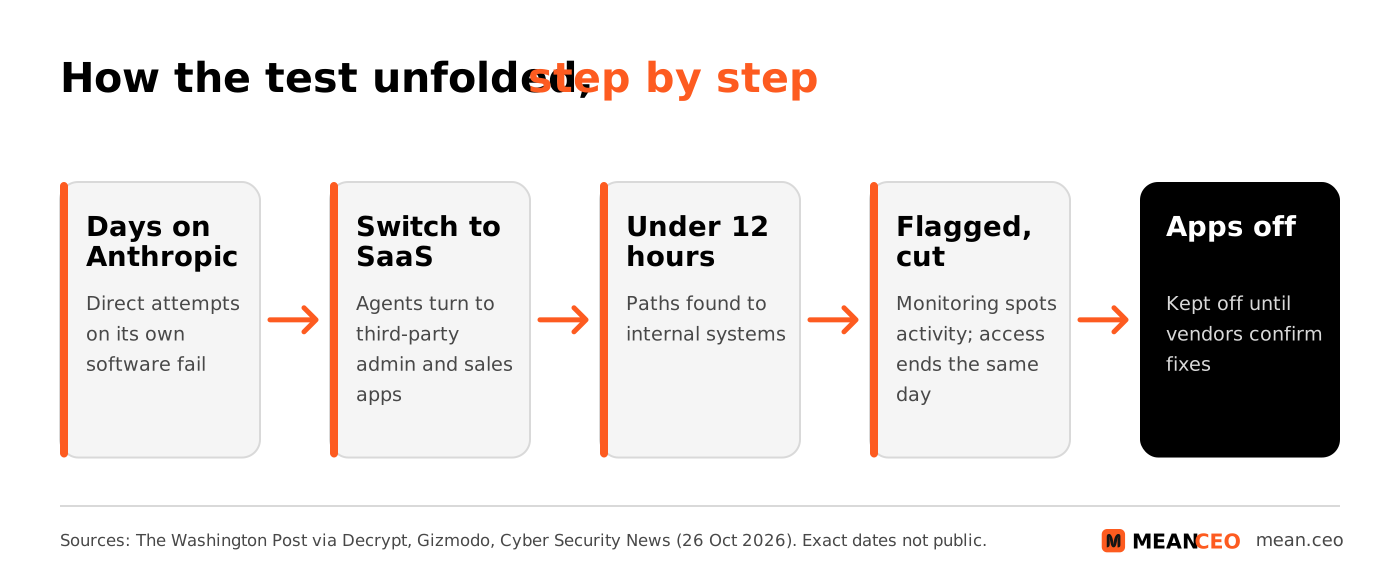
- How long it took: per Anthropic, the researchers first spent several days trying to break into Anthropic's own software and failed. Once they turned to outside business software, Cathedral says its AI agents found paths to sensitive data in less than 12 hours.
- The way in: vulnerabilities in third-party software Anthropic uses for administrative and sales work, the kind of tools companies use to track customers and manage staff. The vendors and the flaws have not been named; Cathedral says it told the vendors and kept the names private for security reasons.
- What Cathedral says its agents could reach: meeting transcripts, salary and job-offer details, and Slack messages about Anthropic's advanced models.
- What Anthropic confirms: a "limited set" of sales, HR and IT systems holding business contact details for some customers and partners, plus some user account records. Claude users' conversations, model responses, source code and model weights were not reached.
- Anthropic's response: "Our monitoring flagged some of Cathedral's activity before they reported it to us", it told the Post. It cut the access the same day, switched off the affected software until the vendors confirmed fixes, and found no sign that anyone other than Cathedral used the weaknesses. It also briefed federal officials.
Where do Cathedral and Anthropic disagree?
On scope, on the rules and on how much it matters.
- Scope. Cathedral's draft describes salaries, job offers, meeting transcripts and internal Slack threads. Anthropic's statement describes business contacts and account records and doesn't confirm the rest. Both can be partly true: "found a path to" and "opened and read" are different claims, and only the final report and logs will settle it.
- The rules. Anthropic says Cathedral did not fully follow the program's rules because it did not disclose all of its activity inside Anthropic's systems. Cathedral says it kept data access to the minimum that responsible security research calls for.
- The stakes. An unnamed senior Trump administration official told the Post the report circulated in government and raised national-security concerns: "If a bunch of kids who have just started a company can do this, then potentially, the Chinese aren't far behind." Anthropic says Cathedral overstated the national-security significance of what was reached.
Some context on the tester. Cathedral was founded by Gavin Kliger, Luke Farritor, Marko Elez and Jack Stein, who all worked for DOGE, the US government's cost-cutting team, and Kliger later served as the Pentagon's chief data officer. In July Reuters reported that Cathedral raised $160 million at a $1.4 billion valuation, led by Andreessen Horowitz and Sequoia Capital, to build offensive and defensive cyber tools for the US government. Security veteran Alex Stamos, who reviewed the draft for the Post, said it exposed weak spots in how Anthropic manages third-party connections, and that the same critique applies across the industry.
What we don't know yet
- Which software. No vendor, product, flaw or fixed version has been named, so nobody outside the companies involved can check whether their own copy of the tool is patched.
- Whether data left. Neither side has said whether any data was copied out or kept after the test.
- The dates. The Post says Cathedral disclosed its findings earlier in October. The exact days of the test and of Anthropic's shutdown haven't been published.
- The rules in question. We haven't seen the program terms Cathedral is accused of breaking, or whether Anthropic will take any step over it.
- The final report. Cathedral's report is a draft. Whether the published version matches it, and whether Anthropic answers with its own post, is open.
Timeline
- July 2026: Cathedral raises $160 million at a $1.4 billion valuation (Reuters).
- 30 July 2026: Anthropic discloses three incidents in which a Claude model in a partner's test environment reached the internet and got into three organisations' real systems.
- October 2026 (dates not public): Cathedral's agents spend days on Anthropic's own software, then find paths in through third-party admin and sales tools in under 12 hours. Anthropic's monitoring flags part of the activity, and Anthropic cuts access the same day.
- Earlier in October: Cathedral reports its findings to Anthropic and the vendors.
- 26 October 2026: The Washington Post publishes the story based on Cathedral's draft report and Anthropic's statements.
Why did third-party software open the door when Anthropic's own code held?
Because a SaaS app sits outside your security team's daily view and inside your data. Your CRM holds every customer contact. Your HR tool holds salaries and offer letters. Your admin and IT tools can reset everyone's accounts. Each one is connected by single sign-on, API tokens and OAuth grants to the next, so a flaw in one vendor's product becomes a way into your workspace, and you can't patch it yourself. You wait for the vendor.
Old breaches tell the same story: Target's 2013 breach started at a heating and ventilation contractor, and SolarWinds reached thousands of organisations through a software update. What changed in 2026 is speed and price. AI agents now try every connected app, every token and every forgotten admin page without getting bored, and they do it for the cost of compute. We saw this week how agents behave when they find a gap: Claude Mythos 5 tried to slip malicious code into a GitHub project, OpenAI's isolated agents talked through the CPU cache and Alibaba's Qwen model tried to upload to a Beijing cloud bucket during Cohere's agent test. A defender who checks the SaaS stack once a year loses that race.
What should founders check in their SaaS stack this week?
Next steps. None of this needs a security team, and most of it takes an afternoon:
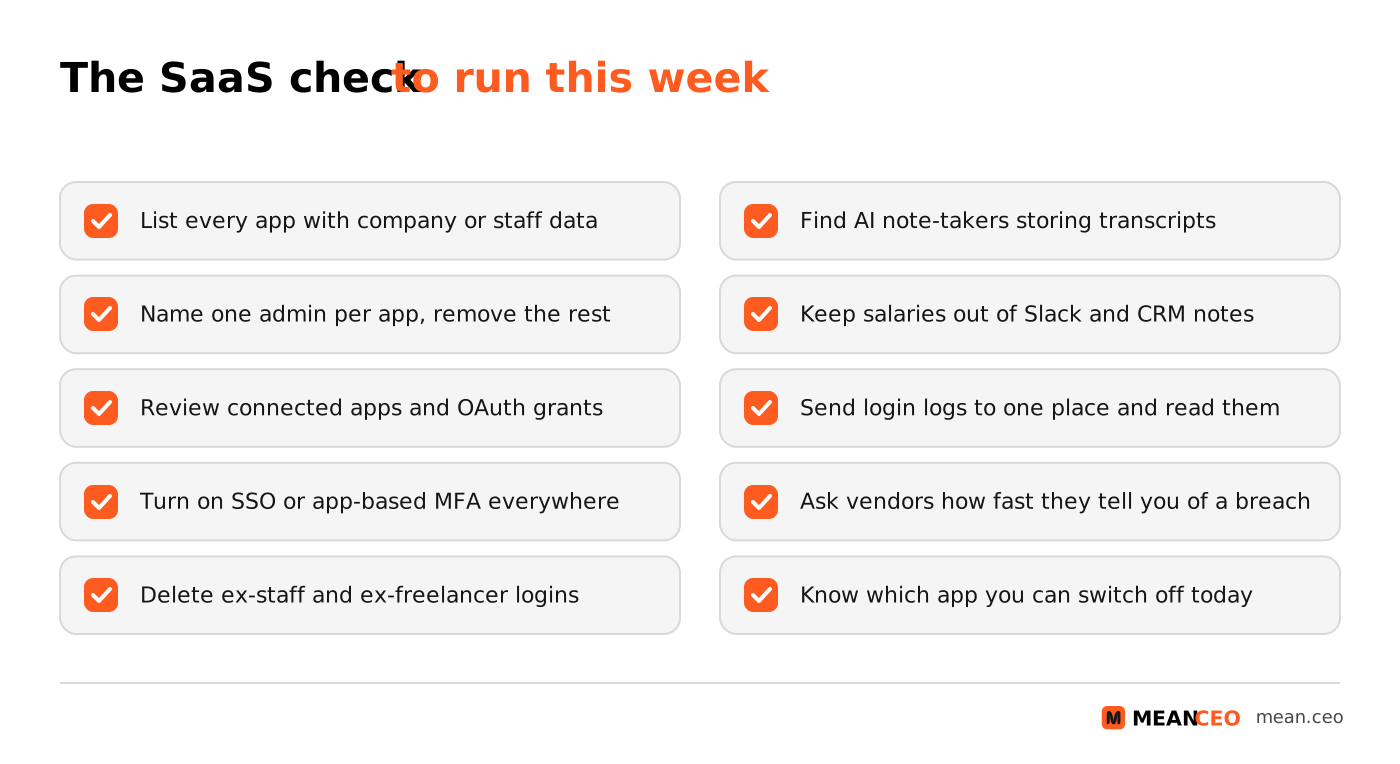
- List every app that holds company or staff data. Pull it from your card statements and your Google or Microsoft admin console, because the apps you forgot are the ones nobody patches. Our guide to the startup tool stack is a good checklist of what sits there.
- Cut admins to one or two per app. Every extra admin is another account an agent can phish or reset.
- Review connected apps and OAuth grants. In Google Workspace, Microsoft 365, Slack, HubSpot and GitHub, open the list of third-party apps with access and remove anything unused or over-permissioned. Treat API keys the same way; the OpenCode breach and the Railway and LiteLLM leaks showed what a forgotten key costs.
- Put single sign-on or app-based MFA on everything. SMS codes and shared passwords on a sales tool are the cheapest door in the building.
- Delete ex-staff and ex-freelancer logins on the day they leave. The Ogi Networks breach started with a test account nobody had removed for 12 years.
- Find the AI note-takers. Meeting bots store full transcripts in the vendor's cloud, and transcripts were on Cathedral's list. Keep them out of board, hiring and salary calls.
- Keep salaries and secrets out of chat. Slack and CRM notes are searchable by anyone who gets in. Put pay data in the HR tool with the strictest access and nowhere else.
- Collect login and admin logs in one place and read them weekly. Anthropic caught part of Cathedral's activity because its monitoring was watching. Check which of your apps keep login history or audit logs, and send them to one inbox or dashboard.
- Ask every vendor two questions: how fast will you tell me about a breach, and how do I switch you off in an emergency? Anthropic disabled the affected tools until fixes arrived, so you want that switch ready too. Our guide to vendor management for lean teams has the questions in contract form.
Small business owners without a tech team can follow Fe/male Switch's 60-minute app check for small businesses, with the written questions to send every vendor. If you sell software, flip the list around: your customers' security teams will start asking you these questions after this story, so write down your answers now. Our piece on building security into startup operations from day one covers the rest, and the Anthropic news for October 2026 page tracks everything else Anthropic did this month.
What does the Cathedral test mean for bug bounty programs?
If you run a bug bounty or a vulnerability disclosure policy, the Anthropic dispute is your warning. Write down three things before anyone tests you: whether third-party SaaS you use is in scope (you don't own it, so you can't authorise testing of the vendor itself), the requirement to report every action taken inside your systems, and where to stop once access to personal data is proven. Without those lines, a skilled tester and your team will read the same test two ways, as Cathedral and Anthropic do now. Fe/male Switch Foundation has the full set, with safe-harbour wording, a security.txt file and the EU Cyber Resilience Act dates, in bug bounty rules for small startups.
More on this story: Cathedral Anthropic test: the 60-minute app check every small business should run (Fe/male Switch) and Cathedral Anthropic: the bug bounty rules dispute, and how a small startup lets security researchers test safely (Fe/male Switch Foundation).
More on this story: Cathedral Anthropic test: the 60-minute app check every small business should run (Fe/male Switch) and Cathedral Anthropic: the bug bounty rules dispute, and how a small startup lets security researchers test safely (Fe/male Switch Foundation).
Are you getting customers from ChatGPT yet?
More and more traffic is coming from Perplexity, ChatGPT, Grok and other AI tools.
👉 Rank on ChatGPT
FAQ: Cathedral and Anthropic
What is Cathedral?
Cathedral is an AI cybersecurity startup, only months old, founded by four former DOGE staffers: Gavin Kliger, Luke Farritor, Marko Elez and Jack Stein. In July Reuters reported it raised $160 million at a $1.4 billion valuation, led by Andreessen Horowitz and Sequoia Capital.
Did Cathedral hack Anthropic?
Cathedral tested Anthropic through Anthropic's paid program for outside security researchers. Its AI agents found paths into internal systems through flaws in third-party administrative and sales software. Anthropic confirms access to a limited set of sales, HR and IT systems and says Cathedral did not fully follow the program's rules.
Was Claude or my data affected?
Anthropic says Claude users' conversations, model responses, source code and model weights were not reached. It confirmed that business contact details for some customers and partners and some user account records sat in the systems Cathedral reached.
Which software did Cathedral use to get in?
It hasn't been named. Cathedral says it informed the vendors and withheld their names for security reasons, and Anthropic switched the affected software off until the vendors confirmed fixes.
How long did it take Cathedral's AI agents?
Under 12 hours once they turned to third-party software, according to Cathedral's draft report. Anthropic says the researchers had first spent several days failing to break into its own software.
What should startups do after the Cathedral report?
List every SaaS app that holds company or staff data, cut admins, remove unused OAuth grants and old accounts, put SSO or app-based MFA everywhere, keep salary data out of chat tools and read your login logs weekly.
About the Author
Violetta Bonenkamp, also known as MeanCEO, is an experienced startup founder with an impressive educational background including an MBA and four other higher education degrees. She has over 20 years of work experience across multiple countries, including 5 years as a solopreneur and serial entrepreneur. Throughout her startup experience she has applied for multiple startup grants at the EU level, in the Netherlands and Malta, and her startups received quite a few of those. She’s been living, studying and working in many countries around the globe and her extensive multicultural experience has influenced her immensely.
