TL;DR: Will China's AI export controls cut off Kimi, Qwen or DeepSeek?
Not the models you already use. On 16 October 2026, China's commerce and science ministries published a draft that adds 23 AI technologies to the country's export control list, including large models of 2 trillion or more parameters. But weights and code that are already public are excluded, and calling a Chinese model through an API, app or SaaS product is outside the controls. The real change is for the next generation: future top models, overseas deployments and licensing deals would need a licence or registration. The draft is Proposed, comments close on 15 November, and a registration rule already applies. If your product runs on cheap open-weight models, now is the time to map your model stack and keep a fallback.
For two years, the cheapest way to build an AI product has been to run open-weight models, very often Chinese ones. This month that bet picked up a new risk: Beijing has written its biggest models into its export control system.
It isn't a ban on what you use today. But it puts a government licence between future Chinese frontier models and the rest of the world, at the exact moment open-weight models carry most of the traffic.
What happened
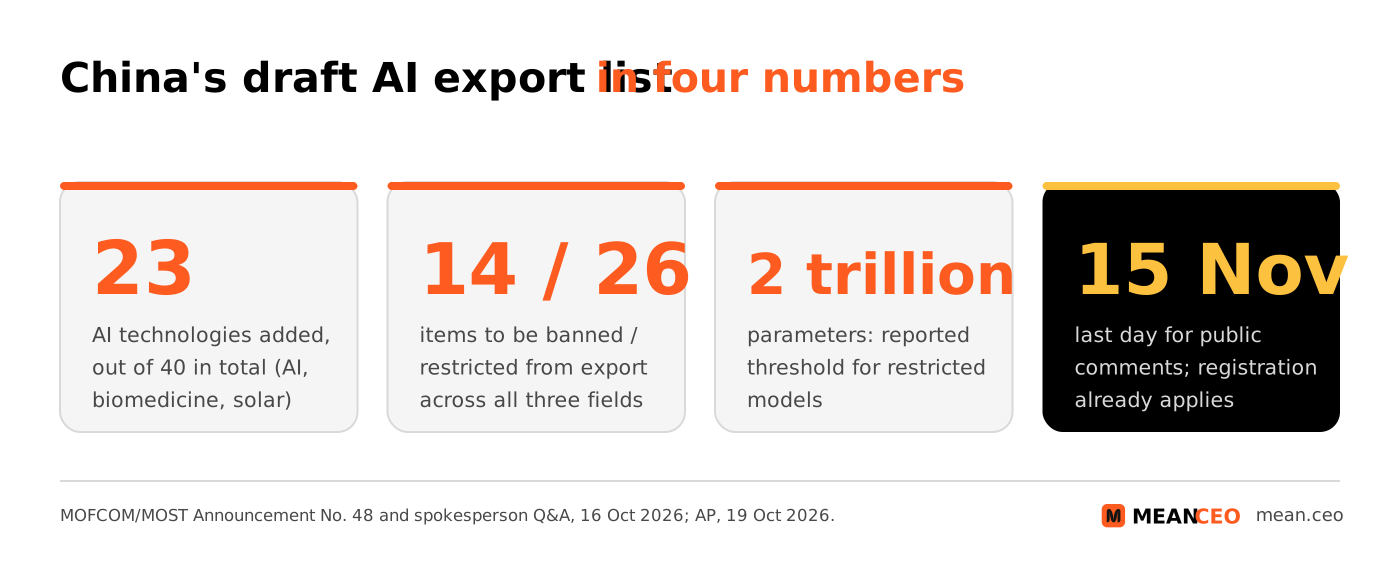
On Friday 16 October 2026, China's Ministry of Commerce (MOFCOM) and Ministry of Science and Technology published Announcement No. 48 of 2026. It proposes to revise China's Catalogue of Technologies Prohibited or Restricted from Export by adding 40 technologies in three fields:
- Artificial intelligence: 23 items, covering large models, AI agents, computing clusters and information processing.
- Biomedicine: 5 items, including cell and gene therapy and pathogenic microorganisms.
- Solar: 12 items, including polysilicon, wafer and cell manufacturing.
In a spokesperson Q&A published the same day, MOFCOM said 14 of the 40 items would be banned from export and 26 restricted. Its AI examples: AI-driven malicious code generation would be banned, and AI-assisted vulnerability discovery would be restricted. The ministry said the revision doesn't target any specific country, region or entity, and that the vast majority of AI technologies could still be exported freely.
Status: Proposed. The catalogue change is a draft open for comments from 16 October to 15 November 2026, by email, fax or letter. One part is already live: from the day of the announcement until the revised catalogue takes effect, anyone exporting a listed technology must first register it on MOFCOM's online platform, including exports that started but aren't finished.
Which AI models are covered
The announcement itself doesn't name models, and its technical thresholds sit in an attachment. According to the Associated Press, exports of AI models with 2 trillion or more parameters, "or with certain world-leading capabilities", could be restricted. AP reports that Moonshot's Kimi K3 and Alibaba's Qwen 3.8-Max are among the Chinese models above 2 trillion parameters, while noting the proposal doesn't name specific models.
AP also reports that core technologies of large models trained on sensitive national data would be banned outright, along with AI agents built for highly sensitive settings such as national defence and critical information infrastructure. Some AI and memory chip design technologies are on the list too.
The ministry's stated reason is security. It points to the risk of misuse, such as attacks on critical infrastructure by non-state actors, and says it wants to ensure "that AI remains under human control", in AP's translation of the statement.
What stays open, and what needs a licence
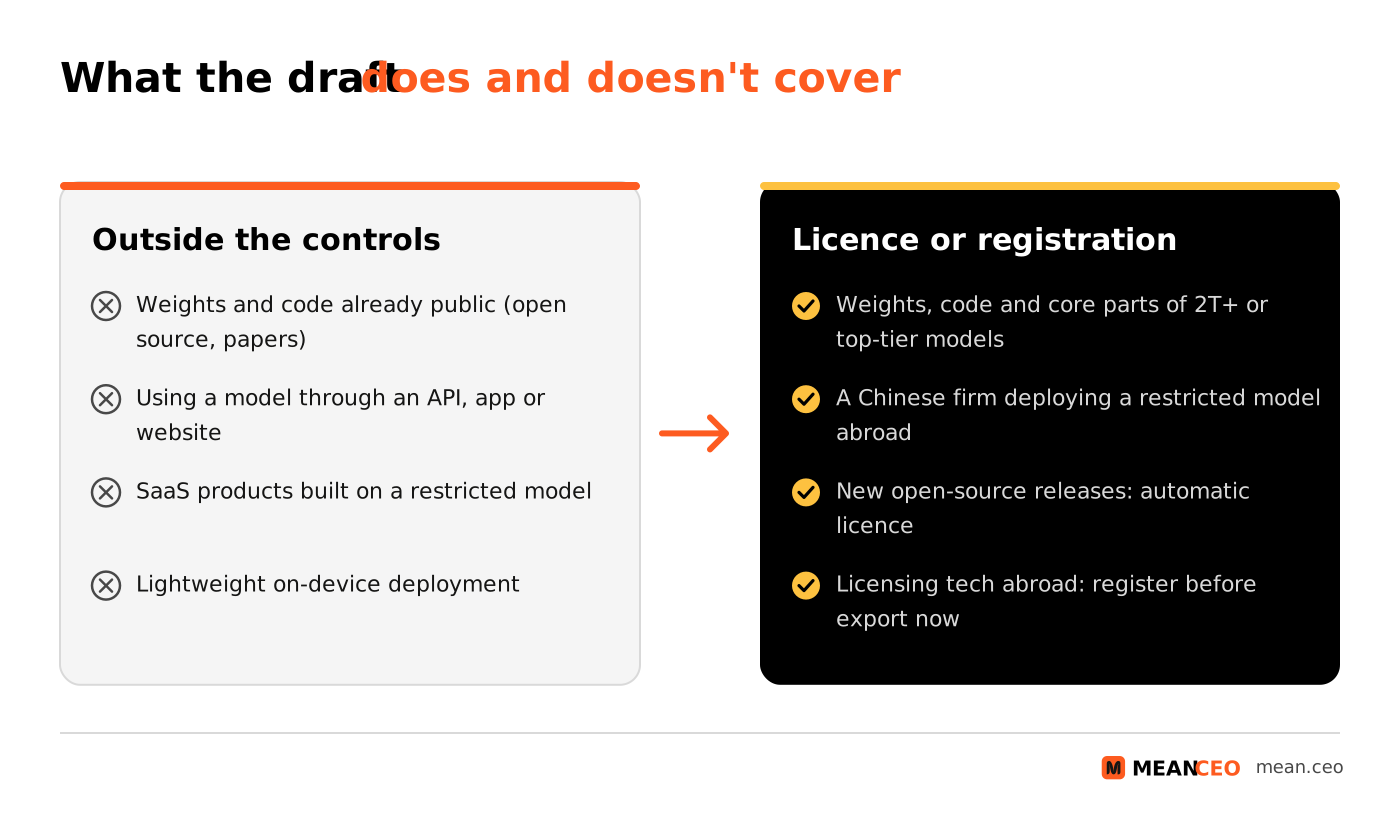
The details matter more than the headline, and the MOFCOM Q&A spells them out.
Sources: MOFCOM/MOST Announcement No. 48 and the MOFCOM spokesperson Q&A, 16 October 2026.
So the open-weight model you run today keeps working. What changes is the pipeline. A Chinese lab that wants to publish the weights of its next frontier model would need an automatic licence first, and the government would hold a lever over whether, and when, that happens.
Why it matters: open weights now carry most AI traffic
The timing is awkward for anyone who builds on cheap models. The day before the draft, Vercel published its AI Gateway Production Index for October 2026, based on September traffic. Open-weight models handled 71.5% of all tokens on the gateway and about 23% of estimated spend, up from one in twenty dollars in June. We covered the Anthropic side of the same data in our story on Replit switching its default to OpenAI; the China side is just as big.
Source: Vercel, AI Gateway Production Index, 15 October 2026. Gateway traffic only; spend estimated at list prices.
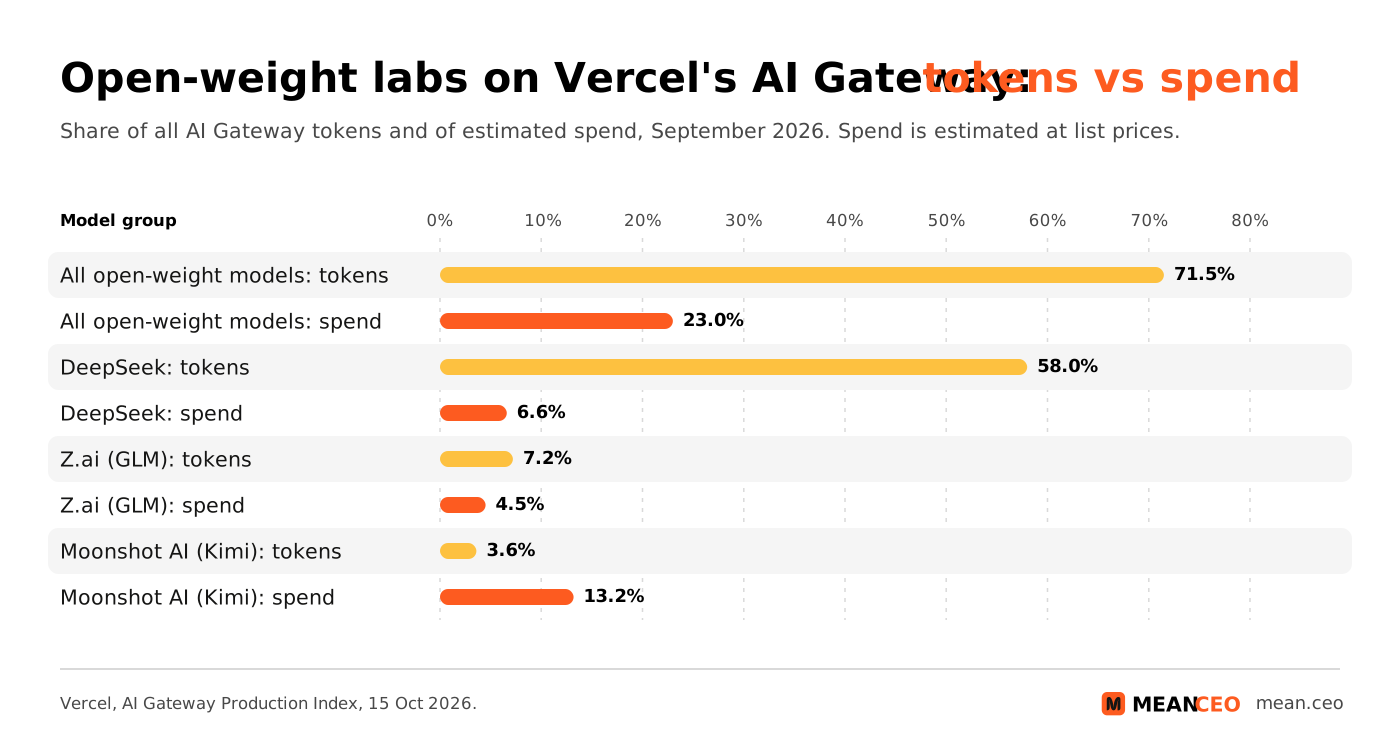
Two details stand out. First, Kimi K3, one of the two models AP names as above the threshold, is where the money is going: Vercel says it accounted for nearly half of the increase in open-weight spending in September. Second, "the Chinese lab builds the model; the American provider runs it and sells access", as Vercel puts it: more than two-thirds of September spend on Chinese models went to US-based hosts. That hosting model is exactly what export rules on weights can touch.
The Register quoted Chris McGuire of the Council on Foreign Relations, who wrote that the draft "introduces significant uncertainty for US businesses that host or rely on Chinese models". His reason: with Chinese labs moving toward licensing their open-source models for revenue, Beijing is signalling that it can curtail those licensing agreements at any time. heise, writing on 19 October, called it bad news for Europe. And Omdia's Lian Jye Su told AP the move "can be seen as a response to Western countries posting sovereignty requirements on AI, robotics, telecommunications, and other key technologies".
Want the wider picture of open models this month? Our open-source AI news for October 2026 roundup tracks the releases, and the AI news for October 2026 page covers everything else.
The European angle
No European lab shows up among the big names in Vercel's data, and that's the uncomfortable part. Many of the cheap tokens European startups use come from Chinese labs, served by US hosts. Two things are worth knowing:
- Mistral's big open model is due this month. Mistral says it will release the weights of Mistral Large 4, a 1 trillion parameter model with 52 billion active parameters, "by the end of the month". It was trained on 3,800 NVIDIA Grace Blackwell GPUs in Mistral's own European datacentres, and Mistral promises a European deployment it operates "under European law". For a founder who wants a top open model with no export-licence question attached, that's the one to test.
- GDPR already limits China-hosted APIs. In June 2025, Berlin's data protection commissioner reported the DeepSeek app to Apple and Google as illegal content, because it sent personal data to China without the safeguards GDPR Article 46 requires. China has no EU adequacy decision. Running open weights on an EU host avoids that problem; sending customer data to a China-hosted API doesn't. Our guide on how European startups use AI without breaking GDPR walks through the checks.
Price pressure is coming from the closed side too. Google's introductory price for Gemini 4 Argon runs out on 30 November, as we reported in our Gemini 4 Argon and Muse Wonder story. If both your cheap open option and your closed option can get pricier or harder to get, flexibility is worth real money.
What this means for you
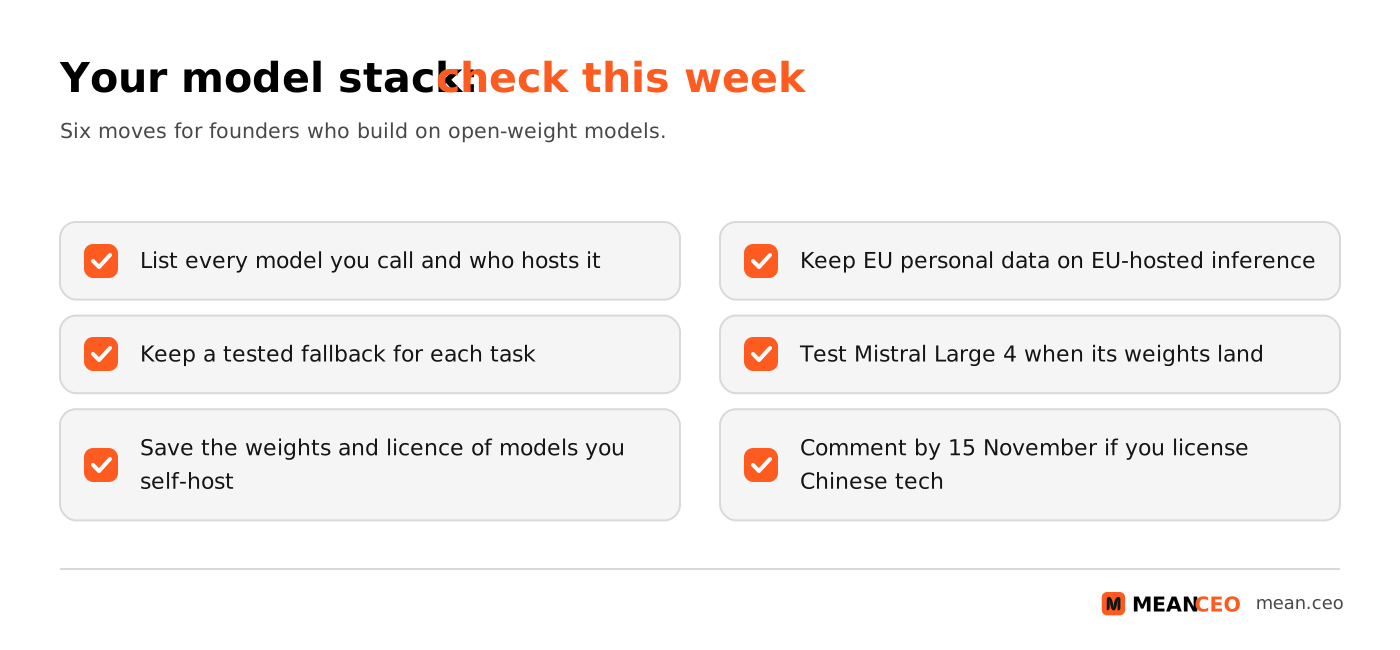
- Map your model stack. Write down every model you call, who hosts it and where. Many founders don't know whether their "Kimi" runs in China, the US or the EU. The answer decides both your export risk and your GDPR risk.
- Keep a tested fallback for every task. Almost one in three teams on Vercel's gateway changed their most-used lab in September alone. Routing layers make switching cheap, but only if you've tested the second model on your own prompts. Our AI price war roundup lists the cheaper closed options.
- Save what you self-host. If you run open weights on your own servers, keep a copy of the exact version and its licence. Public weights are outside the draft, but future versions may arrive later, or not at all.
- Keep customer data on EU inference. Use open weights through an EU-region host, or a European provider, for anything with personal data.
- Put Mistral Large 4 on your test list. When the weights land, run your own evals against the Chinese model you use now.
- Lock down your keys while you switch. Every new provider means a new API key. After the OpenCode breach that exposed saved OpenAI and Anthropic keys, set spend caps and rotate keys you no longer use.
If you license technology from a Chinese company, or sell technology into China, read the draft with your lawyer. The comment window closes on 15 November, and the registration rule applies already.
Are you getting customers from AI search yet?
More and more traffic is coming from Perplexity, ChatGPT, Grok and other AI tools.
👉 Rank on ChatGPT
FAQ: China's AI export controls
Is China banning exports of AI models?
Partly, and only in draft. Announcement No. 48 of 16 October 2026 proposes adding 23 AI technologies to China's export control catalogue. Across all 40 new items, 14 would be banned and 26 restricted. Large models above a reported 2 trillion parameters, or with world-leading capabilities, could be restricted. Comments are open until 15 November 2026.
Can I still use Kimi, Qwen or DeepSeek from Europe?
Yes. MOFCOM says API calls, app and web access, SaaS products and lightweight on-device deployment are outside the large-model export controls, and technology already public through open source is excluded. The draft is about moving restricted model technology abroad, not about using a model.
Which models are above the 2 trillion parameter threshold?
The draft doesn't name any. AP reports that Moonshot's Kimi K3 and Alibaba's Qwen 3.8-Max are among the Chinese models with more than 2 trillion parameters.
Will future Chinese open-weight models still be released?
The draft gives open-sourcing an automatic licence, which MOFCOM describes as export as soon as it's filed. So releases need a filing step but aren't blocked. Still, the government gains a lever over when, and whether, a top model's weights are published.
When do the rules take effect?
The catalogue change applies only after the comment period and a final decision; no date has been set. A temporary registration rule applies from 16 October 2026: exporters of listed technologies must register on MOFCOM's platform before exporting.
What is the best European alternative to Chinese open-weight models?
Mistral Large 4 is the main candidate. Mistral says the 1 trillion parameter model was trained in its own European datacentres and that the weights will be released by the end of October 2026. Test it on your own tasks before you switch.
About the Author
Violetta Bonenkamp, also known as MeanCEO, is an experienced startup founder with an impressive educational background including an MBA and four other higher education degrees. She has over 20 years of work experience across multiple countries, including 5 years as a solopreneur and serial entrepreneur. Throughout her startup experience she has applied for multiple startup grants at the EU level, in the Netherlands and Malta, and her startups received quite a few of those. She’s been living, studying and working in many countries around the globe and her extensive multicultural experience has influenced her immensely.
