TL;DR: Why was Revolut down today?
Revolut outage reports spiked on the morning of Tuesday 20 October 2026, when card payments, transfers, ATM withdrawals and app sign-ins failed for customers in the UK and Ireland. At the same time, Google Cloud's London region (europe-west2) had a major incident, which Google blamed on "a power event" in one of its zones. Revolut didn't name Google publicly, but Reuters reported, citing a person familiar with the matter, that the two were related. Revolut says customers' money and data are safe. The lesson for founders: if one bank or one cloud zone can stop your business for a day, you need a backup now, not after the next outage.
Revolut outage day is a bad day to discover that your startup has one bank account, one card and one cloud region. Payroll tools, ad accounts and SaaS subscriptions all charge the same card, and when that card stops working, so does a lot of your business.
That's what happened to plenty of founders in the UK and Ireland this morning. Here's what we know, what we don't, and what to change this week.
What happened to Revolut and Google Cloud?
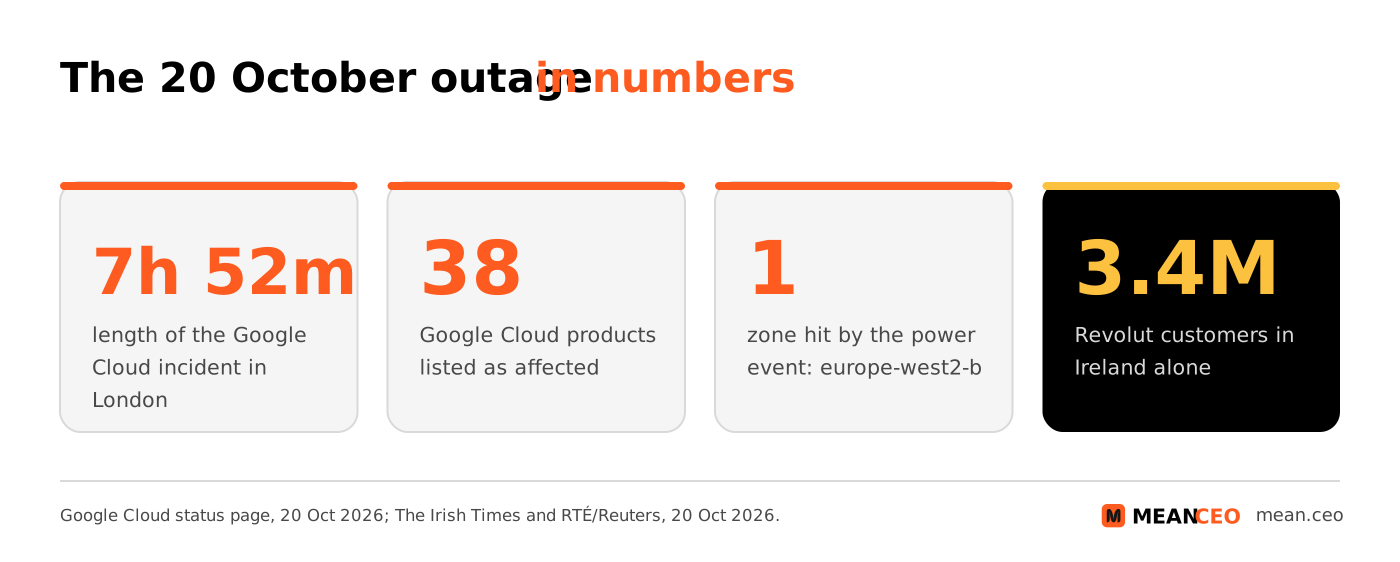
Here's the sequence on 20 October 2026, based on Google Cloud's status page and reporting by Reuters, The Irish Times, RTÉ and The Stack. Times are UK and Irish time (BST); Google's status page uses Pacific time.
Google listed 38 affected products, including Compute Engine, Google Kubernetes Engine, Cloud Run, Cloud Spanner, AlloyDB for PostgreSQL and its virtual private cloud networking. Google says it will publish an analysis of the incident after its internal investigation. Until then, "power event" is all the explanation there is.
A Revolut spokesman told The Irish Times: "We are currently experiencing a service disruption affecting multiple services." The company added: "We can confirm that all our customers' money and data are safe," and said it had been working on the issue since it was identified in the morning and apologised to anyone affected. According to reports of its status page, sign-ins, card payments, transfers, currency exchange, stock trading and live support chat were all partly unavailable, and Reuters also reported problems with ATM withdrawals.
Nothing in the reporting points to a cyberattack. This was an infrastructure failure, not a breach. For a recent example of what an actual breach looks like, see our OpenCode breach guide. A day later France got its own reminder: an equipment failure cut calls, SMS and mobile data across the country for about ten hours, and we explain what happened in the Orange outage and how founders stop depending on one mobile network.
Was it really Google Cloud's fault?
Here's where to be careful. Revolut hasn't publicly named Google Cloud as the cause. The link comes from Reuters, which cited a person familiar with the matter, and from the timing: both problems started at the same moment. The Irish Times also describes Google Cloud as a provider of core infrastructure to Revolut, and Revolut itself said in 2025 that it uses Google Cloud's infrastructure for its global systems.
At the time of writing, we couldn't find a Revolut statement saying every service was fully restored. If you rely on it, check Revolut's own status page before you assume the problem is gone. A day later came a different kind of outage: Pokémon, Wikimedia and several European governments switched services off on purpose over the PHP issue, to patch before attackers could get in.
Who else was hit?
Revolut wasn't alone. According to Reuters, Downdetector showed reports from users of Lloyds Bank, HSBC, Rightmove, DPD, NHS England and Royal Mail, and the outage also hit UK public-sector websites. Lloyds said services should return to normal because the root issues had been resolved. HSBC said it was aware some customers had trouble. Royal Mail said letters and parcels weren't affected. In Ireland, AIB and Bank of Ireland said their services were running normally.
The UK's Financial Conduct Authority said: "We are aware of an incident affecting services provided by Google." That matters. In July, the UK put Google Cloud, Microsoft, Amazon Web Services and Oracle under direct oversight as critical third parties for the financial sector, and last year EU regulators named Google Cloud as one of 19 critical third-party technology providers for the bloc's finance industry under DORA (Adopted). Those rules give supervisors more power over cloud providers. They don't stop power failures.
It's also not the first time. In October 2025, an AWS problem took down apps including Fortnite and Snapchat, plus banks and messaging services, and a week later Microsoft Azure had problems of its own. If you build on Chinese AI models or any single foreign provider, the same logic applies: one supplier you don't control can stop your product.
What this means for your startup
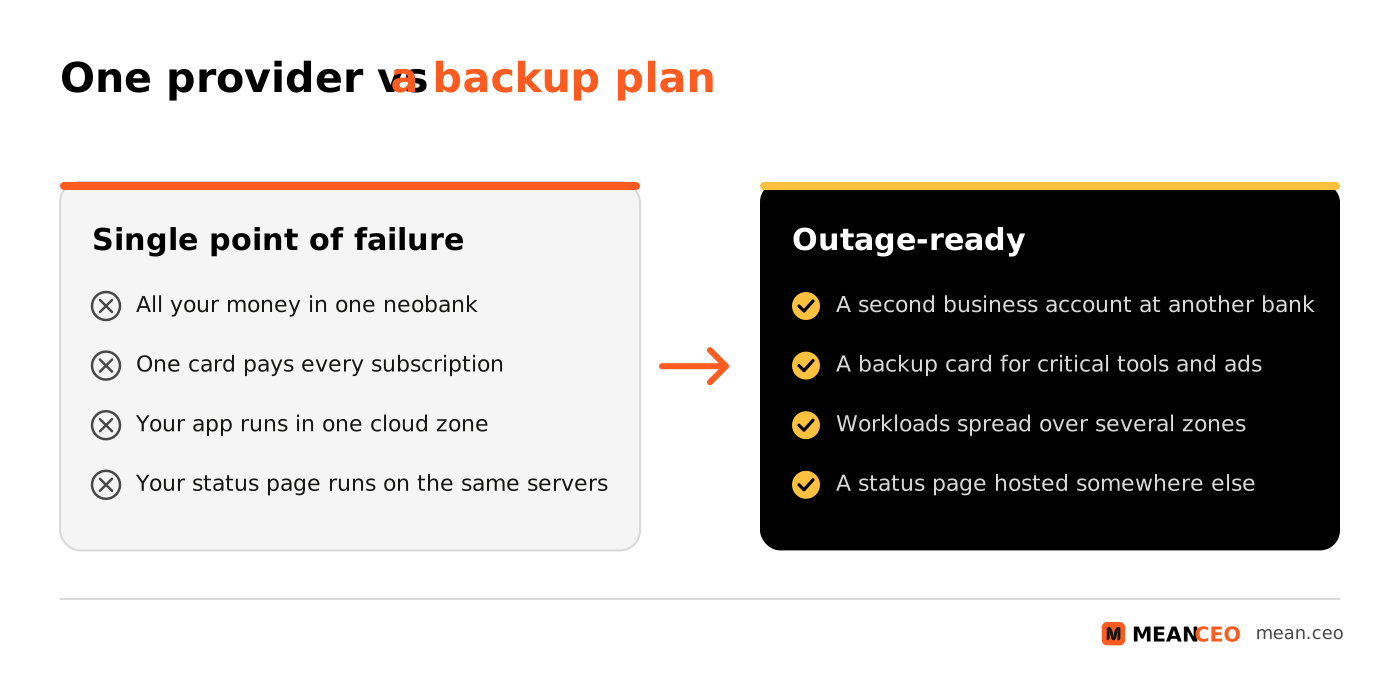
You can't prevent a power failure in a London data centre. You can make sure it doesn't stop your company. Here's what I'd do as a bootstrapped founder:
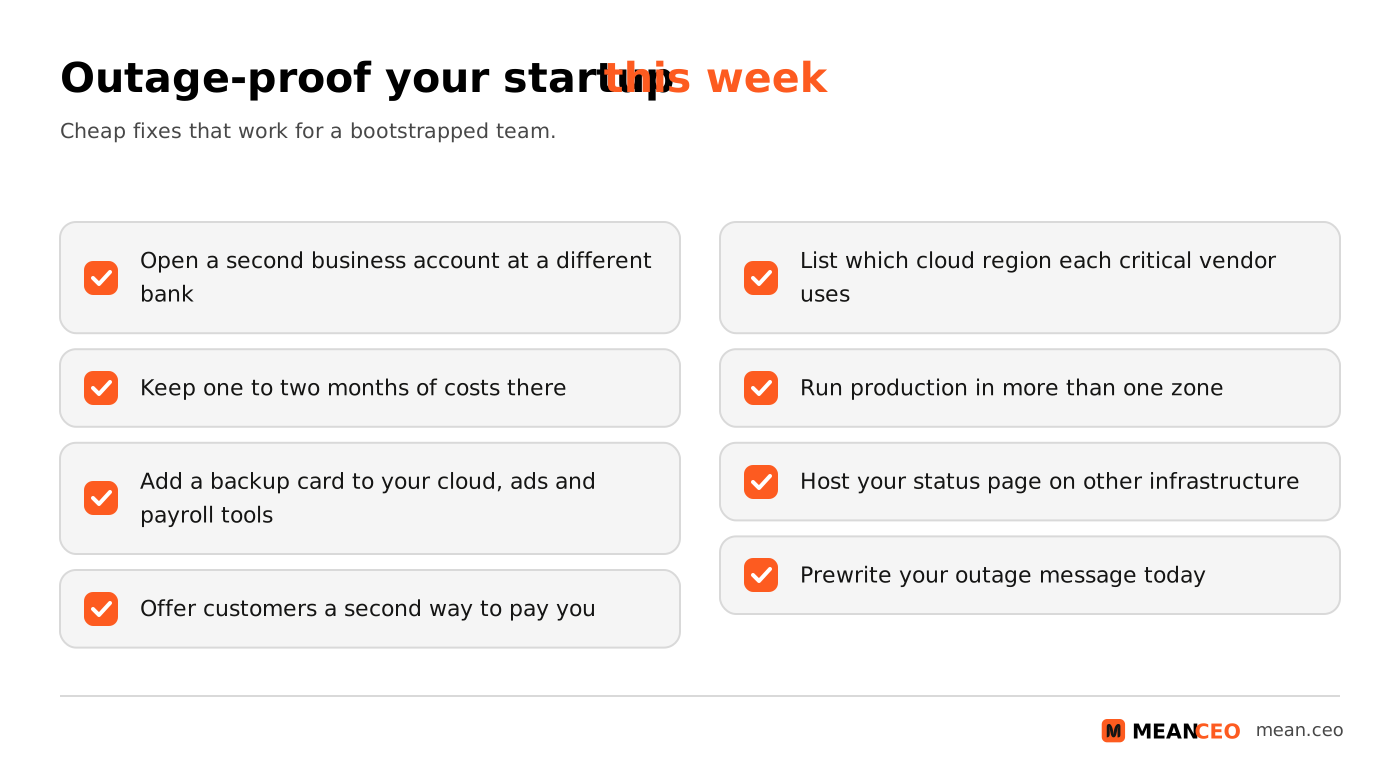
- Have two banks, not one. Neobanks are great for startups, but keep a second business account at a bank that runs on different infrastructure, with one to two months of costs in it. Our guide to European banking for startups compares the options, and our cash flow guide for first-year founders helps you size that buffer.
- Add a backup card to critical tools. Cloud hosting, ad accounts, payroll and your domain registrar can suspend you when a payment fails. Most let you add a second card. Do it today.
- Give customers a second way to pay. If your invoices show one IBAN or your checkout has one payment provider, an outage on their side becomes lost revenue on yours. Add a second account to invoices or a fallback payment link.
- Know where your vendors run. You often only find out which cloud a supplier depends on when it fails. Ask your critical suppliers which cloud and region they use, and what happens if it fails. Our vendor management guide for lean teams shows how to keep that list short.
- Spread your own app over several zones. Google's 12:00 advice was to move workloads to another zone or region. That only works if you prepared. Multi-zone setups are usually cheap; multi-region and multi-cloud cost more and only make sense when downtime costs you real money. The Stack noted that Monzo, for example, runs a backup platform on Google Cloud that can take over from its main platform on AWS. Most startups don't need that, but they do need backups they've actually tested. Start with the basics in our guide to building security into startup operations.
- Plan your outage message now. Revolut's first line, that money and data are safe, is the right one: say what's broken, say what isn't, and say when the next update comes. Host your status page somewhere other than your main servers, or it goes down with them.
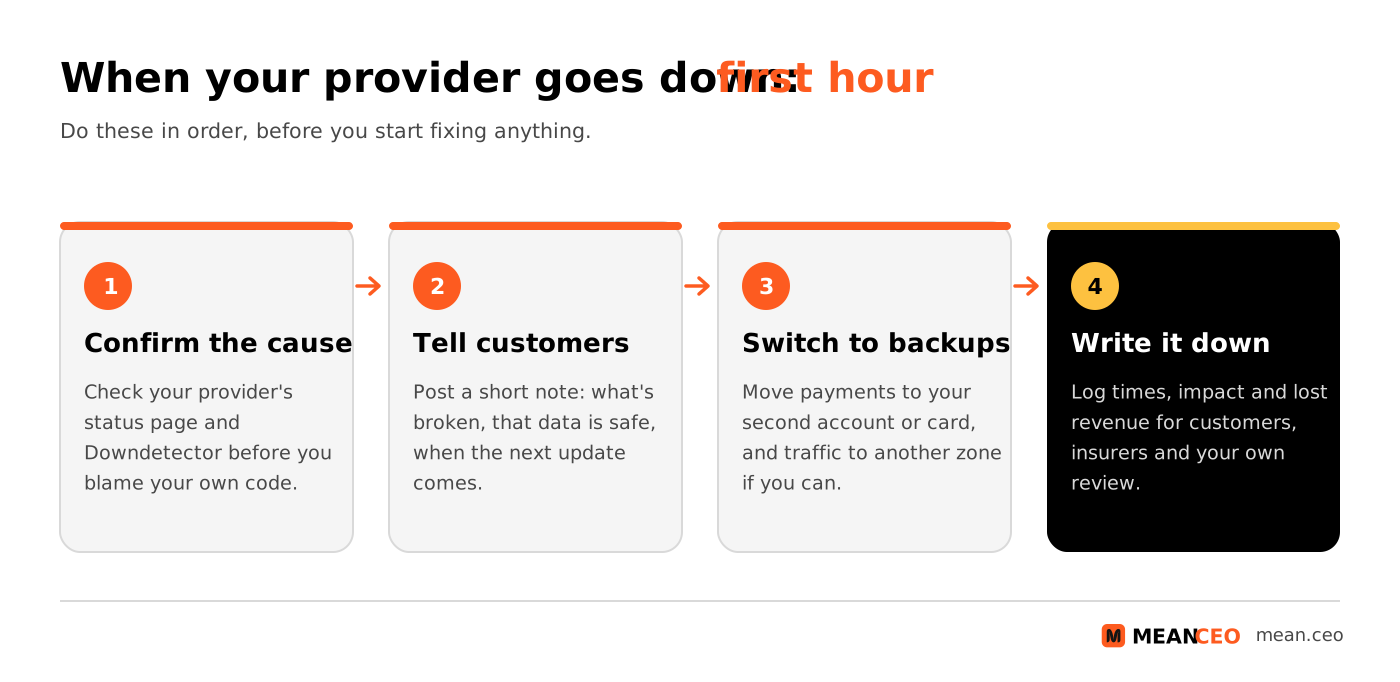
Review your startup tool stack and your back-office stack with one question: if this tool disappears for eight hours, what stops? Then fix the top three answers. For more incidents like this one, follow our cybersecurity news for October 2026.
Are you getting customers from ChatGPT yet?
More and more traffic is coming from Perplexity, ChatGPT, Grok and other AI tools.
👉 Rank on ChatGPT
FAQ: the Revolut outage
Why was Revolut down on 20 October 2026?
Revolut had a disruption affecting multiple services from the morning of 20 October. It coincided with a Google Cloud incident in its London region, which Google blamed on a power event. Reuters reported, citing a person familiar with the matter, that the two were related. Revolut hasn't publicly named the cause.
Was Revolut hacked?
No report points to a hack. Revolut said: "We can confirm that all our customers' money and data are safe." Google described the cause on its side as a power event, not an attack.
Which Revolut services stopped working?
Reports of Revolut's status page listed sign-ins, card payments, transfers, currency exchange, stock trading and live support chat as partly unavailable. Reuters also reported problems with ATM withdrawals.
What is Google Cloud europe-west2?
It is Google Cloud's London region, a group of data centres split into zones. Google said a power event caused an outage in the europe-west2-b zone, and it listed 38 affected products.
Which other companies were affected?
According to Reuters, Downdetector showed reports for Lloyds Bank, HSBC, Rightmove, DPD, NHS England and Royal Mail. Royal Mail said deliveries weren't affected. AIB and Bank of Ireland said their services ran normally.
How can a startup protect itself from a bank or cloud outage?
Keep a second business account at a different bank, add a backup card to critical tools, offer customers a second way to pay, run your app in more than one cloud zone, and host your status page on separate infrastructure.
About the Author
Violetta Bonenkamp, also known as MeanCEO, is an experienced startup founder with an impressive educational background including an MBA and four other higher education degrees. She has over 20 years of work experience across multiple countries, including 5 years as a solopreneur and serial entrepreneur. Throughout her startup experience she has applied for multiple startup grants at the EU level, in the Netherlands and Malta, and her startups received quite a few of those. She’s been living, studying and working in many countries around the globe and her extensive multicultural experience has influenced her immensely.
