TL;DR: What did Sam Altman say about RAM?
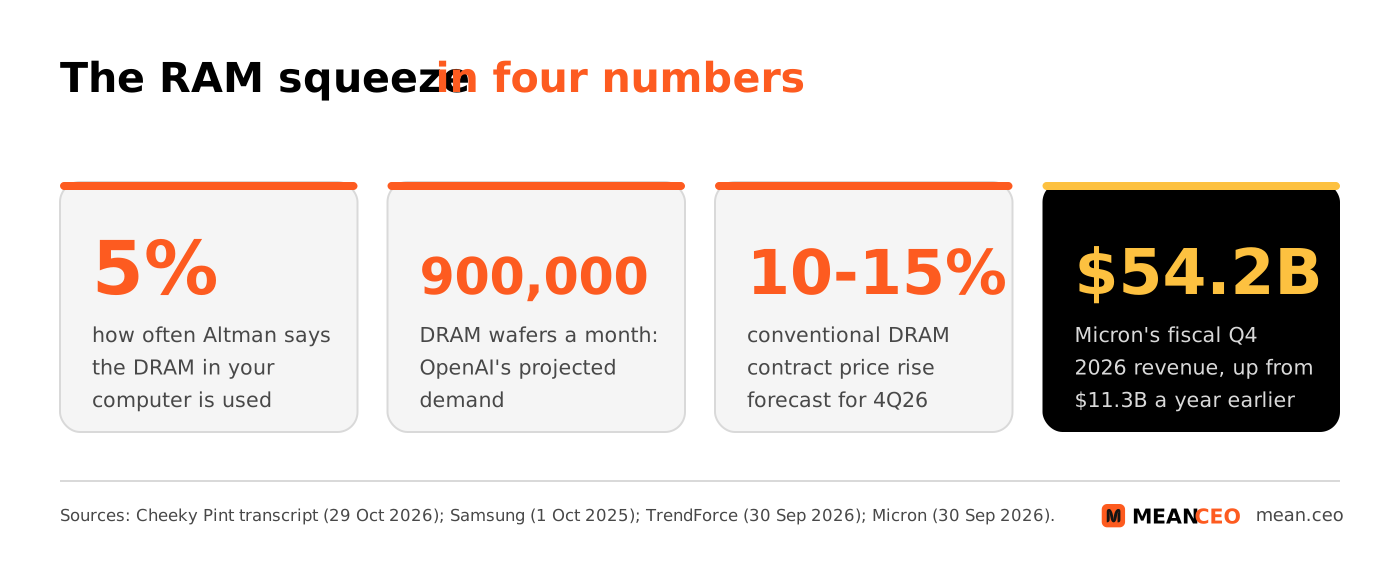
On the Cheeky Pint podcast with Stripe co-founder John Collison, published on 29 October 2026, OpenAI CEO Sam Altman said it is "quite terrible", from a global allocation view, for everybody to keep part of the world's limited DRAM supply in their own computer, used about 5% of the time. His fix: maximum utilization in cloud data centers. Critics point out that OpenAI's own buying helped cause the memory shortage. For founders the remark matters less than the market behind it: DRAM contract prices are still rising (TrendForce forecasts 10-15% for conventional DRAM in 4Q26), SK hynix expects demand to beat supply through 2030, and laptops and servers keep getting dearer.
Searches for "Sam Altman PC RAM comments" jumped 900% in the US on Friday after tech sites quoted one minute of a 52-minute interview. Most headlines turned it into "Altman wants your RAM". I read the full transcript, and the real story is the memory squeeze behind his argument, which now shapes every hardware and AI budget a small team sets for 2027.
What exactly did Sam Altman say about RAM?
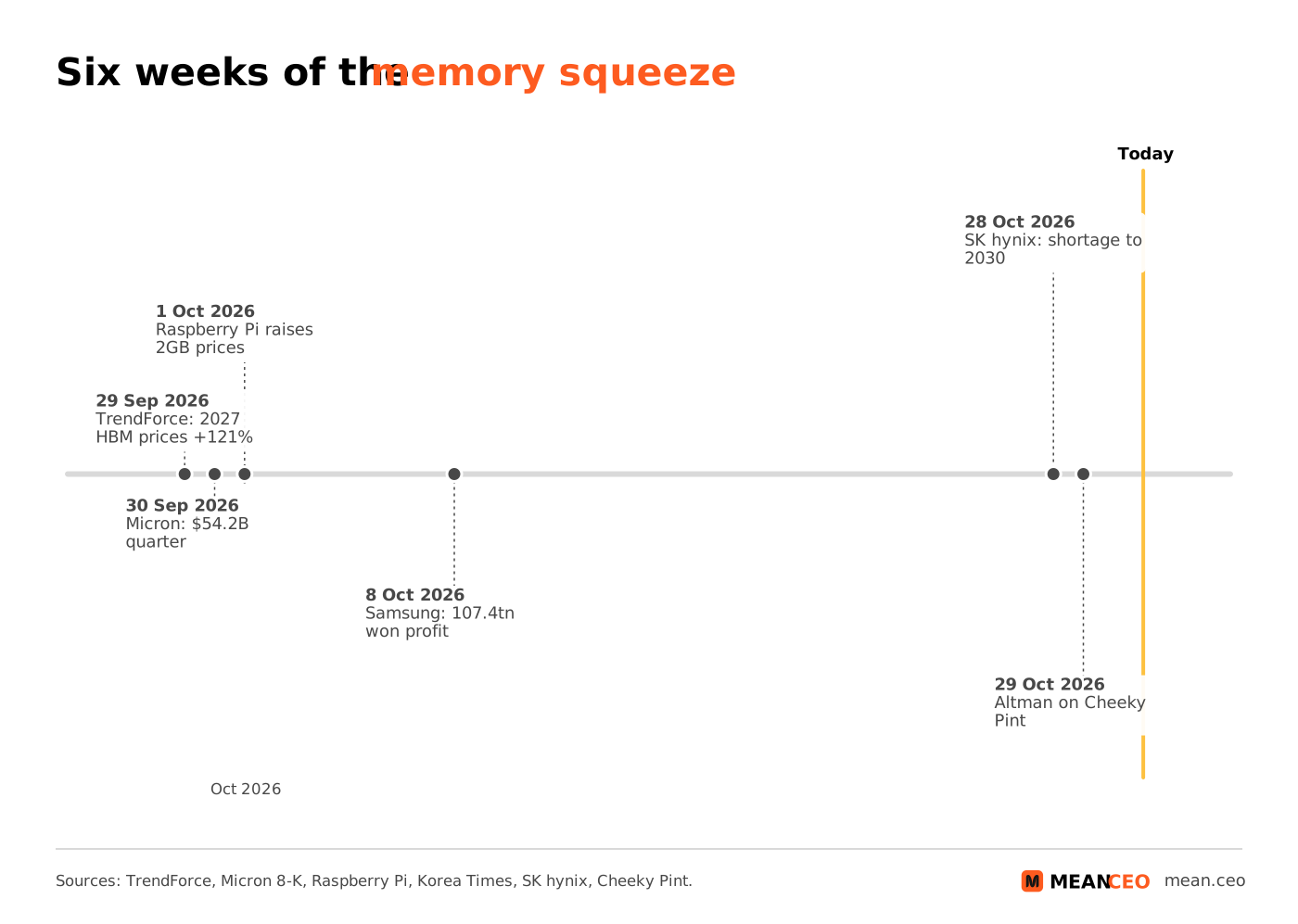
The remark sits in the "Compute" chapter of the episode Why Sam Altman is against a single superintelligence, at about the 29-minute mark. Collison asks how the compute shortage is going and whether high prices for memory and GPUs will bring new supply. Altman answers "Bad" and adds "I think the invisible hand is failing right now."
Then he turns to local AI. According to the official transcript, he said:
A lot of people want local inference. And somehow, they assume that the problem is solved now. Because, we are going to have open-source models. We're going to be able to run them on our computers. And so we're not going to need all the stuff in the data center. But from a global allocation perspective, actually, it's quite terrible to have everybody have a bunch of the world's limited supply of DRAM sitting in their own computer. And, being used... 5% of the time. You want maximum utilization in the cloud if you're trying to deal with this very supply constrained environment.
Two things get lost in the headlines. He was talking about local inference, meaning running AI models on your own machine. And he gave no source for the 5% figure. It works as a rough picture of how idle a laptop's memory is from an AI point of view, and nobody has measured it.
What else did Altman say about memory and compute?
- On memory makers: for years a DRAM maker would "invest $20 billion of CapEx to make $19 billion", and now "these guys are each going to make like $100 billion of free cash flow in a year". He says they remember near-bankruptcies from overbuilding, so they stay careful with new factories.
- On OpenAI's answer: "We made a chip", OpenAI is learning to build its own data centers, and it has a robotics program it plans to point at building more of them.
- On cost: he puts the five-year cost of a gigawatt of AI capacity at about $70 billion and says the world would be "much happier" at 20.
- On pricing: "Tokens are a kind of fake unit." He said OpenAI almost stopped pricing its next model in tokens and backed off because customers reacted so badly.
That last line deserves more attention from founders than the RAM quote. If the biggest AI vendor wants to move away from per-token pricing, the way you budget AI will change too. Our piece on AI token costs shows why bills keep rising even as per-token prices fall.
Why are critics angry about the RAM comments?
Reaction landed within a day. Tom's Hardware wrote that Altman is "really defending the company's business model", PC Gamer called it "a bit rich" given the scarcity OpenAI helped create, and Tom's Guide listed what local AI gives users: privacy, no rate limits and no subscription.
Both sides have a point. Shared hardware does get used more hours per day, which is why cloud computing won in the first place. Data centers are also built for peak demand, so their memory sits idle part of the time as well, and the 5% comparison flatters the cloud.
How tight is the DRAM market right now?
Very. Memory makers are steering factory capacity toward AI servers and HBM, the stacked DRAM that sits next to AI chips, and everything else gets less.
The TrendForce forecast says suppliers keep prioritising server products, and PC DRAM supply "could decline in 2027" as more capacity moves to servers. SK hynix says long-term contracts already cover more than half of its 2027 and 2028 capacity. Raspberry Pi blamed its October price rise on memory costs that have "risen very steeply over the past two years", and Gartner expects the sub-$500 PC to disappear by 2028.
How much of the shortage comes from OpenAI itself?
A large share of the demand, on paper. In October 2025 OpenAI signed letters of intent with Samsung and SK hynix for its Stargate data centers, and the Samsung announcement says OpenAI's memory demand is "projected to reach up to 900,000 DRAM wafers per month". Tom's Hardware estimated that at around 40% of global DRAM output. These were letters of intent, so 900,000 is a ceiling and no firm order.
So the company asking everyone else to give up local memory is also the biggest planned buyer of it. Altman can still be right about utilization, and his advice still comes from a seller's view of the market. We saw the same compute pressure at Anthropic in its leaked IPO filing.
Should founders run AI locally or in the cloud?
Measure your own utilization before you pick a side. Altman's argument holds when a machine runs a model a few minutes a day. It falls apart when a box runs batch jobs for hours, or when the data can't leave your office.
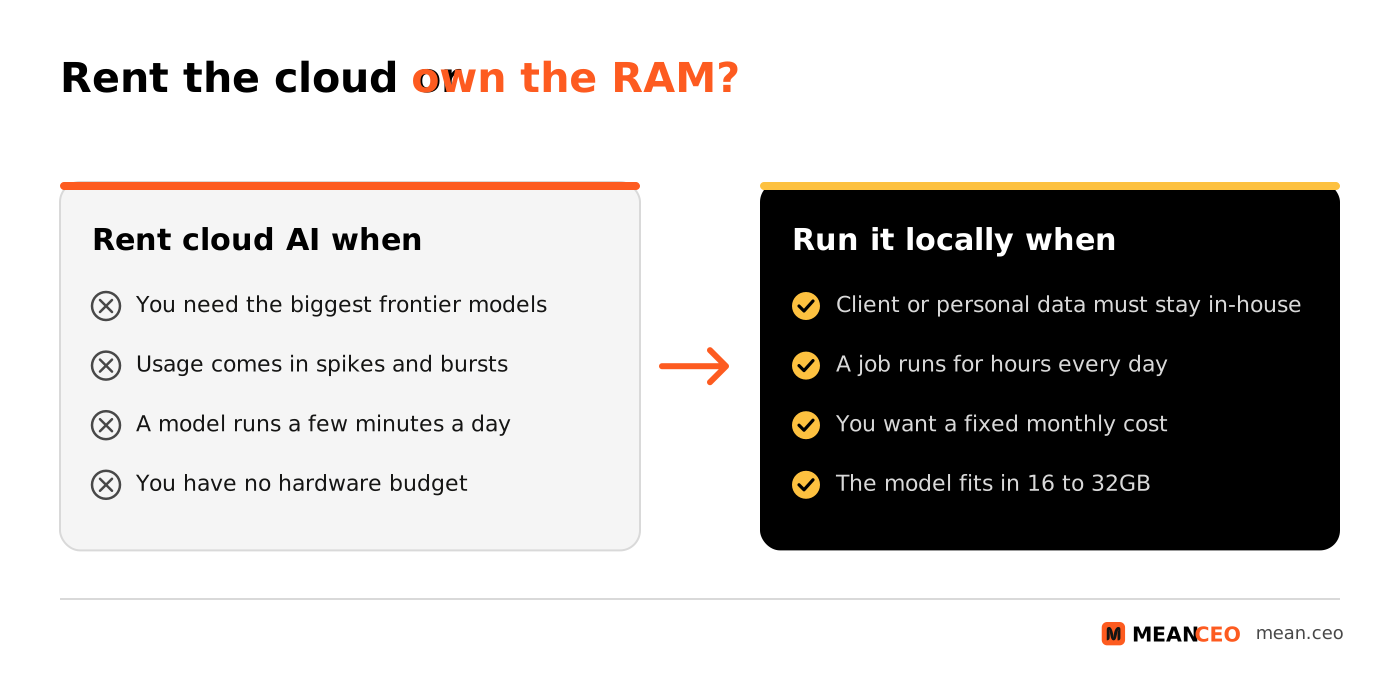
OpenAI's own open-weight model makes the local case for you. Its gpt-oss-20b model card says the model runs "within 16GB of memory" and targets "local or specialized use cases", while the larger gpt-oss-120b needs a single 80GB GPU. A 16GB or 32GB laptop handles a model like that for drafting, classification or private document search. Open models bring their own risks, as the Qwen upload test showed, so sandbox them like any other agent.
For European teams there is a privacy bonus: personal data processed on your own machine never reaches an AI vendor, so there is no extra processor to vet under the GDPR. And the cloud has its own failure mode, as the Revolut outage showed when a Google Cloud power failure in London froze cards and transfers.
What should founders do about the RAM squeeze now?
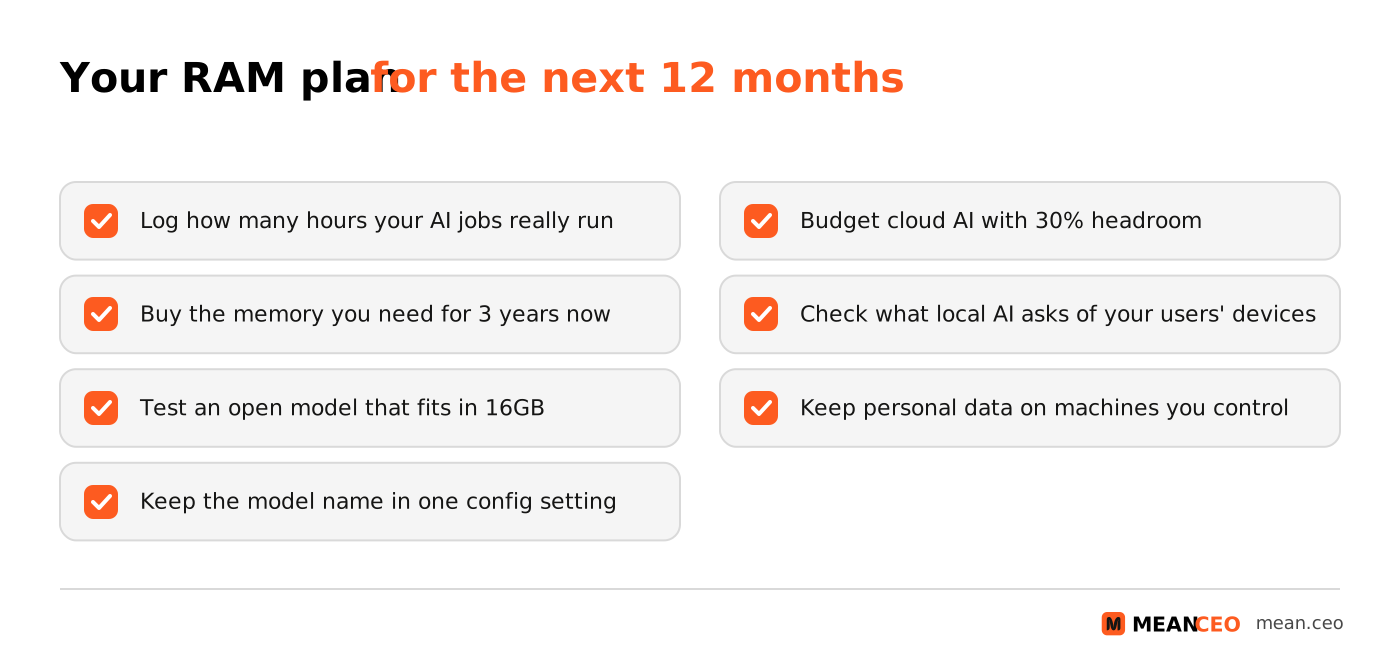
Next steps, in the order I'd take them:
- Log your real AI hours. For two weeks, note how long local models and AI jobs actually run on each machine. Under an hour a day points to the cloud, several hours a day points to owning the hardware.
- Buy the memory you need for three years now. TrendForce and SK hynix both expect supply to stay tight through 2027 and beyond, so waiting for cheaper RAM is a bet against the people who make it. Order team laptops with 32GB instead of 16GB if you plan any local AI.
- Test one open model locally. Run a 16GB-class model such as gpt-oss-20b on a real task, like tagging support tickets, and compare quality and cost with your cloud API.
- Keep the model switchable. Put the model name and provider in one config setting so moving between a local model and GPT-6.1 Terra or Claude takes one change.
- Budget cloud AI with headroom. Memory costs feed into data center costs, and Altman wants to move away from token pricing. Plan 30% above your current bill and lock in credits while vendors still hand them out, as with ChatGPT Pro's API credits.
- Check what your product asks of users' devices. If your app runs AI on the customer's laptop or phone, test it on the cheapest machine your customers use and ship a cloud fallback for devices without enough memory.
- Keep personal data local where you can. Client files, contracts and HR data are the strongest case for on-device AI, and they keep your GDPR paperwork short.
Are you getting customers from ChatGPT yet?
More and more traffic is coming from Perplexity, ChatGPT, Grok and other AI tools.
👉 Rank on ChatGPT
Is Sam Altman right about RAM?
On the arithmetic, partly. A chip running AI around the clock in a data center does more work than one waiting in a laptop, and the memory shortage is real. On the advice, he speaks as the buyer of the largest planned share of that memory and the seller of the cloud alternative.
My take: treat memory like any scarce input. Rent it for spikes, own it for steady work and private data, and stop assuming either one gets cheap again soon. More of this month's AI news is in our October 2026 AI news roundup and the AI price war overview.
FAQ: Sam Altman's RAM comments
What did Sam Altman say about RAM?
On the Cheeky Pint podcast published on 29 October 2026, he said it is "quite terrible", from a global allocation view, for everyone to keep the world's limited DRAM in their own computers, used about 5% of the time, and that cloud data centers use it better.
Where did Sam Altman make the RAM comments?
In an interview with Stripe co-founder John Collison on his Cheeky Pint podcast, in the "Compute" chapter at about 29 minutes. The episode is titled "Why Sam Altman is against a single superintelligence".
Is Sam Altman saying people shouldn't own RAM?
He argued that running open-source AI models locally uses scarce memory less well than shared cloud servers do, and he proposed no limits on what people buy.
Why is RAM so expensive in 2026?
Memory makers are moving capacity to AI servers and HBM. TrendForce forecasts conventional DRAM contract prices up 10-15% in the fourth quarter of 2026, and SK hynix expects demand to exceed supply through 2030.
Did OpenAI cause the RAM shortage?
It is one of the biggest buyers. Samsung said in October 2025 that OpenAI's memory demand is projected to reach up to 900,000 DRAM wafers a month, under non-binding letters of intent.
How much RAM do you need to run AI locally?
OpenAI says its open-weight gpt-oss-20b model runs within 16GB of memory, while gpt-oss-120b needs a single 80GB GPU. For local AI on a work laptop, 32GB gives room for the model and your other apps.
About the Author
Violetta Bonenkamp, also known as MeanCEO, is an experienced startup founder with an impressive educational background including an MBA and four other higher education degrees. She has over 20 years of work experience across multiple countries, including 5 years as a solopreneur and serial entrepreneur. Throughout her startup experience she has applied for multiple startup grants at the EU level, in the Netherlands and Malta, and her startups received quite a few of those. She’s been living, studying and working in many countries around the globe and her extensive multicultural experience has influenced her immensely.
