TL;DR: How to Recover from Google Algorithm Updates
Google announced five core updates and five spam updates between March 2025 and October 2026, each with start and end dates on its Search Status Dashboard. A drop during one of them doesn’t automatically mean your site is bad. Wait until the rollout ends plus a week, compare the same days before and after in Search Console, rule out manual actions and technical faults, then improve the pages that actually lost, for readers rather than for the algorithm. Google says recovery can take several months, sometimes until the next core update.
💡 Ready for smarter SEO strategies? Dive into SEO for Organic Traffic and learn how startups succeed without backlinks.
How to Recover from Google Algorithm Updates: Insights for Startup Founders
Recovering from Google algorithm updates requires a mix of strategic analysis, content refinement, and technical adjustments. For startup founders in Europe, this task carries unique complexity due to constrained resources, cultural barriers, and emerging AI search challenges. Yet, if tackled correctly, recovering from algorithm updates can become a turning point for growth. Here's how you can navigate this situation effectively.
"Google’s preference for quality content and seamless user experiences isn’t new, but in 2026, it’s non-negotiable. Algorithm updates don’t punish; they expose weaknesses."
Recovery usually comes down to finding where your pages fall short of what Google calls “helpful, reliable, people-first content”, and fixing that without panicking. Whether your rankings were hit by thin content, weak trust signals, a spam-policy problem or a mismatch with search intent, this guide walks bootstrapped European founders through the diagnosis and the fixes, using Google’s own guidance and the updates of 2025 and 2026.
Boost Your SEO by Publishing Your Startup Press Release with us.
We publish content about startups, education, tech, funding, etc. that ranks well not only in Google but also in Perplexity, ChatGPT, Grok and other AI tools.
👉 Publish Press Release
What Happens When Google Updates Its Algorithm?
Google changes Search all the time: in 2023 alone it ran more than 700,000 experiments that led to over 4,000 improvements, according to its How Search Works pages. Most of those changes are small and silent. The ones that visibly move rankings are the announced updates. Core updates reassess content broadly and, in Google’s words, “don't target specific sites or individual web pages”. Spam updates demote pages that break Google’s spam policies. Each one is listed with its start and end dates on the Google Search Status Dashboard.
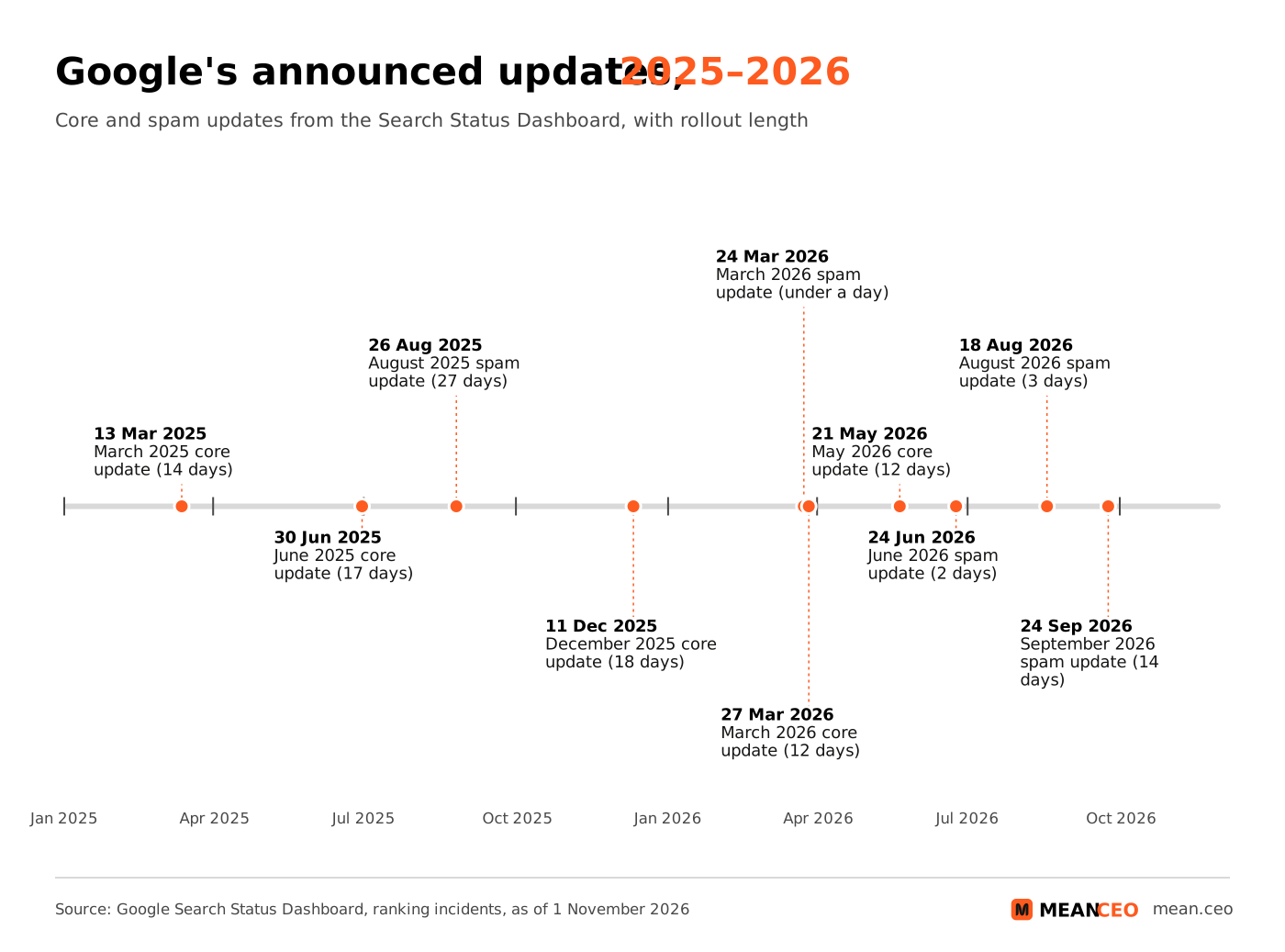
Since January 2025, Google has announced five core updates (March, June and December 2025; March and May 2026) and five spam updates (August 2025; March, June, August and September 2026), plus a Discover-only core update in February 2026 that started with English-language users in the US. Core updates took 12 to 18 days to roll out; spam updates took anything from under a day to 27 days. No core update had been announced by the end of October 2026 since the May 2026 one finished on 2 June. Google also releases smaller core updates without announcing them, so not every wobble has a name.
Core Update, Spam Update or Manual Action?
The fix depends on what hit you, so name it first:
Sources: Google Search Central documentation on core updates, spam updates and manual actions.
In Europe there’s a second layer. Since 2024 Google has been changing its result pages in the EU and EEA to comply with the Digital Markets Act. By Google’s own account, free direct booking clicks for some airlines, hotels and small retailers fell by as much as 30% after its first changes; the European Commission fined Google €460 million for self-preferencing in Search in July 2026, and in September 2026 Google began another revamp of its EU results, according to Reuters. On 30 August 2026 Google also stopped applying site reputation abuse manual actions to searches in the EEA after talks with the Commission, and AI Overviews and AI Mode now run in every EU country. So a European traffic drop can come from a new layout or AI answers rather than an algorithm update. Startups relying on outdated SEO tactics, thin content or keyword stuffing are still the most exposed when a core update lands.
Step-by-Step Recovery Plan
1. Diagnose the Traffic Drop
Start in Google Search Console, not in a rank tracker. Google recommends waiting at least a full week after a core update completes before analysing, then comparing that week with a week before the rollout started. Compare the same days of the week, look at pages and queries separately, and check the last 16 months to rule out seasonality. Since November 2025 you can add custom annotations to the Performance report, so mark each update’s start and end on your chart. Then open the Manual actions and Security issues reports: if either shows a problem, that’s your priority, not the update.
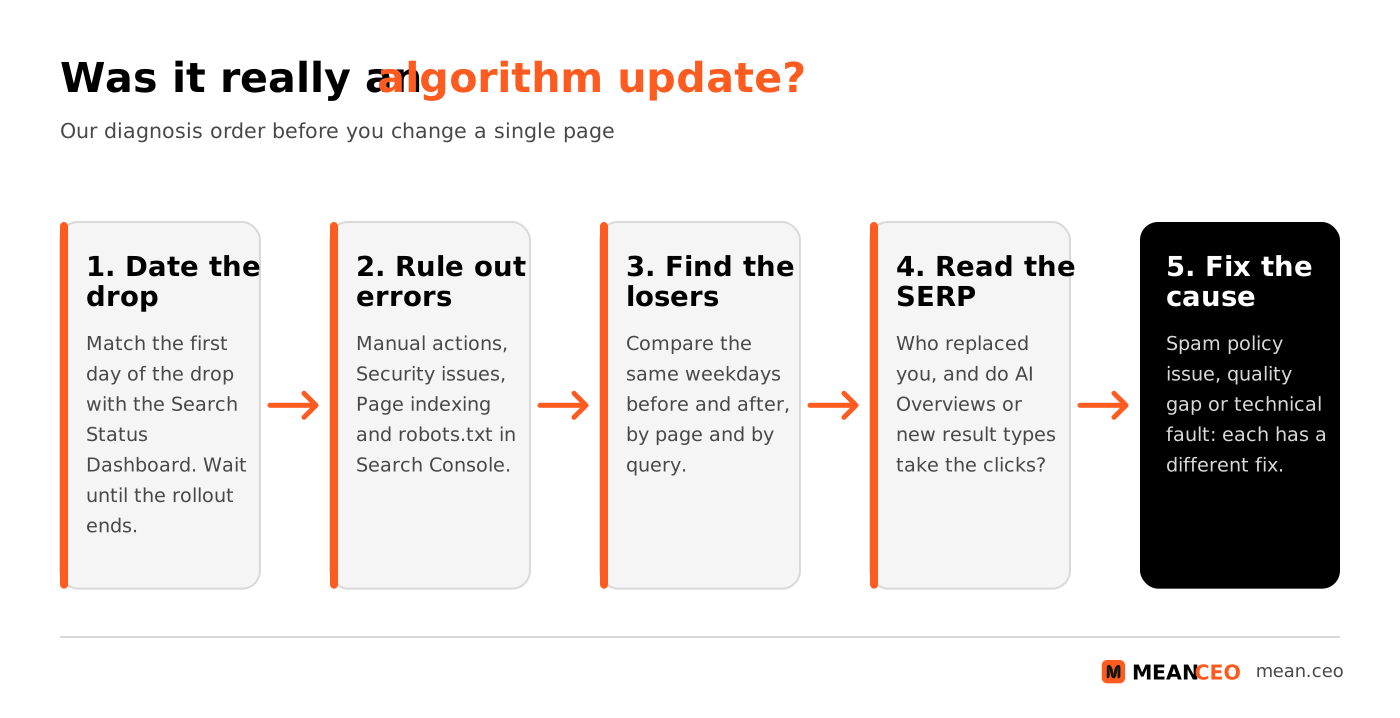
Sources: Google’s guide to debugging search traffic drops and core updates page; our assessment. Google’s rule of thumb: a small drop, such as from position 2 to 4, needs no drastic action; a large one, such as from 4 to 29, needs a deeper assessment. If you’re new to the tool, our guide to Google Search Console metrics that matter shows where each report lives, and SEO analytics for non-marketers covers the rest of your data. If clicks fell while rankings held, read our roundup of AI search traffic studies.
2. Understand Competitor Content Shifts
Analyze competitors who overtook your rankings. What content updates have they made? Look for improved topic depth, freshness, and structure. Google's updates reveal what it prioritizes, giving you a roadmap. Utilize a strategic Competitor Content Analysis to reverse-engineer their approach.
3. Evaluate Your EEAT Signals
E-E-A-T stands for experience, expertise, authoritativeness and trustworthiness; Google added experience in December 2022. Google says E-E-A-T itself isn’t a specific ranking factor, but its systems use a mix of factors to find content that shows these qualities, and trust matters most. In practice: name the author, explain why they know the topic, show first-hand experience such as your own data, screenshots and results, give sources for numbers and keep facts current. If your authority is weak, collaborate with practitioners or add your own data rather than generic advice.
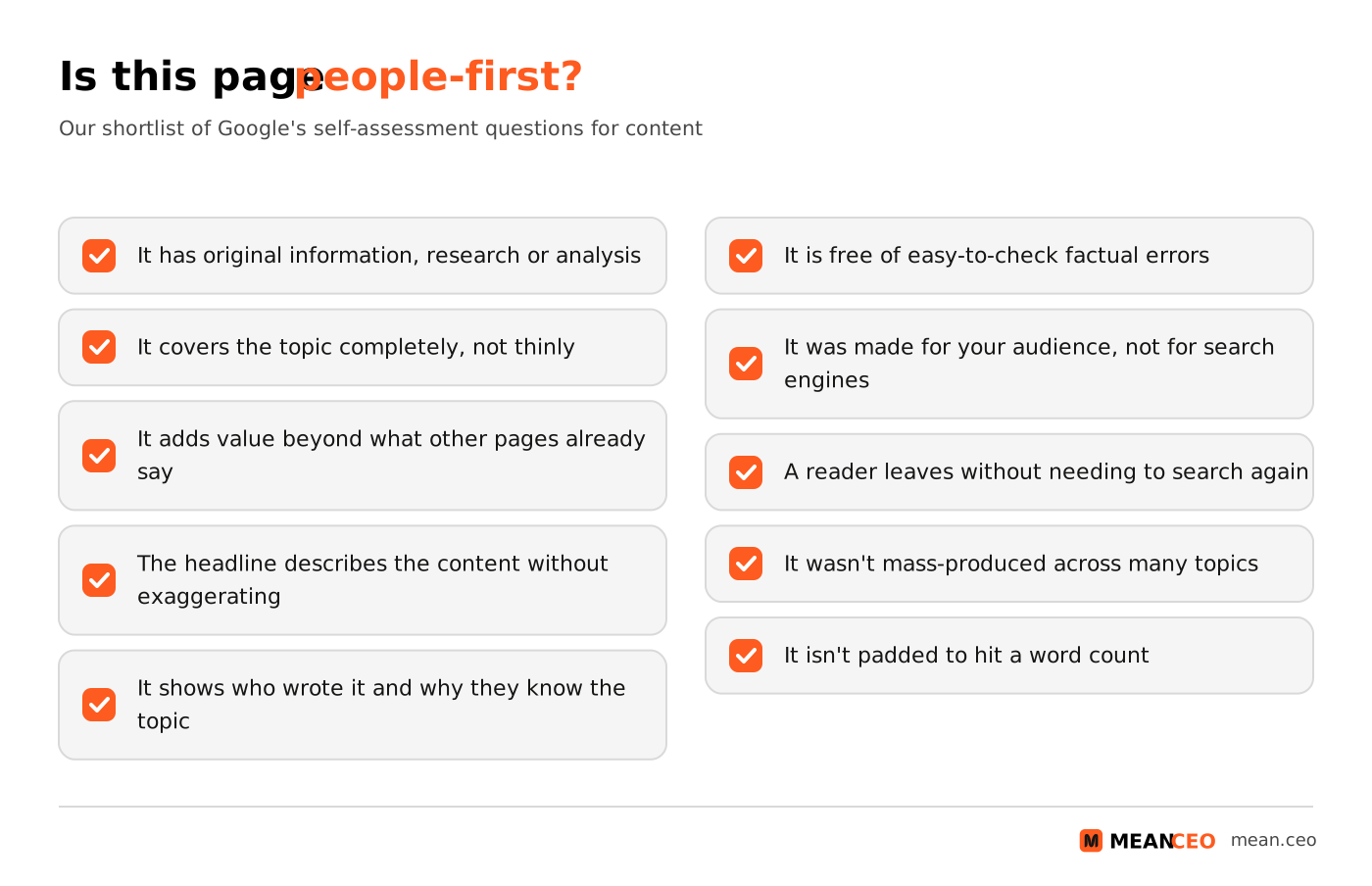
Google’s helpful content page lists more such questions, from whether the content provides original information, reporting, research or analysis to whether the page title avoids exaggerating. Run the pages that lost most through them honestly. Our guide to writing for SEO without sacrificing quality shows how to fix what they reveal.
4. Enhance Technical Performance
Technical SEO is critical. Fix the errors flagged in Search Console and check Core Web Vitals. Google’s “good” thresholds are a Largest Contentful Paint within 2.5 seconds, an Interaction to Next Paint under 200 milliseconds (INP replaced First Input Delay on 12 March 2024) and a Cumulative Layout Shift under 0.1. Make sure every key page works on a phone. Our technical SEO checklist for startup websites lists the checks, and the SEO Recovery Playbook explains how to address technical gaps quickly. Learn practical fixes to regain lost traffic.
5. Update Content Strategically
Thin or outdated content is a common culprit for declines. Refresh posts with comprehensive, reader-centric updates. Add new sections, bring in fresh data, and ensure all content aligns with user intent. If you’re unfamiliar with this process, explore how to Update Old Content for Better Rankings. Google’s own advice is to avoid “quick fix” changes and to treat deleting content as a last resort: improve, merge or redirect weak pages instead, and build content clusters that cover your niche properly.
6. Check for Spam-Policy Problems
If the drop came with a spam update, quality tweaks won’t help. Look for the patterns Google’s spam policies name: scaled content abuse (many pages generated mainly to rank, however they’re made, AI included), expired domain abuse, and site reputation abuse (third-party pages hosted on your domain to borrow its rankings). Fix or remove those pages. Google says a site can improve once its systems learn over a period of months that it complies, but benefits lost from link spam don’t come back. Our analysis of Google’s September 2026 spam update lists the usual suspects.
7. Give It Time and Track It
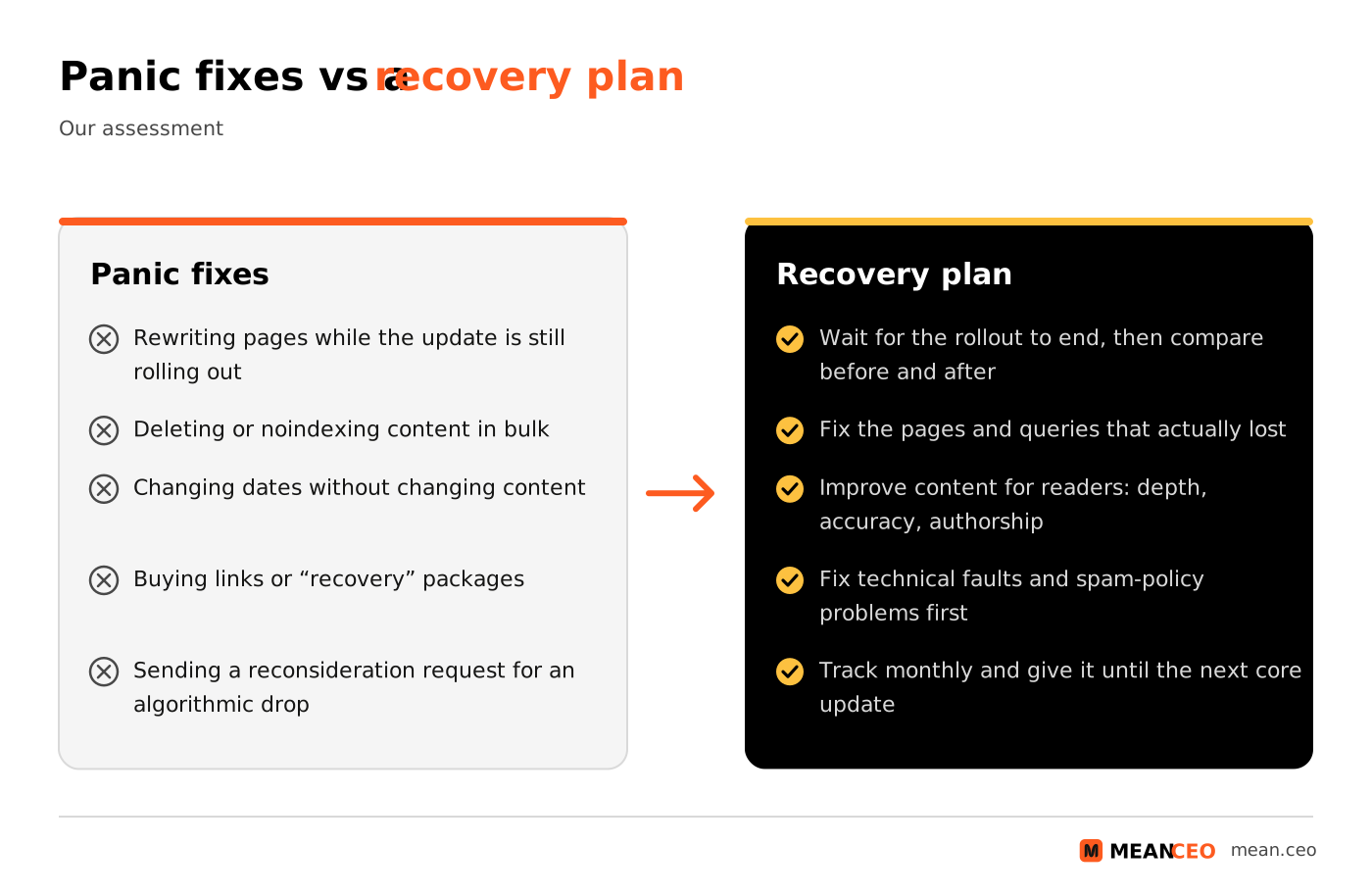
Source: Google’s core updates guidance; the order is our assessment. There’s no guarantee: Google says changes won’t necessarily have a noticeable impact, because other pages may simply serve searchers better. That’s why the tips below include channels Google doesn’t control.
European founders face SEO challenges tied to multiple languages and niche audiences. Strategic content updates not only recover rankings but also diversify traffic sources.
Tips for Effective Recovery
- Track progress weekly to spot any rebound in impressions, clicks and rankings, and annotate every update in Search Console.
- Focus on user experience: simple navigation, speed and clear formatting.
- Use AI tools to speed up audits and research, but don’t mass-produce pages with them: the scaled content abuse policy applies however content is made.
- Build topic authority by expanding coverage in your niche, cementing your position as an expert.
- Write each language version natively; our guide to multi-country SEO for European startups covers hreflang and local keywords.
- Build channels Google doesn’t control, such as an email list, a community and partners, so one update can’t sink you.
Common Mistakes Startup Founders Make
Mistake #1: Ignoring Root Causes
Instead of reacting emotionally to a traffic drop, investigate its underlying cause. Was it an alignment issue with Google's preference for quality? Technical errors? Keyword mismatch? Premature changes without diagnosis often worsen outcomes.
Mistake #2: Relying on Old SEO Tactics
Keyword stuffing and backlinks alone no longer suffice. Shift towards intent-driven content with a clear structure, honest authorship and useful extras such as tables, calculators or your own data. Structured data still helps Google understand pages, but it won’t rescue thin content. In 2026, SEO is more about user trust and engagement than static mechanics.
Mistake #3: Overlooking Technical Debt
Technical oversights, slow page load times, JavaScript errors, non-responsive designs, prevent recovery. Make quarterly audits integral to your process, especially for startups in hypercompetitive industries.
Mistake #4: Panic Changes During the Rollout
Rewriting dozens of pages while an update is still rolling out makes it impossible to tell what worked. Wait for the rollout to end, measure, then change the pages that lost, one batch at a time.
Mistake #5: Asking Google to Reconsider an Algorithmic Drop
A reconsideration request is for manual actions and security issues only. If Search Console shows no manual action, there’s nothing to reconsider; the fix is improving the site. Google also doesn’t offer one-to-one help with rankings: the Search Central Help Community is the place to ask.
Conclusion: The Post-Recovery Opportunity
Algorithm updates aren't setbacks; they’re opportunities. Use recovery as a gateway to improve content quality, strengthen user trust, and refine technical precision. For bootstrapped startups, focusing on low-cost, impactful actions provides an edge over resource-heavy competitors.
If you’re feeling overwhelmed by Google’s evolving search priorities, adopt ready strategic frameworks to future-proof your SEO process. Transitioning to SEO for Organic Growth Without Backlinks can help you dominate your niche and thrive beyond recovery efforts, and semantic SEO shows how to rank without a link budget.
Are you getting customers from ChatGPT yet?
More and more traffic is coming from Perplexity, ChatGPT, Grok and other AI tools.
👉 Rank on ChatGPT
People Also Ask:
What is the best way to recover from a Google algorithm update?
Wait until the update has finished rolling out, then give it at least a full week before comparing performance with a week before the rollout started. Find the pages and queries that lost, rule out manual actions and technical errors in Search Console, then improve those pages for readers: depth, accuracy, clear authorship and a good page experience. Google says it can take several months for its systems to recognise improvements, and sometimes until the next core update.
Why does Google update its algorithms?
Google updates its algorithms to enhance search quality and deliver better answers to users. These adjustments aim to combat spam, improve relevance of search results, and ensure websites offering misleading information or poor user experiences don't rank highly. Major updates, such as Core Updates, often realign ranking signals to reflect new standards for content authenticity, technical optimization, and user satisfaction. Google's goal is to continually refine its ability to present the most trustworthy and useful information.
How can businesses prepare for future Google algorithm updates?
Preparing for Google updates involves maintaining a continuous improvement mindset. Focus on creating high-quality, user-centric content that aligns with current web standards. Keep your site technically optimized for speed, mobile compatibility, and security. Track industry news to anticipate algorithm trends and apply best practices for SEO, such as fixing crawl errors, maintaining structured data, and staying updated on spam policies. Regular auditing and a proactive approach can ensure resilience against future updates.
What is Google's E-E-A-T principle?
E-E-A-T stands for experience, expertise, authoritativeness and trustworthiness. It comes from Google’s Search Quality Rater Guidelines, which added experience in December 2022. Google says E-E-A-T itself isn’t a specific ranking factor, but its systems look for content that shows these qualities, and trust is the most important. Show who wrote a page, why they know the topic, first-hand experience and sources for your facts.
How can small startups use Google updates to grow?
Each core update reshuffles results, which opens room for smaller sites with original, first-hand content. Startups can win by publishing what big competitors can’t: their own data, customer stories and niche expertise, in every language they serve. Use AI and keyword tools to save research time, but keep every page useful and reviewed by a person.
Can Google Support help after an algorithm update?
Not with rankings. Google doesn’t offer one-to-one support for ranking drops, and its Search Central office hours aren’t meant for site-specific questions. You can ask in the Search Central Help Community, where product experts and experienced site owners answer. If Search Console shows a manual action, fix it and send a reconsideration request; that’s the review process Google offers for penalties.
What tools can improve website rankings after a Google penalty?
Start with free tools: Google Search Console (Performance, Manual actions, Page indexing and Core Web Vitals reports), PageSpeed Insights and Google Analytics. Screaming Frog’s free version crawls up to 500 URLs for technical audits, and Semrush or Ahrefs show which competitors gained when you lost. Tools only diagnose; the recovery comes from fixing the pages. Our list of SEO tools for bootstrapped founders compares the options.
FAQs on Recovering from Google Algorithm Updates
How can I identify if my site was impacted by an algorithm update?
Check Google Search Console for drops in clicks and impressions that start in the first days of an update, then compare them with the dates on Google’s Search Status Dashboard, which lists every announced core and spam update with its start and end. Wait until the rollout is complete before drawing conclusions.
Can competitors help me understand ranking changes after an update?
Yes, analyzing competitors can provide clarity. Study who replaced you in rankings, their content depth, and their website’s usability improvements. Use tools to benchmark changes and adapt accordingly. Learn more about competitor analysis techniques in insights like the Google Core Update Playbook.
What are EEAT signals, and why are they important?
E-E-A-T stands for experience, expertise, authoritativeness and trustworthiness. It isn’t a single ranking factor, but Google’s systems look for content that shows these qualities. Strengthen it with real author bios, first-hand experience, sources for your facts and a secure, up-to-date site.
How do Google's updates affect AI tool visibility?
Google’s AI Overviews and AI Mode build their answers from pages in Google’s index, so a ranking drop can also mean fewer citations there; Search Console’s generative AI performance reports, available to all sites since August 2026, show this. Assistants such as ChatGPT rely on other search indexes, so watch them separately. Learn more about the link between Google rankings and AI in AI Search Dependence Insights.
What technical SEO fixes should I prioritize when recovering?
Focus on eliminating site errors flagged in Search Console, improving Core Web Vitals, ensuring mobile responsiveness, and optimizing crawl efficiency. Timely technical audits enhance recovery speed and maintain rankings.
Are old SEO tactics like keyword stuffing still valid?
No. Tactics like keyword stuffing harm rankings under new algorithms. Instead, optimize content around user intent, incorporate structured data, and prioritize readability. Google's recent updates favor high-quality, user-centered content over outdated methods.
What role does on-page SEO play in recovering rankings?
On-page SEO remains crucial. Focus on keyword optimization, clear content hierarchy, and internal linking to improve relevance and user experience. Startups failing at on-page SEO often miss opportunities, learn strategies with this SEO Guide for Startups.
How can I future-proof against algorithm updates?
Create evergreen, user-first content emphasizing long-term quality. Regularly audit for technical issues, maintain EEAT signals, and avoid shortcuts. Diversify traffic sources so updates impact less critical areas of your digital presence.
What’s the importance of analyzing traffic patterns post-update?
Analyzing traffic patterns reveals affected pages, informs corrective actions and shows which content Google favours. Custom annotations in Search Console, available since November 2025, let you mark update dates on the chart while you track recovery over time.
Can poor UX impact rankings after an update?
Yes. Slow load times, clunky navigation and intrusive pop-ups or ads hurt page experience and make readers leave. Use feedback tools and analytics to improve user satisfaction and engagement, which makes your pages more resilient during updates.
About the Author
Violetta Bonenkamp, also known as MeanCEO, is an experienced startup founder with an impressive educational background including an MBA and four other higher education degrees. She has over 20 years of work experience across multiple countries, including 5 years as a solopreneur and serial entrepreneur. Throughout her startup experience she has applied for multiple startup grants at the EU level, in the Netherlands and Malta, and her startups received quite a few of those. She’s been living, studying and working in many countries around the globe and her extensive multicultural experience has influenced her immensely.
