TL;DR: Should a bootstrapped founder drop SEO for GEO?
No. A week of new studies says the opposite. Across 100 websites, ChatGPT sent just 0.62% as many sessions as Google organic search, and Google still drove 96.5% of conversions. A UK benchmark of 95 websites found organic search sent 39 times more traffic than all AI assistants together, and that growing organic by 5% would bring more sales than doubling AI traffic. AI visitors do convert well, and AI answers are worth showing up in, but mostly as a brand channel. The page features that get you cited by ChatGPT and Google's AI Mode, according to a German study of 96,418 URLs, are plain good SEO: structure, tables, FAQs, an author box and a current title. llms.txt showed no measurable advantage.
If you run a small startup, someone has probably tried to sell you GEO this year: generative engine optimisation, AI visibility tracking, prompts to monitor, a dashboard of how often ChatGPT mentions your brand. The pitch is simple. Google is dying, so move your budget to AI search.
This week, the data pushed back. Between 19 and 22 October 2026, five sets of numbers landed from SEO consultants and tool makers, and they mostly point the same way. AI search is real, but for most websites it's still a rounding error next to Google.
What happened
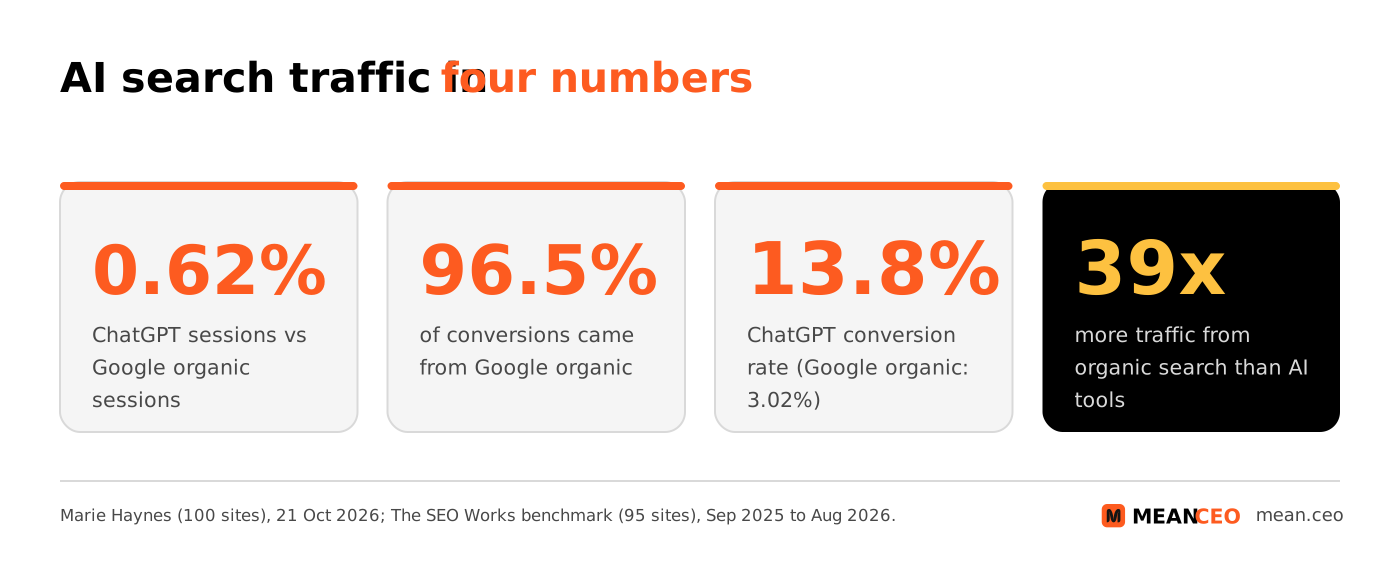
On 21 October 2026, SEO consultant Marie Haynes published "GEO is a distraction". She looked at 12 months of GA4 data from 100 websites of different sizes, with more than 145 million sessions in total. Sessions from ChatGPT added up to 0.62% of the sessions Google organic search sent. Adding every other LLM only lifted that to 0.73%.
Her conversion numbers are the twist. Of the 55 sites that tracked conversions, ChatGPT visitors converted at 13.8% and Google organic visitors at 3.02%, so more than 4.5 times better. Yet Google organic still drove 96.5% of the conversions she analysed, and 27 times more than all LLMs combined. She also found that ChatGPT's referral growth stopped being exponential in August 2025, around the GPT-5 release, and has fallen since. Her summary: "The AI search that is actually sending people to businesses today isn't ChatGPT. It's Google."
One detail stood out to us more than any headline number: 45 of her 100 randomly chosen sites didn't track a single key event. If you can't see your conversions, you can't judge any channel, AI or not.
The rest of the week filled in the picture:
- 19 October: Kevin Indig asked in his Growth Memo whether AI drives more Direct traffic. Across 12 GA4 properties, total Direct traffic rose 140.9% from January to September, but engaged Direct changed by −1.0%. Most of the jump was bots: one site logged 409,000 Direct sessions, of which only 198 were engaged.
- 21 October: Semrush found that AI Overviews now appear on 88% of the 400 commercial keywords it tracks (US desktop data), up from 45.75% in September 2025, and on 97.08% when weighted by search volume.
- 22 October: German SEO tool maker SISTRIX published its Citation Worthiness study of what cited pages have in common. The same day, Mike King of iPullRank and Rand Fishkin of SparkToro answered Haynes, and Search Engine Roundtable summed it up as studies suggesting AI visibility is "not worth investing in".
A UK agency study got a second life in the same debate. The SEO Works' AI Referral Traffic Benchmark first came out on 7 September and was updated on 14 October. It covers 95 websites from September 2025 to August 2026: 2,825,594 organic sessions against 72,095 AI referral sessions.
The numbers side by side
Sources: the studies linked in this article, read 24 Oct 2026.
These are small, self-selected samples. The Haynes dataset gives no industry mix or conversion definitions, the SEO Works sites are one agency's clients, and "conversions" means GA4 key events, not revenue. None of the studies can separate clicks from Google's AI Overviews, which arrive as ordinary organic sessions. Still, when five different datasets land in the same place, it's worth listening.
AI visitors convert better. Mostly.
The best argument for AI search is quality, and The SEO Works backs it up, with caveats. AI referral traffic converted at 7.18% against 6.08% for organic, about a fifth better. But the ratio depends on what you compare it with: 0.67x against paid search, 1.18x against organic, 1.37x against all sessions and 2.48x against direct. AI traffic converted worse than organic on 23 of the 63 websites with conversion data, and five sites recorded no AI conversions at all.
Source: The SEO Works AI Referral Traffic Benchmark (pooled ratios), read 24 Oct 2026.
Look at the last row. B2B product websites got the most AI traffic relative to organic, and it converted worst. If you sell software to businesses, that's a reason to measure, not assume.
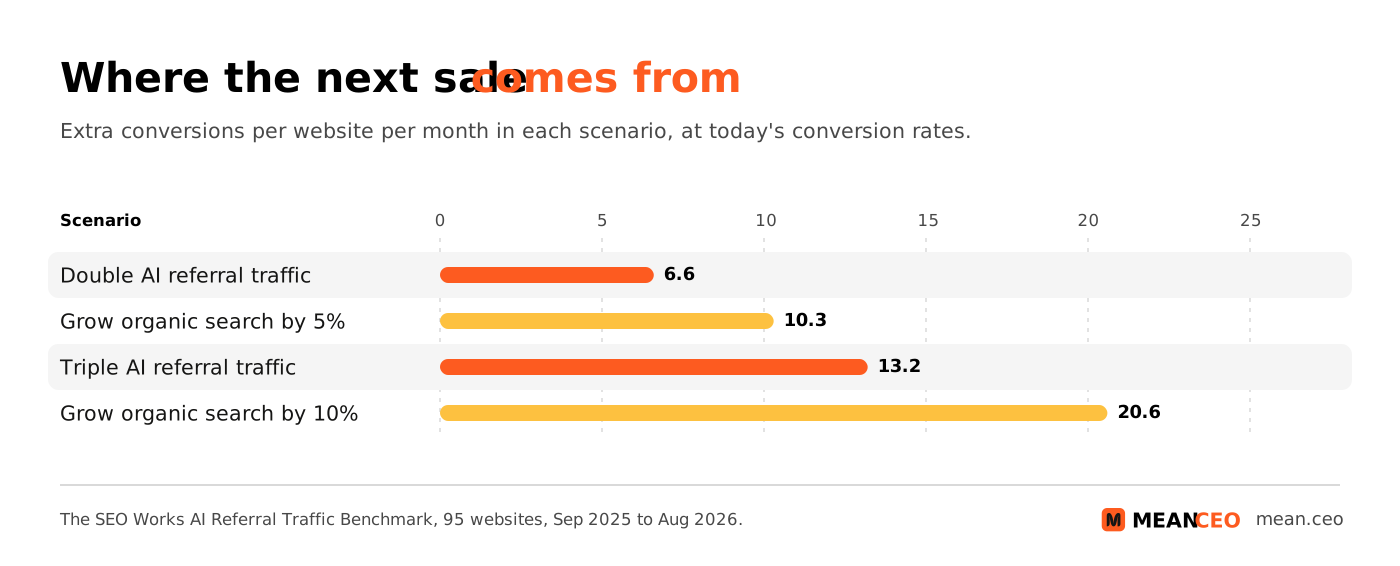
The volume gap is what kills the GEO-first plan. In The SEO Works' scenarios, doubling AI referral traffic adds 6.6 conversions per website per month. Growing organic search by just 5% adds 10.3. Doubling organic adds 205.8. In the agency's words: "A 5% improvement in organic search performance would deliver more additional conversions than doubling AI referral traffic."
The SEO Works also found that AI referrals tend to grow on the same sites where organic grows (a correlation of +0.557 across 61 websites), and saw no sign that AI growth lifts Direct traffic. Indig reached a similar result from another angle: in 632 tests on four brands, he found no reliable link between AI visibility and later branded search or Direct visits. "Some companies with outstanding AI growth might be able to detect this," he wrote, but he couldn't across his 12 sites.
The case for AI search: it's a billboard
Not everyone reads the data as "ignore AI". Mike King of iPullRank replied the next day: "The numbers are right. The category is wrong." His point is that AI answers work like brand advertising. ChatGPT now reaches 1.2 billion weekly users, and people increasingly get their answer without clicking at all. King cites Semrush figures of roughly 34% of sessions ending without a click with no AI Overview, about 43% with one, and about 93% in AI Mode. Judging that channel by referral clicks, he argues, is like judging TV by its click-through rate.
Rand Fishkin agreed on both counts. He noted that ChatGPT's 0.62% is less traffic than DuckDuckGo sends, and called AI "a digital billboard if you will" that should be invested in and measured as one.
Semrush's data shows why that matters even for Google traffic. AI Overviews appeared on just 30.14% of "reviews" searches in September 2025; by August 2026, every commercial modifier it tracked sat between 82.05% and 96.12%. "Best X for Y" searches topped the list. Ecommerce price and cost searches went from 4.76% to 71.43%. So the AI answer increasingly sits on top of the very searches where people pick a product. That's Google, not ChatGPT, and it's another reason the two can't be split neatly. We covered Google's latest changes to links in those answers in Google's AI Mode links update. Update: on 29 October, Reddit said its Google search referrals fell by more than 1 million a week in October, and its CEO said AI Mode "does not drive traffic". We cover what that means in Reddit's move to a login-only site.
What actually gets you cited
If AI answers are a billboard, how do you get on it? The SISTRIX study is the most useful piece of the week for that, partly because it's big and partly because it's European. Johannes Beus and Julia Weissbach took 48,527 pages cited by ChatGPT, AI Mode or AI Overviews in the DACH region in the second quarter of 2026 and paired each with a page from the same domain that wasn't cited. That cancels out brand strength and leaves only what's on the page.
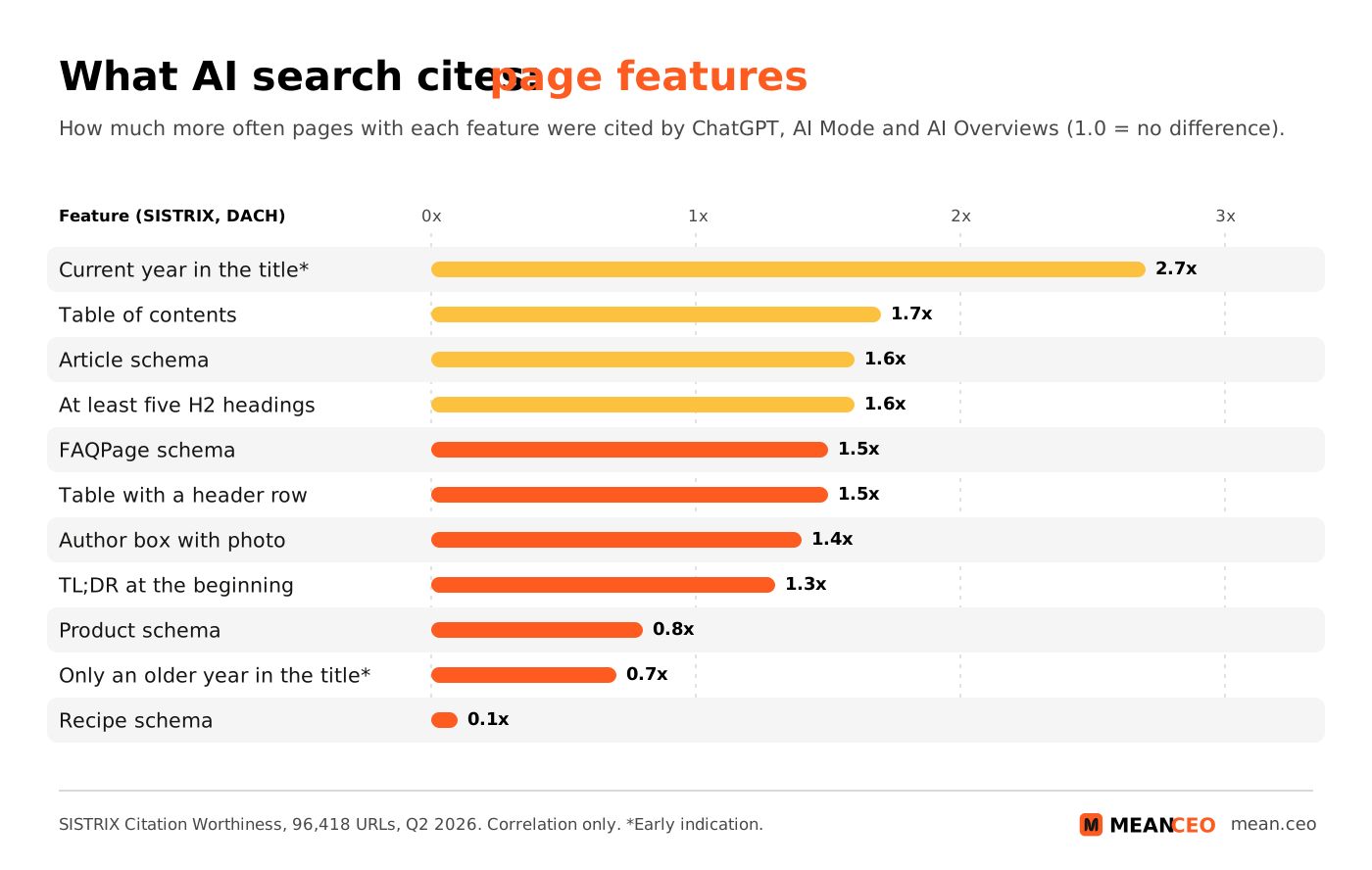
Pages that combined many of these features were cited 2.1 times as often as barely optimised ones, and only 10% of cited pages already had many of them. Some findings are worth repeating to anyone selling you a GEO package:
- llms.txt showed no measurable advantage. 11.7% of cited URLs came from domains with an llms.txt file, while such domains make up 14.0% of all domains in the data.
- Schema is not a miracle cure. Article and FAQPage schema went with more citations; Breadcrumb, HowTo and QAPage schema made no difference; Product schema went with fewer.
- Readability and word count are symptoms, not causes. Flesch readability was not significant, and SISTRIX advises against padding texts to a set length.
- Small studies mislead. At 833 URLs, FAQ schema looked 23% less common on cited pages; at 96,418 it was 19% more common. SISTRIX's rule: "Don't trust a GEO study with fewer than 5,000 URLs."
SISTRIX is clear that this is correlation, not proof, and that Perplexity, Claude and the Gemini app weren't included. Still, its list reads like a checklist for good, well-structured content. Our guide on how to write SEO content that converts covers most of it.
The European angle
Two of this week's datasets are European, which makes them more useful to you than the usual US studies: SISTRIX measured German-speaking markets and The SEO Works measured UK sites. Google's AI Mode has been live in much of Europe since October 2025, and the European Commission's antitrust investigation into how Google uses publishers' content for AI Overviews and AI Mode, opened in December 2025, had produced no decision that we could find by 24 October. Until that changes, expect AI answers to keep taking space on European results pages.
Measurement is the other European issue. Consent banners already hide part of your traffic, GA4's own "AI Assistant" channel only exists from June 2026 (according to The SEO Works), and we reported this month that ChatGPT visits were landing in Direct after a tagging bug. Add Indig's bot finding, and "Direct went up, so AI must be working" is the weakest argument you can make.
Europe also has its own AI-visibility tool makers, such as Berlin's Peec AI and Austria's Otterly.AI. Those tools can be useful for checking how assistants describe your brand. Just treat the share-of-voice numbers as a brand metric, not as a traffic forecast.
What this means for you
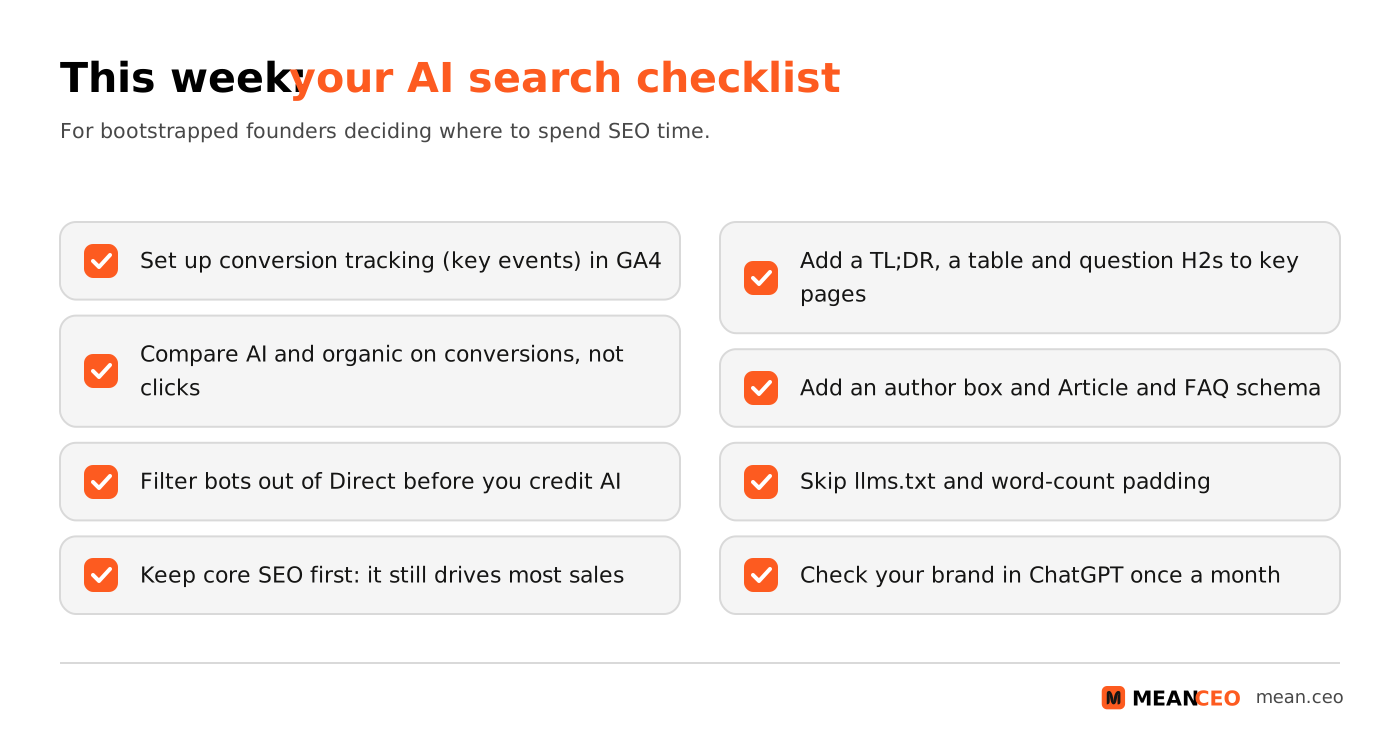
- Fix your tracking before you pick a channel. Almost half of the Haynes sites tracked no conversions. Set up key events in GA4 and compare channels on sign-ups and sales. Our SEO analytics guide for non-marketers walks you through it.
- Keep classic SEO as your main bet. For a bootstrapped startup, a 5% organic gain is worth more than doubling AI traffic. If you're starting from zero, follow a plan like our SEO roadmap for the first six months.
- Write pages that both Google and AI can use. Start with a short answer, use clear H2s (some phrased as questions), add a table and an FAQ, show the author and keep titles current. That's what SISTRIX found on cited pages, and it helps human readers too.
- Don't pay for magic files. llms.txt showed no measurable advantage. Spend that hour on a better comparison table.
- Treat AI visibility as branding. Ask ChatGPT, Gemini and Perplexity the questions your customers ask once a month and note whether you appear and how you're described. Don't expect it to show up as traffic.
- Clean up Direct before you celebrate. Break Direct traffic down by landing page, country and engagement. If engaged sessions didn't move, it's bots, not AI.
For more of this month's search and AI changes, see our generative engine optimization news for October 2026 and the SEO news for October 2026.
Are you getting customers from AI search yet?
More and more traffic is coming from Perplexity, ChatGPT, Grok and other AI tools.
👉 Rank on ChatGPT
FAQ: AI search traffic vs Google
How much traffic does ChatGPT send compared with Google?
Very little for most websites. In Marie Haynes' study of 100 websites and more than 145 million sessions, ChatGPT sent 0.62% as many sessions as Google organic search, and all LLMs together 0.73%. The SEO Works found organic search sent 39 times more traffic than AI assistants across 95 websites.
Do visitors from ChatGPT convert better?
Often, but not always. Haynes found 13.8% for ChatGPT visitors against 3.02% for Google organic. The SEO Works found 7.18% against 6.08%, but AI converted worse on 23 of 63 websites and worse for B2B product companies (0.62x).
Is GEO a waste of time for startups?
Not entirely, but it shouldn't replace SEO. Google organic still drove 96.5% of conversions in the Haynes data, and a 5% organic gain beat doubling AI traffic in The SEO Works scenarios. Treat AI visibility as a brand channel and keep classic SEO as your main growth bet.
What makes a page more likely to be cited by ChatGPT or AI Mode?
SISTRIX's study of 96,418 URLs found more citations for pages with the current year in the title (an early indication), a table of contents, Article and FAQPage schema, at least five H2 headings, tables, an author box and a TL;DR. Well-optimised pages were cited 2.1 times as often. It's a correlation, not proof.
Does llms.txt help with AI search?
Not measurably, according to SISTRIX. 11.7% of cited URLs came from domains with an llms.txt file, while those domains make up 14.0% of all domains in its data. It's not harmful as far as anyone knows, but it shouldn't be a priority.
Is AI traffic hiding in my Direct traffic?
Probably less than you think. Kevin Indig found that Direct sessions with identifiable AI traces were only 0.003% of Direct traffic across 12 sites, and that most of this year's Direct growth was bots. Check engaged sessions before you credit AI.
About the Author
Violetta Bonenkamp, also known as MeanCEO, is an experienced startup founder with an impressive educational background including an MBA and four other higher education degrees. She has over 20 years of work experience across multiple countries, including 5 years as a solopreneur and serial entrepreneur. Throughout her startup experience she has applied for multiple startup grants at the EU level, in the Netherlands and Malta, and her startups received quite a few of those. She’s been living, studying and working in many countries around the globe and her extensive multicultural experience has influenced her immensely.
