TL;DR: SEO for Startups: Building Organic Traffic Without Backlinks
Backlinks still count in Google’s ranking, but a new startup doesn’t need a link-building budget to get its first organic traffic. Pick long-tail queries with low competition and clear buyer intent, answer each one better than the pages already ranking, fix the technical basics, connect your pages with internal links and measure everything in Google Search Console. Be patient: Ahrefs found that only 1.74% of new pages reach Google’s top 10 within a year, while almost 93% of keywords get fewer than 10 searches a month, and that long tail is where small sites win first. Good pages then tend to earn links on their own.
🔥 Want the semantic SEO side of this? Read how to rank on Google with zero backlinks.
SEO for Startups: Building Organic Traffic Without Backlinks
SEO for startups often feels daunting, especially when you’re bootstrapped and navigating the competitive European landscape. The advice frequently centers on acquiring backlinks, but let me be clear: as a serial entrepreneur, I can assure you that backlinks alone won’t lead you to success. For founders embracing creative strategies to attract organic traffic, this guide will provide actionable insights for how to thrive.
The secret isn’t in buying or chasing links; it’s in strategic content, technical SEO and smart keyword research. By focusing on user value and structuring your website around clear, engaging information, you can get visible without costly backlink campaigns. Building traffic must be intentional, but that doesn’t mean expensive.
"European startups can outcompete through strategy, not budget. Effective SEO in 2026 is about relevance, structure, and user trust, not the size of your backlink profile."
Is your SEO strategy ready for the AI era?
Stop chasing backlinks and start optimizing for ChatGPT, Bing AI, and Perplexity rankings.
👉 Adapt your SEO today
Why Backlink-Free SEO Works for Startups
For years, backlinks have been touted as a cornerstone of SEO, but startups operating without significant budgets or expansive networks must approach things differently. Let’s explore why backlink-free strategies are not just viable but essential for new businesses in Europe and beyond.
- Cost-effective: Backlink campaigns and guest-post fees add up fast. Refining your content and website architecture costs mainly time and brainpower, perfect for bootstrapped founders.
- User-first approach: Google’s guidance asks for helpful, reliable, people-first content. For narrow questions, a page that answers the exact need can outrank bigger sites with more links.
- Focus on intent: Ranking without link building means targeting niche, low-competition keywords that match your audience’s exact needs.
This doesn’t mean links stopped mattering. It means a young site has better uses for its first hours: structure, internal links and pages that match search intent. Startups that get those right first are ready to earn links later, instead of paying for links to pages nobody needs. If you want AI to do the legwork on keyword research, drafts and audits, read our guide to AI-powered SEO for resource-constrained startups.
What Backlinks Still Do, and When You Can Skip Link Building
Links still matter. Google’s guide to its ranking systems says PageRank, its link analysis system, continues to be part of its core ranking systems. Ahrefs’ 2023 study of about 14 billion pages found that 96.55% of pages get no traffic from Google at all, and a lack of backlinks is one of the main reasons it names. In April 2024, Google’s Gary Illyes said at a conference in Sofia that Google needs very few links to rank pages, then said days later he shouldn’t have said it. So don’t believe anyone who says links are dead.
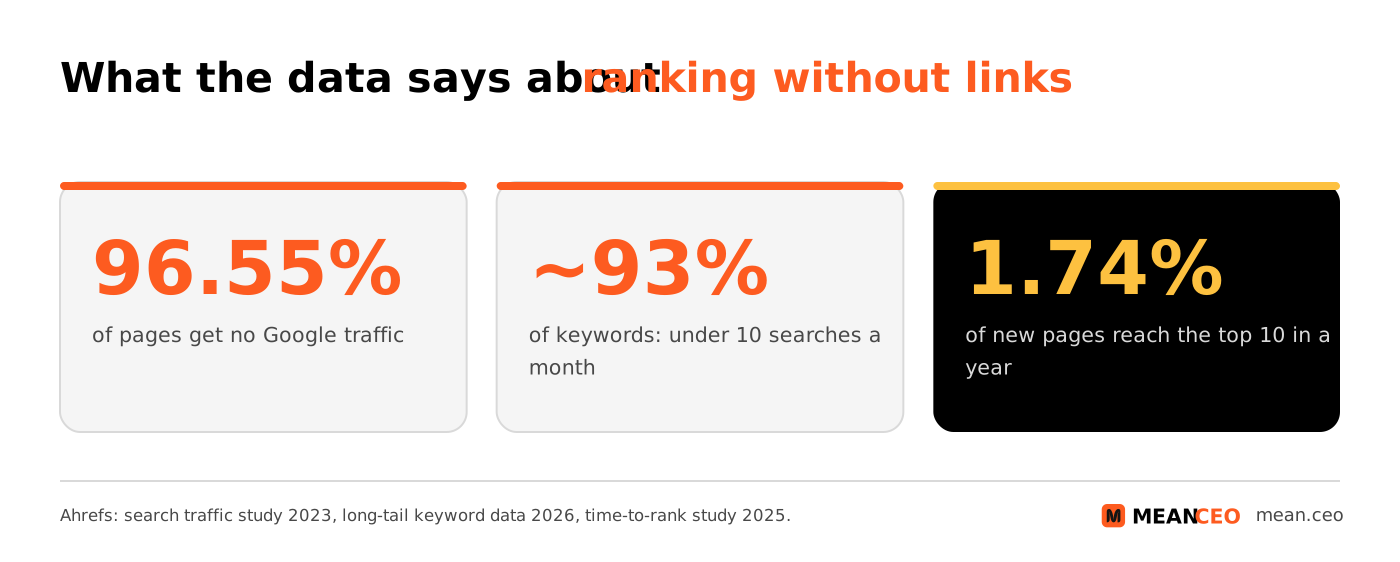
So where does that leave a startup with zero links? In the long tail. Ahrefs’ long-tail keyword data show that almost 93% of keywords get fewer than 10 searches a month, and its traffic study notes that pages earning traffic without backlinks mostly rank for keywords with very low difficulty. New pages also need patience: in Ahrefs’ 2025 study of how long ranking takes, only 1.74% of new pages reached the top 10 within a year. Our take: for the first 6 to 12 months, put your hours into many specific pages for low-competition queries, not into outreach.
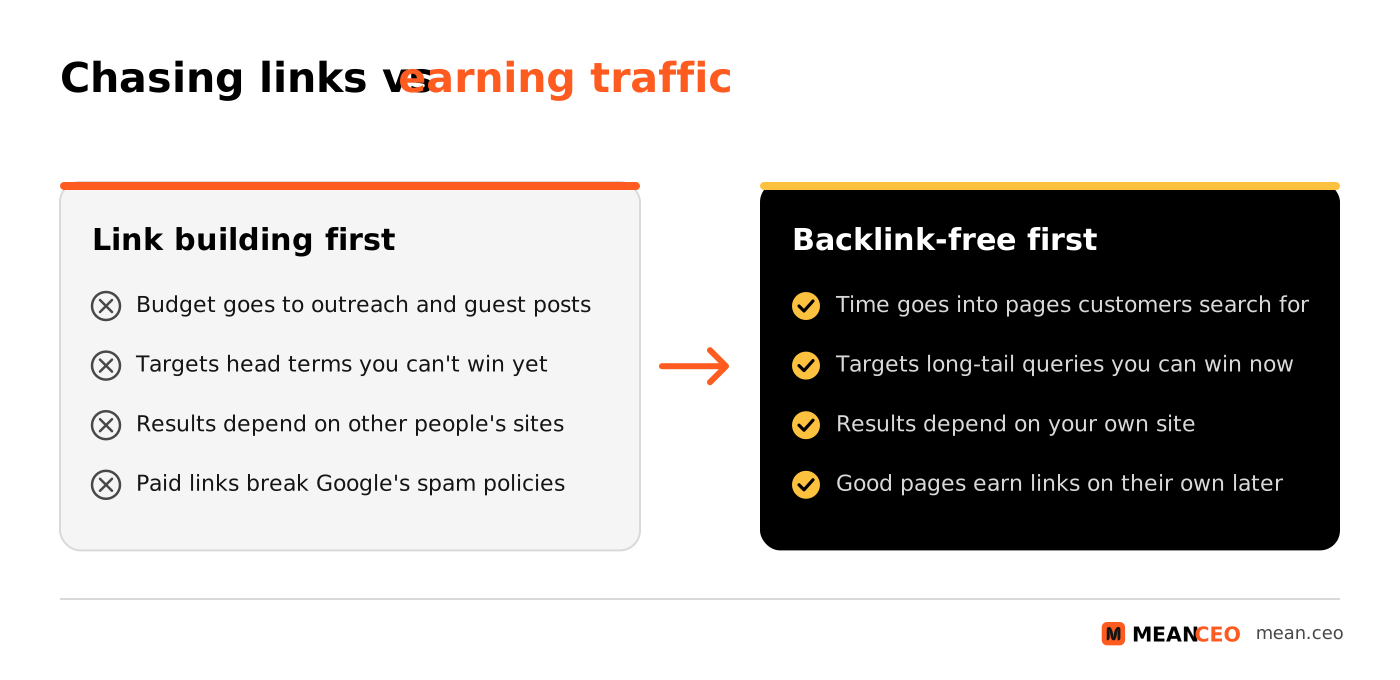
When you do reach the point where a page needs links, earn them: see 15 creative link building strategies with no budget and how to build backlinks naturally without outreach.
Step-by-Step Plan: Organic Traffic Without Links
Here’s how to implement a backlink-independent SEO strategy:
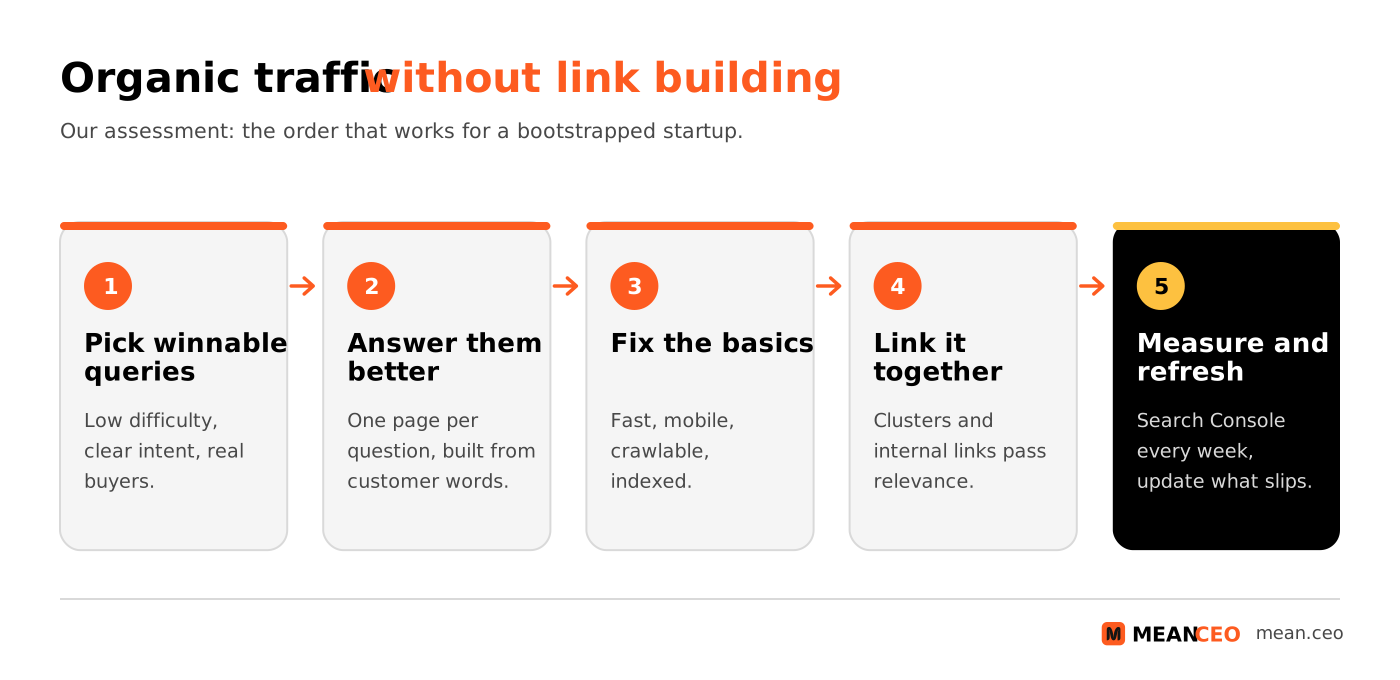
- Perform Intent-Driven Keyword Research: Use free tools like Google Keyword Planner, Ahrefs Webmaster Tools and Search Console to find keywords specific to niche markets. Choose terms with low competition and clear commercial intent rather than generic phrases.
- Build Semantic Content Clusters: Group your content under broader themes that establish relevance in your industry. Learn how content clusters improve rankings by connecting related resources.
- Master Technical SEO: Audit your website for speed, mobile usability and crawlability. Without links to lean on, a fast, indexable site matters even more.
- Leverage AI SEO Opportunities: Use clear headings, short direct answers, FAQs and structured data. As Violetta Bonenkamp puts it, "AI-era SEO needs conversational formatting that enables machine comprehension."
- Engage with Your Audience: Use free tools like Microsoft Clarity or Hotjar’s free plan to see where visitors get stuck, then fix the layout. A page that answers the question quickly keeps readers and turns more of them into leads.
Which Pages Can Rank Without Backlinks?
Not every page type is equal. Some queries are dominated by big brands with thousands of linking domains; others are answered badly by everyone. Start where the competition is thin and the reader is close to buying.
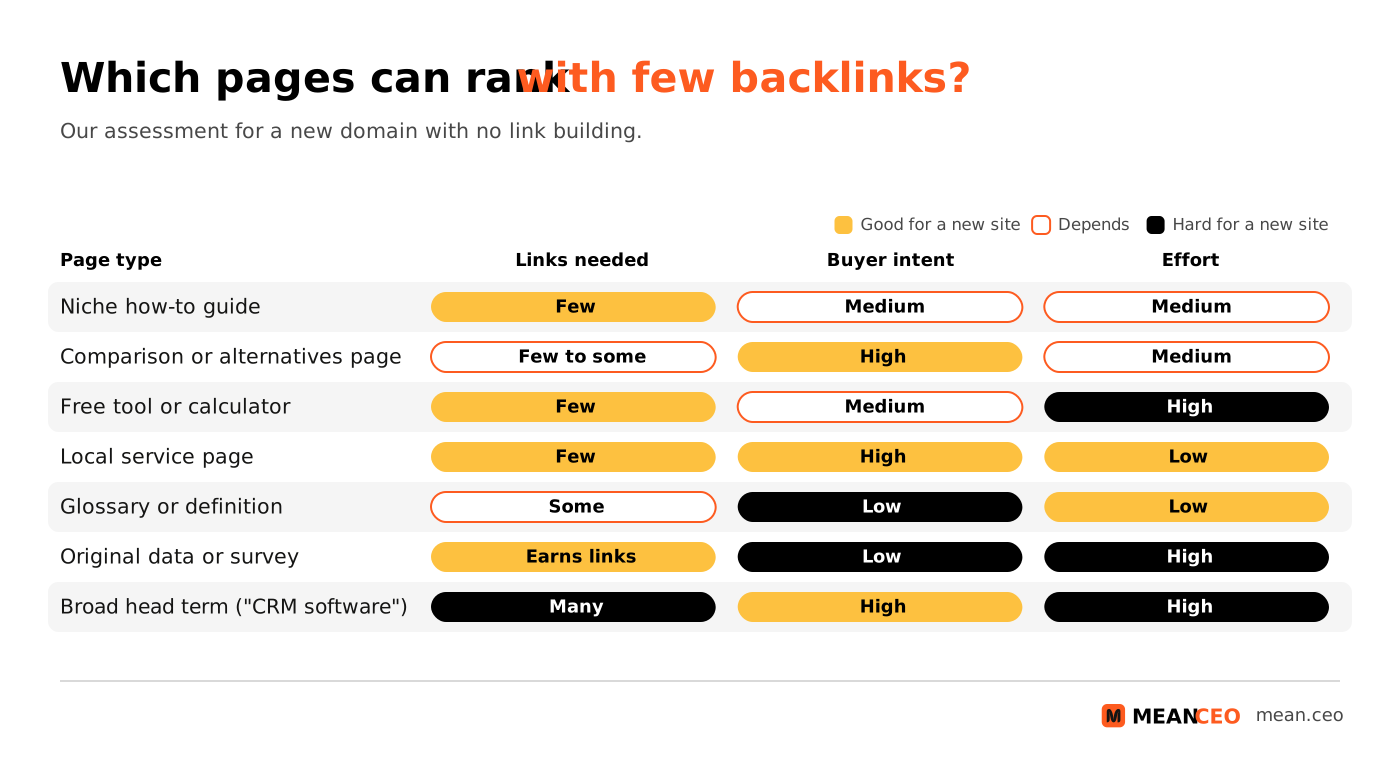
Source: our assessment. Example queries are illustrations, not measured search volumes.
For local businesses, our local SEO guide for service-based startups in Europe covers the Business Profile and reviews side.
Avoid These Mistakes: Common SEO Pitfalls
Bootstrapped founders should watch out for strategies that work against them. These avoidable errors show up in many startup journeys:
- Over-focusing on links: Buying links breaks Google’s spam policies, and chasing them early takes time away from the pages that bring customers.
- Ignoring keyword intent: Just targeting volume wastes resources. Know exactly what your audience is searching for and optimize accordingly.
- Assuming all content performs equally: Regularly audit underperforming pages and remove, merge or refresh them with better data and user focus.
- Publishing and forgetting: Not checking whether new pages are indexed. Search Console’s page indexing report shows which pages Google skipped and why.
Remember, search engines and AI assistants reward pages they can read and trust. Clear structure helps both.
Free SEO Tool Stack for Bootstrapped Startups
You don’t need a paid SEO suite to start. These tools cover keyword research, indexing and technical checks for free:
Paid prices from the Ahrefs and Semrush pricing pages for Europe, billed monthly, October 2026. Upgrade only when the free data stops answering your questions. For more tools, a €0, €30 and €150 stack and when each one is worth paying for, see our SEO tools guide for bootstrapped founders.
Technical SEO Basics You Can Check Today
With few links pointing to your site, Google’s crawlers rely on your sitemap and internal links to find pages, and visitors judge you on speed. Check these before you write your next article; our technical SEO checklist for startup websites goes deeper.
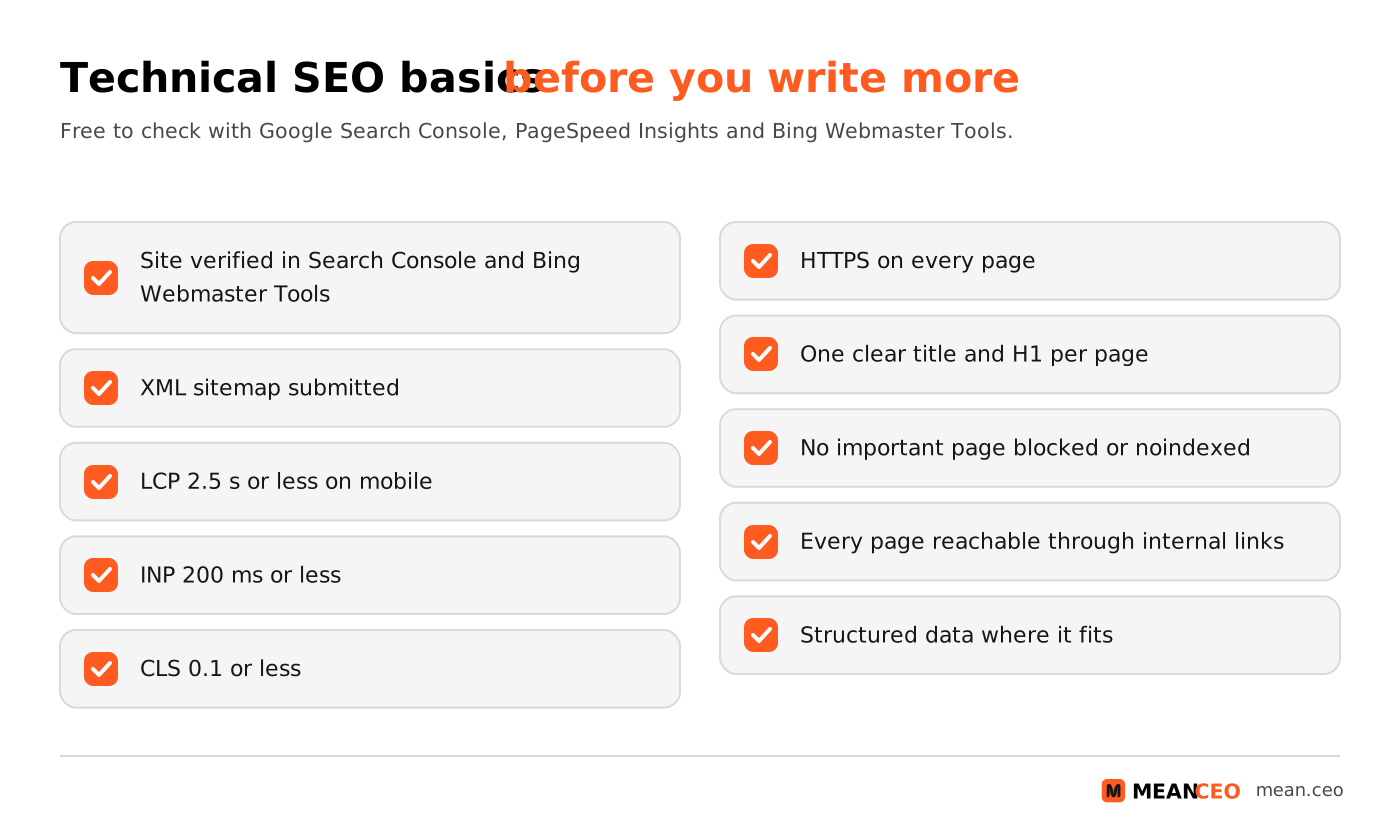
Thresholds from Google’s Web Vitals guidance, measured at the 75th percentile of page loads. INP replaced FID as a Core Web Vital on 12 March 2024.
Don’t Forget Bing and AI Search
Google isn’t the only door. Bing powers Microsoft Copilot’s web answers, and OpenAI says ChatGPT search uses third-party search providers alongside content from partners. Verify your site in Bing Webmaster Tools (it can import your Search Console setup) and turn on IndexNow, a protocol that tells Bing, Yandex, Seznam.cz, Naver and Yep about new or changed pages; one submission is shared with all of them. Google doesn’t take part in IndexNow, so keep your sitemap in Search Console too. For AI answers, the same habits help: clear headings, a direct answer in the first lines and facts that are easy to quote.
What to Measure Every Week
Backlink-free SEO is slow at first, so track leading signals, not just traffic. All of these are free in Search Console; see which Search Console metrics matter for startups and our SEO analytics guide for non-marketers.
Source: our assessment.
Boost Content Visibility Without Backlinks
Learn how to combine semantic keyword strategies and AI optimizations.
👉 Adopt cutting-edge methods
What’s Next? Content Marketing or Community Focus?
Once your SEO road map gains traction, evaluating complementary strategies is your next step. Consider diving into content marketing strategies that drive 100k visitors sustainably. Alternatively, shift gears into community-first marketing, a powerful approach for startups building genuine, loyal ecosystems around their product.
These paths fit well with backlink-free SEO: no paid placements, no complex procurement, just organic growth. If you want a month-by-month plan, follow our SEO roadmap for the first 6 months of a bootstrapped startup, build topical authority with a 90-day plan, and learn how to write SEO content that converts.
People Also Ask:
Is SEO dying in 2026?
SEO is not dying but changing because of AI answers, voice search and personalization. Search engines focus on intent rather than keyword stuffing, and AI assistants such as ChatGPT and Copilot cite web pages in their answers. Founders who publish clear, helpful pages and keep their sites technically sound benefit from both.
How can startups with limited budgets use SEO?
Start with on-page SEO: keyword-focused titles and headings, fast pages and internal links. Free tools such as Google Search Console, Bing Webmaster Tools and Google Keyword Planner help you find valuable search terms. Founders often share authentic stories and expert insights on their own blog, which builds trust and organic traffic at low cost.
What are the top strategies to build traffic without backlinks?
Some effective strategies include creating useful content that resonates with your audience, optimizing for long-tail keywords, and enhancing page structure for better readability. Interactive tools like calculators or quizzes can also engage users without relying on backlinks.
What are the 3 C's of SEO every startup should focus on?
The three C's of SEO are content, code, and credibility. Content involves publishing relevant and optimized articles or videos, code relates to a well-structured website, and credibility grows through user trust, reviews, and clear policies.
What types of businesses benefit the most from SEO?
Companies in niche markets, service businesses, local businesses and e-commerce stores tend to gain the most, because their customers search for specific problems. Startups in sustainable products, local services or educational tools often face thin competition for long-tail searches, which makes them good candidates.
Is focusing on mobile SEO essential in 2026?
Yes. Google said in October 2023 that its move to mobile-first indexing was complete, so it crawls and ranks the mobile version of your pages. Phones also bring most web traffic: Statcounter put mobile at about 59% of worldwide web traffic and 55% in Europe in September 2026.
How does AI impact SEO in 2026?
AI changes both how people search and how founders work. AI Overviews and chat assistants answer many questions directly, so pages need clear, quotable answers. On the work side, AI tools help with keyword clustering, outlines and analytics, as long as a human checks facts and keeps the founder’s voice.
What are effective ways to make technical SEO improvements?
Some technical fixes include optimizing website speed, fixing broken links, implementing SSL certificates for security, and using schema markup to provide structured data to search engines.
Does content marketing help startups rank higher?
Yes, when each piece answers a real query better than what already ranks. Many startups use storytelling in blogs, case studies and how-to guides to connect with audiences and to give other sites a reason to link.
Can startups succeed in SEO without in-house expertise?
Yes. Free tools and guides let founders handle the basics themselves, and freelancers or consultants can cover audits or technical fixes without a full-time hire.
FAQ on Building Organic Traffic Without Backlinks for Startups
How does user intent influence keyword strategies for startups?
User intent is critical to targeting keywords that address specific needs or problems. Startups should analyze search queries to match their content with user intent effectively, focusing on long-tail keywords for niche relevancy. Discover more in the Getting Started with SEO guide.
Can schema markup boost SEO for startups?
Yes, structured data helps search engines understand your content and makes pages eligible for rich results such as product, review or event snippets. Don’t expect FAQ dropdowns in Google, though: since August 2023 Google shows FAQ rich results only for well-known government and health sites, and HowTo rich results are gone. Use schema that matches your real content, and keep a visible FAQ for readers and AI answers.
How can AI tools benefit startups optimizing SEO strategies?
AI tools like ChatGPT and Google’s Natural Language API help you check whether a page covers the entities and questions searchers expect. They aid semantic optimization and conversational formatting, but every fact still needs a human check.
What are the risks of relying solely on backlinks for SEO?
Link-only strategies leave startups exposed: bought or traded links break Google’s spam policies and can be ignored or penalised, and a page with links but a weak answer still loses to pages that match intent better.
How can startups effectively target low-competition keywords?
Use keyword tools like SEMrush or Ahrefs to identify keywords with good search intent and low competition. Focus on niche markets and optimize content for long-tail queries, which tend to convert better.
Does internal linking improve organic traffic?
Absolutely! Internal linking connects related pages, enhancing user experience and improving crawlability, which helps search engines understand your site's hierarchy and boosts rankings.
How can startups use content clusters to gain authority?
Organize content into thematic clusters under broad topics. This strategy builds topical authority and showcases relevancy. Learn effective clustering tactics in the SEO Starter Guide.
What metrics should startups use to measure SEO success?
Track organic impressions, clicks, click-through rate, average position, indexed pages and conversions from organic visitors. Engagement data in your own analytics shows whether a page answers the question; treat it as a signal for you, not as a known Google ranking factor.
How can startups optimize site speed for better SEO?
Optimize images, enable caching, and use lightweight code to speed up your site. Faster-loading sites improve user experience and rank higher, especially on mobile devices.
What role does mobile responsiveness play in rankings?
Google uses mobile-first indexing, so the mobile version of your page is the one it ranks. Use responsive layouts, legible fonts and fast load times to improve organic visibility and user engagement.
About the Author
Violetta Bonenkamp, also known as MeanCEO, is an experienced startup founder with an impressive educational background including an MBA and four other higher education degrees. She has over 20 years of work experience across multiple countries, including 5 years as a solopreneur and serial entrepreneur. Throughout her startup experience she has applied for multiple startup grants at the EU level, in the Netherlands and Malta, and her startups received quite a few of those. She’s been living, studying and working in many countries around the globe and her extensive multicultural experience has influenced her immensely.
