TL;DR: Competitor Content Analysis Unlocks SEO Wins
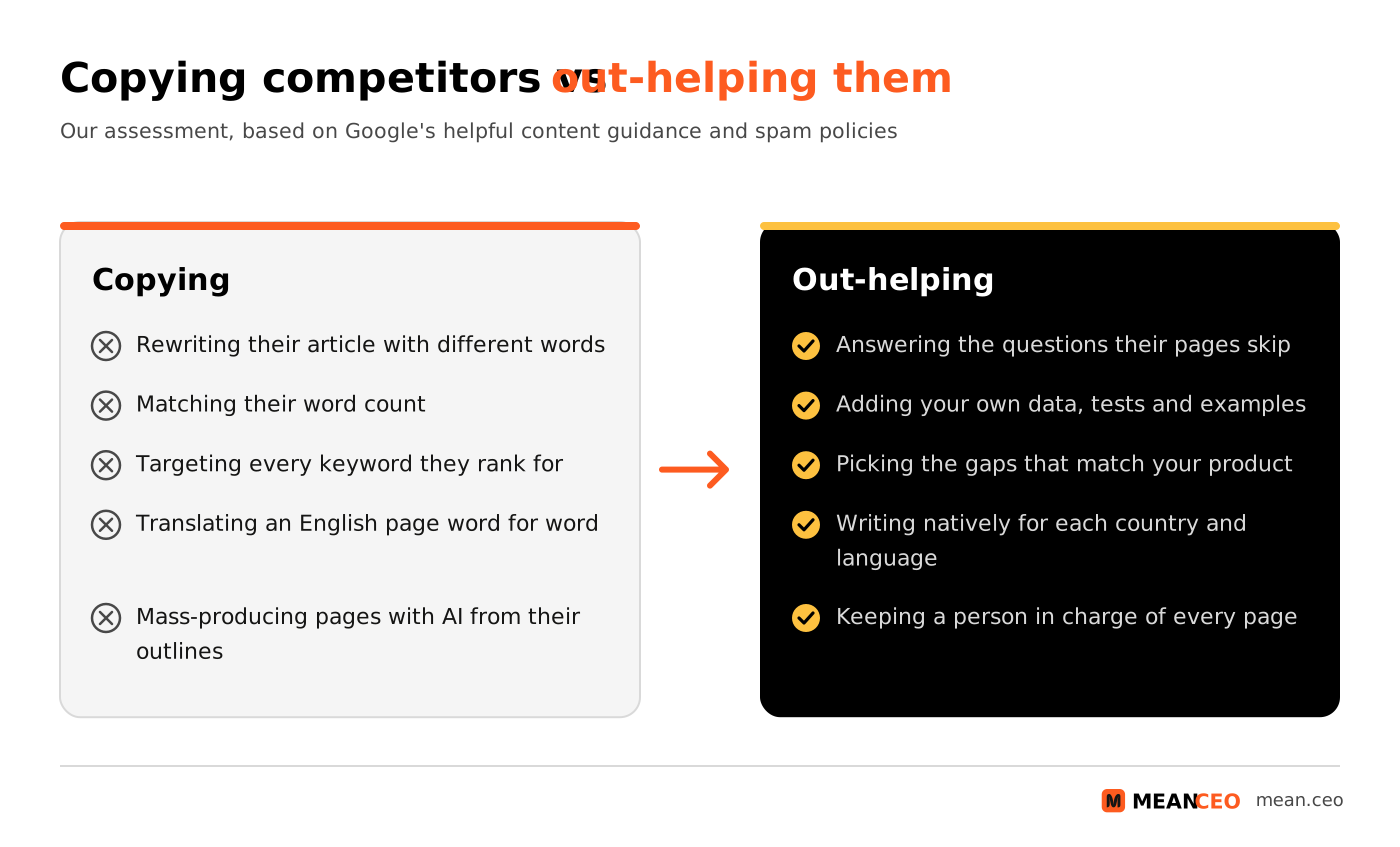
Competitor content analysis means studying the pages that already rank for your keywords, finding the questions and topics they cover that you don’t, and publishing something more useful. You can do most of it for free with Google’s own results, Search Console and a spreadsheet; gap tools such as Ahrefs Lite (€119 a month) or Semrush (€134) speed it up. The goal isn’t to copy rivals: Google asks whether your page adds “substantial value when compared to other pages in search results”, and its spam policies demote scraped and lightly rewritten content.
👉 Curious about scaling SEO without backlinks? Explore proven tactics in building organic traffic for startups.
Competitor Content Analysis for Startup SEO
Competitor Content Analysis for Startup SEO is the process of examining your rivals' content strategies to uncover insights and weaknesses, helping your startup refine its approach for better visibility. In a European startup context, where resources are often limited, this strategy can enable founders to punch above their weight in crowded markets.
This guide gives bootstrapped founders a practical blueprint: how to find your real search competitors in each European market, map the gaps, score their pages, and turn that into content briefs, mostly with free tools. By the end, you’ll be able to spot gaps, use competitor insights without copying anyone, and build an SEO roadmap that fits your goals.
“Startups often fail at SEO not because they lack effort but because they overlook the actionable data hidden in their competitors’ content strategies.” – Violetta Bonenkamp, Mean CEO
Is your startup ranking in AI search results yet?
Optimize your content for platforms like ChatGPT, Perplexity, Grok, and beyond.
👉 Analyze your SEO now
Why Competitor Content Analysis Matters for Startups
Startup founders, especially those bootstrapping, face challenges like limited budgets, rising digital ad costs, and fierce competition for attention. Competitor Content Analysis enables founders to identify gaps (what competitors rank for that you don’t), understand user intent, and refine strategies based on proven patterns.
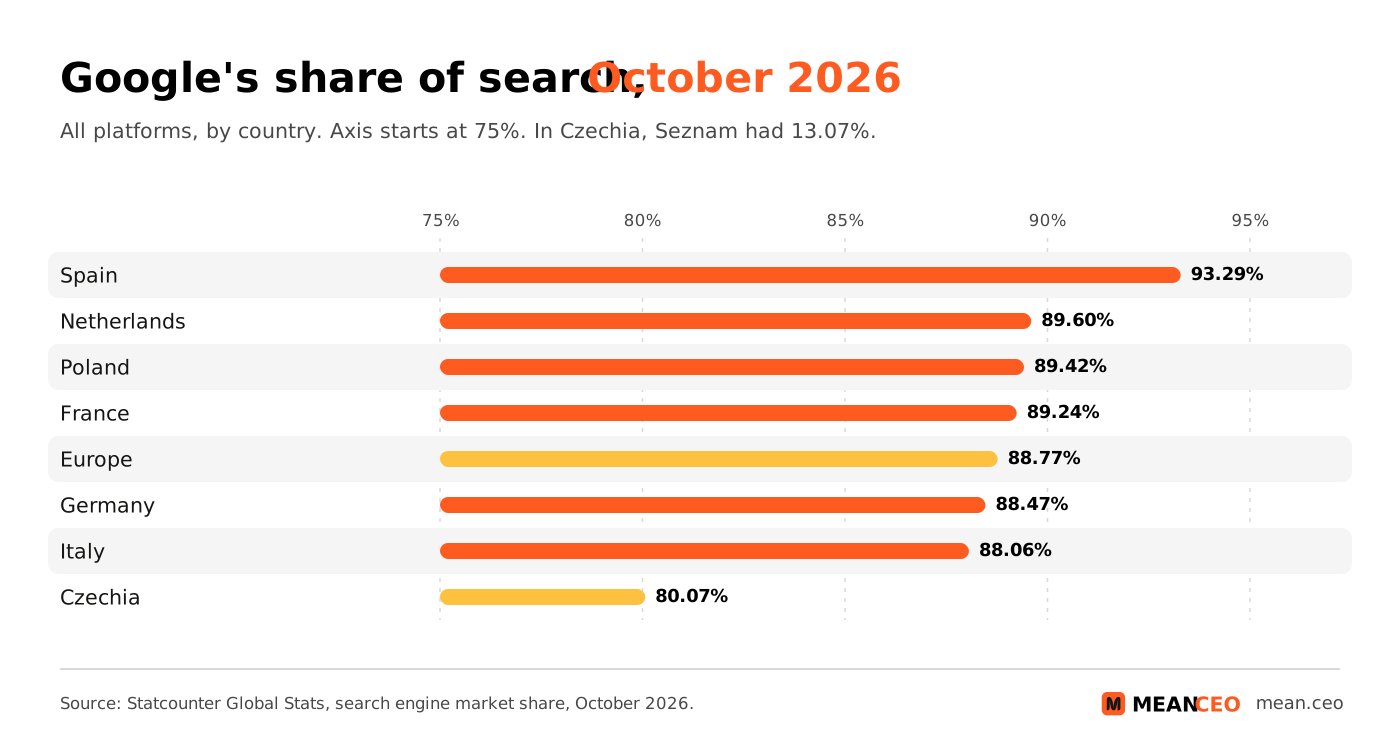
In Europe, SEO is more complex because of language diversity and fragmented markets: your rivals in Germany are rarely the ones ranking in France or Czechia. Google dominates almost everywhere, but not equally. In October 2026 it had 88.77% of searches across Europe and 93.29% in Spain, while in Czechia it had 80.07% and the local engine Seznam 13.07%, according to Statcounter. Competitor insights show how rivals win in each of these niches without VC funding, and niche keyword targeting is often the cheapest way in.
Business Competitors vs Search Competitors
The companies you lose deals to aren’t always the sites you lose clicks to. For most keywords, your search competitors are publishers, marketplaces, review sites and bigger blogs, and they change by country and language:
Our assessment. For the business side of the picture, see how to compete with funded competitors as a bootstrapped startup.
How to Perform Competitor Content Analysis in 2026
Step 1: Identify Competitors
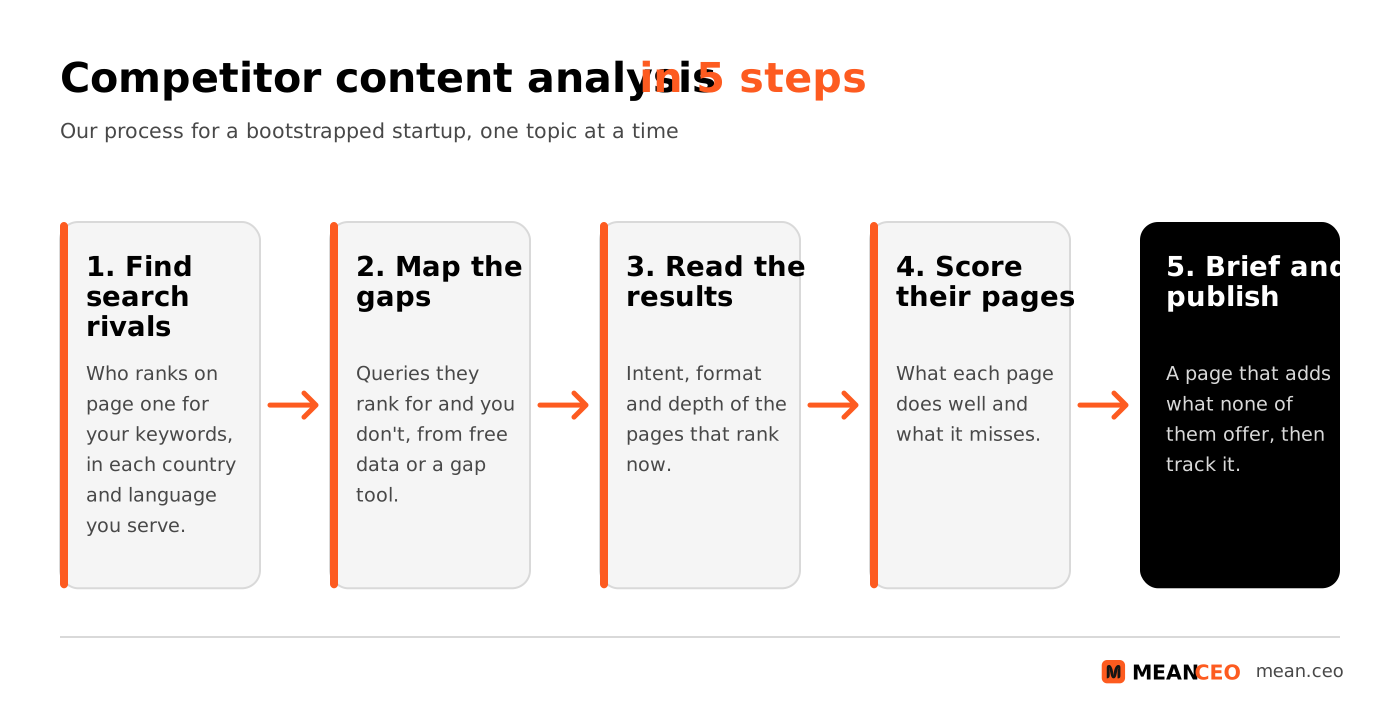
Search your 10–20 most important keywords in a private window and note who ranks on page one. Repeat it for each country and language you sell in, because the results differ. The domains that keep reappearing are your search competitors. Ahrefs (Organic competitors) and Semrush (Competitors report) list them automatically, but the manual check is free and shows you the result pages as searchers see them.
Search your 10–20 most important keywords in a private window and note who ranks on page one. Repeat it for each country and language you sell in, because the results differ. The domains that keep reappearing are your search competitors. Ahrefs (Organic competitors) and Semrush (Competitors report) list them automatically, but the manual check is free and shows you the result pages as searchers see them.
Step 2: Analyze Their Keywords
Find the queries your competitors rank for and you don’t. Paid gap tools do this in one report: Ahrefs Content Gap compares your site with up to 10 competitors (in the Lite plan and above), and Semrush Keyword Gap with up to five, labelling keywords as missing, weak or untapped. Free alternatives work too: your own Search Console queries (pages where you appear on page two are the easiest wins), Google’s related searches and “People also ask” questions, Google Trends (up to 8 groups of terms at once) and Bing Webmaster Tools’ keyword research. AnswerThePublic and AlsoAsked give 3 free searches a day for question-based keywords. Our guide to keyword research for niche startup markets shows how to judge which gaps are worth it.
Find the queries your competitors rank for and you don’t. Paid gap tools do this in one report: Ahrefs Content Gap compares your site with up to 10 competitors (in the Lite plan and above), and Semrush Keyword Gap with up to five, labelling keywords as missing, weak or untapped. Free alternatives work too: your own Search Console queries (pages where you appear on page two are the easiest wins), Google’s related searches and “People also ask” questions, Google Trends (up to 8 groups of terms at once) and Bing Webmaster Tools’ keyword research. AnswerThePublic and AlsoAsked give 3 free searches a day for question-based keywords. Our guide to keyword research for niche startup markets shows how to judge which gaps are worth it.
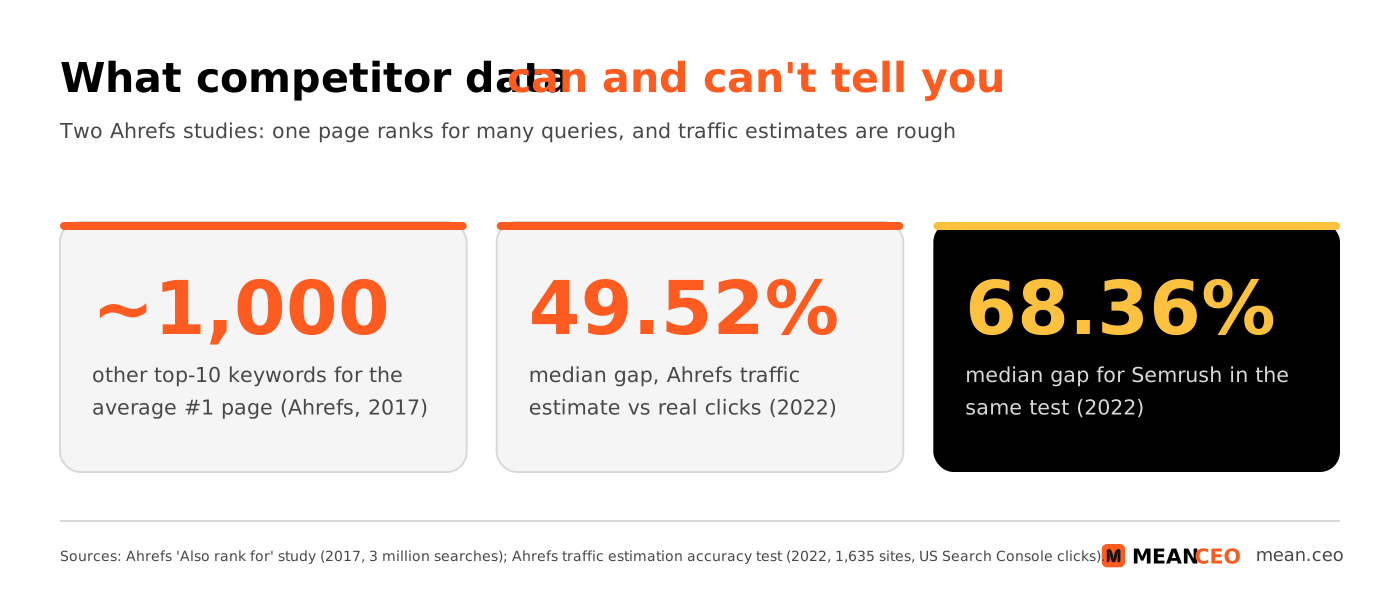
Two numbers help you read gap reports. One page rarely ranks for one keyword: an Ahrefs study of 3 million searches (2017) found that the average #1 page also ranks in the top 10 for nearly 1,000 other relevant keywords. So group gap keywords by topic and plan one strong page per group, not one page per keyword. And treat competitors’ traffic numbers as rough: when Ahrefs compared its estimates with real Search Console clicks for 1,635 sites in 2022, the median deviation was 49.52%, and 68.36% for Semrush. Use them to compare sites with each other, not to plan revenue.
Step 3: Evaluate Content Quality
Open the top five results for each priority keyword and read them like a customer. What does the searcher want: to learn, compare, buy or find a local business? Which format wins: guides, lists, comparison tables, tools or product pages? Which questions do the pages answer, and which do they skip? Don’t copy their length: Google says outright that it has no preferred word count. Google also suggests paying attention to related search queries when you plan topics, so note those too.
Open the top five results for each priority keyword and read them like a customer. What does the searcher want: to learn, compare, buy or find a local business? Which format wins: guides, lists, comparison tables, tools or product pages? Which questions do the pages answer, and which do they skip? Don’t copy their length: Google says outright that it has no preferred word count. Google also suggests paying attention to related search queries when you plan topics, so note those too.
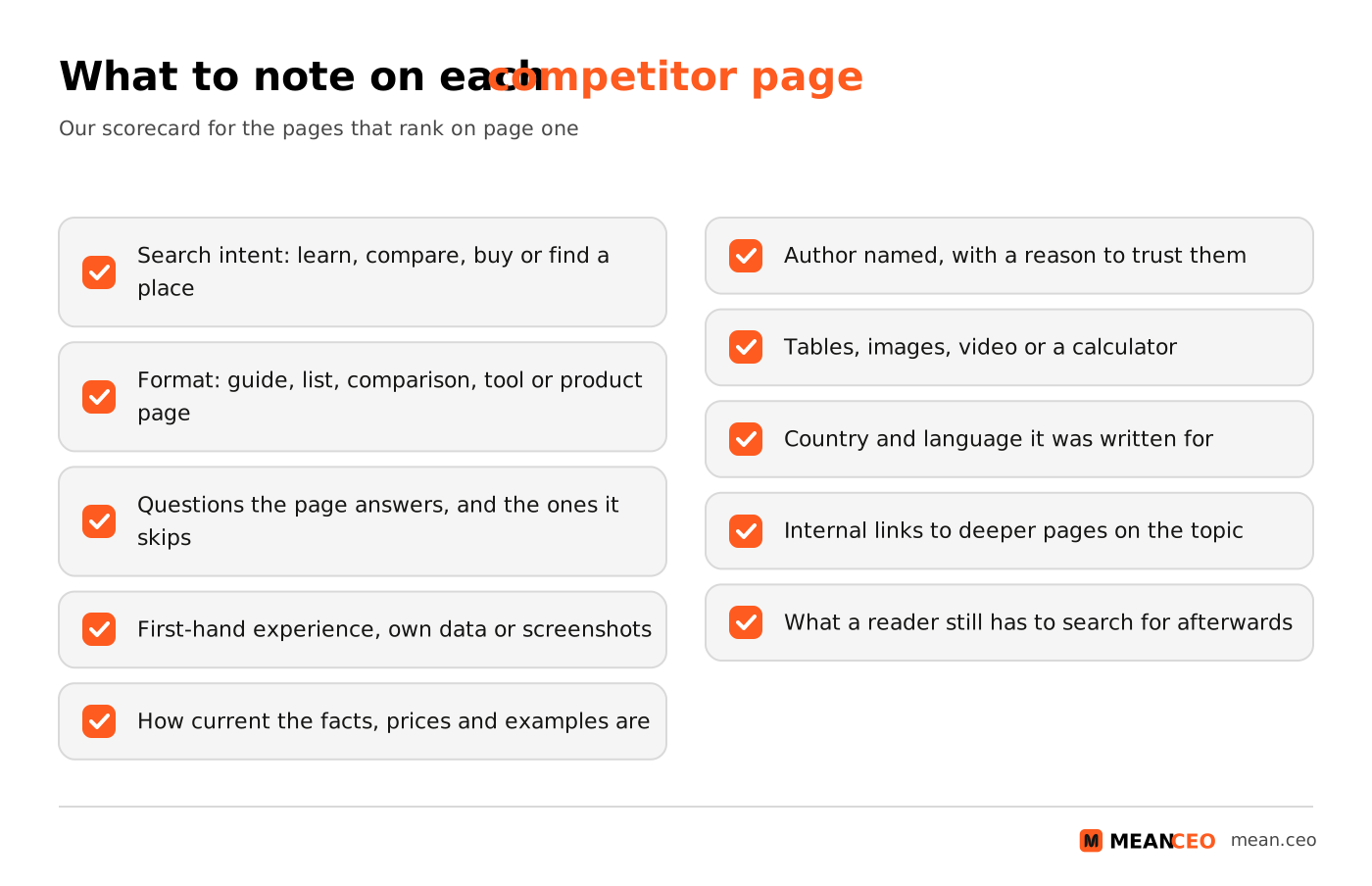
Put the answers in a simple scorecard, one row per ranking page. Here’s a filled-in example for an illustrative keyword, “invoice template freelancer Netherlands”:
Illustration, not real data. The gap here is obvious: a page with a Dutch-language template, the legally required fields explained in plain words and worked VAT examples.
Step 4: Examine Backlink Profiles
Look at which pages earn competitors their links and from where. Semrush Backlink Gap compares up to five domains and lists the sites that link to them but not to you; Ahrefs and SE Ranking (Core plan, €109 a month) offer the same kind of report. Free Ahrefs (formerly Ahrefs Webmaster Tools) only shows backlinks for sites you’ve verified, so it can’t show a competitor’s links. Look for patterns you can repeat honestly, such as resource lists, local directories, partner pages or data studies, rather than links you’d have to buy.
Look at which pages earn competitors their links and from where. Semrush Backlink Gap compares up to five domains and lists the sites that link to them but not to you; Ahrefs and SE Ranking (Core plan, €109 a month) offer the same kind of report. Free Ahrefs (formerly Ahrefs Webmaster Tools) only shows backlinks for sites you’ve verified, so it can’t show a competitor’s links. Look for patterns you can repeat honestly, such as resource lists, local directories, partner pages or data studies, rather than links you’d have to buy.
Step 5: Reverse-Engineer Content Briefs
Turn your notes into a brief: the main question, the subtopics every ranking page covers, the questions they skip, the format searchers expect, and what only you can add, such as your own data, screenshots, customer examples or local rules. Google’s self-assessment asks whether your content provides “original information, reporting, research, or analysis”, so that last part matters most. Group related briefs into content clusters so each page supports the others.
Turn your notes into a brief: the main question, the subtopics every ranking page covers, the questions they skip, the format searchers expect, and what only you can add, such as your own data, screenshots, customer examples or local rules. Google’s self-assessment asks whether your content provides “original information, reporting, research, or analysis”, so that last part matters most. Group related briefs into content clusters so each page supports the others.
Step 6: Prioritise the Gaps and Track Them
You won’t fill every gap, and you shouldn’t. Rank them by fit with your product, by how weak the current results are and by effort:
Our assessment. Recheck your main keywords every quarter and after big Google updates, and measure results in Search Console; our guide to Google Search Console metrics that matter shows what to watch.
Common Mistakes During Competitor Content Analysis
- Neglecting long-tail keywords: European markets have many local and specific search terms, often in several languages, so long-tail keywords matter more.
- Ignoring user intent: Many startups mimic content without understanding what the searcher wants, which leads to poor engagement.
- Copying instead of adding: Google’s spam policies on scraping include “copying content from other sites, modify it only slightly”, and its helpful content guidance warns against “mainly summarizing what others have to say without adding much value”.
- Trusting estimates too much: Traffic and “authority” numbers in SEO tools are vendor estimates. Use them to compare, not as facts.
- Skipping regular updates: Results change. Revisiting your analysis quarterly keeps it relevant, as discussed in keeping content updated.
Leveraging AI in Competitor Content Analysis
AI tools now take over much of the manual work. Content tools such as Frase build briefs from the pages that rank, and general assistants such as ChatGPT, Claude or Gemini can summarise ten competitor pages into a table of covered and missing questions in minutes. Check their output against the pages themselves, because they miss things and sometimes invent them, and keep a person in charge of what you publish. Our guide to using AI to analyze competitor strategies covers prompts and workflows beyond SEO.
Competitor analysis now also covers AI answers. Type your customers’ main questions into ChatGPT, Perplexity, Gemini and Google’s AI Mode and note which sites they cite: those are competitors too. Paid trackers do this at scale: Semrush’s AI Visibility Toolkit covers Google AI Overviews, AI Mode, ChatGPT, Gemini and Perplexity (standalone from €94.94 a month per domain, billed annually), and Ahrefs Brand Radar starts at €179 a month. There’s no special markup for AI answers: Google says the same SEO basics apply to its AI features. Clear, well-sourced pages that answer questions directly are what get cited.
Competitor Analysis Tools for Bootstrapped Startups
Prices from vendors’ pricing pages, monthly billing, viewed from Europe on 30 October and 2 November 2026; AnswerThePublic’s €10 plan is billed yearly. For the full stack, see our SEO tools for bootstrapped founders.
Conclusion: A Tactic to Scale Without Backlinks
Effective competitor content analysis lets bootstrapped startups grow organically. You don’t need the biggest budget, only a clear view of what already ranks, what it misses and what you can add that nobody else can.
Next, dive into how to leverage SEO without backlinks by exploring building organic traffic strategies for startups.
Are you getting customers from ChatGPT yet?
More and more traffic is coming from Perplexity, ChatGPT, Grok and other AI tools.
👉 Rank on ChatGPT
People Also Ask:
What is SEO competitor analysis?
SEO competitor analysis is the practice of examining how competing sites perform in search results: which keywords they rank for, what their content covers, where their links come from and how their pages are built. These insights show the gaps in your own site, so you can decide which topics to cover and how to make your pages more useful than the ones already ranking.
What are the 4 P's of competitor analysis?
The 4 Ps are the marketing mix described by E. Jerome McCarthy in 1960: product, price, place and promotion. They’re a common frame for comparing competitors: what they offer, what it costs, where they sell and how they market it. For example, a founder of an invoicing app might compare a competitor’s features, pricing tiers, sales channels and the content it uses to attract users.
What are the 4 types of SEO?
There’s no official list, but SEO is commonly split into four types: on-page SEO (content, titles and structure of each page), off-page SEO (links and mentions from other sites), technical SEO (crawling, indexing and speed) and local SEO (visibility in maps and local results). Some guides list content SEO instead of local SEO.
What are the 5 steps of a competitive analysis?
- Identify your competitors in your niche.
- Audit their content and understand the type of information they provide.
- Examine their website's design, functionality, and key SEO metrics.
- Review their presence on social media, including engagement strategies.
- Develop your next steps by identifying areas they haven’t capitalized on and adapting their strengths to fit your own vision.
How do startups perform competitor content analysis?
Startups assess competitor content by finding who ranks on page one for their keywords in each market, listing the topics and questions those pages cover, scoring them for depth and freshness, and writing briefs for pages that add something new. Adding a perspective the others lack, such as your own data or an underserved audience, makes content more useful and harder to copy.
Why is competitor analysis crucial for startup SEO?
Competitor analysis shows how others succeed in search, so you spend a small budget on topics and formats that can actually rank. For instance, an e-commerce founder might find that comparison pages win in their niche and build those first, instead of guessing.
What tools can startups use for SEO competitor analysis?
Start free: Google’s own results, Google Search Console, Google Trends and Bing Webmaster Tools. For competitor keywords and links, paid tools such as Ahrefs (Content Gap in Lite, €119 a month), Semrush (Keyword Gap, €134) or SE Ranking (€109) save time; Semrush’s free plan allows 10 reports a day. Ubersuggest and Similarweb’s free checker give rougher competitor overviews.
How can startups act on data from competitor analysis?
Turn insights into a short list of actions: improve pages that already rank on page two, write new pages for missing topics that fit your product, add the formats searchers expect (tables, templates, tools) and pursue the link sources you can earn honestly. Technical fixes such as faster load times help too, but content gaps usually matter most.
What advantages do small startups have in competitor analysis?
Small startups can move faster than big competitors and go deeper into a niche. They can publish first-hand experience, customer stories and local detail that large sites skip, and cover underserved audiences and languages. Competitor analysis shows exactly where those openings are.
How frequently should startups review their competitor analysis?
Revisit it quarterly for your main keywords, and check again after big Google updates or when a new competitor appears. A full review once or twice a year is enough for the rest.
FAQ on Competitor Content Analysis for Startup SEO
How can startups find competitors effectively using SEO tools?
Startups can identify competitors by searching for primary keywords on Google and using tools like Semrush or Ahrefs. These tools analyze ranking domains, revealing shared target keywords and top-performing pages. Learn more in this SEO tools comparison guide.
Is competitor analysis necessary in niche European markets?
Competitor analysis in Europe is crucial due to its market fragmentation and language diversity. It helps bootstrapped startups target niche keywords and uncover region-specific opportunities, enhancing visibility with minimal resources.
Which KPIs are key in competitor content analysis?
Useful KPIs include keyword rankings, the number of keywords a competitor ranks for, referring domains, estimated traffic and how often their pages are updated. Treat traffic estimates and scores such as Domain Authority or Domain Rating as vendor estimates, useful for comparison only. For your own site, use real data from Search Console: clicks, impressions and positions per page.
How can startups optimize for AI-driven search platforms?
There’s no special markup that gets you into AI answers; Google says the same SEO basics apply to its AI features, and structured data only helps search engines understand your pages. Write clear answers to real questions, back them with sources and your own experience, make sure Google and Bing can crawl your site, and check which competitors AI tools cite for your topics. For detailed optimization steps, visit this AI search optimization guide.
What are common errors during competitor content analysis?
Mistakes include ignoring user intent, overestimating keyword value without checking conversion potential, trusting traffic estimates as facts, copying instead of adding value, and neglecting periodic updates. European startups also often treat one country’s results as valid for all.
How do long-tail keywords benefit startup SEO?
Long-tail keywords capture specific search queries with lower competition, crucial for startups entering saturated niches or operating in localized European markets. They improve ranking potential and align with cost-effective SEO strategies.
What role do backlinks play in competitor analysis?
Analyzing competitors’ backlinks shows which pages earn links and from where. Backlink gap reports in Semrush, Ahrefs or SE Ranking list the sites linking to competitors but not to you, helping you find directories, partners and resource pages you can earn links from honestly.
Can AI tools replace manual SEO analysis?
No. AI tools such as Frase, ChatGPT or Claude reduce manual work by summarising competitor pages, grouping keywords and drafting briefs, but they can miss or invent details. Use them to speed up the research, then check the results yourself and decide what to publish.
How should startups address user intent when planning content?
Analyze competitor content to identify the questions and pain points addressed. Align your strategy with user-specific needs, providing actionable answers and high-quality resources to boost engagement and search visibility.
What is content clustering, and why should startups use it?
Content clustering organizes related articles around a central pillar page, showing search engines and readers that you cover a topic in depth. It helps European startups rank in fragmented niches and makes internal linking natural. Competitor analysis tells you which subtopics each cluster needs; multi-country SEO explains how to repeat clusters across languages, and our SEO strategy for European B2B SaaS startups shows the plan in practice.
About the Author
Violetta Bonenkamp, also known as MeanCEO, is an experienced startup founder with an impressive educational background including an MBA and four other higher education degrees. She has over 20 years of work experience across multiple countries, including 5 years as a solopreneur and serial entrepreneur. Throughout her startup experience she has applied for multiple startup grants at the EU level, in the Netherlands and Malta, and her startups received quite a few of those. She’s been living, studying and working in many countries around the globe and her extensive multicultural experience has influenced her immensely.
