TL;DR: Building a CEO Personal Brand on LinkedIn (30-Day Plan)
You can build a credible CEO presence on LinkedIn in 30 days with about 30 to 45 minutes on most days. Week one: decide who you help, fix your profile and list the 50 people you want to reach. Week two: publish three posts and comment thoughtfully every day. Week three: connect with people after you have talked to them in comments, and try one new format. Week four: share one real result, check your analytics and keep only what worked. Count conversations, not followers: only about 5% of B2B buyers are in the market at any time, so the plan builds memory for later, not leads in week one.
💡 Want to dive deeper into CEO branding techniques? Check out how CEO personal branding drives customer acquisition for more actionable tips.
Building a CEO Personal Brand on LinkedIn (30-Day Plan)
Building a CEO personal brand on LinkedIn is a strategic move that allows startup founders and entrepreneurs to showcase their expertise, industry insights, and leadership qualities effectively. In 2026, it has become a vital part of startup building due to its ability to connect founders with stakeholders, attract customers, and establish thought leadership in competitive markets. Leveraging LinkedIn for branding isn't just about gaining visibility; it's about creating trust and credibility that enhances business growth.
"A LinkedIn profile isn't a resume, it's a storytelling platform where CEOs share their vision, expertise, and impact."
This guide outlines a practical 30-day plan to help startup founders, especially female entrepreneurs in Europe, build their CEO brand on LinkedIn step by step. It is about the routine: what to do on which days. For the craft of writing a single post, see how to write LinkedIn posts that drive business results; for what a personal brand does for sales, how CEO personal branding drives bootstrapped customer acquisition.
Want to master LinkedIn branding like the pros?
Start with the posts themselves: hooks, structure and what to avoid.
👉 Write posts that drive results
Why LinkedIn Personal Branding Matters in 2026
CEOs and startup founders face unique challenges in building public visibility. This is especially true for bootstrapping entrepreneurs who cannot afford gigantic marketing budgets. Platforms like LinkedIn offer an organic and efficient way to build trust with customers, attract talent, and communicate your story.
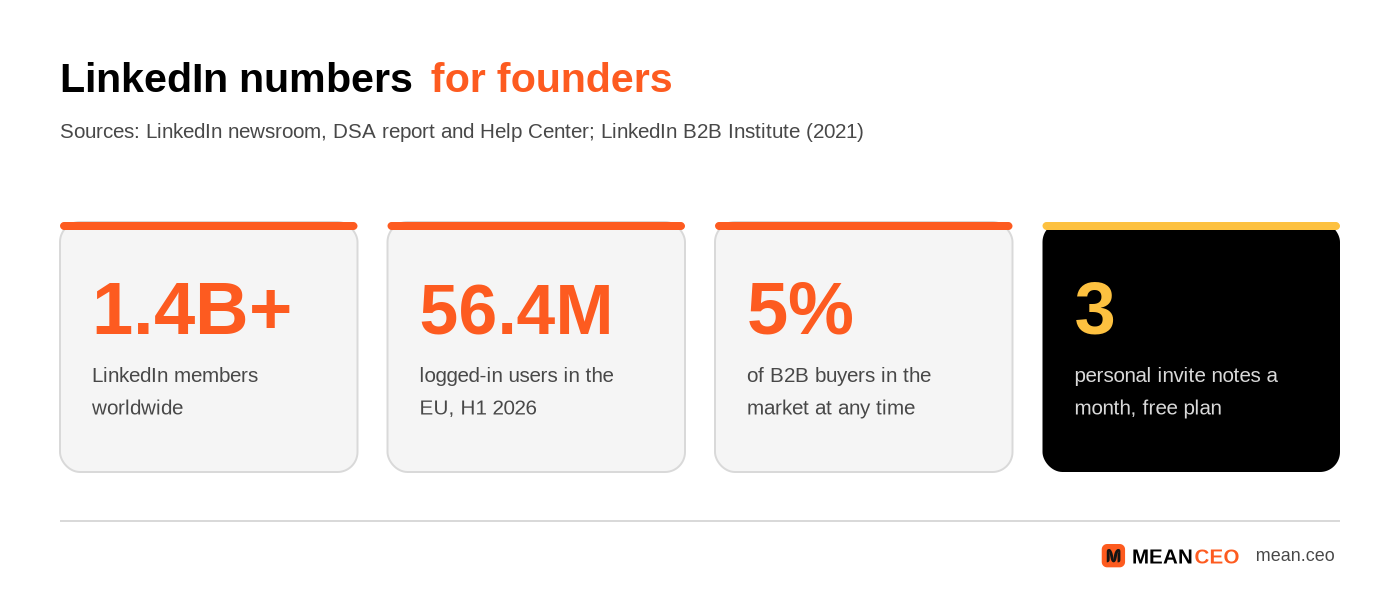
The audience is large and close to home. LinkedIn reports more than 1.4 billion members, over 450 million of them in Europe, the Middle East and Africa, and in its EU transparency report under the Digital Services Act it counted about 56.4 million logged-in users in the EU on average per month from January to June 2026. In most European B2B markets it is the place buyers, partners, journalists and future hires check before a first call.
Expect slow, compounding results, not leads in week one. Research by Professor John Dawes of the Ehrenberg-Bass Institute for the LinkedIn B2B Institute (2021) found that only about 5% of B2B buyers are in the market at any given time; LinkedIn calls this the 95-5 rule. A 30-day plan won’t change who is buying this month. It makes sure that when the other 95% are ready, your name is the one they remember. The 2025 Edelman–LinkedIn B2B Thought Leadership Impact Report, as reported by trade press, found that 95% of “hidden buyers” (people in a buying group whom sellers rarely meet) are more receptive to outreach after strong thought leadership; the report was paid for by LinkedIn, so read it as a signal, not proof that posting sells.
The 30-Day Plan at a Glance
The plan has four stages. Each one builds on the last: a clear position makes the profile easy to write, a good profile turns comments into profile visits, and visits turn into connections and conversations. Skip the first week and the rest of the month is spent posting into the void.
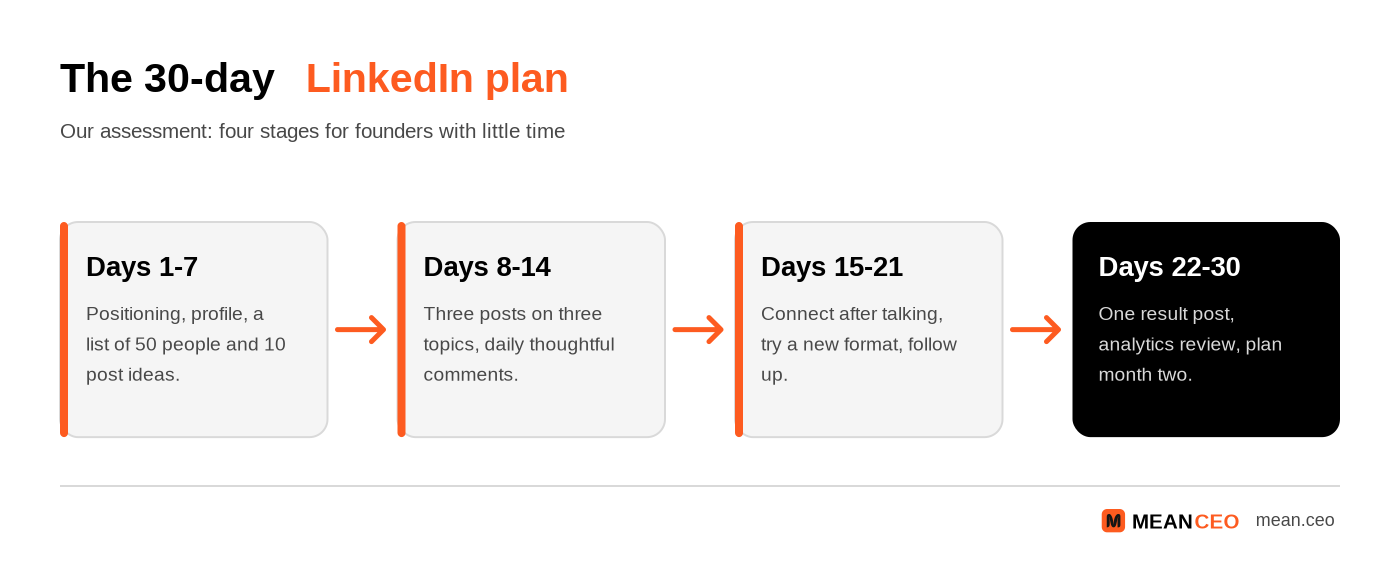
Our assessment: about 30 to 45 minutes on most days, plus one longer writing session a week. Adjust the numbers to your market; the order matters more than the counts.
Week 1 (Days 1–7): Position, Profile and People
Days 1–2, positioning. Write one sentence: “I help [who] with [problem] by [how].” Then choose three topics you can post about for months without running dry: usually your customers’ main problem, how you build your company, and one industry topic where you have a view. Set one goal for the month that you can count, such as five conversations with potential customers or two partner introductions.
1. Optimize Your LinkedIn Profile
Your LinkedIn profile functions as your digital introduction. It must convey who you are, whom you help, and what you stand for. Begin by crafting a headline that is concise but value-driven.
- Headline: Describe your role and expertise in clear terms: "Startup Founder | AI Strategist | Championing Female Entrepreneurship."
- Banner: Use prime real estate to highlight your niche and credentials.
- About Section: Structure similar to a pitch deck: state your transformation journey, articulate customers' problems, and list how you solve them.
- Featured Content: Add recent posts, links to interviews, and key achievements that instantly convey authority.
LinkedIn recommends a background photo of 1584 × 396 pixels (JPG or PNG, under 8 MB). Keep text away from the bottom left, where your profile photo covers it, and check how it looks on your phone.
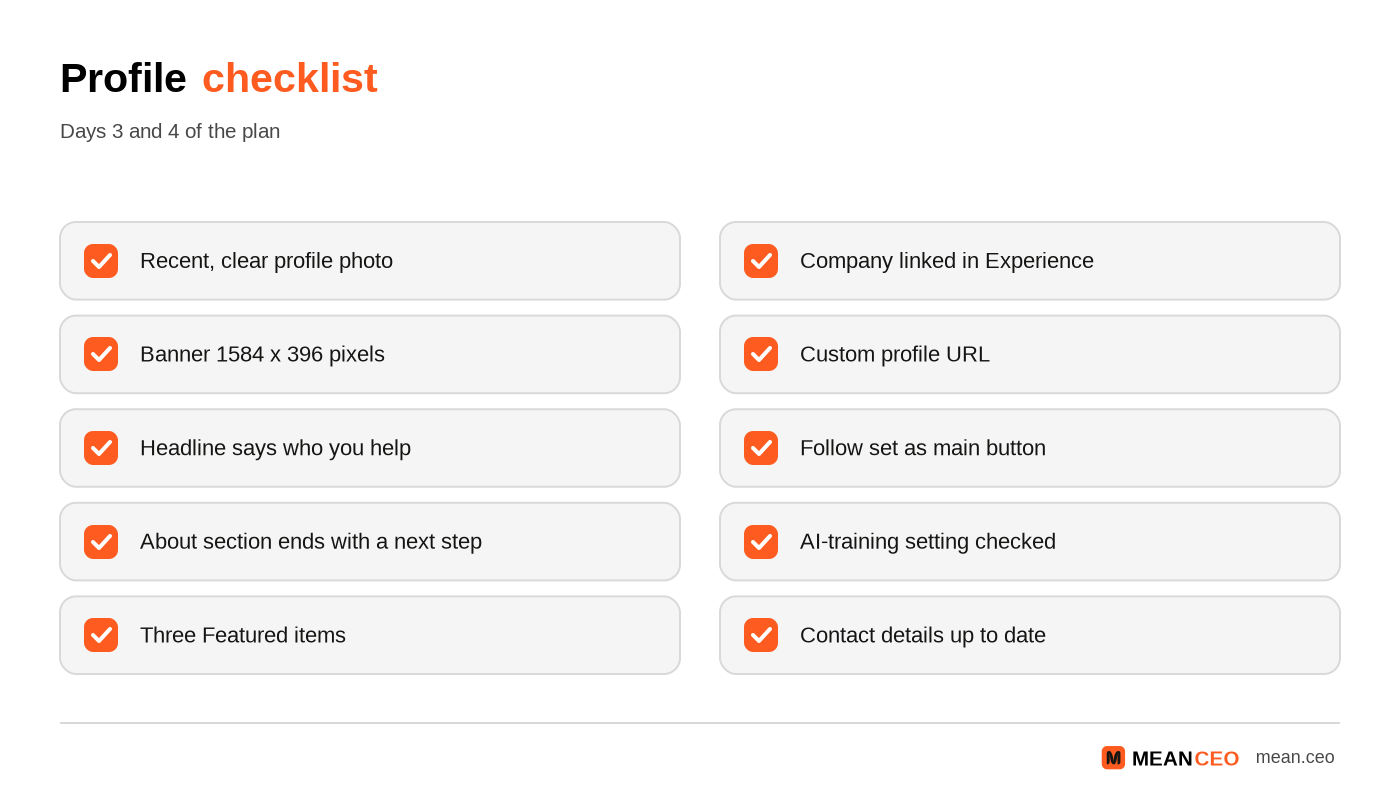
One EU-specific setting to check on day four: since 3 November 2025, LinkedIn has used data from members in the EEA, Switzerland and the UK, including public posts, to train its generative AI models. The setting is called “Data for Generative AI Improvement” and is on by default; switching it off stops future use, not use that has already happened. Decide on purpose, especially if you post about clients.
Days 5–7, people and ideas. List 50 people you want to reach: customers, potential customers, partners, peers, journalists and investors in your space. Follow ten people whose posts your buyers read. Then collect ten post ideas from questions customers actually asked you, in their words, and draft your first two posts. A simple first post works: why you started the company and what you have learned so far. If you write in batches, LinkedIn lets you schedule posts up to three months ahead.
Week 2 (Days 8–14): Find Your Voice
2. Craft Engaging Content
Publishing consistent LinkedIn content builds visibility. CEOs who write posts demonstrating their expertise grow followers and create opportunities for engagement.
- Publish three posts this week, one per topic: a short story from your company, a how-to that answers a customer question, and an opinion about your industry.
- Use a clear first line that tells readers what they will get, and avoid self-serving tones. Learn how to produce thought leadership content without sounding preachy.
- Turn your best ideas into new posts later: a story can become a how-to, a how-to can become a document post. Our guide to repurposing CEO content shows how.
Spend 15 minutes a day commenting on posts by people on your list. A useful comment adds an example, a number or a question; “Great post!” adds nothing. Reply to every comment on your own posts the same day, because those replies are often where the real conversations start.
Skip shortcuts. Posts that ask people to “comment YES” may get a burst of activity, but LinkedIn said in March 2026 that it is reducing the reach of engagement bait and repetitive, low-substance posts, and its Professional Community Policies forbid agreeing with others in advance to like or reshare each other’s posts, which is what engagement pods do.
Week 3 (Days 15–21): Network on Purpose
Female entrepreneurs, especially first-time founders in Europe, often struggle with limited access to networks. LinkedIn resolves this gap by enabling direct connection opportunities.
- Comment on a person’s posts a few times before you send a connection request, so your name is familiar when it arrives.
- Connect with peers, potential customers and collaborators from your list, starting with people who already know you.
- Congratulate connections on real achievements; the small gestures build rapport.
- Join a few niche communities or LinkedIn groups where your buyers actually discuss their work, and contribute before you share links. Our guide to LinkedIn groups for lead generation goes deeper.
Plan your outreach around one limit many founders discover too late: without Premium, LinkedIn lets you add a personal note to only three connection requests a month, and each note can be up to 200 characters. So send most requests without a note to people who already know you or have seen your comments, and save the notes for the few people who don’t. Once someone accepts, a short, specific message does the job a note would have done.
Try one new format this week: a document post (a short PDF with steps or a checklist) or a one-minute video explaining something you know well; our beginner’s guide to video content for CEO personal brands covers the basics. Then message three people who engaged with your posts. Thank them, add something useful (a resource, an introduction, an answer) and don’t pitch. Networking advice that doesn’t feel salesy is in CEO networking strategies that don’t feel salesy and female founder networking: quality over quantity.
Thinking about cross-platform strategies?
See our analysis of LinkedIn vs Twitter branding strategies for CEOs.
👉 Compare platforms
Week 4 (Days 22–30): Show Proof, Measure and Plan Month Two
Publish three more posts, and make one of them about a real result: a customer outcome, a number from your business, a lesson from something that failed. Results posts are the ones buyers and investors remember. Move your best post of the month into the Featured section.
LinkedIn provides visibility metrics like impressions, engagement rates, and follower growth. Treat your account like a startup experiment where you refine content based on performance data.
You don’t need extra tools. LinkedIn post analytics show, for each post, impressions and members reached, how much of the audience came from inside and outside your network, profile activity, reactions, comments, reposts, saves and sends, link clicks and viewer demographics such as job titles, industries and locations. LinkedIn says creator analytics are now available to all members; some views are still desktop-only.
Our assessment of what to watch in the first month. Small numbers are normal: ten comments from the right people are worth more than a thousand impressions from the wrong ones.
- On day 29, open your post analytics and list your posts by comments from people on your list, not by impressions.
- Keep the two formats and topics that started the most conversations; drop the rest.
- On day 30, book a fixed weekly writing slot for month two. Our CEO content calendar gives you a weekly framework for it.
Common Mistakes and Solutions
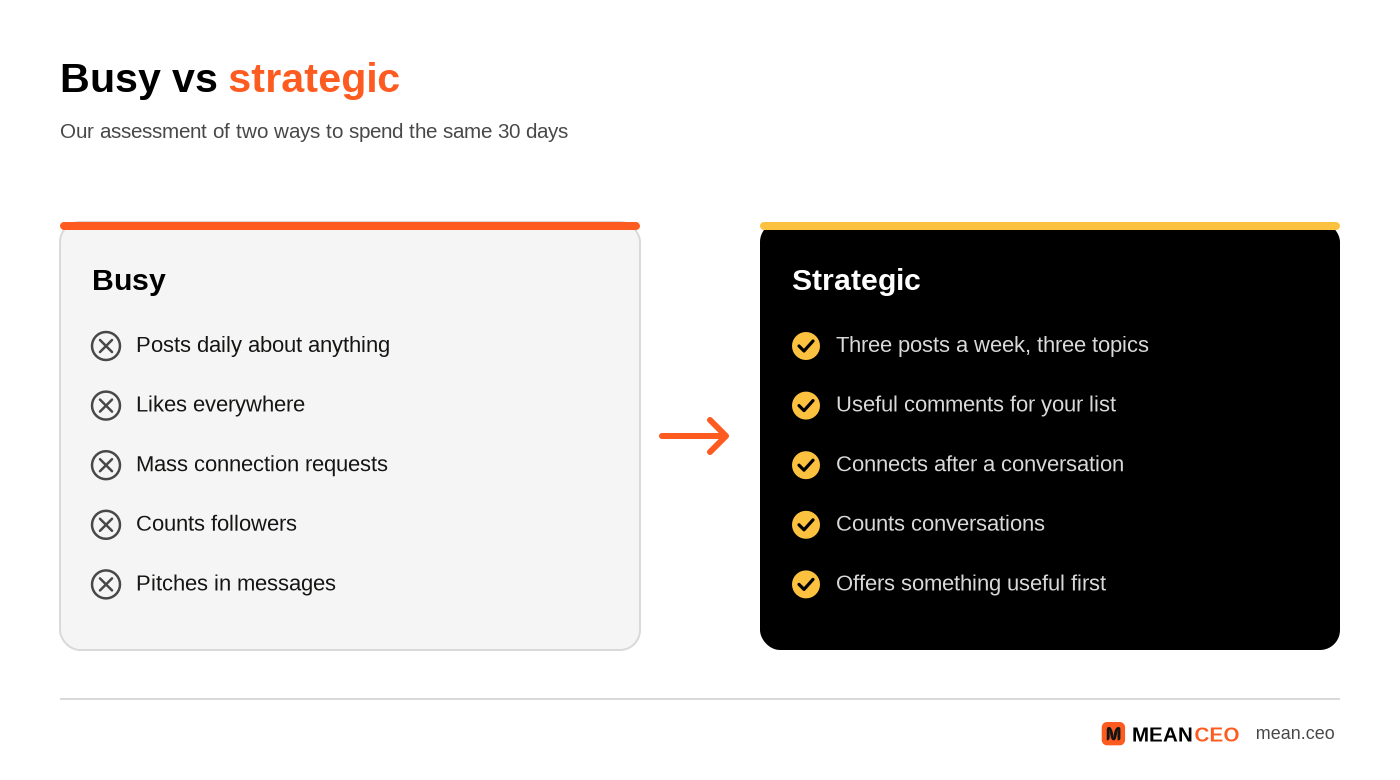
Mistake #1: Posting Without Intent
Avoid posting just for the sake of visibility. Focus on delivering consistent value and actionable insights that resonate with your audience. CEOs gain credibility when their LinkedIn presence aligns with their real achievements.
Mistake #2: Ignoring Engagement
CEOs who engage actively through comments, questions, and reactions signal genuine community involvement. Passive profiles may attract fewer meaningful connections, limiting growth of personal influence.
Mistake #3: Poor Branding Consistency
Make sure profile photos, banner images, tone in written content, and language in connection requests all convey the same professional image. Conflicting visuals or texts dilute your authority.
Mistake #4: Taking Every Comment Personally
A visible CEO gets visible criticism. Answer fair points calmly and in public, take personal attacks out of the comments, and don’t argue with people who only want an audience. Our guide on how to handle negative feedback as a public CEO has a simple routine for it.
Mistake #5: Expecting Leads in Week One
Most of the people who read your posts won’t buy this month, and that is normal. Judge the first 30 days by the conversations they start and the people who now know your name. What a personal brand is worth in sales over a longer period is covered in personal branding ROI: how CEO visibility drives sales.
How Female Founders Can Incorporate Grants Into Their Brand Strategy
Funding challenges for women in Europe remain significant, but CEOs leveraging grants as part of their LinkedIn content stand out. Talk about your wins, process, and insights into national and EU grant opportunities.
If your project is EU-funded, check the grant agreement before you post: EU programmes generally require you to show the EU emblem and a funding statement when you communicate about the funded work, so a LinkedIn post about it should say so too. Our guide to grants for women entrepreneurs that are worth your hours lists the programmes, and announcing a win is a natural post for week four.
This isn’t only a feeling. In experiments published in the Quarterly Journal of Economics in 2022, economists Christine Exley and Judd Kessler found that women described their own performance less favourably than equally performing men. A plan with fixed post types (a result, a lesson, a how-to) makes it easier to share results plainly, because the format asks for them.
Need a CEO content calendar?
Read our weekly publishing framework for founders.
👉 Start publishing smarter
Rules of Thumb You Will Hear, and What They Are Worth
Branding advice is full of number rules. Some are useful reminders; few are backed by research. Here is what the common ones say:
Boost Your SEO by Sharing Unique Insights.
Optimized founder content can rank on platforms like Google, ChatGPT, and more. More and more traffic is coming from Perplexity, ChatGPT, Grok and other AI tools.
👉 Rank on ChatGPT
Final Thoughts: The Link to Future Brand Strategies
Building a CEO personal brand on LinkedIn isn’t a one-time task; it is a habit. The first 30 days set up your profile, your topics and your routine. For female founders in Europe, combining consistent posting with grant wins, real results and a network built on conversations keeps opening doors long after the first month.
On top of LinkedIn strategy, exploring broader themes like how CEO personal branding brings in customers, or working through our LinkedIn playbook for female founders, will keep your brand relevant and adaptable to new challenges.
When LinkedIn works, decide whether to add a second platform: our comparison of LinkedIn and X for CEO personal branding helps you choose, and a LinkedIn newsletter can turn followers into subscribers.
People Also Ask:
Is building a personal brand on LinkedIn worth the effort?
For most founders selling to businesses, yes, if you treat it as a routine rather than a campaign. A clear profile and regular, useful posts help buyers, partners, investors and future hires understand who you are before the first call. Women executives in particular can use LinkedIn to highlight expertise, attract collaboration offers and find mentors. Results build over months, so judge it by the conversations it starts, not by follower counts in the first weeks.
What is the 5 3 2 rule for LinkedIn engagement?
The 5-3-2 rule is a rule of thumb from social media marketing: of every 10 posts, 5 share useful content from others, 3 are your own content and 2 are personal. There is no known research behind it. For a founder building a CEO brand, your own posts and thoughtful comments matter more than shares, so use it only as a reminder to mix your content with other people’s and to show a little of yourself.
What are the 5 C’s of personal branding?
There is no single standard list. Versions in circulation include clarity, consistency, credibility, commitment, character, creativity or connection. Treat any version as a checklist: are you clear about who you help, consistent in topics and visuals, and credible because you share real results? Those three do most of the work.
What is the 3 7 27 rule of branding?
The 3-7-27 rule says people need about 3 exposures to notice a brand, 7 to remember it and 27 to trust it. The numbers aren’t from a published study, so don’t plan around them. The useful idea behind them is real: trust builds through repeated, consistent contact, which is why a 30-day plan is a start, not the finish.
How can women entrepreneurs use LinkedIn to build their CEO brands?
Women entrepreneurs can use LinkedIn strategically by sharing their leadership experiences, showcasing innovations, and connecting directly with other successful female leaders. Posting thought leadership articles, engaging in discussions, and highlighting achievements are practical steps for establishing authority while driving industry-specific conversations. Fixed post types help here too: a monthly result post makes it easier to share achievements plainly.
What are practical strategies for a 30-day LinkedIn branding plan?
Spend the first week on positioning, your profile and a list of the 50 people you want to reach. In week two publish three posts and comment daily; in week three connect with people after talking to them in comments and try a new format; in week four share a real result, review your analytics and keep only what worked. About 30 to 45 minutes on most days is enough.
Why is LinkedIn critical for female CEOs in 2026?
LinkedIn lets female CEOs show their expertise directly to buyers, investors and partners, without waiting for a stage or a press mention. The platform also helps find mentors and peers across countries, which matters in Europe, where many founder networks are national and small.
How does the 30-day plan assist in establishing a CEO presence?
A 30-day plan replaces good intentions with a schedule. It fixes the order (position, profile, posts, network, review) so you don’t post before people can understand your profile, and it ends with a review, so month two is based on what actually started conversations.
What are the unique challenges women face in building LinkedIn brands?
Many women deal with bias in how authority is perceived, the worry of appearing too assertive, and more hostile comments when they post publicly. Research also suggests women describe their own performance less favourably than equally performing men. Concrete results, a supportive network and a clear routine for handling criticism help.
Can LinkedIn branding secure funding opportunities for female founders?
It can help, but it doesn’t replace a pitch. A clear profile and regular posts about progress make you easier to find and check, and warm introductions often start in comments. Expect investors to look at your profile before or after a first meeting, so make sure it tells the same story as your deck.
FAQ on Building a CEO Personal Brand on LinkedIn in 2026
How can CEOs create unique content to stand out on LinkedIn?
Blend personal stories with what you know about your industry. Use customer questions, lessons from mistakes and numbers from your own business; nobody else has them. AI assistants can help with research and editing, but add your own examples and opinions before you publish, and check every fact.
What are the best LinkedIn tools to analyze personal branding performance?
Start with LinkedIn’s own post analytics, which show reach, engagement, profile views, followers and viewer job titles. A simple spreadsheet for the conversations your posts start is the second tool you need. AI assistants can help you spot patterns in exported data; see our comparison of Claude Cowork and Perplexity for marketing.
Should CEOs focus on their personal brand or their company brand?
A CEO’s personal brand complements the company brand, fostering trust and authenticity. Share content about your expertise while linking achievements and values back to your organization. Strengthening both simultaneously amplifies visibility and connects with stakeholders on a personal level.
What role does LinkedIn play in attracting investors for startups?
LinkedIn shows your leadership and your startup’s progress to potential investors. Regular posts about milestones, market insights and lessons signal competence and build credibility. Many investors look founders up before a first meeting, so keep your profile, headline and Featured section consistent with your pitch.
How can female founders leverage LinkedIn for funding opportunities?
Highlight achievements, share grant wins and what you learned from applying, and post regularly about your progress. Join a few industry-specific groups and comment where investors and programme managers are active. To save time on research and drafting, see the AI for startups workshop.
What type of LinkedIn posts drive the highest engagement for CEOs?
LinkedIn posts focusing on thought leadership, customer success stories, and authentic personal narratives achieve the highest engagement. Use strong hooks and concise takeaways. Avoid overly promotional tones; instead, provide value to your audience through actionable insights or solutions.
How does LinkedIn help CEOs build industry authority?
By consistently sharing expertise, CEOs position themselves as thought leaders in their field. Regular contributions to industry discussions, publishing articles, and engaging with relevant content on LinkedIn establish authority and help build trust with peers, clients, and stakeholders.
How important is engagement for LinkedIn personal branding?
Active engagement is critical. CEOs should comment thoughtfully on posts, answer queries, and participate in niche LinkedIn groups. Interaction signals genuine involvement, boosting visibility and expanding network connections organically. Remember, engagement builds relationships and enhances your professional credibility.
What common mistakes do CEOs make on LinkedIn?
Mistakes include inconsistent posting, ignoring engagement opportunities, and failing to align post content with business goals. Avoid overly sales-driven posts; instead, focus on sharing knowledge and connecting authentically. Ensure your profile and content consistently reflect your expertise and leadership style.
How can LinkedIn integrate into a multi-platform branding strategy?
LinkedIn often serves as the base of a founder’s professional brand, with X (formerly Twitter) for short industry takes and a blog or newsletter for long-form thinking. Repurpose your best LinkedIn posts into articles and keep the same name, photo and positioning everywhere. Our LinkedIn vs X comparison helps you decide where a second platform fits.
About the Author
Violetta Bonenkamp, also known as MeanCEO, is an experienced startup founder with an impressive educational background including an MBA and four other higher education degrees. She has over 20 years of work experience across multiple countries, including 5 years as a solopreneur and serial entrepreneur. Throughout her startup experience she has applied for multiple startup grants at the EU level, in the Netherlands and Malta, and her startups received quite a few of those. She’s been living, studying and working in many countries around the globe and her extensive multicultural experience has influenced her immensely.
