TL;DR: LinkedIn vs Twitter (X) for CEO Personal Branding in 2026
LinkedIn is where buyers, partners, hires and grant contacts check who you are, so for most European B2B founders it should be the main platform. X (formerly Twitter) is faster and louder: good for testing ideas, joining live debates in tech, AI, crypto and policy, and reaching journalists, and it has changed a lot since 2023: new owners, paid checkmarks, an EU fine and AI training on posts. Pick one main platform, use the other to test ideas, turn the posts that work into longer LinkedIn content, and check each platform’s AI-training settings before you post.
💡 Want a proven strategy? Check out this guide to building CEO personal branding for actionable steps tailored for startup founders!
LinkedIn vs Twitter for CEO Personal Branding in 2026
Leveraging LinkedIn and X (formerly Twitter) for CEO personal branding in 2026 boils down to understanding the strengths of each platform. LinkedIn offers a professional, polished space for thought leadership and deep networking; X works as a faster, more chaotic place for quick reactions, live debates and testing ideas.
As a female founder in Europe bootstrapping startups while navigating complex ecosystems such as EU grants, I’ve developed strategies that optimize time and resources to extract maximum value from both platforms. This guide unpacks the differences and synergies between LinkedIn and Twitter and shows how CEOs, particularly those in Europe, can tailor their approach to build a sustainable and influential personal brand.
This guide compares the two platforms for founders: who you reach in Europe, what each one rewards, what has changed on X since 2023, how to split your time without burning out and which mistakes to avoid. If you already know LinkedIn is your platform, our guide on how to write LinkedIn posts that drive business results covers the posts themselves.
“In the game of personal branding, LinkedIn builds trust, while Twitter sparks conversation. Combining both platforms allows you to leverage their strengths without falling into the volume trap.”
Learn to Write for LinkedIn Like a Pro
Discover how to craft engaging content on LinkedIn that resonates with your audience.
👉 How to Write LinkedIn Posts That Drive Business Results
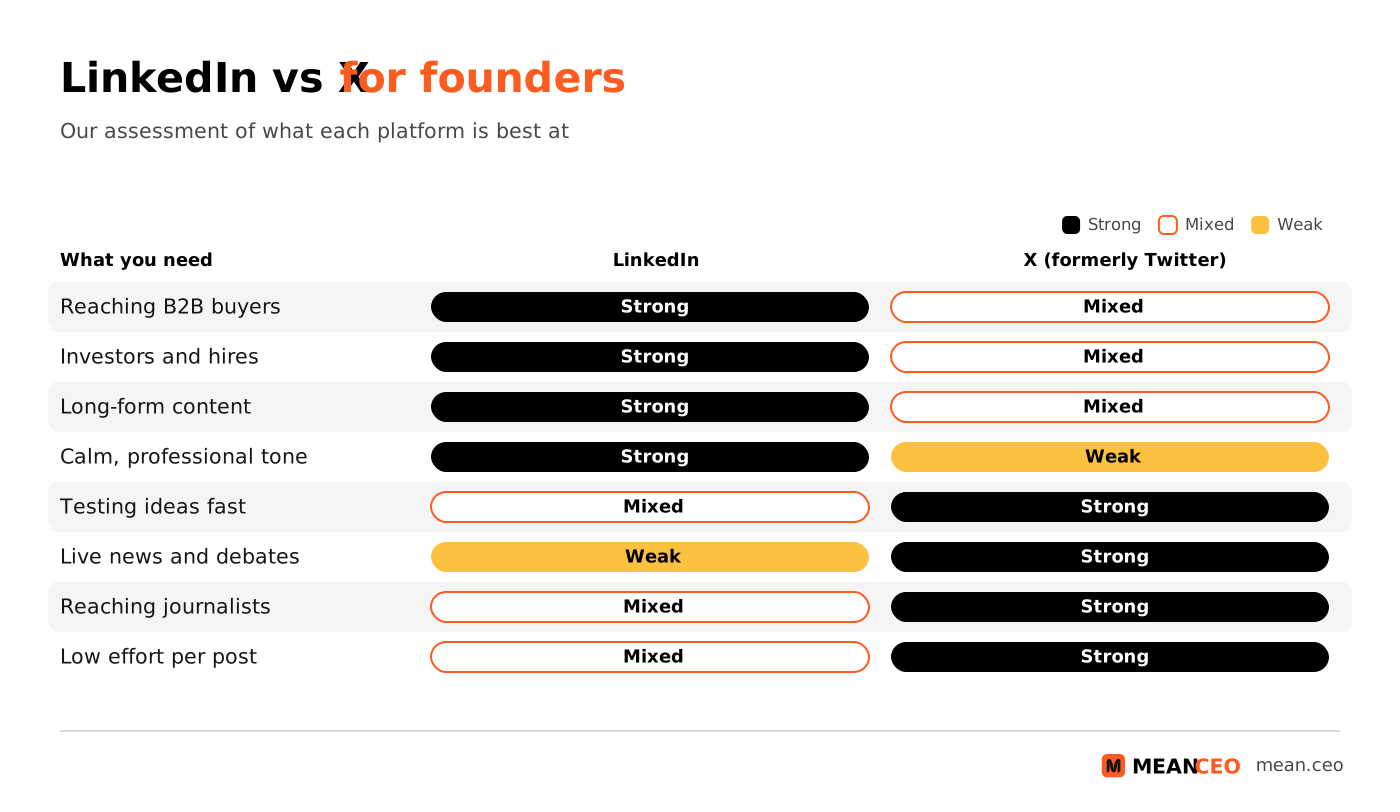
LinkedIn vs X at a Glance
Before the details, here is how the two platforms compare on what matters for a founder’s personal brand:
EU user figures come from each platform’s Digital Services Act transparency report for January to June 2026; the platforms count users in their own way, so treat them as rough. Other rows: platform help pages and our assessment, checked 11 Nov 2026.
Why Should CEOs Even Care About Social Media in 2026?
The days when CEOs could avoid social media and rely on their companies to define their public image are over. In 2026, stakeholder expectations go beyond LinkedIn endorsements or occasional interviews. CEOs are now expected to be authentic storytellers, thought leaders, and active participants in global conversations.
In Europe, where female founders face unique barriers, from accessing financial resources to combatting cultural stereotypes, establishing a strong and trusted personal brand becomes essential to open doors for funding and collaboration. The good news? Platforms such as LinkedIn and Twitter can level the playing field for women entering entrepreneurship without traditional venture capital privileges.
For instance, LinkedIn helps female entrepreneurs project leadership credibility through polished content while also attracting potential team members, clients, or investors. Conversely, Twitter enables European entrepreneurs to amplify their voices in a fast-paced marketplace dominated by dynamic discussions and trends.
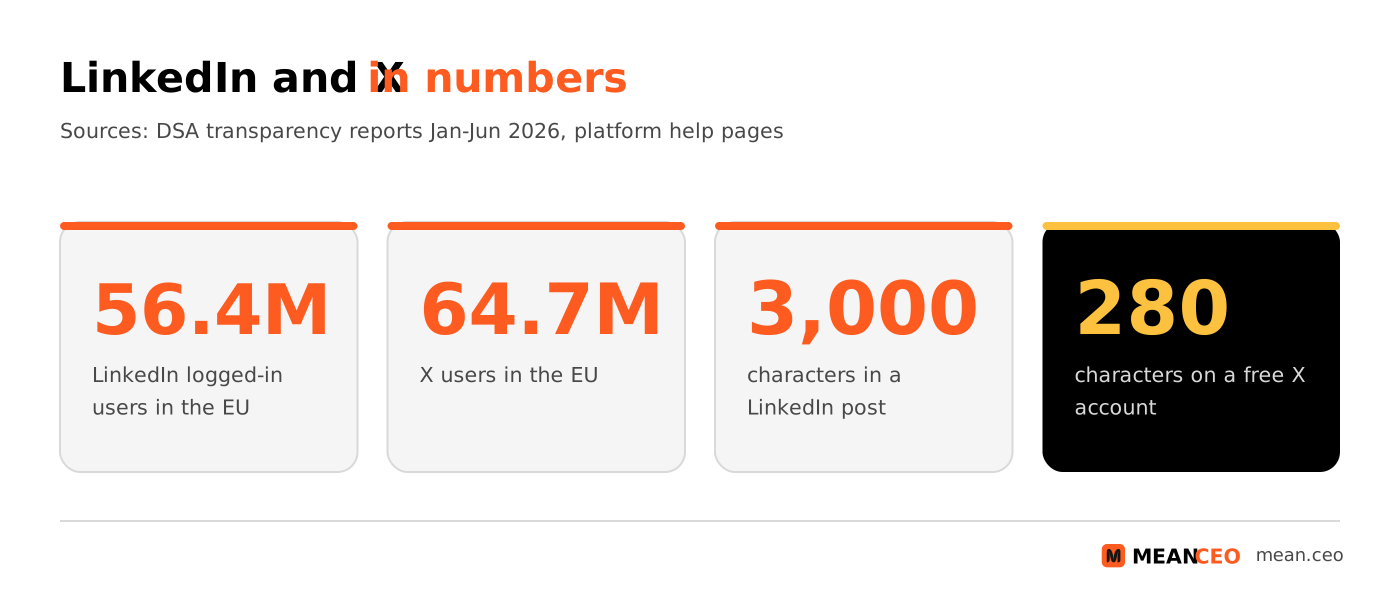
In Europe the two platforms are closer in size than many founders think. Under the EU Digital Services Act, both must publish their average monthly active users in the EU every six months. For January to June 2026, LinkedIn reported about 56.4 million logged-in users in the EU and X reported about 64.7 million. The difference is who those people are: on LinkedIn they come to talk about work, on X about everything.
Buyers do read what founders publish. The 2025 Edelman–LinkedIn B2B Thought Leadership Impact Report, as reported by trade press, found that 95% of “hidden buyers” (people in a buying group whom sellers rarely meet) are more receptive to outreach after strong thought leadership, and 64% trust it more than marketing materials. The report was paid for by LinkedIn, so read it as a signal, not proof that posting sells.
What Makes LinkedIn Ideal for Detailed Thought Leadership?
LinkedIn stands out by providing unparalleled opportunities for CEOs to publish in-depth content that establishes their authority within their industries. Unlike Twitter’s rapid-fire conversation model, LinkedIn values substance, offering features like articles, newsletters, and the ability to use multimedia to demonstrate expertise.
Our own work on Fe/male Switch, a game-based startup school, shows the kind of topic LinkedIn suits: a post explaining how AI co-founders fit into startup education needs room for context and examples, and LinkedIn gives you that room and an audience that reads it.
If you're looking to control the narrative around your successes or share hard-earned insights, LinkedIn is the go-to platform. Use it wisely by following proven strategies such as this 30-day plan for building a CEO personal brand.
You don’t need special settings to use these tools anymore. LinkedIn retired the creator mode switch in March 2024 and gave its sharing tools and analytics to all members; you can still make Follow the main button on your profile. Every member can start a newsletter, and companies can now promote a founder’s or employee’s post as an ad, with the author’s approval.
One EU-specific point: since 3 November 2025, LinkedIn has used data from members in the EEA, Switzerland and the UK, including public posts, to train its generative AI models. The setting is called “Data for Generative AI Improvement” and is on by default; switching it off stops future use, not use that has already happened.
How Can X (Formerly Twitter) Drive Visibility and Real-Time Engagement?
While LinkedIn builds credibility over time, X thrives on speed and direct replies. Many discussions in tech, AI, crypto, media and policy still start there, and journalists use it to find sources and react to news. Its recommendation system is public: X published the code of its Grok-based “For You” ranking in January 2026, after open-sourcing the earlier version in 2023. In July 2026 Elon Musk said X had not penalised posts with links “for over a year”, although independent analyses had found lower reach for link posts before, so test it with your own posts.
Free accounts can post up to 280 characters; longer posts of up to 25,000 characters, longer videos and the checkmark need a paid plan. In October 2026 X replaced its Basic, Premium and Premium+ plans for new buyers with “The X Subscription”, in tiers from $8 to $200 a month that bundle the Grok AI assistant; existing subscribers can keep their old plan. X also closed its Communities feature in May 2026, so groups now move to group chats.
If, for example, you want to test a strong opinion about how bootstrapped companies get through a downturn, a short thread on X shows within a day whether people agree, push back or ask for more. The threads that start real conversations can later become longer LinkedIn posts or articles with more depth and your own data.
For those cautious about blending personal with professional opinions, here’s a handy guide on how to balance personal and professional on social media to maintain consistency and relevance.
What Has Changed on X, and Why It Matters for European Founders
X is not the Twitter many founders joined. Elon Musk bought Twitter for $44 billion in October 2022 and renamed it X in July 2023. In March 2025 his AI company xAI took over X in an all-stock deal, and in February 2026 SpaceX acquired xAI, and with it X. For a founder, that means the platform’s priorities are tied to Grok and its owner’s other businesses, and features, subscriptions and rules change often.
European regulators are watching closely. On 5 December 2025 the European Commission fined X €120 million under the Digital Services Act, its first non-compliance decision under the law, for a misleading blue checkmark that anyone can buy without meaningful identity checks, a deficient ad repository and blocking researchers’ access to public data. X appealed to the EU General Court in February 2026. In January 2026 the Commission also opened an investigation into Grok and X’s recommender systems. For your brand, the lesson is simple: a checkmark on X doesn’t prove who someone is, and your audience knows it.
Your posts may also train AI. In 2024 X agreed with Ireland’s Data Protection Commission to stop using EU and EEA users’ posts to train Grok, and in April 2025 the regulator opened an inquiry into whether earlier use was lawful; no decision has been published yet. Check the “Grok & Third-party Collaborators” setting under Privacy and safety, Data sharing and personalization, and decide on purpose.
Some of your audience may have left. On 10 January 2025, more than 60 German-speaking universities and research institutions stopped posting on X, and more joined in the following weeks. Meanwhile Meta says Threads passed 500 million monthly active users in mid-2026, and Bluesky passed 40 million registered users in October 2025. Before you invest in X, check whether your buyers are still there.
Figures as reported by each platform or by TechCrunch for Bluesky; platforms count users differently, so compare them with care.
How Do You Leverage Both Without Burning Out?
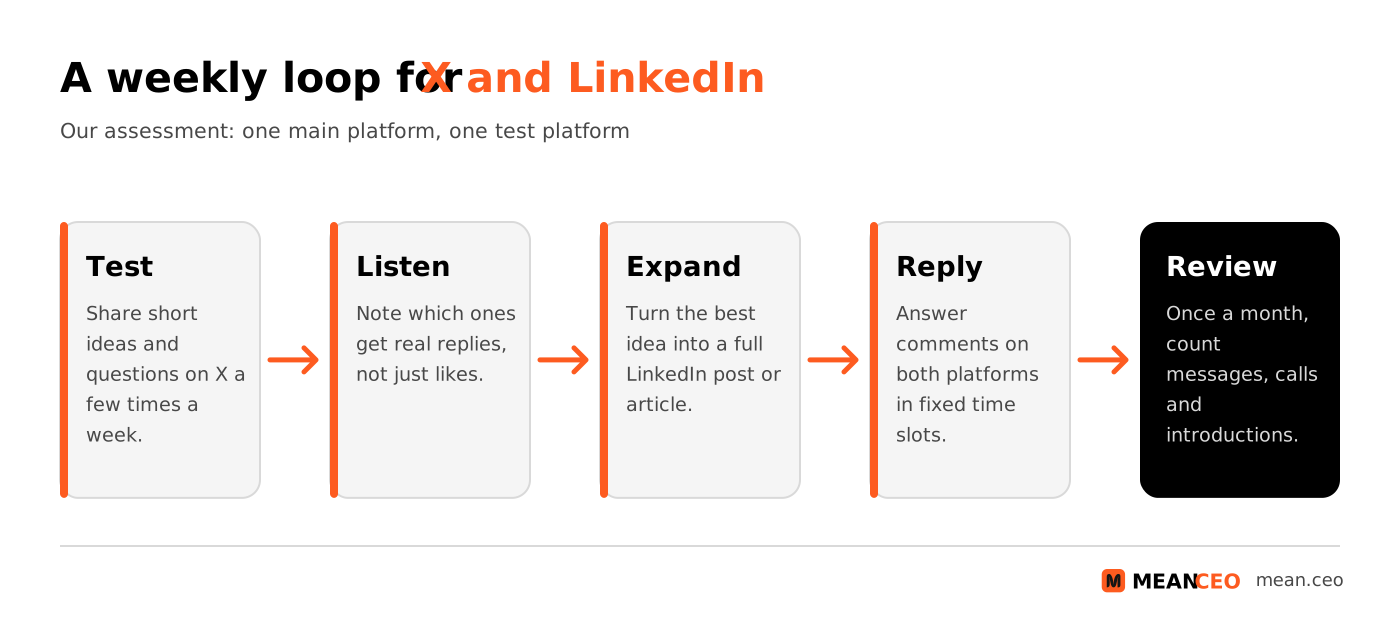
Too many CEOs try to master both platforms at once and end up overwhelmed. Here is a simple framework to use LinkedIn and X together:
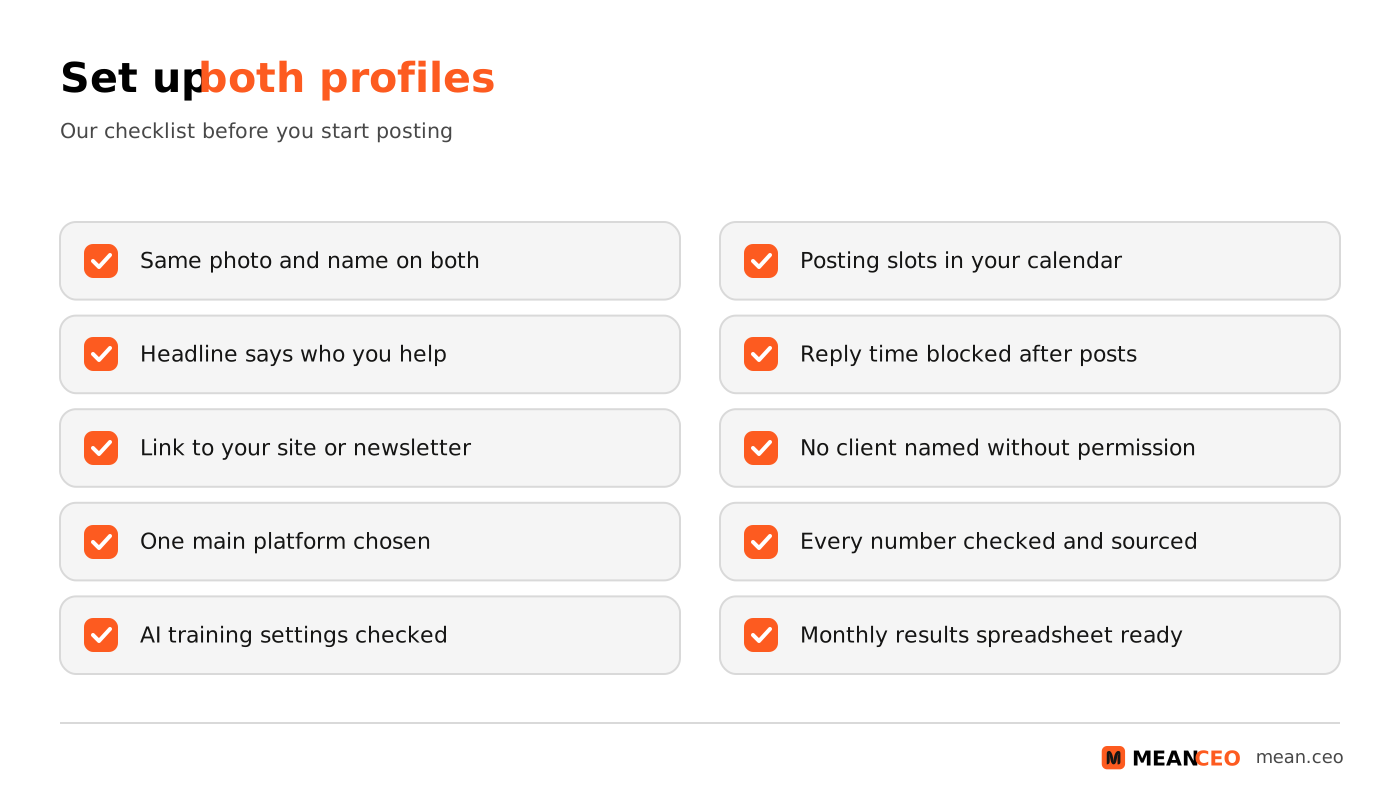
- Choose one main platform. For most European B2B founders that is LinkedIn; for founders in developer tools, AI, crypto or tech policy, X may deserve equal weight.
- Use X to test ideas. Share a short, unpolished thought or a question a few times a week and join conversations where your buyers already talk.
- Promote the winners. Once a week, pick the idea that got the best replies and turn it into a fuller LinkedIn post, document post or article.
- Publish one to three strong LinkedIn posts a week. A rhythm you can keep for months beats a burst of daily posts.
- Review monthly. Use each platform’s analytics, and track the messages, calls and introductions each one brings in a simple spreadsheet.
How much time each platform deserves depends on who you sell to. Our assessment for typical founder situations:
Our assessment, not a platform rule. Whatever you choose, block a fixed time for posting and replying, for example 30 minutes, three times a week, and stop when it is over.
Mistakes Founders Often Make and How to Fix Them
Spreading yourself too thin: Being half-present on five platforms helps nobody. Pick one main platform where your buyers are, add a second only for testing ideas, and check the results each month.
Posting too frequently on LinkedIn: Over-posting dilutes your message. Focus instead on a few thoughtful posts each week.
Using AI-generated, impersonal content: While AI is helpful, audiences today detect generic AI posts. Personalize content to retain credibility.
Copying the same text everywhere: A 1,500-character LinkedIn post doesn’t fit in a 280-character post on X, and a quick X joke rarely works on LinkedIn. Adapt the idea, not the text.
Ignoring settings and rules: Both platforms use posts to train AI unless you change a setting, X’s paid checkmark impresses fewer people than it once did, and buying followers or joining engagement groups breaks both platforms’ rules. Check your settings once, write for real readers and let the numbers grow slowly.
Are you getting customers from ChatGPT yet?
More and more traffic is coming from Perplexity, ChatGPT, Grok and other AI tools.
👉 Rank on ChatGPT
What’s Next for European Female Founders?
Navigating the challenges of personal branding on LinkedIn and Twitter provides a foundation to build visibility. However, for those looking to expand further, the next logical step may involve strategies like grooming brand authority as startup founders. For insights into building authority, explore the CEO personal branding guide.
To get more out of every post, see our guide to repurposing CEO content across platforms; to see how visibility turns into revenue, read Personal Branding ROI: how CEO visibility drives sales. And if you want more readers before you post, our content strategy for CEO thought leadership shows how posts, articles and newsletters work together.
For the women daring to bootstrap, the future looks bright. Use tools and platforms strategically, and you’ll lead the conversation in your niche without sacrificing focus on business growth.
People Also Ask:
Is LinkedIn still relevant for professional branding in 2026?
Yes. LinkedIn reports more than 1.4 billion members worldwide and about 56.4 million logged-in users in the EU, and it is still the network where buyers, partners, recruiters and investors check who you are before a first call. For founders it works for networking, industry discussions and hiring, and a clear profile plus regular posts make you easy to find when someone searches for your expertise.
What is the 5 3 2 rule on LinkedIn and how is it applied?
It is a widely shared rule of thumb with no clear author, not a LinkedIn rule: out of every ten posts, five are content from others that your audience will value, three are your own expertise and two are personal, human posts. Use it as a check that most posts give the reader something and only a few sell. Our guide to writing LinkedIn posts covers this and similar mixes.
Which is better for CEO branding in 2026, LinkedIn or Twitter?
They do different jobs. LinkedIn is better for detailed professional insights, trust and business leads; X (formerly Twitter) is better for quick reactions, live debates and reaching tech, media and policy circles. For most European B2B founders LinkedIn should be the main platform and X a place to test ideas; founders in developer tools, AI or crypto may need both.
What is the 3 7 27 rule of branding?
It is a marketing rule of thumb with no known research behind it: people notice a brand after about 3 exposures, recognise it after 7 and remember it after 27. The numbers aren’t proven, but the lesson holds: one post rarely makes an impression, so keep your message consistent across platforms and show up regularly.
Has personal branding shifted for women entrepreneurs in 2026?
The basics haven’t changed: share real expertise, be consistent and be easy to find. What has changed is the platform mix. X has become more polarised since 2023 and some European institutions have left it, while Bluesky and Threads have grown. Many women founders now put LinkedIn first, test ideas on a second platform and use AI tools for drafts while keeping their own voice and stories.
Can women entrepreneurs bootstrap using social platforms like LinkedIn?
Yes. Posting, commenting and direct messages on LinkedIn cost nothing but time, and they can bring clients, partners and hires without an ad budget. Founders who share useful lessons regularly tend to get more inbound messages than those who only post announcements. Our article on how CEO personal branding drives bootstrapped customer acquisition goes deeper.
What sectors are trending for female entrepreneurs using LinkedIn in 2026?
LinkedIn suits sectors where trust and expertise sell: consulting and professional services, B2B software, health technology, education, sustainability and climate, and AI services. In these fields buyers often check a founder’s profile and posts before they reply, so visible expertise shortens the path to a first call.
What are the key challenges for women using Twitter for branding?
Standing out in fast conversations, dealing with harassment and pile-ons, and a feed that has become more polarised. Mute and block tools, limiting who can reply to a post and sticking to topics you know well help. Many founders also keep X for listening and short replies, and put their main effort into LinkedIn, where the tone is calmer.
How can women CEOs amplify their brand using AI tools in 2026?
Use AI assistants such as ChatGPT, Claude or Gemini to draft outlines, shorten long posts, suggest hooks and turn a talk or article into several posts, then rewrite in your own words. Readers notice generic AI text, so keep your stories, numbers and opinions your own. Our guide on training AI on your brand voice shows how.
Should women focus more on personal or business branding in 2026?
Both, with the personal brand leading in the early years. People trust people more than logos, so a founder’s profile often brings the first clients and partners; the company page then builds on that trust. LinkedIn is a good place to combine the two: post as yourself and reshare the best posts from the company page.
FAQ on LinkedIn and Twitter (X) for CEO Personal Branding in 2026
How should CEOs divide their time between LinkedIn and Twitter?
There is no fixed rule. Our assessment: if you sell to European businesses, spend most of your social media time on LinkedIn and use X for short tests and conversations; if your buyers are developers, AI or crypto people, journalists or policy makers, split your time more evenly. Review the split each month based on the messages and calls each platform brings.
What kind of content works best on LinkedIn for CEO branding?
Lessons from your own work, short stories with a clear takeaway, how-to posts, document posts with frameworks and opinions on your industry backed by facts. For content strategies tailored to LinkedIn, explore the guide to launching a startup on LinkedIn.
Can Twitter really help CEOs build thought leadership?
Yes, especially in fast-moving fields such as AI, developer tools, crypto and tech policy, where many discussions start on X. Share short insights and threads, join relevant debates and reply to people you respect. The posts that start conversations can become longer, polished LinkedIn content.
What is the optimal posting frequency for CEOs on LinkedIn?
LinkedIn doesn’t publish an ideal frequency. Our assessment: one to three strong posts a week is enough when LinkedIn is one of two platforms, and two to four if it is your only one. A rhythm you can keep for months matters more than a burst of daily posts.
What mistakes should CEOs avoid when building their personal brand?
Spreading yourself across too many platforms, posting impersonal AI-generated content, copying the same text everywhere and over-posting on LinkedIn. Instead, choose one main platform, personalise every post, adapt ideas to each platform and check your privacy and AI-training settings.
How do LinkedIn SEO strategies boost visibility for CEOs?
Use the words your buyers search for in your headline, About section and experience, complete your profile and post about the same few topics consistently. Hashtags matter less than they used to; clear wording matters more. Learn more in this LinkedIn SEO guide for startups.
How can female founders overcome challenges on social media platforms?
Choose the platform where your buyers are, post about what you know best and use mute, block and reply controls without guilt. Write about your results plainly: research shows women tend to describe their own work less favourably than men with the same results, so name your wins.
What LinkedIn features effectively showcase CEO expertise?
Newsletters, articles, document posts (PDF carousels), featured posts on your profile and short native videos. Creator mode no longer exists as a switch; its tools are available to every member. LinkedIn post analytics show which topics bring profile views, followers and messages.
How can Twitter threads impact professional brand awareness?
Threads break a complex idea into short steps that are easy to read and share, and a good one can reach people far outside your followers. Pin your best thread to your profile and turn the ones that started real conversations into LinkedIn posts or articles.
What tools can prevent burnout while managing LinkedIn and Twitter?
Schedule posts in batches: LinkedIn lets you schedule posts natively, and tools such as Buffer or Hootsuite handle several platforms. Our review of AI tools for social media management compares options. Block fixed times for replies and switch off notifications outside them.
Should CEOs use paid advertising to grow their presence on LinkedIn?
Only after your organic posts work. LinkedIn’s Thought Leader Ads let your company promote your own posts, with your approval, and you can also boost a single post from your profile. Start with a small budget, boost a post that already performs well and measure messages and calls, not just impressions.
About the Author
Violetta Bonenkamp, also known as MeanCEO, is an experienced startup founder with an impressive educational background including an MBA and four other higher education degrees. She has over 20 years of work experience across multiple countries, including 5 years as a solopreneur and serial entrepreneur. Throughout her startup experience she has applied for multiple startup grants at the EU level, in the Netherlands and Malta, and her startups received quite a few of those. She’s been living, studying and working in many countries around the globe and her extensive multicultural experience has influenced her immensely.
