TL;DR: CEO Content Calendar: Weekly Publishing Framework
A CEO content calendar turns “I should post more” into a fixed weekly routine: one main piece a week on one of 3 to 5 themes, published on your site or newsletter, then cut into a few posts for the channel where your buyers are. Consistency matters because readers learn when to expect you and every useful piece adds to your authority, not because Google rewards a posting schedule: it doesn’t. Block about 3 to 4 hours a week, keep the calendar in one simple sheet or board, check every number before you publish and review what worked once a month.
💡 Want to build authority fast? Check out startup founder branding tips for actionable next steps on maximizing your personal presence.
CEO Content Calendar: Weekly Publishing Framework
Publishing professional, targeted content weekly is the linchpin for growth in 2026, especially for CEOs building personal brands or startup founders looking to establish their authority. A CEO content calendar provides the strategic structure needed to maintain consistency and amplify your voice across platforms. Using such a framework ensures message alignment, saves time, and builds credibility.
Why consistency matters: Not because Google rewards a schedule. Asked whether publishing frequency gives a ranking boost, Google’s John Mueller answered “Nope” and added that a site shouldn’t be a machine that pumps out content at a fixed rate. Google does run “query deserves freshness” systems, but they favour fresh pages only for searches where people expect them, such as news or a new release, and its crawl documentation says popular and changing pages get crawled more often. The real payoff is simpler: your audience learns when to expect you, and every useful piece adds to your authority on the topics you want to own.
This guide is about the calendar of one busy founder: what goes in it, a weekly rhythm you can keep for months, a sample month, the tools that cost nothing and the mistakes to avoid. If you plan content for a whole team, see our guide to content calendar planning and management; for a LinkedIn-only plan, see the LinkedIn content calendar for startups.
Boost Visibility Across Platforms
Learn how to systematically repurpose your CEO content to maximize reach.
👉 How to Repurpose CEO Content Across Platforms
What is a CEO Content Calendar?
A CEO content calendar is a structured tool for planning and scheduling content tailored to your audience. This framework allows leaders to focus on strategic themes, address audience questions, and deliver value consistently.
For bootstrap founders in Europe, like myself, this calendar is a game-changer. Rather than relying on massive teams or agencies, a focused plan ensures your time and resources are spent wisely. By prioritizing strategic, high-impact topics, you can maximize reach and influence while staying lean.
A calendar is not the same as a strategy or a to-do list. Here is how the three planning tools differ and how often you touch each one:
Why CEOs Need a Weekly Publishing Routine
Weekly publishing offers three core benefits:
- Topical authority: Consistently addressing your niche builds credibility as an industry expert.
- Search visibility: Every useful page on a topic you own is another page that can rank and answer questions. Google doesn’t reward a posting schedule itself, but a weekly habit means the useful pages actually get written.
- Audience engagement: Regular content fosters stronger relationships with your followers and partners.
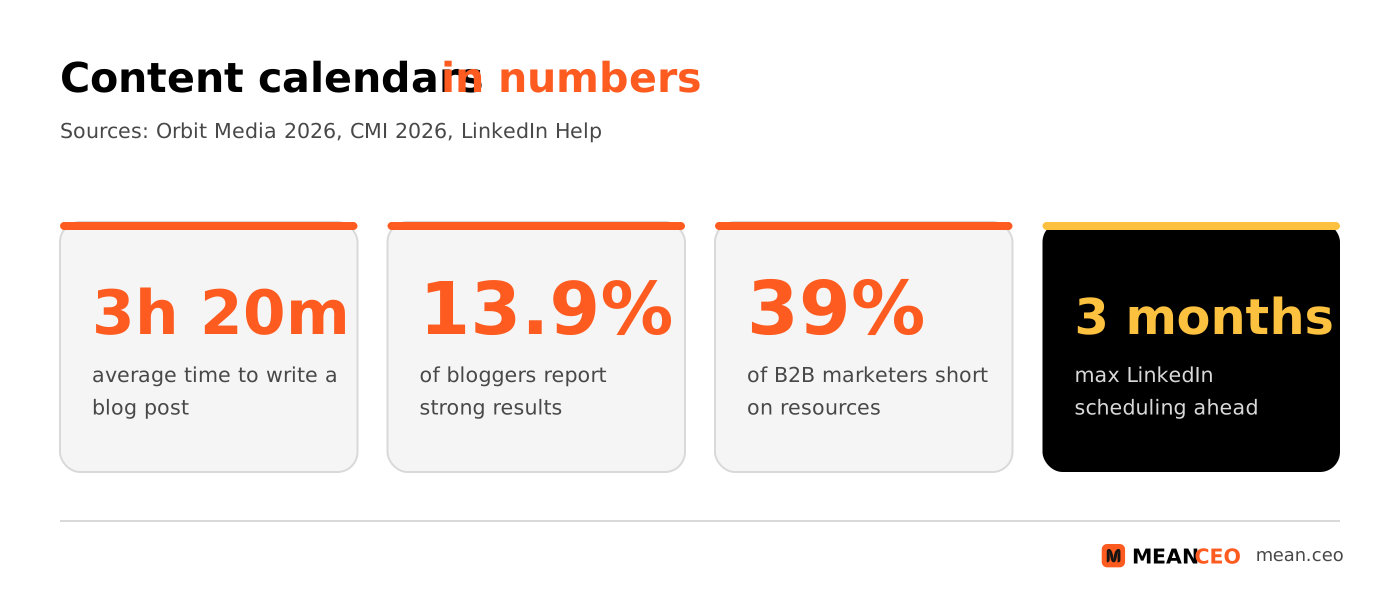
How much time does a weekly piece really take? Orbit Media’s 2026 survey of 1,042 bloggers found that the average blog post now has 1,312 words and takes 3 hours 20 minutes to write. Only 13.9% of bloggers said their blog delivers strong results, the lowest share in the survey’s history, while posts that took more than 6 hours and used four or more content strategies reached 31%. And 92% of bloggers now use AI, but AI use did not go together with better results. The lesson for a founder’s calendar: fewer, better pieces beat more, faster ones. Time is the usual bottleneck: in the Content Marketing Institute’s 2026 B2B research, 39% of marketers named resource constraints (time, people, budget) among their top challenges.
“The single most important job of a CEO is to communicate their vision, goals, and mission. Content bridges this gap on a scalable level.” — Violetta Bonenkamp
For leaders of bootstrapped startups, the emphasis on cost-effective tools and systems, such as no-code platforms, lets you develop your content calendar with little overhead. A spreadsheet or a free board is enough to start; these are the free plans worth knowing:
Free plans as shown on each tool’s pricing page on 12 Nov 2026; limits change, so check before you build on them. LinkedIn’s own post scheduling is free too.
Create a Winning Personal Brand on LinkedIn
Leverage our 30-day action plan for LinkedIn to elevate your executive presence.
👉 Building a CEO Personal Brand on LinkedIn
How to Build a Top-Tier CEO Content Calendar
Creating a robust content calendar requires thoughtful preparation and clear objectives. Here’s the step-by-step approach:
Step 1: Define Your Messaging Strategy
- Core themes: Choose 3-5 topics you want to be known for. For example, female entrepreneurship, zero-code tools, or scaling startups in Europe.
- Audience needs: Use Google Trends to map your audience’s seasonal search behaviour. You can compare up to 8 groups of search terms at once, which is enough to check all your themes side by side.
- Call-to-action alignment: Ensure content ties back to your business goals, whether it’s driving consultations or email subscriptions.
Pro tip: Match themes with search intent. People who search “how to” want a guide, people who compare options want a comparison table, and people who follow you on LinkedIn want your opinion and your lessons. Our guide to topical authority for startup blogs shows how to turn themes into clusters of related articles.
Step 2: Map Out Content Formats and Delivery Channels
Using a multi-format approach is crucial for CEOs looking to expand their reach. Pair blog posts with LinkedIn posts or articles, and repurpose webinar content into short LinkedIn document posts or threads on X (formerly Twitter).
- Format: Blog posts, LinkedIn posts and articles, newsletters, video snippets or guides.
- Channel: Publish the full piece on your website, share a summary on LinkedIn, and send it to your email newsletter subscribers.
- Best engagement: Video content can amplify personal brands quickly when paired with a strong storytelling narrative.
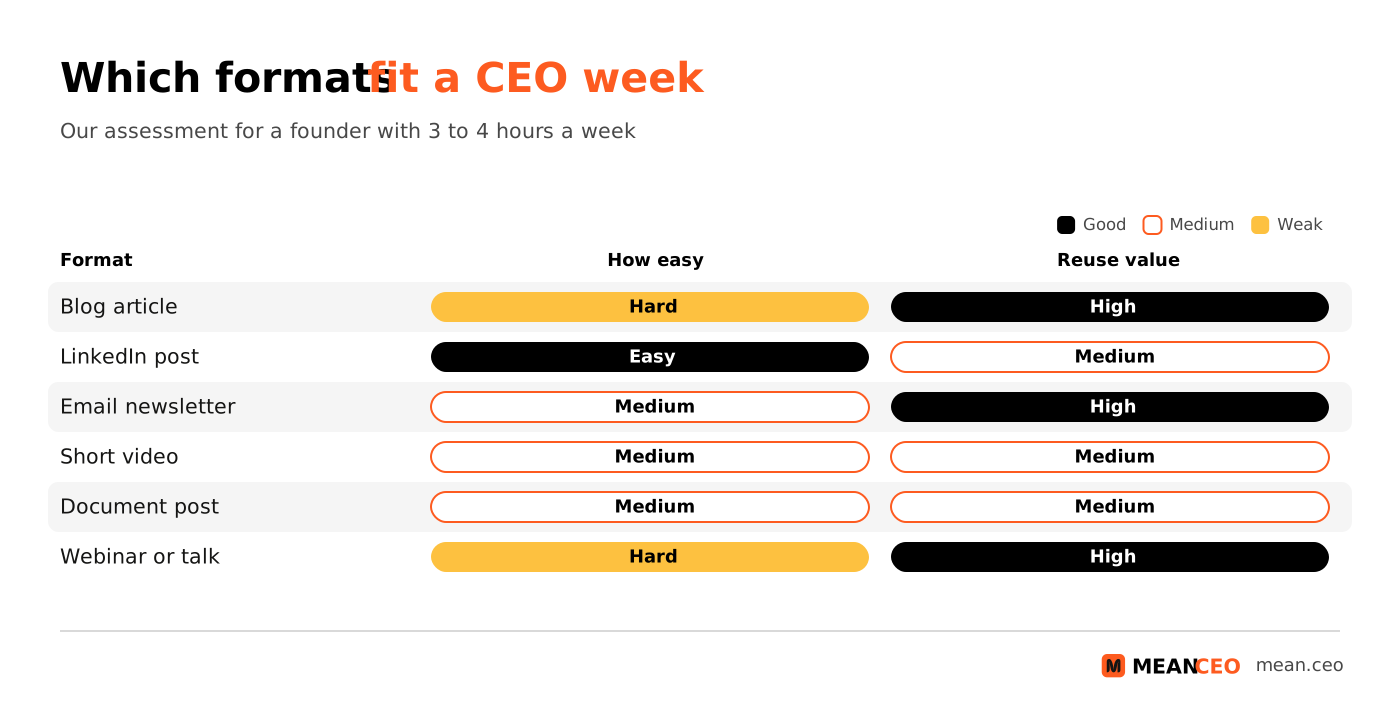
Each channel has its own job and limits, so plan the format with the channel in mind. Your website or blog is the home of the main piece and builds search visibility over time. LinkedIn brings the idea to your network in posts of up to 3,000 characters. Your email newsletter reaches people who asked to hear from you, and X (formerly Twitter) is good for testing ideas in 280 characters on a free account. Short video shows your face and voice: cut a clip from a talk or record a one-minute summary of the main piece.
Repurpose Dynamic CEO Stories
Turn long-form articles into platform-specific assets with ease.
👉 Building a CEO Content Team on a Budget
Step 3: Set a Weekly Workflow
- Monday: Brainstorm or finalize weekly topic and research audience queries.
- Tuesday: Draft content, focusing on tone and value.
- Wednesday: Polish, add visuals, and integrate actionable tips.
- Thursday: Schedule posts across platforms; ensure content fits site SEO needs.
- Friday: Reinforce LinkedIn posts or email newsletter excerpts tailored to subscriber segments.
This pace ensures you're iterating efficiently without compromising quality.
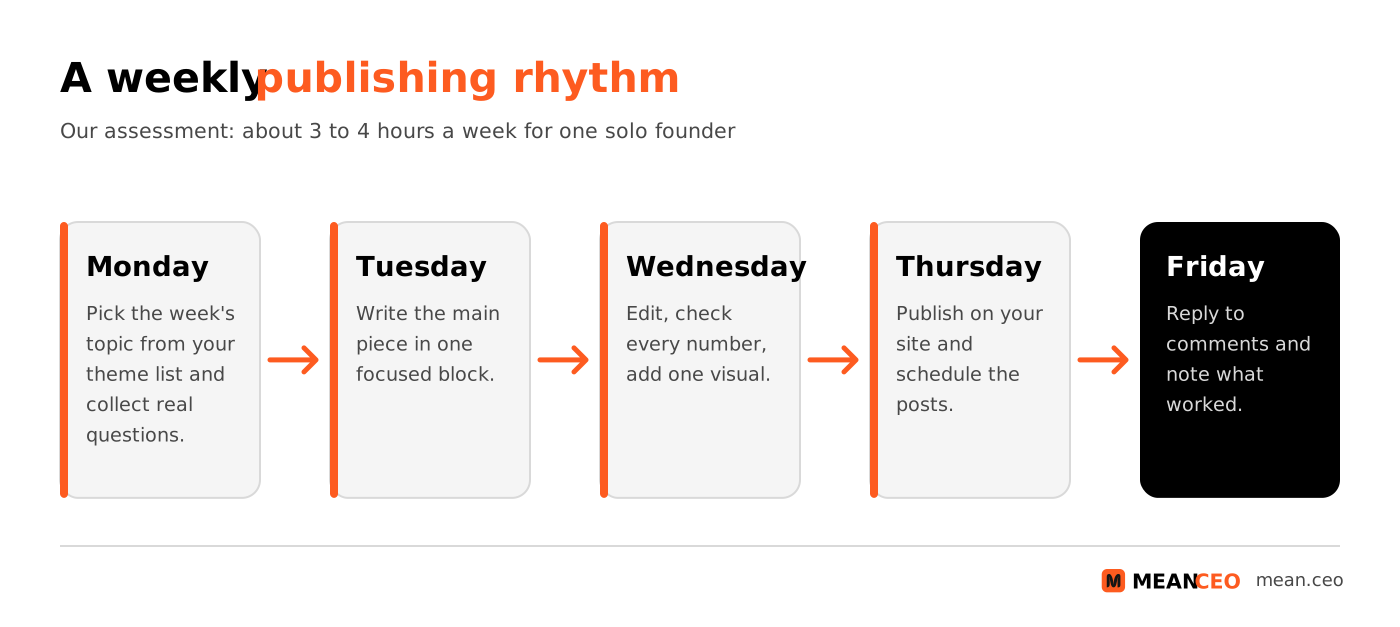
How long each step takes depends on your writing speed. A realistic time budget for a founder who writes the main piece personally:
Our assessment, not a rule. If you have less time, publish every two weeks and keep the same steps; a slower rhythm you keep beats a weekly one you drop in March.
Step 4: Batch and Schedule
Write when you have energy, publish when your readers are online. LinkedIn lets you schedule a post from 10 minutes to 3 months ahead, so you can prepare all of a week’s posts on Thursday and let them go out on different days. Free schedulers such as Buffer cover several channels; for more automation, tools such as n8n or Zernio (formerly Late) can post a new article to your social channels for you. Keep a buffer of one or two finished pieces for weeks when sales, travel or illness take over.
Step 5: Review Once a Month
Once a month, spend 30 minutes with your analytics and your inbox. Look at what each piece brought: replies, newsletter sign-ups, calls booked and introductions, not only views and likes. Keep doing the themes and formats that brought conversations, drop the ones that didn’t, and refresh older articles that still get traffic. Our guide on how to update old content explains when a refresh is worth it. What to check:
- Views and reading time (Your website analytics): Which topics people actually read.
- Search clicks and queries (Google Search Console): Which pieces bring search traffic, and for which searches.
- Comments and messages (LinkedIn, your inbox): Which ideas start conversations.
- Newsletter sign-ups and unsubscribes (Your email tool): Whether the content builds your list.
- Calls, demos and introductions (Your CRM or a simple sheet): Whether content brings business.
A Sample Month: The 4-Week Theme Rotation
Rotating your themes keeps the calendar varied without new planning every week. Here is a sample month for a founder of a bootstrapped B2B startup with three themes: building in Europe, no-code operations and founder lessons.
Write the 12 topics for the next quarter in one sitting, then fill the weeks. When news breaks in your field, swap one week’s topic, not the whole plan.
Common Mistakes CEOs Make With Content Calendars
Avoid the following pitfalls to sustain engagement as you grow your audience:
- Lack of focus: Posting generalized content without speaking to a specific audience or niche.
- Inconsistent cadence: Sporadic uploads break trust: readers who liked one piece have nothing to come back to.
- No CTAs: Forgetting to include actionable next steps limits engagement and conversions.
- Poor segmentation: Neglecting platform-specific strategies; what works on LinkedIn may flop on Instagram.
- Fake freshness: Changing the date on an old article without real changes doesn’t make it fresh. Google’s helpful content guidance lists it as a warning sign: “Are you changing the date of pages to make them seem fresh when the content has not substantially changed?”
- Unchecked numbers: A statistic you can’t trace to a source can cost more trust than it earns. Link the source or leave the number out.
- Mailing without consent: In the EU, sending a newsletter to private individuals needs their prior opt-in consent, with no pre-ticked boxes; the exception is existing customers hearing about similar products, who can unsubscribe each time. France’s data regulator CNIL explains the rules (in French); check your own country’s rules before you import a contact list.
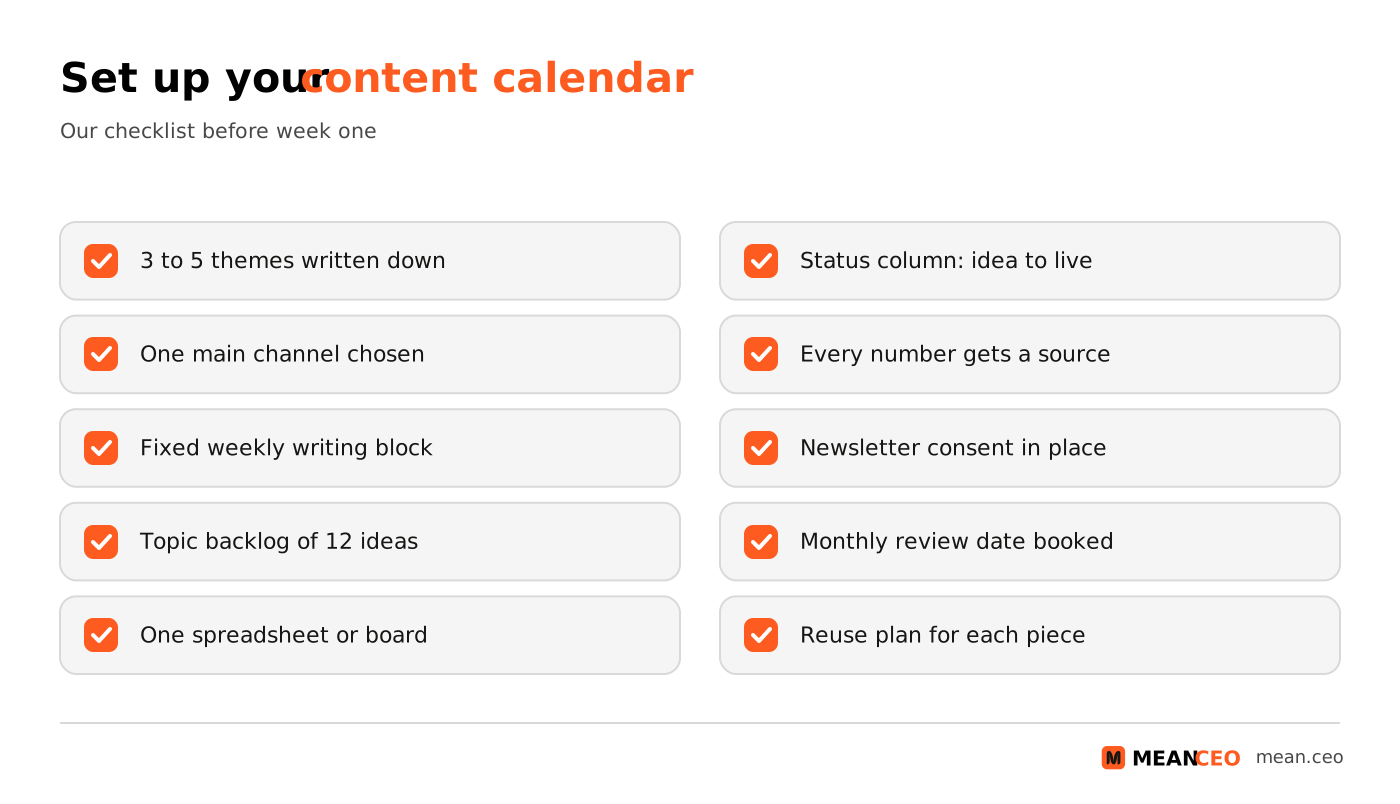
Effective content calendars fuel engagement, not noise. Each piece has intent, whether it's generating traffic or establishing authority.
Are you getting customers from ChatGPT yet?
More and more traffic is coming from Perplexity, ChatGPT, Grok and other AI tools.
👉 Rank on ChatGPT
Final Thoughts: Content as the Foundation of Leadership
For CEOs and founders across Europe, building a sustainable publishing rhythm through a content calendar is critical. In a crowded market, structured messaging lifts you above competitors who lack focus or consistency.
Once you’ve built a foundation, don’t forget to explore strategies for building authority as a startup founder. Our content strategy for CEO thought leadership shows how posts, articles and newsletters work together, and our guide to writing LinkedIn posts that drive business results helps with the short posts in your calendar.
People Also Ask:
What is the purpose of a content calendar?
A content calendar ensures consistent posting to maintain audience engagement while saving time through organized planning. By scheduling content in advance, creators can avoid gaps that might disengage their audience. It is an essential tool for aligning content themes with business objectives and managing publication timelines without last-minute stress.
Which elements are critical for an effective content calendar?
Publication dates, the theme and working title of each piece, the channel and format, the owner, a status (idea, draft, edited, scheduled, live) and the call to action. A column for sources helps too, so every number in a piece can be checked before it goes out.
How can entrepreneurs structure a content calendar for maximum efficiency?
Start with goals and 3 to 5 themes, then write a backlog of topics for the next quarter and give each week one main piece. Create a simple template, pick your channels, prioritize evergreen topics, add a clear call to action to each piece and use analytics once a month to see what to keep.
What is the difference between a content plan and a content calendar?
A content plan serves as a strategic overview, organizing ideas, goals, and strategies over a specific period, while a content calendar translates these plans into a detailed publishing schedule with deadlines for execution.
How can a weekly publishing framework benefit CEOs and female founders?
A weekly publishing framework turns content into a fixed habit instead of a task that waits for spare time. Founders with small teams and busy schedules benefit most: they know which day they write, which day they publish and what they publish about, so content keeps coming even in busy weeks.
What industries are best suited for content calendar strategies in 2026?
Any business where buyers research before they buy: B2B software, professional services, health technology, education, sustainability and climate, and AI services. In these fields a steady stream of useful content helps people find you, understand what you do and trust you before the first call.
How have AI tools changed content calendaring for busy founders?
AI assistants help with topic ideas, outlines, first drafts, summaries and turning one article into several posts, which saves hours each week. They don’t replace your own stories, opinions and checked facts; readers notice generic AI text. Our guide on training AI on your brand voice shows how to keep drafts sounding like you.
What challenges do founders face when building a content calendar?
The most common ones are time, ideas and consistency: content competes with sales, product and hiring, ideas run out after a few weeks and the routine breaks during busy periods. A fixed weekly writing block, a backlog of 12 topics and a lighter fallback (one short post instead of a full article) keep the calendar going.
How does a content calendar support sustainable business growth?
Content calendars assist in planning consistent, audience-centric messaging and adapting strategies based on analytics. Helping founders maintain visibility while nurturing audience trust can foster steady growth and avoid costly missteps such as random campaigns that nobody follows up.
Why is audience segmentation vital in content calendar creation?
Audience segmentation allows businesses to tailor content specifically to the needs and preferences of different audience groups. This targeted approach ensures better engagement, increases conversion potential, and enhances brand loyalty over time.
What tools can simplify the development of a content calendar?
Platforms like Trello, Notion, Airtable and Google Sheets are popular among startups for creating content calendars, and a scheduler such as Buffer or the scheduling built into LinkedIn handles the posting. These tools simplify scheduling, provide collaborative features for teams, and help you see the whole month at a glance.
FAQ on Building and Managing a CEO Content Calendar
How can I effectively balance quality and quantity in content publishing?
Focus on delivering high-quality, well-researched pieces consistently rather than overproducing mediocre content. One strong piece a week, or every two weeks, beats daily filler. Learn more about balancing content cadence and strategy from the Publishing Frequency Establishment Guide.
What tools help CEOs automate their publishing workflows?
CEOs can use tools like Airtable, Google Sheets and automation platforms such as Zernio (formerly Late) or n8n to schedule content efficiently across platforms. This reduces manual tasks, ensuring a consistent, multi-channel presence. Explore these tools in the social media automation article and in our list of automation workflows every startup should implement.
How does publishing predictability impact SEO rankings?
Less than most people think. Google has said publishing frequency is not a ranking factor in itself, and posting a lot is not a problem either, as long as the content is useful. What a regular schedule does is make sure useful pages keep getting written; those pages are what rank. For searches where freshness matters, such as news, recent pages can get a boost.
What steps should I take to improve keyword targeting for my content?
Use tools like Google Trends, Google Search Console and Semrush to understand seasonal trends and the searches that already bring people to your site. Map content topics around relevant keywords and match them with audience intent. For women-focused startups, check out SEO strategies tailored for startups.
How can CEOs repurpose content effectively across different platforms?
Start with long-form content such as blog posts, then break it into smaller assets like LinkedIn document posts, threads on X (formerly Twitter) or short videos. Tailor each piece to suit individual platform audiences while staying consistent with your branding.
Does a content calendar improve personal brand visibility?
Yes, a structured content calendar ensures your messaging is aligned and frequent, which builds credibility and fosters trust with your audience. Well-planned posting increases reach and positions you as an authority in your niche.
What are the best practices during a social media launch using a content calendar?
Plan the launch weeks in advance, prepare a small library of images, quotes and short videos, schedule the main posts and keep time free to reply to comments. Some marketers use the 5:3:2 mix (five posts sharing others’ content, three of your own, two personal); it is a rule of thumb with no clear source, so use it as a check that most posts give the reader something, not as a rule.
How can I create CTAs that drive higher conversions?
Align your CTAs with the specific goals of each content piece, whether it’s subscribing to a newsletter, booking a consultation, or downloading a resource. Use clear, actionable language and place CTAs strategically within your content.
What are the common pitfalls to avoid in content calendar management?
Avoid vague audience targeting, inconsistency in posting, and neglecting platform-specific tactics. Always include action-driven CTAs while ensuring your content resonates with your target audience to optimize reach and engagement.
Why is updating and refreshing older content important?
Refreshing older content keeps it accurate and useful, which helps it keep its rankings and its readers’ trust. Update facts, prices, screenshots and examples, and add what you have learned since. Change the date only when you change the substance; Google warns against freshening dates without real updates.
How do seasonal trends influence a strong content calendar?
Seasonal trends help anticipate spikes in audience interest, ensuring timely and relevant content production. Check last year’s pattern in Google Trends and publish seasonal pieces several weeks before the peak, so they are live and shared by the time people search; for most topics a month or two ahead is enough (our assessment).
About the Author
Violetta Bonenkamp, also known as MeanCEO, is an experienced startup founder with an impressive educational background including an MBA and four other higher education degrees. She has over 20 years of work experience across multiple countries, including 5 years as a solopreneur and serial entrepreneur. Throughout her startup experience she has applied for multiple startup grants at the EU level, in the Netherlands and Malta, and her startups received quite a few of those. She’s been living, studying and working in many countries around the globe and her extensive multicultural experience has influenced her immensely.
