TL;DR: How to Create Thought Leadership Content Without Sounding Preachy
Thought leadership works when readers feel helped, not judged. Preachy content tells people what they should do; useful content shows what you did, what happened and what you would do differently. Write like a peer: lead with a real problem, tell your own story including the mistakes, back every claim with a source or your own numbers, swap “you should” for “here is what worked for us”, and end with a question instead of a verdict. Research on reactance, humblebragging and moral superiority explains why lectures backfire, and only 15% of B2B buyers rate most of the thought leadership they read as very good or excellent, so the bar is low for founders who simply share honest, specific lessons.
💡 Build authority the right way, check out CEO Personal Branding for advanced insights to elevate your startup visibility.
How to Create Thought Leadership Content Without Sounding Preachy
It's easy to assume that writing thought leadership content means focusing on showcasing your expertise, but here's the uncomfortable truth: most of these attempts fail because they appear preachy, overly self-promotional, or disconnected from the audience's reality.
Thought leadership done right involves starting conversations, providing solutions grounded in real experiences, and inspiring action. According to Violetta Bonenkamp, a serial bootstrapping entrepreneur from Europe, the key lies in balancing authenticity with relatability.
Thought leadership is not about being the loudest voice; it's about being the most helpful. Help your audience feel empowered, not lectured. — Violetta Bonenkamp
The term “thought leader” is older than LinkedIn: it was popularised in its business sense in the mid-1990s by Joel Kurtzman, founding editor of the magazine strategy+business, who used it for the people the magazine interviewed, and earlier uses go back to the 19th century. This guide is about the wording: how to share a strong view without lecturing. For choosing what to be known for, see thought leadership positioning; for the content system behind it, our content strategy for CEO thought leadership.
Boost Your SEO by Sharing Unique Insights.
Optimized thought leadership content can rank on platforms like Google, ChatGPT, and more. More and more traffic is coming from Perplexity, ChatGPT, Grok and other AI tools.
👉 Rank on ChatGPT
What Makes Thought Leadership Content Truly Effective?
Effective thought leadership content starts with empathy and avoids overt preaching. Here's what sets high-performing pieces apart:
- Authenticity: Share real experiences, not just achievements. Our guide to building authority through case studies and founder stories shows how to turn them into content.
- Actionable Insights: Provide takeaways that empower your audience to take action. Avoid abstract ideas that don’t connect to realistic scenarios.
- Relatable Stories: Use storytelling to visualize practical solutions. Shared formats help too: see how to collaborate with other CEO thought leaders.
- Evidence: A strong opinion with a source, a number from your own business or a named example reads as expertise; the same opinion without them reads as a sermon.
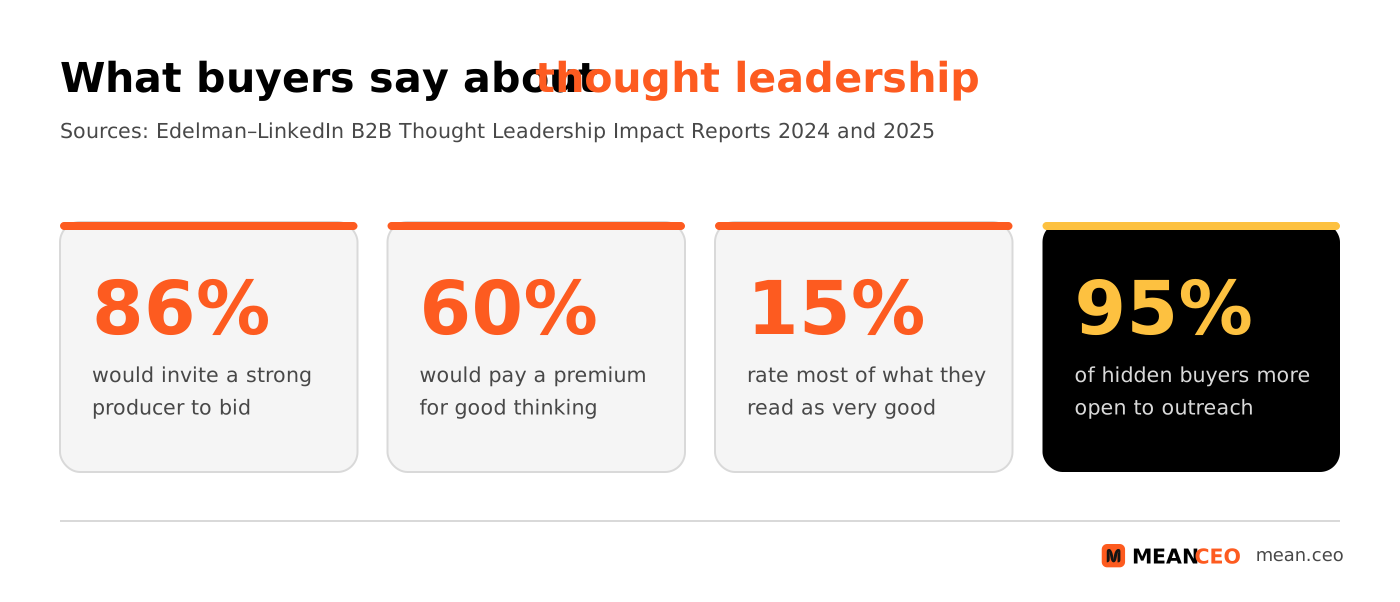
Buyers do read this content, and they are picky. In the 2024 Edelman–LinkedIn B2B Thought Leadership Impact Report (nearly 3,500 decision-makers in seven countries, including the UK and Germany), 86% said they were likely to invite organisations that consistently produce thought leadership to bid for work, 73% called it a more trustworthy basis for judging a company than its marketing materials, and 60% would pay a premium. But only 15% rated most of what they read as very good or excellent. The pieces they valued most had strong research and data, helped them understand their own challenges, and offered concrete guidance and case studies: the opposite of a sermon. The 2025 edition (nearly 2,000 professionals) found that 95% of “hidden buyers”, the people who shape a purchase without talking to sales, become more receptive to outreach after strong thought leadership. Both reports were produced with LinkedIn, so read them as a signal, not proof that posting sells.
What “Preachy” Actually Means, and Why Readers Tune Out
Preachy content isn’t about having opinions. It is about the position you take towards the reader: above them, telling them what they get wrong, instead of next to them, working on the same problem. Three findings from psychology explain why that position backfires:
- Reactance: Psychologist Jack Brehm’s reactance theory (1966) describes how people push back when they feel their freedom to choose is threatened. Later studies found that controlling language such as “you should” and “you must” triggers more reactance than softer words such as “consider” or “you could”. Tell readers what to do, and many will do the opposite.
- Moral superiority: In research on “do-gooder derogation”, Julia Minson and Benoît Monin (2012) found that people put down others they expect to feel morally superior: 47% of meat-eaters in their first study spontaneously used negative words about vegetarians. Content that sounds morally superior invites the same reaction.
- Humblebragging: Across nine studies, Ovul Sezer, Francesca Gino and Michael Norton (2018) found that humblebrags (“So humbled to be named…”) made people like the speaker less and rate them as less competent than plain bragging did, because they seemed insincere. If you have a result to share, say it plainly.
You can hear preachiness in single sentences. These are the patterns to look for in your drafts, and what to write instead:
Our assessment, based on the research above and our own editing. None of these phrases is forbidden; the problem is a draft full of them.
How to Create Thought Leadership Content That Stands Out
Follow these steps to build thought leadership content that resonates deeply with your audience:
Step 1: Start with Empathy
Empathy must form the foundation of your content strategy. Listen to your audience through feedback loops, monitor social media conversations, and even create surveys tailored to their pain points. As Violetta emphasizes, empathy isn't just about understanding; it's about acting on what you've learned.
A practical way to start: before you write, collect ten real questions from sales calls, support emails, comments and DMs, in the words people used. Write about one of them. A piece that answers a question someone actually asked can’t sound like a lecture, because the reader asked for it.
Step 2: Build Around Stories, Not Lectures
Stories unlock engagement in ways data alone cannot, particularly for female founders navigating the startup ecosystem in Europe. For example, Violetta frequently uses anecdotes about bootstrapping and leveraging EU grants, offering aspiring founders actionable examples rather than bland statistics.
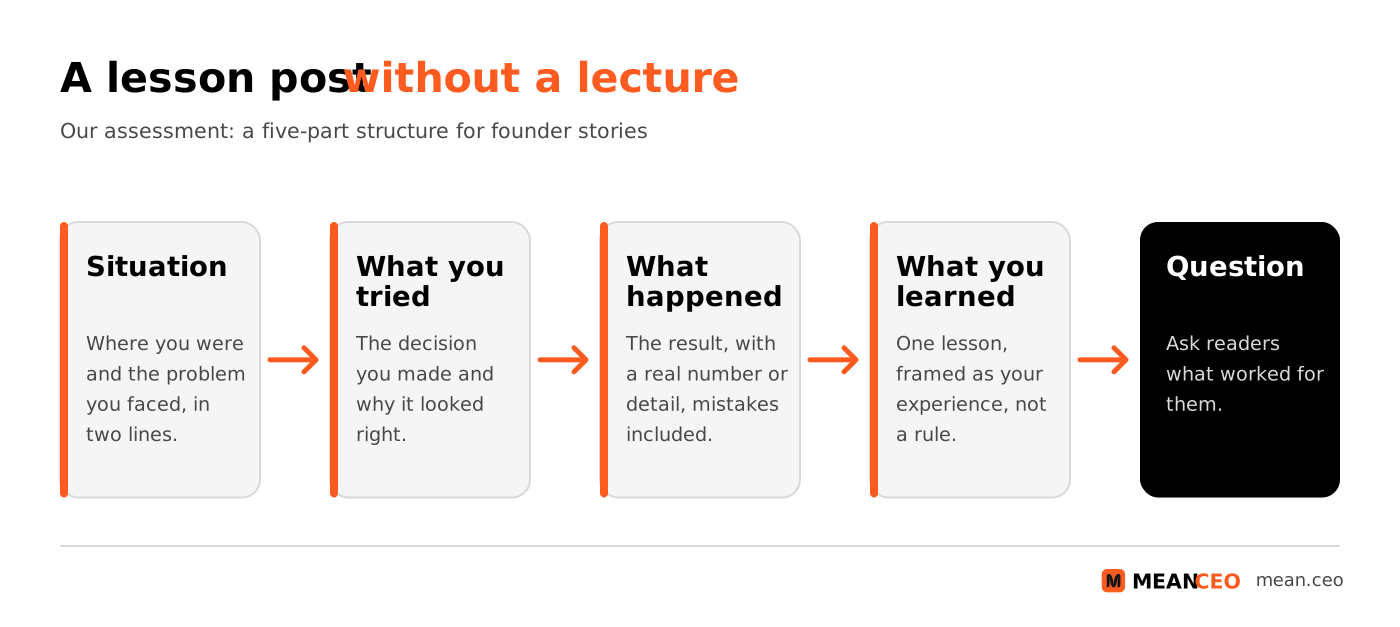
Sharing failures is not just honest; it changes how readers see you. In studies by Alison Wood Brooks and colleagues (2019), people who revealed their failures alongside their successes triggered less malicious envy, and in a field study with entrepreneurs they came across as less arrogant. A story that includes what went wrong is easier to trust than a list of wins.
Step 3: Create Accessible Formats
Not everyone has time to read a 3,000-word blog post. Develop thought leadership pieces that vary in style and format, including infographics, Q&A articles, and short-form social content that can link back to longer, more detailed work.
Our assessment for a founder with a few hours a week. For the short posts, see our guide to writing LinkedIn posts that drive business results; for video, the beginner’s guide to video content for CEO personal brands.
Step 4: Write Like a Peer, Not a Preacher
Most preachiness lives in the sentences, not the ideas. A few editing rules fix most of it:
- Use “I” and “we” for advice, “you” for questions. “We stopped offering discounts and lost two clients, then gained five” teaches more than “You should never discount.”
- Show your working. Say where a number comes from, what you tried and what you don’t know yet. Admitting a limit makes the rest more believable.
- One claim per paragraph, with one example. Long paragraphs of principles sound like a sermon; a short claim plus a concrete case sounds like a colleague.
- Cut moral words. “Must”, “never”, “always”, “the truth is”, “wake up” and “real founders” turn a tip into a judgment.
- Short sentences, plain words. The European Commission’s “How to write clearly” guide suggests an average of about 20 words per sentence, verbs instead of nouns (“evaluate” rather than “carry out an evaluation of”) and the active voice. It helps non-native readers too, and many of your European readers read English as a second language.
Step 5: Run the “Preachy Test” Before You Publish
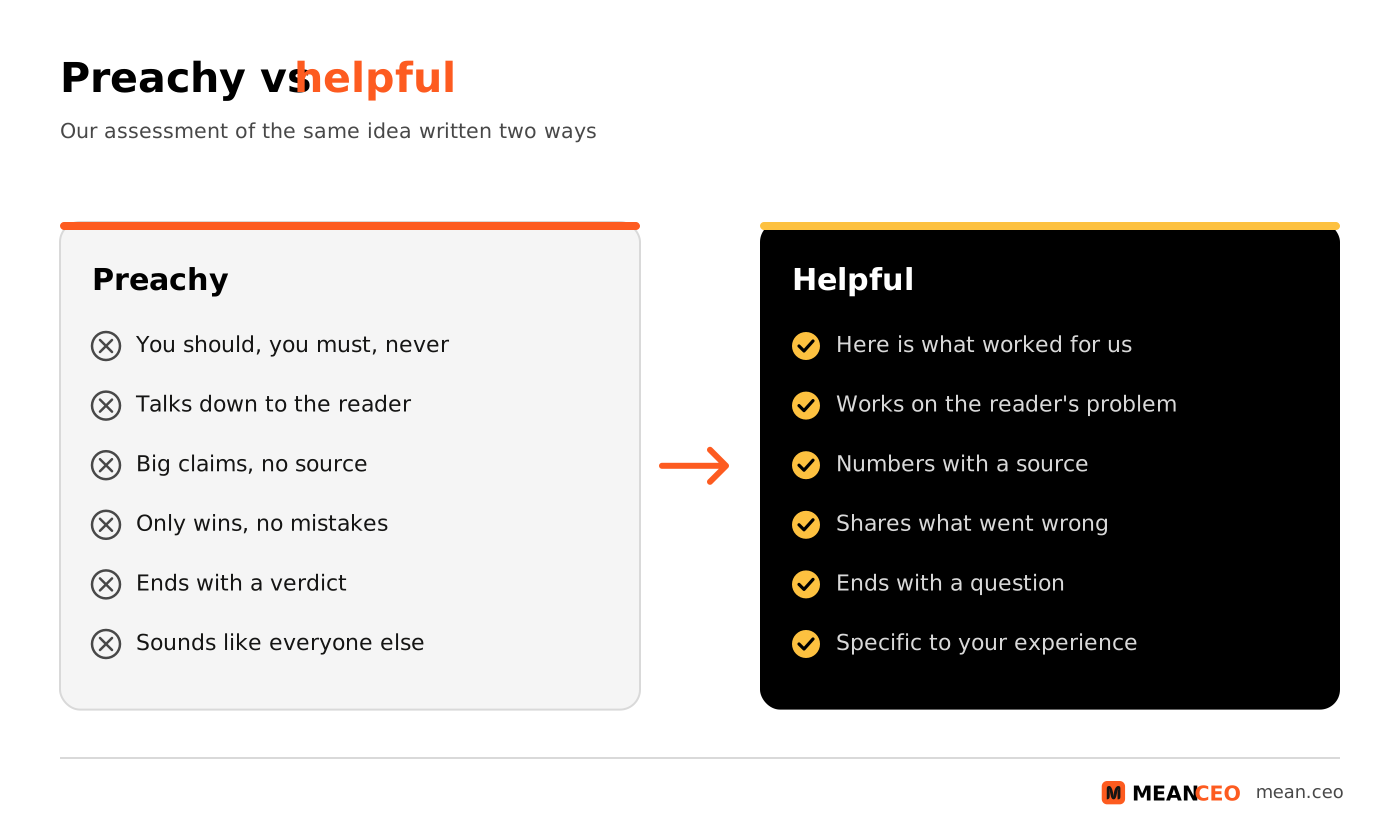
Read the draft out loud, as if you were saying it to one customer over coffee. If you would feel awkward saying a sentence to their face, rewrite it. Then check the draft against this list; it takes five minutes and catches most problems:
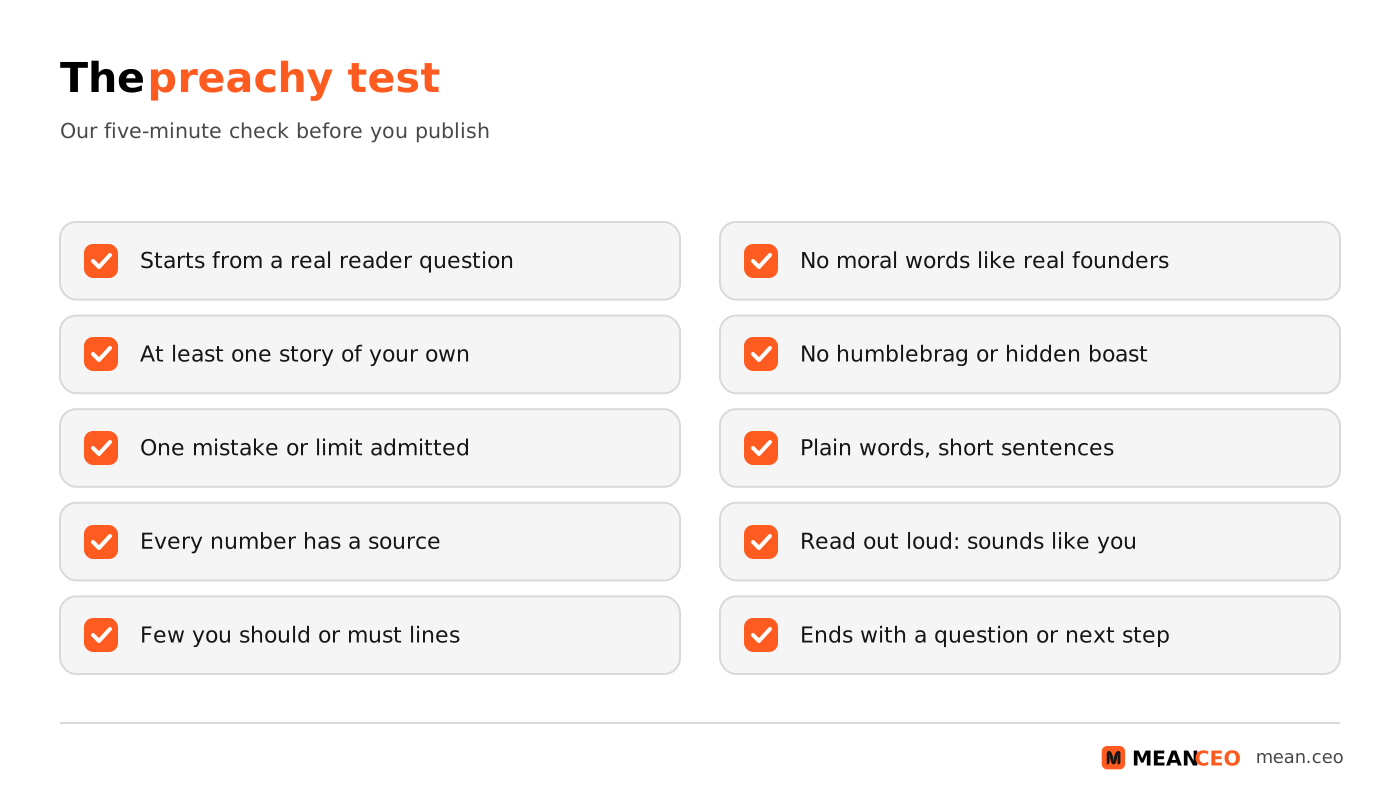
If you use AI to draft, run the same test twice: AI assistants tend to produce generic advice and confident “you should” sentences. Our guide on training AI on your brand voice shows how to get drafts that sound like you, and brand voice work helps you write the rules down.
Common Mistakes to Avoid in Thought Leadership Content
Even the best intentions can lead to mistakes that reduce the effectiveness of your thought leadership efforts. Here's a list of pitfalls and how to steer clear of them:
- Mistake #1: Sounding overly academic. Insight should be accessible, not dense with jargon.
- Mistake #2: Concentrating too much on self-promotion. Position your expertise as a conversation starter, not a sales pitch.
- Mistake #3: Failing to research audience needs. Create tailored content through the lens of the problems your audience actively cares about.
Four more mistakes are common in founder content, and each has a simple fix:
Sell Ideas, Not Ego.
Your audience values readability and clarity over credentials. Ready to bolster your connections instead of opinions?
👉 Get Content Strategies
A Worked Example: One Preachy Post, Rewritten
Here is a made-up post of the kind that fills professional feeds, and a rewrite of the same idea by a fictional founder. The numbers are illustrative; use your own.
Before: “Founders, stop wasting money on ads. Real entrepreneurs build an audience first. If you’re still paying for clicks in 2026, you simply haven’t understood marketing. Do the work.”
After: “In our first year we spent most of our small marketing budget on ads and got a handful of paying customers. Then we wrote one guide a week answering the questions our trial users asked. It took six months, but by the end most new sign-ups came from search and newsletters. Ads aren’t wrong; for us they were too early, before we knew which message worked. What did your first paying customers respond to?”
The idea is the same: build an audience before you scale paid ads. The second version works because it shows what happened, admits it took time, gives ads a fair hearing and invites the reader in. It is also more useful, because a reader can copy the method.
Why European Female Founders Need Thought Leadership
Female founders in Europe, particularly bootstrappers, face structural challenges ranging from limited access to funding to cultural biases. Thought leadership content becomes a tool not just for self-promotion but for showcasing resilience and attracting collaboration opportunities. Speaking is one route, covered in CEO speaking engagements: from first talk to keynote.
Visibility matters because capital is scarce. In Atomico’s State of European Tech 2025, all-women founding teams received about 2% of capital invested at pre-seed, about 4% at seed and around 1% at Series A and later stages in 2025, while mixed-gender teams received roughly 16% to 22% depending on the stage. Being known for useful ideas brings introductions, customers and partners without asking anyone for permission.
There is a second gap. In experiments by economists Christine Exley and Judd Kessler (NBER working paper, published in the Quarterly Journal of Economics in 2022), women described their own performance less favourably than equally performing men. The answer to that gap isn’t to sound louder or more certain than you are. Talk about the work: what you built, what you measured, what failed. Concrete results don’t need boasting, and they can’t be dismissed as opinion.
Closing Thoughts: What's Next for Female Founders
Becoming a recognized authority isn’t reserved for PhDs or seasoned executives, it’s achievable for bootstrapped entrepreneurs willing to understand their audience deeply and lead conversations authentically. Start by amplifying your voice through targeted content strategies tailored to community-driven narratives.
For actionable insights into branding as a female entrepreneur, explore the next step in this journey: Female Founder LinkedIn Playbook: Building Authority in 90 Days. This input genuinely aligns content creation strategies with startup credibility and growth.
Once your wording works, decide where it goes: our comparison of LinkedIn and X for CEO personal branding helps you choose, and how to repurpose CEO content across platforms shows how one honest article becomes a week of posts.
People Also Ask:
How do you create thought leadership content effectively?
To create thought leadership content, focus on understanding your audience's needs deeply. Address pain points with actionable solutions, back your insights with credible sources or data, and present your expertise authentically. Use a conversational tone to engage readers while avoiding a self-promotional style. Writing regularly, staying consistent with your message, and partnering with trusted industry voices can amplify your efforts.
What are the 7 Ps of leadership in 2026?
There is no single standard list of “7 Ps of leadership”. Different trainers and authors use different words, such as purpose, people, planning, persistence, patience, presence or passion, so treat any list as a memory aid, not a recognised model. For thought leadership, the useful part is simpler: a clear purpose, real knowledge of the people you write for, and patience, because authority builds over months, not weeks.
What types of content work best for thought leadership in 2026?
In-depth articles with original data or experience, short videos, newsletters, talks and webinars all work when they share a specific view backed by evidence. In the 2024 Edelman–LinkedIn research only 15% of buyers rated most of what they read as very good or excellent, so depth and specificity matter more than the format. Episodic formats such as a newsletter or podcast series help readers come back.
How can female entrepreneurs avoid sounding preachy in their content?
Female entrepreneurs can share impactful content by telling personal stories and showing vulnerability. Instead of lecturing, focus on engaging the audience through relatable experiences, asking questions, and encouraging dialogue. Balanced messaging that highlights both successes and lessons learned will resonate without sounding condescending. The same applies to every founder: write from your own experience, use “I” and “we” instead of “you should”, and end with a question.
Does thought leadership benefit small businesses or only corporations?
Thought leadership equally benefits small and large businesses. For small businesses, it establishes credibility, attracts loyal customers, and differentiates them in competitive markets. Sharing thoughtful insights via blogs, community forums, and local workshops can help small brands build authority without requiring significant financial investment.
What are simple tips for consistently producing leadership content?
Stay consistent by keeping a simple weekly content calendar, breaking topics into smaller, manageable pieces, and batch-producing content when possible. Collaborate with team members or partners for guest contributions and stay inspired by regularly engaging with industry news. Repurpose long-form content like webinars into shorter posts for various platforms.
Why is authenticity important in thought leadership?
Authenticity builds trust and differentiation in saturated markets. Audiences value real-world insights and honest reflections over generic or overly polished narratives. Authentic messaging shows a brand's human side, making it relatable and convincing in competitive ecosystems.
How has AI changed thought leadership content creation in 2026?
AI assistants speed up research, outlines, first drafts, editing and turning one article into several posts. They also flood feeds with generic text, which makes your own stories, numbers and opinions more valuable, not less. Use AI for the groundwork, then add what only you know, and check every fact it suggests.
What challenges do women face when developing thought leadership?
Women leaders often have less access to the same expert networks and speaking slots as male peers, and research suggests women describe their own performance less favourably than equally performing men. Bias in how authority is perceived can make the same confident post land differently. Concrete results, a supportive network, co-created content and mentors help showcase expertise without overselling.
How can social media amplify female entrepreneurs’ thought leadership?
Platforms like LinkedIn, Instagram, and YouTube provide free, scalable avenues for female entrepreneurs to share their perspectives and build audiences. Targeted hashtags, tagged collaborations, and engaging multimedia approaches help increase visibility and encourage discussions on diverse topics like career-building, leadership, and balanced growth.
FAQ on Thought Leadership Content Creation
What should be the first step when developing thought leadership content?
Begin by identifying and deeply understanding your target audience. Create content tailored to their needs, challenges, and aspirations by leveraging tools like customer surveys and social listening platforms that can gather insights into their struggles and interests. Make empathy your starting point.
How can I ensure my content stays relevant over time?
Audit your content regularly, tracking audience engagement and industry trends. Incorporate emerging topics into your strategy to reflect societal or technological shifts. Utilize tools like social listening and competitor analysis to refine future themes that resonate with your audience.
What makes storytelling essential in thought leadership content?
Stories build relatability and trust, turning abstract ideas into tangible scenarios your readers or listeners can digest. Use personal anecdotes or client experiences to illustrate your points and show actionable solutions based on real events. Our storytelling framework for startup marketing goes deeper.
Should thought leadership content be opinionated?
Yes, but opinions must be grounded in evidence and experience. Bold, well-supported views challenge your audience to think differently while establishing your authority on the subject matter. Strong opinions don’t have to sound preachy: present yours as a view you hold for reasons, show the reasons and accept that some readers will disagree.
What is the role of LinkedIn in thought leadership strategy?
LinkedIn is ideal for thought leadership due to its professional networking base. Post consistently, interact with comments, and share insights to become a trusted voice in your industry. Learn how to build LinkedIn authority in 10 proven steps to build thought leadership, and see the Female Founder LinkedIn Playbook for a 90-day plan.
How do AI tools help in streamlining content creation?
AI tools help with research, outlines, first drafts and editing, but check what each one is for today: Copy.ai now presents itself as a go-to-market AI platform for sales and marketing teams (Fullcast acquired it in October 2025), and Writesonic has repositioned as an AI search visibility platform, though its plans still include an AI article writer. Neither has a free plan; Writesonic offers a free trial. General assistants such as ChatGPT or Claude cover most drafting needs. Use any of them for the groundwork and add your own stories and opinions before you publish. Compare two of them in this Copy.ai vs Writesonic guide.
Can content formats affect engagement levels?
Absolutely. Offer diverse formats like infographics, short videos, or concise newsletters to reach different audience preferences. Structured summaries help busy readers act, while webinars provide deeper insights.
How can I balance authenticity with expertise?
Combine personal stories and real-world case studies with actionable takeaways. Authenticity draws audiences by illustrating vulnerability, while expertise ensures your solutions are credible and practical.
What pitfalls should I avoid in thought leadership content?
Avoid overly salesy tones, academic jargon, or generic advice. Instead, focus on empowering your audience with realistic, actionable solutions to inspire trust in your perspective. Watch for humblebragging and unsourced numbers too; both cost trust quickly.
Is thought leadership only for seasoned entrepreneurs?
No. Aspiring founders and professionals can build credibility by sharing niche perspectives, unique challenges, and actionable insights. Experience isn’t a requirement for showcasing value; focus on relatable solutions.
About the Author
Violetta Bonenkamp, also known as MeanCEO, is an experienced startup founder with an impressive educational background including an MBA and four other higher education degrees. She has over 20 years of work experience across multiple countries, including 5 years as a solopreneur and serial entrepreneur. Throughout her startup experience she has applied for multiple startup grants at the EU level, in the Netherlands and Malta, and her startups received quite a few of those. She’s been living, studying and working in many countries around the globe and her extensive multicultural experience has influenced her immensely.
