TL;DR: Write LinkedIn Posts That Actually Drive Results
LinkedIn posts that bring clients, partners and investors share what you know, start a conversation and make the next step easy. Skip the buzzwords and the sales tone. Use stories, practical lessons and before-and-after examples from your own work, and write for one clear reader. Structure every post as hook, context, value and one call to action, and judge it by comments, profile visits and messages rather than likes. European founders stand out by writing about local problems: EU rules, funding programmes, cross-border sales and working in several languages.
💡 Want a personal branding edge? Explore the CEO Personal Branding Playbook for strategies tailored to startup founders.
How to Write LinkedIn Posts That Drive Business Results
There’s no question that LinkedIn is a powerful platform for entrepreneurs and founders, especially in Europe where professional networks are critical to gaining visibility. Yet, many fail to leverage its full potential, drowning their profiles in corporate jargon, overused trends, or overly promotional content. Knowing how to write LinkedIn posts that drive business results is an art that can transform your startup profile into an inbound lead generator or brand-building powerhouse.
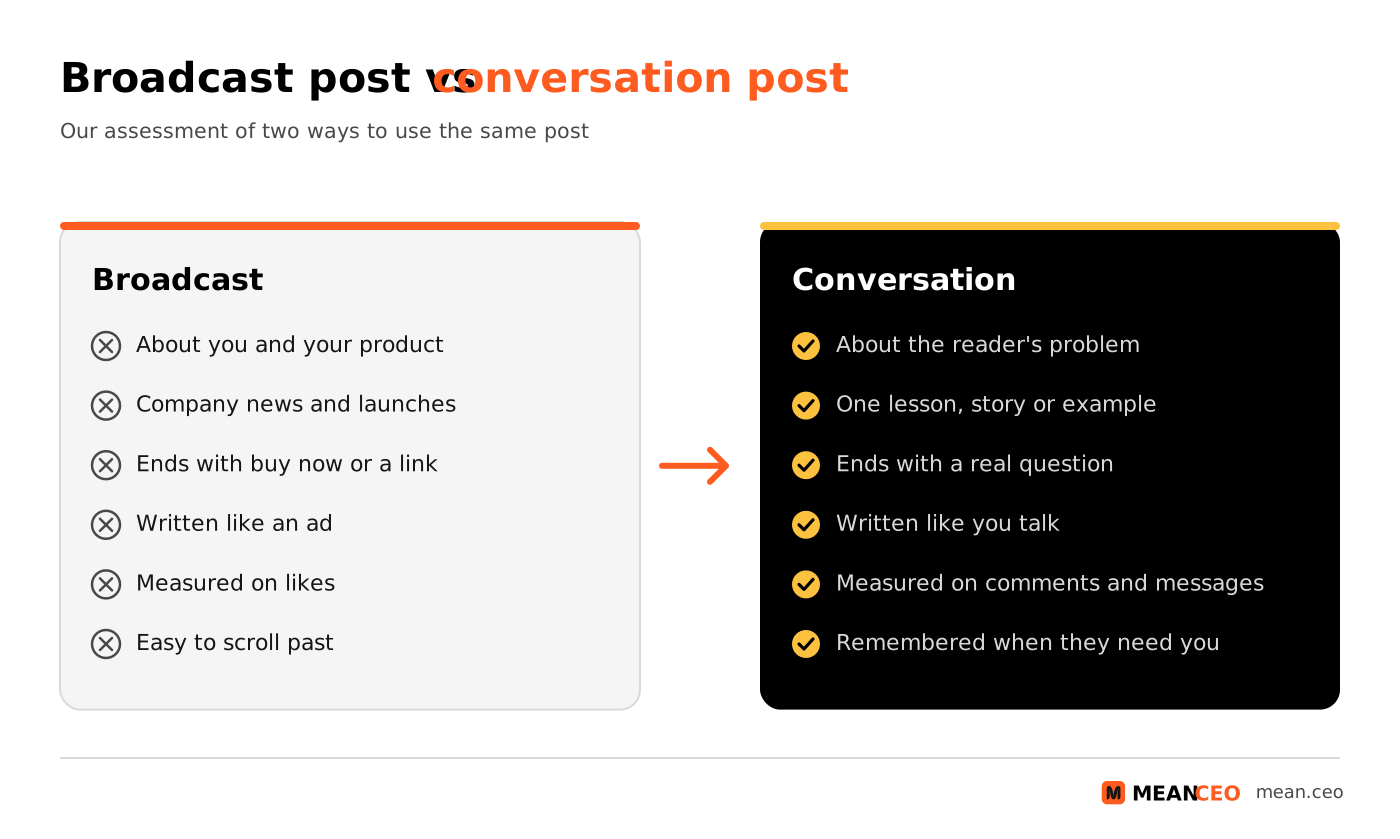
This isn’t about playing the LinkedIn algorithm. It’s about using authenticity, strategy, and audience-first thinking to connect with the right people and achieve measurable outcomes such as lead generation, collaboration opportunities, or even funding discussions. Here’s the secret: the posts that work on LinkedIn reflect your expertise, offer value, and create conversations rather than just telling people what you do.
This guide is about the posts themselves: which formats work, how to structure a post that converts, what to write as a European founder, which mistakes cost you reach and how to tell whether a post did its job. If you want to understand how the feed decides who sees your post, read our guide to the LinkedIn algorithm; to plan a month of posts, see the LinkedIn content calendar for startups.
Boost Your LinkedIn Presence Instantly
Looking to build an audience and authority within weeks? Use a weekly CEO content calendar designed for entrepreneurs.
👉 Start building your personal brand now
Why You Should Rethink Your LinkedIn Strategy
Posting on LinkedIn offers real advantages to startup founders and bootstrappers, particularly in Europe, where partners, buyers and grant evaluators often look you up before they reply. Here is how it supports startup growth:
- Organic visibility: Unlike traditional ads, LinkedIn posts can organically reach new investors, partners, or clients.
- Proof of expertise: Thought leadership posts prove your knowledge and set you apart as a trusted solution provider.
- High-intent audience: LinkedIn users are actively working on business solutions, making them more receptive to your ideas and offers.
- Brand building: Regular, engaging posts enhance your reputation much faster than outdated tactics or cold outreach.
The audience is large and close to home. LinkedIn reports more than 1.4 billion members, over 450 million of them in Europe, the Middle East and Africa. LinkedIn doesn’t publish a figure for the EU alone, but in most European markets it is the network buyers, partners and hires check before a first call.
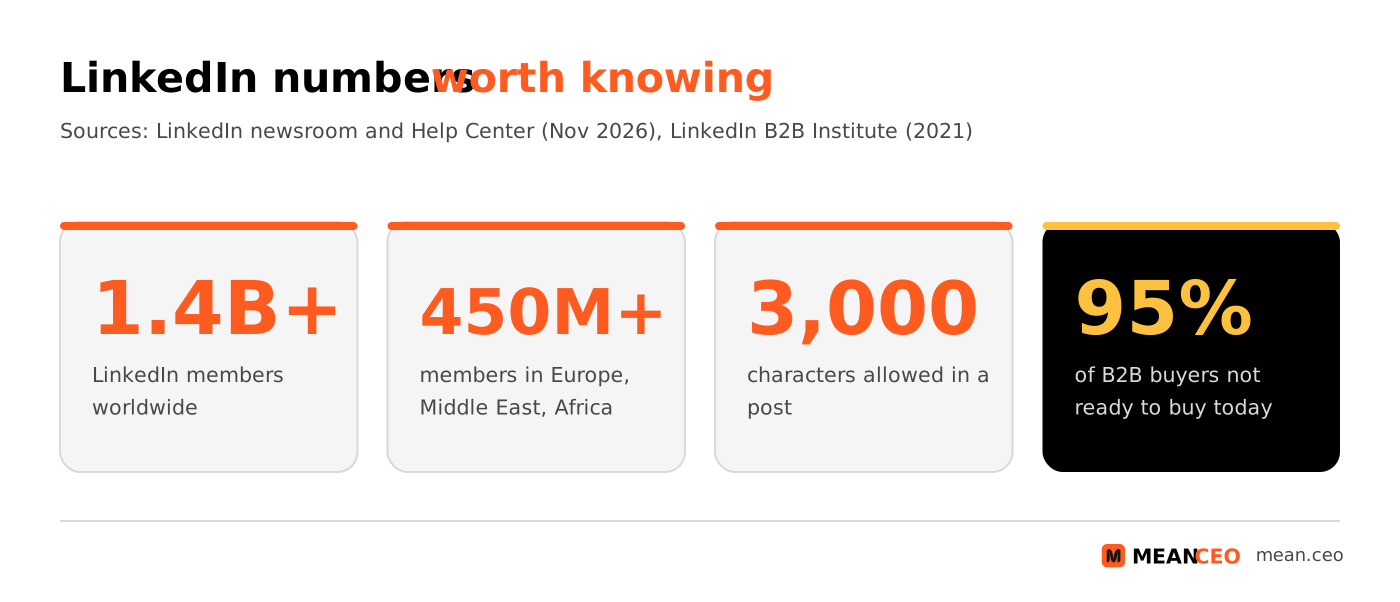
Most people who read your post won’t buy this month, and that is normal. Research by Professor John Dawes of the Ehrenberg-Bass Institute for the LinkedIn B2B Institute (2021) found that only about 5% of B2B buyers are in the market at any given time; LinkedIn calls this the 95-5 rule. Your posts work on the other 95%: when they are ready to buy, they remember the founder who kept teaching them something useful. Thought leadership matters to buyers too. The 2025 Edelman–LinkedIn B2B Thought Leadership Impact Report, as reported by O’Dwyer’s, found that 95% of “hidden buyers” (people in the buying group whom sellers rarely meet) said compelling content makes them more receptive to sales and marketing. Our guide to content strategy for CEO thought leadership shows how posts and long-form articles work together.
What Types of LinkedIn Posts Actually Work?
Here’s the truth: you don’t need flashy graphics or viral hooks. What you do need is strategic content based on proven formats. Here are the types of LinkedIn posts that consistently deliver results:
- Storytelling: Share moments of struggles, breakthroughs, or growth. For bootstrapped European startups, storytelling about overcoming resource constraints resonates widely.
- Educational nuggets: Teach your audience something they didn’t know, such as navigating EU grant applications or using AI tools to save startup costs.
- Transformation case studies: Highlight how your solutions or services solve pain points. A strong before-and-after format works wonders here.
- Opinion posts: Challenge an idea or reflect on a trending industry debate relevant to your field.
- Behind-the-scenes: Offer glimpses into how you build your product, handle challenges, or run operations. This humanizes your brand.
Each format also has its own practical limits. Here is what LinkedIn allows today and what each format is best at:
Limits as listed in LinkedIn’s Help Center on 10 Nov 2026. LinkedIn also lets you schedule posts up to three months ahead with the clock icon in the post box, which helps if you write in batches. For video, see our beginner’s guide to video content for CEO personal brands; for long-form, read about building a LinkedIn newsletter.
How to Structure a LinkedIn Post That Converts
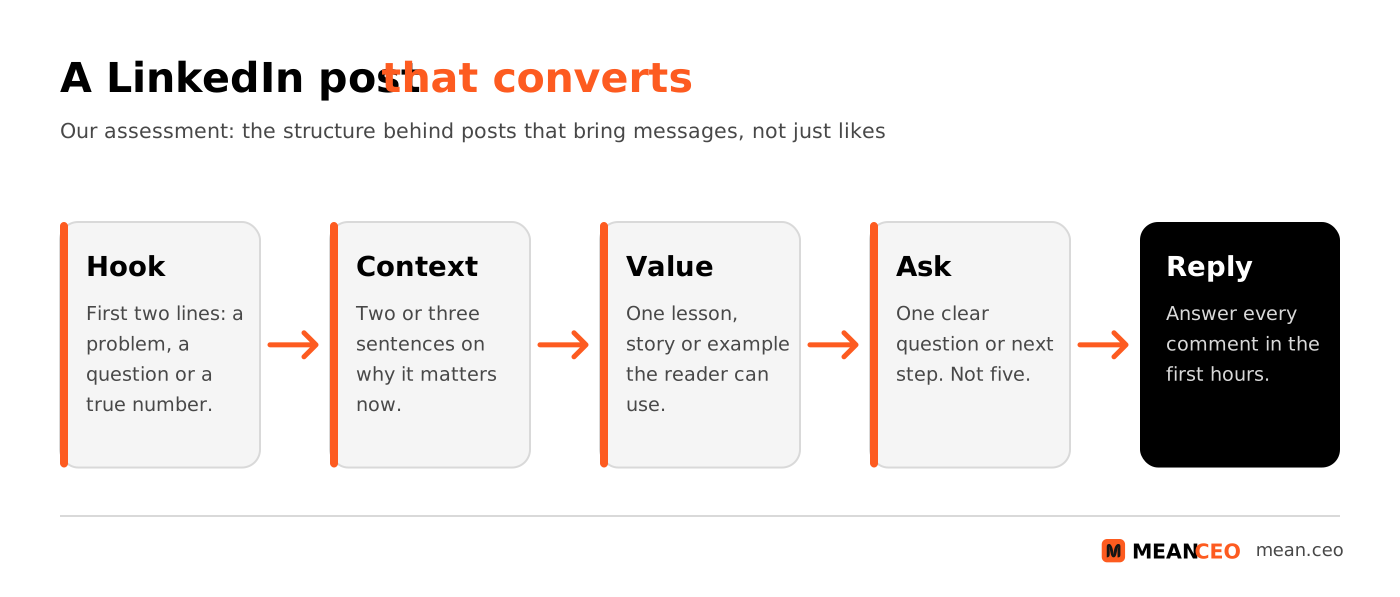
Writing impactful LinkedIn posts is a formula, not a guessing game. Use this framework to structure your content effectively:
- Start with a hook: Your first two lines are make-or-break, because LinkedIn shows only the opening lines of a post before the “see more” link (the exact cut-off depends on the screen, so treat any character count you read online as an estimate). Ask a sharp question, state a surprising (checked) fact or name the reader’s problem.
- Introduce context: Explain briefly why the topic matters and how it connects to your expertise.
- Deliver value: This is the part where you teach, show or tell. Cut the fluff; readers come for something they can use today.
- Engage with a CTA: End with one specific ask: a question to answer in the comments, an opinion to share or an invitation to message you.
Hooks that work for founders
A hook only has to earn the click on “see more”. These patterns work without clickbait:
Examples are illustrations; use your own numbers and stories. Only put a number in a hook if you can show where it comes from.
For example: Are you struggling to choose between LinkedIn and Twitter for CEO positioning? Here’s a breakdown of the differences and the smarter platform for engagement in CEO branding.
Key Tips for Crafting European-Specific Startup Posts
Startups in Europe face different challenges from their American counterparts. Your LinkedIn content should reflect this reality:
- Emphasize EU-specific solutions, like leveraging programs such as Horizon Europe or grants tailored to female entrepreneurs.
- Use regional pain points in examples. For instance, cite regulatory hurdles or digital readiness gaps common to European startups.
- Spotlight diversity and inclusivity discussions, crucial topics in most EU startup ecosystems.
- Communicate in clear, accessible English for multilingual audiences, avoiding corporate jargon or overly complex phrasing.
Language is a choice, not a default. If your buyers are in one country, posting in their language often gets more replies than English; if you sell across borders, write in clear, simple English and keep sentences short so non-native readers and translation tools follow you. Some founders alternate: the main post in English, with a short summary in the local language in the first comment.
One EU-specific point: since 3 November 2025, LinkedIn has used data from members in the EEA, Switzerland and the UK, including public posts, to train its generative AI models. The setting is called “Data for Generative AI Improvement” and is switched on by default; you can turn it off in your data privacy settings, which stops future use but not use that has already happened. Decide on purpose, especially if you post about clients or unreleased products.
Common LinkedIn Mistakes Founders Make
Founders, and many women founders in particular, lose reach and leads to the same handful of errors. Avoid these:
- Over-selling: Avoid overly promotional tones. Share expertise, not just your product pitch.
- Underselling your results: Research backs this up: in experiments by economists Christine Exley and Judd Kessler (NBER working paper, published in the Quarterly Journal of Economics in 2022), women described their own performance less favourably than equally performing men. State your wins plainly, with numbers you can back up (for example, “we went from 12 to 40 paying customers in a year”).
- Inconsistent posting: Posting five times one week and then going silent for a month breaks the habit you are building with readers. Pick a rhythm you can keep, such as two posts a week.
- Ignoring comments: Not replying wastes the conversation your post started and the relationships that come with it.
- Engagement bait: Posts that ask people to “comment YES” or like to vote may get a burst of activity, but LinkedIn said in March 2026 that it is reducing the reach of engagement bait and repetitive, low-substance posts. Its Professional Community Policies also forbid artificially increasing engagement, such as agreeing with others in advance to like or reshare each other’s posts.
- Unclear visuals: Stock photos that have nothing to do with the text add little. Use a screenshot, a chart, a photo from your work or no image at all.
Need a 30-day LinkedIn Plan?
Take inspiration from this 30-day plan for building a CEO personal brand tailored for visibility and results.
👉 Dive into action today
How to Measure Whether Your LinkedIn Posts Work
You don’t need extra tools to start. LinkedIn post analytics show, for each post, how it was discovered (impressions and members reached), how much of the audience came from inside and outside your network, profile activity, social engagement (reactions, comments, reposts, saves and sends), link clicks and viewer demographics such as job titles, industries and locations. LinkedIn says creator analytics are now available to all members; some views are still desktop-only.
Our assessment: for a founder, a post that brings two relevant messages beats one with a thousand likes. Track messages, calls booked and introductions in a simple spreadsheet next to each post, and review it once a month.
Are you getting customers from ChatGPT yet?
More and more traffic is coming from Perplexity, ChatGPT, Grok and other AI tools.
👉 Rank on ChatGPT
Closing Thoughts and Your Next Move
LinkedIn remains the main professional network for startup founders, particularly those building cross-border partnerships in Europe. Turn your answers to customers’ questions into posts, use the formats that suit what you have to say, and you can grow your company’s reach without an ad budget.
Pick one idea from this guide and start this week. To turn one post into several pieces of content, see our guide to repurposing CEO content across platforms; to see how visibility turns into revenue, read Personal Branding ROI: how CEO visibility drives sales. For the bigger picture, explore how community-first marketing and building authority as a female founder can complement your LinkedIn efforts.
People Also Ask:
What is the 4-1-1 rule on LinkedIn?
The 4-1-1 rule is a content-mix guideline from social media marketing, credited to Andrew Davis of Tippingpoint Labs and popularised with Joe Pulizzi of the Content Marketing Institute. For every six posts, share four pieces of useful content from others, one reshare and one post about your own offer. It was written for Twitter, so on LinkedIn many founders adapt it: four helpful posts, one soft mention of what you do and one direct offer.
What is the 5-3-2 rule for LinkedIn?
It is a widely shared rule of thumb with no clear author: out of every ten posts, five are content from others that your audience will value, three are your own content and two are personal, human posts. Treat it as a starting point for balance, not a LinkedIn rule. LinkedIn’s own guidance for nonprofits suggests a similar “2-2-1” mix for every five posts.
How does the 3-2-1 rule on LinkedIn improve content quality?
There is no official 3-2-1 rule for LinkedIn; the term is used by consultants for different mixes, for example three shared posts, two posts with your own commentary and one fully original post. What these rules have in common is useful: most posts should give the reader something, and only a few should sell.
What is the 95-5 rule in LinkedIn marketing?
The 95-5 rule comes from research by Professor John Dawes of the Ehrenberg-Bass Institute for the LinkedIn B2B Institute (2021): only about 5% of B2B buyers are in the market at any one time, and 95% are not ready to buy yet. For LinkedIn posts it means building memory over time, so that buyers think of you when they enter the market, rather than expecting each post to sell.
Why should entrepreneurs follow specific rules for LinkedIn posting?
Rules such as 4-1-1 or 5-3-2 aren’t laws, but they stop you from posting only promotions. They give you a simple check on the balance between helpful, personal and sales content, which keeps followers interested and makes your occasional offer more credible.
What makes LinkedIn an effective platform for female entrepreneurs?
LinkedIn connects founders with buyers, investors, partners and journalists in one place, and a good post can reach people far outside your existing network. For women founders, who are often outside the informal networks where deals start, posting regularly is a low-cost way to be visible and to be found when someone searches for expertise. Our guide to LinkedIn for female founders goes deeper.
How do hooks improve LinkedIn post visibility?
Hooks grab attention in the first lines, before the “see more” link, and persuade people to open the full post. A strong hook names a problem, asks a sharp question or shares a specific, true number. More people reading and replying gives the post a better chance of being shown to others.
How can storytelling improve LinkedIn posts?
Stories show how you think and what you have learned, which builds trust faster than claims. Share a real moment, the decision you made and the lesson, and keep client details anonymous unless they agreed to be named.
What posting frequency works best on LinkedIn?
LinkedIn doesn’t publish an ideal frequency. Our assessment: two to four posts a week is enough for most founders to stay visible, and a rhythm you can keep for months matters more than a burst of daily posts. Each post should still bring something useful.
How can female founders repurpose content on LinkedIn?
Turn a talk, webinar, blog article or newsletter issue into a short text post with one lesson, a document post with the key slides or a short video clip. Our guide to repurposing CEO content across platforms shows the workflow, and a CEO newsletter is a good source of post ideas.
FAQ on Writing LinkedIn Posts That Drive Results
How do I identify the right audience for my LinkedIn posts?
Start from your customers: write down the job titles, industries and countries of the people who buy from you. Then check the viewer demographics in your post analytics to see whether you are reaching them, and adjust your topics if you are not.
What is the best posting frequency to maintain LinkedIn engagement?
Pick a rhythm you can keep, such as two or three posts a week, and mix educational, story and interactive formats. A steady rhythm builds a reading habit; long silences followed by bursts don’t. Learn more about launching on the platform in our LinkedIn Startup Guide.
How can LinkedIn polls enhance post interactivity?
Polls are quick to answer and work well for market questions. A poll has two to four options and runs for one week by default. Follow up with a post that shares what you learned from the results, which often gets more discussion than the poll itself.
Is using personal anecdotes in LinkedIn posts effective?
Yes, personal stories humanise your brand and make your content relatable. Share a challenge you overcame or a lesson learned, then connect it to practical advice so the post stays professional and useful.
How can AI tools improve LinkedIn post performance?
AI assistants such as ChatGPT or Claude help you brainstorm ideas, shorten drafts, test different hooks and check grammar in a second language. Keep the stories, opinions and numbers your own, and edit the result until it sounds like you. Our AI in marketing comparison looks at two newer tools.
What are the biggest mistakes to avoid when writing LinkedIn posts?
Generic hooks, posting only promotions, engagement bait, irregular posting and ignoring comments. Another common one is never looking at the analytics, so you keep repeating posts that don’t reach your buyers.
How do carousels enhance LinkedIn engagement?
Carousels on LinkedIn are document posts: you upload a PDF, PowerPoint or Word file (up to 100 MB and 300 pages) and readers swipe through it. They suit step-by-step guides and frameworks. Keep them short, with one idea per slide, and readers are more likely to save and share them.
Can LinkedIn posts generate direct business leads?
Yes. Posts that address a specific problem your buyers have, followed by a clear and low-pressure next step (a question, a resource or an invitation to message you), regularly lead to conversations. Track those messages yourself, because analytics only show the first part of the journey.
What metrics determine a successful LinkedIn post?
Members reached, comments, saves and sends, profile views from the post and followers gained are the most useful in-app signals. For business posts, the real measure is messages, calls and introductions, which you log yourself.
Should I include hashtags in my LinkedIn posts?
Hashtags are no longer a main discovery tool on LinkedIn: in 2024 LinkedIn removed the “talks about” hashtags from profiles and now relies more on what the post itself is about. One to three relevant hashtags do no harm; clear wording about your topic does more.
How does content format influence post performance on LinkedIn?
Each format does a different job: text posts for opinions and stories, document posts for frameworks, video for showing your face and voice, polls for quick questions. Test formats for a few weeks each and keep the ones that bring the reactions and messages you want.
About the Author
Violetta Bonenkamp, also known as MeanCEO, is an experienced startup founder with an impressive educational background including an MBA and four other higher education degrees. She has over 20 years of work experience across multiple countries, including 5 years as a solopreneur and serial entrepreneur. Throughout her startup experience she has applied for multiple startup grants at the EU level, in the Netherlands and Malta, and her startups received quite a few of those. She’s been living, studying and working in many countries around the globe and her extensive multicultural experience has influenced her immensely.
