TL;DR: What changed for your traffic on 10 November 2026?
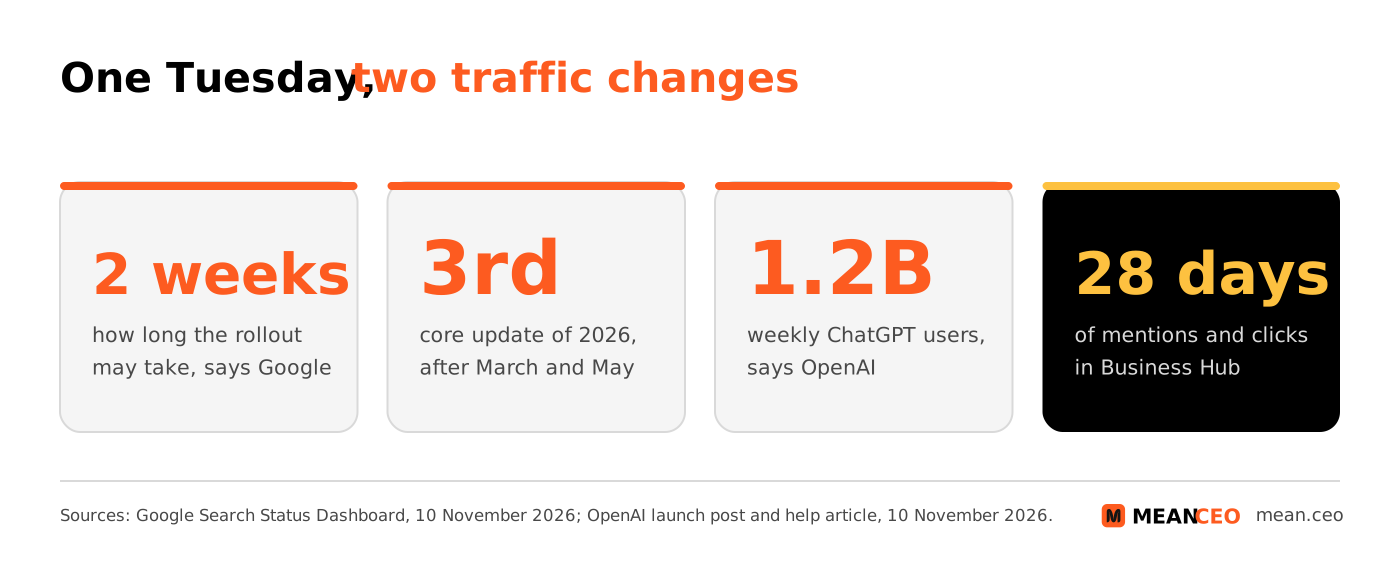
Two things, on the same day. Google started its November 2026 core update, the third of the year. It applies to all countries and languages and may take up to 2 weeks, which puts the end around 24 November, right before Black Friday. A few hours later, OpenAI launched Businesses in ChatGPT in beta: you can claim your business, fix how ChatGPT describes it, and see how often ChatGPT cites your website and how many clicks it sends you. This week: note the date in Search Console, don't touch your pages while Google's update rolls out, and claim your business in ChatGPT before someone else does.
If your traffic looks strange this week, it isn't only you.
On Tuesday, Google started a new core update, and OpenAI gave businesses their first official look at the traffic ChatGPT sends them. One of the two can shuffle your rankings for two weeks. The other finally shows you a number many founders have been guessing at. Here's what happened, what the data does and doesn't tell you, and what to do before Black Friday.
What happened: Google's November 2026 core update
Google's Search Status Dashboard shows that the November 2026 core update began on 10 November at 10:06 Pacific time, which was 19:06 in Paris and Berlin. The note reads: "Released the November 2026 core update, which applies globally and to all languages. The rollout may take up to 2 weeks to complete."
In its post on LinkedIn, Google Search Central called it "a regular update designed to better surface relevant, satisfying content for searchers from all types of sites." Google said it will update its ranking release history page when the rollout is complete. There's no blog post, no list of what changed, and no named target. That's normal for core updates.
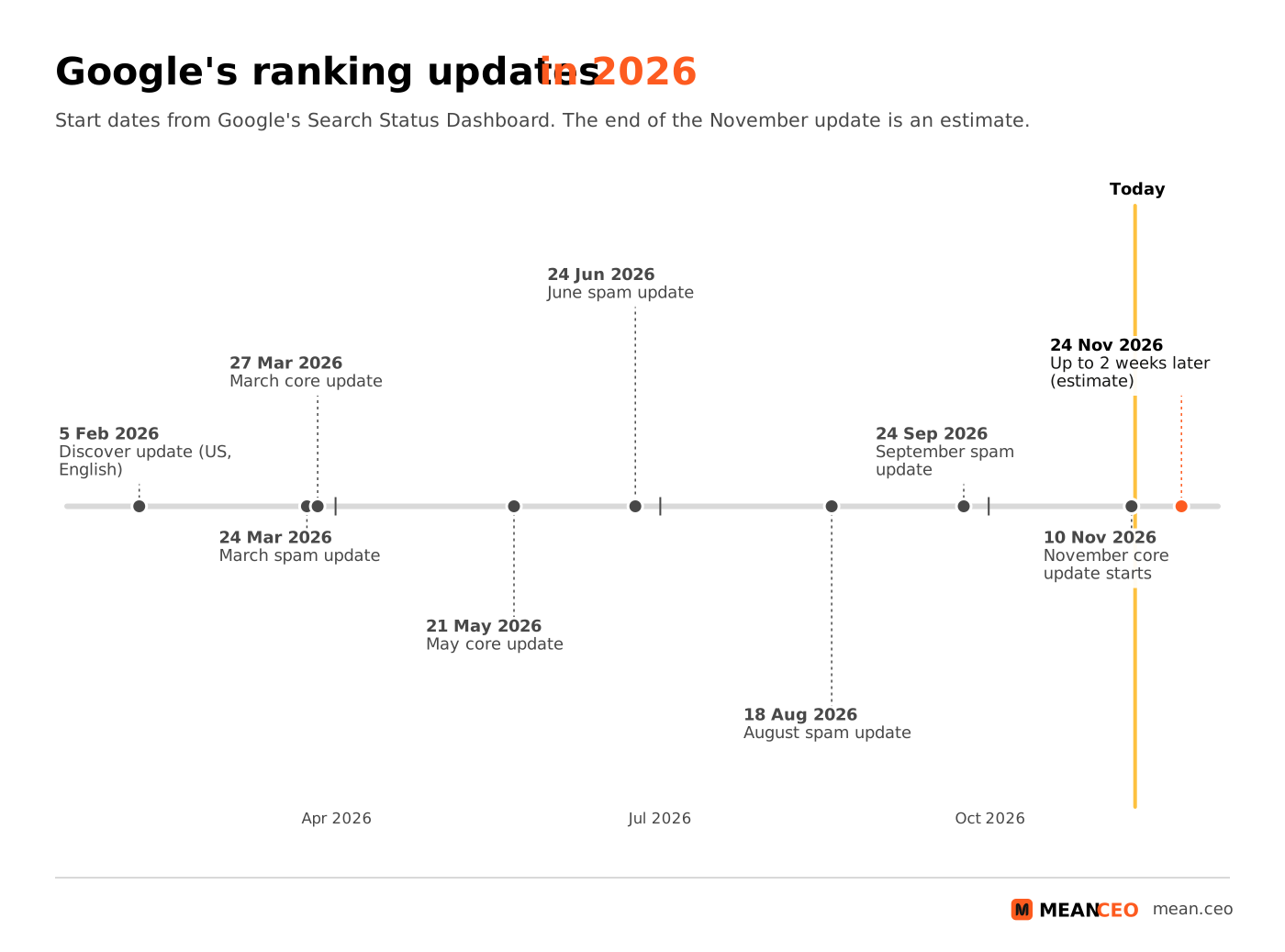
This is Google's third core update of 2026, after March and May, and the eighth ranking update on its dashboard this year. The September spam update took nearly two weeks and ended on 8 October. If Google needs the full two weeks this time, the update ends around 24 November. That's the week of Black Friday on 27 November and Cyber Monday on 30 November.
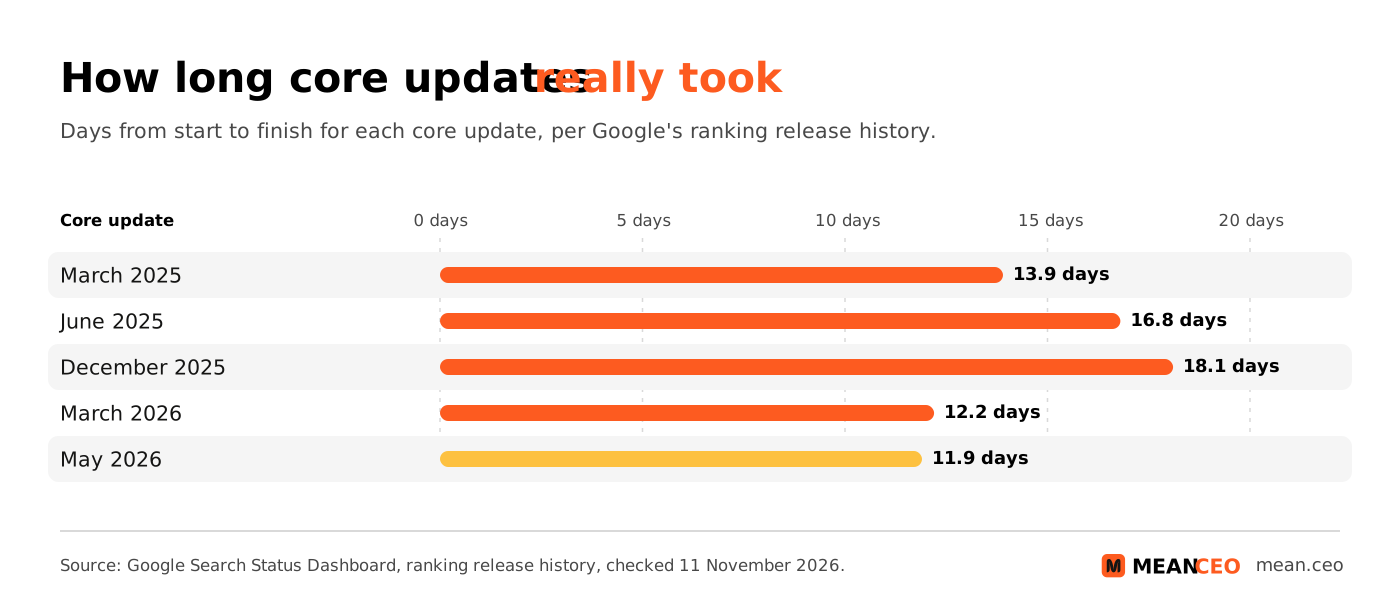
How long will it really take? Recent core updates took between 12 and 18 days from start to finish, according to Google's own release history. The two 2026 core updates were the fastest, at about 12 days each. Last December's update took 18 days and ran over Christmas.
What Google tells you to do (and not do)
Google's guidance on core updates hasn't changed since December 2025, and most of it is about patience. "In general, most sites don't need to worry about core updates and may not even realize one has happened," it says. Core updates are "broad in nature" and don't target specific sites or pages.
On timing, Google is specific: "We recommend waiting at least a full week after a core update completes before analyzing your site in Search Console. After a week, try comparing this week with a week before the core update started rolling out." For a small drop, such as going from position 2 to 4, it says "There's no need to take drastic action". And if you do improve your content after a big drop, Google warns that "it could take several months" for its systems to notice.
This year that advice has a catch. If the update ends around 24 November, the first clean week to compare is the one with Black Friday and Cyber Monday in it. For an online shop or a SaaS with a Black Friday deal, that week will look nothing like the week before 10 November. Compare the same pages year over year, or look at positions and impressions, not only clicks.
One more warning: your tools may be wrong too. On 9 November, Barry Schwartz at Search Engine Roundtable said the ranking trackers seemed off because of Google's blocking, and that the Search Console performance report was off for many sites. We covered why Google feeds fake results to rank trackers in October. Trust your own Search Console data over third-party charts, and give it a few days to settle.
What happened: ChatGPT now shows businesses their clicks
A few hours after Google's update started, OpenAI introduced Businesses in ChatGPT in beta. It gives businesses "a new way to connect with the 1.2 billion people who use ChatGPT each week." There are three parts:
- Business Hub, a dashboard where you claim your business, edit its details, add product feeds and see insights.
- Insights: "the number of mentions and website clicks a business receives", plus "discovery topics", the common themes in conversations where your website is cited.
- Business Agents: a chat assistant customers can talk to from your ChatGPT profile. These are only for "eligible ecommerce and online service businesses in the United States" for now.
OpenAI's help article gives the details. You verify your claim by business phone, business email, a DNS TXT record on your domain, or your Shopify store. Then you complete an identity check with Persona before you can publish changes, see insights or build an agent. Persona "may need a government-issued ID, business registration information, and proof that you're authorized to represent the business." The blue verified check only appears after that check is approved. You don't need an Ads account or an Enterprise agreement to claim your business.
Sources: OpenAI help article and launch post, 10 November 2026; Search Engine Roundtable, 10 November 2026.
Read the small print on clicks. In Business Hub, the tooltip says "Clicks don't confirm website visits or conversions", as Search Engine Roundtable showed. And OpenAI says data only appears when there are enough conversations to meet its privacy thresholds, so small sites may see blanks at first. Still, it's more than you had last week. Many founders have been losing ChatGPT visits in the "direct" bucket of their analytics. Now you can at least compare ChatGPT's count with what your own tools record.
Does claiming help you rank in ChatGPT? OpenAI says no: claiming "doesn't guarantee increased visibility or give you direct control over ChatGPT's independent recommendations. Advertising doesn't influence ChatGPT's independent answers." What it does give you is control over the facts ChatGPT shows next to your name: website, description, category, logo, delivery and return policies, and product feeds. OpenAI reviews every change before it goes live.
There's a commercial side too. Businesses can sponsor their Business Agent and use it as the landing spot for ChatGPT Ads. OpenAI says sponsored placements are clearly labelled and separate from ChatGPT's answers.
The European angle
OpenAI doesn't name Europe, either as included or excluded. Its launch post says "Any eligible business located where ChatGPT is available can claim their business", and the help article adds that availability "depends on the business's location and type." Two limits are clear: Business Agents are US-only, and "Local stores and restaurants can currently claim only an existing U.S. listing." So a European SaaS, online shop or agency should search for itself in Business Hub and try. A café in Lisbon can't claim yet. Our sister site Fe/male Switch Foundation has a step-by-step guide to claiming your business in ChatGPT from Europe.
Before you upload your passport, know where it goes. The identity check runs through Persona, a third-party verification company, not through OpenAI alone. Let the person who legally represents the company do it, read Persona's privacy notice first, and keep a note of what you shared.
Europe also has fresh data on what AI answers do to clicks. Google launched AI Overviews and AI Mode in France on 22 July 2026, and on 9 November SEO consultant Glenn Gabe published Search Console data from French sites:
Source: Glenn Gabe, GSQI, 9 November 2026. He adds: "But not all sites dropped."
Put the two stories together and the trend is clear. Google answers more questions itself, so each ranking is worth fewer clicks. ChatGPT sends fewer clicks than Google, but now it tells you how many. Our roundup of this autumn's AI search traffic studies has the numbers on how small that ChatGPT share still is.
What this means for you
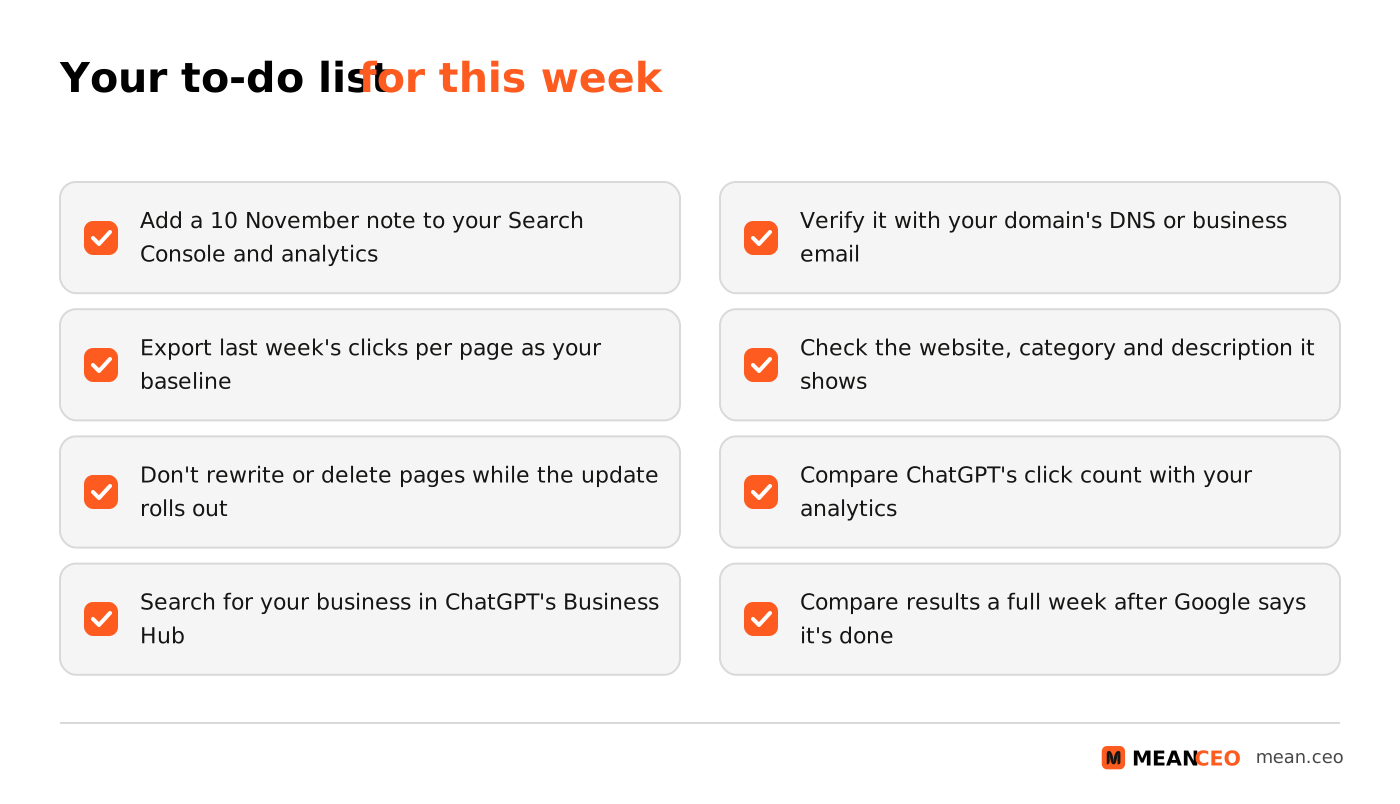
- Mark 10 November everywhere. Add an annotation in your analytics and save a note with your Search Console numbers for 3 to 9 November. That week is your baseline.
- Don't touch your pages for two weeks. Rewriting titles, deleting posts or changing links mid-update makes it impossible to tell what caused a change. Our guide on how to recover from Google algorithm updates explains what to look at once it's over.
- Plan your Black Friday comparison now. If the update ends around 24 November, compare year over year or by position, not week over week.
- Claim your business in ChatGPT this week. Search for it in Business Hub. Use DNS or your business email to verify: it's faster to do it now than to dispute a wrong claim later.
- Fix what ChatGPT says about you. Check your website, category and description. If you sell products, add a product feed with correct prices.
- Measure ChatGPT clicks your own way too. Every month, compare Business Hub's click count with the ChatGPT visits your analytics records. A big gap tells you how much ChatGPT traffic is hiding in "direct".
My take: these two launches on the same afternoon show where search is going. Google keeps rewriting the rules and asks you to wait, as it has for twenty years. OpenAI hands you a dashboard and asks for your passport. Neither one owes you traffic. Bootstrapped founders should stop treating either as a channel they control. Build the things that survive both: an email list, pages that answer real questions better than an AI summary, and a brand people search for by name. Then use Business Hub for what it is: data about a channel you couldn't measure before. For the rest of this month's search news, see our SEO news for November 2026.
Are you getting customers from AI search yet?
More and more traffic is coming from Perplexity, ChatGPT, Grok and other AI tools.
👉 Rank on ChatGPT
FAQ: Google's November 2026 core update and ChatGPT business profiles
When did Google's November 2026 core update start?
On 10 November 2026 at 10:06 Pacific time (19:06 CET), according to Google's Search Status Dashboard. Google says it applies to all countries and languages and may take up to 2 weeks to complete.
When will the November 2026 core update finish?
Google hasn't said. If it takes the full two weeks, it ends around 24 November. Recent core updates took between 12 and 18 days. Google will mark it complete on its ranking release history page.
What should I do if my traffic dropped this week?
Wait. Google recommends waiting at least a full week after the update completes, then comparing that week with a week before it started. For small drops, it says there's no need for drastic action. Check our post on the September 2026 spam update to rule out spam issues.
What is Business Hub in ChatGPT?
It's OpenAI's new dashboard, launched in beta on 10 November 2026. Businesses can claim their profile in ChatGPT, update their details and product feeds, and see mentions, website clicks and discovery topics for the past 28 days.
Can European businesses claim their profile in ChatGPT?
OpenAI says any eligible business located where ChatGPT is available can claim, depending on location and type, but it doesn't name Europe. Local stores and restaurants can only claim existing US listings for now, and Business Agents are US-only.
Does claiming my business help me rank in ChatGPT?
No, according to OpenAI. Claiming lets you manage your information, but it doesn't guarantee more visibility, and OpenAI says advertising doesn't influence ChatGPT's independent answers.
About the Author
Violetta Bonenkamp, also known as MeanCEO, is an experienced startup founder with an impressive educational background including an MBA and four other higher education degrees. She has over 20 years of work experience across multiple countries, including 5 years as a solopreneur and serial entrepreneur. Throughout her startup experience she has applied for multiple startup grants at the EU level, in the Netherlands and Malta, and her startups received quite a few of those. She’s been living, studying and working in many countries around the globe and her extensive multicultural experience has influenced her immensely.
