TL;DR: The best startup accelerators for European tech founders in 2026 are the ones whose deal still looks good at your next round. On the terms pages of 12 programmes, checked on 12 November 2026, Techstars prices its fixed 5% at $400,000, Y Combinator prices its 7% at $1.79 million, Antler UK adds a £40,000 programme fee, and UnternehmerTUM and Google take no equity at all. At a $6 million next round, YC's stake plus its SAFE is worth $795,000 for $500,000 of cash. Put your own offer into the Accelerator deal calculator below before you sign anything.
The lists that rank for "best startup accelerators" repeat five American names, copy old terms and never price the equity. Doors also close: Sequoia ended Arc this year, as we covered in our piece on Sequoia closing its London office.
I am Violetta Bonenkamp, and I have built companies in Europe for two decades, mostly bootstrapped. My rule: an accelerator sells capital plus services, and you are the buyer. So this guide judges each programme on the DEAL: cheque, equity, instrument, implied valuation, length, location and what alumni got.
Every term comes from the programme's own page, opened on 12 November 2026; private numbers are marked "not published". For a broader directory of programmes by country, our sister site keeps a ranked list of European startup accelerators.
What is a startup accelerator, and how does it differ from an incubator?
A startup accelerator is a fixed-length programme that invests a small cheque in a group of startups, gives them mentors and ends with a demo day, where the companies pitch to investors. The group that starts together is a cohort (or batch). The neighbours:
- Incubator: gives early teams space and support for longer, with little or no money. The incubator vs accelerator difference comes down to cash and a deadline: incubators rarely invest, accelerators invest and push you to raise.
- Pre-accelerator: a short, cheaper programme for very early teams, such as Startup Wise Guys' online Founders Club.
- Venture builder: creates startups itself, recruits founders into them and keeps a large stake.
- Talent investor: backs individuals before a company or co-founder exists, as Entrepreneur First and Antler do.
Four money terms decide whether a deal is good. A SAFE (Simple Agreement for Future Equity) is cash now for shares later, converting at your next priced round; our guide to SAFE agreements and convertible notes covers the mechanics. Pre-money valuation is what your company is worth before new money comes in; post-money valuation is pre-money plus the new money. Dilution is the shrinking of your percentage each time new shares are issued.
How do you work out what an accelerator deal really costs?
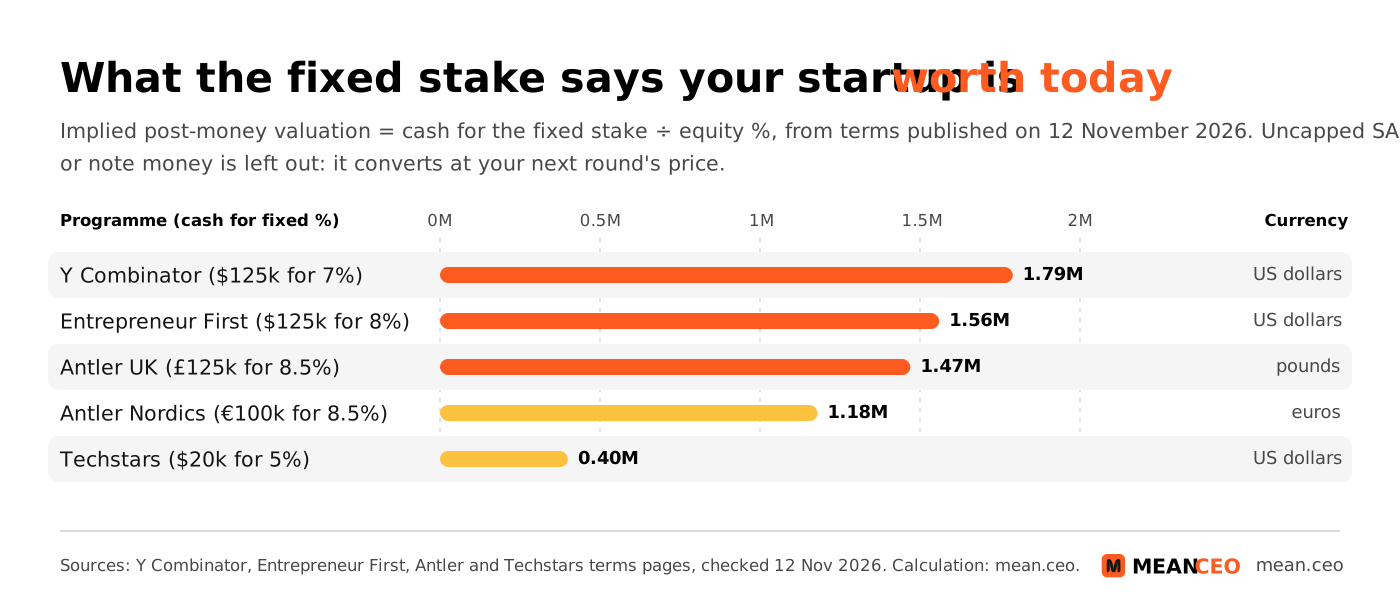
Here is the maths most founders skip. Divide the cash an accelerator pays for its FIXED stake by the percentage it gets, and you have the implied post-money valuation: the price it pays for your company today.
- Y Combinator: $125,000 for 7% = $1.79 million post-money.
- Entrepreneur First: $125,000 for 8% = $1.56 million.
- Antler UK: £125,000 for 8.5% = £1.47 million.
- Antler Nordics and Antler ONE: €100,000 for 8.5% = €1.18 million.
- Techstars: $20,000 for 5% = $400,000.
Uncapped SAFEs with a most favoured nation (MFN) clause sit on top and convert at your next round's price, so they cost you only the cash they bring. You pay through the fixed stake.
Then project the stake to your next round. If you raise at a $6 million pre-money, YC's 7% is worth $420,000; add its $375,000 SAFE and YC holds $795,000 of your company for $500,000 of cash. You paid $295,000 for the programme and the brand. Techstars' 5% becomes $300,000 plus a $200,000 SAFE: $500,000 for $220,000 of cash, so the programme cost you $280,000. Check your valuation guess against our startup valuation guide first.
How the calculator works: pick up to three offers. Each preset holds the terms published on 12 November 2026 (cash for the fixed stake, equity %, uncapped SAFE or note, fees); edit any number to match your term sheet. Add your expected next-round pre-money and the months until then. You get the implied post-money, the real price (stake plus SAFE plus fees), the cash you receive and the difference: what you pay for the programme. The last line names the cheapest offer per unit of cash. The currency selector only swaps the symbol.
Which money-first accelerator programs pay the most cash?
These top startup accelerators suit founders who want cash and an investor brand, and accept a fixed stake.
1. Y Combinator: the US benchmark European founders still fly to
YC is the benchmark for every other deal. Its deal page commits $500,000 on the day of acceptance with no milestones attached, and states that YC charges companies no fees. Its FAQ says 40% of funded companies in each batch are "just an idea".
- Deal as published: $125,000 on a post-money SAFE for 7%, plus $375,000 on an uncapped MFN SAFE. Pro rata right in later rounds.
- Format and place: 3 months, in person in San Francisco. Winter 2027 runs January to March; late applications are still open.
- My verdict: the most cash per point of equity here. You need a US, Canadian, Singapore or Cayman parent company.
2. Techstars London: three months, $220,000, and a 5% stake priced at $400,000
Techstars London is the only European city programme on Techstars' accelerator list, open to any vertical until 18 November 2026. It starts on 8 March 2027, with Demo Day on 3 June 2027.
- Deal as published: $220,000 at acceptance: $200,000 on an uncapped MFN SAFE plus $20,000 on a convertible equity agreement that becomes 5%, option pool included, at a priced round of at least $1 million.
- Format and place: 3 months of mentorship-driven support in London. Its page does not state whether you must attend in person.
- My verdict: the SAFE is fair money; the fixed 5% for $20,000 is the most expensive equity in this guide. It includes your option pool, so size the pool first with our explainer on equity and stock option plans.
3. Startup Wise Guys: up to €100,000 for B2B teams, with a €35,000 fee
Startup Wise Guys started in the Baltics and backs B2B software. Its homepage claims 800+ founders, 25+ exits and €460 million raised by its portfolio across 45+ programmes.
- Deal as published: up to €100,000 for "a negotiated equity", with no fixed percentage, through equity, convertible notes or SAFEs. A €35,000 programme service fee is invoiced after the money arrives.
- Format and place: 14 weeks. The Founders Club pre-accelerator runs 3 months online, from €1,000 + VAT.
- My verdict: €100,000 minus the fee is €65,000 of usable cash, priced as €100,000. Negotiate the percentage hard.
4. Founders Factory: £50,000 and four months of operators for fintech
Founders Factory runs corporate-backed programmes; the European ones open today are fintech, with Aviva in London and Mediobanca in Milan. It lists 450+ portfolio investments.
- Deal as published: the Aviva programme offers £50,000 of capital. Equity is not published.
- Format and place: 4 months of operational support, London and remote, pre-seed to Series A, insurance, wealth, property and AI.
- My verdict: worth it when Aviva is your dream customer. Ask for the equity number before the second call.
5. Seedcamp: a seed fund, and the yardstick for a real seed cheque
Seedcamp calls itself "a private investment fund" in its FAQ and runs no cohort or demo day. I include it as the yardstick for a European seed cheque. Its homepage lists Revolut, Synthesia and 9fin.
- Deal as published: a first cheque between $350,000 and $1.25 million, as convertible or equity. No percentage published.
- Format and place: London fund, FCA-regulated, citing more than 550 company journeys.
- My verdict: if you already have a team, a product and early revenue, pitch Seedcamp and skip the accelerator.
Which accelerator programs work if you have no co-founder or no team yet?
Talent investors back people before the company exists: the answer for a strong engineer with no partner.
6. Entrepreneur First: a co-founder match in London, then San Francisco
EF recruits individuals, matches them into teams and invests once a company forms. Its homepage says the portfolio is "collectively valued at over $16B", and that companies raise $1 million to $7 million within weeks of its San Francisco demo day.
- Deal as published: a £6,000 Talent Investment when you sign. If the Investment Committee backs your team: $125,000 on a post-money SAFE for 8%, plus an optional $125,000 on an uncapped MFN SAFE from EF and its partner Transpose Platform.
- Format and place: 12 weeks in person in London, then 12 weeks in San Francisco for funded teams. The Bridge is an 8-week Bay Area residency for Europeans who graduated in 2023 or later.
- My verdict: the right pick if your bottleneck is a technical co-founder. Before you pay 8% for a match, try our guide to finding a female co-founder.
7. Antler: residencies in London, Berlin and four Nordic capitals
Antler runs residencies where solo founders and teams build and pitch for investment. Terms differ by region.
- Deal as published: UK: £210,000 at inception, £125,000 for 8.5% plus an £85,000 convertible note, plus a £40,000 programme fee. Continental Europe (Antler ONE): €200,000 wired at inception, €100,000 converting into 8.5% plus €100,000 on an uncapped MFN note, and up to €300,000 more. Antler's own page says the full €500,000 "typically" converts into about 10% at a €5 million valuation. Nordics: €100,000 for 8.5% plus €100,000 uncapped.
- Format and place: UK: up to 8 weeks full-time in London. Antler ONE: Berlin and Amsterdam, intakes in March and September, 6 to 10 weeks. Nordics: 8 weeks in Stockholm, Helsinki, Oslo or Copenhagen.
- My verdict: the continental and Nordic deals are cleaner than the UK one. In London, put the £40,000 fee into the calculator before you celebrate.
Which top startup accelerators take no equity?
Equity-free programmes trade your time for a network, customers or a grant, and suit founders who refuse to price their company early. For the full list of alternatives to equity, read our overview of European startup funding beyond VC.
8. UnternehmerTUM Accelerator: three months near Munich, zero equity
This is the programme formerly called XPRENEURS; Munich Startup reported the rename on 25 June 2026. Its page states "a founders-first approach without taking equity" and claims 300+ tech teams since 2017, over 60% of them funded, with more than €3.3 billion in venture capital raised.
- Deal as published: no equity and no cash. Its FAQ says it does not give grants or invest. Free co-working at Munich Urban Colab or Garching.
- Format and place: 3 months, full-time, mostly B2B deep tech. Batch 21 runs March to June 2027; applications open December 2026 to January 2027.
- My verdict: the best deal on this list for a technical B2B team in Germany. You pay with three months of focus.
9. Google for Startups Accelerator: Europe and Israel
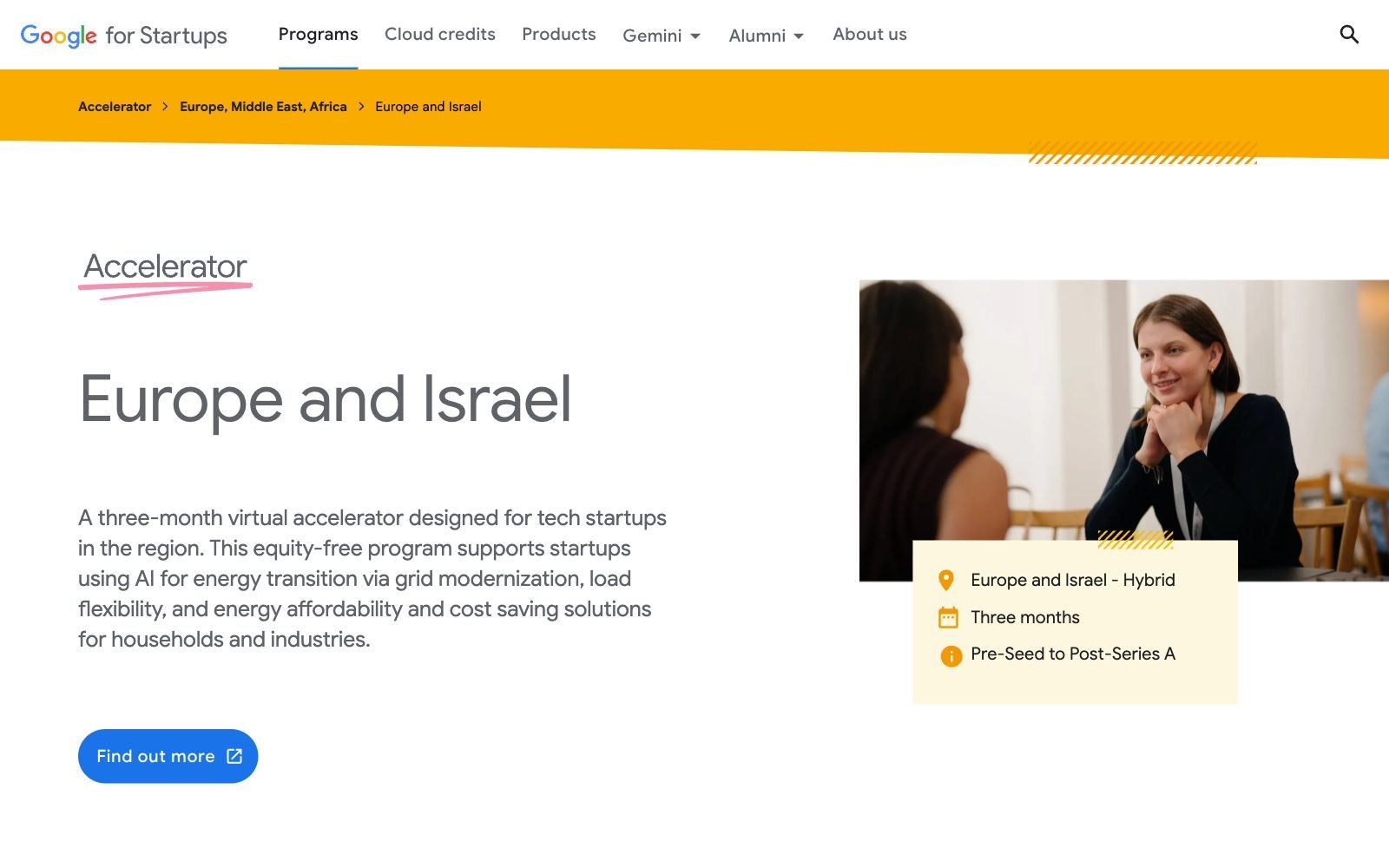
The 2026 cohort of Google's European programme works on AI for the energy transition: grid modernisation, load flexibility and energy affordability.
- Deal as published: "equity-free for all participating startups". Cloud credits on application.
- Format and place: 3 months, hybrid, for pre-seed to post-Series A startups headquartered in Europe or Israel. Applications closed on 12 June 2026; Demo Day is in November and graduation in December 2026.
- My verdict: apply when the theme matches your product. Watch the page in spring for the 2027 theme, and check our map of sectors where VC money is going.
10. Station F Founders Program: a Paris campus desk, priced per month
Station F's own Founders Program in Paris takes early-stage tech startups on a rolling basis.
- Deal as published: from €259 per desk per month. The page lists no equity terms and mentions "a chance to receive funding from STATION F" without numbers. Its Fighters Program for founders from less privileged backgrounds is free; applications are closed today.
- Format and place: 3 to 18 months on the Paris campus.
- My verdict: two desks for six months cost €3,108 before VAT. Compare that with the rest of your budget in our breakdown of what a startup really costs in 9 European countries.
11. EIT Food Accelerator Network: six hubs and subgrants up to €50,000
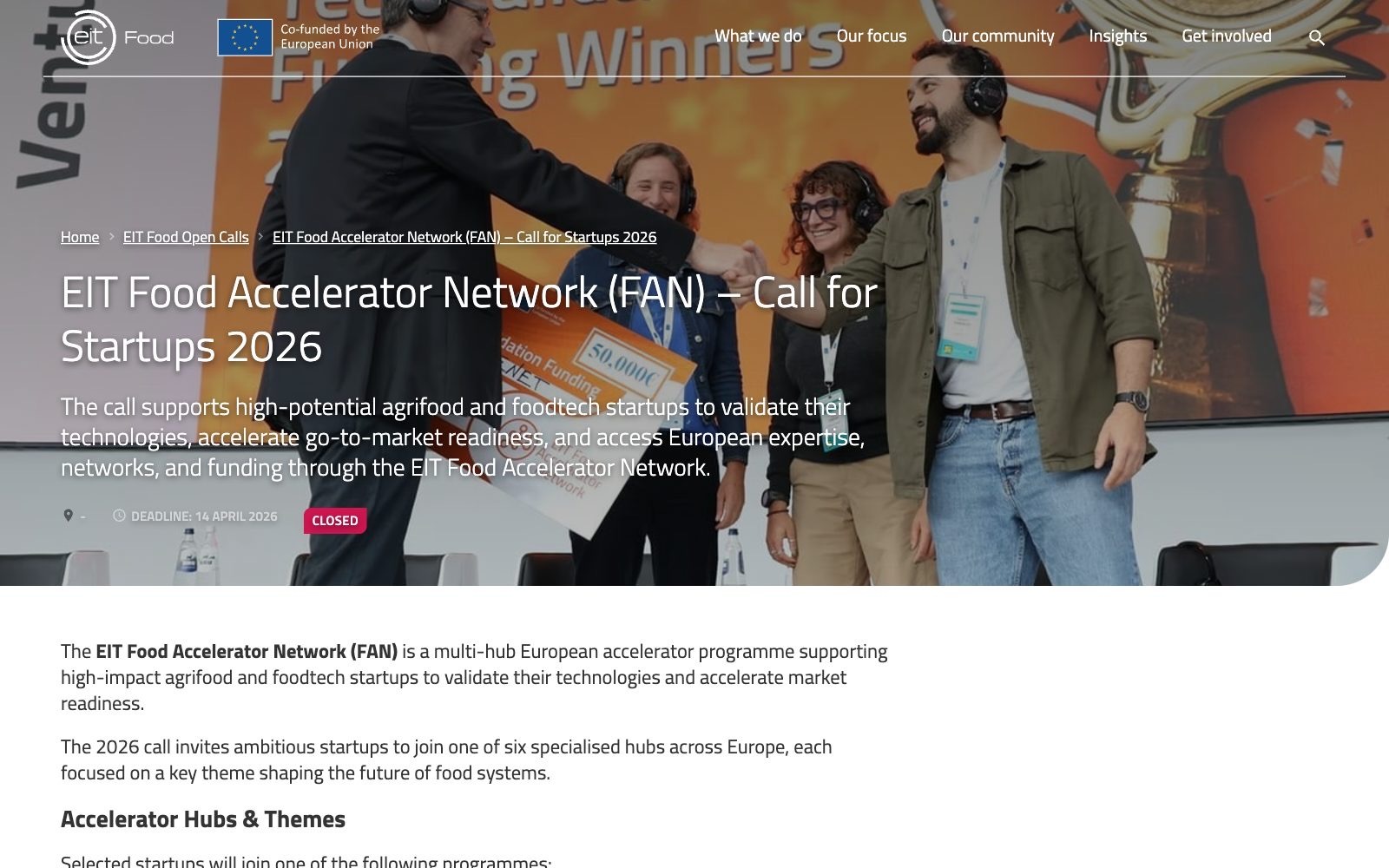
The EIT Food Accelerator Network is backed by the EU's EIT and runs from September to December 2026 in Munich, Helsinki, Paris, Warsaw, Catania and Wageningen.
- Deal as published: subgrants of €50,000, €30,000 and €20,000 to the top three startups per hub, 18 in total, for a validation project in 2027. The call page mentions no equity.
- Format and place: 2 to 3 months, for EU agrifood and foodtech companies, pre-Series A, revenue up to €1 million. The 2026 call closed on 14 April.
- My verdict: the only programme here that can hand you non-dilutive cash. Watch EIT Food's open calls for the 2027 round.
12. Plug and Play: the new state-funded programme in Cyprus

Plug and Play claims 2,500+ startups in its portfolio. Cyprus Mail reported its first Cyprus batch, 10 startups, on 21 August 2026.
- Deal as published: funded by the Republic of Cyprus. No equity or fee terms were published in the report.
- Format and place: 3-month programmes in Limassol, six over three years, for about 60 startups.
- My verdict: worth a look if you sell in Cyprus. Get the terms in writing before you relocate.
How do the 12 startup accelerators in Europe compare side by side?
Sources: programme websites, checked 12 Nov 2026 (Plug and Play: Cyprus Mail, 21 Aug 2026).
How do you judge an accelerator offer before you sign?
The process I give every founder who asks which offer to take:
- Validate the business first. An accelerator speeds up a company that already has customers in sight. Our guide to validating a startup idea cheaply takes two weeks.
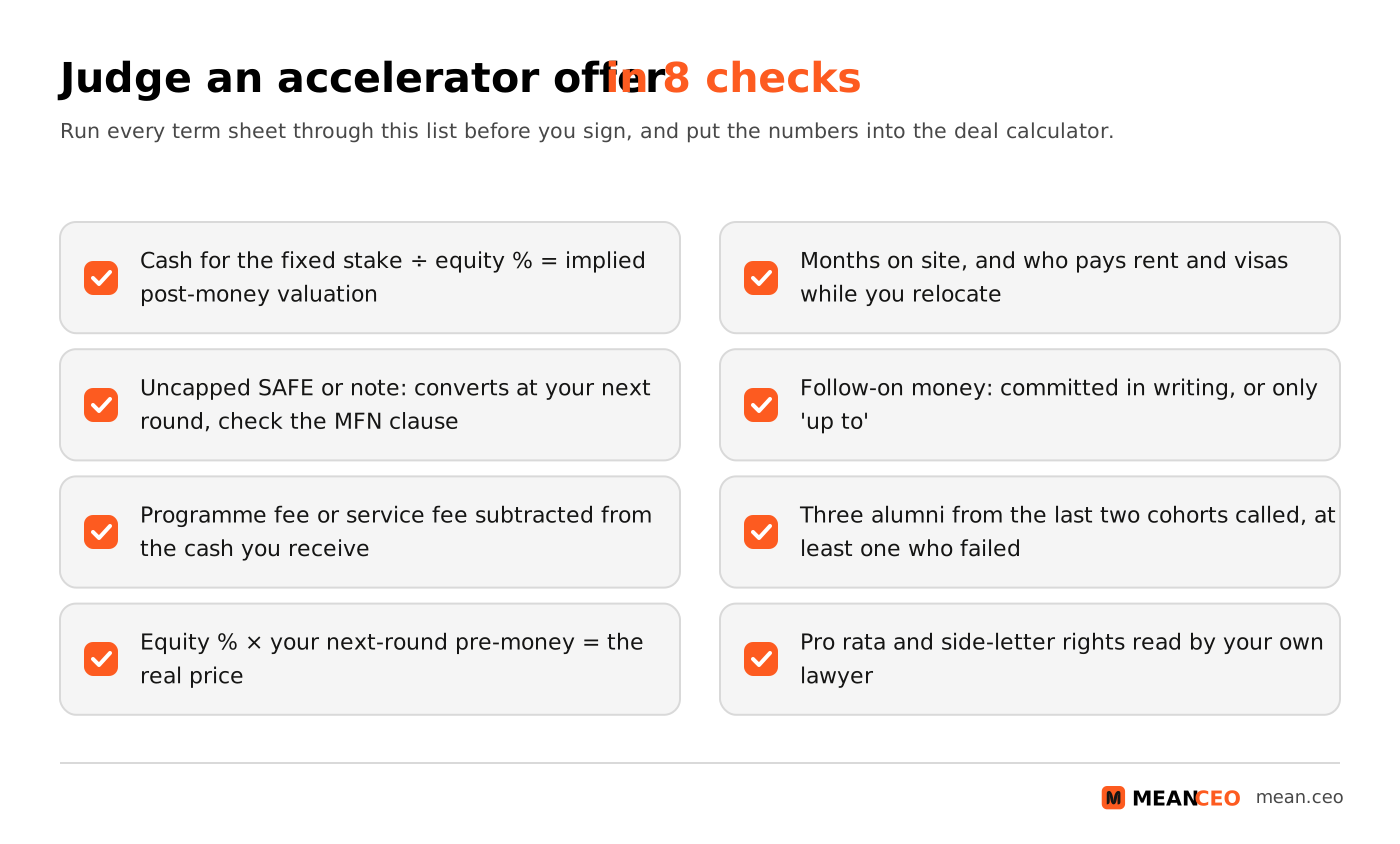
- Split the offer into parts: cash for a fixed stake, uncapped SAFE or note, and fees. Write each number down.
- Calculate the implied post-money valuation of the fixed stake. Anything under €1 million means the programme is buying cheap.
- Project the stake to your next round with the calculator, using a realistic pre-money. The difference between the real price and the cash is what you pay for the programme.
- Put the follow-on in context. "Up to" money is a promise. Ask for committed money with a deadline, in writing. Place it in your funding plan from pre-seed to Series A.
- Count the hidden costs: relocation, rent, visas, months away from customers.
- Call alumni, including one company that failed. The questions are in the next section.
- Have your own lawyer read the side letter and any pro rata rights before you sign.
What should you ask alumni, and how do you write the application?
Copy and adapt these.
- Application outline: What we build, in one sentence a customer would use. Who pays, how much, and how many have paid so far. Why this team, with one hard fact per founder. What we will prove during the programme, in numbers. What we will do with the money, month by month.
- Questions for alumni: "How much of the cash did you spend on rent and travel?" "Which mentor did you still talk to six months later?" "Did the follow-on money arrive, and on what terms?" "Would you sign the same deal again?"
- Term check for the programme team: "Is the fee paid out of the investment or on top?" "Does the percentage include the option pool?" "Which rights sit in the side letter?"
- AI prompt for your application: "Act as an accelerator partner. Mark every claim in my answers below that has no number, and the one question you would ask me in the interview."
- AI prompt for the term sheet: "Here is an accelerator term sheet. List the cash, the fixed equity, every convertible instrument and every fee. Calculate the implied post-money valuation and the value of the stake at a [X] pre-money round in [Y] months."
Interviews follow the form, so study our pitch deck examples, slide by slide before demo day.
Look for non-dilutive money before you sell 7% or 8%. The free mean.ceo non-dilutive funding finder lists grants, competitions and programmes your startup qualifies for. Then compare the accelerator with other funding sources that cut dilution.
My verdict: which startup accelerator should a European founder pick in 2026?
- No co-founder yet: Entrepreneur First or Antler ONE. You pay for the match; the €1.18 million to $1.56 million entry valuations are fair for a team that does not exist yet.
- Team and product, ready to move: Y Combinator, because it pays the highest price per point of equity and its $375,000 SAFE costs you only the cash it brings.
- B2B deep tech in Germany: UnternehmerTUM Accelerator. Zero equity and three months of focus.
- Agrifood: the EIT Food Accelerator Network, for grant money with no shares attached.
- Revenue and a team: skip accelerators and pitch Seedcamp-sized seed funds directly.
My hard line is the fee. A programme that takes equity AND invoices €35,000 or £40,000 must prove its network is worth both. Many founders I mentor should first learn how to say no to VC money and weigh bootstrapping against VC funding.
Next steps: put your three best offers into the calculator, call two alumni of each, and decide by the numbers.
FAQ: best startup accelerators
What is the best startup accelerator in Europe in 2026?
Y Combinator pays the most per point of equity and accepts Europeans. In Europe, Antler ONE wires €200,000 at inception, and UnternehmerTUM Accelerator takes no equity.
How much equity do startup accelerators take?
On published terms: Y Combinator 7% for $125,000, Entrepreneur First 8% for $125,000, Antler 8.5% for £125,000 or €100,000, Techstars 5% for $20,000, plus uncapped SAFEs that convert at your next round.
What is the difference between an incubator and an accelerator?
An accelerator runs a fixed-length cohort, invests and ends with a demo day. An incubator gives space and support for longer, with little or no money.
Do I need a co-founder to apply to an accelerator?
No. Entrepreneur First and Antler accept solo founders and match them with co-founders during the programme.
Are there equity-free startup accelerators in Europe?
Yes. UnternehmerTUM Accelerator and Google for Startups Accelerator: Europe and Israel take no equity, and the EIT Food Accelerator Network pays subgrants with no equity mentioned.
Is Techstars still running in Europe?
Yes. Techstars London is open for applications until 18 November 2026, and the programme starts on 8 March 2027.
Is Seedcamp an accelerator?
No. Seedcamp calls itself a private investment fund, writing a first cheque between $350,000 and $1.25 million.
About the Author
Violetta Bonenkamp, also known as MeanCEO, is an experienced startup founder with an impressive educational background including an MBA and four other higher education degrees. She has over 20 years of work experience across multiple countries, including 5 years as a solopreneur and serial entrepreneur. Throughout her startup experience she has applied for multiple startup grants at the EU level, in the Netherlands and Malta, and her startups received quite a few of those. She’s been living, studying and working in many countries around the globe and her extensive multicultural experience has influenced her immensely.
