
TL;DR: What did Sequoia announce about Europe?
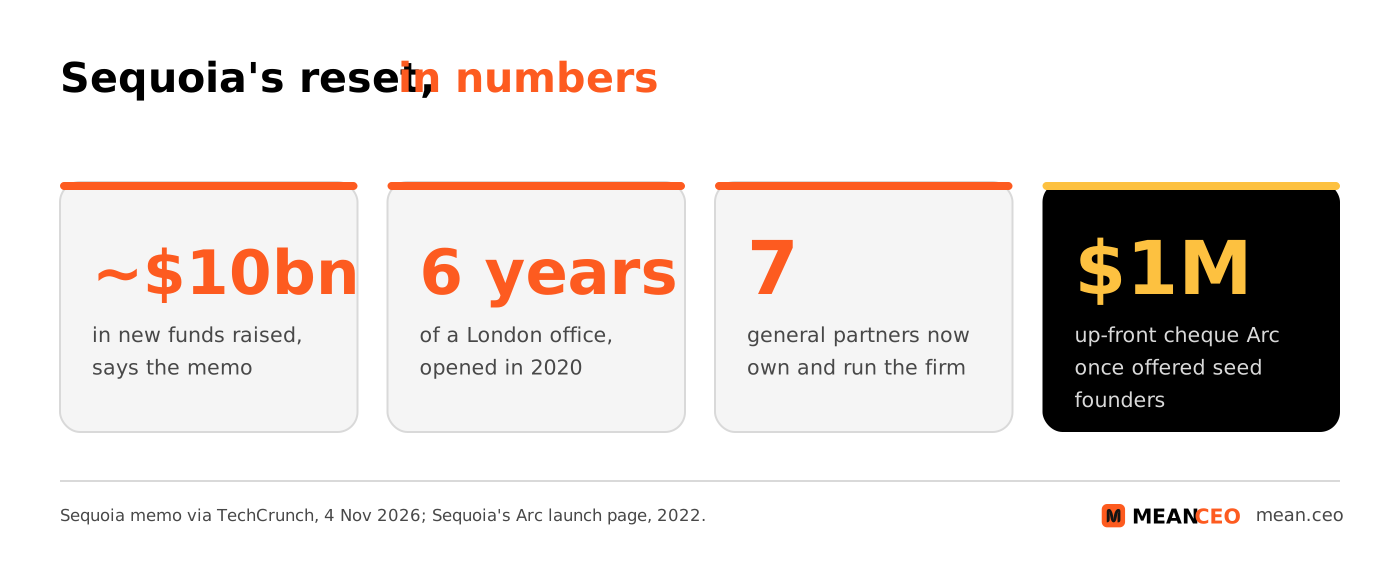
On 4 November 2026, Sequoia Capital posted a memo on X called "The Sequoia of Tomorrow". It closes the London office it opened in 2020, shuts its Arc seed accelerator and its Scouts programme, merges its early and growth teams and says it has raised about $10 billion in new funds. "We simply don't see the need for a local presence," the memo says, adding that Sequoia can support European founders "from our home base in the Bay Area". For bootstrapped founders in Europe, little changes in practice. The lesson is bigger: the easy early cheques from famous US funds were never a plan, and seed money in Europe is flat while late-stage rounds take 70% of the cash.
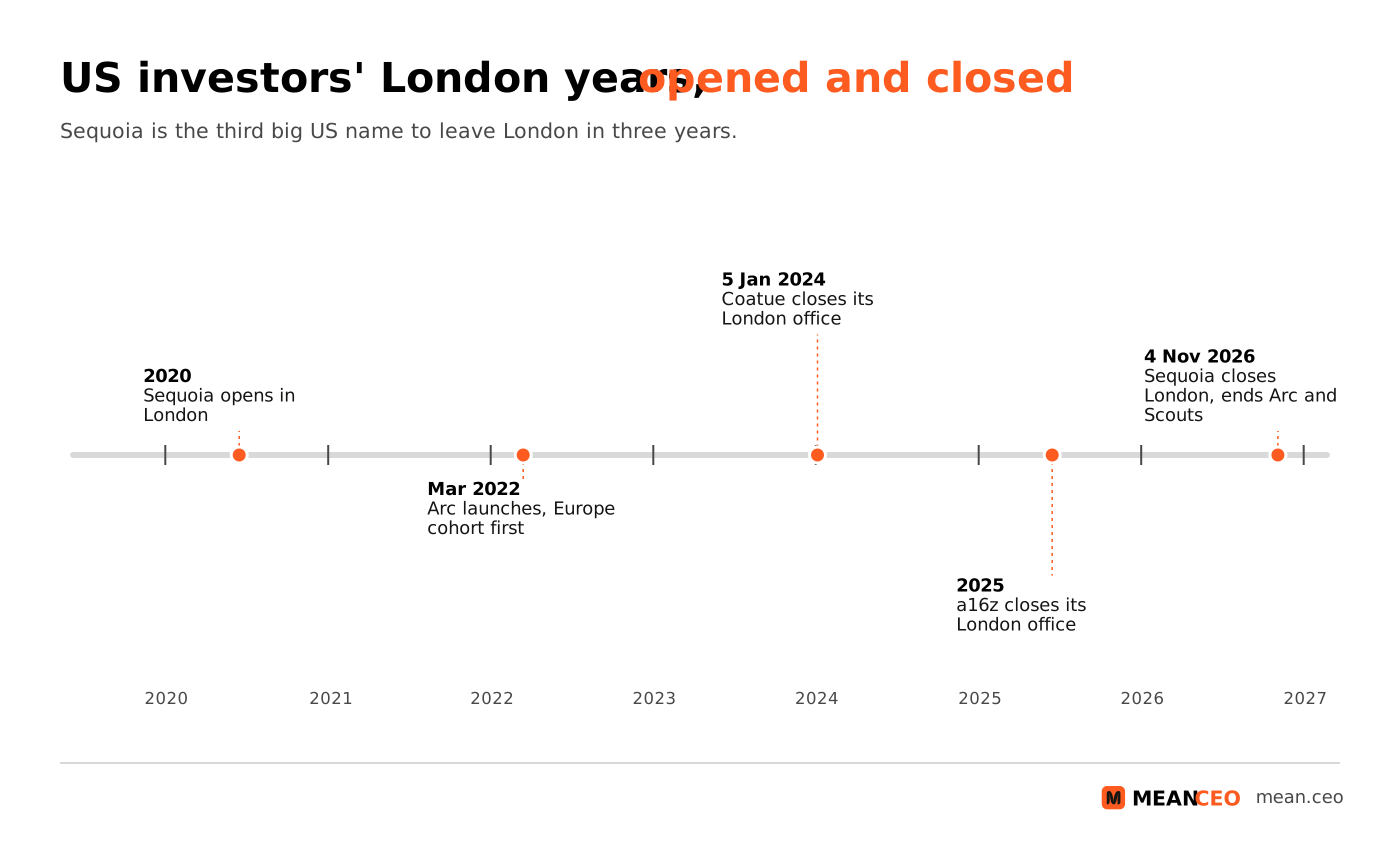
Sequoia is one of Silicon Valley's best-known venture firms, an early backer of Stripe and, in Europe, of Klarna. It opened an office in London in 2020. Six years later it's going home. And it isn't only closing an office. It's also ending the two programmes that put it closest to very early founders: Arc, which wrote seed cheques of up to $1 million, and Scouts, which let founders invest on its behalf.
Here's what Sequoia actually said, who stays and who goes, what the funding data says about Europe right now, and what it means if you're building without venture money, or thinking about raising some.
What happened
On Wednesday 4 November 2026, Sequoia's seven general partners posted the memo on X. TechCrunch reprinted it in full the same morning. These are the changes it lists:
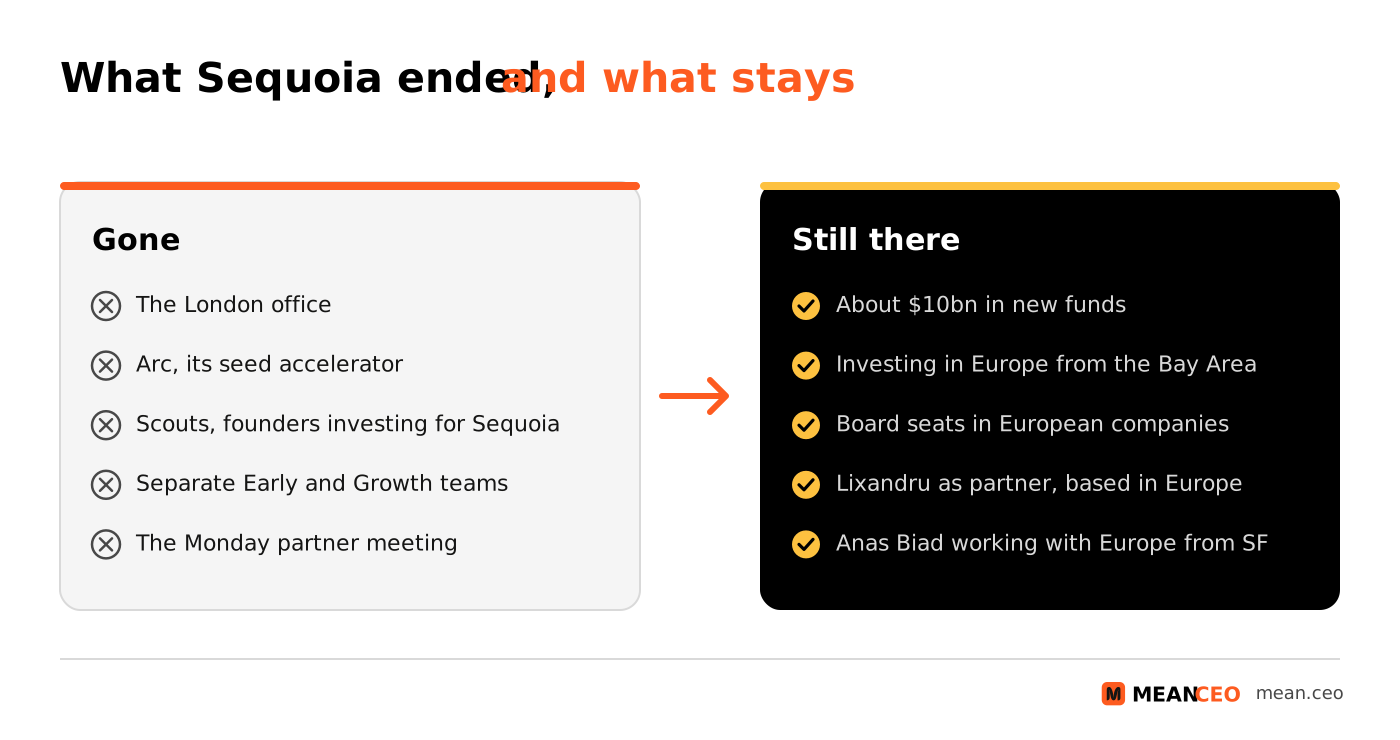
- London closes. "We are closing our London office, which means several people will be leaving Sequoia. This is not about the team - they are excellent. We simply don't see the need for a local presence."
- Arc and Scouts end. Sequoia says it has "sunset our batch accelerator (Arc) and Scouts programs" to focus on "high-conviction, highly selective venture capital investing".
- One team. "There is no more 'Early & Growth'. There is only Sequoia."
- No more Monday partner meeting. "Founders operate 24/7, and so do we."
- More money. "We've raised ~$10Bn in new funds."
The memo explains the reset this way: Sequoia is "coming out of a ~20 year expansionary phase", during which it built "multiple businesses in multiple geos", and "one unintended side effect was hierarchy". It also says: "Our objective function is not scale, but quality."
On Europe, it keeps one door open: "We believe that Europe will continue to produce outlier founders and companies, and that we can continue to provide world class support from our home base in the Bay Area." TechCrunch's editor Connie Loizos put the practical effect bluntly: "If founders didn't already feel pressured to move to the Bay Area or open an office in the region, they will now."
Who stays, who moves and who might go
The memo names no one in London. The partners spoke for themselves on X and LinkedIn, as Pathfounders reported on 4 November.
- Luciana Lixandru, hired from Accel in 2020 as Sequoia's first partner in Europe, was offered a move to San Francisco and said no. "My conviction on Europe hasn't moved, and neither am I," she wrote. She stays a partner, keeps her board seats and will invest personally in European founders.
- Anas Biad stays with Sequoia and moves: "Personal update: I'm moving from London to San Francisco with @sequoia." He said he will keep working with European founders.
- Julien Bek wrote: "Sequoia is consolidating in the US. I'm staying in Europe. Time to build." He didn't say whether he is leaving the firm.
- George Robson wrote that Sequoia is "consolidating around the Bay Area, where the pace of change is extraordinary". His status is also unclear.
Source: the partners' own posts as quoted by Pathfounders and TechCrunch, 4 November 2026.
The London team's record isn't small. According to Dealroom News, Lixandru credited it with backing Pennylane, STARK, Profound, Rillet, Robco, Serval, Nevis, Avelios, Aspora and Trade Republic "in their early days". Those companies keep Sequoia as an investor. What changes is who sits across the table when the next European company pitches.
Why Arc and Scouts matter more than the office
For very early founders, the bigger loss is the two programmes. When Sequoia launched Arc in 2022, it called it "a seed-stage catalyst for outlier founders", and its first cohort was European. Each company got "a $1M up-front investment", and the first batch ran from 23 May to 15 July 2022. TechCrunch says Arc later ran several cohorts a year for seven weeks, with $500,000 to $1 million up front.
Scouts was older. Sequoia started it around 2009, giving small cheques to founders and operators who invested for the firm. Jason Calacanis pointed Sequoia to Uber that way, and Sam Altman brought in Stripe.
In Europe, scouts helped build the angel scene. Station F's Roxanne Varza, a Sequoia scout from 2020 to 2025, told TechCrunch on 6 November: "I believe they have helped to foster the investment culture and early-stage investment landscape that we now see in Europe, for example." Not everyone agrees the model worked. Investor Sheel Mohnot wrote on X: "They pioneered the scout program but [to be honest] it never made sense to me!" Andreessen Horowitz has kept its scouts but cut their number. "They get more budget, but we have reduced the number," partner Gabriel Vasquez told TechCrunch.
So the trend is clear. Big funds are moving away from wide nets of small early bets and toward fewer, bigger ones. If your plan was to get noticed through a scout or an accelerator run by a famous US fund, that route is narrower now. Our guide to European accelerators worth applying to lists the ones that remain.
Sequoia isn't the first US fund to leave London
Coatue closed its London venture office in January 2024, two years after opening it, Bloomberg reported at the time. Andreessen Horowitz closed its London office in 2025. Now Sequoia is following.
That doesn't mean the money has left. Dealroom's take: "The retreat matters more for where a major investor deploys its people than for European funding levels." UK startups raised $23.7 billion in 2025, up 33%, and foreign investors supplied 74% of UK venture funding, according to Dealroom figures cited by City AM. US money still flows into Europe. It just comes with fewer people on the ground, and that matters most to founders who don't already have a network.
What the funding data says about Europe right now
Europe had a strong quarter, but not for everyone. Crunchbase News reported on 8 October that European startups raised $25 billion in Q3 2026, up 77% from $14 billion a year earlier and the strongest quarter in four years. AI took $18.8 billion of it, or 75%.
Look at where it went, though. Late-stage deals took $17.3 billion, or 70%, and that went to just 83 companies. Four rounds of more than $1 billion (Mistral, Nscale, Helsing and Quantum Systems) made up close to 40% of the quarter. Early-stage funding was $5.7 billion, flat year over year. Seed was about $2 billion across more than 750 companies, also flat.
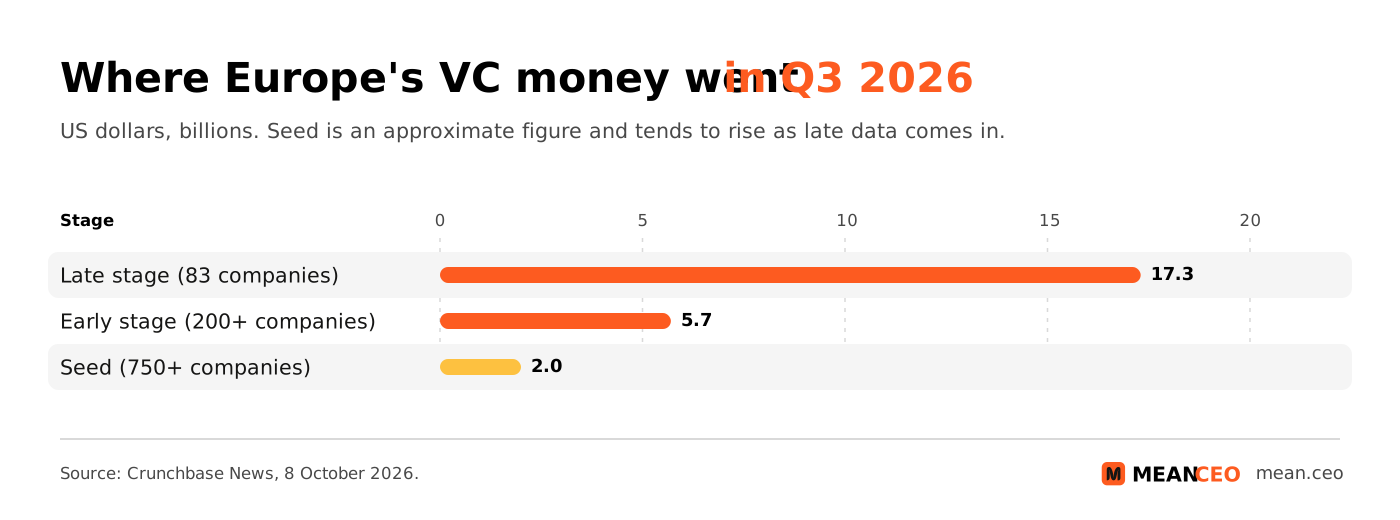
That's the real backdrop to Sequoia's move. Big funds want fewer, larger bets. The money at the top grows. The money at the bottom doesn't. If you're at the idea or first-revenue stage, the funds' attention is not where you are.
Bootstrapping was already rising
UK founders were moving away from outside money before this week's news. Startups.co.uk asked applicants to its Startups 100 Index how they financed their businesses, and TechRound reported the results in January: 40.2% of 2026 applicants said they bootstrapped, up from 23.9% a year earlier. Angel funding fell from 42.6% to 33.2%, and venture capital from 17.0% to 15.9%.
Source: Startups.co.uk via TechRound, 19 January 2026. Survey of index applicants, who could pick more than one funding type, so it isn't a picture of all UK startups.
Zohra Huda, editor of Startups.co.uk, summed it up: "The past year has seen bootstrapping going from a last resort to a strategic masterstroke." She credits AI, which lets founders "build leaner, more capital efficient businesses without the huge overheads and strings attached of traditional venture capital."
What this means for you
- Don't build your plan around a famous fund. Arc's $1 million cheques are gone, and the scouts who could get you a meeting are gone. Plan to reach revenue first, then raise from a position of strength if you still want to. Our guide on bootstrapping vs VC funding helps you decide which path fits your business.
- Use European money first. Grants, revenue-based loans, angels and crowdfunding are closer to you than a Bay Area partner meeting. Start with our map of alternatives to VC in Europe and our comparison of crowdfunding platforms in Europe.
- If you do want US money, make it come to you. Sequoia says it will still back European "outlier founders" from California. Outliers get noticed by their numbers, not their address. Revenue, growth and a sharp story matter more than ever; our breakdown of pitch deck examples shows what still works.
- Don't move to San Francisco just because a fund did. A move costs months and a lot of money. Most bootstrapped businesses sell to customers, not to investors, and Europe is still a big market.
- Watch the UK rules if you plan to sell one day. The UK has proposed a 10% capital gains rate for founders from April 2027, with tests most startups won't pass, as we explain in our post on Founders' Relief.
- Track the trend monthly. We collect the bootstrapping news that matters in our bootstrapping startups news for November 2026.
My take: I've watched founders in Europe treat a famous US fund like a lottery ticket for years. This week's memo should end that. Sequoia was honest: it wants fewer, bigger bets, run from California. That's its right, and the data says the whole market is moving the same way, with seed money flat while a few giant rounds grow. For the rest of us, the answer hasn't changed. Build something people pay for, keep your costs low with AI and no-code tools, and stay in control of your company. If an investor shows up later, you'll be negotiating, not begging. And you won't need anyone's London office for that.
Are you getting customers from AI search yet?
More and more traffic is coming from Perplexity, ChatGPT, Grok and other AI tools.
👉 Rank on ChatGPT
FAQ: Sequoia's London closure, Arc and Scouts
Is Sequoia closing its London office?
Yes. In a memo posted on X on 4 November 2026, Sequoia said it is closing the London office it opened in 2020 and that several people will leave the firm. It says it will support European founders from the Bay Area.
Will Sequoia still invest in European startups?
The memo says Sequoia believes Europe "will continue to produce outlier founders and companies" and that it can support them from its home base in the Bay Area. It didn't say it would stop funding European companies, and partner Luciana Lixandru keeps her board seats.
What was Sequoia Arc?
Arc was Sequoia's seed-stage accelerator, launched in 2022 with a first cohort for European companies. Companies got up to $1 million up front and joined a programme of several weeks. Sequoia has now shut it down.
What was the Sequoia Scouts programme?
Started around 2009, it gave founders and operators small cheques to invest in startups on Sequoia's behalf. Scouts brought Sequoia deals such as Uber and Stripe. Sequoia ended the programme in the same memo.
Which other US investors have left London?
Coatue closed its London venture office in January 2024 and Andreessen Horowitz closed its London office in 2025. Sequoia is the third big US name to leave in three years.
Should European founders bootstrap instead of raising VC?
It depends on the business, but the data favours starting lean. Seed funding in Europe was flat in Q3 2026 while late-stage deals took 70% of the money, and 40.2% of UK Startups 100 applicants said they bootstrapped in 2026. Revenue first gives you more options later.
About the Author
Violetta Bonenkamp, also known as MeanCEO, is an experienced startup founder with an impressive educational background including an MBA and four other higher education degrees. She has over 20 years of work experience across multiple countries, including 5 years as a solopreneur and serial entrepreneur. Throughout her startup experience she has applied for multiple startup grants at the EU level, in the Netherlands and Malta, and her startups received quite a few of those. She’s been living, studying and working in many countries around the globe and her extensive multicultural experience has influenced her immensely.
