TL;DR: which startup ideas are investors funding in 2026?
AI dominates: it took 64% of global venture funding in Q3 2026 and a record 75% in Europe. The fastest-growing areas beyond general AI are vertical AI agents, compliance automation, defence and dual-use tech, robotics software, cybersecurity, energy storage and grids, and AI for healthcare and ageing. Money is concentrated in fewer, bigger rounds, so a new founder's best bet is a narrow problem in one of these areas that customers pay for early. Below: 12 ideas with funding signals, buyers, rules and a first step for each.
👉 Check your idea with the free Idea Validator
Founders often pick startup ideas from what they see on social media. Investors pick them from data. Following the money doesn't mean you must raise venture capital. It shows where customers are spending, where acquirers are looking, and where grants and accelerators will open doors. If you'd rather serve a smaller group of customers really well, see these niche market examples in Europe.
This guide reads the latest funding data from Crunchbase, PitchBook, Atomico and Dealroom, the new Y Combinator wish list and the EU's own innovation priorities. It then turns them into 12 startup ideas a small European team can start on. If you'd rather start from problems you've lived yourself, see our guide to turning personal pain points into startup ideas.
Follow the money to find the problem, then follow the customer to build the company.
Where is venture capital going in 2026?
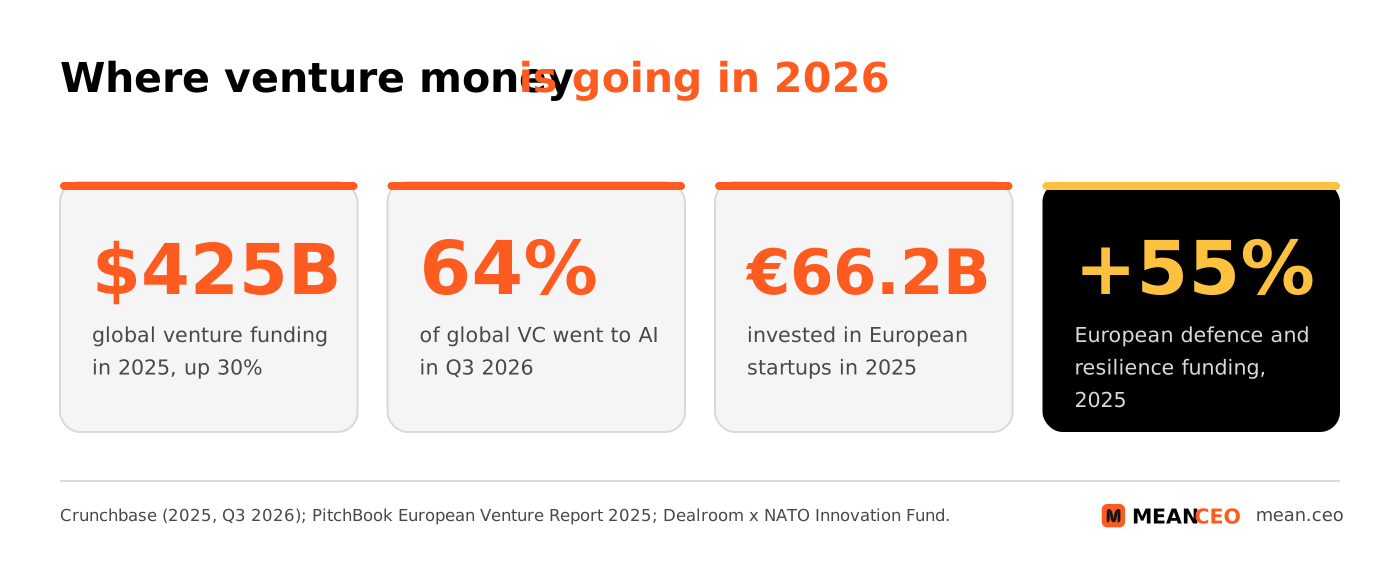
Global venture funding reached $425B in 2025, up 30% from 2024, and AI companies took about half of it, according to Crunchbase. 2026 is bigger still: $679B in the first three quarters, a record. In Q3 2026 alone, startups raised $159B, and AI took $102B, or 64%, according to Crunchbase.
Europe follows the same trend at a smaller scale. European startups raised €66.2B in 2025, up 5.1%, while the number of deals fell 20.6%, according to the PitchBook European Venture Report. AI took 35.5% of the money, and without AI the market would have shrunk. Atomico's State of European Tech 2025 finds that 36% of European venture capital now goes to deep tech, up from 19% in 2021.
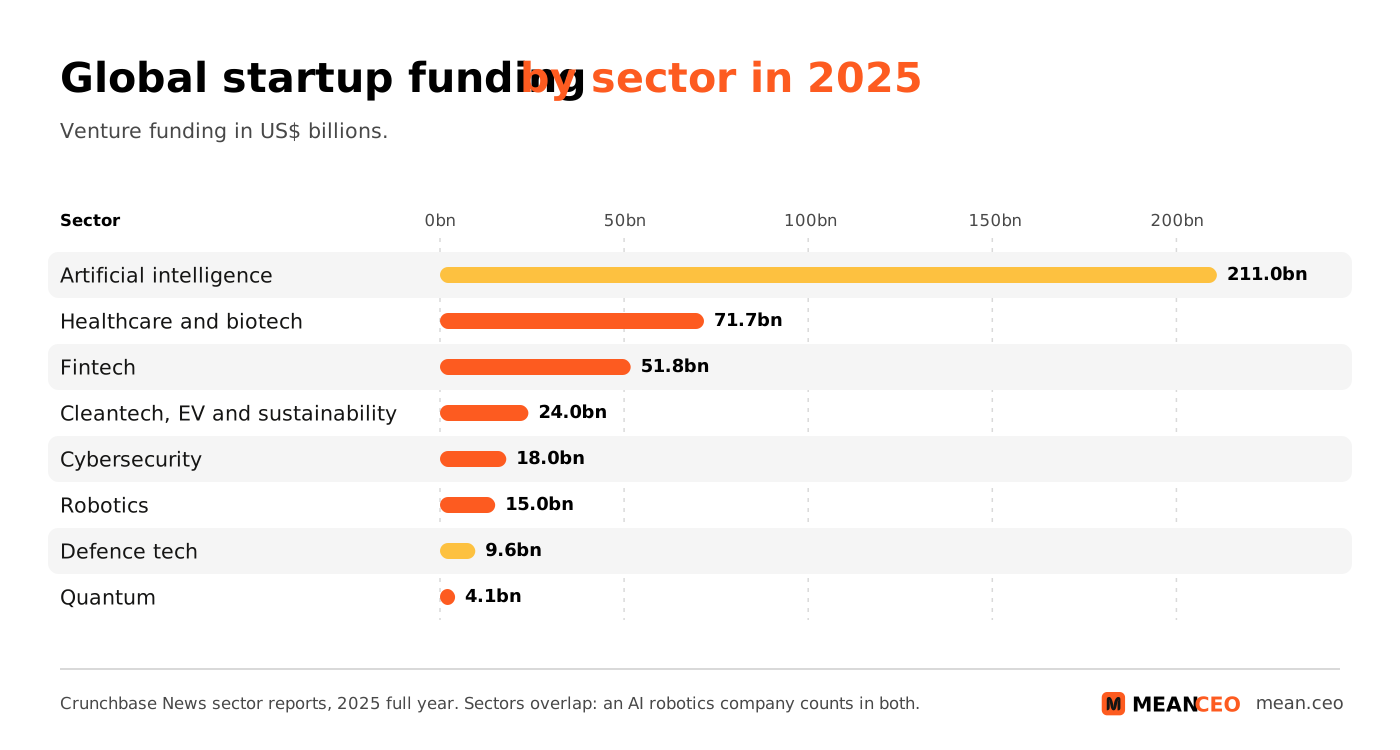
Sources: Crunchbase News sector reports; PitchBook for European figures.
What the funding data means for a new founder
- Money is concentrated. A record 27 rounds of $1B or more closed in Q3 2026, according to Crunchbase. Most AI dollars go to a few model and infrastructure companies, not to new teams.
- There are fewer deals. Carta counted 4,859 rounds on its platform in 2025, the lowest in at least six years and 41% below the 2021 peak, according to its State of Private Markets report. In Europe, deal numbers fell by a fifth.
- Seed rounds are bigger but harder to win. More than 42% of global seed dollars went to AI in 2025, according to Crunchbase. The bar for traction is higher.
- Hard tech is back. Defence, robotics, energy and materials attract money that a few years ago went to consumer apps and delivery.
- The best idea for a small team is narrow. Pick one customer group inside a growing sector and solve one expensive problem better than anyone else.
For monthly updates on rounds and sectors, see our startup news and trends for September 2026.
12 startup ideas where the money is going
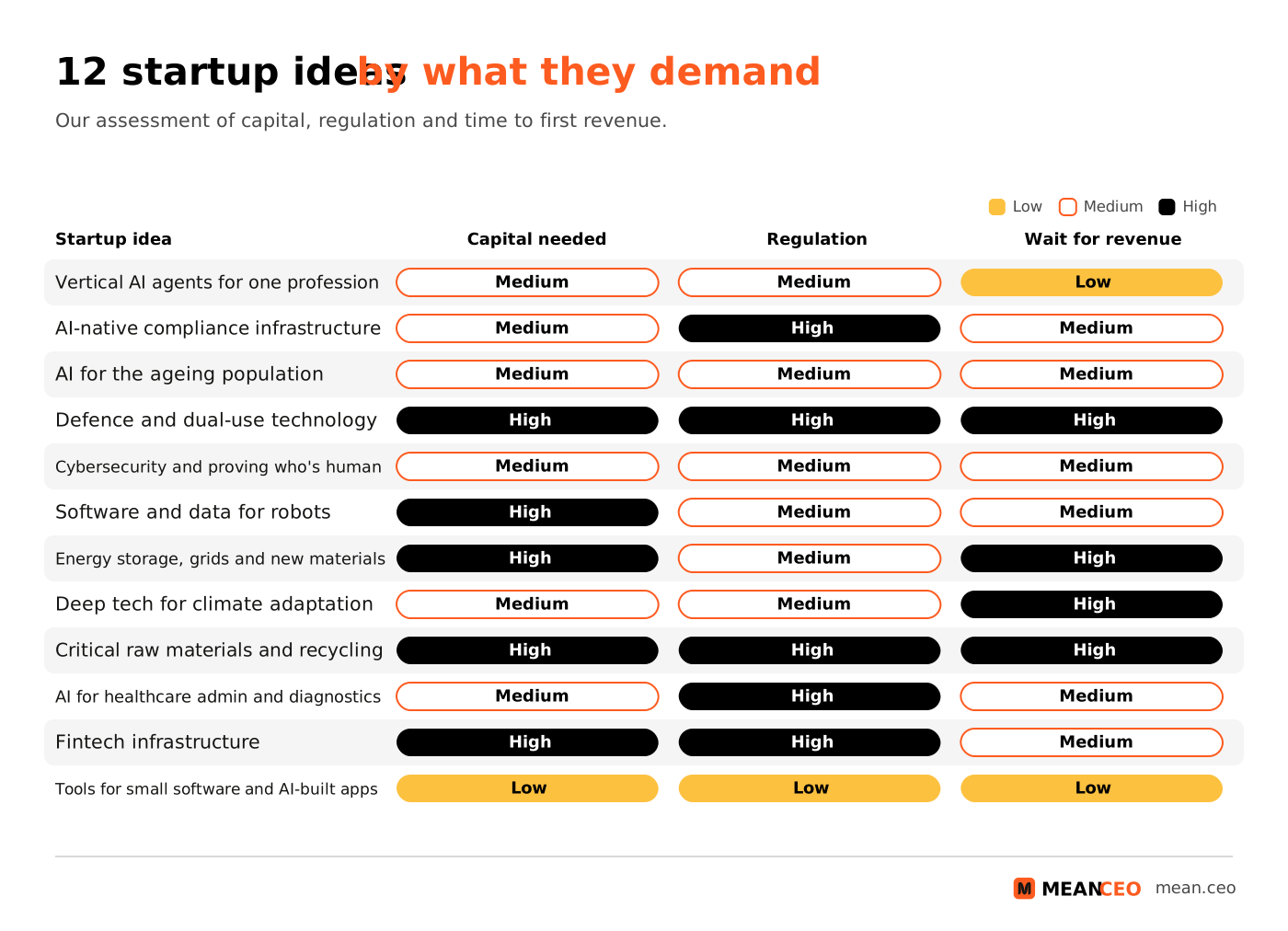
Each idea below comes with the funding signal behind it, who pays, what it takes and a first step you can take this month. The chart compares how much capital, regulation and patience each one needs.
1. Vertical AI agents for one profession
Software that does one defined job from start to finish for a single profession. Examples are reconciling invoices for accountants, drafting claim decisions for insurers, or preparing customs documents for freight forwarders. Generic AI assistants are crowded. Agents that know one workflow, its data and its rules are where many new companies are being built.
- Money signal: AI companies raised $102B in Q3 2026, 64% of all global venture funding, according to Crunchbase. In Europe, AI took a record 75% of the quarter's funding, Crunchbase reports.
- Who pays: Firms with expensive, repetitive back-office work: accounting and law firms, insurers, logistics companies and property managers.
- What it takes: A founder who knows the workflow from the inside, access to real customer data and serious data protection. Under GDPR you need a data processing agreement with every client.
- Watch out: Much of the AI money goes to a handful of model companies in huge rounds; Crunchbase counted a record 27 rounds of $1B or more in Q3 2026. Seed investors want proof that customers use your agent every week, not a demo.
- First step: Spend a day each with five people in one profession and list the tasks they hate. Automate one of them in a paid pilot.
2. AI-native compliance infrastructure
Tools that keep companies compliant automatically. They map which rules apply, collect evidence, monitor AI systems and prepare audits. Europe writes many of the world's technology rules, which gives European founders a home advantage.
- Money signal: "AI-Native Compliance Infrastructure" is one of 13 categories in Y Combinator's Fall 2026 Requests for Startups.
- Who pays: Banks and insurers under DORA, which has applied since 17 January 2025; companies covered by the NIS2 cybersecurity directive; and any business that uses AI under the EU AI Act.
- What it takes: Legal or audit expertise on the team, and a process to keep content current as rules change. Regulators won't accept "the AI said so", so keep a human sign-off in the product.
- Watch out: Rules move. The EU's simplification (omnibus) packages of 2025 and 2026 changed several reporting and AI rules, so build for frequent updates, not for one fixed text.
- First step: Pick one regulation and one type of company, and sell a readiness audit done by hand before you automate it.
3. AI for the ageing population
Products that help older people live independently and help families and carers look after them. Think fall detection, medication reminders, voice assistants, care coordination and tools that cut carers' paperwork.
- Money signal: "AI for the Aging Population" is in Y Combinator's Fall 2026 Requests for Startups.
- Demand: More than one in five people in the EU is 65 or older, according to Eurostat, and the share keeps rising. Care workers are in short supply across Europe.
- Who pays: Families, home-care providers, insurers and municipalities. Older users rarely pay for apps themselves, so find out early who signs the cheque.
- Rules: Software with a medical purpose, such as detecting a health problem, can count as a medical device under the EU Medical Device Regulation. Companionship and coordination tools usually don't.
- First step: Spend a week with a home-care agency and build for the carers' worst admin task first.
Women live longer and do most unpaid care work in Europe, so many of these products are bought by women. Our list of global problems affecting women that startups can solve has more ideas in this space.
4. Defence and dual-use technology
Drones and counter-drone systems, sensing, secure communications, space and resilience tools that serve both military and civilian customers. Since 2022, many European investors have moved defence from a no-go area to a priority.
- Money signal: European defence, security and resilience startups raised a record $8.7B in 2025, up 55%, according to Dealroom and the NATO Innovation Fund. Globally, defence tech raised $9.6B in 2025 and more than $14.6B in 2026 by early June, according to Crunchbase.
- Who pays: Defence ministries and procurement agencies, large defence contractors, and civilian buyers such as border, police, energy and critical-infrastructure operators.
- Rules: Exporting dual-use items needs a licence under the EU Dual-Use Regulation (2021/821). Defence sales cycles are long, so many founders start with civilian or security customers.
- Funding routes: The NATO Innovation Fund, NATO's DIANA accelerator and the European Defence Fund, alongside a growing group of specialist investors.
- First step: Find one operational problem an operator has today and get a letter of intent for a trial.
5. Cybersecurity and proving who's human
Security for the AI era: protecting AI systems and agents, detecting deepfakes and fraud, and checking that a user is a real person. Attackers use the same AI tools as everyone else, and small firms are exposed.
- Money signal: Cybersecurity startups raised $18B in 2025, up about 26%, but in just under 1,000 deals, a ten-year low, according to Crunchbase. Investors are backing fewer, stronger companies. "Proving You're Human" is one of Y Combinator's Fall 2026 requests.
- Who pays: Companies newly covered by NIS2, banks and fintechs fighting fraud, and online platforms fighting bots and fake accounts.
- What it takes: Deep security expertise and credibility. Buyers rarely trust a first-time team without references, so a security background or a respected adviser helps a lot.
- First step: Run a free phishing or deepfake test for ten small companies and sell them the fix.
6. Software and data for robots
Robots are getting cheaper and smarter, but warehouses, farms, factories and hospitals need software to deploy, coordinate and maintain them, and real-world data to train them. You don't have to build a humanoid robot to ride this wave.
- Money signal: Robotics startups raised about $15B in 2025 and $18.8B in 2026 by late June, already more than in all of 2025, according to Crunchbase. Y Combinator asks for "New Operating Systems for the Physical World" and "Data for the Real World".
- Who pays: Logistics operators, manufacturers, farms and robot makers that need fleet management, safety checks, simulation or training data.
- Rules: The EU Machinery Regulation applies from January 2027 and covers the safety of machines with self-learning functions.
- First step: Offer to collect or label real-world data for a robotics team, and learn which problems they can't solve.
7. Energy storage, grids and new materials
Batteries, grid software, flexibility markets and new materials that let renewable power run the grid. Climate money has moved away from consumer apps towards hard energy infrastructure.
- Money signal: Cleantech venture funding fell to just over $24B in 2025, its lowest in five years, according to Crunchbase. But energy was one of five sectors that each raised more than $10B in Q3 2026, and nuclear startups (fission and fusion) passed $6B in 2026 by October.
- EU signal: Two of the EIC Accelerator's five 2026 challenges are "Advanced Materials for Renewable Energy and Energy Storage Systems" and "Alternative Concepts and Key Enabling Technologies for Fusion Power Plants".
- Who pays: Grid operators, utilities, energy communities, industrial sites and owners of large buildings.
- What it takes: Hardware ideas need millions and years. Software for forecasting, flexibility trading or battery management can start lean.
- First step: Ask three grid operators or energy communities about their congestion problems.
8. Deep tech for climate adaptation
Tools that help cities, farms, insurers and infrastructure owners cope with the floods, heatwaves, droughts and wildfires that are already happening.
- Money signal: "Deep Tech for Climate Adaptation" is one of five EIC Accelerator challenges for 2026, which share €220M. Another challenge, "Biotech for Regenerating Agricultural Soils", targets farming.
- Who pays: Municipalities, water utilities, insurers, farmers and food companies.
- Watch out: Public buyers move slowly; insurers and food companies often buy faster.
- First step: Map one climate risk for one region with open data and sell the analysis to a local insurer or utility.
9. Critical raw materials and recycling
Recovering, refining and replacing the metals Europe needs for batteries, magnets and chips, from urban mining of electronic waste to better processing.
- Money signal: "Boosting the European Critical Raw Materials value chain" is one of the EIC Accelerator's 2026 challenges.
- Rules: The EU Critical Raw Materials Act sets benchmarks for 2030: at least 10% of the EU's yearly needs extracted, 40% processed and 25% recycled within the EU.
- Who pays: Battery makers, carmakers, electronics recyclers and magnet producers.
- What it takes: Chemistry or metallurgy expertise, pilot plants and permits. Expect high capital needs.
- First step: Partner with a university lab and an e-waste recycler to test one recovery process.
10. AI for healthcare admin and diagnostics
AI that writes clinical notes, codes visits, triages patients or supports diagnosis. Health systems are short of staff, and admin is the easiest place to start.
- Money signal: Healthcare and biotech startups raised about $71.7B worldwide in 2025, according to Crunchbase. In Europe, life sciences raised €8.4B, down 6.2%, according to PitchBook, so investors are selective.
- Rules: Diagnostic software is usually a medical device under the EU Medical Device Regulation and can be high-risk AI under the AI Act. Admin tools face lighter rules, but health data is specially protected under GDPR.
- Who pays: Clinics, hospital groups and insurers. Public procurement is slow in many countries, so private clinics are often faster first customers.
- First step: Shadow a clinic and measure how many hours a week staff lose on one admin task.
11. Fintech infrastructure: payments, stablecoins and compliance
Infrastructure that lets other companies move money, issue cards, accept stablecoins or meet anti-money-laundering rules, rather than another consumer finance app.
- Money signal: Fintech startups raised $51.8B worldwide in 2025, up 27%, while the number of deals fell 23%, according to Crunchbase. In Europe, fintech raised €13.4B, up 29.3%, according to PitchBook. Y Combinator says it's "The Best Time to Build in Crypto".
- Rules: The EU's crypto-asset regulation, MiCA, has applied in full since 30 December 2024. Payment and e-money services need licences, and the new EU Anti-Money Laundering Authority (AMLA) is building up its supervision.
- What it takes: Regulatory know-how, partner banks, and capital to obtain a licence or work through a licensed partner.
- First step: Interview finance teams at ten mid-sized companies about one payment problem, and test a fix on a licensed partner's API.
12. Tools for small software and AI-built apps
Now that anyone can build an app with AI, millions of small apps need hosting, maintenance, security and integrations that keep working. This is the cheapest idea on the list to start.
- Money signal: Y Combinator's Fall 2026 list asks for "A Cloud for Small Software" and "Self-Maintaining APIs".
- Who pays: Solo founders, agencies and teams inside companies that build internal tools with AI.
- What it takes: Strong engineering and little capital. You can launch with a small paid plan and grow on customer revenue.
- First step: Build the tool you need for your own AI-built projects and charge the first ten people who ask for it.
This is the idea most suited to bootstrapping; see how to bootstrap a SaaS startup and the AI tools solo founders use.
What investors and the EU are asking for
Two lists are worth reading before you choose. Y Combinator's Requests for Startups names the ideas the world's best-known accelerator wants to fund. Its Fall 2026 list has 13 categories:
- The Primer
- The Future of American Defense
- A Cloud for Small Software
- Multiplayer AI
- Compute at Sea
- AI-Powered Consumer Products for 1 Billion People
- AI for the Aging Population
- New Operating Systems for the Physical World
- The Best Time to Build in Crypto
- Data for the Real World
- Proving You're Human
- AI-Native Compliance Infrastructure
- Self-Maintaining APIs
The EU's equivalent is the European Innovation Council (EIC) Accelerator, which funds deep-tech startups with grants and equity. For 2026 it has an open call with €414M and five challenges sharing €220M, according to the European Innovation Council.
Grants can fund the riskiest early work without giving up equity; see how European grants fund startups and the European accelerators worth applying to.
Seed funding benchmarks for 2026
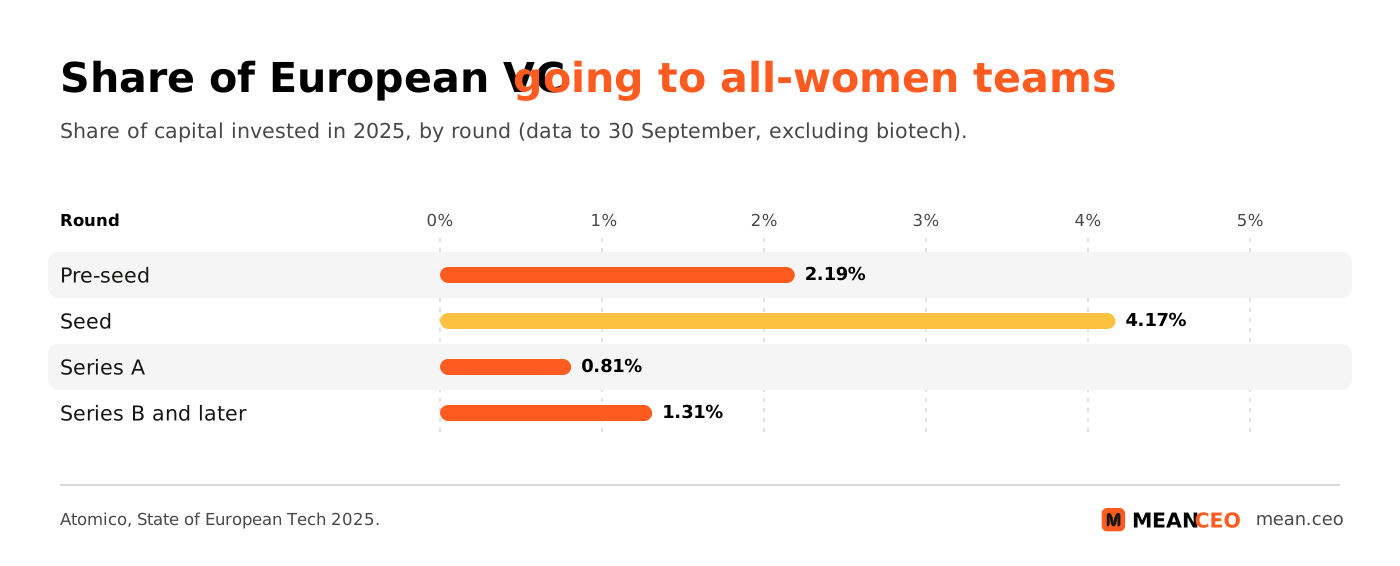
For women the gap is far wider. All-women teams received just 4.17% of seed capital and 0.81% of Series A capital in Europe in 2025, according to Atomico. That's why many female founders combine customer revenue, grants and angels instead of relying on VC alone.
Before you decide, read our honest comparison of bootstrapping versus VC funding and a map of the European startup funding landscape.
How to choose your startup idea from this list
- Start from your unfair advantage. Pick the sector where you already know the customers, the jargon or the rules. A former nurse has a head start in healthcare admin; a former bank compliance officer in compliance tools.
- Match the idea to your capital. If you'll bootstrap, choose low-capital ideas such as AI agents, compliance software or tools for small apps. Hardware, materials and defence usually need grants or investors from day one.
- Find ten people with the problem. Interview them before you build. Our guide to validating a startup idea shows how.
- Sell before you build. A paid pilot, a letter of intent or a pre-order is worth more than any pitch deck.
- Line up non-dilutive money. Check EIC and national grant deadlines early; they run months ahead.
New to startups? Our sister guides cover how to start a startup step by step and new business ideas already proven abroad.
Test your startup idea in a game first
The Fe/male Switch startup game lets you build a startup in weekly quests, with an AI co-founder, before you risk your savings.
👉 Start building in the game
Conclusion: follow the money, but build for the customer
In 2026 venture money flows to AI first, and then to defence, robotics, energy, cybersecurity, fintech infrastructure and healthcare. That tells you where demand and budgets are growing. It doesn't tell you to raise a big round. Most of the money goes to a few very large companies, so the best move for a new founder is a narrow, painful problem in a growing sector, sold to paying customers early. Pick one idea from this list that fits your experience and capital, talk to ten potential customers this month, and let their answers decide.
FAQ: startup ideas for 2026
What are the best startup ideas for 2026?
Ideas in sectors with growing budgets: vertical AI agents for one profession, AI-native compliance tools, AI for the ageing population, defence and dual-use tech, cybersecurity, software and data for robots, energy storage and grids, climate adaptation, critical raw materials, healthcare AI, fintech infrastructure and tools for AI-built apps.
Which industries get the most venture capital?
Artificial intelligence by far: about half of global venture funding in 2025 ($211B) and 64% in Q3 2026, according to Crunchbase. Healthcare and biotech ($71.7B) and fintech ($51.8B) follow.
What startups are VCs investing in right now?
AI models and infrastructure, AI agents, defence and security, robotics, energy (including nuclear), cybersecurity and fintech infrastructure. Investors back fewer companies with bigger rounds.
Is it too late to start an AI startup?
No, but general-purpose AI is crowded and dominated by companies with billions in funding. Opportunities for new founders are in narrow, workflow-specific AI where you know the customer and the data.
What startup ideas can I start without much money?
Software ideas: AI agents for one profession, compliance automation and tools for small software. Hardware, materials, defence and medical devices usually need grants or investors.
What does Y Combinator want to fund in 2026?
Its Fall 2026 Requests for Startups list 13 areas, including AI for the ageing population, AI-native compliance infrastructure, new operating systems for the physical world, a cloud for small software, proving you're human and crypto.
Which startup ideas does the EU fund?
The EIC Accelerator funds deep tech in any field through its open call, plus five 2026 challenges: energy storage materials, fusion power, soil biotech, critical raw materials and climate adaptation.
How much is a typical seed round in 2026?
In the US, the median seed round in 2025 was $3.8M at a $16M pre-money valuation (PitchBook-NVCA). The European median is about half the US level, according to Atomico.
About the Author
Violetta Bonenkamp, also known as MeanCEO, is an experienced startup founder with an impressive educational background including an MBA and four other higher education degrees. She has over 20 years of work experience across multiple countries, including 5 years as a solopreneur and serial entrepreneur. Throughout her startup experience she has applied for multiple startup grants at the EU level, in the Netherlands and Malta, and her startups received quite a few of those. She’s been living, studying and working in many countries around the globe and her extensive multicultural experience has influenced her immensely.
