TL;DR: Pitch deck examples teach you the most when you read each one next to the round it raised and the company it became. I took 11 public decks, five classic US ones (Airbnb, Uber, LinkedIn, YouTube, Buffer) and six from European founders (Intercom, Revolut, Alan, Front, Juro, Mistral AI), checked every number on 31 October 2026 and gave each a "would it raise in 2026?" verdict. The decks that raised showed one number an investor could not argue with, and none of them won on design. Score your own deck against the same 12 checks in the free deck scorer below.
Pitch deck examples fill hundreds of vendor blogs, and most show the same Airbnb slides with a redesign and a download button. They skip what a founder needs: what the deck raised, what the company became and whether the slides would get a meeting today. In 2008 Airbnb's founders asked seven investors for $150,000 at a $1.5 million valuation. Five said no and two never replied. In 2025 the company booked 533 million nights and seats.
I build companies in Europe, so I wanted European decks too, and they are rarer than the lists suggest. I kept only decks whose slides the founder or an investor published, or that a named reviewer described slide by slide. Every number comes from a page I opened on 31 October 2026; where sources disagree, I leave the number out. The verdicts are MY OPINION.
Four terms first. A pitch deck is the slide presentation a startup shows investors to raise money. VC means venture capital, funds that buy shares in young companies. Pre-seed and seed are the first rounds; Series A and Series B come once growth is proven. ARR is annual recurring revenue.
How does the deck scorer work?
The scorer asks 12 questions that the decks below answer well, from a one-line problem to the ask. Mark each yes, partly or no for your deck. You get a score out of 100, a verdict, your three weakest slides first with a fix for each, and the deck from this article to study for that slide. Nothing leaves your browser.
Two rules keep it honest. "Yes" needs a number on the slide: "fast growth" is a partly, "40% a month" is a yes. And score the deck you would send today, without the story you tell on the call.
What do investors look for in a pitch deck in 2026?
DocSend, the tool that tracks how investors read decks, published this research in April 2025:
- Investors spend less than 3 minutes on a deck.
- In 2020, pre-seed investors spent over 4 minutes on decks that raised and about 1 minute 30 seconds on decks that did not.
- The business model gets the most time in seed decks, and 48% more time for all-female teams.
- Decks that raised put product and "Why now?" earlier. A typical deck runs about 20 slides with about 50 words each.
My read for 2026: three minutes covers three things, the problem, the proof and the money. The 48% gap tells women founders where the questions land, and our 2026 funding playbook for female entrepreneurs covers what to prepare. AI tools now write a passable deck in minutes, so a generic "massive market" slide marks you as one of hundreds.
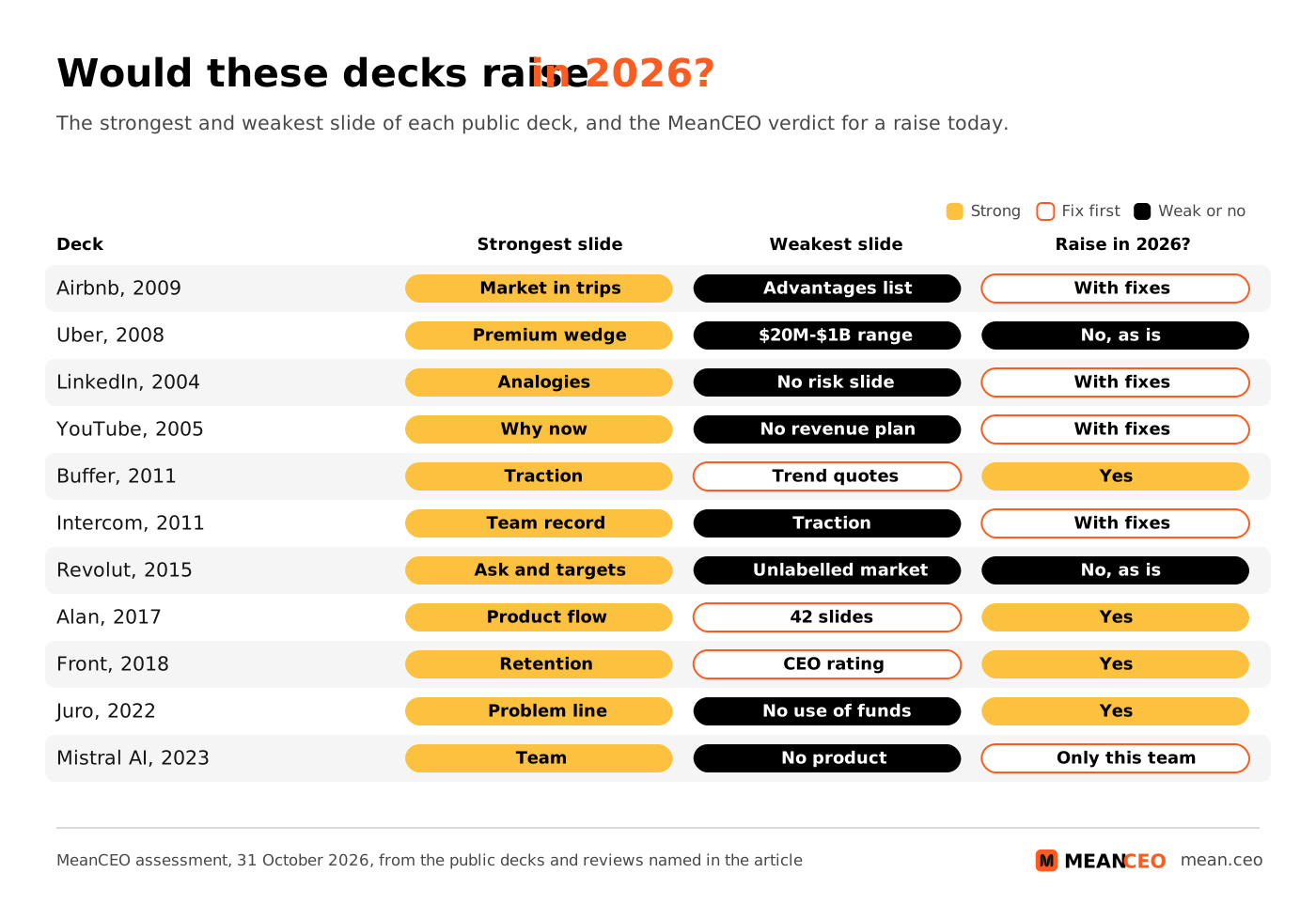
Which pitch deck examples are on this list, and how do they compare?
Sources: named in each section; lessons are my opinion.
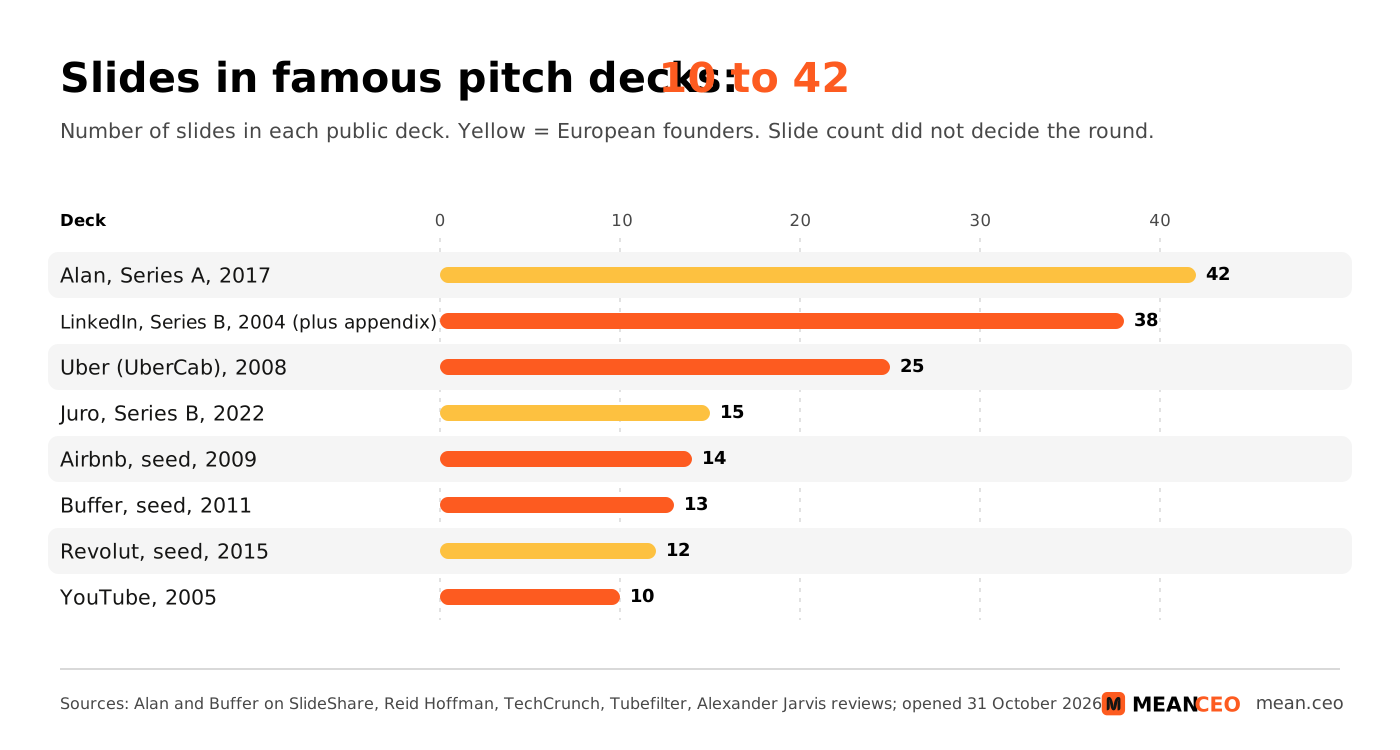
Slide count predicts nothing: YouTube raised with 10 slides, Alan with 42. The short decks share one slide that carries the round.
What can founders still learn from the classic US pitch decks?
1. Airbnb, 2009 seed deck: a market sized in trips
The cover reads "Book rooms with locals, rather than hotels." The market slide counts trips, not dollars: "2 Billion+" trips a year and a 15% share target, per Slidebean's teardown, with 17,000 weekly Craigslist listings in San Francisco and New York as validation. The model is a 10% fee on an average $25 transaction, and the ask was $500,000 to reach 80,000 transactions in 12 months, according to Alexander Jarvis's review. Airbnb made $12.2 billion revenue in 2025.
Would it raise in 2026? With fixes: investors would tear apart the 15% guess and ask for booking data. If rejections pile up, read how to handle investor rejection.
- Round and year: $600,000 seed in 2009, led by Sequoia Capital.
- What to copy: an ask tied to a target and a runway in months.
- What to skip today: the "competitive advantages" slide, six items that are mostly features; investors want a reason rivals cannot copy you.
2. Uber (UberCab), late 2008 deck: a premium wedge first
Garrett Camp published "the very first pitch deck we created in late 2008" in August 2017. The 25 slides pitch the "NetJets of car services": invite-only Mercedes-Benz sedans instead of Crown Victoria cabs, booked by SMS or one click. The deck sizes the US on-demand cab market at about $4.2 billion. UberCab closed a $1.25 million angel round led by First Round Capital in October 2010, and Uber reported $52.0 billion revenue and about 13.6 billion trips in 2025.
Would it raise in 2026? No, as is: 25 concept slides with no rides behind them get a polite pass.
- Round and year: late 2008; no source ties the deck to one round.
- What to copy: a narrow, premium first customer before the mass market.
- What to skip today: a revenue range of $20 million to $1 billion, which tells investors you have no model yet.
3. LinkedIn, 2004 Series B deck: the investment thesis
Reid Hoffman published this deck with notes on every slide. It raised $10 million led by Greylock while LinkedIn had no revenue and was still approaching its first million users. So Hoffman pitched by analogy (eBay, PayPal, Google) and listed three revenue streams: ads, listings and subscriptions. His advice now: "Open with your investment thesis," name the risks, prefer internal data, and cut the quotes slide as "overkill". Microsoft completed its $26.2 billion purchase of LinkedIn in December 2016; LinkedIn made $19.8 billion revenue in fiscal 2026.
Would it raise in 2026? With the fixes Hoffman lists himself: thesis first, risks named, far fewer slides.
- Round and year: $10 million Series B in 2004, led by Greylock.
- What to copy: a risk slide with your plan for each risk.
- What to skip today: 38 slides plus an appendix.
4. YouTube, 2005 deck: why now

YouTube raised $3.5 million from Sequoia Capital in November 2005 with 10 slides, Tubefilter reported. The problem slide is about file formats, which Jarvis calls too technical. There is no market size; the market slide gives two reasons the timing is right. Competition is a list of names, including Google as "a chief competitor", and there is no clear revenue plan. Google bought YouTube for $1.65 billion in November 2006; YouTube made $60 billion in 2025.
Would it raise in 2026? With fixes: the timing argument still lands, and investors would ask for a revenue slide.
- Round and year: $3.5 million from Sequoia Capital, November 2005.
- What to copy: two concrete reasons the timing changed this year.
- What to skip today: a competition slide that only lists names.
5. Buffer, 2011 seed deck: unit economics on one slide
Buffer's 13-slide deck puts the proof on slide 5: 800 paying users, $150,000 annual run rate, 55,000 users growing 40% a month. The business model slide does the math investors read longest: 2% free-to-paid conversion, 5% churn, a lifetime value (LTV) of $240, so Buffer could pay up to $5 to win a free user. The team slide adds advisors Guy Kawasaki and Hiten Shah, a move our guide to building an advisory board explains. Co-founder Leo Widrich wrote they started "absolutely uninvestable". Buffer later spent $3.3 million buying out its main Series A investors and shows $27.9 million ARR today.
Would it raise in 2026? Yes, with this year's numbers in place of the trend slides.
- Round and year: $330,000 seed in 2011, $450,000 in total with AngelPad.
- What to copy: conversion, churn and LTV on one slide; our business model analysis guide shows the math.
- What to skip today: quotes about social media trends; your own data says more.
Which European founders published their pitch decks, and what did they get right?
Six decks from European founders in Dublin, London and Paris. Intercom and Front have their headquarters in San Francisco today: Intercom builds much of its product in Dublin, and Front's founders started it in France.
6. Intercom (now Fin), 2011 seed deck: the team carries the round
Eoghan McCabe published Intercom's first deck in 2016, from a time when "raising $600,000 was a monumental task." The deck opens with the team: founders who had built three companies and sold two. It claims rivals covered only 10 to 15% of Intercom's functions, and Bizplan's teardown calls traction the weak spot. The company renamed itself Fin in May 2026, reports over $400 million ARR, and Salesforce agreed to buy it for about $3.6 billion; the deal has not closed yet.
Would it raise in 2026? With fixes: a repeat-founder team opens doors, and a seed investor would want paying customers next to it.
- Round and year: $600,000 convertible note (a loan that turns into shares later), late 2011.
- What to copy: one line per founder on what they built and sold.
- What to skip today: a top-down SaaS market of almost $100 billion; count your own buyers.
7. Revolut, 2015 seed deck: the plain deck that still raised
Nik Storonsky pitched a "personal money cloud" and asked for £1.5 million, Tech Funding News reported. Jarvis's review of the 12 slides is brutal: "I don't know what personal money cloud means," and on the unlabelled market figure, "$1.4 trillion is what?" The model slide lists freemium and viral growth; traction shows one month of sign-ups. Revolut now has over 75 million retail customers, a UK banking licence and a reported $115 billion valuation from a 2026 share sale, which Revolut has not confirmed. Our note on its Google Cloud outage this month shows what that scale costs when it breaks.
Would it raise in 2026? No, as is. The idea was right and the deck hid it.
- Round and year: seed, 2015, asking for £1.5 million.
- What to copy: an ask with dated targets for hires, monthly active users and Series A readiness.
- What to skip today: unlabelled numbers, and "viral" as a business model.
8. Alan, 2017 Series A deck: the product flow, screen by screen
Alan's November 2017 deck runs to 42 slides and shows the product as a customer meets it: a company signs up online in 5 minutes, then each employee does. Prices sit on the slide (€50 a month per employee under 36), the market slide sizes the €36 billion French private health insurance market, and Alan got its licence in under 8 months against the usual 2.5+ years. Index Ventures led a €23 million Series A, with partner Jan Hammer praising "Alan's stellar team." In June 2026 Alan raised €480 million at a €5.5 billion valuation with more than €800 million ARR.
Would it raise in 2026? Yes, cut to 15 slides with the rest in an appendix.
- Round and year: €23 million Series A, announced April 2018 (deck dated November 2017).
- What to copy: the sign-up flow in screenshots plus the price.
- What to skip today: 42 slides in the first send; keep the detail for the data room and our due diligence checklist.
9. Front, 2018 Series B deck: retention and money well spent
Mathilde Collin shared the deck behind a $66 million round led by Sequoia, which went from a Monday start to a Friday term sheet (the signed offer that sets price and terms). The headline: "Email was never built for teams to collaborate." The slides are mostly charts on average selling price, headcount and net retention, plus one slide on how the seed and Series A money was spent. Collin credited the deck's complete data for the speed. Front reports over 9,300 business customers and passing $100 million ARR in 2025.
Would it raise in 2026? Yes. Our guide to retention metrics worth tracking shows how to build that chart.
- Round and year: $66 million Series B, early 2018, led by Sequoia Capital.
- What to copy: a slide on how you spent the last round and what it bought.
- What to skip today: the CEO's 100% approval rating; investors check that through references.
10. Juro, 2022 Series B deck: the problem with a number
UK-based Juro shared its 15-slide Series B deck with TechCrunch's Pitch Deck Teardown. The problem headline does the work: "It takes ~5 tools to process just one contract." Reviewer Haje Jan Kamps calls it an "Excellent problem description" and flags two gaps: no use of funds slide and no cost of winning a customer. Juro raised $23 million led by Eight Roads in January 2022 and says it has processed 3 million contracts.
Would it raise in 2026? Yes, once the use-of-funds slide is added.
- Round and year: $23 million Series B, January 2022, led by Eight Roads.
- What to copy: every slide title is a full sentence with a claim.
- What to skip today: a lead chart on a metric other than revenue; put ARR first.
11. Mistral AI, 2023 seed memo: the deck that was a memo
Mistral AI raised a €105 million seed at a €240 million valuation, led by Lightspeed, at about four weeks old. Sifted obtained the document: a 7-page strategic memo, "more of a Google doc" than a deck, Linas's Newsletter reported. It argues that closed models are forming an oligopoly and Europe needs an open alternative, plans a first model family by the end of 2023 and names founders from DeepMind and Meta's Llama team. Alan's two founders appear in its founding team. Jarvis calls raising with a memo "not normal". In September 2026 Mistral raised €3 billion at more than €21 billion.
Would it raise in 2026? Only with this team.
- Round and year: €105 million seed, June 2023, led by Lightspeed.
- What to copy: a one-page thesis memo sent next to your deck.
- What to skip today: raising with no product unless your team wrote the research investors use.
What do the decks that raised have in common?
- ONE NUMBER CARRIES THE ROUND. Buffer's 40% monthly growth, Front's net retention, Juro's adoption curve. Put yours on slide 3 to 5.
- The problem fits on one line. Juro's five tools per contract need no explanation.
- The ask is tied to targets. Airbnb asked for $500,000 to reach 80,000 transactions.
- Founders show what they did before. Intercom's built-and-sold record and Mistral's research credits did more than any market slide.
- Strong founders raised with weak slides. Revolut and YouTube prove it, and that is survivorship: do not plan your round on it.
How do you build your deck from these examples?
- Write your one-line problem with a number, as Juro did, and test it on someone outside your industry.
- Add a why-now slide with two reasons the timing changed, as YouTube did.
- Size the market bottom-up: buyers you can reach times your price. List segments first in our free Lean Canvas template.
- Show the product as a flow of three to five screens, like Alan.
- Put traction on one slide with a number and a trend, like Buffer.
- Show competition honestly: why each rival loses a deal to you. Read how to compete with better-funded rivals and analyse competitors with AI.
- Close with the ask, use of funds and 18 to 24 months of targets, and know your valuation logic before anyone asks.
Send it to five friendly investors first, and build investor relationships months before you need the money. If the design needs help, see our pitch deck design agencies for deep tech startups.
Which slide outline and prompts can you copy?
A 12-slide outline built from these decks:
- 1. Cover: what you do, for whom, in one line
- 2. Problem: one sentence with a number (Juro)
- 3. Why now: two reasons the timing changed (YouTube)
- 4. Product: three to five screens in customer order (Alan)
- 5. Traction: one number, one trend (Buffer)
- 6. Business model: price, conversion, churn, LTV (Buffer)
- 7. Market: reachable buyers times price, sources named (Airbnb)
- 8. Competition: who else, and why they lose to you
- 9. Team: what each founder built or sold before (Intercom)
- 10. Risks: the three biggest and your plan for each (LinkedIn)
- 11. Past money: how you spent it and what retention it bought (Front)
- 12. Ask: amount, use of funds, targets for 18 to 24 months (Airbnb)
One-line problem template: [Customer] spends [time or money] on [task] because [current tool] [fails how], and [number] of them [proof].
Prompts for your AI assistant:
- Score each slide of my deck [PASTE] against this outline [PASTE] and list the three slides a seed investor would question first, with the question.
- Rewrite every slide title as a full sentence with one claim and one number, under 12 words.
- Act as a sceptical VC partner: ask me the 10 hardest questions about my market slide [PASTE].
Before you send a deck, test the business behind it. Get five fitting startup ideas in about two minutes from the free MeanCEO Business Idea Generator, map yours on the free Lean Canvas template and check which grants and loans fit you in the non-dilutive funding finder. Money that costs no equity makes every later round smaller.
What should you do with your deck this week?
Score your deck in the tool above and fix the three weakest slides first, using the example deck the scorer names. Cut it to 12 to 20 slides and move the rest to an appendix. If the score stays under 50, the business behind the deck needs work, and no redesign fixes that. Many European founders also raise too early; our map of European startup funding beyond VC and the European accelerators worth applying to show other paths. When a term sheet arrives, read how to negotiate it before you sign.
The deck opens the door, and the proof behind it closes the round. Build the proof first.
FAQ: pitch deck examples
What is the most famous pitch deck example?
Airbnb's 2009 seed deck: 14 slides that raised $600,000, led by Sequoia Capital.
How many slides should a startup pitch deck have?
The decks here range from 10 (YouTube) to 42 (Alan). I recommend 12 to 20 plus an appendix.
How long do investors spend reading a pitch deck?
Less than 3 minutes, according to DocSend research published in April 2025.
Which slide do investors read longest?
The business model slide, in DocSend's data on seed decks, and 48% longer for all-female teams.
Are there European pitch deck examples I can read?
Yes: Alan's 2017 Series A deck on SlideShare, Juro's Series B deck in TechCrunch's teardown, plus decks from Revolut, Intercom and Front.
Did Mistral AI raise with a pitch deck?
No. It raised €105 million with a 7-page strategic memo that Sifted obtained, at about four weeks old.
Would the Airbnb pitch deck raise money today?
With fixes, in my opinion: the structure works, and investors would challenge its 15% share assumption.
What should a seed pitch deck include in 2026?
Problem, why now, product, traction, model, market, competition, team, risks and the ask.
About the Author
Violetta Bonenkamp, also known as MeanCEO, is an experienced startup founder with an impressive educational background including an MBA and four other higher education degrees. She has over 20 years of work experience across multiple countries, including 5 years as a solopreneur and serial entrepreneur. Throughout her startup experience she has applied for multiple startup grants at the EU level, in the Netherlands and Malta, and her startups received quite a few of those. She’s been living, studying and working in many countries around the globe and her extensive multicultural experience has influenced her immensely.
