TL;DR: What is Founders' Relief, and who gets it?
A 10% CGT rate on up to £10 million of lifetime gains, for share sales from 6 April 2027, announced in the Budget of 28 October 2026. The tests are proposed, with consultation open until 30 November 2026: 25% of the shares when trading started, a company with £10m turnover and 15 full-time staff, and two of three growth tests. Most bootstrapped founders miss that bar and get the Business Asset Disposal Relief (BADR) cut to £500,000 instead.
Founders' Relief is the headline founder measure in the Budget that Chancellor John Healey delivered on Wednesday 28 October 2026, and a capital gains break tied to how fast your company grew. Here is everything the Autumn Budget 2026 changed for small businesses. Below: the tests, worked examples, who misses out and what to do now.
What is Founders' Relief, and what is already decided?
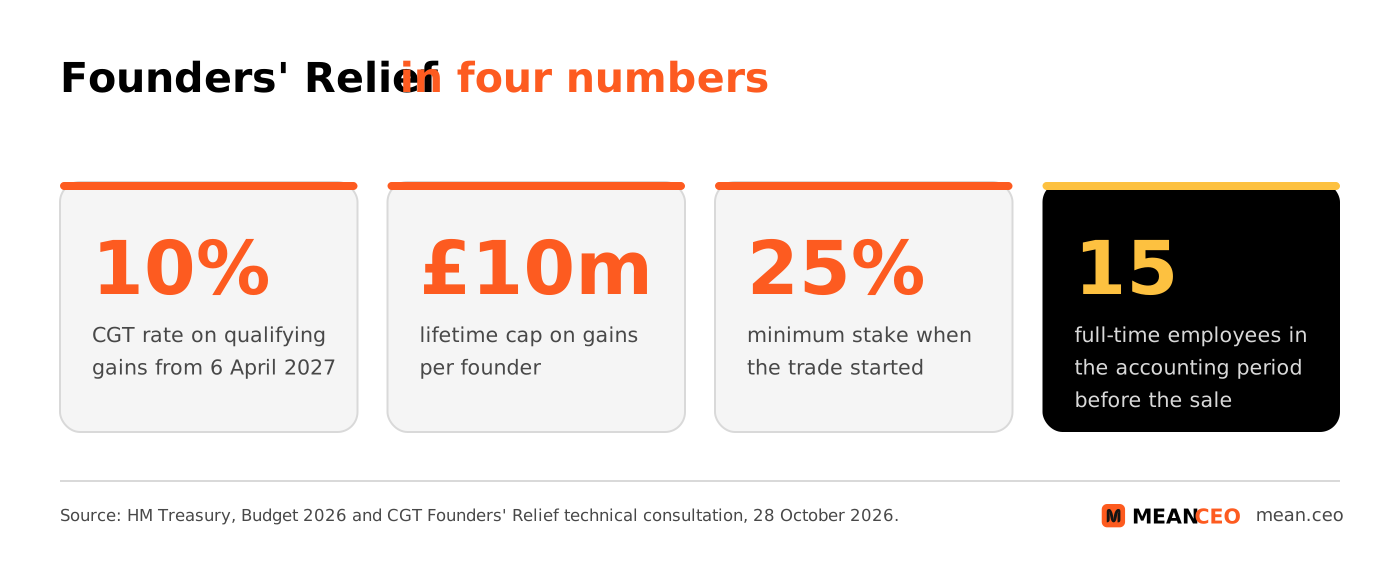
Announced: the 10% rate on qualifying share disposals from 6 April 2027 and the £10 million lifetime cap per individual, so each qualifying co-founder gets one. Proposed (consultation): almost everything else.
What are the proposed Founders' Relief conditions?
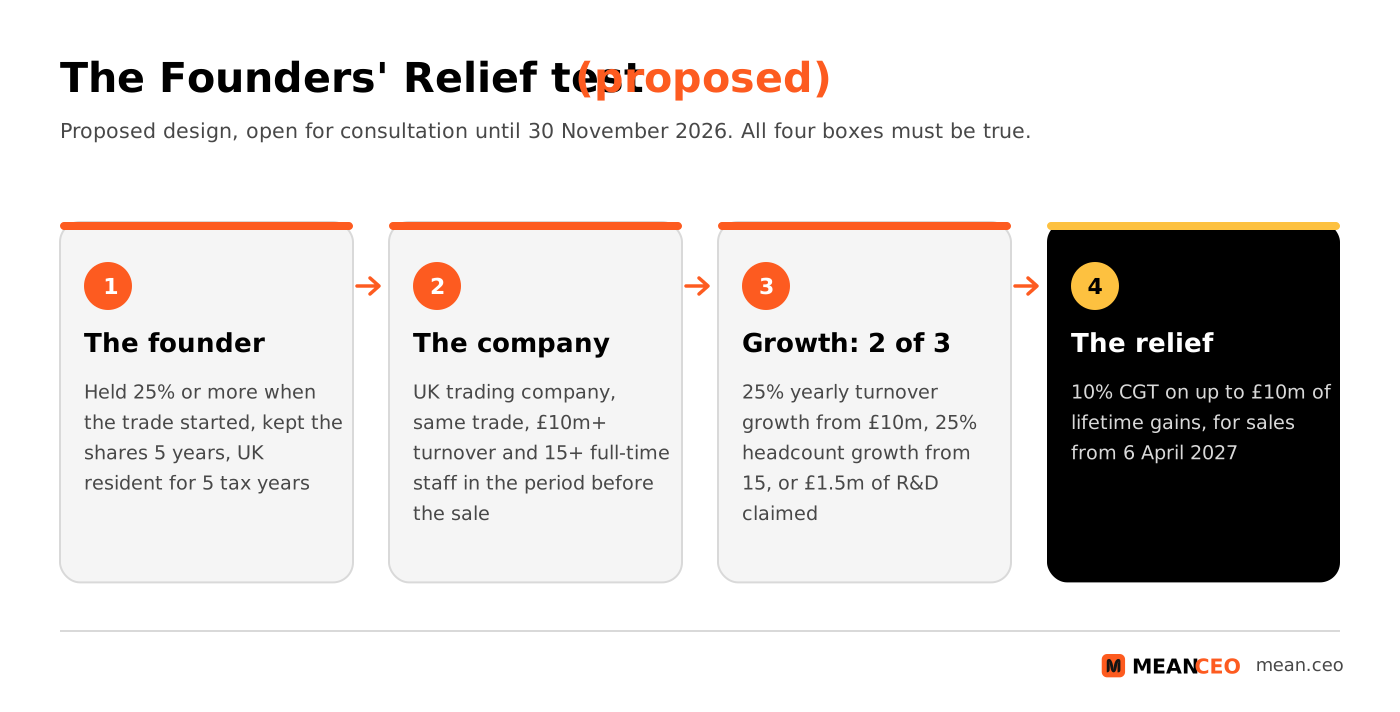
All of it is Proposed (consultation): you need every founder and company test, plus two of three growth tests.
Who qualifies for Founders' Relief as an individual?
The 25% is measured when the trade, or the preparation for it, started. A founder who began with 30% and owns 12% after three funding rounds still passes, and the relief covers every share she sells, including ones acquired later. The day-one split decides the rest: four equal co-founders hold 25% each and all of them pass, while a five-way equal split leaves everyone on 20% and nobody qualifies. Settle the equity with that in mind if you are still finding a co-founder.
The 25% can sit in the holding company of a trading group, only individuals can claim, and "significant early investors" count too, so an angel with 25% at the start qualifies.
Which companies pass the Founders' Relief company tests?
Most UK startups drop out here. £10 million of turnover and 15 qualifying full-time employees in the accounting period before the sale are hard floors. Full-time means 35 hours a week or more at no less than the National Minimum Wage, and directors, contractors and agency staff don't count, so ten employees plus eight full-time freelancers make ten. Lean teams should reread our guide to contractor vs employee classification.
The trade condition worries me most as a serial founder. The proposed wording demands "no major change in the nature of the trade", and startups pivot: an agency that turned into a SaaS product has no guidance yet on where it stands. Excluded trades follow the Enterprise Investment Scheme (EIS) list, including financial services, so fintech founders should check it now.
How do the Founders' Relief growth tests work?
The company also needs two of three growth tests. Growth of 25% a year over three periods multiplies the base by 1.953 (our calculation), so turnover must climb from at least £10m to about £19.5m, or full-time staff from at least 15 to about 30. Any three consecutive accounting periods within the ten years before the sale count.
The R&D test, officially the "Innovation test", needs £1.5m or more of qualifying R&D spend with relief claimed for periods ending in the three years before the sale. The sting: if HMRC later overturns the company's R&D claim, the founder loses the relief and pays the extra tax with interest.
How much does Founders' Relief save on an £8 million gain?
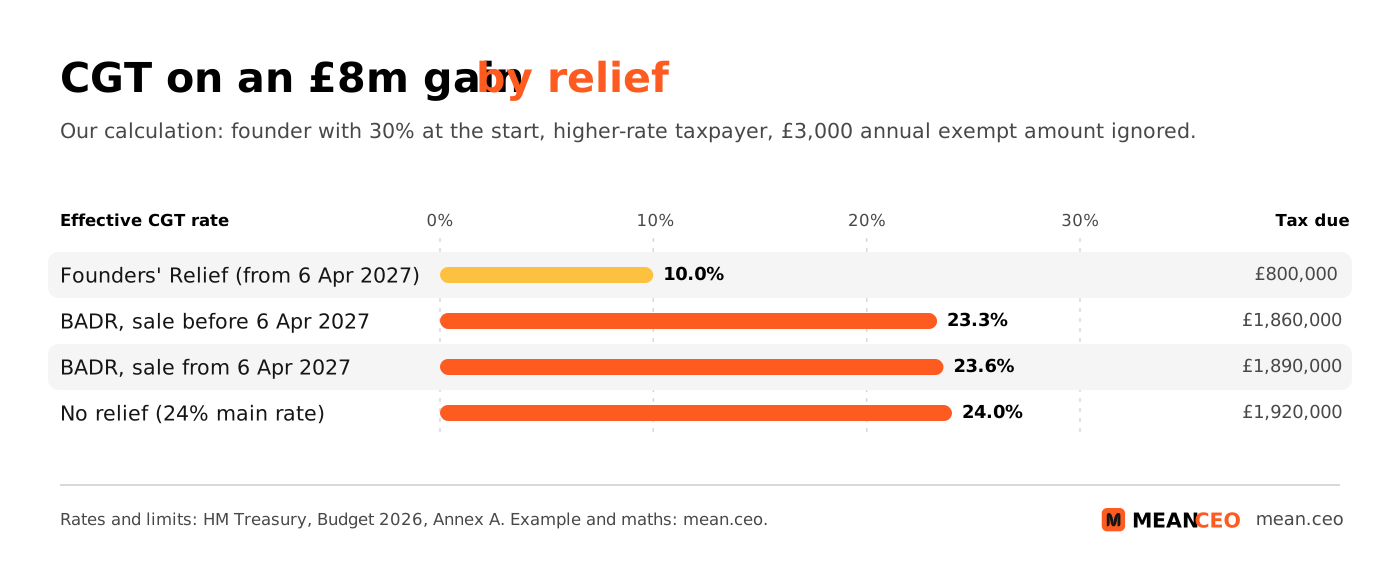
Our example: a founder who held 30% when her software company started trading sells in 2028 for a gain of £8 million. The company passes every test, she is a higher-rate taxpayer with no earlier BADR claims, and we ignore the £3,000 annual exempt amount.
Founders' Relief saves her £1,090,000 against BADR. Above the cap the main rate returns: a £14 million gain costs £1,000,000 on the first £10 million plus £960,000 on the rest, £1,960,000 in total.
What happens when a company fails the growth tests?
Our second example: a bootstrapped software company sells in 2029. Over a base period and the three that follow, turnover went £5m, £6.5m, £8.5m and £12m, full-time staff went 16, 20, 26 and 32, and it claimed R&D relief on £900,000 of spend in the last three years. It clears both size floors, and headcount growth of 26% a year from a base of 16 passes. Turnover grew faster, 34% a year, yet from £5m, below the £10m base, and the R&D spend sits under £1.5m, so both of those fail. One test out of three means no relief, so our 30% founder pays £1,890,000 on £8m instead of £800,000. A great business, shut out because it started small.
Who will not qualify for Founders' Relief?
- Companies under £10m turnover: the bootstrapped and lifestyle majority.
- Founders who started below 25%: late co-founders, option holders and five-way equal splits.
- Founders who left the UK within five tax years of the sale.
- Companies that pivoted, until guidance says where a "major change" begins.
- Contractor-heavy teams, plus anyone selling shares held for under five years.
My take: Founders' Relief rewards the top slice of venture-backed companies, a fair policy choice. For most founders reading this, the real news is the BADR cut, and our bootstrapping vs VC decision framework now has one more line in the VC column. If your business is still a side project, the change for you is the £3,000 trading allowance for side hustles.
How does the Business Asset Disposal Relief 2027 cut hit everyone else?
Announced: the BADR lifetime limit falls from £1 million to £500,000 for disposals from 6 April 2027, and the rate stays at 18%. HM Treasury says three-quarters of BADR claimants still get relief on their entire gain. For a higher-rate taxpayer with £1 million or more of gains, the cut costs up to £30,000: £500,000 times the 6-point gap between 24% and 18% (our calculation). Selling a sole-trader business instead of shares? Our list of self-employed tax changes puts the BADR cut next to every other change for sole traders.
A sale that completes before 6 April 2027 keeps the £1 million limit. Special provisions cover earlier contracts that haven't completed by then; the overview doesn't detail them, so agree timing with your tax adviser. Our guide to bootstrapped exit strategies covers other options.
The reliefs share one cap. BADR or Investors' Relief claimed from 6 April 2027 reduces your £10 million Founders' Relief limit. Use £500,000 of BADR on a small exit in 2028, and £9.5 million is left for your next company (our example).
What records should founders keep from now on?
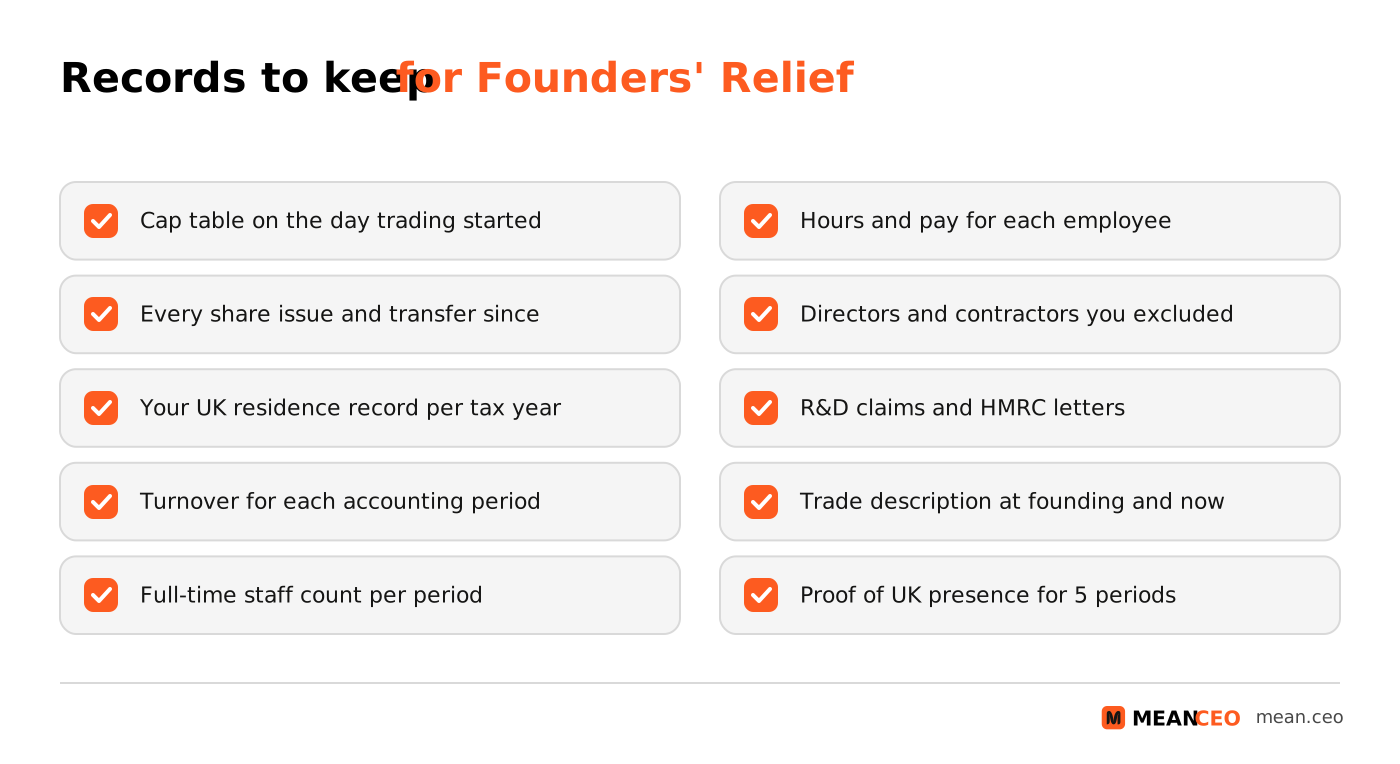
Claims go in your Self Assessment return with the periods you rely on, and HMRC treats a claim without the prescribed information as "unsatisfactory". The evidence reaches back up to ten years and mostly sits with the company, so start the file now, and add an information clause to the shareholders' agreement at your next round in case you end up a minority holder. Our due diligence preparation guide and the guide to startup bookkeeping cover the rest.
How do you respond to the Founders' Relief consultation?
The Founders' Relief technical consultation closes on 30 November 2026. Email responses to EnterpriseTax@hmtreasury.gov.uk early; the window is short because HM Treasury's Tax Support for Entrepreneurs Call for Evidence already gathered evidence. Its seven questions cover the founder conditions, the company conditions and their side effects, the three growth tests, alternatives to the R&D test, the right to company information (and how fast companies must reply) and avoidance risks.
Answer with your own numbers. A line like "our 22-person team includes 9 contractors, so we fail the 15-employee test" gives the Treasury something to act on.
What is still unknown about Founders' Relief?
- Final legislation, due as amendments to Finance Bill 2026-27.
- The targeted anti-avoidance rules.
- The deadline for company information requests, and whether a standard claim form is required.
- What HMRC can tell a founder when the company's R&D claim is challenged.
- Where a "major change in the nature of the trade" begins, and what counts as a "substantial UK presence".
What else did Budget 2026 change for founders?
- EMI2 (announced): the Company Share Option Plan (CSOP) becomes EMI2 from 6 April 2027, with the individual option limit doubled from £60,000 to £120,000, a 15-year exercise period and no link to the EMI limit. Our guide to equity and stock option plans explains option pools.
- EMI (announced): from 6 April 2027 the exercise window after a disqualifying event grows from 90 to 180 days, companies moving to an Employee Ownership Trust keep EMI, and grants are reported in the end-of-year return.
- R&D (announced): the Claim Notification Form goes from 1 April 2027.
- British Business Bank (announced): £1.4 billion for equity funds backing high-growth businesses and £450 million for a new venture debt product, within a £5 billion uplift to £30.6 billion. Weigh debt vs equity financing before you apply.
- Non-compete clauses (announced, details in early 2027): legislation so they stop blocking startup and scale-up hiring; no length limit is published yet.
- SEIS, EIS and VCT (announced): minor technical fixes in Finance Bill 2026-27.
Details are in the Budget 2026 document on GOV.UK. The same Budget set the timetable for UK e-invoicing from April 2029 and changed the VAT reverse charge for overseas SaaS from April 2027. If your startup sells physical products through Amazon or eBay, read our sister guide to online marketplace VAT from October 2027.
What does Founders' Relief mean for you?
- Find the day-one cap table. Under 25% means BADR is your plan.
- Test your last four accounting periods against the growth maths above.
- Recount your team without contractors and directors.
- Keep R&D claims clean; a weak one can cost you the relief later.
- If you won't qualify, watch 6 April 2027: the old BADR limit is worth up to £30,000 more.
- Stay UK resident for the five tax years before any exit.
- Respond by 30 November 2026 with your own figures.
Are you getting customers from ChatGPT yet?
More and more traffic is coming from Perplexity, ChatGPT, Grok and other AI tools.
👉 Rank on ChatGPT
FAQ: Founders' Relief
What is the Founders' Relief 10% CGT rate?
A 10% Capital Gains Tax rate on qualifying share disposals from 6 April 2027, on up to £10 million of lifetime gains per individual. Gains above the cap pay the main rates of 18% or 24%.
Is Founders Relief UK-only?
Yes, as proposed. You need five continuous tax years of UK residence before the sale, and the company needs a "substantial UK presence" for the five accounting periods before it.
Can more than one co-founder claim Founders' Relief?
Yes. The cap is per individual, so every co-founder who meets the tests, including 25% at the start, gets their own.
Does dilution after the start stop me qualifying?
No, under the proposed design. The 25% test looks at your stake when the trade began, and the relief covers all the shares you sell.
What happens to Business Asset Disposal Relief in 2027?
Its lifetime limit halves to £500,000 for disposals from 6 April 2027, still at 18%, and BADR claimed from that date reduces your Founders' Relief cap.
How do I respond to the Founders' Relief consultation?
Email EnterpriseTax@hmtreasury.gov.uk before 30 November 2026, answering any of its seven questions with your own company's figures.
- Autumn Budget 2026: What It Changes for Small Businesses and First-Time Founders, From the £13.21 Wage to a £3,000 Trading Allowance
- British Business Bank Gets £5bn in the Autumn Budget 2026: £450m Venture Debt, £1.4bn Equity and £6.5bn of Guaranteed SME Loans
- Trading Allowance Triples to £3,000 From 6 April 2027: What Budget 2026 Means for Your Side Hustle
- UK E-Invoicing From April 2029: What the Budget 2026 Plan Means for SaaS Founders, Plus the Two VAT Changes That Land in 2027
- Online Marketplace VAT: From October 2027 Amazon and eBay Collect VAT for UK Sellers. What Budget 2026 Means for Your Shop, With a Cash-Flow Example (Fe/male Switch)
- Self-Employed Tax Changes in Budget 2026: The Full List for Sole Traders and Freelance Founders, From April 2027 to 2029
About the Author
Violetta Bonenkamp, also known as MeanCEO, is an experienced startup founder with an impressive educational background including an MBA and four other higher education degrees. She has over 20 years of work experience across multiple countries, including 5 years as a solopreneur and serial entrepreneur. Throughout her startup experience she has applied for multiple startup grants at the EU level, in the Netherlands and Malta, and her startups received quite a few of those. She’s been living, studying and working in many countries around the globe and her extensive multicultural experience has influenced her immensely.
