TL;DR: Is SaaS dead?
"SaaS is dead" is back in the headlines after Salesforce fell about 9% on 17 November 2026 and Bubble's co-CEOs announced layoffs the same day. The data says one kind of SaaS is dying: thin tools that put forms on a database and charge per seat. Software that holds customer data, runs regulated work or charges for outcomes keeps growing. For a bootstrapper, the better bets in 2026 are services delivered with AI, vertical tools and usage pricing.
The "SaaS is dead" debate got a fresh data point this week, when Bubble's co-CEOs announced layoffs on LinkedIn on 17 November 2026, the same day a selloff knocked Salesforce, ServiceNow, HubSpot and Workday. For a founder choosing what to build next year, the real question is whether customers will keep paying for your software or ask an AI agent to build it for them.
Why is everyone saying "SaaS is dead" in November 2026?
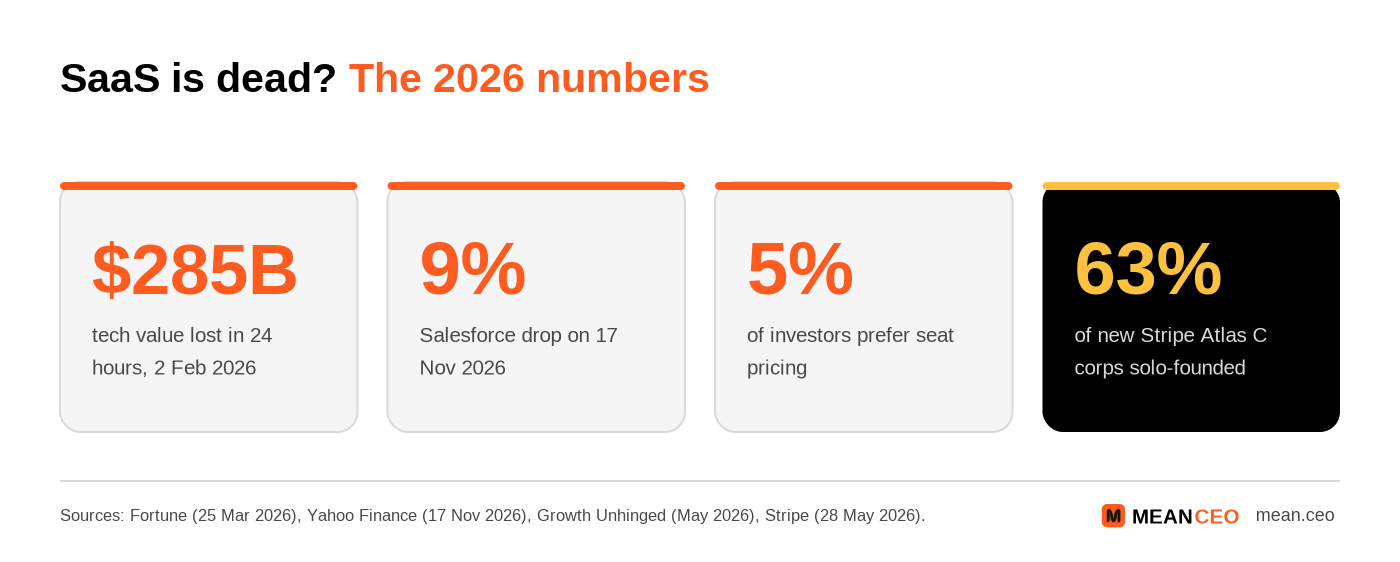
Because the market said it out loud on Tuesday. On 17 November 2026, Yahoo Finance reported that Salesforce fell about 9% to $194.52, ServiceNow and HubSpot lost 7% each and Workday 5%, a day before Anthropic's IPO. Salesforce now trades at 15 times forward earnings against a five-year average of 27. RBC analyst Rishi Jaluria put the fear bluntly: "the AI companies are going to try to destroy Salesforce entirely."
The slide is wider than one day. Adobe and ServiceNow are each about 30% lower in 2026, and Intuit is "nearly half lower", according to Yahoo Finance on 5 November. The IGV software ETF shows a -9.4% total return for 2026 at the 17 November close, per ChartRow data, after +5.6% in 2025.
Software companies are cutting staff too. In May 2026 Wix cut about 1,000 jobs (roughly 20%), ClickUp cut 22% and Webflow restructured without giving a number. Bubble is the latest. Josh Haas wrote that the company is moving to "smaller teams that own a problem from start to finish" and is building AI into how every team works; neither co-CEO gave a headcount. Our startup layoffs news for November 2026 tracks the rest of the month.
Where did the SaaSpocalypse start?
The word SaaSpocalypse was born on 2 February 2026, when Anthropic released a legal plug-in for Claude Cowork. Fortune reported that $285 billion of tech market value disappeared in the next 24 hours. Nvidia's Jensen Huang called the idea of AI replacing software "the most illogical thing in the world".
Two quotes keep coming back in every "SaaS is dead" thread, and both get misquoted.
- Satya Nadella, BG2 podcast, December 2024. As reported by CX Today, Microsoft's CEO said business applications could "collapse" in the agentic era, because "all the logic will be in the AI tier, so to speak… Once the AI tier becomes the place where all the logic is then people will start replacing the back ends." The popular line about SaaS being "CRUD databases with business logic" is CX Today's paraphrase; we could not verify it as his own words.
- Klarna, August 2024. On its quarterly investor call Klarna said it had shut down Salesforce and would drop Workday. In March 2025 CEO Sebastian Siemiatkowski corrected it in an interview with CX Today: "we did not replace SaaS with an LLM". He described the result as "the liquidation of SaaS – not all of them, but a lot of them".
Both point the same way: value moves to the AI layer, and the apps most at risk only store records and show them on a screen. The other exit for mature software is a buyer that runs it for cash, which is what happens when Bending Spoons buys a company.
Is SaaS actually still growing?
Yes, at the top end, where vendors sell AI agents on top of the data they already hold. Salesforce's Q2 fiscal 2027 results (26 August 2026) show revenue of $11.3 billion, up 11%, and Agentforce annual recurring revenue above $1.5 billion, up 240%. (Salesforce's ARR definition now includes Slackbot.) ServiceNow reported third-quarter subscription revenue of $3,988 million, up 21%, and raised its 2026 AI contract target to $1.7 billion.
Bank of America's Vivek Arya called the February selloff "indiscriminate". Here is the scoreboard:
Sources: Fortune, Yahoo Finance, ChartRow, Growth Unhinged, Salesforce, ServiceNow, Madrona (2026).
Why is seat-based pricing the real casualty?
If an AI agent does the work, the customer needs fewer human logins, and per-seat revenue shrinks even when the product stays. Kyle Poyar's State of B2B Monetization 2026 (230+ companies, surveyed April to May 2026) found hybrid pricing at 37%, up from 25% a year earlier. Ask investors what they want to see and only 5% pick seat-based pricing, against 35% for hybrid, 26% for outcome-based and 24% for usage-based. The report cites Nadella describing a seat as "just entitlement to some consumption".
Zapier shows the shift from the inside. Its CEO told Madrona in April 2026 that every plan will have a tier "based on tasks alone" and that the data-moving layer is "increasingly getting commoditized". Our guide to pricing a bootstrapped SaaS in a crowded market walks through the options for a small product.
Can customers now build their own tools and skip SaaS?
More and more of them can. Google AI Studio, updated at I/O on 19 May 2026, builds Android and Workspace apps and lets users deploy their first two apps to Google Cloud at no cost. OpenAI added Sites to Codex, in preview for Business and Enterprise customers, to build hosted internal apps; IT Brief reported that more than 5 million people use Codex each week and non-developers make up about 20% of them. Lovable passed $500 million in annualized recurring revenue in June 2026, as reported by Business Insider, and Wix says its Base44 builder is nearing $250 million ARR.
The catch is that a home-built tool comes with its own bill. YipitData found that only about 1 in 10 US Lovable payers from late 2025 still had a Lovable receipt in mid-2026, and Red Access counted about 5,000 apps built on AI builders that exposed potentially sensitive information. Model costs keep falling, too: Anthropic's new top model, Claude Fable 5.2, costs 20% less, which makes "build it ourselves" cheaper every quarter.
We lived this shift. femaleswitch.app ran on Bubble for about five years, from at least October 2021, and back then Bubble was a great choice for a small team. In October 2026 we moved the public site to WordPress and rebuilt its AI tools as our own plugin, written with Codex and running on Claude Haiku 5.5 with a fixed budget of EUR 100 a month. Violetta Bonenkamp's view: with AI, zero-code tools like Bubble make far less sense for new builds. Bubble's answer is Agent 2, a rebuilt AI agent, plus the Bubble MCP, and Josh Haas says 6 million builders use the platform.
Which SaaS dies and which survives? MeanCEO's take
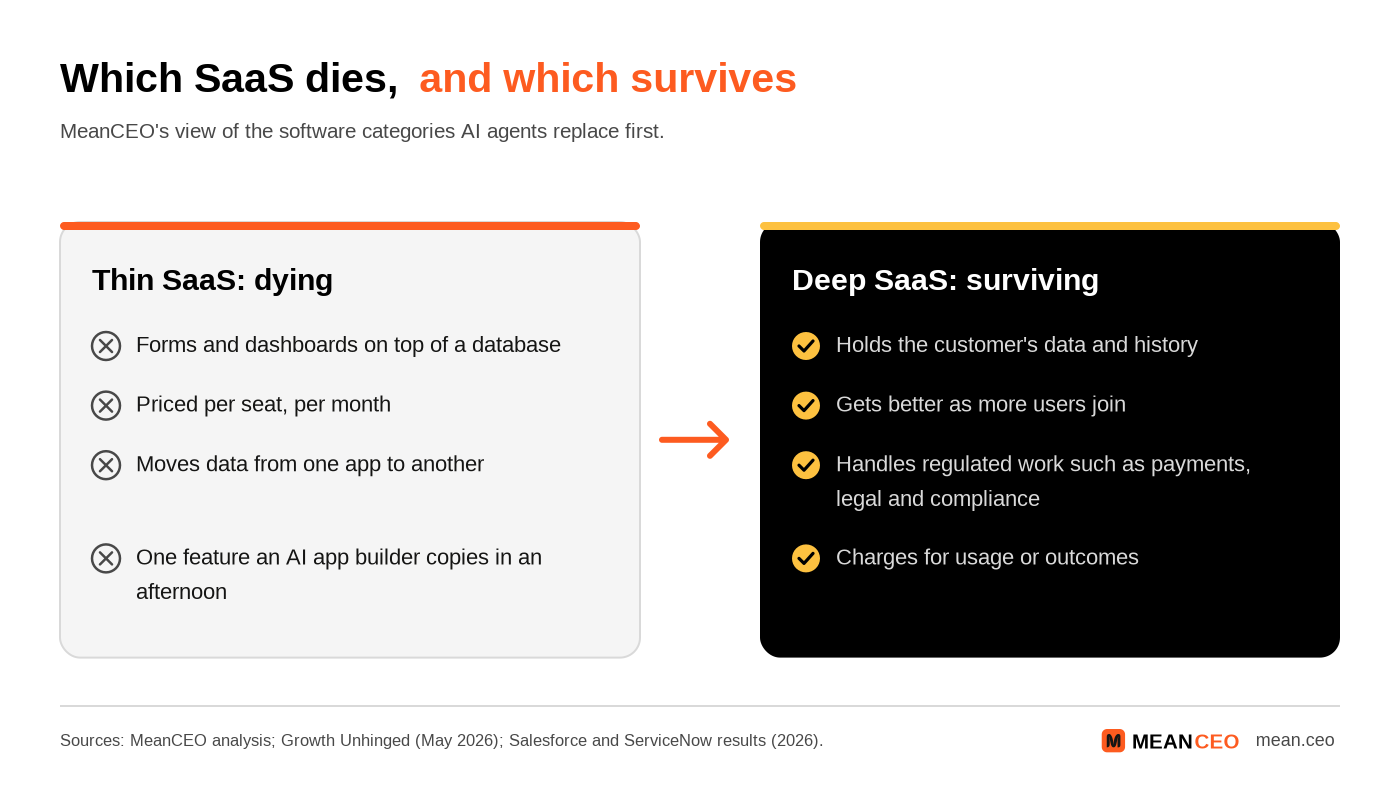
This is our opinion, built on the data above. The SaaS that dies first is THIN SaaS: a form, a table and a dashboard on top of a database, sold per seat, doing one job an AI agent or an AI app builder can now copy in an afternoon. Tools that only move data between other apps sit in the same group.
The SaaS that survives is DEEP SaaS. It holds years of a customer's data and history, it gets better as more users join, it handles regulated work where a mistake costs money or a licence, and it charges for usage or outcomes. Regulation keeps adding to that list: the EU's Digital Fairness Act proposal asks subscription businesses for consent before a trial turns paid and a cancel button on every account, exactly the kind of work customers will not want to vibe-code for themselves.
What should a bootstrapper build in 2026 instead?
Start with the founder data, because the people building next year look different. Stripe Atlas reported that solo founders made up 63% of C corps formed in Q2 2026, an all-time high, and that AI-native solo startups earned almost twice the revenue of other solo startups by month 24.
Here is what we would build with a small budget and no investors:
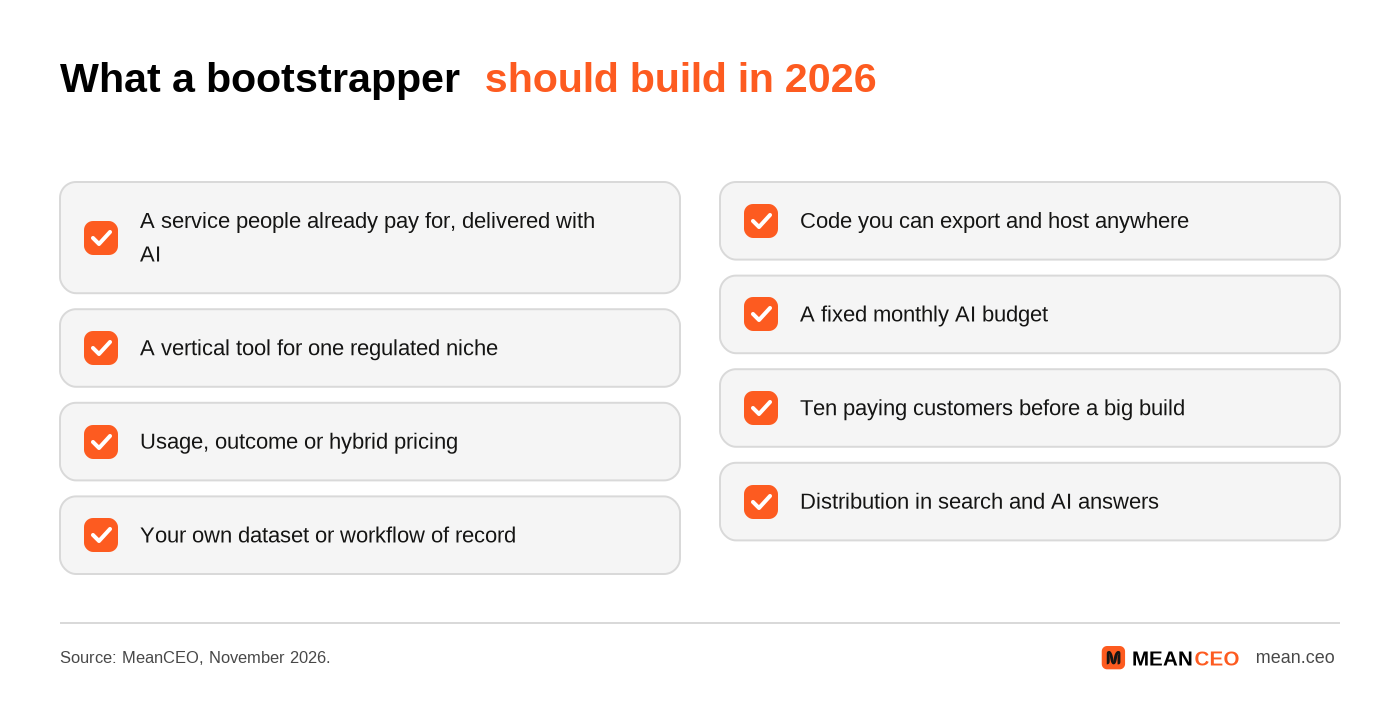
- Sell a service, deliver it with AI. Bookkeeping, SEO or compliance files already have buyers, and AI lets one person deliver them at software margins.
- Go vertical and pick a regulated niche. A tool for Dutch landlords or EU grant applicants carries rules and liability that a general AI builder doesn't know.
- Price on usage, outcomes or a hybrid. 85% of surveyed investors prefer one of these models, and your revenue survives when the customer's team shrinks.
- Own a dataset or a workflow of record. If the customer's history lives in your product, their AI agents have to call it.
- Build on code you can export. Bubble says it plainly: visual workflows built in its editor "can't be exported as runnable code", so leaving means a rebuild. Pick tools that let you take your code with you.
- Cap your AI bill. Set a fixed monthly model budget, as we did with EUR 100 for the femaleswitch.app tools.
- Get ten paying customers before a big build. Our guides on bootstrapping a SaaS startup without coding and running a one-person company that pays cover rates, capacity and first sales.
For more solo-founder data and tools, see our solopreneur news for November 2026 and AI news for November 2026.
Are you getting customers from ChatGPT yet?
More and more traffic is coming from Perplexity, ChatGPT, Grok and other AI tools.
👉 Rank on ChatGPT
- Bubble layoffs: what the co-CEOs announced and what it means for no-code builders (MeanCEO)
- AI app builders vs Bubble: will Lovable, Replit and Base44 share Bubble's fate? (Fe/male Switch)
- Zapier vs Make vs n8n: who survives the AI-agent era (Fe/male Switch)
- AI layoffs and the solo founder boom: what laid-off women in Europe can build in 30 days (Fe/male Switch Foundation)
- Leaving Bubble: why we moved femaleswitch.app after five years (Fe/male Switch Foundation)
FAQ: is SaaS dead?
Is SaaS dead in 2026?
No. Thin SaaS sold per seat is losing ground fast, while vendors with deep customer data still grow: Salesforce revenue rose 11% and ServiceNow subscription revenue 21% in their latest reported quarters.
What is the SaaSpocalypse?
SaaSpocalypse is the name for the software selloff that started on 2 February 2026, when Anthropic released a legal plug-in for Claude Cowork and $285 billion of tech market value disappeared within 24 hours, according to Fortune.
Did Satya Nadella say SaaS is dead?
He never used that phrase. On the BG2 podcast in December 2024 he said business applications could "collapse" in the agentic era because the logic moves to the AI tier, as reported by CX Today. The "CRUD databases with business logic" line is CX Today's paraphrase.
Did Klarna replace Salesforce with AI?
Klarna said in August 2024 that it had shut down Salesforce and would drop Workday. In March 2025 its CEO said "we did not replace SaaS with an LLM" and called the result "the liquidation of SaaS" for a lot of its tools, though not all of them.
Why did Salesforce stock fall on 17 November 2026?
Salesforce fell about 9% to $194.52 on 17 November 2026, a day before Anthropic's IPO. RBC analyst Rishi Jaluria summed up the fear: "the AI companies are going to try to destroy Salesforce entirely."
Should a bootstrapper still start a SaaS company?
Yes, if it is deep SaaS: a vertical tool that holds customer data or handles regulated work, priced on usage or outcomes. A service delivered with AI is the faster start for most solo founders.
About the Author
Violetta Bonenkamp, also known as MeanCEO, is an experienced startup founder with an impressive educational background including an MBA and four other higher education degrees. She has over 20 years of work experience across multiple countries, including 5 years as a solopreneur and serial entrepreneur. Throughout her startup experience she has applied for multiple startup grants at the EU level, in the Netherlands and Malta, and her startups received quite a few of those. She’s been living, studying and working in many countries around the globe and her extensive multicultural experience has influenced her immensely.
