TL;DR: What does the Digital Fairness Act mean for my SaaS or app?
On 11 November 2026, the European Commission officially proposed the Digital Fairness Act (status: Proposed, not yet law). If you sell subscriptions to consumers in the EU, it would change your whole billing flow: a free trial can't turn into a paid plan unless the customer says yes, renewal reminders must go out 1 month to 14 days before a long contract renews, and every account needs a "terminate the contract here" button. It also bans ten dark patterns, such as fake "only 2 left" claims and guilt-trip cancel screens, and adds rules for AI shopping agents. Nothing applies yet: the Parliament and Council must agree first, and then companies get 12 months. Start the redesign in 2027, not the week before the deadline.
Two days ago, a leaked draft of the Digital Fairness Act made the rounds. Now the real thing is out.
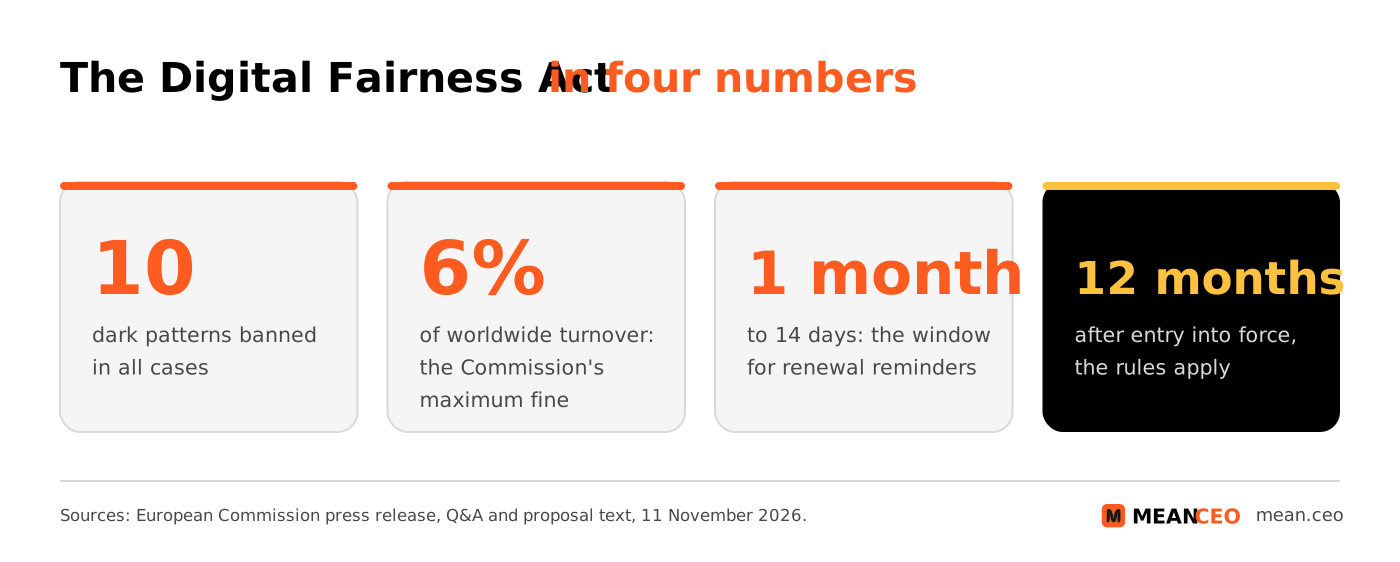
The European Commission published its proposal on Wednesday, together with a plan to give itself direct enforcement powers and fines of up to 6% of global turnover. Most of the coverage is about loot boxes, influencers and ticket prices. But if you run a SaaS, an app or any subscription business with consumer customers, the most important pages are Articles 20 to 26. They rewrite how trials, renewals and cancellations work. Here's what the official text says, what's already law, and what to change first.
What happened on 11 November
The Commission presented its proposal for a Digital Fairness Act, which it calls a major update of EU consumer rules so that people get "the same high level of protection online as they do offline." It came as a package with two other texts: a revision of the Consumer Protection Cooperation Regulation, which gives the Commission its own enforcement powers, and a small directive that simplifies the Consumer Rights Directive.
The DFA is a Regulation, not a Directive. That matters for founders. It turns the 2005 Unfair Commercial Practices Directive into one rulebook that applies directly in every member state, instead of 27 national versions. According to the Commission's questions and answers, it applies to every company that sells to consumers, not only to big platforms.
Commissioner Michael McGrath said: "Shopping has never been more convenient, but convenience must never come at the expense of fairness." He called it "the most ambitious reform of EU consumer protection rules in a generation." The Commission says the package could save EU consumers up to €13.7 billion a year.
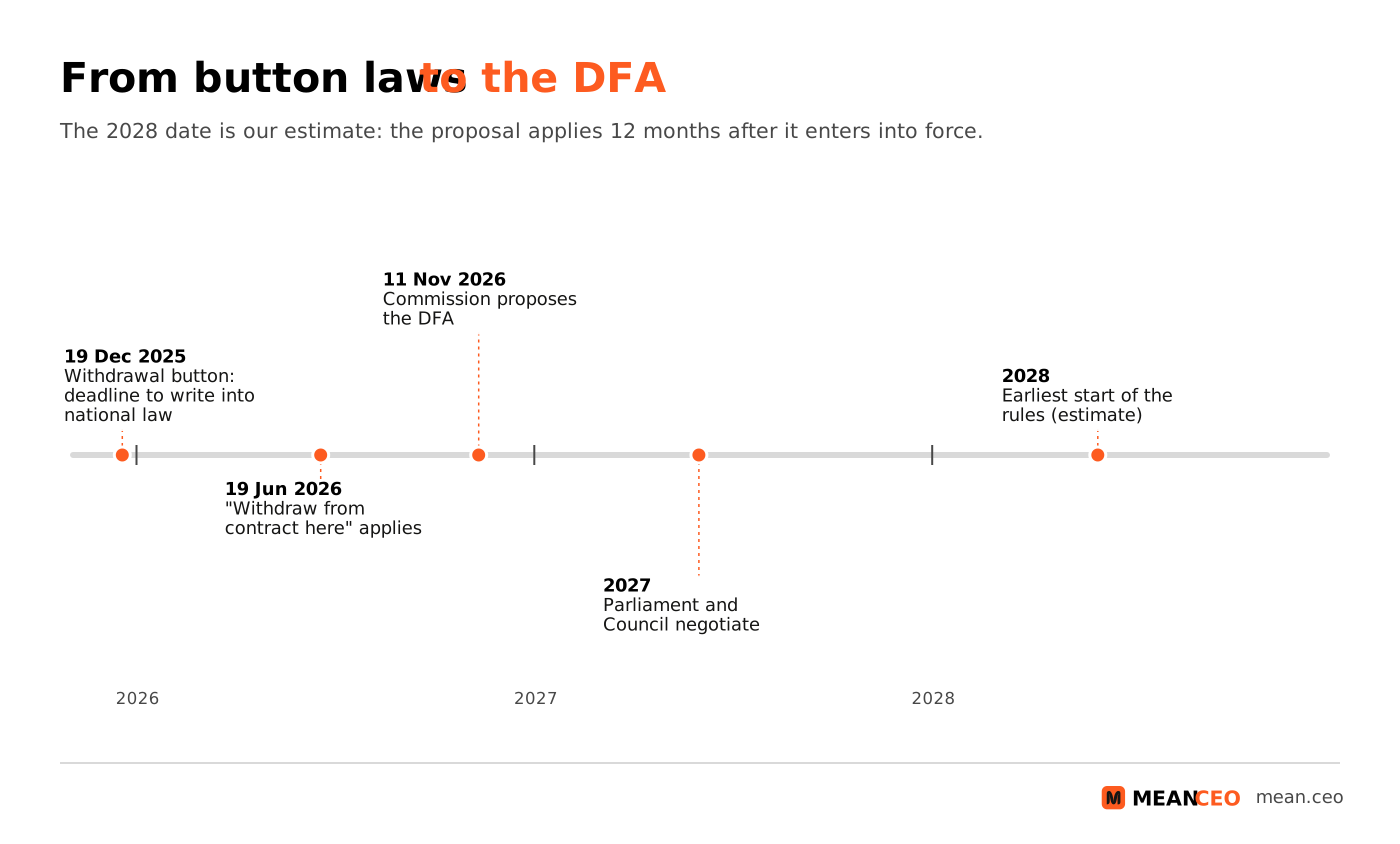
Status: Proposed. The press release says the proposals "will now be discussed by the European Parliament and Council." The proposal text says the rules apply 12 months after the law enters into force. Even if the Parliament and Council move fast, that points to 2028 at the earliest. That's our estimate, not an official date.
The subscription rules, article by article
Here's what the proposal text says about the parts that touch your billing page. All of them cover contracts made online or by other digital means.
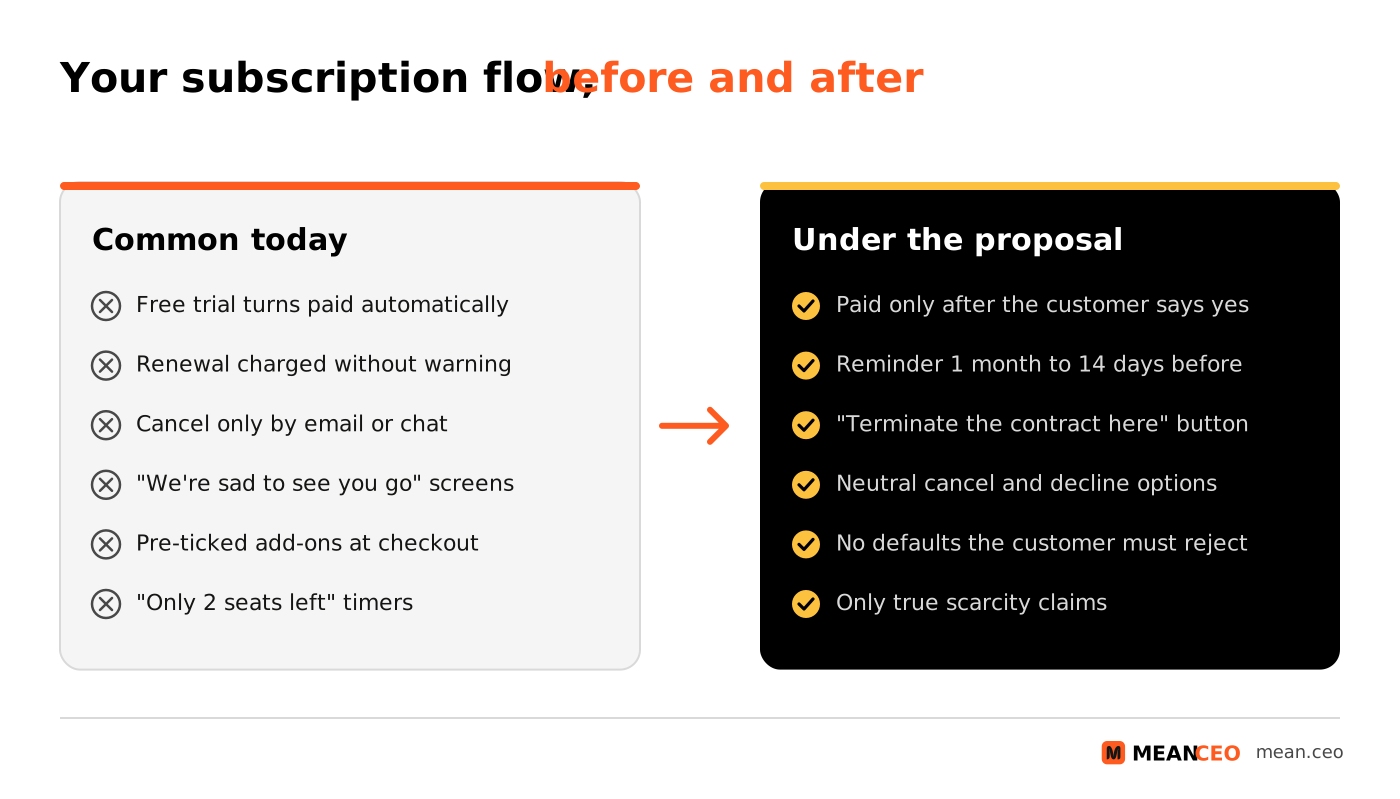
Free trials (Article 20). Before a free trial ends, you must send a reminder "in a clear and prominent manner on a durable medium", such as an email. It has to state the end date, the price, the duration and how to cancel the paid plan. Here's the big change: if you don't send the reminder, or if the customer hasn't "expressly agreed" to continue on a paid basis, "the consumer shall not be bound by the contract." No yes, no charge. Once the customer agrees, you confirm it within a week.
Renewals of contracts of six months or longer (Article 21). You send a reminder "no earlier than 1 month and no later than fourteen days" before the automatic renewal, with the date, the next period, the price and a link to the cancel button. Forget the reminder, and the customer can cancel for free at any time, with no notice period and nothing owed after the renewal date. After a renewal for an indefinite period, customers can always leave with at most one month's notice.
Short contracts, such as monthly plans (Article 22). You don't need a reminder every month. But you do need one at least a week before the renewal that takes the contract to six months in total, or before the tenth renewal, whichever comes first.
The cancel button (Article 23). If customers can sign up online, they must be able to cancel online, "irrespective of the manner in which the contract was concluded." The function must be labelled "terminate the contract here" or an equally clear phrase, shown prominently, and end with a button that says only "confirm the contract termination." You then send a receipt with the date and time and when the cancellation takes effect, within a week.
A human, when needed (Article 25). If you offer online customer service after the sale, customers can ask for a human "when other means are not effective." A chatbot-only support desk would no longer be enough.
Source: Proposal for a Digital Fairness Act, Articles 20 to 25, European Commission, 11 November 2026.
The ten banned dark patterns
Annex I of the proposal adds ten practices to the EU blacklist. Blacklisted means banned in all cases: no one has to prove that a customer was misled. In plain words, you can't:
- Make false claims that a product is scarce or popular.
- Keep repeating scarcity messages all through checkout.
- Use defaults the customer has to reject, such as pre-ticked add-ons.
- Present saying no, or cancelling, as the wrong choice.
- Pretend the highlighted option is the only one.
- Keep asking customers to change a choice they've already made.
- Use confusing wording, such as double negatives or flipped lists.
- Show the price, contract length or auto-renewal less prominently than other key information.
- Send fake "someone contacted you" or "needs your attention" notifications.
- Make refusing, cancelling or changing a choice harder than it needs to be.
The Commission's Q&A gives examples: "Only 1 left", "We're sad to see you go", and a button saying "I don't like good deals" to unsubscribe from a newsletter. If your cancel flow has a three-screen retention funnel, number 10 is the one to read twice. Your cookie banner is covered by GDPR rules too, and the EU's separate fix for consent pop-ups has stalled in the digital omnibus.
The pricing rules matter for SaaS too. The Q&A says companies must "show the full price from the start, including additional fees, taxes, and charges", which ends drip pricing. If your pricing page shows €9 and checkout shows €10.89 with VAT and a "platform fee", fix that before anyone makes you. Our guide on pricing a bootstrapped SaaS can help you rebuild your price page.
New rules for AI shopping agents
Article 26 is the first EU consumer rule written for AI agents that buy things for people. If you offer an agent that can sign contracts for a user, it must ask on first use which of three modes the user wants: confirm every purchase, confirm only some (for example, above a maximum price or after a time limit), or no confirmation at all. Users can change this at any time, and you send a confirmation of their choice.
Two more lines matter for founders building agents. The agent must disclose any payment it receives for proposing a contract and any conflict of interest, and in that case the user must confirm the purchase whatever mode they chose. And shops may not force customers to use an agent to buy. We've covered how fast AI agents are moving into Europe and why banks still block agents from accounts. The DFA adds the consumer-law side.
What's already law, and what's new
Some of this isn't new. Germany already requires a cancel button labelled "Verträge hier kündigen" under Section 312k of its Civil Code. And an EU withdrawal button is already in force: Directive (EU) 2023/2673 requires a "withdraw from contract here" function for online contracts, applied from 19 June 2026.
Sources: EUR-Lex; German Federal Ministry of Justice, gesetze-im-internet.de; European Commission, 11 November 2026.
What about enforcement against small companies? The Commission's new direct powers, with fines of up to 6% of worldwide turnover, only apply to cases that hit consumers in at least two-thirds of member states, and only to companies that are not SMEs. National authorities still enforce the rules against everyone else. The proposal says penalties must take a trader's size and economic capacity into account, but it also says consumers get the same protection "irrespective of the size of the trader." There's no SME exemption from the rules themselves.
The Commission is open about the cost. Its explanatory memorandum says "SMEs may face an initial compliance burden - redesigning interfaces, processes and documentation", which it expects simplification measures to offset. One detail founders will like: the proposal says traders held liable should have recourse against third-party software providers whose actions caused the problem. If your billing tool can't send the reminders, that's a conversation to have with your vendor now.
What this means for you
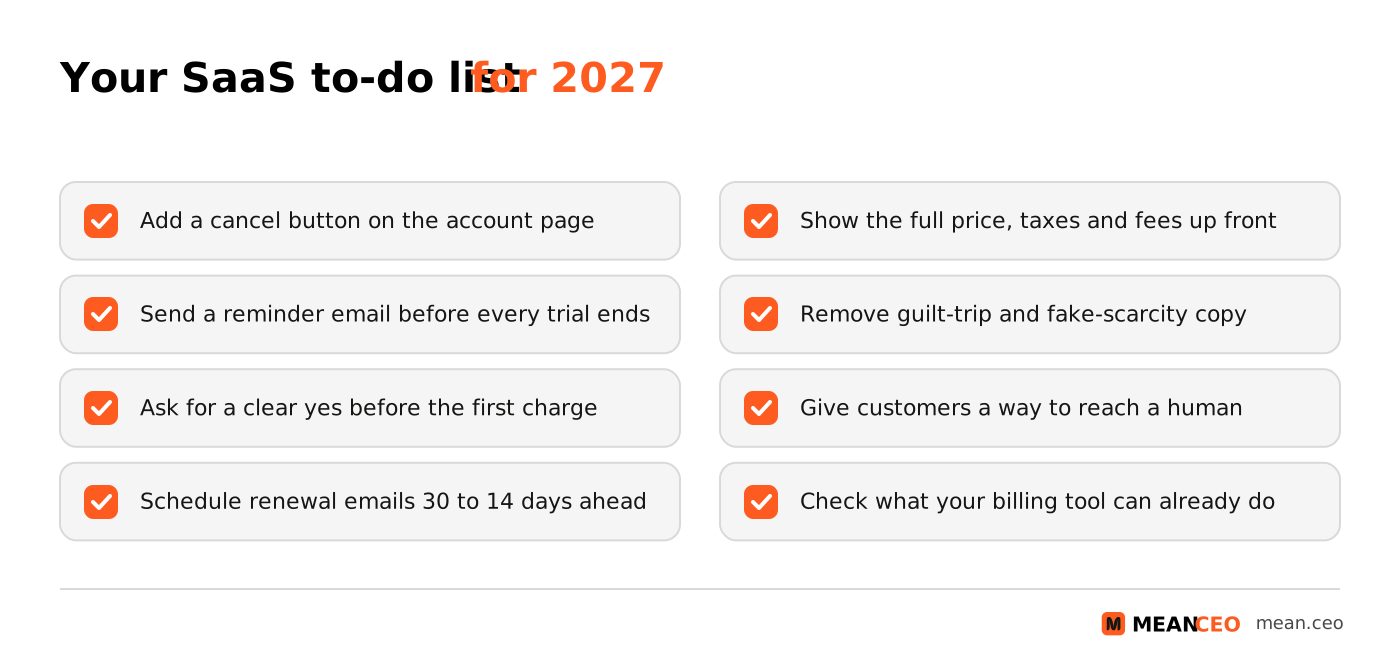
- Check if you're in scope. The DFA covers business-to-consumer sales. A pure B2B SaaS that only sells to companies is mostly outside it, but many tools sell to freelancers and individuals too. If anyone can sign up with a personal card, assume you're in.
- Build the cancel button first. It's the clearest rule, Germany already requires one, and the EU withdrawal button is already in force. A visible "Cancel subscription" link plus one confirmation screen covers most of it.
- Turn trials into opt-in. Send a reminder email before every trial ends and add a clear "Yes, start my paid plan" step. Yes, conversion may drop. Paying customers who chose to pay also churn less and cause fewer chargebacks.
- Schedule renewal reminders. For annual plans, an email 30 to 14 days before renewal with the price and a cancel link. Then use win-back campaigns instead of dark patterns to keep people.
- Rewrite your copy. Remove guilt-trip buttons, fake countdowns and pre-ticked upsells now. They're already risky under today's rules, and they'll be banned outright.
- Ask your billing provider for a roadmap. Find out when your payment or subscription tool will support trial reminders, express consent and online cancellation, so you don't have to build it all yourself.
My take: this proposal is good news for bootstrapped founders, even if it means work. The subscription traps it bans are mostly used by big players with growth teams paid to squeeze conversion. A small SaaS that is honest about its trial and lets people leave in two clicks already wins trust. The DFA makes that the rule for everyone. Don't wait for 2028. Fix the cancel flow this quarter, add the reminder emails next quarter, and you'll be ready while competitors scramble. Our sister site femaleswitch.org covered what the leaked draft said, and our EU AI Act news for November 2026 tracks the other EU rules landing this month.
Are you getting customers from AI search yet?
More and more traffic is coming from Perplexity, ChatGPT, Grok and other AI tools.
👉 Rank on ChatGPT
FAQ: the Digital Fairness Act for SaaS and subscription founders
Is the Digital Fairness Act law yet?
No. The European Commission proposed it on 11 November 2026. The European Parliament and the Council must now agree on a final text. Once it enters into force, the rules apply 12 months later, which points to 2028 at the earliest (our estimate).
Does the Digital Fairness Act apply to small businesses and startups?
Yes. It applies to every company that sells to consumers in the EU, and there's no SME exemption from the rules. Penalties must take a company's size into account, and the Commission's own direct enforcement powers don't apply to SMEs.
Can a free trial still turn into a paid subscription automatically?
Not under the proposal. You must remind the customer before the trial ends, and if they haven't expressly agreed to continue on a paid basis, they are not bound by the paid contract.
What does the cancel button have to say?
The proposal requires a function labelled "terminate the contract here" or an equally clear phrase, followed by a button labelled "confirm the contract termination". You must then send a receipt within a week.
When do I have to send renewal reminders?
For contracts of six months or longer, between one month and 14 days before the automatic renewal. For shorter contracts, at least a week before the renewal that reaches six months in total or the tenth renewal, whichever comes first.
Does the Digital Fairness Act cover AI agents?
Yes. Article 26 says agents that sign contracts for consumers must let users choose on first use whether to confirm every purchase, some purchases or none, and must disclose payments or conflicts of interest. Shops also can't force customers to buy through an agent.
About the Author
Violetta Bonenkamp, also known as MeanCEO, is an experienced startup founder with an impressive educational background including an MBA and four other higher education degrees. She has over 20 years of work experience across multiple countries, including 5 years as a solopreneur and serial entrepreneur. Throughout her startup experience she has applied for multiple startup grants at the EU level, in the Netherlands and Malta, and her startups received quite a few of those. She’s been living, studying and working in many countries around the globe and her extensive multicultural experience has influenced her immensely.
