TL;DR: What happens after Bending Spoons acquisitions?
Bending Spoons acquisitions follow one pattern: buy a mature software brand, cut the team hard, move it onto Bending Spoons' own tech, rework pricing and the free plan, then use the cash to buy the next one. The Milan company has bought Evernote, WeTransfer, Vimeo, Eventbrite, Airtable and Miro, and on 19 November 2026 agreed to buy Mailchimp for $3.68 billion. Its revenue grew 125% last quarter, while organic growth was only 3%. If you depend on a tool it buys, export your data and plan for price and plan changes.
Bending Spoons acquisitions are back in the news because the Italian company is buying Mailchimp from Intuit; here is what happened with the Mailchimp deal. This article looks at the buyer: how it makes money and what happened to the companies it bought, the best guide to what Mailchimp, Miro and Airtable users should expect.
What is Bending Spoons?
Bending Spoons is a Milan-based software company founded in 2013 by Luca Ferrari (CEO), Matteo Danieli, Francesco Patarnello and Luca Querella. It grew out of Evertale, a failed Copenhagen startup, and bootstrapped for years before raising outside money, according to TechCrunch's company profile.
It listed on Nasdaq under the ticker BSP on 1 July 2026. The shares priced at $29, above the $26 to $28 range, and The Next Web reported about 58 million shares and roughly $1.68 billion raised, 41% of it sold by existing shareholders. The company itself says it received $1.09 billion in net proceeds. Berkshire Hathaway put in $600 million at the IPO and another $330 million in October, for a stake of about 4%, CNBC reported.
Bending Spoons says it acquires digital businesses, overhauls them deeply to expand earnings, and reinvests in more acquisitions, and that it has "never sold a material business". Ferrari has said the company identified "more than 1,000 digital businesses (both private and public) that could be attractive acquisition targets".
How does the Bending Spoons business model make money?
The Bending Spoons business model is a buy, fix and hold machine. It buys a product with millions of users and flat growth, cuts costs fast, raises what each user pays, and keeps the cash. Subscriptions made up 93% of 2025 sales, according to Fortune's coverage of the IPO filing, and the portfolio counted about 9 million monthly paying customers.
Revenue climbed from $387 million in 2023 to $671 million in 2024 and $1.31 billion in 2025. For 2026, the Q3 2026 results published on 19 November guide to $3.07 billion to $3.09 billion, up from $2.78 billion to $2.82 billion three months earlier. That forecast excludes Mailchimp.
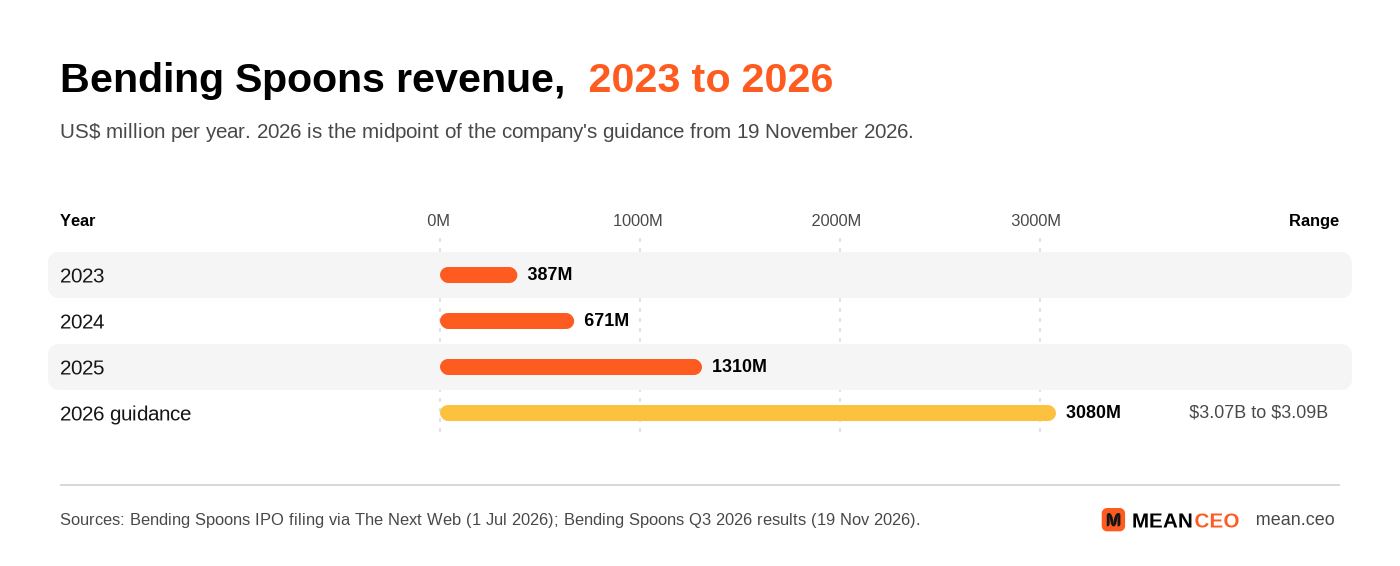
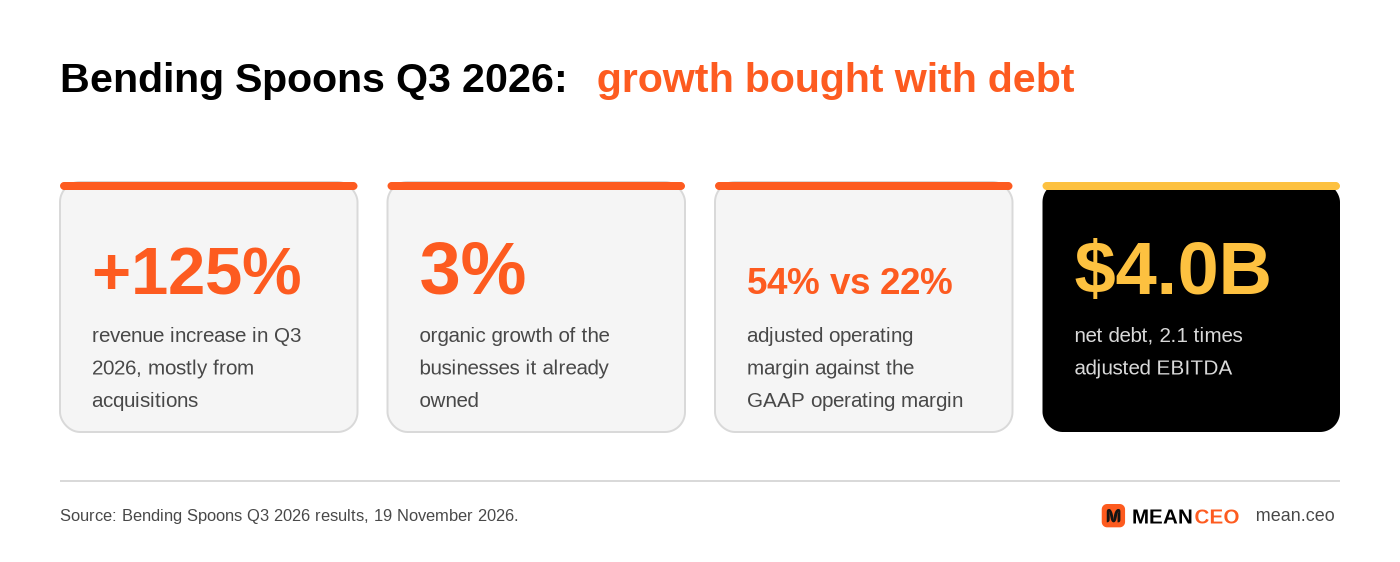
The growth comes from buying. In Q3 2026 revenue rose 125% to $780 million, and the company names acquisitions as the main reason. Organic growth (the same businesses year on year) was 3%; Tractive and WeTransfer grew, Remini shrank. Net revenue retention was 95% in 2025, so existing customers paid about 5% less than a year earlier before any new deal is counted.
Profit depends on which number you read. Adjusted operating income was $424 million, a 54% margin. The GAAP operating margin was 22%, down from 37% a year earlier, because the company booked $189 million of amortization on the brands it bought in Q3, plus severance and deal costs.
Debt pays for the deals. Net debt stood at $4.00 billion at the end of September, 2.1 times adjusted EBITDA, and interest cost $107 million in Q3 alone, against $41 million a year earlier. After the quarter it added new bonds, term loans and a $1.30 billion share sale to pay for Miro and Mailchimp.
What happens when Bending Spoons buys a company?
The same playbook shows up in almost every deal. The company describes its own process as "reorganizing teams, overhauling technology, redesigning user interfaces, accelerating product development" plus changes to marketing and monetization. On the ground, that has meant deep staff cuts within weeks or months, a move onto Bending Spoons' own tech stack, and a stricter free plan.
Sources: Bending Spoons results and releases, Intuit, TechCrunch, InformationWeek, Reuters, Cyclingnews, Axios, CNBC (2023 to 2026). Price = enterprise value or reported deal value.
Bending Spoons confirmed to TechCrunch in September 2024 that it planned to cut about 75% of WeTransfer's staff; Ferrari described the goal as "a smaller, more sharply focused WeTransfer organization". Across AOL, Eventbrite and Vimeo the company says it took on 1,830 full-time equivalent staff and expects "only a few hundred to remain" once the overhauls finish. At Airtable, the new product lead told staff in October that the company was moving to "smaller teams with clearer responsibilities", InformationWeek reported, while plans, prices and the customer-facing team stayed as they were.
The free plan is the second pattern. Evernote cut its free tier to one notebook and 50 notes from 4 December 2023, as TechCrunch reported, and WeTransfer's free plan now allows 10 transfers or 3 GB in any 30-day window.
Did any products get better under Bending Spoons?
Yes. Evernote's own 2023 recap says the team moved from a release every four to eight weeks to weekly releases, removed about 40,000 lines of old code and made the web app's first sync "almost 17 times faster". In October 2025 Evernote shipped v11 with an AI assistant, semantic search and meeting transcription, its biggest update since 2020, and Bending Spoons counted more than 200 improvements since the deal, Engadget reported. Business Insider reported that Evernote went from about 350 employees to around 20, so the product kept shipping with a fraction of the team.
The Q3 results add about 30 Eventbrite improvements and 40% faster Vimeo video processing. Miro's co-founder Andrey Khusid welcomed "an owner who invests for the long term and cares deeply about product quality" in the closing announcement. Investors like the model for the same reason Business Insider compared it with Berkshire Hathaway: a permanent owner that reinvests cash into the next purchase. The difference, as that piece noted, is that Berkshire leaves its companies alone and Bending Spoons rebuilds them.
What should Mailchimp, Miro and Airtable users expect?
This is my read of the pattern, and it is a forecast. Bending Spoons has made no announcement about Mailchimp's team, prices or plans, and the deal still needs regulatory approval. Intuit's press release shows why the price fell: Mailchimp revenue was $313 million last quarter, down 1%, and Intuit guides to $1.256 billion to $1.266 billion for its fiscal year, flat at best. Intuit paid about $12 billion in 2021; Bending Spoons pays $3.68 billion, under three times annual revenue by my calculation.
- Mailchimp: expect a smaller team, a review of pricing and packaging, and a tighter free plan, the same steps AOL, Evernote and WeTransfer went through. I also expect faster product releases and more AI features inside the editor.
- Airtable: the staff cut already happened. Prices are unchanged so far; watch the next renewal cycle.
- Miro: nothing is announced. Its outlook counts Miro only from 26 October, so watch the Q4 results for the first details.
Why do mature SaaS tools end up with operators?
My take, built on the numbers above: what died for mature tools is SaaS growth. Our piece on whether SaaS is dead showed thin, seat-priced software losing ground to AI, and Bubble's layoffs on 17 November showed the same pressure on no-code platforms. When a product stops growing, venture investors lose interest, and the tool becomes a cash-generating asset that an operator buys at a discount and runs for profit.
Bending Spoons is one kind of operator; private equity is another. In no-code, Adalo's CTO Jason Gilmore lists himself as a partner at the private-equity firm Xenon Partners since 2024, and industry profiles report that Xenon bought Adalo; we could not find an official announcement of that deal. We moved our own platform off Bubble for related reasons, and explained why we left Bubble after five years.
My guess, clearly speculation: the next targets look like Mailchimp did. Large user base, mostly self-serve subscriptions, flat or shrinking revenue, a parent that wants cash. Older form builders, scheduling tools, website builders and even a no-code platform or two fit that profile.
If you send newsletters on Mailchimp, start with our shortlist of Mailchimp alternatives, and read what it really takes to build your own Mailchimp with AI before you decide.
What this means for you
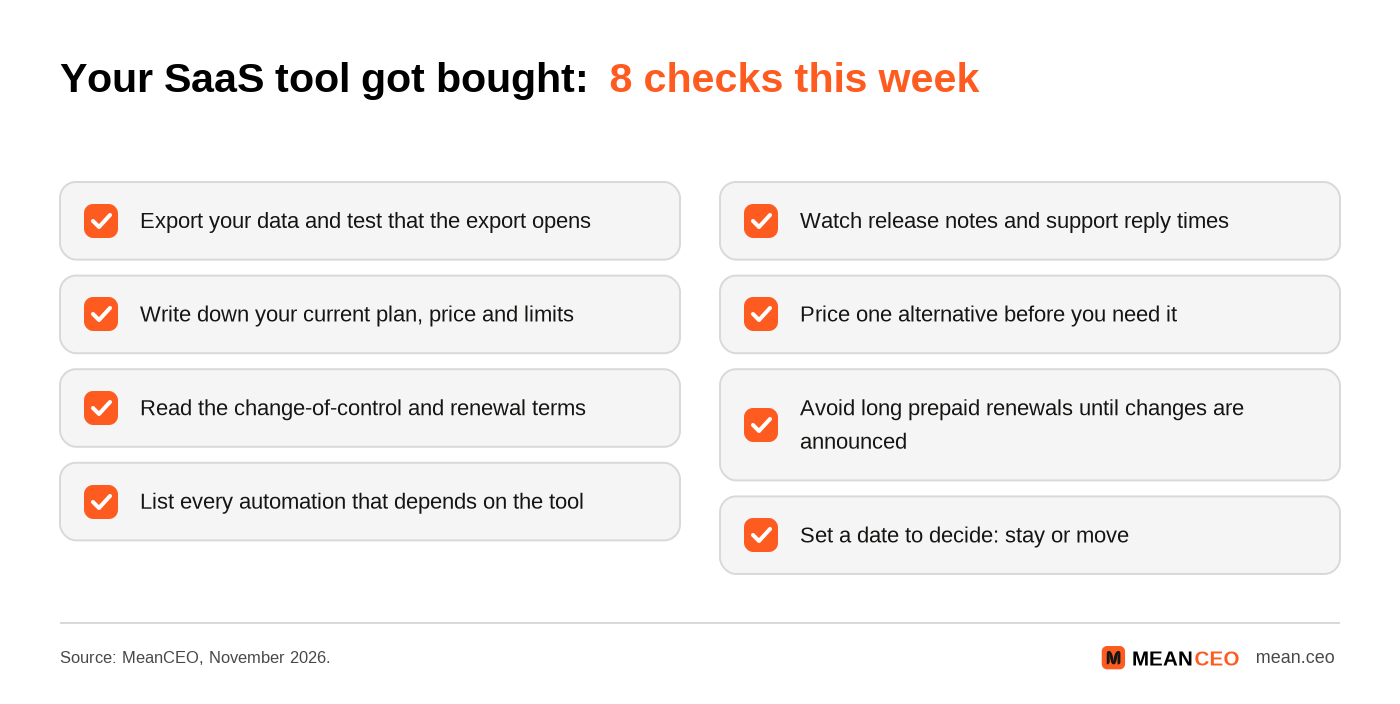
If you run your business on a SaaS tool, assume it can change owners at any time and act before the email arrives:
- Export your data now and open the export to check it works. For Mailchimp, that means your audience, tags, templates and campaign history.
- Write down your current plan, price and limits, so you can spot changes the day they land.
- Read the contract for change-of-control, price protection, data export and renewal terms.
- Map what depends on the tool: forms, automations, Zapier or Make flows, landing pages.
- Price one alternative and estimate how long a move would take, before you need it.
- Hold off on long prepaid renewals until the new owner announces its plans.
If you are building SaaS, Bending Spoons is also a buyer, and that changes the exit maths. It buys products with loyal users and flat growth, which means a founder can build for cash flow and still have an exit. Keep revenue clean and mostly subscription, keep churn low, and keep the product simple to run with a small team. Our guide to bootstrapping a SaaS startup covers the first steps. In these deals few staff stay, so negotiate severance for your team before you sign.
Are you getting customers from ChatGPT yet?
More and more traffic is coming from Perplexity, ChatGPT, Grok and other AI tools.
👉 Rank on ChatGPT
FAQ: Bending Spoons acquisitions
Who owns Bending Spoons?
Bending Spoons has traded on Nasdaq as BSP since July 2026. Its four co-founders, led by CEO Luca Ferrari, hold more than 80% of the voting power; Berkshire Hathaway owns about 4%.
What companies has Bending Spoons acquired?
Evernote, Meetup, StreamYard, Issuu, WeTransfer, Brightcove, komoot, Vimeo, AOL, Eventbrite, Tractive, Airtable and Miro, among others. On 19 November 2026 it agreed to buy Mailchimp from Intuit for $3.68 billion.
What happens when Bending Spoons buys a company?
In past deals Bending Spoons cut a large share of the staff, moved the product onto its own technology, reworked pricing and the free plan, and sped up product releases. It planned to cut about 75% of WeTransfer's staff, and Evernote limited free users to one notebook and 50 notes.
Does Bending Spoons ever sell the companies it buys?
No. The company says it has never sold a material business and plans to hold what it buys, using the cash to fund more acquisitions.
How does Bending Spoons make money?
Mostly from subscriptions, 93% of 2025 sales, plus advertising. It buys mature products, cuts costs and raises revenue per user. Q3 2026 revenue was $780 million, up 125%, with 3% organic growth.
Will Mailchimp prices go up after the Bending Spoons deal?
Nothing is announced, and the deal should close in early 2027. Past deals point to pricing and free-plan changes, so export your data and note your plan now.
About the Author
Violetta Bonenkamp, also known as MeanCEO, is an experienced startup founder with an impressive educational background including an MBA and four other higher education degrees. She has over 20 years of work experience across multiple countries, including 5 years as a solopreneur and serial entrepreneur. Throughout her startup experience she has applied for multiple startup grants at the EU level, in the Netherlands and Malta, and her startups received quite a few of those. She’s been living, studying and working in many countries around the globe and her extensive multicultural experience has influenced her immensely.
