GDPR and AI: a compliance checklist for startups that use or build AI
GDPR applies to AI whenever personal data goes in or comes out: prompts with customer names, meeting recordings, support tickets, CVs, training data. The rules are the same as for any other processing (a lawful basis, a clear purpose, as little data as possible, a contract with each vendor, security, and rights for the people concerned), plus two that bite harder with AI: limits on fully automated decisions (Article 22) and impact assessments for high-risk processing (Article 35). On top of that, the EU AI Act adds its own duties, phased in until 2028.
Quick answer: to use AI under GDPR, map what personal data each AI tool receives, pick a lawful basis for each purpose, sign a data processing agreement with the vendor and switch off training on your data, keep data in the EU or use a valid transfer mechanism, tell people in your privacy notice, keep a human in decisions that significantly affect someone, and run a DPIA when the risk is high. If you build AI features, add privacy by design (Article 25) and check whether the AI Act classes your use as high-risk.
Struggling to determine the right AI tools?
Check this detailed framework for selecting GDPR-compliant AI tools suitable for your European startup!
👇 Streamline your decision-making today!
Using AI tools vs building AI features: which rules apply
Most small companies are in the first column. Many SaaS startups are in both: they use AI tools internally and ship AI features to customers.
"Embedding data privacy from day one means fewer sleepless nights during audits." , Violetta Bonenkamp, Mean CEO
The GDPR articles that matter most for AI
Source: GDPR text and the EDPB Opinion 28/2024 on AI models (17 December 2024), which also says AI models trained on personal data are not automatically anonymous: it has to be assessed case by case. Fines for breaching the principles, lawful basis or data subject rights go up to €20 million or 4% of worldwide annual turnover (Article 83(5)).
Which AI use cases need what
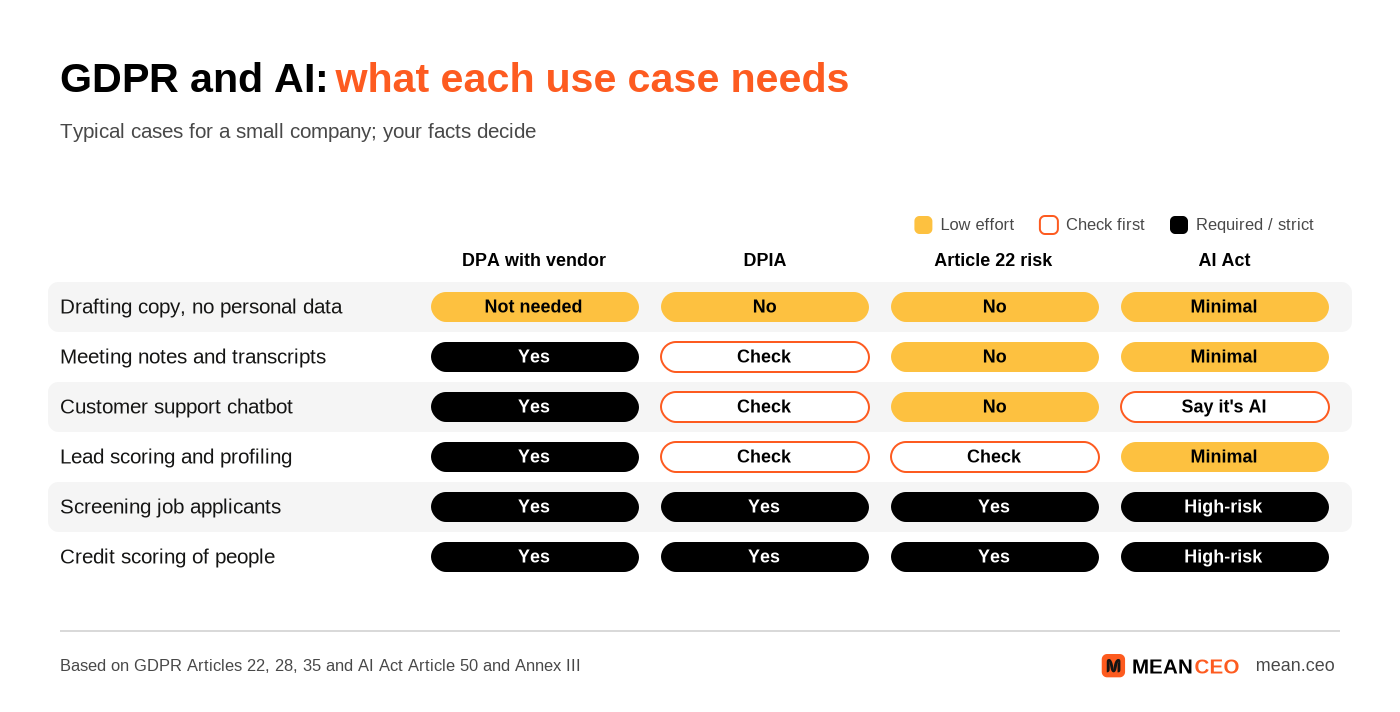
Two rows deserve a warning. Screening job applicants and assessing people's creditworthiness are listed as high-risk in Annex III of the AI Act, and both easily become solely automated decisions under GDPR Article 22. Meeting tools are the opposite trap: they look harmless but record everyone on the call, so check the vendor's terms before you switch on auto-recording; our review of AI meeting summarisation tools covers what to look for.
GDPR and the AI Act: how they fit together
The AI Act (Regulation (EU) 2024/1689) does not replace GDPR. GDPR protects personal data in any processing; the AI Act regulates AI systems by risk level, whether or not personal data is involved. An AI feature that processes personal data has to meet both.
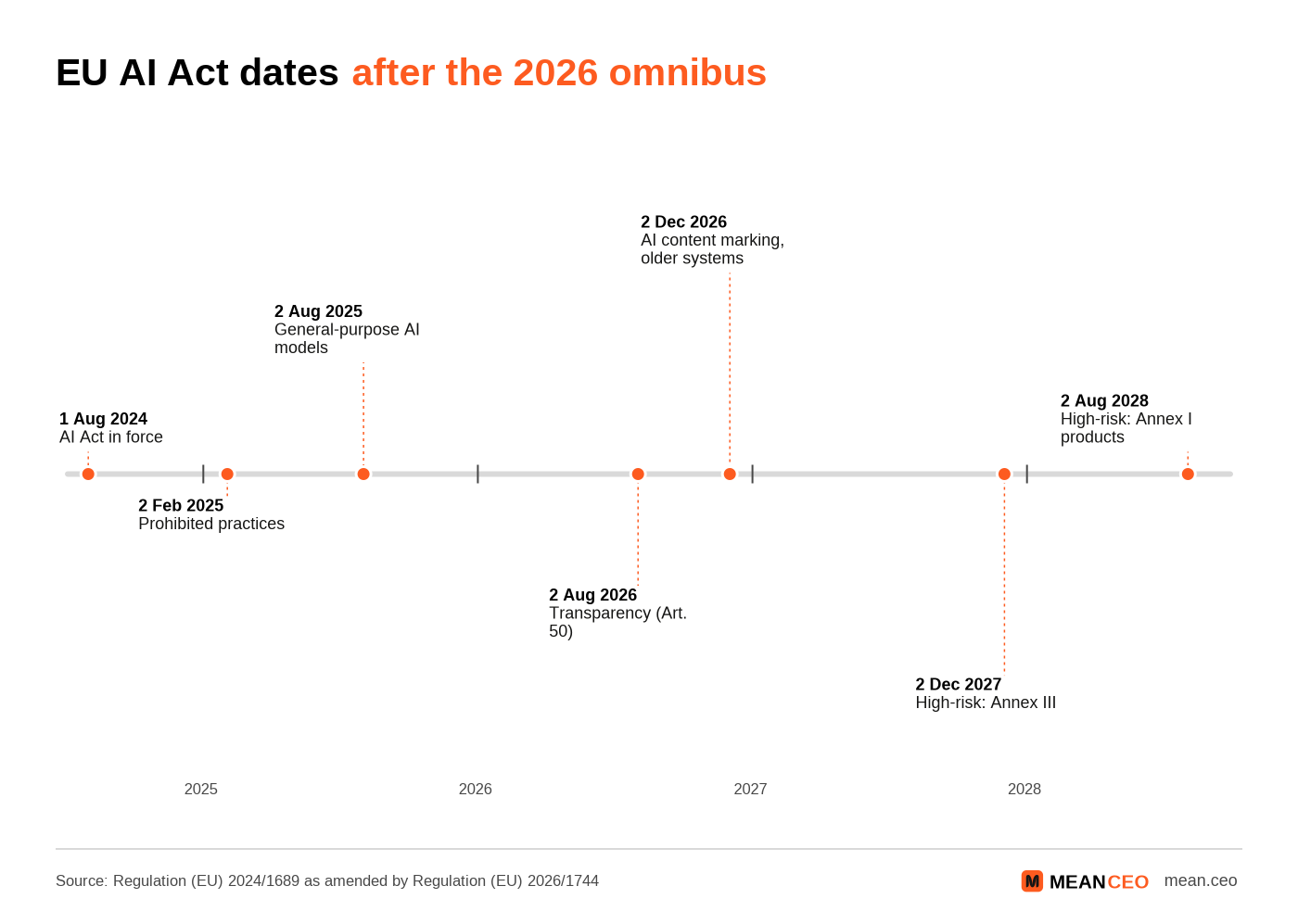
The Digital Omnibus on AI (Regulation (EU) 2026/1744), in force since 27 July 2026, moved the high-risk obligations for Annex III uses such as hiring and credit scoring to 2 December 2027 and for Annex I products to 2 August 2028. It also lets providers and deployers of all AI systems process special category data to detect and correct bias, but only where strictly necessary. The separate omnibus that would change GDPR itself and cookie consent is still being negotiated, so today's GDPR rules apply in full: see why the GDPR and cookie omnibus has stalled. Our sister blog has a fuller EU AI Act guide for startups.
GDPR and AI checklist before you ship an AI feature
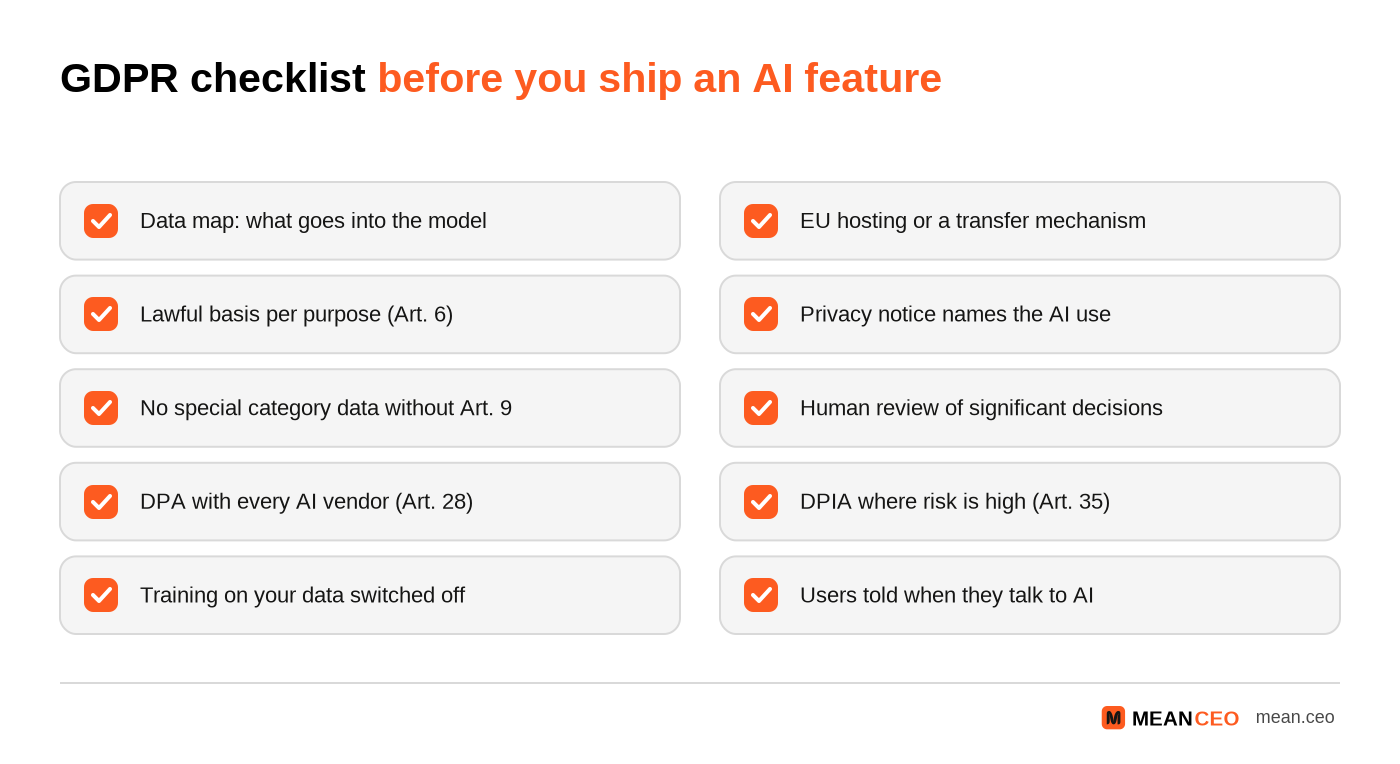
- Map the data. For each AI tool or feature: which personal data goes in, whose it is, what comes out and where it is stored.
- Set the purpose and lawful basis. One line per purpose. If you rely on legitimate interest, write down the three-step test.
- Keep sensitive data out. Block or strip special category data unless an Article 9 exception clearly applies.
- Vet the vendor. Business plan, a DPA, training on your data off, a sub-processor list, EU hosting or a named transfer mechanism. Use our checklist for evaluating AI vendors.
- Update the privacy notice. Say what AI processing happens and which providers are involved.
- Keep a human in significant decisions. A person who can actually change the outcome, not a rubber stamp.
- Run a DPIA when the risk is high. Profiling, decisions about people, sensitive data or large-scale monitoring all point to one.
- Disclose AI to users. Tell people when they are talking to a chatbot, and label AI-generated content where the AI Act requires it.
If you are new to GDPR altogether, start with the GDPR compliance step-by-step guide and the GDPR basics for early-stage startups, then come back to the AI-specific checks.
GDPR and AI mistakes startups make
- Personal accounts for work data. Free or personal AI accounts usually come with consumer terms and no DPA. Give the team business accounts and a one-page AI policy.
- Assuming the model is anonymous. The EDPB says a model trained on personal data is not automatically anonymous; outputs can reveal the data it learned from.
- "Human in the loop" on paper only. A reviewer who approves every AI recommendation without the time or authority to change it does not take the decision out of Article 22.
- Training on customer data because the contract allows it. Your terms with business customers don't replace a lawful basis towards the people in their data.
- Forgetting the website. AI chat widgets and analytics also process personal data and may set cookies; they belong in your consent set-up.
- Ignoring security. AI tools add new ways for data to leak (prompt injection, over-broad integrations). The basics of security for a small startup still apply.
Want to keep your content out of other companies' AI training? That is a separate question: see how to use robots.txt to block AI training crawlers. For where AI saves a small team the most time, read AI-powered startup operations.
FAQ on GDPR and AI
Does GDPR apply to AI?
Yes, whenever an AI system processes personal data, whether in prompts, uploaded files, training data or outputs. The same principles apply as for any processing, plus Article 22 on automated decisions and Article 35 on impact assessments.
Is ChatGPT GDPR compliant?
No tool is compliant on its own; what matters is how you use it. For work with personal data, use a business plan that comes with a data processing agreement and keeps your data out of model training, check where data is stored, and mention the processing in your privacy notice.
Can I put customer data into an AI tool?
Only if you have a lawful basis for that purpose, a DPA with the vendor, training on your data switched off, a valid transfer mechanism if data leaves the EEA, and your privacy notice covers it. Leave out data you don't need.
Do I need a DPIA for AI?
Not for every AI use. You need one before processing likely to result in a high risk, for example systematic automated evaluation or profiling that leads to decisions with legal or similarly significant effects, large-scale sensitive data or large-scale monitoring.
What does Article 22 GDPR mean for AI decisions?
People have the right not to be subject to a decision based solely on automated processing that has legal or similarly significant effects on them, except in limited cases with safeguards such as the right to human intervention and to contest the decision.
What is the difference between the AI Act and GDPR?
GDPR protects personal data in any processing. The AI Act regulates AI systems by risk level, whether or not personal data is involved. An AI system that processes personal data must comply with both.
When do the AI Act's high-risk rules apply?
After the Digital Omnibus on AI (Regulation (EU) 2026/1744): from 2 December 2027 for Annex III uses such as hiring and credit scoring, and from 2 August 2028 for AI in products covered by Annex I. Prohibitions apply since February 2025 and transparency duties since August 2026.
Can I train an AI model on personal data under GDPR?
Possibly, with a lawful basis (the EDPB accepts legitimate interest only after a careful three-step test), clear information to the people concerned, data minimisation and security. Whether the resulting model is anonymous has to be assessed case by case.
