TL;DR: AI-Powered SEO for Resource-Constrained Startups
A small startup can now do most SEO legwork with AI: keyword clustering, outlines, first drafts, meta descriptions, schema code and audit summaries. What AI can’t do is decide which queries matter to your buyers, check facts or add the first-hand experience that Google and AI assistants look for. Search is changing: in 2024 about 6 in 10 Google searches in the EU already ended without a click, and AI Overviews cut clicks further, so being a source that AI answers quote now matters as much as ranking. Write pages that answer one question clearly, keep a human editor on every page, fix the technical basics and track results weekly in Search Console and Bing Webmaster Tools.
💡 Looking to build organic traffic even without backlinks? Check out strategies for startups in SEO for Startups: Building Organic Traffic Without Backlinks.
How AI-Powered SEO Transforms Resource-Constrained Startups
AI-powered SEO for resource-constrained startups is not a luxury; it can decide whether you get found or stay invisible. For startups operating on lean budgets, AI lets you do work that used to need an agency or a full-time specialist, so you can compete in crowded markets without breaking the bank.
AI speeds up keyword research, content outlines and technical checks. Instead of hiring expensive agencies, founders can use chat assistants such as ChatGPT, Claude or Gemini, plus the AI features built into SEO tools, to run focused projects at a fraction of the cost. The catch: AI is fast and confident, and it is sometimes wrong. The startups that win use it for speed and keep a human in charge of judgement.
Is Your Startup SEO Optimized for 2026?
AI visibility is driving millions of engagements, are you missing out?
👉 Learn How to Optimize for AI Overviews and Featured Snippets
Why Startups Struggle Without AI-Driven SEO
The fundamental challenge for startups is resource scarcity, whether it's limited marketing budgets, small teams, or insufficient technical expertise. Traditional SEO often requires months of effort and significant resources to produce measurable results, putting many startups at a strategic disadvantage from the outset.
What’s more alarming is that fewer searches lead to a click at all. SparkToro and Datos’ 2024 zero-click study found that 59.7% of Google searches in the EU and 58.5% in the US ended without a click; for every 1,000 EU searches, only 374 clicks went to the open web (360 in the US). AI Overviews push in the same direction: Ahrefs’ February 2026 update found that when an AI Overview appears, the top-ranking page gets about 58% fewer clicks on average, up from 34.5% in its April 2025 study (a correlation, not proof of cause). Without adjusting your strategy, your startup risks being missed where AI now curates the answers.
When Google showed an AI summary, users clicked a traditional search result on 8% of visits, compared with 15% when no summary appeared. (Pew Research Center, July 2025)
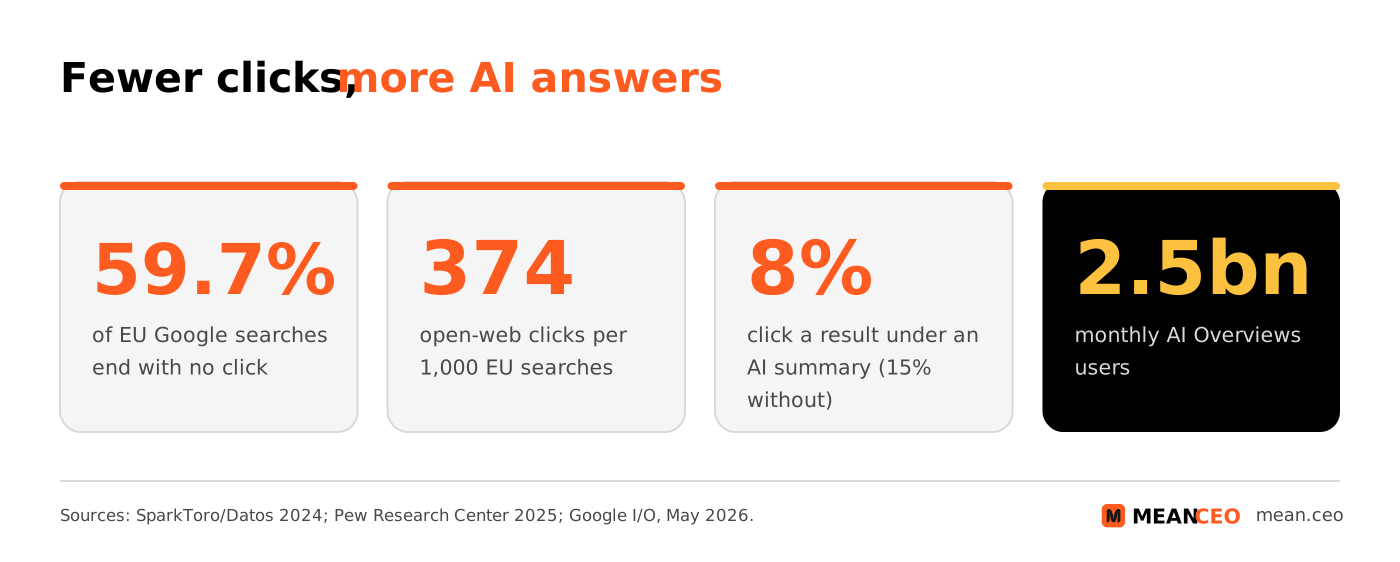
Pew Research Center tracked the searches of 900 US adults in March 2025. When an AI summary appeared, they clicked a link inside it on only 1% of visits, and they ended their browsing session on 26% of those visits, against 16% without a summary. The audience is huge: Google said at I/O in May 2026 that AI Overviews has over 2.5 billion monthly users and AI Mode over 1 billion. The upside for small sites: AI answers are built from web pages, so a precise page on a narrow question can be one of the sources they cite.
How AI Helps Startups Navigate SEO Challenges
AI SEO removes much of the complexity and manual effort associated with traditional optimization. Here are four pivotal ways it changes the game for resource-strapped startups:
- Faster keyword research: AI assistants are good at grouping hundreds of keywords by intent and suggesting questions buyers ask. They don’t know real search volumes, so pair them with data from Search Console, Bing Webmaster Tools or a keyword tool.
- Content drafts: Tools like ChatGPT, Claude, Jasper or the AI writers inside Semrush and SE Ranking produce outlines and first drafts in minutes. Treat them as drafts: a human adds facts, examples and the final edit.
- Technical help: Site audit tools find broken links, missing titles, slow pages and crawl errors, and an AI assistant can explain each issue and write the fix, from a redirect rule to JSON-LD schema code, even without an in-house developer.
- Faster analysis: Paste a Search Console export into an AI assistant and ask which pages lost clicks and why. It turns a morning of spreadsheet work into a few minutes, as long as you check its maths.
Structured data still helps search engines understand your pages and makes them eligible for rich results, but it doesn’t buy a place in AI summaries. Clear pages that answer the question do. To see which pages actually bring visitors, use this founder’s guide to SEO analytics.
What AI Can and Can’t Do for Your SEO
The quickest way to waste an AI subscription is to hand it the wrong jobs. Here’s how we split the work at a small startup:
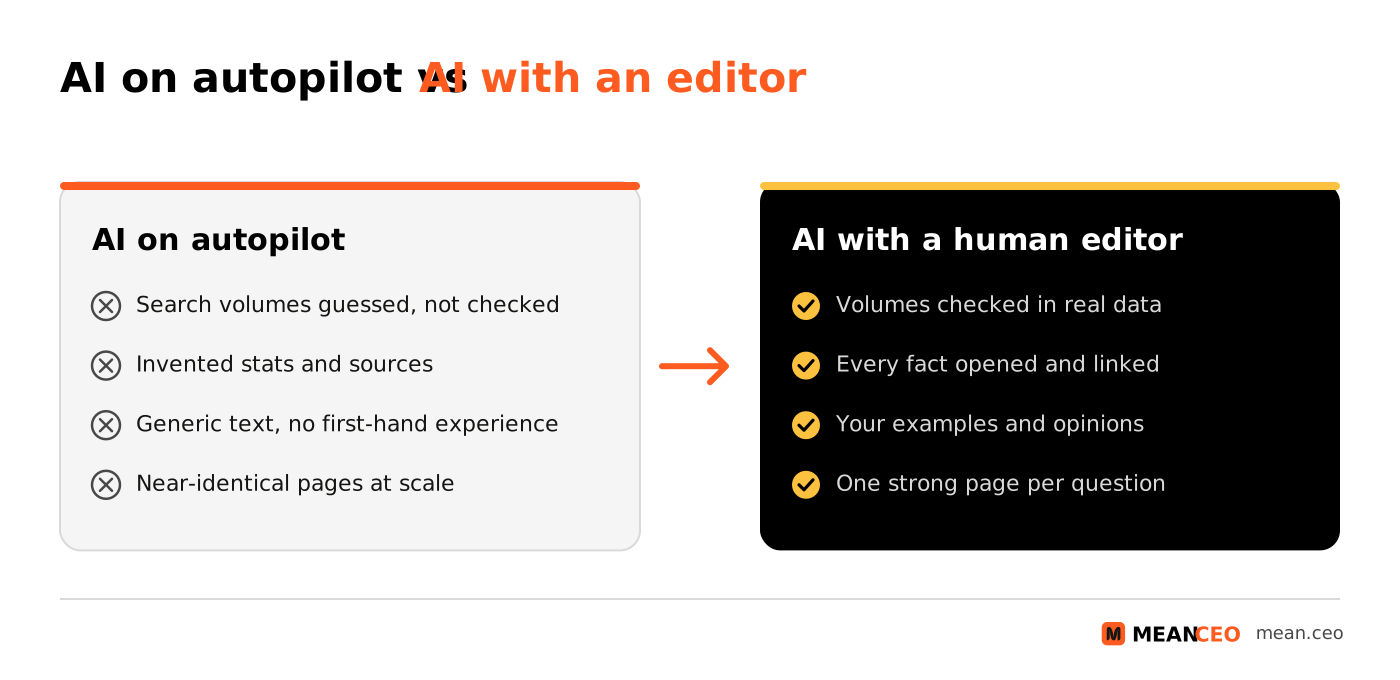
Source: our assessment from running content for mean.ceo and our other sites.
Implementation Framework for AI-Powered SEO
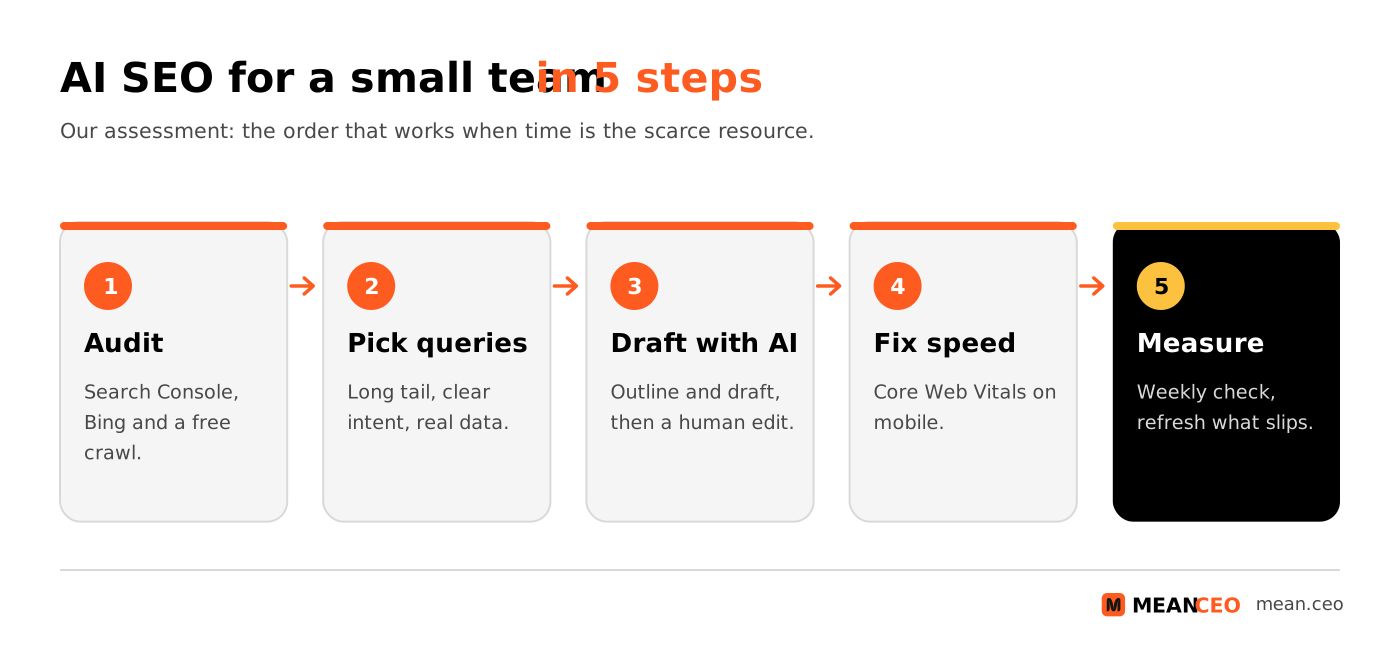
Follow these step-by-step instructions to implement AI SEO strategies, starting today:
1. Set the Foundation: SEO Readiness Audit
- Verify your site in Google Search Console and Bing Webmaster Tools (both free) and run a free site audit, for example with Ahrefs’ free plan for verified sites or Ubersuggest’s free searches.
- Fix immediate barriers like broken links, missing titles and pages blocked from indexing, and note your baseline clicks and impressions.
2. Master AI SEO Content Creation
AI can transform your team’s speed. Use it to build a content brief from the questions people ask, draft sections, then edit hard: add your own numbers, examples and opinions. Put a direct answer in the first lines of each section, and add a visible FAQ where readers have real follow-up questions. Don’t add special markup for AI: Google’s guide to AI features in Search says there are no extra requirements to appear in AI Overviews or AI Mode, and you don’t need AI text files such as llms.txt or special schema. Our guide to AI-powered content creation for startup blogs shows how to keep the result from sounding robotic.
3. Optimize Core Web Vitals Early
Core Web Vitals are part of Google’s page experience signals: LCP should be 2.5 seconds or less, INP 200 milliseconds or less and CLS 0.1 or less. PageSpeed Insights shows them for free, and an AI assistant can explain each recommendation and suggest fixes your website builder supports. Here’s an excellent resource on achieving Core Web Vitals optimization on a budget.
4. Connect Pages into Topic Clusters
Ask AI to group your keyword list into topics, then plan one main guide per topic and shorter pages for each sub-question, all linked to each other. Internal links help search engines find new pages and understand what your site is about. See how content clusters improve rankings and our guide to keyword research for niche startup markets.
5. Measure Weekly and Refresh What Slips
Check Search Console and Bing Webmaster Tools once a week. Pages in positions 8 to 20 are your quickest wins: improve the answer, update facts and add internal links to them. Our guide to Google Search Console metrics that matter for startups shows where to look.
Common Mistakes Startups Should Avoid
- Publishing AI text without editing: Google says appropriate use of AI or automation is not against its guidelines, but its spam policies treat many pages generated mainly to manipulate rankings as scaled content abuse, however they were made. Edit every page and add something AI can’t.
- Trusting AI facts: Chat assistants invent statistics, studies and even links. Check every number against a source you opened yourself.
- Keyword stuffing: Google’s spam policies list keyword stuffing as spam. Write for the reader and cover the topic fully instead.
- Ignoring Bing: Bing Webmaster Tools is free and Bing’s index feeds Microsoft Copilot, so skipping it leaves AI visibility on the table.
Avoid these pitfalls and track your progress carefully. For timeline-specific tips, startups can use the first six months roadmap for SEO.
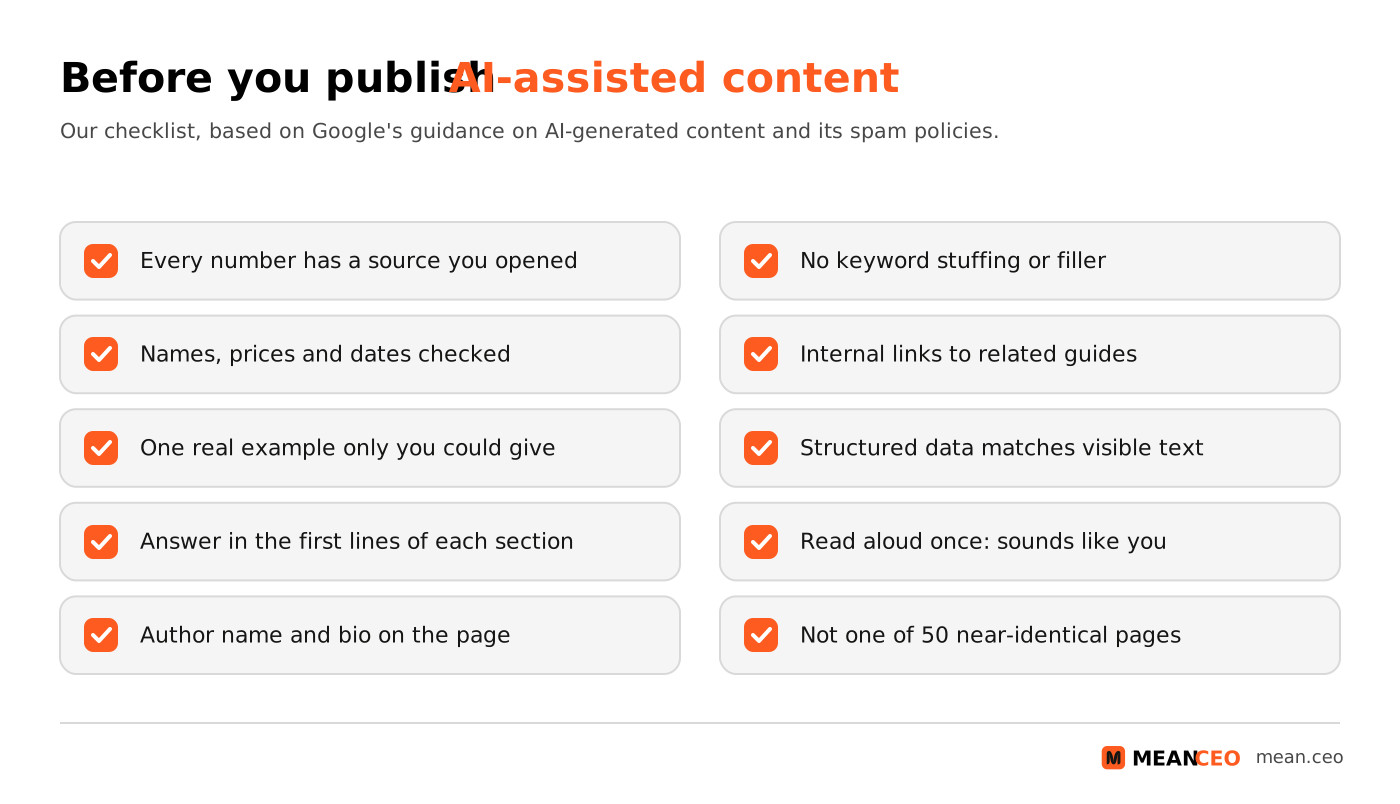
Best Practices for SEO Success in 2026
- Answer first: Put a clear, quotable answer in the first lines under each heading. It helps featured snippets, AI Overviews and assistants like ChatGPT and Perplexity.
- Create Hyper-Specific Content: Niche questions with clear intent are easier to win than broad terms, and AI assistants often pull from the page that answers the exact question.
- Refresh your best pages: Update facts, prices and dates when they change, and say what changed. Google’s ranking systems favour fresh content for queries where people expect it, such as news or new products.
- Show E-E-A-T: Experience, expertise, authoritativeness and trust are how Google’s raters judge quality. Show real author bios, first-hand examples and sources, especially for technical content.
A Budget AI SEO Tool Stack
You don’t need an enterprise suite. Start free, then pay for one tool when the free data stops answering your questions: For every tool’s free plan and entry price, see our guide to free and affordable SEO tools for bootstrapped founders.
Prices from each vendor’s pricing page, monthly billing, viewed from Europe in October 2026; annual billing is cheaper, and Ubersuggest lists prices in US dollars.
For a longer, tool-by-tool comparison, see our AI SEO guide for startups on the Mean CEO blog.
Getting Found in AI Search Beyond Google
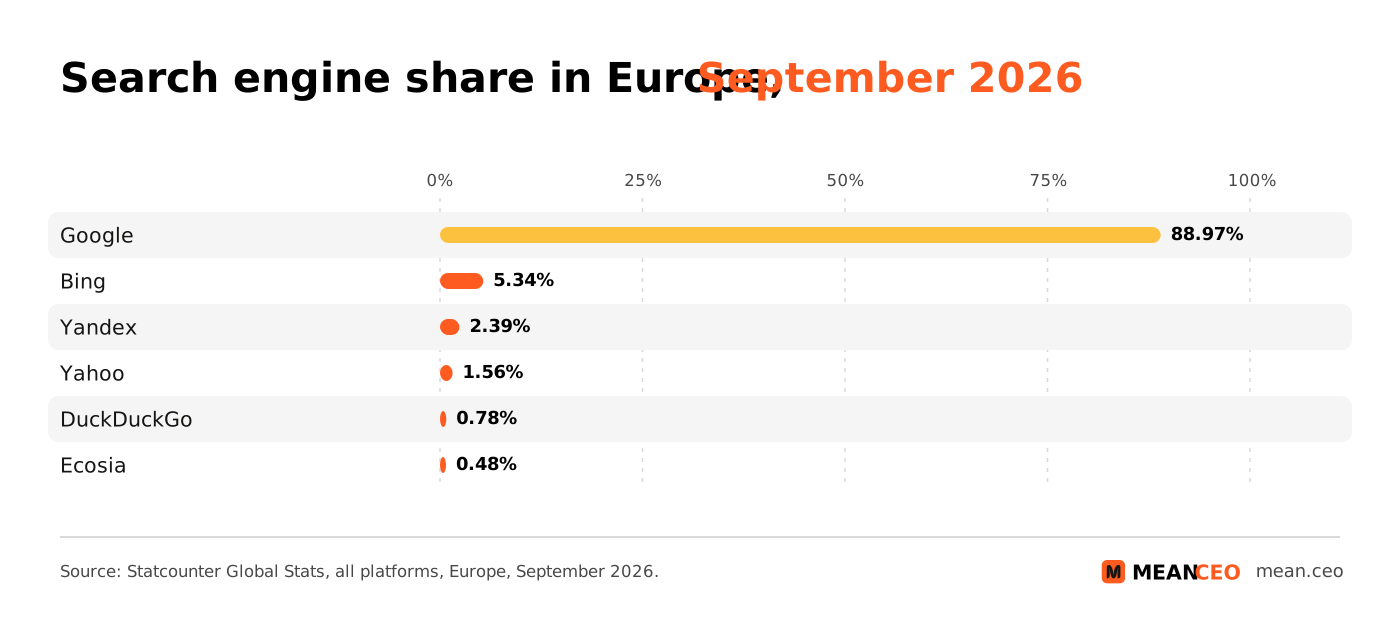
Google still handles most searches in Europe: Statcounter put its share at 88.97% in September 2026, against 5.34% for Bing. But Bing’s index also feeds Microsoft Copilot, and since February 2026 Bing Webmaster Tools has an AI Performance report that shows when Copilot and Bing’s AI summaries cite your pages. Google added generative AI reports to Search Console in June 2026: they show your impressions in AI Overviews and AI Mode, while clicks from those features stay in the normal Performance report. Verify your site in both tools, submit your sitemap and turn on IndexNow so Bing hears about new pages quickly. For ChatGPT, Claude and Perplexity, the same habits help: a direct answer under each heading, facts with sources that are easy to quote, and a visible author.
A Weekly AI SEO Routine for a Two-Person Team
Here’s a routine that fits around a founder’s week. The hours are our estimate for one new article plus upkeep:
Source: our assessment. Writing for SEO? Our guide on how to write SEO content that converts covers the editing side.
Wondering How to Rank Without Backlinks?
Semantic SEO is changing the game for startups!
👉 Discover How to Rank on Google Without Backlinks
Final Takeaways: The Road Forward
SEO for startups is changing fast under the influence of AI. For bootstrapped founders, especially in Europe, where small teams compete with well-funded players across many languages and markets, this change creates more opportunities than risks.
By using AI well, you compete on how smart you work rather than on budget size. Start small, simplify your keyword research, answer real questions clearly, and adjust using your own Search Console data. Results take months, not weeks, but pages that answer real questions keep bringing visitors long after you publish them.
If you're ready to take the leap beyond SEO and explore integrated marketing systems, learn how to scale content marketing from zero to 100k visitors seamlessly.
Boost your startup visibility with content that ranks in AI search tools!
More buyers now ask AI assistants before they open Google. Is your startup ready to be found and quoted by ChatGPT, Perplexity and Grok?
👉 Rank your startup on ChatGPT
People Also Ask:
What is AI-powered SEO optimization?
AI-powered SEO uses AI tools to speed up search optimization: grouping keywords, drafting content, writing meta descriptions and schema, and summarising audit and analytics data. Tools such as ChatGPT, Claude and the AI features in Semrush, SE Ranking or Moz Pro do the repetitive work, while a person sets the strategy and checks the output.
Is SEO dead or evolving in 2026?
SEO is evolving, not dead. People now get answers from AI Overviews, AI Mode and chat assistants as well as from blue links, and those AI answers are built from web pages. Google’s own guidance says the same SEO best practices apply to its AI features. Clear answers, solid technical basics and trustworthy content matter more than ever.
What is the 30% rule for AI?
There’s no official “30% rule” for AI in SEO, and Google sets no limit on how much of a page AI may write; its rules are about purpose and quality. People use the phrase loosely, for example for a 70/30 habit where AI produces the draft and a human adds the final 30%: facts, examples and the edit. Some institutions set their own caps, such as a 30% limit on AI-generated course material, but that’s local policy, not a standard.
What is the 80-20 rule in SEO?
The 80-20 rule in SEO posits that 80% of results come from 20% of efforts. For startups, focusing energy on high-ranking keywords, structured formatting, and user-focused content yields the most impact with minimal output, making it particularly useful for small teams facing limited resources.
How are female entrepreneurs leveraging AI for SEO growth?
The same way as any bootstrapped founder: they use free tools such as Search Console and Bing Webmaster Tools, AI assistants for keyword clustering and drafts, and their own expertise for the parts AI can’t fake. Violetta Bonenkamp, the author of this guide, bootstraps her startups and uses AI to research and structure content, while keeping the facts, examples and final edit human. Organic search costs time rather than ad money, which suits founders who bootstrap.
What are effective SEO strategies for small business websites in 2026?
Answer specific customer questions on dedicated pages, keep the site fast on mobile, claim your Google Business Profile if you serve local customers and link related pages together. Plugins such as Rank Math or Yoast help WordPress sites with titles, sitemaps and schema, and most website builders, Tilda included, cover the basics too.
How do startups with limited budgets compete using advanced SEO?
They compete where big players are weak: long-tail questions, local searches and niche topics. Use free tools like Google Business Profile, Search Console and Bing Webmaster Tools, and use AI to produce better pages faster. Enterprise platforms like BrightEdge are built for large companies; a small team gets more from one affordable keyword tool and a strong editing habit.
What are AI-driven SEO tools for women-founded businesses?
The same tools as any business. A typical lean stack: Google Search Console and Bing Webmaster Tools (free), an AI assistant on a free or paid plan, one keyword tool on its entry plan, and Rank Math or Yoast on WordPress. Premium content tools such as Clearscope or Similarweb make sense later, when content is already bringing customers.
Can AI replace manual SEO processes entirely?
No. AI handles many tasks, like keyword clustering, drafts and audit summaries, but strategy, fact-checking and first-hand experience need a person. Google’s spam policies also target pages generated at scale with little value for readers, so fully automated publishing is a risk.
What are the benefits of AI SEO automation for growing startups?
AI automation cuts costs, reduces time spent on repetitive tasks, and helps startups identify untapped keyword opportunities. By combining data learning with actionable insights, businesses can streamline their SEO efforts and focus resources on scaling toward growth goals efficiently.
FAQ on AI-Powered SEO for Resource-Constrained Startups
What makes AI-powered SEO cost-effective for startups?
AI tools speed up keyword research, content drafts and technical audits, which reduces dependence on expensive agencies and consultants. Many founders run their SEO on free tools plus one paid subscription, and spend the saved money on the editing and fact-checking that make the content worth ranking.
How can startups implement AI SEO to rank on zero-click queries?
Write question-based content with a clear answer in the first lines, cover follow-up questions and keep facts easy to quote. Don’t count on FAQ markup: Google limited FAQ rich results to well-known government and health sites in August 2023 and stopped showing them for all sites in May 2026, and it needs no special schema for AI Overviews. Learn more about crafting impactful SEO SOPs.
Can startups use AI SEO without technical skills?
Yes. Website builders such as Tilda, Webflow or WordPress with an SEO plugin handle titles, sitemaps and mobile layouts without code, and an AI assistant can explain any audit warning in plain English. Tools like SE Ranking or Ubersuggest give on-page suggestions and keyword tracking with little technical knowledge.
How does AI enhance keyword research for startups?
AI assistants are good at expanding a seed topic into related questions and grouping keywords by intent. They don’t have reliable search volumes, so check their ideas against Search Console, Bing Webmaster Tools or a keyword tool before you write. Claude Skills can turn these steps into a repeatable workflow. Explore Claude Skills for targeted SEO.
How can small teams maintain SEO quality using AI tools?
Let AI do the repetitive tasks, such as meta descriptions, audit summaries and outlines, and keep a fixed human checklist for every page: facts checked, sources linked, one real example, author shown. A checklist keeps quality steady even when one person publishes several articles a week.
What is the role of E-E-A-T in AI-driven SEO?
E-E-A-T stands for experience, expertise, authoritativeness and trustworthiness. Google’s guide to helpful content says E-E-A-T itself isn’t a specific ranking factor, but its systems use a mix of signals that identify content with good E-E-A-T. Show who wrote the page, add first-hand examples and cite sources; the same signals make it easier for AI assistants to trust and quote you.
Why is content refreshing essential for startups leveraging AI SEO?
Facts, prices and tools change fast, and outdated pages lose clicks and trust. Google’s ranking systems also favour fresh content for queries where people expect it. Review your best pages every few months, update what changed and use Search Console to spot pages whose clicks are falling.
What are common mistakes startups should avoid in AI SEO?
Publishing unedited AI text, trusting AI-generated statistics, keyword stuffing, mass-producing near-identical pages and ignoring Bing. Focus on user-centred, detailed content and check every fact before you publish.
How can startups measure ROI from AI SEO investments?
Track clicks, impressions, average position and indexed pages in Search Console and Bing Webmaster Tools, then follow organic visitors to sign-ups or sales in your analytics. Compare that with what you spend on tools and hours to see the real return.
Is AI SEO scalable for long-term startup growth?
Yes, AI tools provide scalability by automating complex processes like content creation and technical SEO audits. Startups can continuously refine their strategies using AI-powered predictive insights, enabling sustainable growth without proportional increases in time or labor.
About the Author
Violetta Bonenkamp, also known as MeanCEO, is an experienced startup founder with an impressive educational background including an MBA and four other higher education degrees. She has over 20 years of work experience across multiple countries, including 5 years as a solopreneur and serial entrepreneur. Throughout her startup experience she has applied for multiple startup grants at the EU level, in the Netherlands and Malta, and her startups received quite a few of those. She’s been living, studying and working in many countries around the globe and her extensive multicultural experience has influenced her immensely.
