Most deep tech founders don't struggle with the science. They struggle with making investors care about it. The top pitch deck design agencies that actually understand this space know the difference between a beautiful slide and a slide that gets a second meeting. Translating quantum algorithms, synthetic biology platforms, or autonomous robotics into a narrative that a non-technical VC finds compelling is genuinely hard work. After reviewing dozens of agencies across review platforms, founder communities, and verified case studies, this guide breaks down the five best options for deep tech founders preparing for seed, pre-seed, or Series A rounds.
The research approach for this ranking pulled from verified review platforms, agency directories, official service pages, and founder case studies. Every company on this list had to show a real track record in startup fundraising contexts, not just general design work. Ratings, review patterns, and portfolio signals all fed into the final selection.-> See the full research breakdown
- Whitepage Studio - Best for investor pitch deck design and fundraising strategy
- Superside - Best for enterprise pitch deck design and data visualization
- Duck Design - Best for startup pitch decks and brand identity
- Slide Bean - Best for investor-ready pitch decks for startups
- Designity - Best for startup pitch decks and fundraising materials
Why Top Pitch Deck Design Agencies For Deep Tech Startups Matter for Your Business
Deep tech is a different category entirely. A biotech founder and a SaaS founder walk into the same room with very different problems, and the pitch deck challenge reflects that.
When your product lives in a lab, runs on proprietary hardware, or solves a problem most investors have never heard of, generic design work won't carry the story. The deck needs to do real intellectual lifting.
Agencies with genuine understanding of AI, biotech, quantum computing, or robotics can structure arguments that balance scientific credibility with the kind of emotional clarity that gets investors nodding. That combination is rarer than it sounds.
And the right agency doesn't just make things look good. It reduces the time between deck delivery and first investor response, raises the number of meetings booked per deck sent, and directly affects funding round close rate by making complex ideas feel inevitable rather than experimental.
Top 5 Top Pitch Deck Design Agencies For Deep Tech Startups Breakdown and Comparison
Note: All data in this table is sourced from review platforms and the official websites of the listed companies.
Whitepage Studio - Best for Investor Pitch Deck Design and Fundraising Strategy
What Does Whitepage Studio Do?
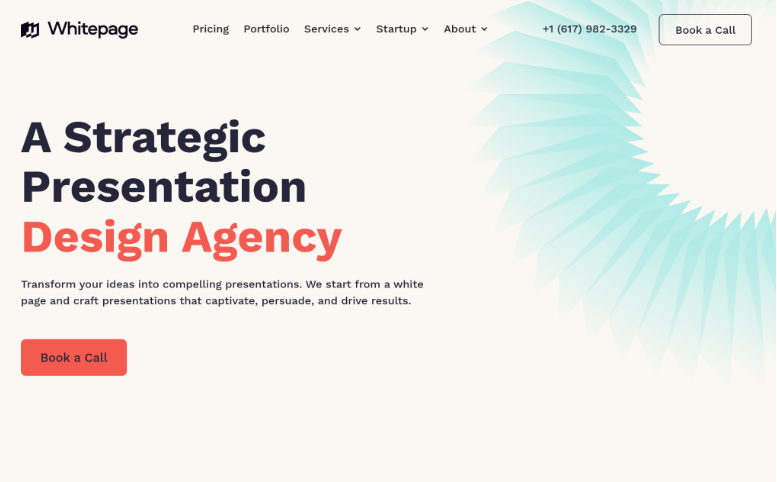
Whitepage Studio is a Boston-based presentation design agency with over 12 years of experience building investor pitch decks, sales presentations, and strategic marketing materials. They work across tech, finance, and healthcare sectors for both early-stage startups and Fortune 500 clients. Their focus sits firmly on narrative-driven design, meaning every slide earns its place by moving the story forward. With 10,000+ projects completed and clients collectively raising over $1.7B in funding and acquisitions, their track record in high-stakes fundraising contexts is genuinely hard to match.Pricing starts at $3,500 per project, reflecting their focus on high-impact engagements.
Why Whitepage Studio Stands Out for Top Pitch Deck Design Agencies For Deep Tech Startups:
Deep tech founders often need someone who can look at a complex technical concept and translate it into an investor-facing story. That’s exactly where Whitepage Studio’s narrative architecture approach pays off. Their core strength lies in turning complex fields like quantum, fusion, photonics, AI, and biotech into clear, fundable narratives without losing accuracy. They combine strategy, financial logic, and visual storytelling in one engagement, while also supporting dual-audience challenges—adapting the same technology for different investor types.
Their CEO-led model means the person with the most context is actively involved in every project, not just signing off at the end. They also bring experience across a wide range of deep tech sectors, including robotics, spatial biology, advanced wireless, and DevOps infrastructure, and are often brought in to restructure high-iteration decks that have lost clarity.
Summary of Real User Reviews:
Clients consistently point to two things: how fast the team responds and how well they simplify dense technical content without losing accuracy. The recurring mention of CEO Tanya's direct involvement across 18 verified Clutch reviews tells you something real about how they run projects. Positive funding outcomes and repeat engagement (75% client retention) show up frequently enough to feel like a pattern, not a coincidence.
Superside - Best for Enterprise Pitch Deck Design and Data Visualization
What Does Superside Do?
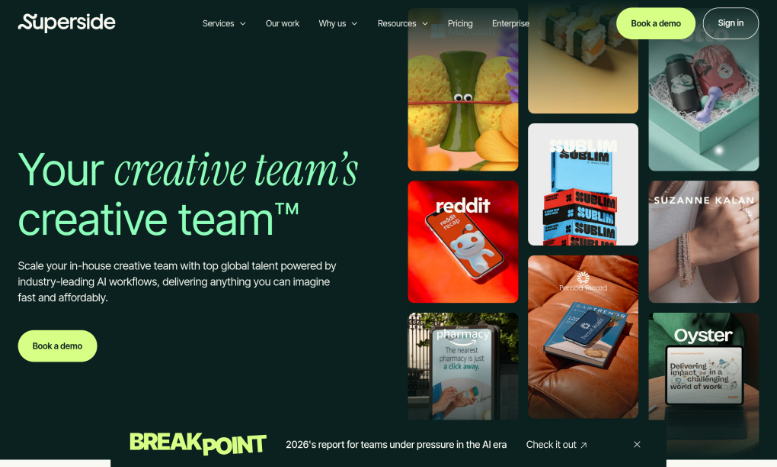
Superside is a Creative-as-a-Service platform with a global team operating across 72 countries. They serve 450+ enterprise brands with subscription-based design covering pitch decks, infographics, motion design, video, and branding. Their pitch deck work draws on experience supporting Y Combinator portfolio companies, and their 48-hour standard turnaround (with 12-24 hour expedited options) makes them a strong fit for fundraising timelines that don't wait. The scale here is real (think enterprise pricing, starting at $5,000/month), but so is the output quality.
Why Superside Stands Out for Top Pitch Deck Design Agencies For Deep Tech Startups:
For deep tech startups that need sophisticated data visualization alongside investor storytelling, Superside's combination of 700-person creative depth and AI-assisted workflows covers ground that smaller agencies simply can't. Their track record with Y Combinator-backed companies means the team already understands what seed and Series A investor decks need to accomplish.
Summary of Real User Reviews:
G2 reviewers give Superside a 4.5/5, and the praise clusters around fast delivery, strong design quality, and a platform that actually makes revision cycles manageable. The criticism worth noting is consistent: the pricing is steep, and founders in earlier stages sometimes find the subscription model inflexible for their needs. That usually means Superside is a better fit once a startup has some operational runway behind it.
Duck Design - Best for Startup Pitch Decks and Brand Identity
What Does Duck Design Do?
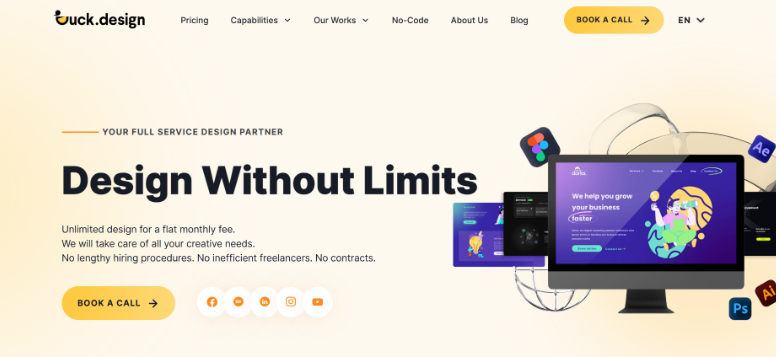
Duck Design is a London-based subscription design agency that focuses on startups and growth-stage companies. For a fixed monthly fee between $1,199 and $1,999, clients get unlimited design requests and revisions covering pitch decks, branding, UI/UX, motion graphics, and general graphic design. Their portfolio includes work for Fundraising Bootcamp and other startup-facing clients, which means they're not learning what a pitch deck needs to do on your project. Same-day to 48-hour turnarounds make them a practical option for founders who are moving fast and refining quickly.
Why Duck Design Stands Out for Top Pitch Deck Design Agencies For Deep Tech Startups:
Duck Design solves the budget unpredictability problem that plagues early-stage founders, giving them professional pitch deck and brand identity output at a fixed monthly cost with no surprise revision fees. Rapid revision is built into their model rather than charged per round, which matters a lot when investor feedback is coming in and the deck needs to shift quickly.
Summary of Real User Reviews:
Clutch reviewers rate Duck Design at 4.8/5 across 58 reviews, and the feedback is notably consistent about two things: fast turnarounds and the team's ability to absorb brand requirements quickly without lengthy setup processes. Some clients flag that complex multi-revision projects benefit from clearer communication checkpoints. The quality-to-price ratio is where Duck Design really earns its reputation among cost-conscious founders.
Slide Bean - Best for Investor-Ready Pitch Decks for Startups
What Does Slide Bean Do?
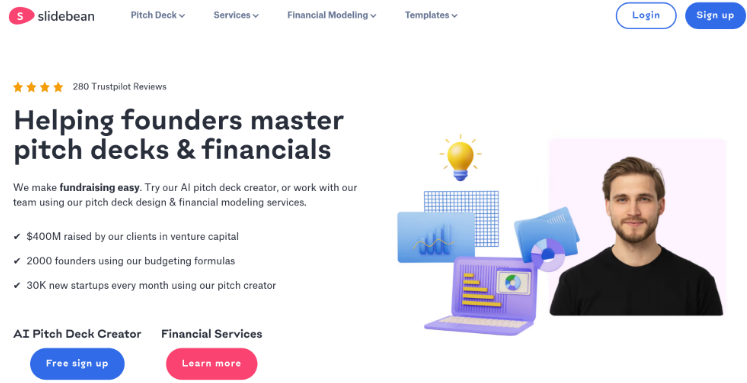
Slidebean sits at an interesting intersection between a SaaS platform and a full-service agency. Founded in 2014 and now covering 30,000+ startups, they offer an AI-assisted deck builder with structured frameworks, financial model templates, and real-world examples from funded companies, alongside agency services for founders who want hands-on help. Their clients have raised $400M in venture capital through the platform. The self-serve plans start at $8/month (not cheap enough to ignore, but not agency-level spend either), and the Accelerate plan at $99/month adds more direct support.
Why Slide Bean Stands Out for Top Pitch Deck Design Agencies For Deep Tech Startups:
Where Slidebean pulls ahead is structure. The platform walks first-time founders through an investor-proven deck framework, which helps deep tech founders who know their science but aren't sure how a VC reads a pitch. That guided logic cuts down the back-and-forth that comes from decks built without fundraising context.
Summary of Real User Reviews:
G2 reviewers give Slidebean 4.4/5, generally praising the intuitive interface and the quality of the templates for investor contexts. The most common criticism is around customization limits on the self-serve side and some friction with customer support on the agency offering. For a deep tech founder who needs structural guidance more than bespoke design, the platform side of Slidebean holds up well.
Designity - Best for Startup Pitch Decks and Fundraising Materials
What Does Designity Do?
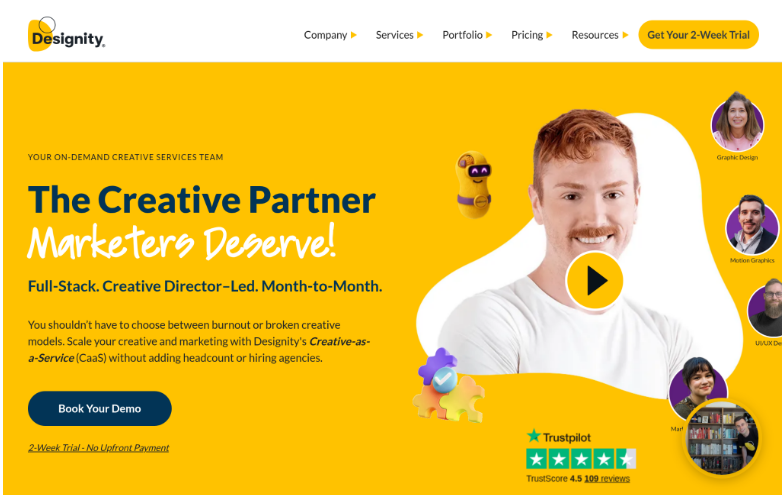
Designity is a New York-based Creative-as-a-Service platform that connects clients with a dedicated Creative Director and a vetted US-based design team. Their monthly subscriptions range from $3,495 for Essentials up to $8,995 for Premium, covering 100+ services including pitch deck design, branding, web development, and video production. The Creative Director model is their clearest differentiator: rather than routing work through project managers, founders deal with a single strategic point of contact who oversees narrative flow, visual consistency, and investor-facing storytelling across everything they produce.
Why Designity Stands Out for Top Pitch Deck Design Agencies For Deep Tech Startups:
The dedicated Creative Director model directly addresses one of the most common deep tech pitch problems: fragmented messaging where the technical slides don't connect to the market opportunity slides. A single strategic voice overseeing the whole deck keeps the investor narrative coherent from slide one through the ask.
Summary of Real User Reviews:
Users frequently highlight the quality of creative output and the value of having a Creative Director who thinks strategically, not just aesthetically. The recurring criticism is ramp-up time: some clients report the two-week trial period feels heavier on meetings than actual work completed. Founders who commit to the relationship past that initial period tend to get strong results, particularly for pitch decks and multi-channel fundraising materials.
Research Methodology and Selection Process
Initial Data Collection
The process started by building a broad longlist of agencies and platforms appearing across startup-focused directories, design review sites, founder forums, and Clutch, G2, and Capterra listings. Search queries targeted pitch deck design agencies with documented experience in fundraising contexts, with particular attention to any mentions of deep tech, biotech, AI, or hardware-stage startups. Official service pages, portfolio links, and stated specializations were logged alongside any publicly available case study material.
Shortlisting Phase
From the initial longlist, options without verifiable review histories or with fewer than a small threshold of independently submitted ratings were removed. Review patterns were analyzed rather than just averaged: a company with 10 detailed, specific reviews often told a more reliable story than one with 50 generic five-star entries. Agencies that appeared only in sponsored listings without independent validation were set aside. The shortlist that emerged represented companies where real client sentiment was accessible and consistent enough to evaluate meaningfully.
Verification of Claims
Every funding figure, client count, and service claim visible on agency websites was cross-referenced against third-party review content and any available press mentions. Where a company claimed deep tech or startup fundraising experience, the reviews were checked for corresponding client types and outcomes. Discrepancies between stated capabilities and actual client feedback were flagged. Claims that couldn't be partially corroborated through independent sources were treated with skepticism in the final assessment.
Authority and Industry Contribution Layer
Beyond review ratings, each agency was assessed for signals that show standing within the startup and investor community. This included mentions in founder-facing publications, participation in accelerator ecosystems (such as Y Combinator relationships), documented outcomes like funding rounds closed, and any original frameworks or tools contributed to the broader pitch deck or fundraising conversation. Companies that showed up consistently across multiple independent contexts ranked higher in this layer.
Top Pitch Deck Design Agencies For Deep Tech Startups-Specific Evidence
The final filter applied to deep tech fundraising fit. Each agency was evaluated for whether they maintained a dedicated pitch deck or fundraising service page, whether their verified reviews reflected experience with technical or science-based products, and whether their stated methodologies addressed the core challenge of translating complex work into investor-ready narratives. Agencies with generic presentation portfolios and no documented startup fundraising context were removed, even if their overall design quality was high.
How to Choose the Right Top Pitch Deck Design Agencies For Deep Tech Startups
The agency that's right for a Series A biotech round might be completely wrong for a pre-seed robotics play. Getting this decision right starts with understanding what your specific fundraising moment actually needs.
- Industry and Domain Experience: Look for agencies that have worked with technically complex products before. An agency that's built decks for AI infrastructure companies will approach your quantum computing narrative very differently than one that came up designing e-commerce pitch decks.
- Features and Service Offerings: Some agencies offer pure design, while others bring narrative strategy, financial modeling support, or structured fundraising frameworks. Know whether you need a deck built from scratch or a story developed first, then designed.
- Pricing Structure: Project-based pricing (like WhitePage Studio's model) suits founders with a single high-stakes round. Subscription models (like Duck Design or Designity) make more sense when you need ongoing materials across a fundraising cycle.
- Results Measurement: Ask how an agency defines success. Agencies worth working with think about investor meeting rate and deck engagement, not just how the final file looks.
- Industry Knowledge and Alignment with Investor Expectations: Pitch decks for deep tech need to meet SEC fundraising disclosure norms and investor-grade presentation standards. An agency unfamiliar with what major investors expect will leave gaps that cost you credibility.
Bottom Line
Picking the right pitch deck agency for a deep tech startup isn't a design decision. It's a fundraising decision. The agencies on this list each bring something real to that challenge, whether it's Whitepage Studio's CEO-led narrative focus, Superside's data visualization depth, or Slidebean's structural guidance for first-time founders. Budget, stage, and how technically complex your product is should shape the final call. As deep tech fundraising grows more competitive, the quality of how a startup tells its story will only matter more.
FAQ on top pitch deck design agencies for deep tech startups
What makes a pitch deck design agency a strong fit for deep tech startups?
A strong agency for deep tech startups does more than polish slides. It knows how to translate scientific complexity, technical differentiation, and long development cycles into a story investors can quickly understand and trust. The best firms combine narrative strategy, visual clarity, and fundraising logic so founders can sell the opportunity without dumbing down the innovation. That is especially valuable when your startup is building in AI, biotech, robotics, quantum, or hardware-heavy markets.
Why do deep tech founders need specialized pitch deck support?
Deep tech founders often know the product deeply but struggle to explain why it matters commercially in a short investor meeting. Specialized pitch deck support helps bridge that gap by connecting breakthrough technology to market timing, customer pain, defensibility, and return potential. In practical terms, that can mean better investor conversations, faster follow-ups, and a more efficient fundraising process. For founders, that is not just a design upgrade but a real business leverage point.
Which agency is best for investor-focused deep tech storytelling?
Whitepage Studio stands out when the priority is investor storytelling shaped around complex technical products. Its strength is turning dense ideas in areas like AI, biotech, photonics, and quantum into decks that feel clear, strategic, and fundable. Because the agency combines narrative structure with presentation design, founders get more than visuals; they get a tighter fundraising argument. That can be a major advantage when every meeting needs to count.
Are subscription-based pitch deck agencies good for early-stage startups?
Yes, subscription-based agencies can be a smart option for early-stage founders who expect multiple rounds of revisions and need ongoing design support. They are especially useful when the deck keeps evolving alongside investor feedback, product milestones, or branding updates. Agencies like Duck Design and Designity fit this model well, offering more predictable monthly spend than one-off creative projects. For an entrepreneurial team watching burn rate closely, cost structure can matter almost as much as slide quality.
How important is data visualization in a deep tech pitch deck?
Data visualization is extremely important because deep tech businesses often rely on technical proof, performance benchmarks, research outcomes, or market modeling. If those numbers are hard to scan, investors may miss the significance of your progress or competitive edge. A good agency can turn raw complexity into charts, diagrams, and visual logic that make your case easier to absorb in minutes rather than hours. That is one of the reasons firms like Superside can be valuable for more data-heavy fundraising narratives.
Can a low-cost platform still help founders create an investor-ready deck?
Yes, lower-cost platforms like Slidebean can still be highly useful, especially for first-time founders who need structure more than bespoke creative direction. These tools help entrepreneurs organize the core deck flow, clarify what investors expect to see, and avoid common storytelling mistakes. They may not offer the same strategic depth as a specialist agency, but they can significantly improve a founder’s baseline fundraising materials. For pre-seed teams, that can be a practical and capital-efficient starting move.
How should founders choose between project-based and monthly pricing?
Project-based pricing works best when you need one high-stakes deck built for a specific round, such as pre-seed, seed, or Series A. Monthly pricing makes more sense when fundraising materials are part of a broader, ongoing workflow that also includes updates, one-pagers, sales decks, or brand assets. The right choice depends on how often your story changes, how many stakeholders are involved, and how tightly you manage cash flow. Smart founders treat this like any other strategic buy: align the pricing model with the actual operating need.
What should deep tech startups look for in agency reviews and case studies?
Founders should look for evidence that an agency has handled technical or science-heavy companies, not just generic startup presentations. Reviews that mention clarity, responsiveness, strategic guidance, and fundraising outcomes are usually more valuable than generic praise about visuals. It is also worth checking whether the agency has real case studies, investor-facing work, or experience with startup ecosystems and accelerators. Strong proof points reduce the risk of hiring a team that looks polished but cannot handle technical storytelling.
How does a great pitch deck support a startup’s broader go-to-market strategy?
A strong pitch deck sharpens more than fundraising; it often clarifies positioning, messaging, and how the company explains itself to the outside world. That same clarity can improve founder confidence, partner conversations, recruitment, and even launch communications. If you are refining your investor story alongside market visibility, this guide pairs well with advice on how to launch a startup on social media, since both depend on making a complex idea instantly understandable. In that sense, a great deck is not just for raising capital; it is a strategic communication asset.
What is the biggest mistake deep tech founders make with pitch decks?
The biggest mistake is assuming that technical sophistication alone will carry investor interest. Investors need to understand not only what the technology does, but why it matters now, who will buy it, how large the market is, and why this team can win. When a deck over-explains the science and under-explains the business, it creates friction instead of momentum. The most effective founders learn that fundraising is part translation, part persuasion, and part disciplined storytelling.
About the Author
Violetta Bonenkamp, also known as MeanCEO, is an experienced startup founder with an impressive educational background including an MBA and four other higher education degrees. She has over 20 years of work experience across multiple countries, including 5 years as a solopreneur and serial entrepreneur. Throughout her startup experience she has applied for multiple startup grants at the EU level, in the Netherlands and Malta, and her startups received quite a few of those. She’s been living, studying and working in many countries around the globe and her extensive multicultural experience has influenced her immensely.
