TL;DR: Refreshing Old Content Supercharges SEO
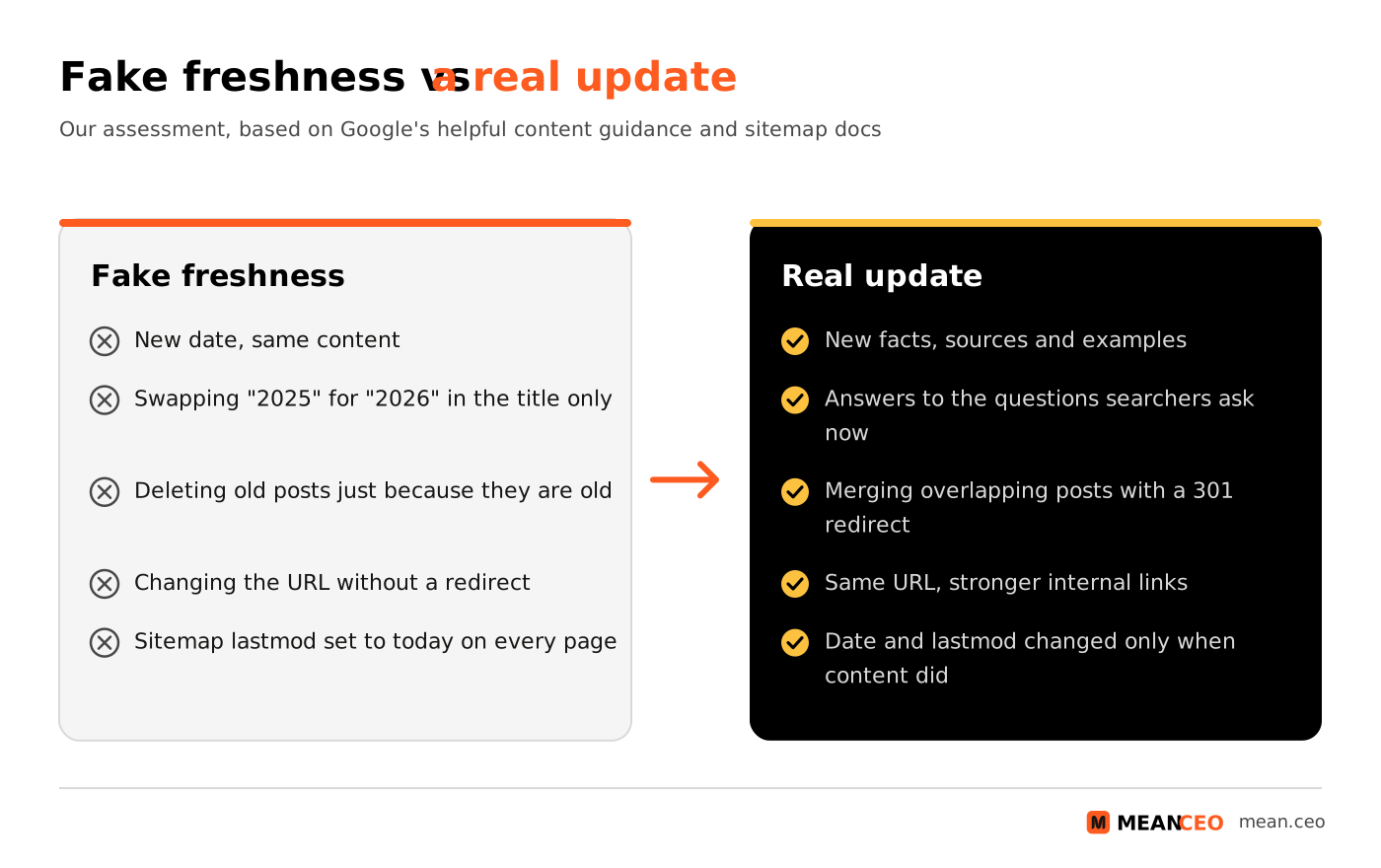
Updating old pages is one of the cheapest ways for a bootstrapped startup to win back search traffic. Use Google Search Console to find pages that lost clicks or sit on page two, check what ranks for their queries today, then update the facts, structure and links on the same URL. Change the visible date only when the content really changed: Google’s own checklist asks whether you’re “changing the date of pages to make them seem fresh when the content has not substantially changed”. Merge overlapping posts with a 301 redirect, and don’t delete posts just because they’re old.
💡 Explore more ways to grow your startup’s organic reach without backlinks in SEO for Startups: Building Organic Traffic Without Backlinks.
How to Update Old Content for Better Rankings
If you're wondering how to update old content for better rankings, you're already ahead. Many startups fail to leverage their existing resources, leaving behind undervalued assets that could drive traffic and conversions. In Europe, where bootstrapped ventures often thrive on resilience and efficiency, optimizing outdated content is a pathway to sustainable growth.
As a female entrepreneur bootstrapping several ventures across deeptech, education and AI tooling, Violetta Bonenkamp has found that refreshing existing content is often more efficient than endlessly creating new material. Here’s how founders can win back search visibility through strategic updates and avoid the common pitfalls.
“On most sites a small group of pages brings in most of the traffic. Identifying and refreshing those pages is one of the quickest wins for any startup looking to scale its organic reach.” – Violetta Bonenkamp, Mean CEO
Want to dominate Google rankings with refreshed content?
Learn how Violetta Bonenkamp rewrites her startup stories for maximum SEO impact.
👉 Write SEO Content That Converts
Why Updating Old Content Matters
Freshness matters, but not for every search. Google says it has various “query deserves freshness” systems “designed to show fresher content for queries where it would be expected”, such as reviews of a film that just came out. For an evergreen question, an older page that answers it well can keep ranking for years. So the point of an update isn’t a new date: it’s making the page more accurate and more useful than what ranks today.
Our assessment. When you’re unsure, search the query yourself: if page one is full of recent dates, freshness counts for it.
For startups, especially bootstrapped ones, optimized old content reduces the cost of acquiring visitors while improving organic traffic. Refreshing these pages lets you reclaim lost traffic, increase relevancy, and target emerging keywords quickly without having to reinvent the wheel.
Updating content also helps with what Google calls E-E-A-T (Experience, Expertise, Authoritativeness and Trustworthiness). Google says E-E-A-T itself isn’t a specific ranking factor, but its systems look for signals of content that shows it. Revisiting old posts with first-hand experience, current sources and a named author is how a small startup shows those qualities.
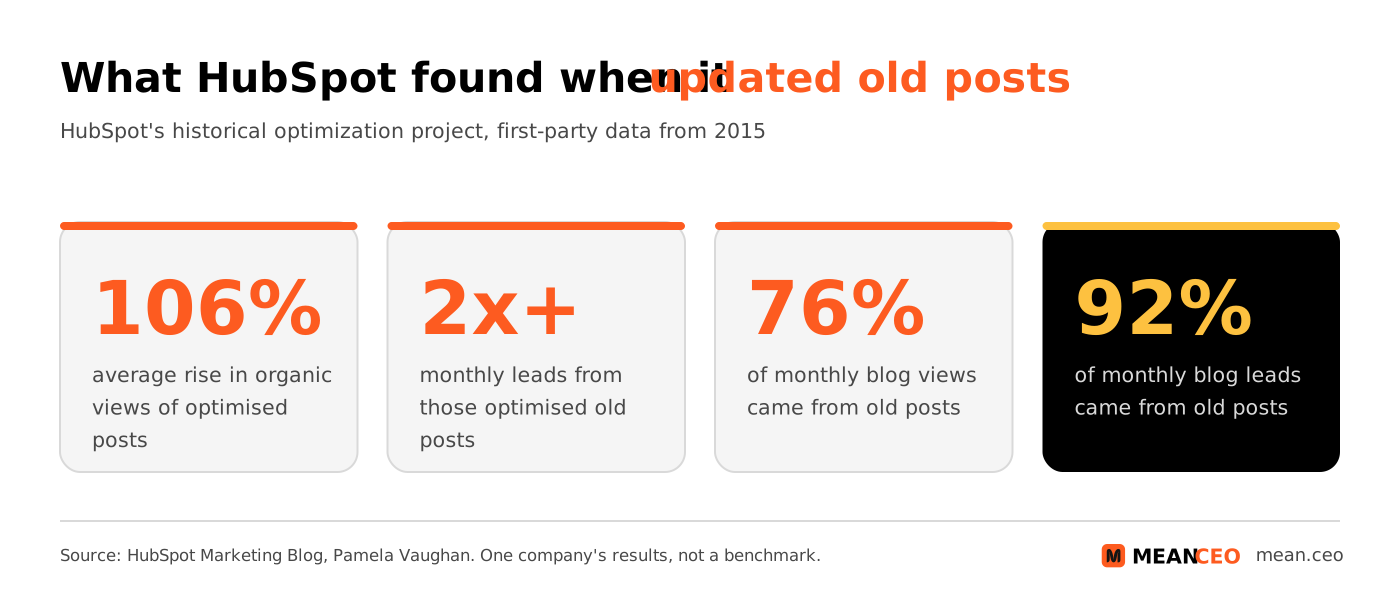
The best-known public case is HubSpot’s. When it began updating and republishing old blog posts, it reported that it had “more than doubled the number of monthly leads” from the optimised posts and increased their monthly organic search views “by an average of 106%”. The data dates from 2015 and comes from one large blog with a big back catalogue, so treat it as a sign of what’s possible, not a forecast for your site.
How to Identify Content Worth Updating
Rather than refreshing everything, focus on pages that have:
- High impressions but a low click-through rate (CTR)
- Clicks dropping over time (compare periods in Search Console)
- Rankings in positions 5–20 for important keywords
- Evergreen topics that still matter but need fresh data
- Facts that have changed: prices, laws, tools, screenshots
For example, Violetta often looks at Fe/male Switch articles that rank for education-related keywords but don’t bring enough sign-ups. She finds them in Google Search Console and turns stale posts into useful resources by rewriting them for today’s searchers.
“Let Google itself guide your priorities. The data you need lives in Google Search Console. Listen to what works and refine from there.”
How to Find Decaying Pages in Search Console
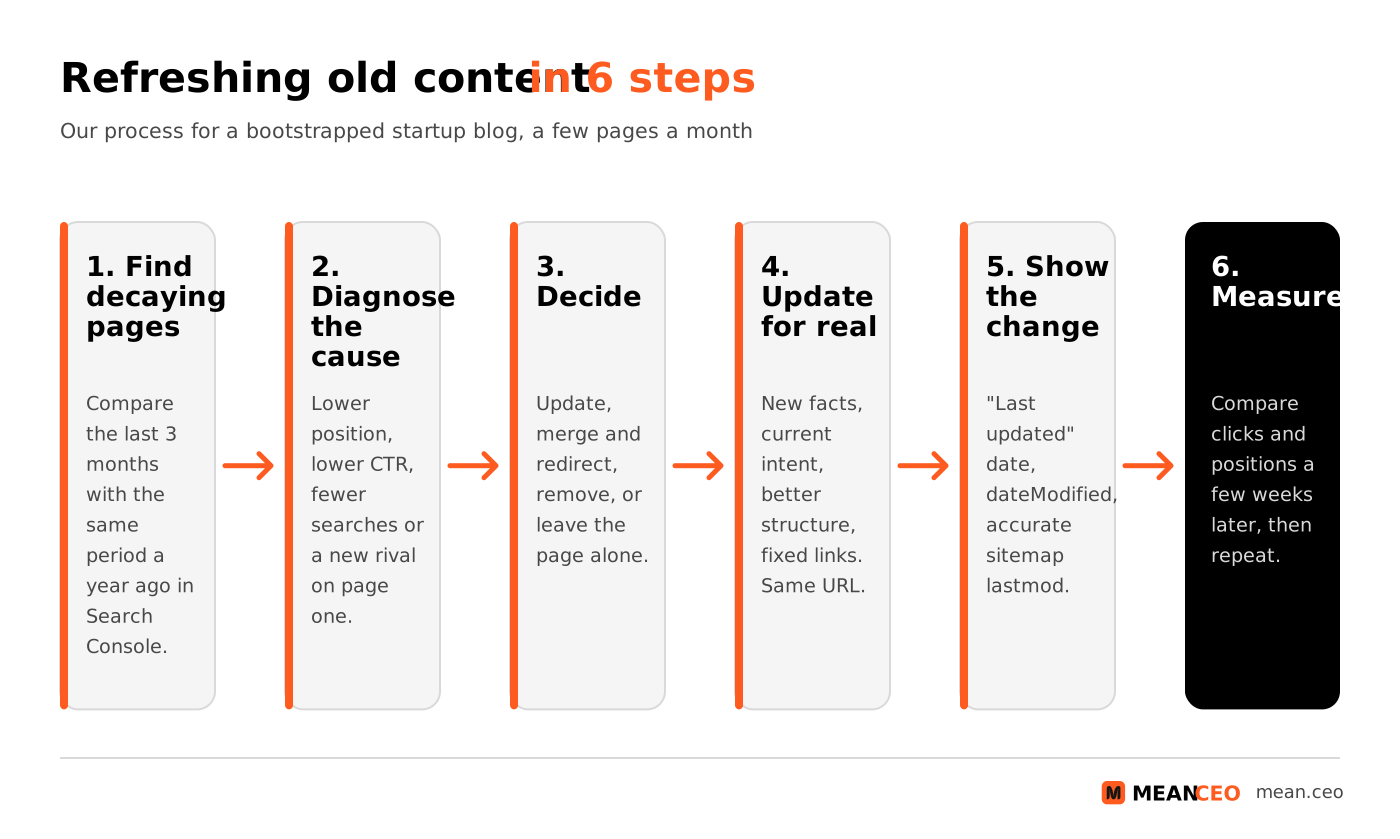
Open the Performance report, click the Date filter, choose Compare and set the last 3 months against the same 3 months a year earlier; Search Console keeps 16 months of data, so year-on-year works. Then open the Pages tab and sort by the clicks difference. The pages with the biggest losses go to the top of your list. Click one, switch to Queries, and you’ll see which searches it lost. Our guide to Google Search Console metrics that matter explains the report in more detail.
Our assessment, based on Search Console data. For drops that hit the whole site at once, see how to recover from Google algorithm updates.
Actionable Steps to Refresh Old Content
- Start with a keyword audit: In Search Console, filter by the page and list the queries it already gets impressions for. Tools like Semrush or Ahrefs add the queries competitors rank for.
- Check what ranks today: Search the main query and read the top results. If searchers now want a comparison table, a template or a short answer, your page must offer it.
- Update statistics and data: Replace outdated figures with current ones and name the source. This matters most for prices, laws and fast-moving sectors such as deeptech, edtech and sustainability.
- Enhance readability: Break long paragraphs into shorter ones and add H2 and H3 headings that match the questions people ask.
- Include new visuals: Updated screenshots, tables and charts make a page easier to scan and harder to copy.
- Fix links: Repair broken links, and link to the refreshed page from your newer posts on the same topic.
- Rewrite the title and meta description if clicks dropped: Google may still choose its own wording, so make the page itself answer the query clearly.
- Repurpose content: Turn the updated post into a LinkedIn carousel, a short video or a newsletter issue.
Titles and snippets are worth a look, but they’re not fully in your hands. Google says its title links are “completely automated” and that snippets are “primarily created from the page content itself”. A clear page beats a clever meta description.
Dates, Sitemaps and Reindexing
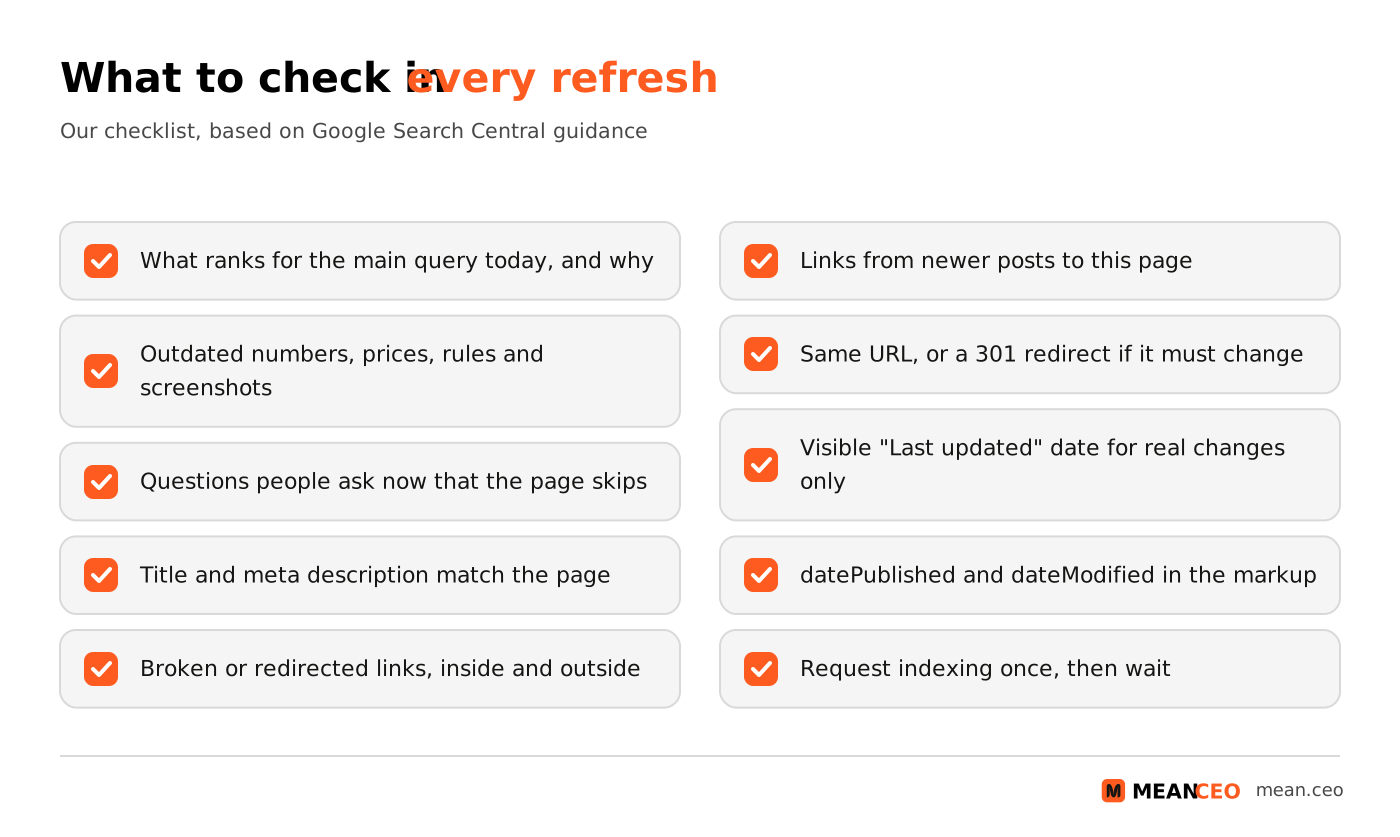
Google’s byline date guidance asks you to show a visible date labelled with text like “Publish” or “Last updated”, to fill in datePublished and dateModified in your structured data, and to keep your dates consistent. Update the date only after a substantial change: fixing a typo isn’t one. The same goes for your sitemap: Google uses the lastmod value only if it’s “consistently and verifiably” accurate, and ignores priority and changefreq.
After publishing, open the URL Inspection tool in Search Console and click Request indexing once. Google says there’s a quota and that requesting a recrawl multiple times for the same URL “won’t get it crawled any faster”. For many pages, submit a sitemap instead.
Update, Merge, Redirect or Delete?
Sources: Google Search Central on redirects and soft 404 errors; our assessment for the last two rows.
Tools for Refreshing Content on a Budget
Prices from vendors’ pricing pages, viewed from Europe on 30 October and 3 November 2026; Rank Math lists USD only, and Surfer now sits at surfer.ai. For crawl and indexing checks, see our technical SEO checklist.
Boost rankings through strategic interlinking.
Learn how to build clusters with related content from your own site and external partners.
👉 Drive Organic Traffic with Content Clusters
The Common Mistakes Startups Make
Updating without a plan wastes time. Avoid these:
- Changing URLs without redirects: the old URL returns an error, and its links and history are lost. Use a 301 redirect.
- Keyword stuffing: forcing in extra keywords breaks Google’s spam policies and reads badly.
- Changing only the date: Google’s helpful content checklist names it, and its byline date guidance asks for consistent dates.
- Deleting posts because they’re old: in 2023 Google’s Search Liaison wrote that the belief “Google doesn’t like ‘old’ content” is “not a thing”, adding: “Older content can still be helpful, too.”
- Ignoring competitors: results change, and the page that overtook you shows what searchers want now. Review competitor strategies to refine your refresh plan.
The European Perspective for Bootstrapped Founders
European startups face their own challenges: several languages, several markets and fast-changing rules. When you update a post, update every language version too, or they’ll contradict each other, and keep their hreflang links pointing at each other. Posts about VAT, GDPR, grants or employment rules age fastest, so check them first. Lean teams benefit most, because a refresh costs hours, not a new budget.
Violetta Bonenkamp uses regular updates, together with AI tools for drafting and checking, for ventures like Fe/male Switch. This approach keeps bootstrapped businesses competitive without outside funding. AI can speed up a refresh, but a person still has to check every fact; our guide to writing for SEO without sacrificing quality shows where to draw the line.
Updating content also strengthens your E-E-A-T. When refreshing posts, add real insights, first-hand experience and current recommendations for your audience. This works especially well for niche audiences, European grant seekers and founders who need credibility to win partners and funding.
Struggling to outshine your competitors?
Learn how competitor analysis simplifies SEO refresh strategies today.
👉 Competitor Content Analysis
Closing Thoughts
Refreshing content isn’t just an SEO tactic. It’s a business habit that fits the bootstrapped mindset: get more out of what you already have. For European founders running on grants and lean budgets, a few hours a month on updates is one of the best-value marketing tasks there is.
As you optimize your content strategy, consider how SEO pairs seamlessly with broader initiatives like building content clusters and leveraging AI-driven tools. And for your next step, dive deeper into strategic growth methods like building larger organic traffic streams through content marketing.
Track the results the same way you found the pages: compare clicks and positions a few weeks after the update with the weeks before, and with the same period last year. Our guide to SEO analytics for non-marketers shows which numbers to watch.
Are you getting customers from ChatGPT yet?
More and more traffic is coming from Perplexity, ChatGPT, Grok and other AI tools.
👉 Rank on ChatGPT
People Also Ask:
How do I update old content for SEO?
Start with the page’s data in Search Console: which queries it gets impressions for and where it lost clicks. Then check what ranks for those queries today, update outdated facts, add the questions the page skips, improve headings and images with descriptive alt text, and fix links. Rewrite the title and meta description if clicks dropped, keep the same URL and request indexing once you’re done.
How to optimize existing content for SEO?
Begin by reviewing your target keywords and aligning them within your text naturally. Break up long paragraphs with subheadings, utilize easy-to-read formats, and include high-quality, relevant images with proper alt text. Address your audience’s common questions to build trust and encourage longer visit durations, which positively impact SEO metrics.
Is SEO dead or evolving in 2026?
SEO continues to grow in scope, adapting to advancements in AI and user demand for meaningful, relevant content. Factors like user intent, content quality, and technical optimization determine success, making it vital for businesses to embrace evolving strategies to maintain relevance in search rankings.
What is the 80/20 rule in SEO?
It’s the Pareto principle applied to SEO: a rule of thumb that a small share of your pages and tasks brings most of the results. On most sites a handful of pages earn most of the clicks, so updating and linking to those first gives the biggest return for limited time.
Does refreshing old content improve rankings?
It can, when the update makes the page more useful: new data, current examples and answers to the questions searchers ask now. A new date alone doesn’t help. HubSpot reported more than double the leads from old posts it optimised, but results vary by site, and some refreshed pages won’t move.
How can founders in Europe stand out with SEO strategies?
Founders can use community-building and honest storytelling while optimizing their websites for search visibility. Research local keywords in each language, work with regional voices, and publish first-hand stories that big competitors can’t copy.
What tools help optimize and update old content effectively?
Content tools such as Surfer suggest structure changes, related terms and readability fixes. Grammarly improves the language, and WordPress plugins such as Yoast SEO or Rank Math flag on-page issues. Google Search Console stays the most important tool: it shows which pages need the update in the first place. See the tools table above for prices.
What metrics determine successful content refreshes?
Measure clicks, impressions, average position and CTR for the page in Search Console, comparing the weeks after the update with the weeks before and with last year. In Google Analytics 4, look at engagement rate, average engagement time and conversions from organic search. New backlinks are a bonus sign that the page has become a better resource.
Why is user intent critical to optimizing old content?
Understanding user intent lets you shape the update around what searchers want: a quick answer, a comparison, a template or a step-by-step guide. Pages that match intent tend to keep their rankings. Search Console shows the queries people used to find your page; Google Analytics doesn’t show search queries, but it shows what visitors did next.
Is it better to refresh content or create new material?
Refreshing content can be quicker and more cost-effective for maintaining existing rankings, while new content expands reach into untapped areas. Both strategies complement one another, and selecting requires understanding whether resources or specific targets align better for immediate priorities.
FAQ on Updating Old Website Content for SEO
How do I pinpoint which articles need refreshing?
Use tools like Google Search Console to identify pages with declining impressions, low CTR, or rankings outside the top five. Pages that consistently attract traffic but show signs of decay are prime candidates for updates. Prioritize evergreen topics for enhanced long-term impact.
What are the best techniques to optimize content during a refresh?
Update outdated statistics, improve readability by using headers and bullet points, and optimize for relevant keywords. Enhance content visuals and add interlinks to related articles. For broader advice on SEO best practices, explore the Insider SEO Tips article.
How can I make my content stand out in competitive niches?
Adding unique insights, industry-specific case studies, and personalized anecdotes helps differentiate content. Consider repurposing posts into videos, infographics, or podcasts to engage audiences. Align with Google's E-E-A-T framework to showcase expertise and authority for niche visibility.
Is it better to refresh old articles or create new ones?
Refreshing outdated content is faster, less resource-intensive, and maintains URL authority. Revitalizing older posts can reclaim lost traffic and improve rankings, while new articles excel for targeting emerging trends or unaddressed queries. Strike a balance based on traffic data and business goals.
Can outdated content harm my site's overall SEO performance?
It can, when pages contain wrong prices, broken links or outdated advice: visitors leave, and better pages overtake them. But age alone isn’t the problem. Google’s Search Liaison said in 2023 that deleting content because Google supposedly doesn’t like “old” content is “not a thing”. Update, merge or remove pages because of their quality, not their date.
Should I delete or merge multiple underperforming pages?
If pages overlap, consolidating them into a comprehensive article with redirects can preserve link equity and improve relevance. Avoid deletion unless the content is completely irrelevant or duplicate. For detailed guidance, explore the Guide to Cleaning Up Content.
What role does interlinking play in content updates?
Strategic interlinking helps distribute ranking power across pages, enhancing SEO. Link refreshed articles to high-performing pages for better authority flow and user navigation. Building robust content clusters reinforces topical relevance and improves organic visibility, making your site a trustworthy resource.
How can refreshed content align with Google’s user intent priorities?
Tailor your updates to match how intent has changed: check what ranks now, answer the new questions people ask, and expand sections that are too thin. Place keywords where they fit naturally, and make sure the page works well on mobile.
Is updating metadata essential during a content refresh?
It’s worth checking, especially when impressions hold steady but clicks fall. Include the main query naturally and say what the reader gets. Changes only show up after Google recrawls the page, and Google may still write its own title link or use page text for the snippet, so the page content matters more than the tags.
What tools simplify the process of refreshing old content?
Google Search Console (free) shows which pages lost clicks and for which queries. Semrush and Ahrefs add competitor data, Screaming Frog finds broken links and missing titles (free up to 500 URLs), Grammarly improves readability, and Canva helps with visuals. Our guide to SEO tools for bootstrapped founders compares them in depth.
About the Author
Violetta Bonenkamp, also known as MeanCEO, is an experienced startup founder with an impressive educational background including an MBA and four other higher education degrees. She has over 20 years of work experience across multiple countries, including 5 years as a solopreneur and serial entrepreneur. Throughout her startup experience she has applied for multiple startup grants at the EU level, in the Netherlands and Malta, and her startups received quite a few of those. She’s been living, studying and working in many countries around the globe and her extensive multicultural experience has influenced her immensely.
