TL;DR: Gamification vs Game-Based Learning for Business Education
Gamification adds game elements (points, badges, streaks, leaderboards) to training you already have, so people show up, finish and repeat. Game-based learning uses a real game or simulation as the lesson itself, so people build skills by making decisions and seeing the consequences. Meta-analyses find both can work: gamification has a medium effect on knowledge (g = 0.49) and smaller effects on motivation and behaviour, while serious games beat conventional instruction on learning and retention, but were not found to be more motivating. For a bootstrapped startup, gamify routine training cheaply and save game-based learning for the hard decisions: sales calls, escalations, pricing and strategy. Always name the skill, measure against a baseline and debrief.
💡 New to game-based startup education? Start with what gamepreneurship is and how it works.
Gamification vs Game-Based Learning for Business Education
Gamification and game-based learning often get confused, but these approaches to education are distinct in both structure and outcomes. Gamification integrates game-like elements, such as points, badges, and leaderboards, into an existing educational framework to increase motivation and engagement. In contrast, game-based learning utilizes actual games or simulations designed with specific learning objectives to drive immersive knowledge acquisition.
For startups and entrepreneurs, both approaches can enhance skill-building efforts for their teams, but only when applied with the right context and clear measurable goals. For the European startup ecosystem, where resource constraints demand smarter learning methods, implementing a structured mix of gamification and game-based learning could be an exceptional advantage.
The most cited definition of gamification comes from Deterding and colleagues (2011): "the use of game design elements in non-game contexts". The training stays the same; the game layer changes how people engage with it. In game-based learning, the game is the content: you learn negotiation by negotiating inside the game.
Source: our assessment, based on Deterding et al. (2011) and the meta-analyses below.
“Gamification creates excitement through competition, while game-based learning allows employees to develop skills by actively solving real-world business challenges.”
Boost Your Startup Learning Framework Today
Discover how structured game mechanics can revolutionize your employee training.
👉 How gamified learning improves startup employee onboarding
What Makes Gamification Relevant for Startups?
Startups operate in fast-paced environments where employee growth directly correlates to business outcomes. Gamification brings immediate feedback loops into traditional learning by incorporating:
- Reward structures like points, competition boards, or digital badges
- Goal-oriented milestones to align with company aspirations
- Micro-engagements that break large projects into manageable tasks
Consider a bootstrapped startup based in Western Europe trying to improve its coding efficiency. Instead of passive coding tutorials, gamification can reward developers with badges for completing error-free pull requests, or issue leaderboards to encourage collaborative learning about debugging.
“For small teams with limited budgets, gamification turns mundane tasks into engaging activities, especially when every member feels part of the bigger competitive ecosystem.”
How Game-Based Learning Elevates Skill-Building
Unlike gamification, game-based learning involves interactive simulations or digital environments. Employees learn by 'playing' through scenarios that mimic real business challenges. For example, employees might engage in a logistics game replicating inventory issues. Such experiences teach decision-making in safe yet realistic conditions. Adults learn this way best when the game respects their time and experience; see our guide to building educational games for adult learners.
A prime example of game-based learning can be seen in how game mechanics teach entrepreneurship better than books. Gaming recreates the possibilities and risks founders face when validating MVPs or pitching ideas. In practice, this allows learners to navigate actual challenges sequentially, reducing the fear of tackling them in real life.
What Does the Research Say About Each Approach?
Both approaches are well studied, and the evidence is more nuanced than most vendor pages suggest.
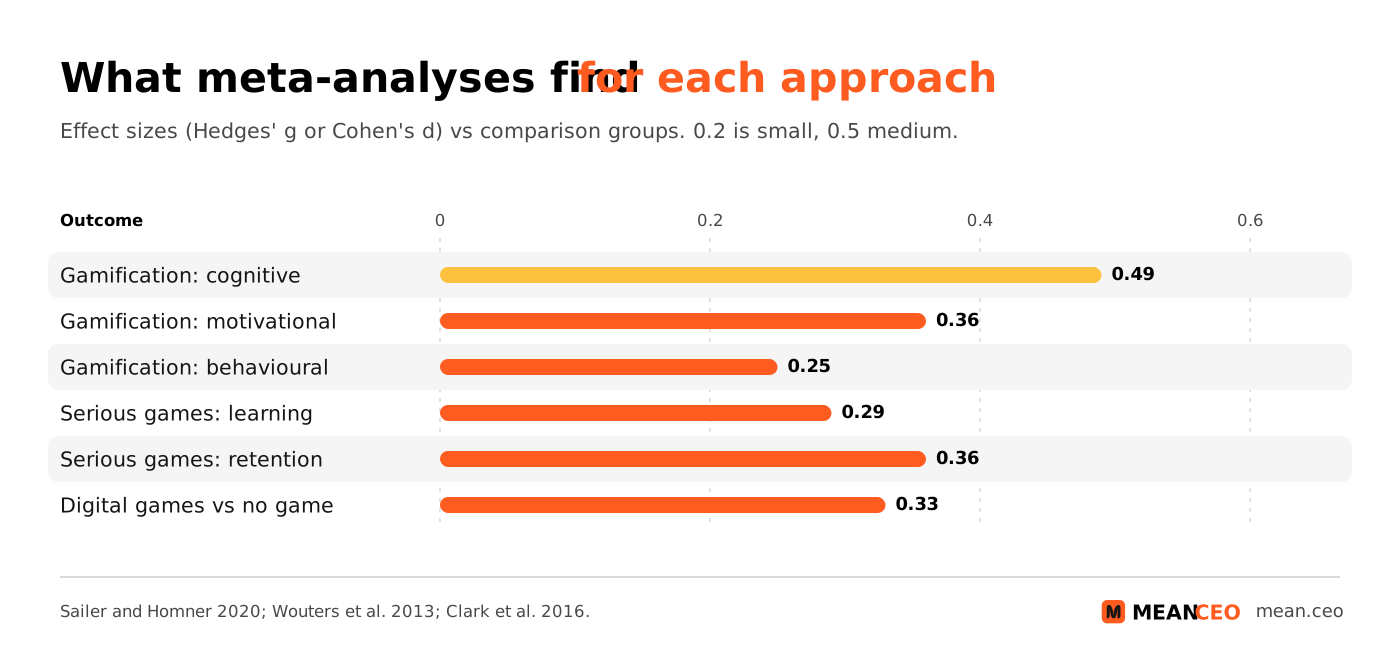
- Gamification works, mostly for knowledge. Sailer and Homner's 2020 meta-analysis in Educational Psychology Review found significant, positive effects of gamification on cognitive (g = 0.49), motivational (g = 0.36) and behavioural (g = 0.25) learning outcomes. The authors call these effects small. Only the cognitive effect held up in the most rigorous studies, so treat the motivation and behaviour gains as less certain. Game fiction (a story or role) and a mix of competition and collaboration worked particularly well for behaviour.
- Serious games teach, but don't automatically motivate. Wouters and colleagues (2013) pooled 77 comparisons and found that serious games beat conventional instruction on learning (d = 0.29) and retention (d = 0.36), but were not more motivating. Games worked better when combined with other teaching, played over several sessions and played in groups.
- Design matters more than the medium. In Clark, Tanner-Smith and Killingsworth's 2016 review in Review of Educational Research, digital games improved learning compared with non-game conditions (g = 0.33) across 69 samples of school and university students, and enhanced game designs did better than basic ones (g = 0.34). Workplace evidence is thinner, but points the same way: Sitzmann's 2011 meta-analysis of simulation games for trainees found 20% higher self-efficacy and 14% higher procedural knowledge than comparison groups.
Sources: the studies named in the table.
The practical lesson: a game layer can get people to do the training, and a well-designed game can teach the skill, but neither works without a clear goal and feedback. Failure is part of that feedback; see how game failure teaches entrepreneurial resilience.
Actionable Steps to Choose the Right Learning Model
Selecting between gamification and game-based learning depends on your startup's stage, resources, and team dynamics. Use the following guidance:
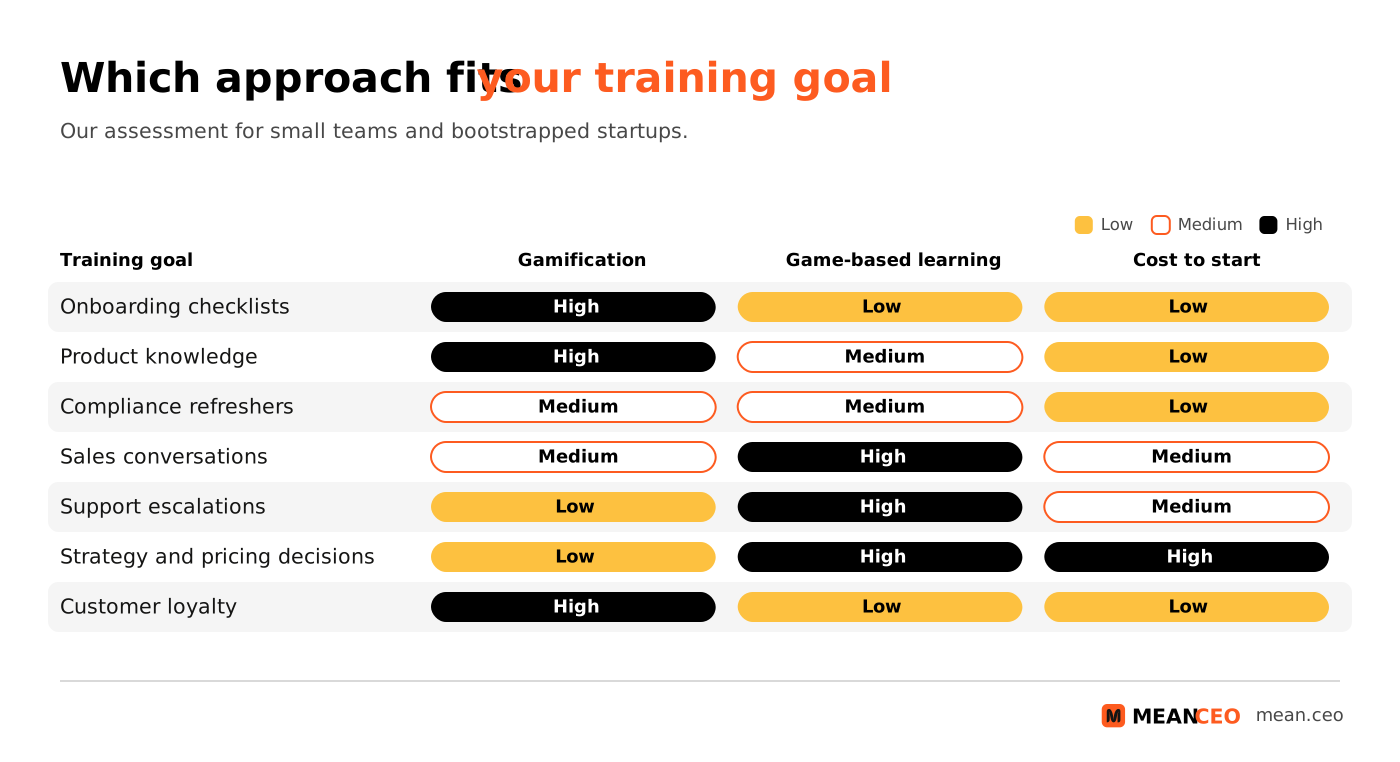
- Startups in early stages: Leverage gamification for team recruitment and educating first hires with micro-milestones, for example a progress bar through your onboarding process.
- Growth-stage startups: Use game-based learning simulations for practical onboarding on roles like customer support or sales pipelines.
- Deep-tech startups: Apply gamified learning with educational hacks around coding sprints or legal compliance tooling, such as IP workflows.
Source: our assessment for small teams.
Create meaningful progression paths by linking both methods. For instance, introduce gamified startup-wide milestones and complement them with game-based simulations specific to high-priority projects.
Common Mistakes Female Founders Should Watch Out For
Violetta Bonenkamp, a serial entrepreneur with deep European expertise in business education, shares the three most common traps when using gamified tools for startups:
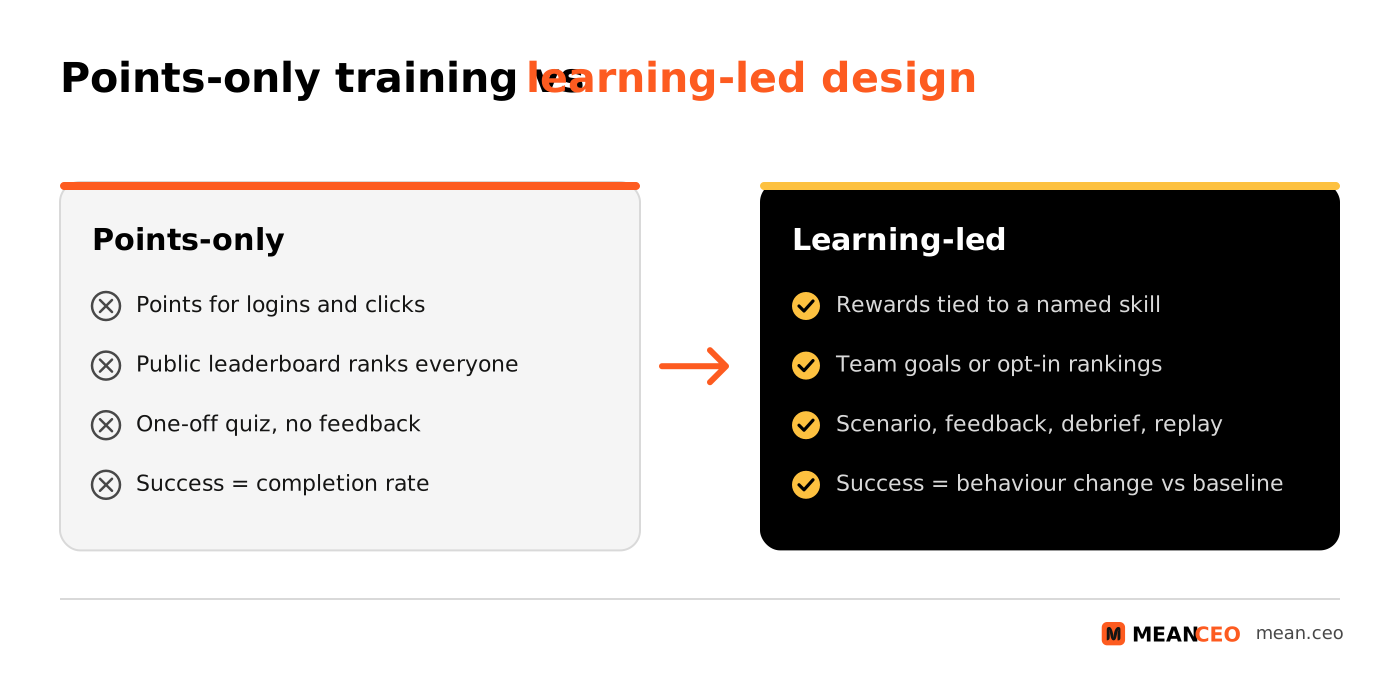
- Superficial gamification adds no learning value. Avoid merely adding points or badges to tasks without aligning them to skill development.
- Over-designed games hinder accessibility. Founders often make the mistake of creating overly complex game mechanics that isolate less tech-savvy team members.
- Lack of measured goals means no indicators of success. Always assess outcomes by specific, tracked metrics related to business maturity.
The first trap is backed by research. In a semester-long study, Hanus and Fox (2015) followed 71 students in two versions of the same course. Students in the version with badges and a leaderboard showed less motivation, satisfaction and empowerment over time, and their lower intrinsic motivation was linked to lower final exam scores. Public rankings can turn learning into a contest that most people lose. Team goals, personal progress and opt-in leaderboards are safer defaults.
Best Practices for Implementing Gamified Learning and GBL
Ensure that gamification and game-based learning strategies stay practical by aligning these with startup goals:
- Start simple: Introduce low-cost gamification, use task leaderboards or point systems before investing in expensive platforms.
- Design for impact: Ensure that game scenarios or benchmarks accurately capture real-world employee activities.
- Use AI with a script: a chatbot can play a sceptical customer or investor in role-play rounds and draft scenario variations quickly. Script its role tightly and check its answers, because people will treat what it says as feedback.
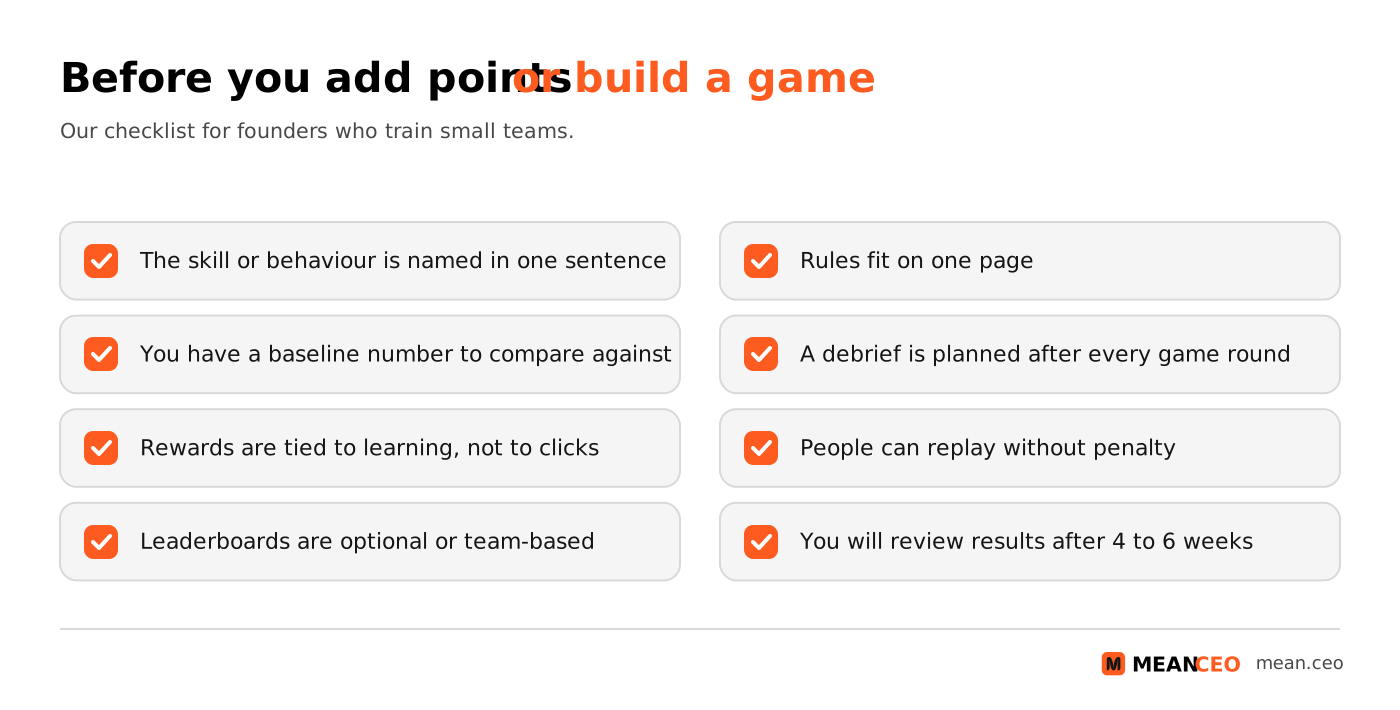
- Debrief every round: ask what happened, why it happened and what people would do differently next time.
- Evaluate outcomes via benchmarks such as collaboration metrics or completion timelines.
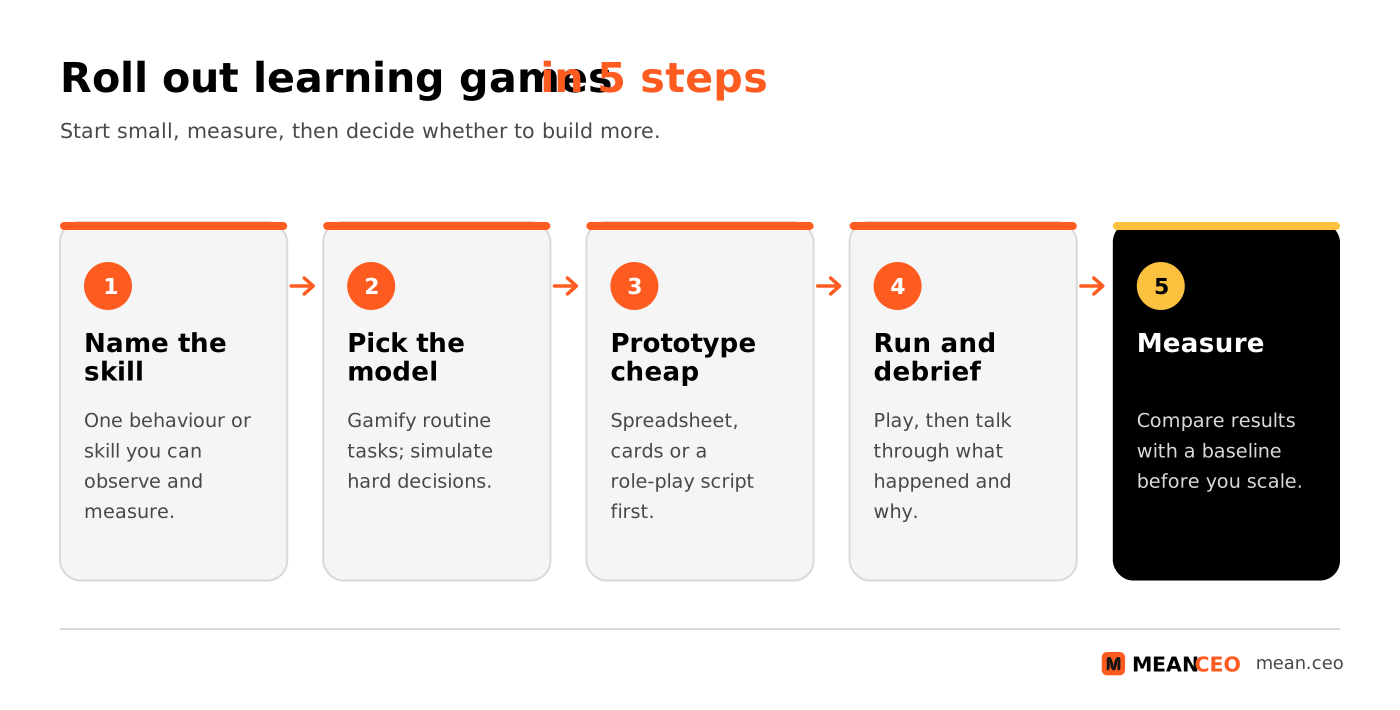
Measure before you scale. Record a baseline (time to first independent task, conversion rate, quiz scores), run the game for four to six weeks and compare. Our guide to measuring learning outcomes in gamified programs explains which metrics to use. If you go the game-based route, here is how to design startup simulations that teach real skills.
Curious about future learning systems?
Learn what makes people want to keep playing, and learning.
👉 Psychological principles behind effective educational games
Final Thoughts: Pioneering a Learning Revolution in Europe
European startups, especially those founded by women, often lack the luxury of large employee training budgets but compensate with creativity and resourcefulness. The gap shows in the data: Eurostat's continuing vocational training survey found that 63.5% of small EU enterprises (10 to 49 employees) provided training in 2020, against 92.8% of large ones, and the survey doesn't even cover firms with fewer than ten people. Tools like gamification encourage instantaneous application of principles, while custom-developed game-based learning instills deeply critical thinking behaviors for entrepreneurial challenges.
Both techniques depend on clear learning goals and smart integration that doesn't waste resources. As startup founders, we need to embed learning systems designed for rapid feedback and long-term behavior change. These learning mechanisms become indispensable instruments for business growth.
Curious about expanding efficiency while blending both game frameworks into entrepreneurship strategy? Read on about the model we use at Fe/male Switch: Gamepreneurship: definition and principles.
Are you getting customers from ChatGPT yet?
More and more traffic is coming from Perplexity, ChatGPT, Grok and other AI tools.
👉 Rank on ChatGPT
People Also Ask:
What is the difference between gamification and game-based learning?
Gamification involves applying game-like elements, such as points, leaderboards, and badges, to non-game contexts to boost motivation and engagement. On the other hand, game-based learning uses fully-fledged games as the core method of teaching or training, where the game itself serves as the educational tool.
Is Kahoot considered gamification or game-based learning?
It sits on the border. Kahoot! describes itself as a game-based learning platform, but most Kahoot sessions are standard quiz questions with game elements added: points, a timer, music and a leaderboard. By the academic definition (game elements in a non-game context), that is gamification. It becomes closer to game-based learning when the questions form a scenario players must solve.
What are the 4 main elements of gamification?
There is no single official list. The most common elements are points, badges and leaderboards, which Kevin Werbach and Dan Hunter call the "PBL triad" in their book For the Win. Many designers add a fourth: challenges or quests that give people a goal. Levels, streaks, progress bars and team goals are also widely used. Research suggests the choice of elements and how they fit the learning goal matter more than the number.
Is Duolingo an example of gamification or game-based learning?
Duolingo is an example of gamification: it adds streaks, XP, leagues with leaderboards and achievements to language lessons to encourage daily practice. The lessons themselves are exercises, not a game, so it is not game-based learning in the strict sense.
How can gamification support female entrepreneurs in education?
Gamification can support female entrepreneurs by providing engaging, motivational tools for learning essential business skills. Platforms with point systems, goal tracking, and simulation exercises can help women entrepreneurs gain problem-solving abilities and improve financial literacy in an interactive manner.
Why is game-based learning impactful for professionals?
Game-based learning immerses professionals in realistic scenarios, allowing them to apply skills in a controlled, safe environment. A meta-analysis by Wouters and colleagues (2013) found that serious games improved learning and retention compared with conventional instruction, especially when combined with other teaching and played over several sessions.
Can gamification improve business outcomes?
It can, when the game elements are tied to clear goals. Adding game-like elements to internal processes, such as sales challenges or upskilling programs, can motivate people to practise and collaborate. The research evidence is strongest for learning and weaker for lasting behaviour change, so measure results against a baseline.
Do small businesses benefit from game-based learning?
Yes. Small businesses can use low-cost game-based learning, such as role-play rounds or a spreadsheet simulation, to improve employee skills and decision-making. Interactive scenarios help small teams practise rare but important situations before they happen with real customers.
What are some examples of gamification in corporate training?
Examples of gamification in corporate training include employee onboarding programs with leaderboards, sales competitions with rewards, and skill-building challenges that provide badges for achievements. These gamified elements encourage participation and make training more effective and enjoyable.
How can female-led startups use gamification for customer growth?
Female-led startups can use gamification strategies like loyalty points, referral programs, and interactive features to attract and retain customers. Quizzes, progress bars and rewards for milestones also work well in customer education and training programs, where they help customers get value from the product faster.
FAQ on Gamification vs Game-Based Learning for Business Education
Can gamification apply to industries outside education?
Absolutely. Gamification is applicable in healthcare, retail, and corporate environments for training, increasing engagement, and even improving customer experiences. For example, loyalty programs with rewards and challenges utilize gamified methods to increase retention. Gamification creates scalable motivation systems across various fields.
How do gamified tools improve employee learning retention?
Gamified tools use storytelling, instant rewards, and challenges to create emotional connections with learners, making content memorable. For more insights, check out how gamification improves learning retention in practice.
How can a startup balance gamification and game-based learning strategies?
Startups can implement gamification for routine tasks like onboarding while utilizing game-based learning for critical skills development such as strategic decision-making. Combining both creates structured progression paths that align with business goals and employee growth.
Is game-based learning suitable for technical training?
Yes, game-based simulations enable employees to engage with complex concepts like coding or engineering in low-risk virtual environments. This fosters deeper understanding and problem-solving. Many industries use platforms that replicate real-world technical scenarios effectively.
What are key mistakes startups should avoid with gamified learning?
Mistakes include overcomplicating game mechanics, using superficial rewards unrelated to actual learning, and failing to set measurable goals. See top gamified learning platforms for practical advice on successful implementation.
What makes gamification effective for ongoing employee engagement?
Gamification's real-time feedback, leaderboards, and reward mechanics create motivational systems that sustain employee engagement over time. When aligned with company goals, it promotes productivity and nurtures collaboration, making tasks more interactive.
Do gender dynamics play a role in gamification success?
Research on gender differences in gamification is mixed, and individual preferences vary more than group averages. Practical design choices matter more: let people opt in to public rankings, offer cooperative and team modes alongside competition, and use progress that people can see for themselves. Narrative quests and visible progress can make learning feel safer for anyone who is new to business topics.
How does cultural context affect gamified learning implementation?
Cultural context can change how people react to competition, public rankings and rewards, so test with your own team instead of assuming. Offer both competitive and cooperative options, and adapt language, examples and rules to each market. Our guide to cultural considerations for European audiences covers this in more detail.
Are gamified learning platforms worth the investment for startups?
They can be, if you start small. Many startups get most of the benefit from free or low-cost options, such as quizzes, progress bars or role-play scripts, before paying for a platform. Set a baseline, run a four-to-six-week pilot and compare results such as onboarding time or quiz scores before you invest more.
Can gamification boost corporate innovation?
Yes, gamification fosters creative problem-solving by challenging teams with real-world scenarios and rewarding lateral thinking. It aligns innovation with measurable progress, driving both productivity and strategic ideation within organizations.
About the Author
Violetta Bonenkamp, also known as MeanCEO, is an experienced startup founder with an impressive educational background including an MBA and four other higher education degrees. She has over 20 years of work experience across multiple countries, including 5 years as a solopreneur and serial entrepreneur. Throughout her startup experience she has applied for multiple startup grants at the EU level, in the Netherlands and Malta, and her startups received quite a few of those. She’s been living, studying and working in many countries around the globe and her extensive multicultural experience has influenced her immensely.
