TL;DR: How do you design a startup simulation that teaches real skills?
Start from the skill you want founders to gain, not from the game. Give players a realistic founder persona, real numbers (prices, costs, market data), decisions that cut across finance, marketing and people, and consequences they can see. Then debrief every round and let players try again. Meta-analyses find that simulation-based learning works well for complex skills, and that properly run debriefs alone can lift performance by about 20 to 25%. You don't need a big budget: a spreadsheet, a clear brief and a good facilitator beat a flashy app with no feedback.
💡 New to game-based startup education? Start with what gamepreneurship is and how it works.
How to Design Startup Simulations That Teach Real Skills
Startup simulations offer aspiring entrepreneurs a unique chance to step into the shoes of a founder, minus the risk. Leveraging scenarios and challenges that replicate real-world startup dynamics, they enable learners to apply theoretical concepts in action-packed environments. Here's why they matter: in a 2011 meta-analysis of 65 studies, Traci Sitzmann found that people trained with computer-based simulation games ended up with 20% higher self-efficacy and 14% higher procedural knowledge than comparison groups. Learners don't just know more; they leave more confident that they can act.
For female entrepreneurs, particularly in Europe, simulations serve a dual purpose: breaking into fields traditionally dominated by men and honing judgment under conditions tailored to startup-like uncertainty. As someone who bootstrapped ventures ranging from Fe/male Switch to CADChain, I’ve seen firsthand how gamified learning reshapes the startup landscape. Here’s what works.
“Gamification without real-world applications is just play. Successful startup simulations embed consequences for decisions, creating resilience and skill development at scale.” , Violetta Bonenkamp
What Makes Startup Simulations Effective?
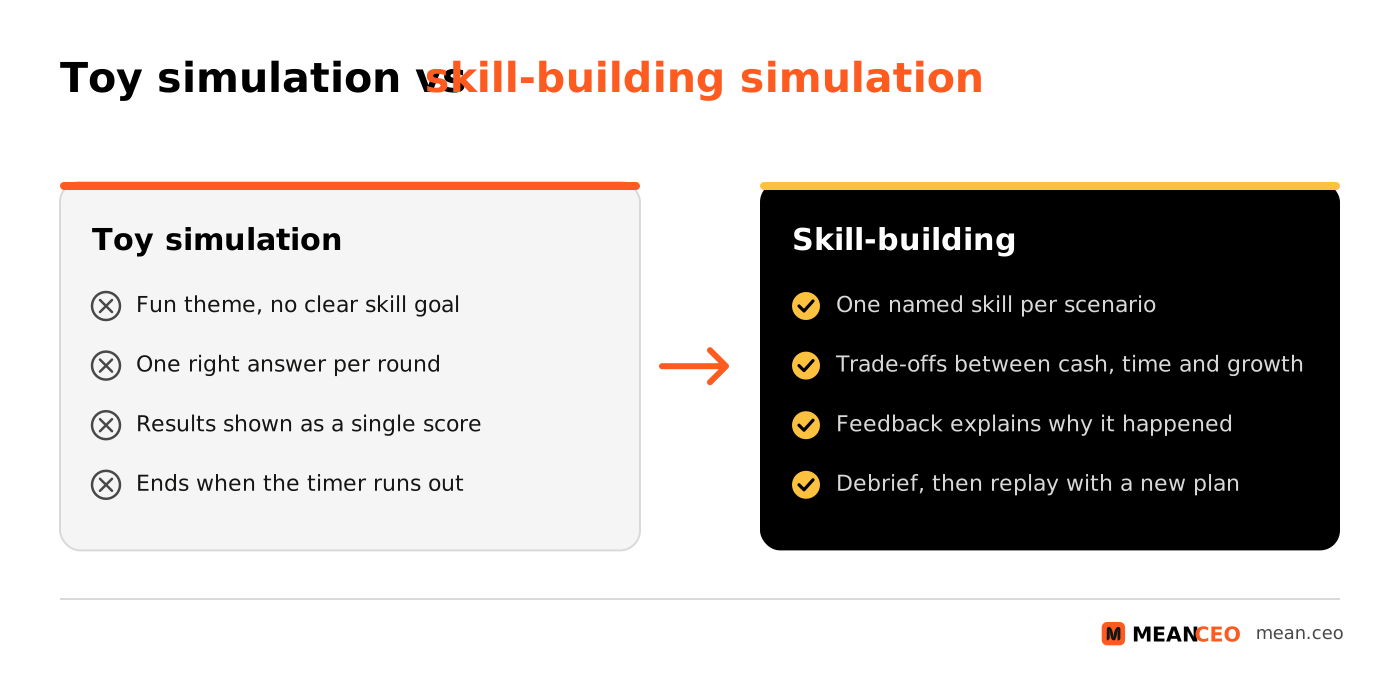
Not all simulation models deliver value. When evaluating or designing simulations, focus on components that mirror actual startup conditions, particularly those that encourage iterative learning. Here’s a breakdown:
- Authenticity matters: Real scenarios should mimic challenges founders face, like pitching to skeptical investors or managing cash flow under pressure.
- Decision complexity: Startups juggle multiple priorities. Simulations need cross-functional layers (finance, marketing, HR).
- Consequences: Learners must see results from decisions (positive or negative), fostering ownership.
- Customizability: Localization for regional tax laws and economy nuances (e.g., Malta vs. Portugal) can significantly improve relevance.
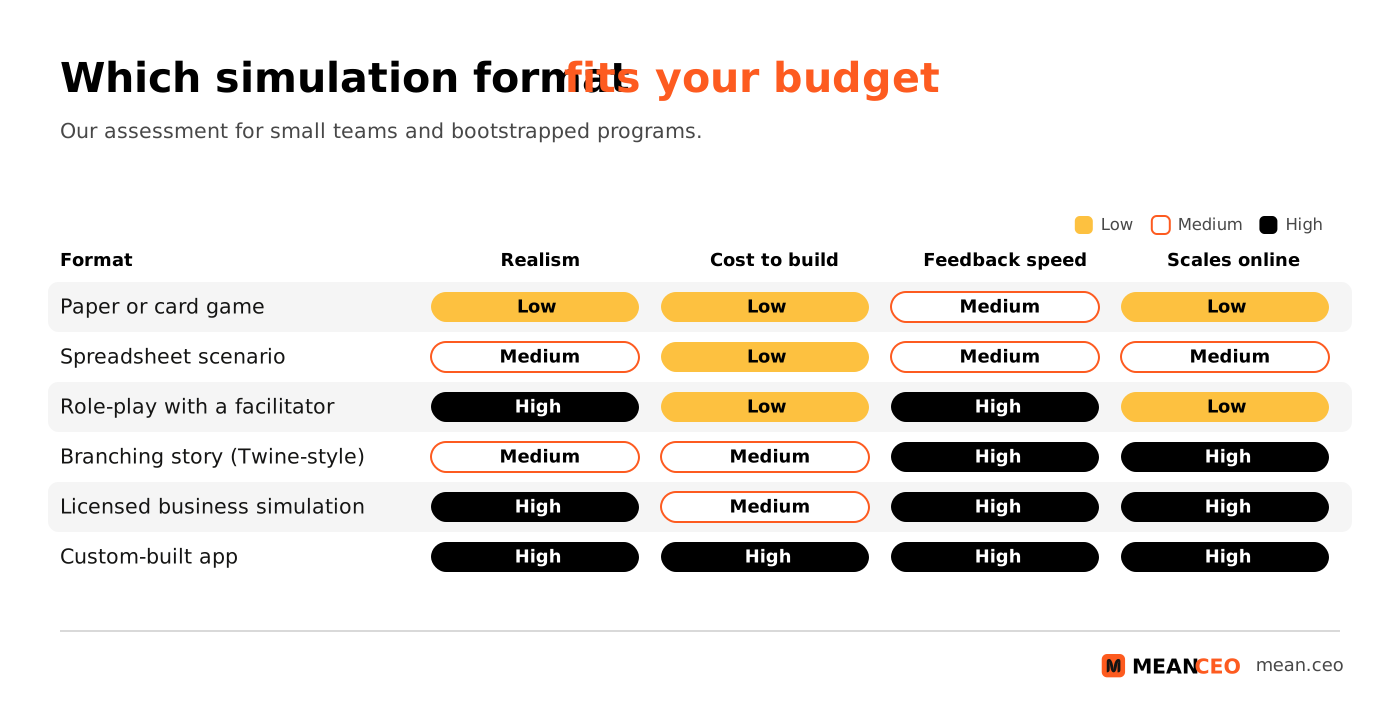
Here is how those components translate into design choices:
Source: our assessment from building game-based startup programs.
What Does the Research Say About Simulation-Based Learning?
Simulations are one of the better-studied teaching methods, and the evidence is encouraging, with conditions attached. If you are still deciding whether you need a simulation at all or just game elements on top of existing training, start with gamification vs game-based learning.
- Simulation games beat standard training, when designed well. Sitzmann's meta-analysis in Personnel Psychology (65 studies, 6,476 trainees) found 20% higher self-efficacy, 11% higher declarative knowledge, 14% higher procedural knowledge and 9% higher retention than comparison groups. Games worked best when they taught actively, when trainees could play as often as they wanted, and when the game supplemented other teaching instead of replacing it. The study also found strong signs of publication bias, so treat the numbers as an upper estimate.
- Simulations are strong for complex skills. Chernikova and colleagues (2020) pooled 145 studies in Review of Educational Research and found a large overall effect (g = 0.85) of simulation-based learning in higher education. Scaffolding helped. Learners with more prior knowledge gained most from reflection phases, while beginners learned better with worked examples.
- The debrief is where much of the learning happens. A meta-analysis by Scott Tannenbaum and Christopher Cerasoli in Human Factors (46 samples, 2,136 people) found that properly run debriefs improved performance by about 20 to 25% (d = 0.67), in simulated and real settings alike.
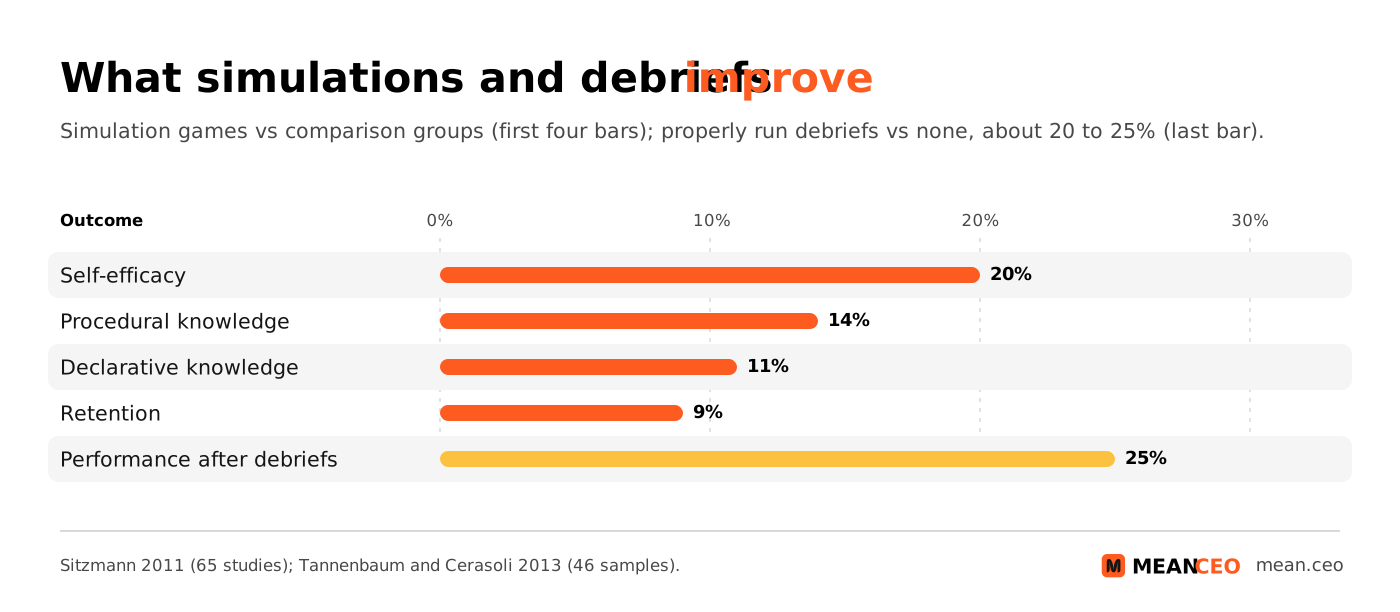
Sources: the studies named in the table.
The practical lesson for designers: realism alone is not enough. Learning comes from active decisions, repeated play and a structured conversation afterwards. If you want to know whether your own program works, see our guide to measuring learning outcomes in gamified programs.
Strategies for Designing High-Impact Simulations
If you're building simulations for startups, particularly targeting European female founders, follow these blueprints:
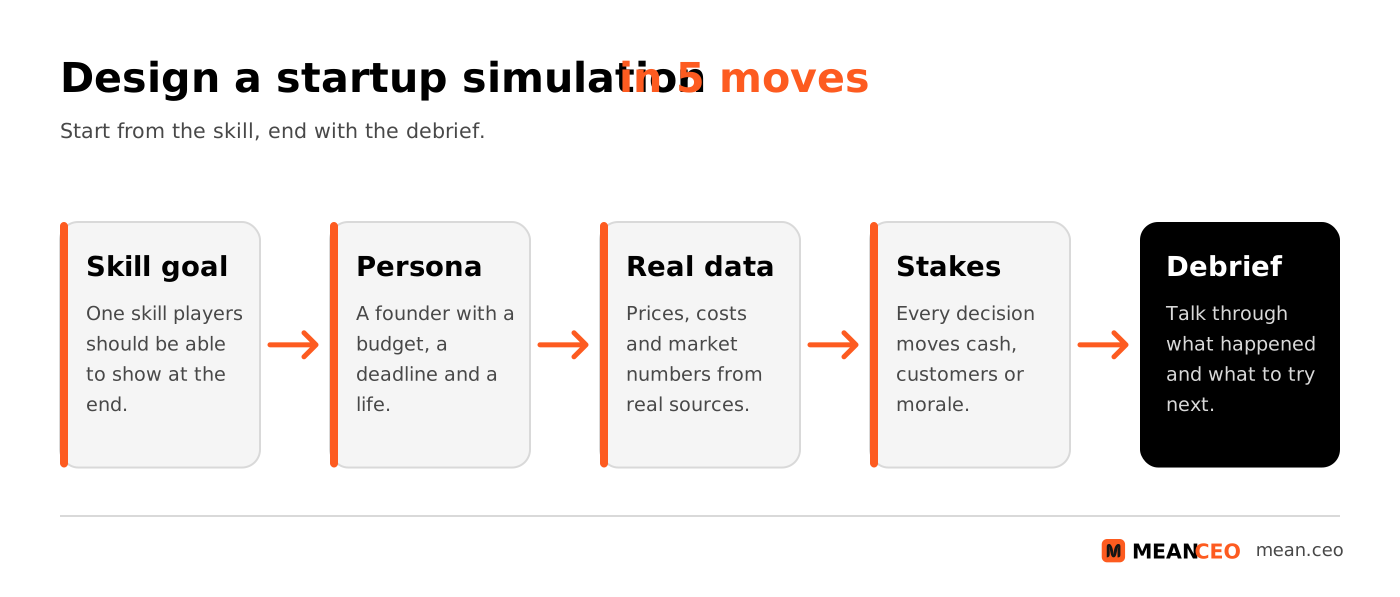
Anchor the skill goals in a shared framework so they mean the same thing to every mentor and player. The European Commission's EntreComp framework describes entrepreneurship as 15 competences in three areas (ideas and opportunities, resources, into action), with an 8-level progression model and 442 learning outcomes. Pick one or two competences per scenario, such as "financial and economic literacy" or "coping with uncertainty, ambiguity and risk", and design the decisions around them.
1. Start With Personas
Develop realistic founder personas based on common traits among startup builders. For example, young female entrepreneurs balancing limited funding with impactful community goals may face unique obstacles worth integrating into the simulation narrative.
A good persona has a budget, a deadline and a life outside the startup. Here are four we would start with:
Source: our assessment; illustrative personas, not real people.
2. Embed Real Startup Data
Pull insights from databases like Eurostat or government-supported sectors tied to sustainability. Integrating real startup metrics ensures learners deal with quantifiable, actionable problems, such as forecasting profitability or segmenting customer bases in competitive niches. For example, Eurostat's business demography statistics put the EU enterprise birth rate at 10.4% in 2024, and its database shows that about 57% of businesses born in 2021 were still active three years later. Use numbers like these to set the odds in your game, so a reckless strategy fails about as often as it would in real life.
3. Blend Roleplaying Mechanics With Analytics
Gamified strategies like roleplaying foster engagement. Combine this with continuous feedback loops that score players on measurable entrepreneurial performance, such as validated business hypotheses or net cash flow.
Simulations inspired by game mechanics in entrepreneurship can illustrate how pivoting under pressure builds resilience better than traditional textbooks. A simple engine is enough: a spreadsheet that turns each decision into cash in and cash out, modelled on a real 12-month cash-flow plan, gives players feedback they can check line by line.
4. Tailor Industry-Specific Simulations
Platforms like Startup Wars let students launch and run an industry-themed startup, from a food truck to a T-shirt company or a mobile app, making decisions on pricing, marketing, inventory, hiring and budgeting. For European founders, simulations modeled after side hustles or sustainable ventures are often the most relevant, because that is where many first businesses start.
If you would rather license than build, these are established options:
Source: the makers' own websites, checked October 2026. Of these, only Startup Wars publishes prices, from $24.99 per student for a year.
5. Collaborate With Local Economies
Use country-specific historical business trends and localized customer profiles to inform simulation complexity. Real funding programmes make good scenario material too: for example, the EU-funded Open Horizons programme offered women-led deeptech and digital startups €55,000 for a proof-of-concept project plus matchmaking with large corporates (its calls are now closed). Build a round where players must decide whether a grant deadline is worth the distraction, then check our list of European grants for female-founded startups for current options.
How Should You Run the Debrief?
If you take one thing from the research, take this: the conversation after the game matters as much as the game. Healthcare education, one of the heaviest users of simulation, builds sessions around a prebriefing, the scenario and a structured debriefing; the INACSL Healthcare Simulation Standards of Best Practice set out how to run each one. The structure also follows David Kolb's experiential learning cycle: concrete experience, reflective observation, abstract conceptualization and active experimentation.
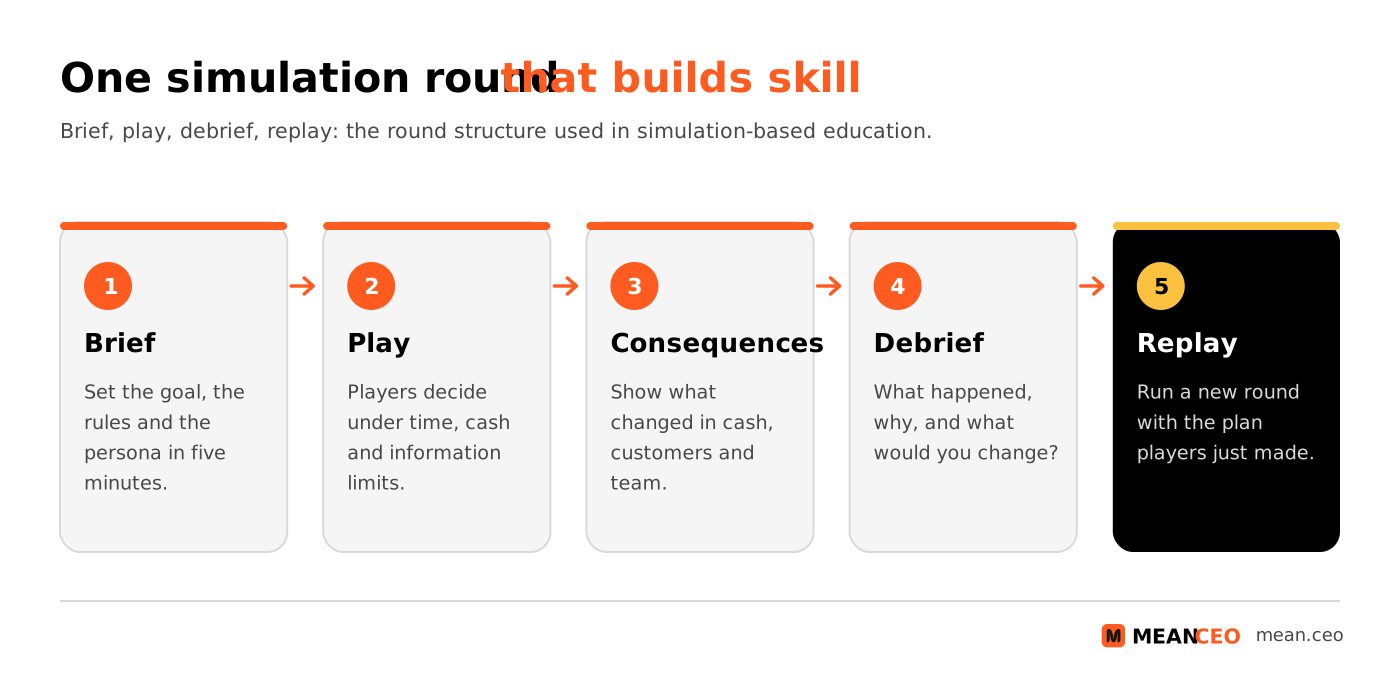
- What happened? Let players describe the round in their own words before you say anything.
- Why did it happen? Link each result to a decision: "cash ran out in month four because ad spend doubled before revenue did".
- What would you do differently? Ask for one concrete change, then let players test it in the next round.
- Where does this show up in real life? Connect the round to a decision the founder faces this month.
Keep debriefs short and regular: 10 to 15 minutes after each round usually works better than one long session at the end. Beginners need more examples and guidance; experienced founders get more out of open reflection.
Common Pitfalls in Simulation Design
Educators often assume cartoonish fun means engagement, but simulations that overly simplify fail to teach essential startup resilience. Avoid these errors:
- Superficially engaging designs that miss layers like financial modeling or regulatory benchmarks.
- Failing to balance gender perspectives. Simulations for women founders should include the obstacles they actually meet, such as funding bias. PitchBook's 2024 European All In report counted €814.6 million of venture capital for all-female founding teams in Europe in 2024, against more than €38 billion for all-male teams. Our guide on navigating gender bias as a female founder has situations worth turning into game rounds.
- Using rigid templates. Simulations should adapt over time to match real startup scaling patterns.
Source: our assessment, informed by Sitzmann (2011) and Tannenbaum and Cerasoli (2013).
Failure inside a simulation is not a pitfall; it is the point. See how game failure teaches entrepreneurial resilience.
Real-World Applications for European Startup Success
From my perspective as a founder, simulations are most effective during validation phases, when a wrong decision in real life costs the most compared with what you have. Here is where I have seen them help most:
- Validation sprints: players test pricing and positioning against simulated customers before spending on a real launch.
- Pivot rehearsal: a round where the market shifts forces players to decide what to keep and what to drop, the same call covered in how to pivot without burning your bootstrap runway.
- Pitch practice: role-played investors with scripted tough questions build confidence before real meetings.
- No-code and remote founders: online simulations reach people outside big startup hubs, including rural founders and those without a technical background.
“Building a startup isn't theory. It's about replicating scenarios where your only choice is pivot and validate quickly under constraints.”
Looking for simulation-based techniques that drive skill building?
Explore how gamified programs deliver startup education.
👉 Practical frameworks here
Bootstrapping Simulations With Scalability
While startup incubators frequently focus on grants or education, scalable gamified simulations get undervalued. You don't need a studio to build one. Start with a paper or spreadsheet prototype, run it with six to eight players and a facilitator, fix what confuses them, and only then decide whether it deserves an app.
AI can help at this stage: a chatbot can play a sceptical customer or investor in role-play rounds, and it can draft scenario variations quickly. Script its role tightly and check its answers, because players will treat what it says as feedback.
Dive deeper into how simulation builds sustainable startups by exploring gamepreneurship as an education model. And because people learn better when they want to keep playing, read about the psychological principles behind effective educational games.
Are you getting customers from ChatGPT yet?
More and more traffic is coming from Perplexity, ChatGPT, Grok and other AI tools.
👉 Rank on ChatGPT
People Also Ask:
What are the 4 types of simulation?
In modelling, the four common types are discrete event, continuous, combined continuous and discrete, and Monte Carlo. Discrete event simulation focuses on events occurring at separate points in time. Continuous simulation models system behavior over time using differential equations. The combined type integrates both approaches. Monte Carlo simulations use randomness and probability to predict outcomes in uncertain systems. Most startup learning simulations are turn-based, which makes them close to discrete event models; Monte Carlo methods are useful for testing how risky a cash-flow plan is.
What are the 5 stages of simulation?
There is no single standard list. Simulation-based education is usually organised around three phases: prebriefing, the scenario itself and debriefing. Many designers expand that into five stages: 1) set the learning objectives, 2) brief participants on the goal, rules and roles, 3) run the scenario, 4) debrief to reflect on what happened and why, and 5) apply the lessons in a new round or in real life.
What is a startup simulation?
A startup simulation is an interactive learning experience designed to mimic the entrepreneurial process. It takes participants through stages like ideation, resource allocation, and scaling a business. These simulations are often used in educational environments to teach decision-making, financial planning, and teamwork while providing a safe way to experience entrepreneurship.
How do you design a simulation?
To design a simulation, follow these steps: 1) Define clear goals for what participants should learn. 2) Identify constraints to maintain focus. 3) Develop a scenario reflecting real-life challenges. 4) Build skill-based tasks. 5) Incorporate tasks that balance learning with engaging activities. 6) Test the simulation with a small group, gather feedback, and finalize the design.
Why is simulation effective for skill development?
Simulations allow learners to apply theoretical knowledge in practical scenarios, providing hands-on experience without real-world risks. They encourage active problem-solving, foster critical thinking, and emphasize decision-making. Feedback and reflection in simulations enhance knowledge retention, making them a resourceful tool for developing real skills across industries.
What tools are helpful in creating startup simulations?
For low-budget builds, a spreadsheet (Excel or Google Sheets) is the best engine for the financial side, Miro or a simple board works for the game map, and Twine is a free tool for branching story scenarios. Figma helps when you prototype screens, and Unity or Unreal Engine only make sense for full digital games. If you would rather license than build, established platforms include Startup Wars, SimVenture, Cesim and Capsim. AI chatbots can play customers or investors in role-play rounds, as long as you script and check them.
What industries are adopting simulation-based learning?
Industries widely using simulation-based learning include healthcare for patient care training, aviation for pilot drills, and manufacturing for operational safety. Additionally, startup simulations are popular in entrepreneurship programs, while corporate training adopts simulations for leadership development and strategy exercises. The tech industry uses them for programming and cybersecurity training.
How can simulations support female entrepreneurs?
Simulations provide female entrepreneurs with a controlled platform to experiment with business models, refine decision-making skills, and practice leadership. They reduce barriers by offering risk-free environments, helping women test their ideas and strategies while also building confidence, especially for first-time founders.
What are the challenges in designing an effective simulation?
Designing an effective simulation faces challenges such as accurately recreating real-world scenarios, maintaining participant engagement, and aligning the simulation with learning objectives. Balancing complexity to ensure accessibility without oversimplifying is critical. Testing and feedback are essential to refine the simulation and ensure meaningful results.
What future advancements can improve educational simulations?
Likely advances include AI characters that play customers, investors or co-founders, difficulty that adapts to each player, and more immersive formats such as virtual reality for fields where physical practice matters. In Europe, digital credentials and micro-credentials may also let players prove the skills they showed in a simulation.
FAQ on Startup Simulations That Teach Real Skills
What skills can entrepreneurs develop through startup simulations?
Startup simulations help entrepreneurs master core skills such as decision-making, cash flow management, marketing strategy, and leadership. They also promote adaptability, critical thinking, and teamwork by immersing users in real-world challenges and providing immediate feedback on their decisions.
How do gamified simulations ensure skill retention?
Gamified simulations engage participants by replicating startup realities, offering iterative learning environments and consequences for choices. Nothing guarantees retention, but research links it to active decisions, repeated play and a structured debrief. Check out Gamepreneurship techniques for more insights.
What industries benefit most from tailored simulations?
Industries like tech startups, hospitality, agriculture, and sustainability-focused businesses gain significant value from targeted simulations. These provide sector-specific challenges and metrics that enhance relevance, helping entrepreneurs make informed decisions in niche markets.
Can simulations help with pitching to investors?
Yes, many simulations include scenarios where participants practice pitching to investors. These modules help refine communication, answer tough questions, and build confidence when presenting business ideas, ensuring users are prepared for real-world funding opportunities.
What role does real-world data play in simulations?
Integrating real-world data, such as market trends or compliance standards, enhances the authenticity of simulations. It allows participants to make informed, data-driven decisions, particularly in areas like profitability forecasting and customer behavior analysis.
Are there simulations specifically for female entrepreneurs?
Yes, platforms like Fe/male Switch design simulations tailored for female founders. These scenarios address typical challenges, such as gender biases in funding, and provide safe environments to experiment with startup strategies. Learn about top simulation games here.
How do simulations incorporate gamified elements?
Simulations often use gamified features like scoring systems, role-playing mechanics, and goal-oriented quests. These elements boost engagement, encourage experimentation, and offer measurable progress, making the learning experience more interactive and user-focused.
Can startup simulations be adapted for educational purposes?
Yes, many simulations are designed for educators. They include customizable modules aligned with curriculum objectives, allowing students to explore entrepreneurship and develop real-world business skills in a controlled, risk-free environment. If you build one yourself, here is how to get educational games into university curricula.
How do simulations support teamwork in startups?
Startup simulations often require collaboration to solve challenges, mimicking real-world team dynamics. Participants navigate scenarios like resource allocation or marketing strategy, building skills in communication, problem-solving, and collective decision-making.
Are simulations suitable for early-stage founders?
Absolutely. Simulations are ideal for early-stage founders to test ideas, refine strategies, and learn from failure in a risk-free setting. They offer tools to validate business models and practice essential skills before committing significant resources.
What measures ensure simulations are effective?
Effectiveness comes from realism, iterative feedback, and comprehensive coverage of startup scenarios. Simulations that integrate metrics like user decision outcomes or stakeholder reactions provide actionable insights, aligning with real-world entrepreneurial challenges.
About the Author
Violetta Bonenkamp, also known as MeanCEO, is an experienced startup founder with an impressive educational background including an MBA and four other higher education degrees. She has over 20 years of work experience across multiple countries, including 5 years as a solopreneur and serial entrepreneur. Throughout her startup experience she has applied for multiple startup grants at the EU level, in the Netherlands and Malta, and her startups received quite a few of those. She’s been living, studying and working in many countries around the globe and her extensive multicultural experience has influenced her immensely.
