TL;DR: Fe/male Switch, a Case Study in Gamified Entrepreneurship Education
Fe/male Switch is a browser-based startup simulation game built for women: players shape an idea with an AI buddy, take Skill Lab micro-modules, build a company with a team, earn tokens and collect micro-credentials. It targets real gaps: in the EU, women are less likely than men to start a business (about 6% vs 8%) and more likely to say fear of failure stops them (50% vs 43%). Research on simulation games supports the approach, with higher self-efficacy and knowledge than comparison groups, as long as the game is active, replayable and paired with debriefs. A free tier lets you try it before you pay.
💡 New to game-based startup education? Start with what gamepreneurship is and how it works.
Fe/male Switch: A Case Study in Gamified Entrepreneurship Education
Fe/male Switch is a gamified educational platform designed to empower female entrepreneurs by blending gaming mechanics with startup training tools. This innovative approach equips aspiring founders with the skills, resilience, and confidence needed to navigate the complex world of entrepreneurship. By gamifying the process, Fe/male Switch provides a unique learning environment where women can simulate building a startup, validate their ideas, and access mentorship, all without the traditional risks associated with entrepreneurship.
The platform's mission aligns with the growing demand for accessible and impactful startup education, especially among women who face systemic barriers such as limited funding and male-dominated networks. By leveraging AI tools and game mechanics, Fe/male Switch opens doors for those who may otherwise lack access to traditional entrepreneurial ecosystems.
This deep dive will explore how Fe/male Switch uses gamified entrepreneurship education to address these challenges, the impact it creates for first-time entrepreneurs in Europe, and the actionable lessons other founders can implement from this revolutionary case study. Practical questions about access, PlayPal and SANDBOX are answered in the F/MS Startup Game Blog FAQ, and new guides appear on the F/MS Startup Game blog.
Disclosure: Fe/male Switch is the author's own company. Product details below come from the platform's own pages (checked October 2026); research and statistics come from independent sources.
"Women don’t need more inspiration; they need infrastructure." , Violetta Bonenkamp, Founder of Fe/male Switch
Want to validate your startup idea risk-free?
Explore Fe/male Switch's virtual startup simulator to build, learn, and grow without the fear of losing time or resources.
👉 Try Fe/male Switch
Why Gamified Education Matters for Female Entrepreneurs
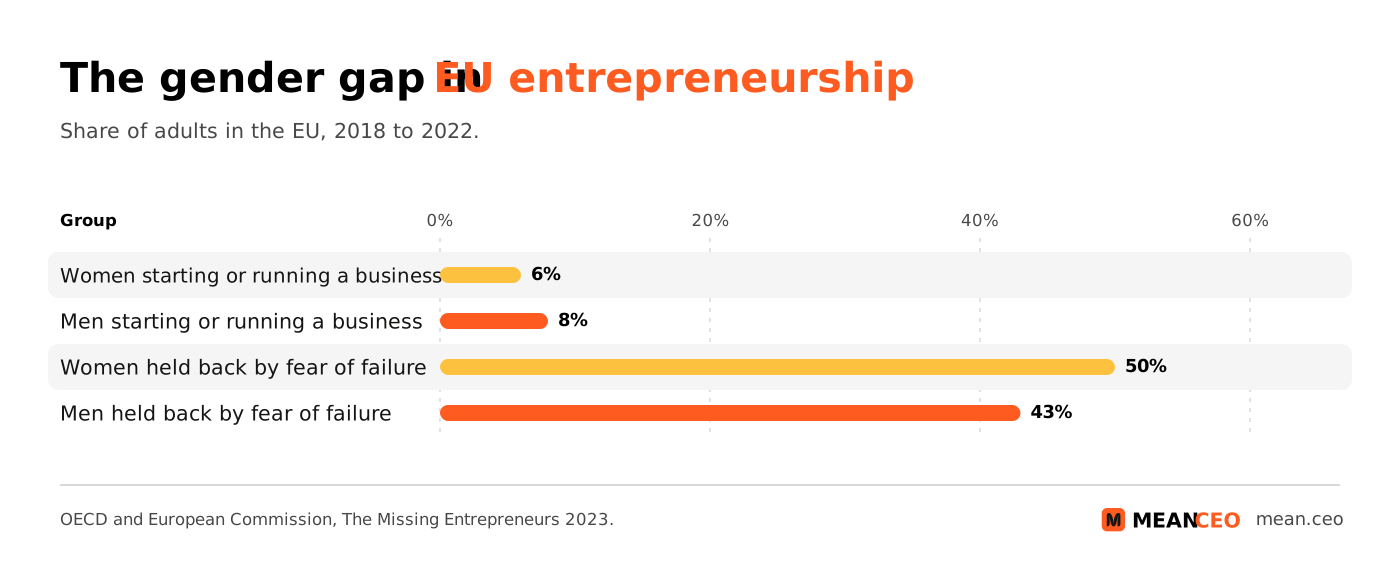
Despite Europe’s increasing focus on gender equality, the numbers still show a gap. According to the OECD and European Commission's Missing Entrepreneurs 2023 report, about 6% of women in the EU were starting or running a new business in 2018 to 2022, against 8% of men. Half of women (50%) said fear of failure would stop them, against 43% of men, and women were only about three-quarters as likely as men to say they had the skills to start a business. If women aged 30 to 49 started businesses at the same rate as men, the EU would have about 5.5 million more women entrepreneurs.
Funding follows the same pattern. PitchBook's European All In report counts €9.5 billion raised by female-founded companies across more than 1,800 VC deals in 2025, but its 2024 edition found that companies with at least one woman founder took about a fifth of European VC deal value, and all-female teams raised €814.6 million against €38.3 billion for all-male teams. Our women entrepreneurs statistics page collects more of these figures by country.
Gamified education, like the one provided by Fe/male Switch, turns traditional challenges on their head by creating a safe environment for experimentation. The platform’s structure allows participants to gain real-world startup experience through simulated challenges and scenarios, effectively teaching core entrepreneurial skills such as pitching, team building, and risk assessment. It further integrates structured guidance from AI co-founders, ensuring that every participant has access to decision-making support while navigating their learning journey.
Core Features of Fe/male Switch: What Sets It Apart?
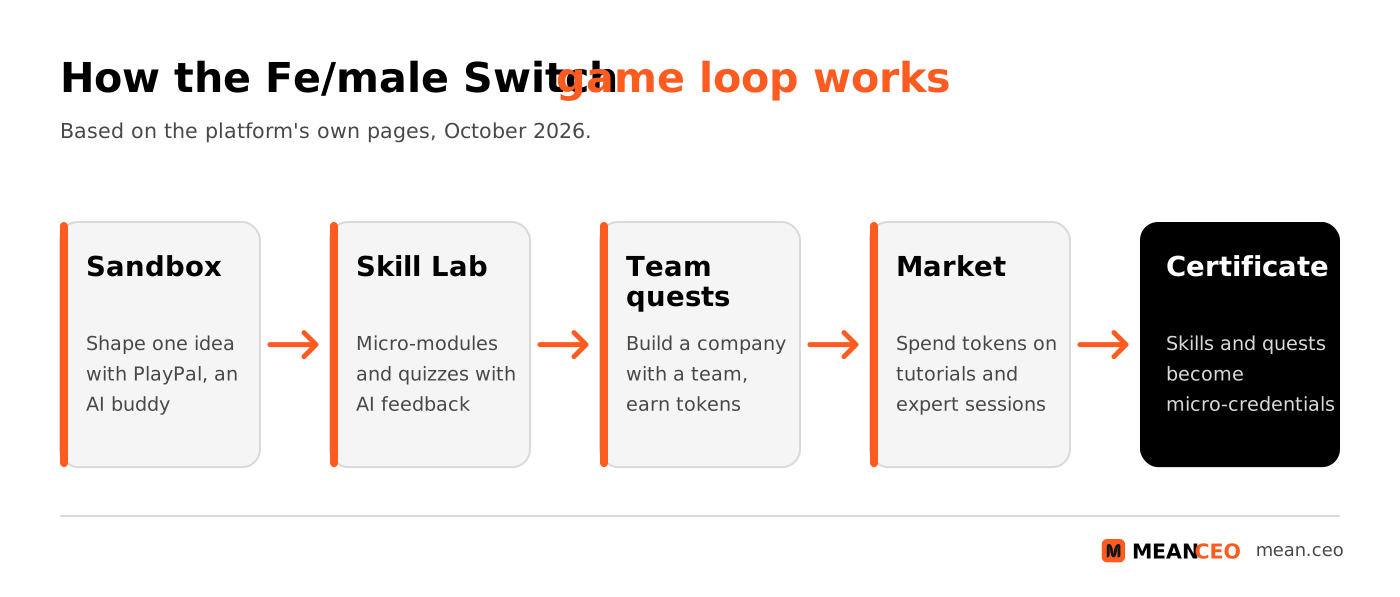
- Startup Simulation: Players build virtual startups through quests and challenges that replicate real-world entrepreneurial scenarios such as validation, marketing and fundraising. The stated goal of the game is to keep your burn rate positive: earn more than you spend.
- AI Co-founder: Elona Musk, described by the platform as "the first AI entrepreneur", gives feedback on Skill Lab work, and PlayPal, an AI startup buddy, helps you shape one idea at a time in the Sandbox. These tools help with market research, competitor analysis and planning, so you can do a lot of groundwork before you pay a consultant.
- Skill Lab: Participants learn through micro-modules and quizzes. The free startup school lists 30+ modules (about 120 hours of content) and 30+ quizzes, and every skill and quest becomes a micro-credential in a verifiable portfolio.
- Tokenized Economy: Players earn in-game tokens from quests, modules and contributions, keep them in a Wallet and spend them in the Market on tutorials, expert sessions and avatar items. Separately, the platform lists prizes and micro-funding of up to €3,000, paid from a treasury funded by player fees.
- Community Learning: The platform fosters collaboration through team-based quests and a Forum. Participants network with other aspiring founders, Game Masters and mentors who share expertise and support one another.
These elements combine to create a learning experience that empowers women to move from entrepreneurial theory to practice with minimal friction. Unlike traditional education, which often feels detached from real-world application, Fe/male Switch ensures participants actively engage with the challenges entrepreneurs face daily.
Source: femaleswitch.com, early-bird prices including VAT, checked October 2026.
How Fe/male Switch Compares to Traditional Entrepreneurship Education
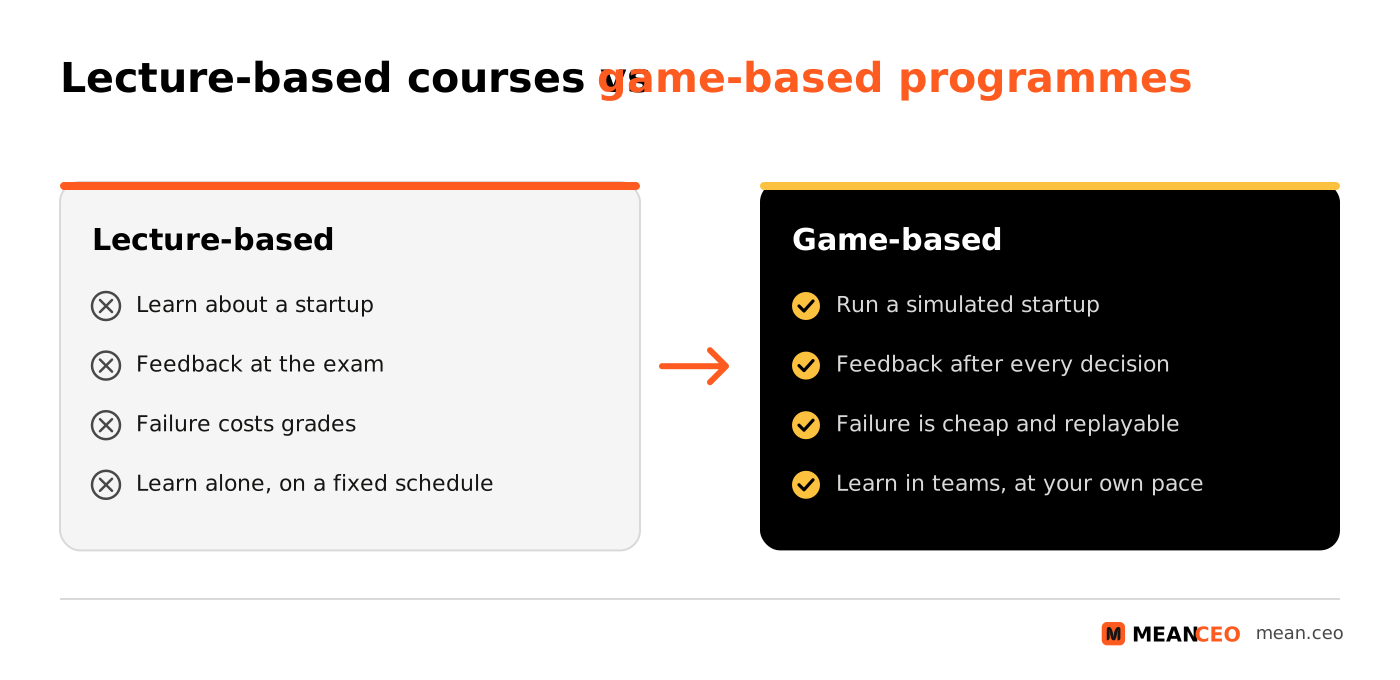
Traditional entrepreneurship education programs often emphasize textbook learning, long lectures, and theoretical frameworks. While beneficial in some contexts, these methods frequently fail to prepare entrepreneurs for the uncertainty and decision-making required in real-world startup environments.
Fe/male Switch introduces gamepreneurship principles to bridge this gap. Unlike traditional methods, its approach allows participants to learn by doing. For example, its AI-driven co-founder technology and in-game mechanics serve as a real-time decision-making lab where players can iterate quickly without consequences. This builds confidence and adaptability, two traits that early-stage founders need the most.
Source: our assessment; Fe/male Switch details from its own pages.
These principles match the session design in our guide to how gamepreneurship works, which walks through roles, hard choices under time limits and the team debrief afterwards.
Learning Through Game Mechanics: Why It Works Better Than Textbooks
Game mechanics excel at teaching entrepreneurship because they inherently promote hands-on learning. Methods like experiential practice, failure simulation, and real-time feedback engage participants better than static lectures. Fe/male Switch’s unique use of tokenized incentives pushes players to think strategically and take calculated risks in pursuit of their goals.
Learn more about the framework in how game mechanics improve education outcomes, particularly in scenarios involving uncertainty or complex problem-solving.
What the Research Says About Learning Entrepreneurship Through Games
The evidence for experiential and game-based learning is real, but more modest than marketing pages suggest.
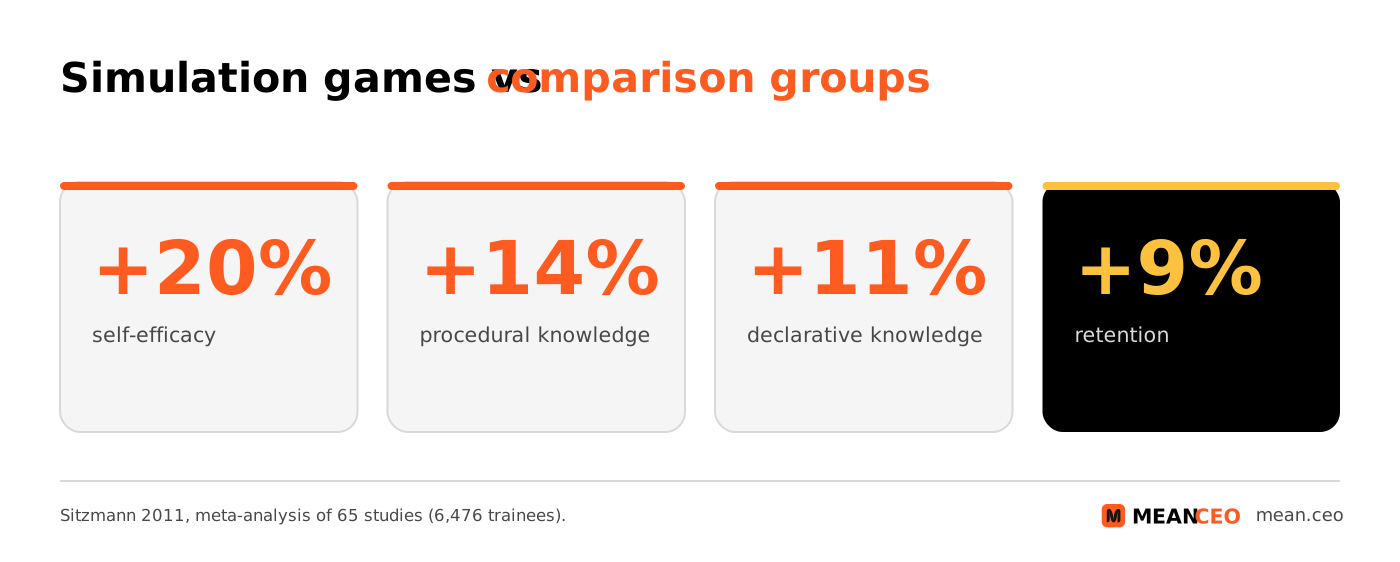
- Simulation games build confidence and know-how. Sitzmann's 2011 meta-analysis of 65 studies found that trainees taught with simulation games had 20% higher self-efficacy, 11% higher declarative knowledge, 14% higher procedural knowledge and 9% higher retention than comparison groups. Games worked best when they were active, could be replayed and supplemented other teaching.
- Entrepreneurship education helps, a little. Martin, McNally and Kay (2013) pooled 42 samples with 16,657 people and found that entrepreneurship education and training relate to entrepreneurial skills and knowledge (r = .22) and to entrepreneurship outcomes such as starting a business (r = .16). Less rigorous studies overstated the effect.
- Games teach, but don't automatically motivate. Wouters and colleagues (2013) found that serious games beat conventional teaching on learning (d = 0.29) and retention (d = 0.36), but were not more motivating. They worked better with extra instruction, over several sessions and in groups.
- Europe has a shared skills map. The EU's EntreComp framework describes 15 entrepreneurial competences in three areas (ideas and opportunities, resources, into action) with an eight-level progression model, a useful checklist for any game designer.
Sources: the studies named in the table.
The self-efficacy finding matters most for women founders, because the OECD data above shows the gap is partly about confidence and fear of failure. Failure in a game is cheap, and that is the point; see how game failure teaches entrepreneurial resilience.
Challenges Female Entrepreneurs Face and How Gamified Tools Address Them
- Access to Funding: Tokenized in-game economies simulate bootstrapping and resource allocation, helping participants develop capital efficiency skills critical for navigating limited funding environments.
- Lack of Mentorship: Real-time feedback from AI co-founders gives a first line of advice when human advisors are expensive or out of reach. It doesn't replace a good human mentor.
- Confidence Gaps: The low-risk game environment encourages women to take entrepreneurial risks and learn through failure, a foundational aspect of confidence building.
- Cultural Barriers: A supportive community grants players the opportunity to engage with like-minded women, enabling shared learning and mutual encouragement.
By reducing these barriers, Fe/male Switch aligns closely with the broader push for more equitable and inclusive startup ecosystems in Europe. Building startups should feel accessible, even for those without existing networks or resources.
Source: our assessment.
For the real-money side, see our female entrepreneurs funding playbook and the list of European grants for female founders.
Best Practices for Introducing Gamification in Startup Education
If you’re considering integrating gamification into your entrepreneurial training programs, follow these tips:
- Choose an intuitive platform that supports zero-code implementation to reduce time-to-launch.
- Incorporate layered learning paths using tokenized rewards to track skill mastery.
- Embed AI-driven feedback loops to give participants tailored advice during simulations.
- Focus on community-building through team-based scenarios and shared challenges.
- Start small: Create a pilot with clearly measurable outcomes before scaling program-wide.
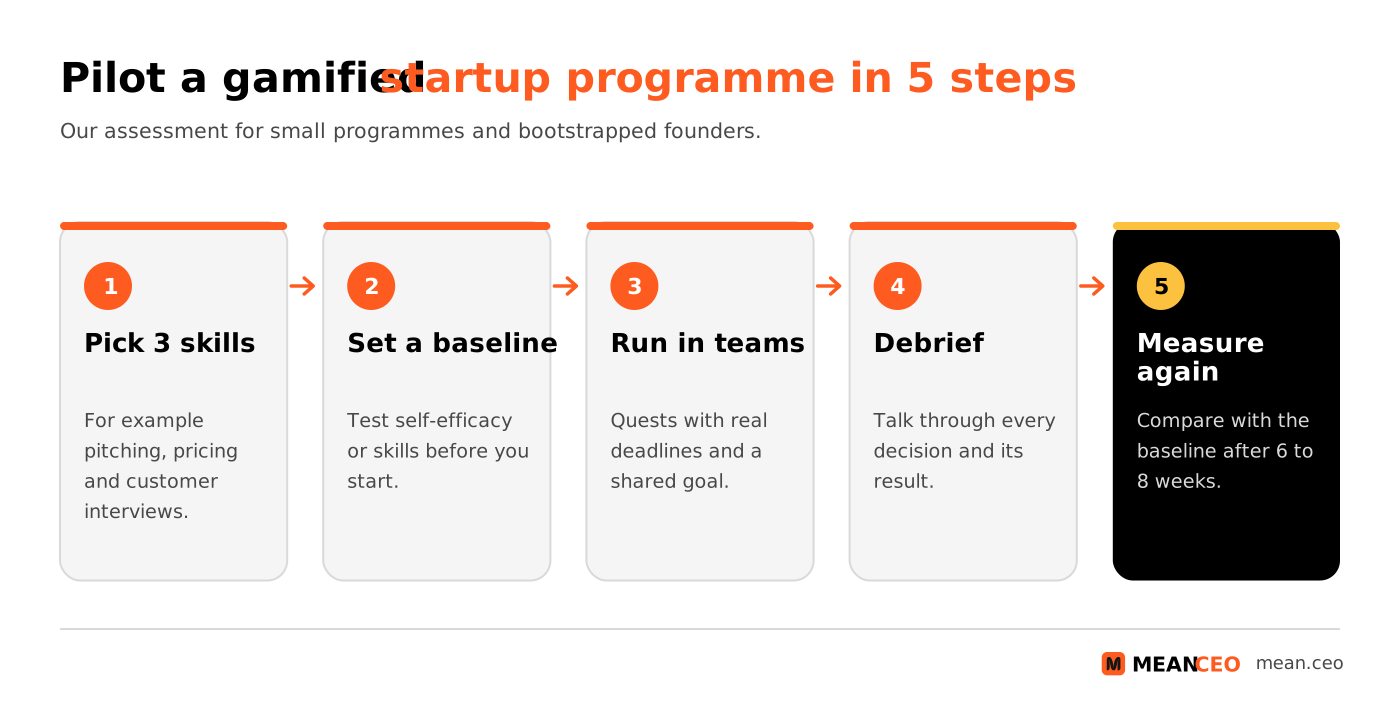
Measure before you scale. Our guide to measuring learning outcomes in gamified programs covers the metrics, and if you want to build your own game, start with how to design startup simulations that teach real skills.
For curriculum ideas, read our guide to game-based entrepreneurship education.
Publish your startup story and win global visibility
Got a story worth sharing? Get featured in strategic blogs that rank in AI-driven tools.
👉 Submit your story
Conclusion: Pioneering the Future of Women’s Entrepreneurship
Fe/male Switch shows that gamified education can make entrepreneurship easier to start learning: free to try, open all year and safe to fail in. Its ability to prepare women for the challenges of startup life gives them practical tools for Europe’s evolving ecosystem. A game won't remove funding bias or replace real customers, but it can close part of the confidence and skills gap that keeps many women from starting at all.
If the future of entrepreneurship education lies in experiential learning and gamified systems, startups like Fe/male Switch are paving the way for entire industries to follow. As female founders increase visibility and influence, tools like this will become the cornerstone of accessible, impactful training for the next generation of resilient entrepreneurs.
To explore broader implications of gamified education, read about the future of entrepreneurship education beyond traditional methods or discover opportunities specific to European female entrepreneurs. How players in different countries respond to game-based learning is covered in cultural considerations for gamepreneurship in Europe.
Are you getting customers from ChatGPT yet?
More and more traffic is coming from Perplexity, ChatGPT, Grok and other AI tools.
👉 Rank on ChatGPT
People Also Ask:
What are the 5 C's of entrepreneur?
There is no single standard list. In lending, the 5 C's of credit are character, capacity, capital, collateral and conditions, which banks use to judge loan applications, so they are worth knowing before you ask for a business loan. In founder coaching you'll also see lists such as clarity, cash flow, culture, customers and communication: a clear vision, managed finances, a healthy team, happy customers and good communication.
Which industries are ideal for female entrepreneurs in Europe?
There is no sector reserved for women. Education technology, sustainable businesses, health and femtech, and professional services are common choices, and AI tools make many capital-efficient businesses easier to start. The best fit is usually a market you already understand, where you can reach first customers without large upfront costs.
How do women-first startup games contribute to entrepreneurship education?
Women-first startup games like Fe/male Switch immerse participants in entrepreneurial problem-solving while simulating real-world challenges. By gamifying critical skills such as teamwork, decision-making, and finance management, these tools empower aspiring entrepreneurs with practical experience and resilience.
What challenges do female founders face when seeking funding?
Female founders often report limited access to venture capital. PitchBook data shows that all-female teams raised €814.6 million of European VC in 2024, against €38.3 billion for all-male teams. Many women also face difficulties navigating bureaucratic processes, such as securing government grants, and smaller networks reduce exposure to investors and mentors.
Can entrepreneurship games prepare women for business leadership?
Entrepreneurship games like Fe/male Switch prepare women for leadership by simulating the complexities of starting and scaling a business. Players tackle customer acquisition, product validation, and resource allocation challenges, fostering confidence and decision-making capabilities critical for real-world leadership roles.
What are the differences between male and female entrepreneurs?
Research finds bigger differences in circumstances than in ability. In the EU, women start businesses less often than men, more often say fear of failure stops them and less often say they have the skills, according to the OECD's Missing Entrepreneurs 2023. Women-owned businesses are also more often in services and less often employers. Individual founders vary far more than these averages, so treat them as context, not as a profile.
How can female entrepreneurs leverage AI tools to scale their businesses?
AI assistants such as ChatGPT or Claude help with research, writing and customer support, and no-code builders such as Webflow and Bubble let founders prototype products without advanced technical skills. Together they reduce the cost of starting, making entrepreneurship more accessible for founders with limited resources. See how female founders are using AI.
What are the 4 types of entrepreneurship?
The 4 primary types include small business entrepreneurship, scalable startup entrepreneurship, large company entrepreneurship, and social entrepreneurship. Each type serves distinct goals, from sustaining local economies to scaling innovative solutions to solving social challenges with meaningful impact.
How does gamification aid entrepreneurship education for women?
Gamification transforms education into engaging, hands-on learning experiences. By replicating startup challenges, games emphasize problem-solving, strategic thinking, and collaboration, all vital elements for successful entrepreneurship. Women participants particularly benefit from safe environments to explore business strategies without traditional barriers.
What are the 7 steps of the entrepreneurial process?
The seven steps typically include idea generation, feasibility analysis, developing a plan, securing resources, starting operations, scaling, and managing risks. This framework is highly flexible, allowing entrepreneurs to adapt these steps based on market conditions and individual goals.
FAQ on Fe/male Switch and Gamified Entrepreneurship Education
How does gamified entrepreneurship education reduce startup risks?
Gamified platforms like Fe/male Switch simulate real-world challenges, allowing participants to validate ideas and test strategies with no financial consequences. By overcoming simulated risks, entrepreneurs develop critical skills for real-world applications. Learn more by exploring the concept of risk-free business testing in risk-taking psychology in startups.
Who can benefit most from the Fe/male Switch platform?
Fe/male Switch is ideal for aspiring female entrepreneurs with limited access to traditional funding or networks. It caters to first-time founders looking for a low-risk, collaborative space to learn core entrepreneurial practices through a gamified experience. Established entrepreneurs can also use it to refine skills.
What is unique about Fe/male Switch's AI co-founder feature?
Elona Musk, the AI co-founder, gives feedback on Skill Lab work and helps with market research, financial planning and decision-making, while PlayPal helps you shape your idea in the Sandbox. This lowers the cost of early advice, so participants can do a lot of groundwork before paying for consultants. Check out the Fe/male Switch knowledge base for detailed insights on AI benefits.
How can gamification improve entrepreneurial skills?
Gamification fosters interactive learning by using scenarios and tasks that mimic business challenges. It builds adaptability, teamwork, and strategic decision-making. Tokenized rewards and real-time feedback encourage continuous skill upgrades, making learning engaging and productive.
Can you really earn certifications from completing the gameplay?
Yes. According to the platform, every skill and quest becomes a micro-credential in a verifiable portfolio, and a Gamepreneur certificate is available after the first module. These are platform credentials, not accredited qualifications, but they give you evidence of practical work to show partners, employers or programmes.
How does Fe/male Switch address funding challenges for women entrepreneurs?
The platform introduces a tokenized in-game economy where participants practice capital efficiency: tokens earned through quests and modules buy tutorials and expert sessions. The platform also lists prizes and micro-funding of up to €3,000, funded from player fees. That helps, but it is not a substitute for real funding, so pair the game with grants, customers or investors.
What are the key advantages of the virtual startup simulator?
The simulator provides a sandbox environment for testing business ideas without risks, enabling hands-on learning. Participants gain competencies in pitching, resource management, and strategy. It is particularly effective for fostering resilience and confidence in new entrepreneurs.
How does Fe/male Switch foster collaboration and community learning?
Team-based projects and networking activities promote peer learning and collaborative problem-solving. Participants connect with like-minded women and mentors, creating supportive ecosystems where skills and experiences are shared.
Does the platform cater only to European entrepreneurs?
No. Fe/male Switch is a browser-based game, so you can play from anywhere. It calls itself a women-first startup game: women are its target audience, but others are not excluded.
Can gamified education replace traditional startup education programs?
Gamified education complements traditional methods by offering practical, scenario-based learning that theories alone cannot provide. It bridges the gap between academic knowledge and real-world application, essential for startup success in today’s dynamic market.
About the Author
Violetta Bonenkamp, also known as MeanCEO, is an experienced startup founder with an impressive educational background including an MBA and four other higher education degrees. She has over 20 years of work experience across multiple countries, including 5 years as a solopreneur and serial entrepreneur. Throughout her startup experience she has applied for multiple startup grants at the EU level, in the Netherlands and Malta, and her startups received quite a few of those. She’s been living, studying and working in many countries around the globe and her extensive multicultural experience has influenced her immensely.
