TL;DR: how does a bootstrapped startup build a customer education programme?
Customer education means teaching customers to get value from your product without waiting for you: help centre articles, short videos, in-app guides, webinars and, later, an academy or certification. Start with the 20 questions customers ask most, map the one action that makes them stay, and teach that first. Measure it with fewer repeat tickets, faster activation and better renewals. You can run a solid programme for well under €100 a month in tools; the real cost is your time.
💡 Not sure what to measure yet? Read retention metrics: what to track and why.
Every founder knows the feeling. The same question lands in your inbox for the tenth time this month. A customer who signed up three weeks ago still hasn't connected the integration that makes your product useful. Another one cancels and says, politely, that the tool "wasn't a fit". Often it was a fit. They just never learned how to use it.
Customer education fixes that by turning what you explain one-to-one into material customers can use on their own. Big SaaS companies run academies with thousands of courses. A bootstrapped European startup can't, and doesn't need to. In this guide I'll show you which formats work on a small budget, how to build a programme step by step, what the tools cost, what changes when you sell across Europe, and how to prove it works.
What is customer education?
Customer education is a planned set of content and training that helps customers adopt your product, use more of it and solve their own problems. It covers everything from a two-minute video on connecting your calendar to a full certification that partners put on their LinkedIn profiles.
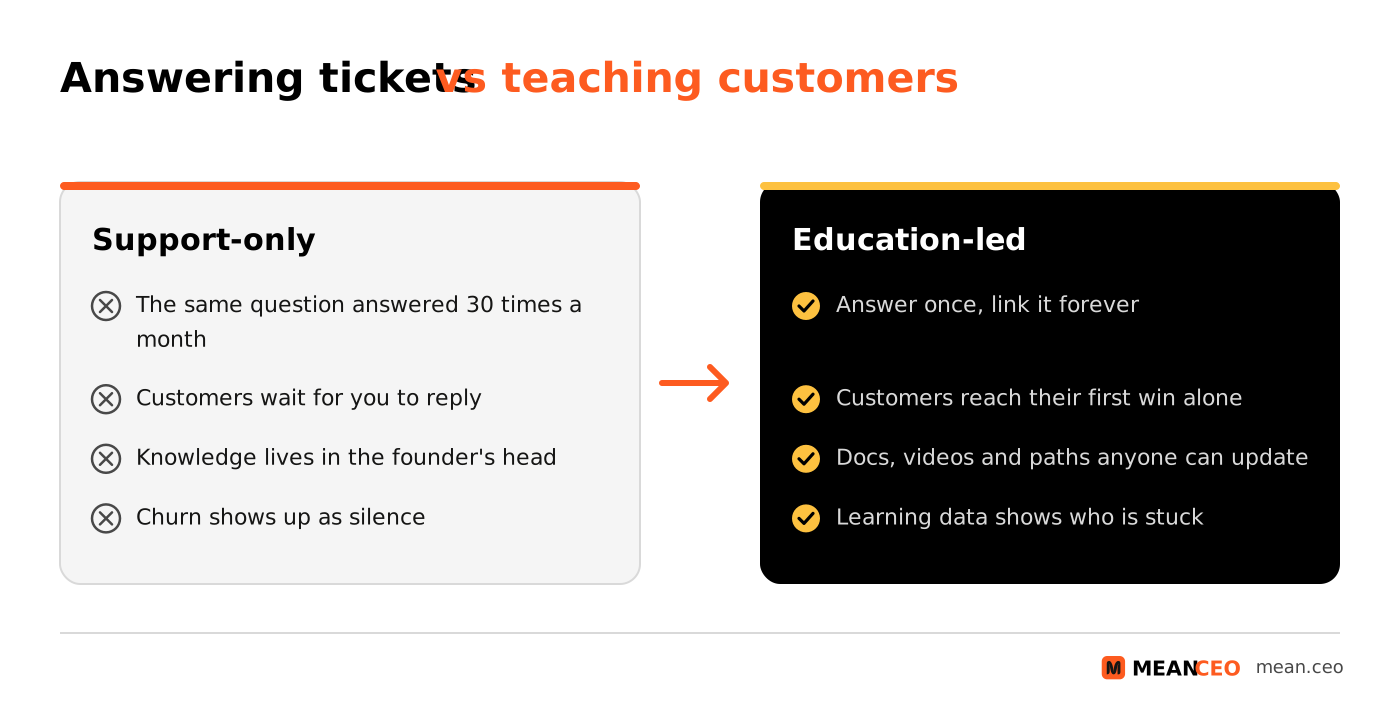
It overlaps with onboarding, support and documentation, which is why founders often mix them up. The difference is the goal: support fixes one problem for one person, while education prevents the next hundred. For the support side, where every request needs an owner, a priority and a clear path upwards, see support ticket management and escalation.
Onboarding is the first chapter of customer education, not a separate project. If you haven't set it up yet, start with building an onboarding process that scales and come back here.
Why customer education matters for bootstrapped startups
Without investors, you can't hire a support team to absorb every question, and you can't afford to lose customers you already paid to acquire. Education works on both problems at once.
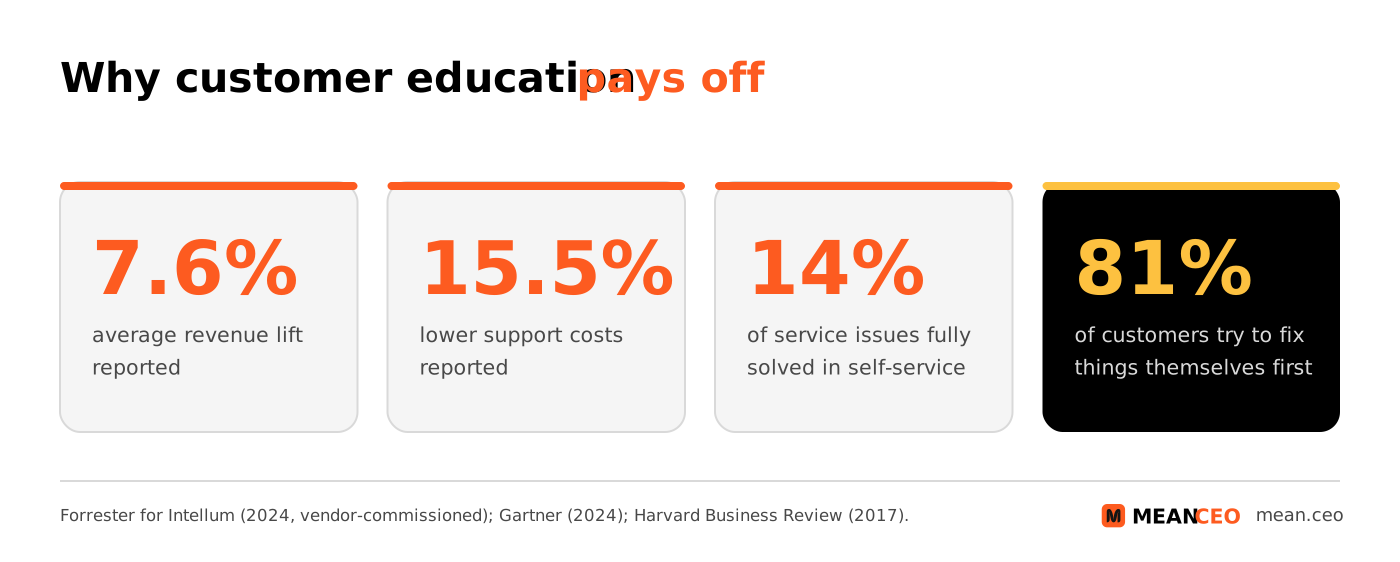
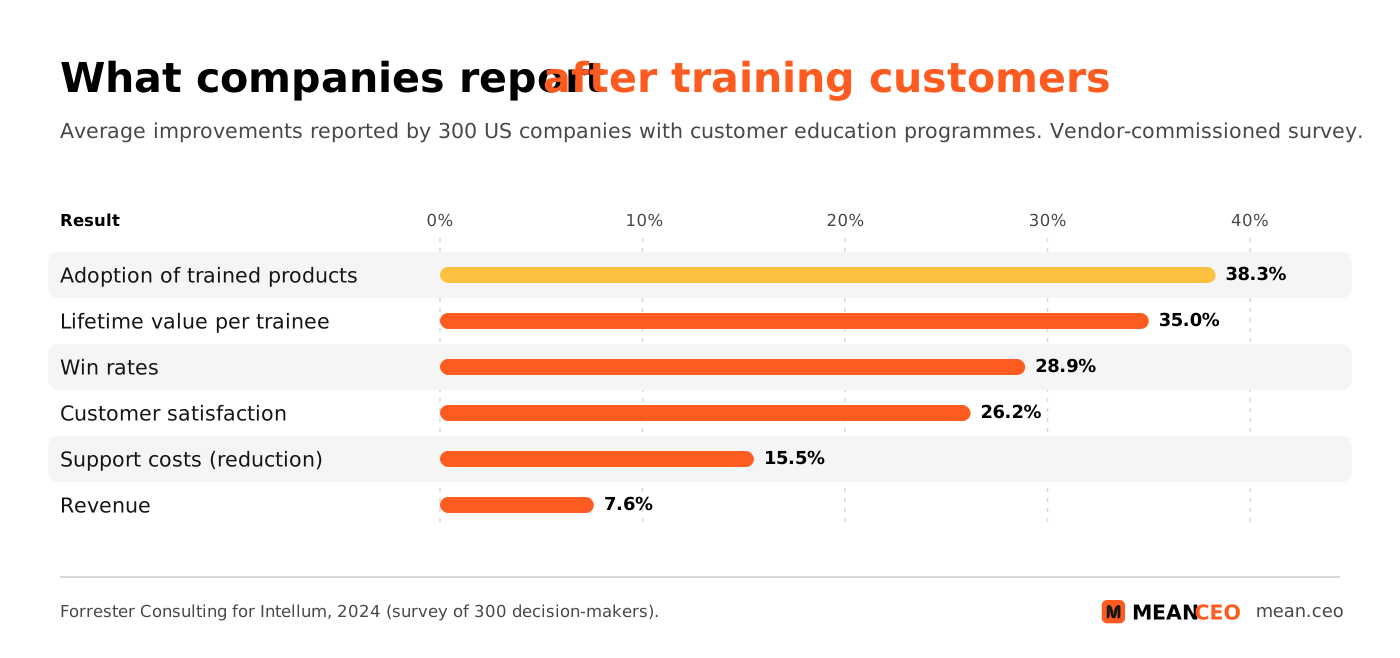
- Companies report more revenue and lower support costs. In a 2024 Forrester survey of 300 US decision-makers, commissioned by the learning platform Intellum, companies with customer education programmes reported on average 7.6% higher revenue, 38.3% higher adoption of the products they trained on and 15.5% lower support costs, according to Intellum's summary of the study. It's a vendor-commissioned survey of self-reported results, so treat the numbers as direction, not promise.
- Customers try to help themselves first. A Harvard Business Review article from 2017 found that 81% of customers across industries attempt to take care of matters themselves before contacting a live representative.
- But self-service usually fails. A Gartner survey of 5,728 customers (published in 2024) found that only 14% of customer service issues are fully resolved in self-service, and only 36% even for very simple issues. The most common reason, according to the same study, is that customers can't find relevant content.
- Onboarding content affects loyalty. In a small Wyzowl survey from 2020 (216 people), 86% said they'd be more likely to stay loyal to a business that invests in onboarding content, and 55% said they had returned a product because they didn't fully understand how to use it.
Put together, the message is clear: customers want to learn on their own, and most companies make it too hard. A small startup that gets this right has an advantage that big competitors with bloated help centres don't.
The paradox: will educated customers leave you?
Some founders worry that teaching customers too much makes them independent and more likely to switch. Research says otherwise. Bell and Eisingerich studied 1,268 high-value investment clients and published the results as "The paradox of customer education" (European Journal of Marketing, 2007). Education was positively linked to loyalty, and customers' growing expertise did not reduce it.
There was a twist, though. As customers became more expert, they cared less about how the service was delivered and more about what was delivered. In plain terms: educated customers see through nice packaging. If your product is good, education makes them more loyal. If it isn't, they'll notice sooner. An earlier study by the same authors, on the same 1,268 clients, found customer education was the strongest driver of loyalty in their model.
6 customer education formats, from cheapest to most demanding
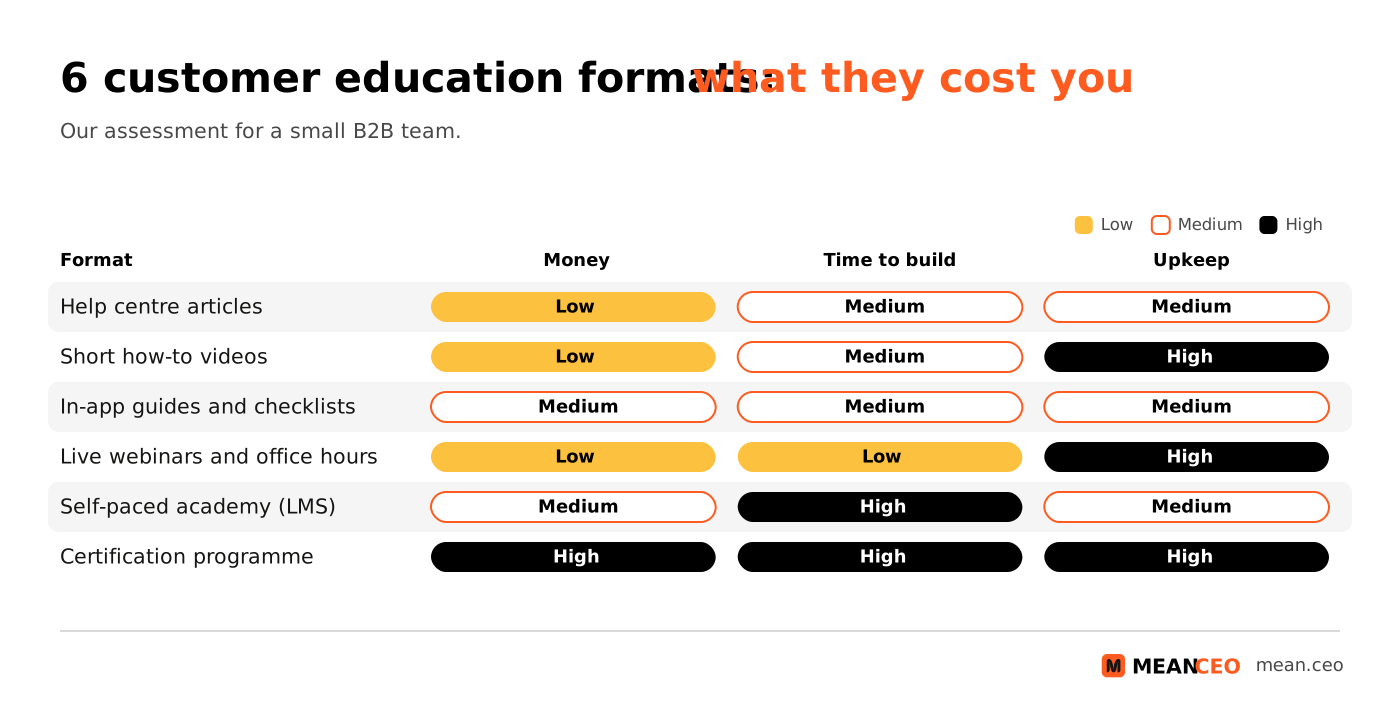
You don't need all six. Most bootstrapped startups should start with the first two, add in-app guidance and a monthly live session, and only build an academy once they have enough customers to fill it.
1. Help centre articles
The base of everything. One article per question, with a title that matches the words customers actually use ("How do I export invoices?", not "Data portability features"). Keep each article focused, add screenshots, and link related articles at the bottom. Gartner's finding that customers fail mostly because they can't find relevant content tells you where to spend effort: titles, search and structure matter more than length.
If you want an AI assistant to answer from your articles later, a clean help centre is the foundation; see building an AI knowledge base for your startup.
2. Short how-to videos
When Wyzowl asked people how they'd prefer to learn about a product or service for its 2026 video marketing report, 63% chose a short video, against 12% for text articles and 4% for ebooks or manuals. Record one- to three-minute screen recordings for your top tasks and embed them in the matching help articles. The catch is upkeep: every interface change can make a video outdated, so keep them short and easy to re-record.
3. In-app guides and checklists
Tooltips, onboarding checklists and empty-state hints teach customers at the moment they need it. They work best for the first win. Don't expect miracles: Userpilot's benchmark of 547 SaaS companies puts the average onboarding checklist completion rate at 19.2%. Keep checklists short and make each step deliver something useful.
4. Live webinars and office hours
A monthly 45-minute session where you show one workflow and answer questions costs almost nothing to set up. It's also the best research you can do: the questions people ask live tell you what to write next. Record it, cut it into short clips, and you have video content for the help centre.
5. Self-paced academy
Once you have a few hundred customers or several user roles, group your content into courses and learning paths on a learning management system (LMS). An academy also works as marketing: HubSpot Academy, running for more than a decade, had half a million certified users and over 40 certification courses by 2023, according to HubSpot. Salesforce's Trailhead, launched in 2014, had more than 3.3 million learners by 2021.
You don't need that scale to benefit. Pipedrive, founded in Estonia, runs a free academy in English, German, Spanish, French and Brazilian Portuguese, and the French sales tool lemlist runs its own academy too.
6. Certification
Certification makes sense when customers or partners gain something from proving their skill: agencies, consultants, implementation partners. It needs exams, rules and regular updates. For most startups under a few hundred customers, it's too early.
How to build a customer education programme in 6 steps
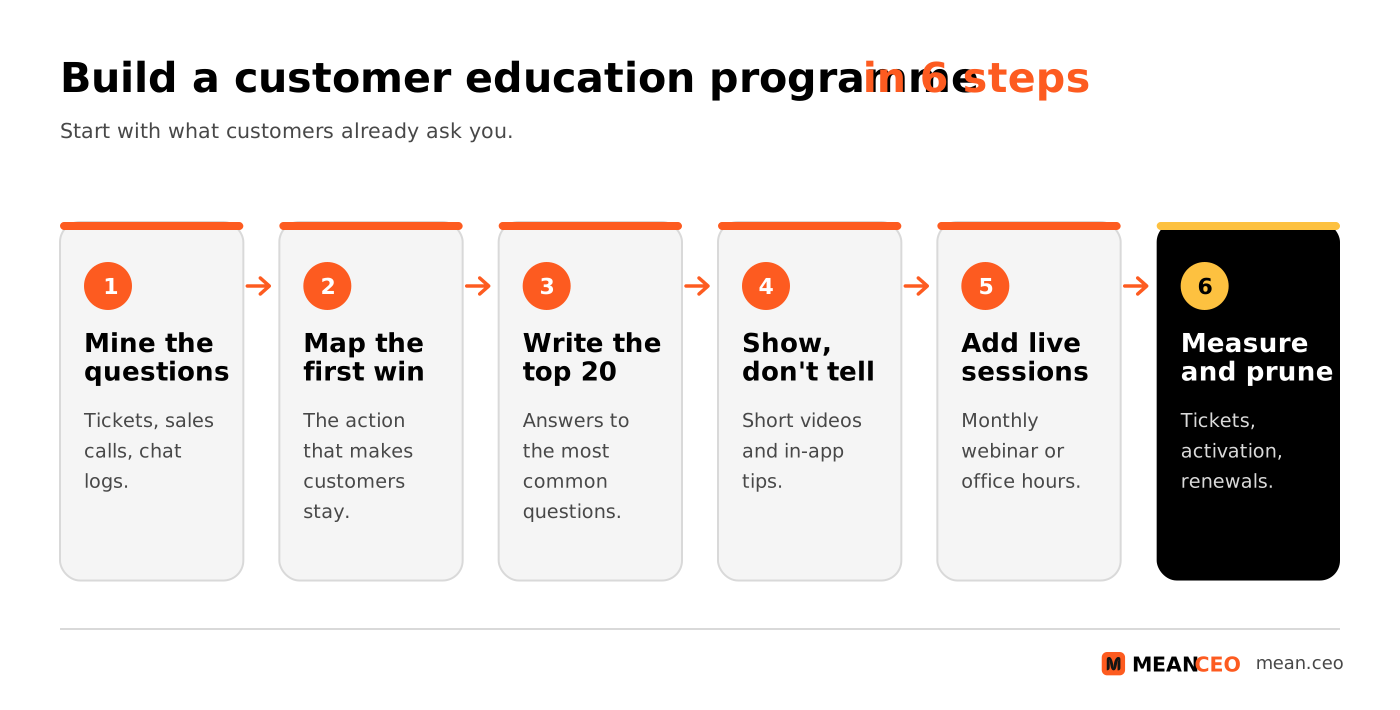
- Mine the questions you already get. Export the last three to six months of tickets, chat logs and sales-call notes. Tag each question and count. A short list of questions usually covers most of the volume.
- Map the first win. Find the action that separates customers who stay from those who leave: the first report sent, the first invoice created, the first integration connected. Everything early in your programme should push customers towards it. If you already score account health, the same usage signals apply; see customer health scoring models.
- Write the top 20 answers. One help article per question, in the customer's words. Link each answer from your ticket replies so you never type it again.
- Show, don't tell. Add a short video to the five most important articles and an in-app tip or checklist for the first win.
- Add live sessions. A monthly webinar or office hours for new customers. Use the questions to fill gaps in your content.
- Measure and prune. Track the metrics below every month. Rewrite articles that people read but still open tickets about, and delete what nobody uses.
Role-based learning paths
In B2B, the person who buys your product is rarely the only one who uses it. Different roles need different lessons. Map them before you build courses:
Tools and costs
You can start for almost nothing: a free help desk plan, a screen recorder and a monthly video call. Add an LMS when you have courses worth grouping, and an in-app guidance tool only when you have enough active users to justify the price.
Prices as published on the vendors' websites in October 2026; check before you buy, as plans change often. The market is also consolidating: Gainsight bought Northpass in 2023 and Skilljar in 2025.
For the rest of your stack, see essential SaaS tools for startup operations.
Selling across Europe: languages, accessibility and GDPR
Languages
In a CSA Research survey of 8,709 consumers in 29 countries (2020), 76% preferred to buy products with information in their own language, and 40% said they never buy from websites in other languages. Germany had the highest share of people who buy only from sites in their own language, at 57%.
You don't have to translate everything. Translate the first-win content (onboarding emails, the checklist, the top ten articles) into the languages of your biggest markets, and keep advanced material in English. Machine translation plus a native speaker's review is usually enough for help articles.
Accessibility
The European Accessibility Act has applied since 28 June 2025. Among other things, it covers e-commerce services sold to consumers. Microenterprises providing services (fewer than 10 people and no more than €2 million in turnover or balance sheet total) are exempt, and a pure B2B academy for business users is generally outside its scope.
Even when the law doesn't apply, accessible content is simply better content: captions on videos, alt text on screenshots, headings that structure the page, and enough contrast. These cost little if you build them in from the start.
GDPR
Tracking who watched which course or passed which quiz is processing personal data. You need a lawful basis, usually the contract with your customer (Article 6(1)(b)) or legitimate interests (Article 6(1)(f)), and a data processing agreement with your LMS or help desk provider (Article 28). Mention learning analytics in your privacy notice and track at account level where you can. For the basics, see our GDPR compliance guide for early-stage startups. This is general information, not legal advice.
How to measure customer education
Course completions and video views feel good but prove little. Measure what education is supposed to change:
Comparing trained and untrained customers is tempting but biased: your most motivated customers are the ones who sign up for training. Look at the same accounts before and after, or roll out a new course to half your new sign-ups first.
Customers who learn your product deeply are also your best candidates for upgrades; see expansion revenue: upsells and cross-sells. And when support volume still grows, how to scale customer support from 10 to 1,000 customers covers the operations side.
Are you getting customers from ChatGPT yet?
More and more traffic is coming from Perplexity, ChatGPT, Grok and other AI tools.
👉 Rank on ChatGPT
Common mistakes
- Building an academy before a help centre. Courses nobody needs yet, while basic questions still go unanswered.
- Writing in your words, not the customer's. If customers search "cancel invoice" and your article is called "Credit note management", it doesn't exist for them.
- Teaching features instead of outcomes. Customers don't want to learn your settings page; they want to send their first campaign.
- Letting content rot. An outdated screenshot costs more trust than no screenshot. Review your top articles every quarter.
- Measuring views, not tickets and renewals. A popular article that doesn't reduce questions is not working.
- Hiding the education. Link it from the product, your emails and every support reply, or nobody will find it.
Community can carry part of the load once you have enough customers: power users answer questions and share tricks. See building a customer community. And if you build gamified onboarding, the Fe/male Switch team wrote about onboarding gamification for startup apps.
Conclusion: teach once, help forever
Customer education is one of the cheapest growth levers a bootstrapped startup has. Start with the questions customers already ask, teach the first win before anything else, and add videos, in-app tips and a monthly live session. Build an academy only when you have the customers to fill it. Then measure what matters: fewer repeat tickets, faster activation and better renewals. Every answer you write once is an answer you never have to type again.
For more on keeping customers once they're trained, Fe/male Switch has a practical guide to customer retention strategies for early-stage startups.
FAQ: customer education and training programmes
What is customer education?
A planned set of content and training, such as help articles, videos, in-app guides, webinars and courses, that helps customers adopt a product, use more of it and solve problems on their own.
What is the difference between customer education and customer onboarding?
Onboarding gets a new customer to the first win in the first days or weeks. Customer education covers the whole customer life, from onboarding to advanced skills and certification. Onboarding is the first part of it.
Does customer education reduce churn?
Companies with education programmes report better retention and adoption, though most data comes from vendor-commissioned surveys. Academic research on 1,268 investment clients found customer education was positively linked to loyalty.
How much does a customer education programme cost?
A basic programme can run on free or low-cost tools: a free help desk plan, a screen recorder from around $18 per user a month and a video call tool. Academy platforms start at around $24 a month; enterprise platforms don't publish prices.
Which customer education format should I start with?
A help centre with answers to your 20 most common questions, plus short videos for the most important tasks. Add in-app guidance and a monthly webinar next, and an academy only when you have several hundred customers or user roles.
How do you measure customer education ROI?
Track repeat tickets per topic, time to first win, self-service success, adoption of trained features and renewal rates. Compare the same accounts before and after training, since motivated customers are more likely to sign up.
Do I need to translate my help centre?
For European markets, translate at least your onboarding content and top articles into your main customers' languages. In CSA Research's 2020 survey, 76% of consumers preferred buying products with information in their own language.
Does the European Accessibility Act apply to my customer academy?
It covers e-commerce services for consumers from 28 June 2025, but microenterprises providing services are exempt, and pure B2B training is generally out of scope. Making content accessible is good practice either way.
About the Author
Violetta Bonenkamp, also known as MeanCEO, is an experienced startup founder with an impressive educational background including an MBA and four other higher education degrees. She has over 20 years of work experience across multiple countries, including 5 years as a solopreneur and serial entrepreneur. Throughout her startup experience she has applied for multiple startup grants at the EU level, in the Netherlands and Malta, and her startups received quite a few of those. She’s been living, studying and working in many countries around the globe and her extensive multicultural experience has influenced her immensely.
