TL;DR: What was the Optimizely vulnerability?
On 16 November 2026 an attacker used a vulnerability in Optimizely's Web Experimentation product to write malicious JavaScript into customers' projects. For most of a day, the A/B testing snippet that sites load from Optimizely's own servers carried a kit that swapped crypto wallet addresses, skimmed cards typed into sites' own forms, stole cookies and screenshots, and pushed iOS exploit kits to older iPhones. Researcher Scott Helme found it on 188 snippets belonging to 178 organisations, including Zoom, the BBC, CNN, HSBC, IKEA and Air France-KLM. Optimizely says it fixed the flaw and removed the code. If your site runs Optimizely Web, check your Project JavaScript and your access list today.
Developing story. Last updated 19 Nov 2026, 10:25 CET. We'll update this article as Optimizely publishes more about how the attacker got in.
Update 19 Nov, 10:25 CET: Optimizely's interim incident report explains the break-in: a flaw in the signup flow let accounts the attacker created act as existing users on customer accounts, found through IDs in the public snippet and up to thousands of guessed employee email addresses per customer. No passwords were stolen. Optimizely says fewer than 5% of its customers were hit, and Scott Helme estimates the code loaded on about 34 million page visits. The timelines still disagree: Optimizely dates the first malicious write to 07:51 UTC, while Report URI and Jscrambler saw attacker code hours earlier.
Update 18 Nov, 10:15 CET: Optimizely told BleepingComputer it has ended active sessions, revoked tokens, reset access for affected user accounts and notified all affected customers. Salesforce says it has disabled Optimizely scripts across its preview and production instances. Report URI dates the first injection to 04:21 UTC on 16 November, about an hour before the main attack domain was registered. Optimizely's status page still says "Monitoring" and no full incident report is out yet.
The Optimizely vulnerability became public late on 16 November, when Report URI published its findings, and Optimizely posted a security notice at 01:02 UTC on 17 November. The story matters to every founder who pastes a third-party script into a website: the 178 victims didn't need a hole in their own code. The code came through a tool they had installed on purpose, from a domain they had told their browsers to trust.
Here is what happened, what the malware did, why most security policies didn't stop it, and the checks to run on your own site. Small business owners can start with the one-hour script check, and manufacturers with what to check on portals and CAD download pages. A day later a second alarm went off for anyone running Java: Java4Shell, a bug in the code under almost every Java runtime. Shopify is tightening its own platform too: every public app must set an IP allowlist by 20 November or lose its App Store listing, so a stolen app token stops working outside the app's own servers.
What happened to Optimizely on 16 November 2026?
Optimizely Web works through a JavaScript snippet: each customer loads a file such as cdn.optimizely.com/js/<project id>.js that holds Optimizely's code, the customer's experiments and an optional field called Project JavaScript, custom code that runs on every page. The file updates by itself, so a site gets new code without its own developers shipping anything.
According to Scott Helme's analysis for Report URI, the attacker wrote extra code into the Project JavaScript of customer projects and left the rest untouched. The file was still served from cdn.optimizely.com with Optimizely's certificate. Sites that serve the snippet from their own domain, such as Vodafone Australia, got the same code, because the content comes from the Optimizely project. Even the snippets on optimizely.com and login.optimizely.com carried it.
Optimizely's status notice confirms the main facts: "an unauthorized party exploited a vulnerability in Experimentation and used it to add malicious JavaScript to some customer projects. We've fixed the vulnerability and removed the injected code from affected projects." A company spokesperson told Gizmodo the flaw sat in the Experimentation account signup flow, as reported by iTWire. In a fuller statement to BleepingComputer, Optimizely said it blocked access to the vulnerable path and deployed a fix, "ended active sessions, revoked tokens, and reset access for affected user accounts", blocked any code from being delivered in Cloudflare and "notified all affected customers." Salesforce told the same outlet it has disabled Optimizely scripts across preview and production instances as a precaution and will notify customers if it finds unauthorized access to their data.
Optimizely's interim incident report, dated 17 November, fills in the method. "A flaw in the signup flow let those accounts act as existing users on customer accounts through a combination of public information and brute force. No passwords were stolen or used to do this." Account and project IDs sit in every site's public snippet, and the attacker guessed variations of employee email addresses, "up to thousands of times" per customer. Optimizely says this "was not the result of a compromised Optimizely administrator account", and its status page added on 18 November: "Less than 5% of our customers were impacted." Mandiant is investigating, the exact bug isn't described yet, and Optimizely writes that "Attribution is pending." Its report also confirms that the separate host for payment pages, cdn-pci.optimizely.com, was affected.
Optimizely's interim incident report, dated 17 November, fills in the method. "A flaw in the signup flow let those accounts act as existing users on customer accounts through a combination of public information and brute force. No passwords were stolen or used to do this." Account and project IDs sit in every site's public snippet, and the attacker guessed variations of employee email addresses, "up to thousands of times" per customer. Optimizely says this "was not the result of a compromised Optimizely administrator account", and its status page added on 18 November: "Less than 5% of our customers were impacted." Mandiant is investigating, the exact bug isn't described yet, and Optimizely writes that "Attribution is pending." Its report also confirms that the separate host for payment pages, cdn-pci.optimizely.com, was affected.
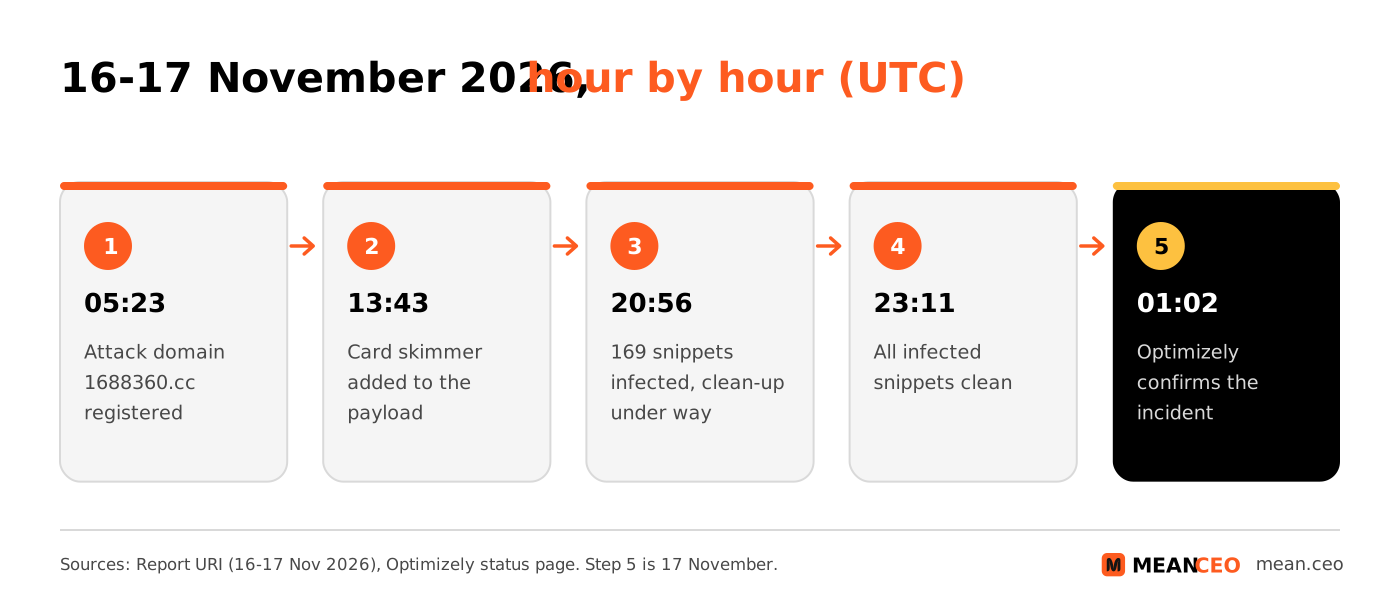
The attacker used three kinds of loader: a plain script tag pointing to 1688360.cc/track.js, the same address hidden in base64, and a full inline copy of the malware that runs through eval when the address is blocked. Smartsheet's snippet was cleaned once and then infected again with the hidden version, which means the attacker still had write access at that point. Report URI's timeline puts the first Optimizely injection at 04:21 UTC on 16 November, a BBC snippet loading the earlier injector webshell.lol, so the window ran from about 04:21 until the last file was cleaned at 23:11 UTC.
Optimizely's own timeline is shorter: first impersonated account created at 00:37 UTC, first malicious code written at 07:51, attack detected at 13:34, outbound code blocked at Cloudflare at 16:06, flaw closed at 16:10 and the code removed from all projects at 22:24 UTC. Two researchers saw attacker code earlier than that. Jscrambler first saw it on the BBC's snippet at 03:55 UTC and writes that "Optimizely has not yet explained the difference." Jscrambler also saw the code read sessionStorage and try to add input fields, which Optimizely's analysis of the recovered version doesn't mention. The two sides also list different attacker domains: Optimizely names pay-cloud[.]online and a workers.dev relay, Report URI named 1688360.cc and webshell.lol, so search your code and logs for all of them.
Optimizely's own timeline is shorter: first impersonated account created at 00:37 UTC, first malicious code written at 07:51, attack detected at 13:34, outbound code blocked at Cloudflare at 16:06, flaw closed at 16:10 and the code removed from all projects at 22:24 UTC. Two researchers saw attacker code earlier than that. Jscrambler first saw it on the BBC's snippet at 03:55 UTC and writes that "Optimizely has not yet explained the difference." Jscrambler also saw the code read sessionStorage and try to add input fields, which Optimizely's analysis of the recovered version doesn't mention. The two sides also list different attacker domains: Optimizely names pay-cloud[.]online and a workers.dev relay, Report URI named 1688360.cc and webshell.lol, so search your code and logs for all of them.
What did the Optimizely malware steal?
Every visitor got the same script, and every part of it was active at once:
- Crypto address swapping. It replaced wallet addresses for Bitcoin, Ethereum and other chains in page text, forms, links and the clipboard. Copy an address on an affected page and you can end up pasting the attacker's.
- Card skimming, added at 13:43 UTC. It watched forms and outgoing requests for a card number, expiry date and CVV and sent them to the attacker. Cards typed into hosted payment iframes from providers such as Stripe and Adyen were out of its reach; cards typed into a site's own fields were exposed.
- Cookie and screenshot theft. It took cookies that lack the HttpOnly flag plus a screenshot of the page.
- iOS exploit kits. On iPhones and iPads it loaded the Coruna and DarkSword kits. Pages on iOS 18.6 or older reloaded every 60 seconds, a visible symptom.
The money trail so far is small. The attacker's wallets received about $7,150 in crypto before being emptied early on 17 November, per Help Net Security. Nobody can see how many cards were skimmed. Hudson Rock, which investigated separately, says it has not shown that a real iPhone was compromised. Report URI also tied a cash-out address to operations in March and on 3 November, and says the same injector showed up on Turkish sites in September and in Kissmetrics, StorifyMe and Minute Media scripts days earlier.
Which websites were affected?
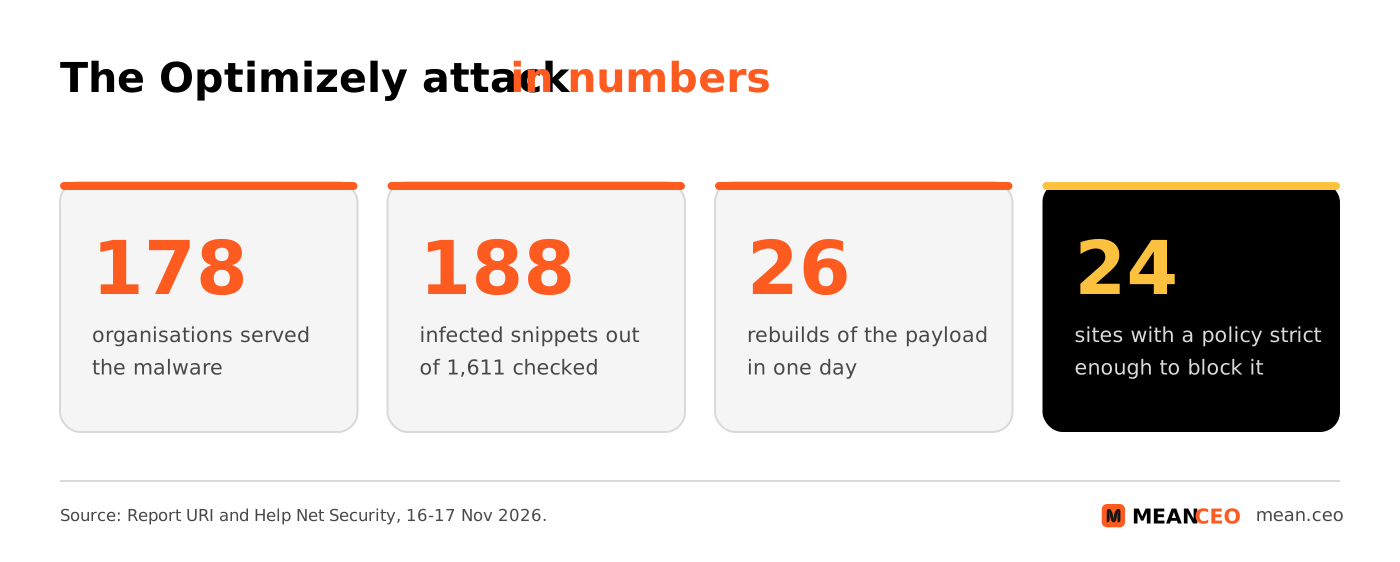
Report URI checked 1,611 Optimizely snippets and found 188 infected, belonging to 178 organisations, and says the real number is higher. Banks and financial firms were the largest group with 32 organisations. A sample:
Source: Report URI, 16 November 2026. By 23:11 UTC that night, Report URI saw every infected file cleaned, and the main attack domain was suspended at 00:37 UTC on 17 November.
Why didn't security policies stop the Optimizely attack?
A Content Security Policy (CSP) is a header that tells browsers which domains a page may load scripts from and send data to. Report URI crawled the affected organisations' sites. Only 24 had a policy strict enough to block the attack, 68 had no CSP at all, and in 50 cases the policy let the malware run and send data out.
- Allowing Optimizely's domain did nothing, because the malware came from that domain.
- 'strict-dynamic' trusts any script a trusted script inserts, so the snippet could pull in the attacker's file.
- 'unsafe-eval', which Optimizely's own documentation tells customers to allow, let the inline backup copy run. At HSBC the policy blocked the main file and the data theft, and the inline copy still ran.
- A tight connect-src helped: 17 sites blocked the card, cookie and screenshot theft because their pages couldn't send data to unknown hosts. The address swapping still worked, since it happens inside the page.
Helme's conclusion is worth printing: "trusted JavaScript doesn't always remain trustworthy. A website can be compromised through a third-party dependency without its own code or infrastructure ever being breached." We saw the same pattern this week with the ARTEX AI hacking tool, which walks in through vendor access, and earlier with the Claude Code extension backdoor.
What should founders do about the Optimizely vulnerability?
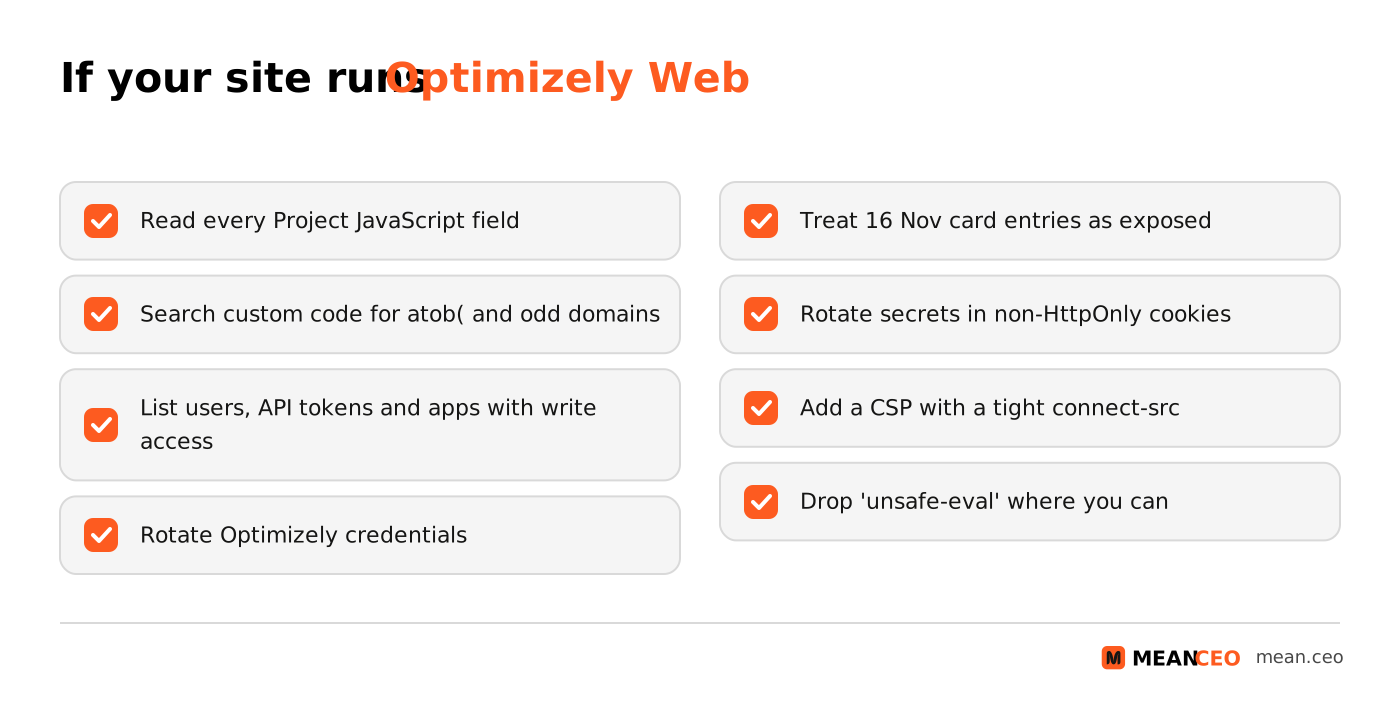
If your site runs Optimizely Web, Report URI's advice comes first. If you use any other script that can change itself, such as a tag manager, a chat widget or another testing tool, the same logic applies:
- Open every Project JavaScript field and every experiment's custom code. Look for 1688360.cc, atob( and any code you didn't write.
- Review write access. List the users, API tokens and connected apps that can change your Optimizely projects, remove what you don't need and rotate credentials. Optimizely's report says passwords and API tokens "do not need to be reset" because none were stolen; Report URI advised rotating them anyway, and doing so costs little.
- Treat cards entered on 16 November as exposed if your checkout uses your own card fields. If you use a hosted payment page or iframe, the skimmer couldn't read the card fields. If your payment pages loaded Optimizely's PCI snippet from cdn-pci.optimizely.com, talk to your acquirer and payment security assessor, since Optimizely confirms that host was hit too.
- Rotate session tokens and secrets stored in cookies without the HttpOnly flag, and set the flag on every new cookie.
- Deploy a CSP in report-only mode this week, restrict connect-src, avoid 'unsafe-eval' where you can, and read the reports before you enforce it. Our sister site has a step-by-step guide to a Content Security Policy for client sites.
- Check history, not just today's file. StepSecurity points out that a clean script fetched after the clean-up can't show what your visitors received earlier, so look at your CSP and browser reports for 16 November.
- Decide what to tell customers. If personal data such as card details was likely taken from your site, EU rules generally require you to notify your data protection authority within 72 hours of becoming aware, and to tell affected people when the risk is high. Check with your DPA or lawyer.
Thinking about leaving Optimizely after this? Fe/male Switch compared 11 Optimizely alternatives on free tiers and public prices, and our guide to A/B testing strategy for product decisions covers when a startup needs a testing tool at all. For the month's other incidents, see our cybersecurity news for November 2026.
Are you getting customers from ChatGPT yet?
More and more traffic is coming from Perplexity, ChatGPT, Grok and other AI tools.
👉 Rank on ChatGPT
What we don't know about the Optimizely hack yet
- The exact bug in the signup flow. Optimizely has explained the method (impersonating existing users, found through public IDs and guessed emails) and will confirm the root cause after Mandiant's investigation.
- When the attack really started. Optimizely says 07:51 UTC; Report URI saw attacker code at 04:21 and Jscrambler at 03:55.
- How many visitors loaded the malware. The only estimate is Scott Helme's, told to Newsweek: about 34 million page visits, with a range of 6 to 150 million. He stresses that counts visits that loaded the code, not people who lost money or data.
- How many cards, cookies and screenshots reached the attacker.
- Who the attacker is. Optimizely says attribution is pending and that the same actor has run command-and-control servers from pay-cloud[.]online since at least September. It is also unknown whether the earlier Kissmetrics, StorifyMe and Minute Media injections came from the same operator.
- When the final incident report comes. Optimizely calls its 17 November document an interim report and warns that busy forensics firms may delay the final one; its status page still read "Monitoring" on 19 November. Of the named victims, Equifax told Newsweek it stopped using Optimizely, IKEA is investigating and Smartsheet says its application and customer data were not affected. Zoom, the BBC, CNN, ABN AMRO and KLM haven't commented publicly.
- Optimizely hack: what third-party scripts on a small business website can take, and a one-hour check (Fe/male Switch Foundation)
- Content Security Policy after the Optimizely hack: what freelancers and small agencies should set on client sites (Fe/male Switch)
- Optimizely hack and manufacturers: what to check on portals, configurators and CAD download pages (CADChain)
FAQ: the Optimizely vulnerability
What happened with Optimizely?
On 16 November 2026 an attacker exploited a vulnerability in Optimizely Web Experimentation to add malicious JavaScript to customer projects. The code reached visitors of 178 organisations through Optimizely's own snippet. Optimizely says the flaw is fixed and the code removed.
Which sites were affected by the Optimizely hack?
Report URI found the malware on 188 snippets of 178 organisations, including Zoom, the BBC, CNN, Salesforce, GitLab, IKEA, HSBC, Equifax, Air France-KLM, Ledger and Peacock. It says the real number is higher.
What did the Optimizely malware do?
It swapped crypto wallet addresses for the attacker's, skimmed cards typed into sites' own payment forms, stole cookies without the HttpOnly flag and screenshots, and loaded the Coruna and DarkSword exploit kits on older iPhones and iPads.
Is the Optimizely vulnerability fixed?
Optimizely says it fixed the vulnerability, removed the injected code, ended active sessions, revoked tokens, reset access for affected accounts and notified all affected customers. Optimizely's interim report says the code was removed from all projects by 22:24 UTC on 16 November, and Report URI saw every infected file cleaned by 23:11 UTC. The attacker got in through a signup-flow flaw that let it impersonate existing users; the exact bug will be confirmed after Mandiant's investigation.
I visited an affected site. What should I do?
Update your iPhone or iPad to iOS 18.7.3 or later, or 26.3 or later, check any crypto transfer you made on 16 November, and watch your card statements if you paid by card on an affected site.
Would a Content Security Policy have stopped it?
Only a strict one. Report URI found 24 affected organisations with a policy that blocked the attack. Allowing Optimizely's domain didn't help, and the 'strict-dynamic' and 'unsafe-eval' settings let the malware run.
About the Author
Violetta Bonenkamp, also known as MeanCEO, is an experienced startup founder with an impressive educational background including an MBA and four other higher education degrees. She has over 20 years of work experience across multiple countries, including 5 years as a solopreneur and serial entrepreneur. Throughout her startup experience she has applied for multiple startup grants at the EU level, in the Netherlands and Malta, and her startups received quite a few of those. She’s been living, studying and working in many countries around the globe and her extensive multicultural experience has influenced her immensely.
