TL;DR: What is ARTEX AI?
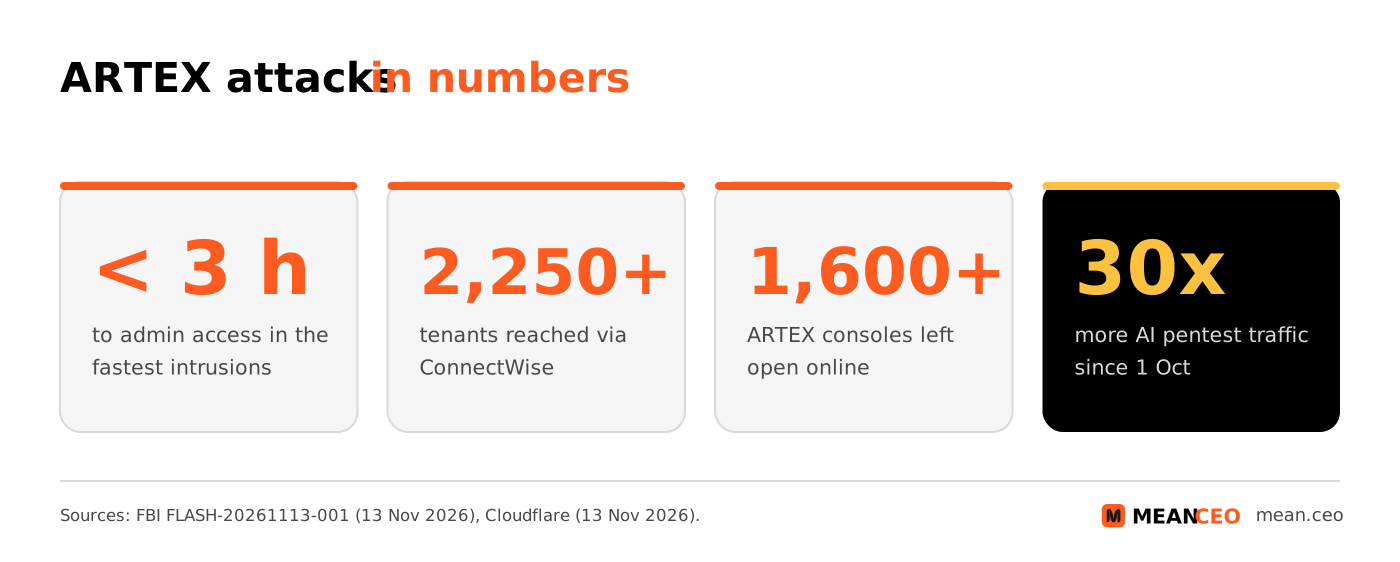
ARTEX is an open-source AI agent framework built for penetration testing that criminals and state-linked groups now use to break into companies. On 13 November 2026 the FBI warned that some ARTEX intrusions went from first targeting to privileged access in under three hours, and the same day Amazon showed ARTEX agents stealing AI API keys at industrial scale, with the stolen keys paying for the agents' own AI bill. The tool was pulled from GitHub on 8 October and keeps spreading through forks. Every entry point in the reports is an old one: keys nobody retired, default passwords, exposed admin panels and secrets in code. The agents simply find them faster than you do.
Searches for hacker jumped in the US and UK on Monday after TechCrunch reported the FBI's warning about ARTEX AI, the autonomous hacking framework behind the ConnectWise, Barracuda and South Korean bank breaches. Amazon had published what ARTEX agents wrote down about their own campaigns three days earlier. For founders, the story matters because ARTEX goes after exactly what small tech teams forget: the vendor key from last year's project, the test admin panel, the AI gateway with its default password.
Here is what ARTEX is, what the FBI, Amazon, Cloudflare and Barracuda reported, and the doors to close this week. On 19 November POLITICO reported that CERT-EU detected ARTEX use in the European Commission cyberattack, which kept staff HR systems offline for over 10 days.
What is ARTEX AI?
ARTEX is an autonomous, multi-agent penetration testing platform written in Go. A penetration test (pentest) is an authorized attack on your own systems to find holes before criminals do. According to the FBI, ARTEX turns a goal written in plain language into commands that specialised AI agents carry out, with little human input after the objective is set.
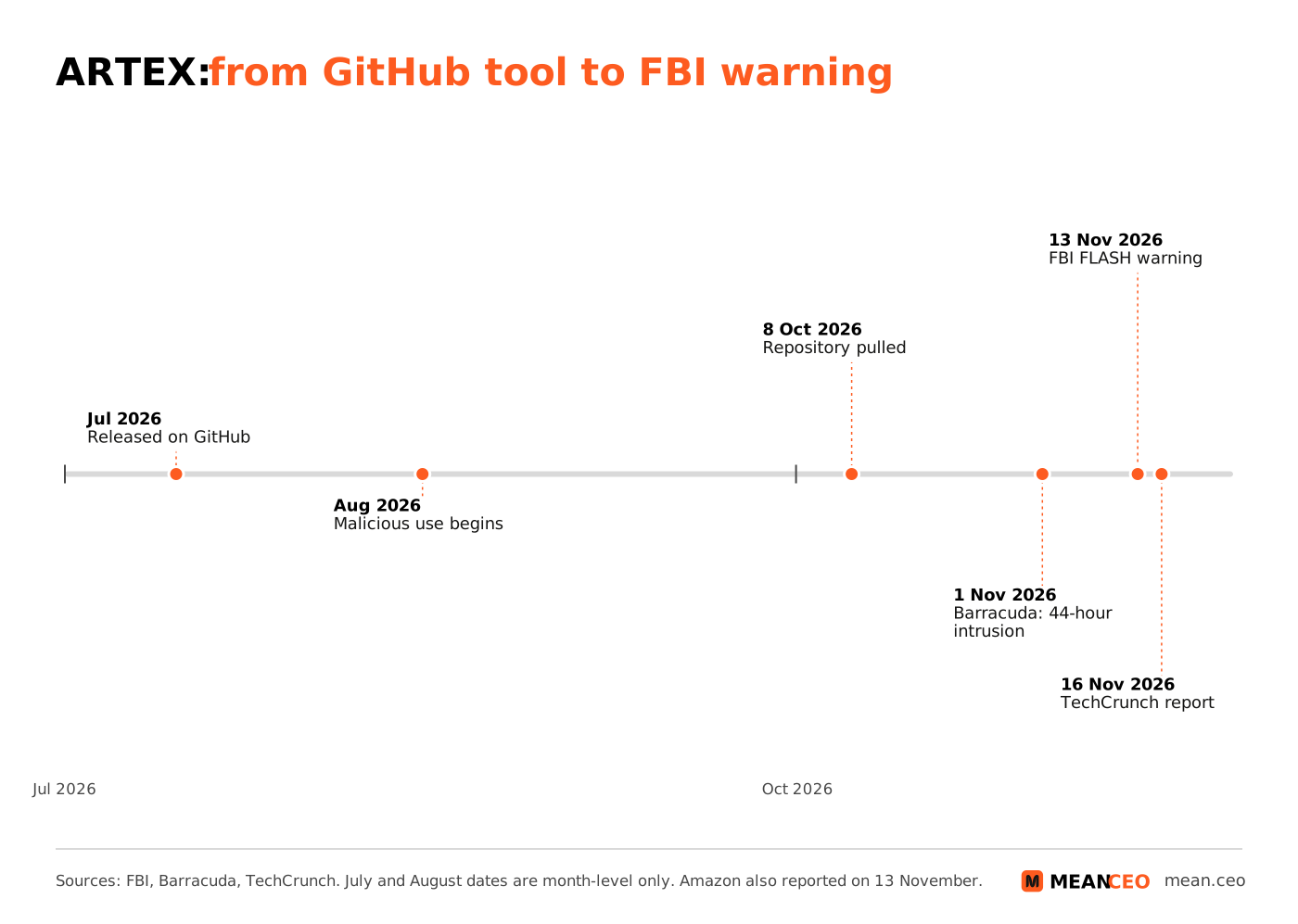
- Who made it: a developer called Autumn-27 released it on GitHub in July 2026. It collected an estimated 1,500 to 2,000 stars in 10 weeks.
- How it thinks: a planner agent picks the next step, worker agents run ordinary hacking tools, and verification and compression agents keep a shared map of the target up to date, per Barracuda and Amazon.
- Which AI models: ARTEX has no model of its own. It plugs into external models, including Anthropic Claude and OpenAI GPT, plus DeepSeek, GLM, Grok and Kimi. The FBI says attacker-run instances mostly use Chinese models, with DeepSeek Flash dominating because it is cheap and shows no guardrails when a request is framed as a pentest.
- Status: the developer made the repository unavailable on 8 October 2026 after reports of abuse. The FBI says forks, mirrors, archived copies and a commercial version, ARTEX PRO, keep it available.
The developer's own words, quoted by Cloudflare: "The malicious exploitation of this tool runs entirely counter to its original intent." The takedown backfired. Cloudflare counts more than 12,000 repositories with ARTEX lineage, and daily requests from AI pentesting tools hitting its network have grown 30x since 1 October.
What did the FBI warn about on 13 November 2026?
The FBI's FLASH-20261113-001 says many different groups have used ARTEX since at least August 2026 against financial services, government, technology, defense, semiconductor, energy, healthcare, manufacturing, telecom and legal organisations worldwide. Three cases stand out: A different supply-chain attack hit 178 websites on 16 November, when an Optimizely vulnerability put malware into a script their visitors' browsers already trusted.
Sources: FBI FLASH of 13 November 2026, Barracuda blog of 11 November 2026.
The FBI lists the entry points it saw, and none of them is exotic: hardcoded admin passwords inside single-page app JavaScript, web APIs with no authentication, SQL injection, weak admin credentials, stolen VPN configurations, leaked credentials, and third-party vendor credentials used to pivot through trusted links between companies. ARTEX, the FBI says, is best at the peripheral systems that get less attention: partner and supplier portals, mobile backends, employee apps, sales-support tools, legacy services, third-party connections and apps built by other teams. Hardware makers should read how ARTEX agents reach OEM design data through weaker suppliers on CADChain.
Two lines from the FLASH sum up why this is news. ARTEX lets "threat actors with minimal technical expertise" run complex, multi-target operations. And while its traffic is noisy enough to trigger alerts, the speed leaves defenders little time to respond before the attacker is done.
How did ARTEX agents steal AI API keys, according to Amazon?
Amazon's report of 13 November covers its decoy sensors, called MadPot, which pretended to be popular AI model APIs between 3 October and 5 November. ARTEX agents sent them requests and, with every request, their own campaign memory: system prompts, tool histories and notes. Amazon assesses with moderate confidence that several separate Chinese-linked groups were behind them.
The biggest campaign was a self-funding theft of AI credentials. Agents found AI apps exposed on the internet, pulled out the provider keys stored inside, tested them and pooled them, and the stolen keys then paid for the inference that powered the next round of key hunting. Targets included:
- AI gateways and proxies: One API, New API, Veloera, Sub2API and LiteLLM.
- AI app builders: Dify, FastGPT, Langflow, RAGFlow, Open WebUI, LobeChat and Ollama.
- Ways in: fresh installs nobody had claimed, admin endpoints open to anyone, default credentials such as the LiteLLM default master key, CVE-2025-3248 in Langflow, CVE-2026-28797 in RAGFlow, and secrets left in client-side JavaScript, source maps, debug routes and environment files.
- Where else they looked: GitHub repositories and event archives, npm and PyPI packages, container images, notebooks, model-hosting spaces, paste sites and Telegram channels.
The agents graded every credential: a lead, a key that works, and a key with proven impact such as readable data or spendable balance. Keys that had been public for more than 30 days counted as low-value, so a fresh leak is the prize and your rotation speed decides the outcome. We saw the money side of this in October: Railway's breach report put stolen customer AI keys behind an estimated $740,000 of compute, as covered in our Railway breach report article.
Amazon's conclusion is the line every founder should pin up: "None of the techniques in these campaigns were new. What AI agents change is the speed and persistence of the attacker."
What does a 44-hour ARTEX intrusion look like?
Barracuda published the most detailed victim account. The attacker used a valid cloud access key that Barracuda had given an AI vendor for an earlier project and never retired ("That is on us", the company wrote). The vendor's development environment was hacked in October.
- 1 November, 04:33: first call with the key; within minutes it maps what the key can reach and reads stored secrets.
- The next 24 hours: each secret opens the next system, from cloud accounts to a data analytics system, to a source-code token, to Kubernetes clusters.
- 2 November: it pushes short-lived branches to trigger a build that prints the build system's secrets into the log, encoded so log masking misses them. It also hunts for crypto wallet variables and tries to create an admin identity, which is blocked.
- 2 November, 23:31: last recorded activity, about 10 cloud accounts touched in 44 hours.
- 4 November: an engineer reports odd activity on their own account, and the vendor warns Barracuda the same day.
The attacker had finished before anyone noticed. Barracuda's CISO Arve Kjoelen told TechCrunch: "Defenders who rely on spotting malicious activity and then responding to it will often arrive after the attacker has finished." Cloudflare's incident teams describe the same pattern: static, non-expiring tokens in CI/CD pipelines, one of them an account-level API token with no IP restriction, used to create Worker scripts named artex-* and request 400 database dumps in an hour.
What should founders do about ARTEX this week?
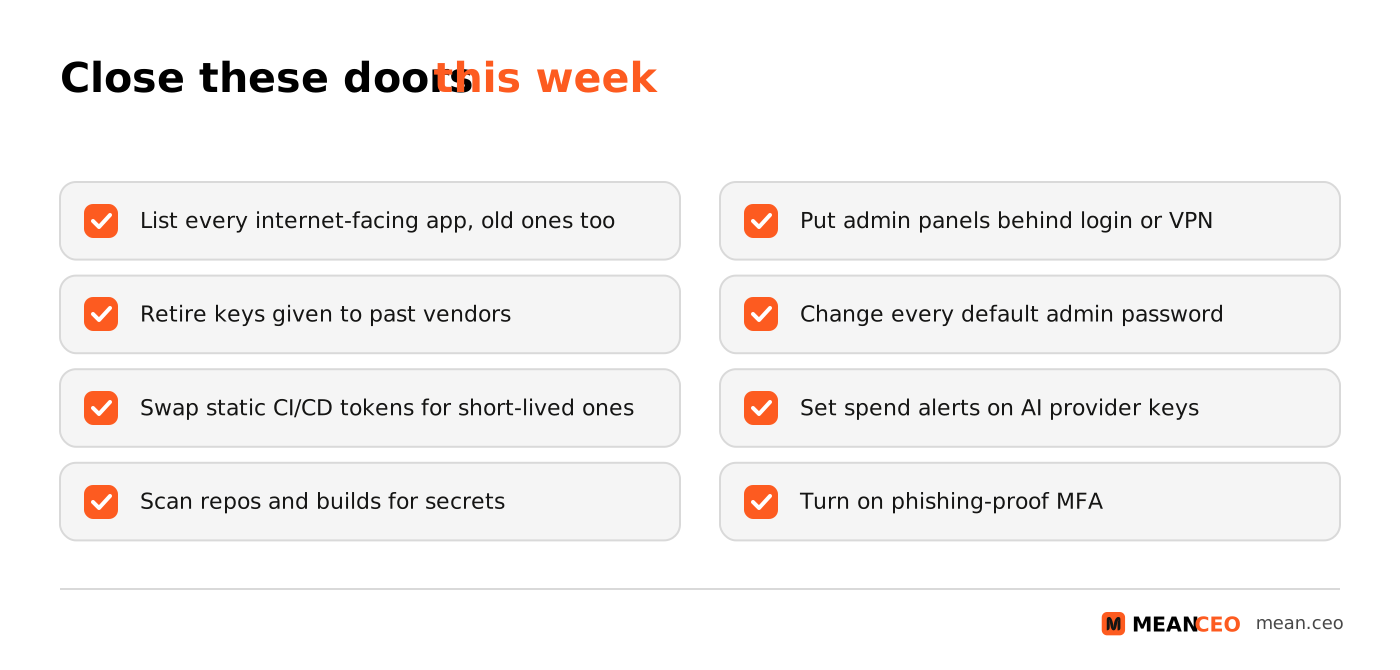
Assume an AI agent will find your mistakes within hours, then remove the mistakes. The list below combines the FBI's immediate actions with Amazon's and Cloudflare's advice, cut down for a small team:
- Write down every internet-facing system. Include the forgotten ones: staging sites, old landing-page backends, partner portals, the admin tool a freelancer built in 2024. The FBI's first recommendation is this inventory.
- Retire vendor and freelancer access the day a project ends. Barracuda's breach started with one unretired key. Keep a simple access list with an end date per key. The Vanden Broele supplier hack we covered in October shows how far one supplier's breach reaches.
- Kill long-lived tokens in CI/CD. Swap static deploy tokens for short-lived credentials, and limit each token to one environment, with IP restrictions where the provider allows them.
- Scan for secrets. Check repositories, container images, build artifacts and front-end bundles for keys and passwords, rotate anything you find, and read how Claude Code leaked 2,539 secrets to GitHub if your team uses coding agents.
- Hide admin panels. Put dashboards, AI gateways, Ollama and Open WebUI instances behind a login wall, VPN or zero-trust access. Nothing admin-shaped should answer an anonymous request.
- Change default credentials on day one. The LiteLLM default master key is on ARTEX's checklist; yours should be gone before the app goes live.
- Watch your AI bill. Set spend limits and usage alerts on every AI provider key, use one key per app, and rotate after any leak. Our guide to the Railway and LiteLLM breaches has the rotation steps, and our sister site explains how ARTEX agents hunt stolen AI API keys with a 30-minute check for freelancers.
- Use phishing-resistant MFA. Cloudflare recommends hardware security keys (FIDO) for admin accounts.
If you use ConnectWise products, the FBI asks you to review every Microsoft 365 tenant where its apps are or were installed, searching by application ID, check activity from at least 1 October 2026, and keep the affected app connections disabled until ConnectWise gives restoration instructions. Suspicious activity in the US goes to your local FBI field office or ic3.gov; in Europe, to your national CSIRT. If you run a small business without a tech team, the Fe/male Switch Foundation has a plain-language checklist against AI hacking tools, with questions to send your IT provider. For the bigger picture of security for a small company, start with our guide on building security into startup operations.
More of this month's incidents are collected in our cybersecurity news for November 2026 and the AI agents news for November 2026.
Are you getting customers from ChatGPT yet?
More and more traffic is coming from Perplexity, ChatGPT, Grok and other AI tools.
👉 Rank on ChatGPT
What we don't know about ARTEX yet
- How many victims there are. The FBI gives no total, and Amazon can't confirm the outcomes the agents claimed.
- Who is behind each campaign. Many groups use ARTEX, so a match describes the attacker's method and says nothing about identity, as Barracuda points out.
- What ARTEX PRO is. The FBI names a commercial version but says nothing about who sells it.
- AI hacking tools: the one-afternoon checklist for small business owners (Fe/male Switch Foundation)
- Stolen AI API keys: how ARTEX agents hunt them, and a 30-minute check for freelancers (Fe/male Switch)
- ARTEX AI and manufacturing: how AI hacking agents reach OEM design data through weaker suppliers (CADChain)
FAQ: ARTEX AI
What is ARTEX AI?
ARTEX is an open-source, multi-agent AI framework for penetration testing, released on GitHub in July 2026. Criminal and state-linked groups use it to automate intrusions, from reconnaissance to data theft, with little human input.
Why did the FBI warn about ARTEX?
In FLASH-20261113-001 of 13 November 2026, the FBI said groups have used ARTEX since at least August 2026 and that some intrusions reached privileged access in under three hours, including the ConnectWise and South Korean bank attacks.
Is ARTEX still available?
The developer pulled the GitHub repository on 8 October 2026, but the FBI says forks, mirrors, archived copies and a commercial version, ARTEX PRO, keep it available. Cloudflare counts more than 12,000 repositories with ARTEX lineage.
Which AI models does ARTEX use?
ARTEX has no model of its own. It connects to external models such as Anthropic Claude, OpenAI GPT, DeepSeek, GLM, Grok and Kimi. The FBI says attacker-run instances mostly use DeepSeek Flash models.
How do ARTEX attacks get in?
Through old mistakes: unretired vendor keys, default or hardcoded passwords, admin panels and APIs without authentication, unpatched software and secrets left in code or build files. Amazon says none of the techniques were new.
How can a small startup protect itself from ARTEX?
List every internet-facing system, retire old vendor and freelancer access, replace long-lived CI/CD tokens, scan code for secrets, hide admin panels behind a login, change default passwords, set AI spend alerts and use hardware-key MFA for admins.
About the Author
Violetta Bonenkamp, also known as MeanCEO, is an experienced startup founder with an impressive educational background including an MBA and four other higher education degrees. She has over 20 years of work experience across multiple countries, including 5 years as a solopreneur and serial entrepreneur. Throughout her startup experience she has applied for multiple startup grants at the EU level, in the Netherlands and Malta, and her startups received quite a few of those. She’s been living, studying and working in many countries around the globe and her extensive multicultural experience has influenced her immensely.
