TL;DR: what is a customer health score, and how do you build one on a bootstrapped budget?
A customer health score combines a few signals, such as product usage, payments, support tickets and sentiment, into one number or colour that tells you which accounts are likely to renew and which are drifting away. Start with three to five signals, score each from 0 to 10, weight them (usage carries the most), and add them up to a 0–100 score with green, yellow and red bands. Then test it on customers who already left, and attach an action to every colour. A spreadsheet is enough until you have well over a hundred accounts.
💡 Not sure which retention numbers to track first? Start with retention metrics: what to track and why.
Most churn is visible weeks before the cancellation email arrives. Logins slow down, the champion who bought your product changes jobs, a card payment fails, a support ticket stays open for ten days. Each signal on its own looks like noise. Put together, they tell you which customer is about to leave while you still have time to act.
That is what a customer health score does. Big SaaS companies run it with dedicated platforms and teams of customer success managers. A bootstrapped European startup can't afford either, and doesn't need to. In this guide I'll show you how health scoring models work, which signals matter most, how to weight and test a score, what it costs, and what GDPR means for tracking your customers' usage.
What is a customer health score?
A customer health score is a single number, grade or colour that estimates how likely an account is to renew, expand or churn. It turns scattered data from your product, billing, help desk and conversations into a ranked list: who is fine, who needs attention this week, and who is at real risk.
Vendors use different scales. Gainsight offers 0–100, A–F or red/yellow/green; Planhat scores from 0 to 10 and starts every customer at a neutral 5; Vitally and Custify grade each signal from 0 to 10 and combine them into a weighted average. The scale matters less than three rules: every input must be defined, the score must be explainable to the person who acts on it, and it must be tested against what customers actually did.
A health score is not a retention metric. Retention and churn rates tell you what already happened across your whole customer base. A health score looks forward at each account, so you can act before the renewal date.
Why health scoring matters for bootstrapped startups
Without investors, your existing customers fund your growth. A lost account isn't just lost revenue this month; it's revenue you had already paid to acquire.
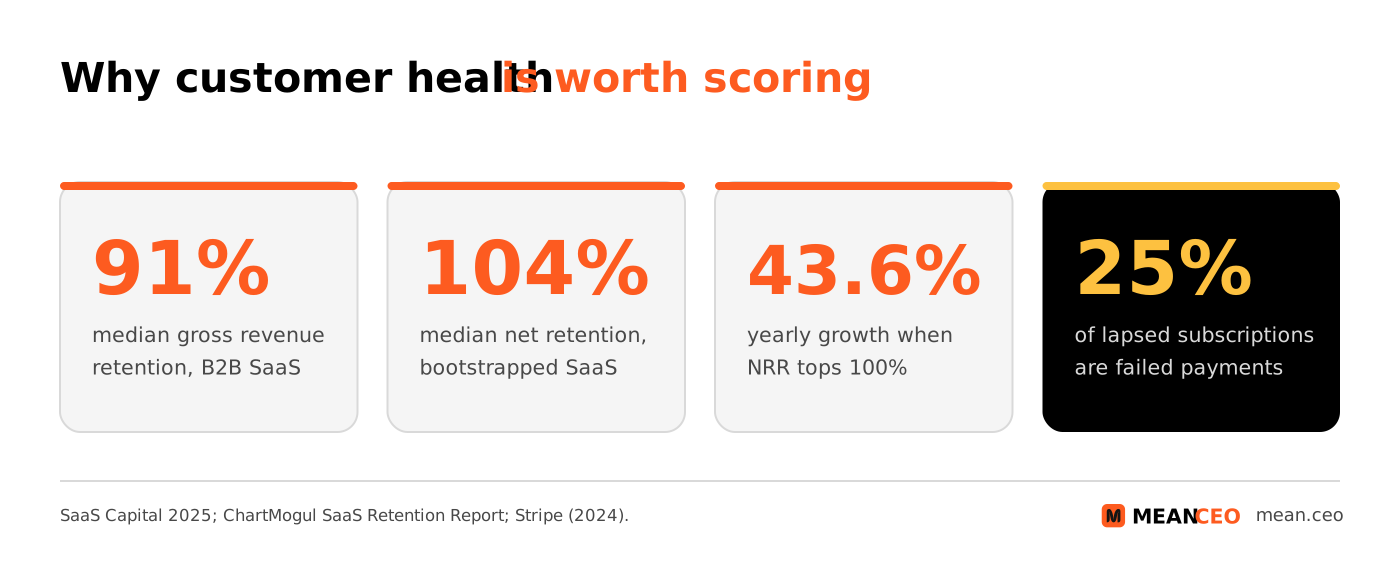
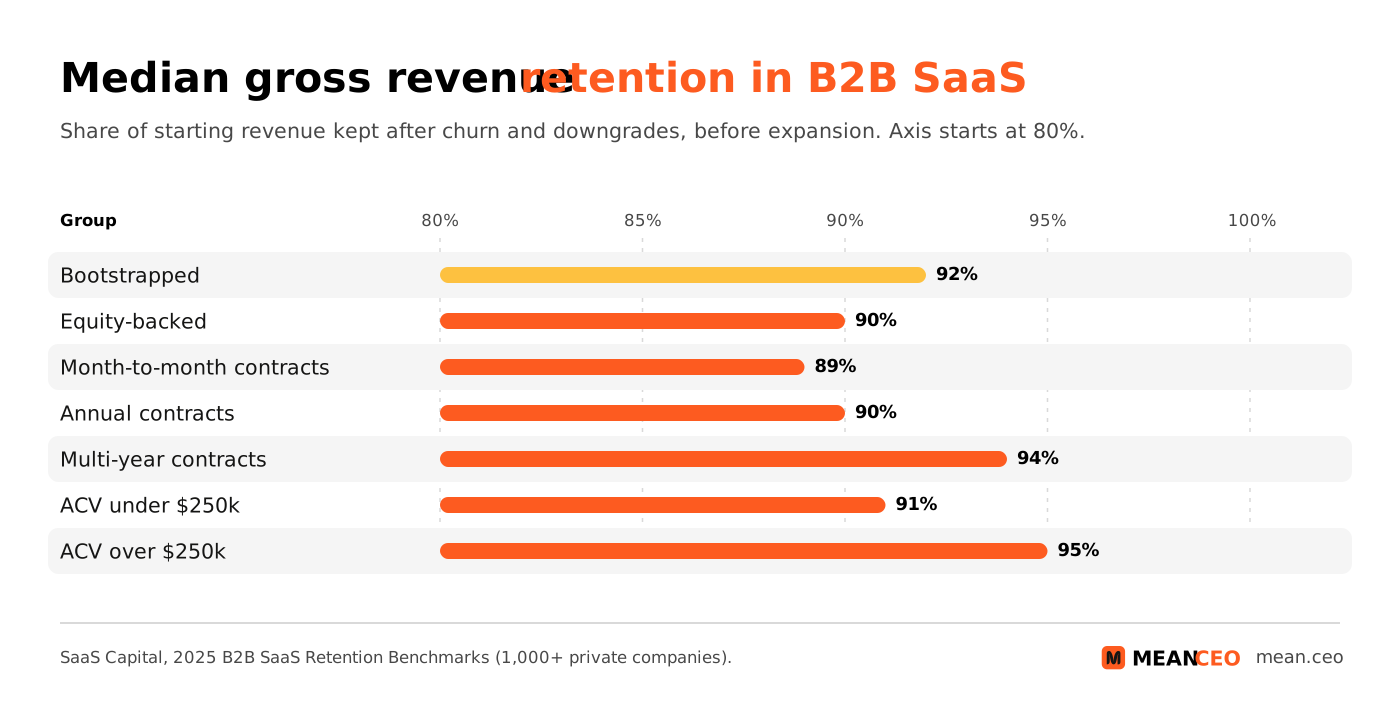
- Bootstrapped companies already retain well. In SaaS Capital's 2025 retention benchmarks, covering more than 1,000 private B2B SaaS companies, bootstrapped companies had a median net revenue retention (NRR) of 104% and gross revenue retention (GRR) of 92%, against 101% and 90% for equity-backed companies.
- 90% is the floor. SaaS Capital says GRR "must be at least 90%". Below that, you are refilling a leaking bucket.
- Retention drives growth. In the ChartMogul SaaS Retention Report (2,100+ businesses), companies with NRR above 100% grew 43.6% a year, while those below 60% grew 13.1%.
- Customer success is lean in bootstrapped companies. Equity-backed SaaS companies spend twice as much on customer success as bootstrapped ones, according to SaaS Capital's 2026 spending benchmarks, and the median spend on support and customer success together is 9% of ARR. With fewer people, you need to know where to look.
Myth check: does a 5% rise in retention really add 25–95% to profits?
The famous figure goes back to Reichheld and Sasser's 1990 Harvard Business Review article "Zero Defections", which said cutting defections by 5% could raise profits by 25% to 85% in the service businesses they studied. A later Bain note put it at more than 25% for financial services. The "25% to 95%" range and the claim that new customers cost "5 to 25 times" more than existing ones are widely repeated, but we couldn't find a primary study behind them. Retention is clearly valuable; just don't build your business case on a number nobody can trace.
Which signals go into a customer health score?
Most tools use the same five families of signals. ChurnZero, for example, lists account attributes, engagement, feature usage, licence utilisation, support tickets and SLAs, NPS, CSAT and CES, tenure and journey stage. For a small team I'd group them like this:
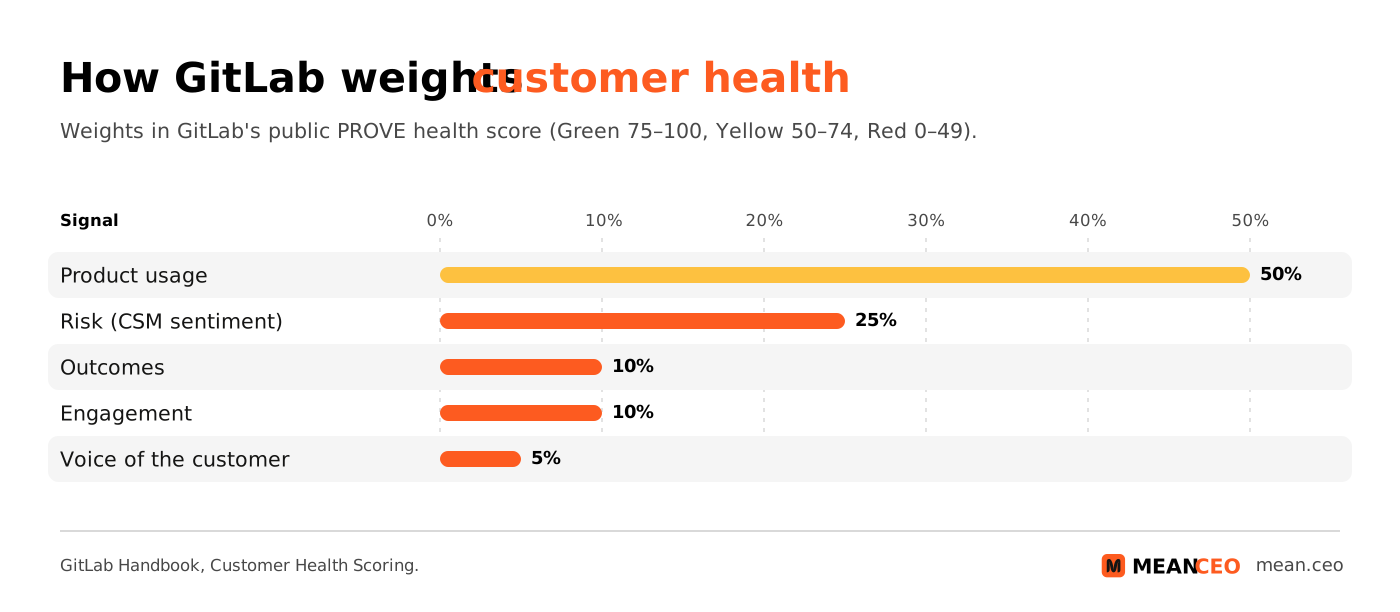
The weights are a starting point, not a rule. GitLab, which publishes its customer success handbook, gives product usage half of the total score. Its PROVE model weights Product 50%, Risk (the CSM's sentiment) 25%, Outcomes 10%, Engagement 10% and Voice of the customer 5%.
Usage and relationships: what predicts churn best?
Usage is the most common predictor because it's objective and easy to collect. But relationships count too. A 2025 master's thesis at Aalto University in Finland, which built churn models for a Nordic B2B SaaS company, found that the strongest single predictor was a composite "relationship strength" metric, ahead of individual usage metrics. In B2B, the person who championed your product is often worth more than any login count. When they leave, flag the account.
Billing: the signal founders forget
Some churn has nothing to do with value: the card simply fails. Stripe reports that 25% of lapsed subscriptions are due purely to payment failures, and that subscriptions recovered with its Smart Retries ran on average seven months longer. Put failed payments and expiring cards into your score, but handle them with a separate, automated playbook: retries, card-update emails and a personal message. For what to do once a customer has gone, see win-back campaigns for churned customers.
NPS: useful input, weak predictor
Net Promoter Score was launched in 2003 as "the one number you need to grow". Later research was less kind. A study of 21 Norwegian firms and more than 15,500 interviews by Keiningham and colleagues (Journal of Marketing, 2007) could not replicate NPS's superiority over other loyalty measures, as this MeasuringU summary explains. Even Bain, which created NPS, wrote in 2021 that self-reported scores and linking NPS to bonuses had damaged its credibility.
So use NPS or CSAT as one input with a small weight, not as your health score. The comment a customer writes next to the number is often worth more than the number. To collect those comments and reply to them every week, set up a simple customer feedback system around NPS.
4 customer health scoring models
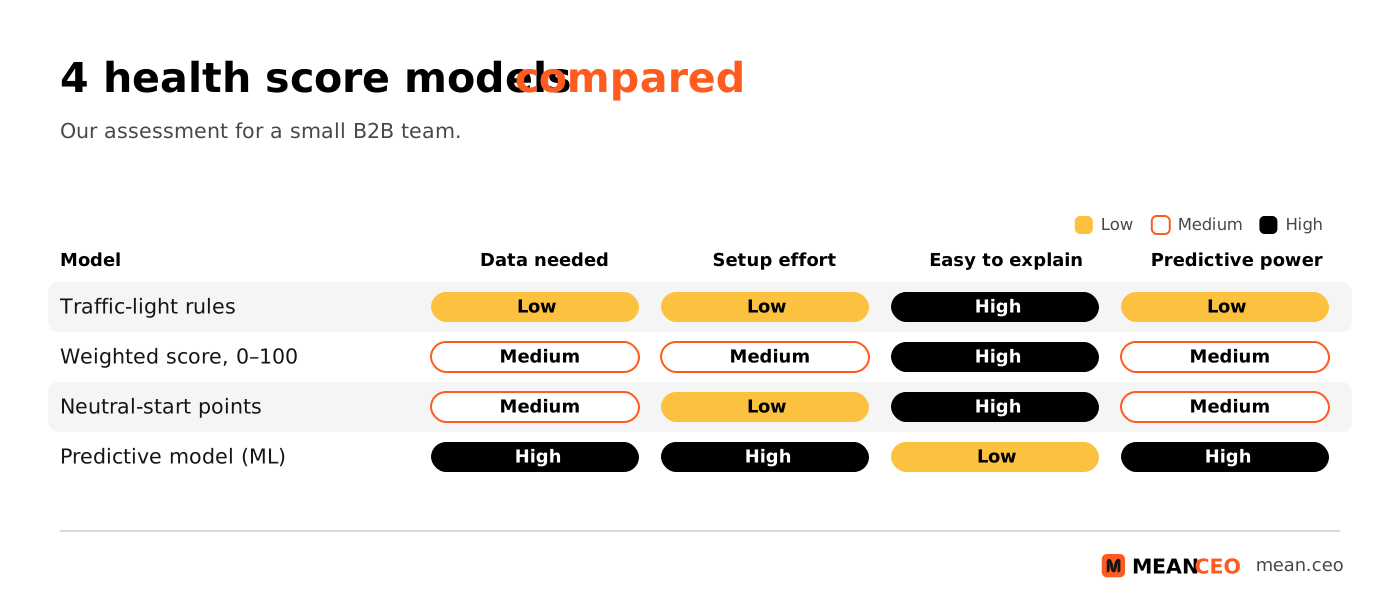
There are four common ways to turn signals into a score. You don't need the most advanced one; you need the one your team will trust and use.
1. Traffic-light rules
A few if-then rules decide the colour: red if no login for 21 days or a failed payment; yellow if usage has dropped by more than a third; otherwise green. It's the fastest place to start and works well under about 50 accounts, when you know most customers personally. The weakness is that every signal counts the same, and accounts flip between colours on small changes.
2. Weighted score from 0 to 100
Each signal is scored from 0 to 10, multiplied by its weight, and the results are added up. GitLab uses this logic with bands of Green 75–100, Yellow 50–74 and Red 0–49; Vitally and Custify work the same way, and Vitally lets you use different weights for different customer segments. This is the best model for most bootstrapped B2B startups: transparent, easy to keep in a spreadsheet, and easy to adjust.
3. Neutral-start points
Planhat starts every customer at a neutral 5 on a 0–10 scale and lets each factor add or subtract points, and recommends between two and eight factors. HubSpot's health scores in Service Hub work on points too, for example +10 points if the last activity was within 30 days, with optional decay over time. This model is intuitive ("what pushes this customer up or down?") and handles missing data well, because a customer with no data stays neutral.
4. Predictive model
A statistical or machine-learning model (logistic regression, random forest, gradient boosting) learns from accounts that renewed and accounts that churned. In the Aalto thesis, gradient boosting (XGBoost) beat logistic regression, support vector machines and random forest. The catch: you need many churned accounts to learn from, usually more than a young startup has, and the result is harder to explain to the person who must call the customer. Most bootstrapped startups should wait.
One more lesson from research: the riskiest customers aren't always the ones worth saving. In "Retention Futility" (Journal of Marketing Research, 2018), Eva Ascarza showed that targeting the customers most likely to respond to an intervention reduced churn more than targeting those most likely to churn. Use your score to find risk, then ask whether a call, training session or discount would actually change the outcome.
How to build your first health score in 6 steps
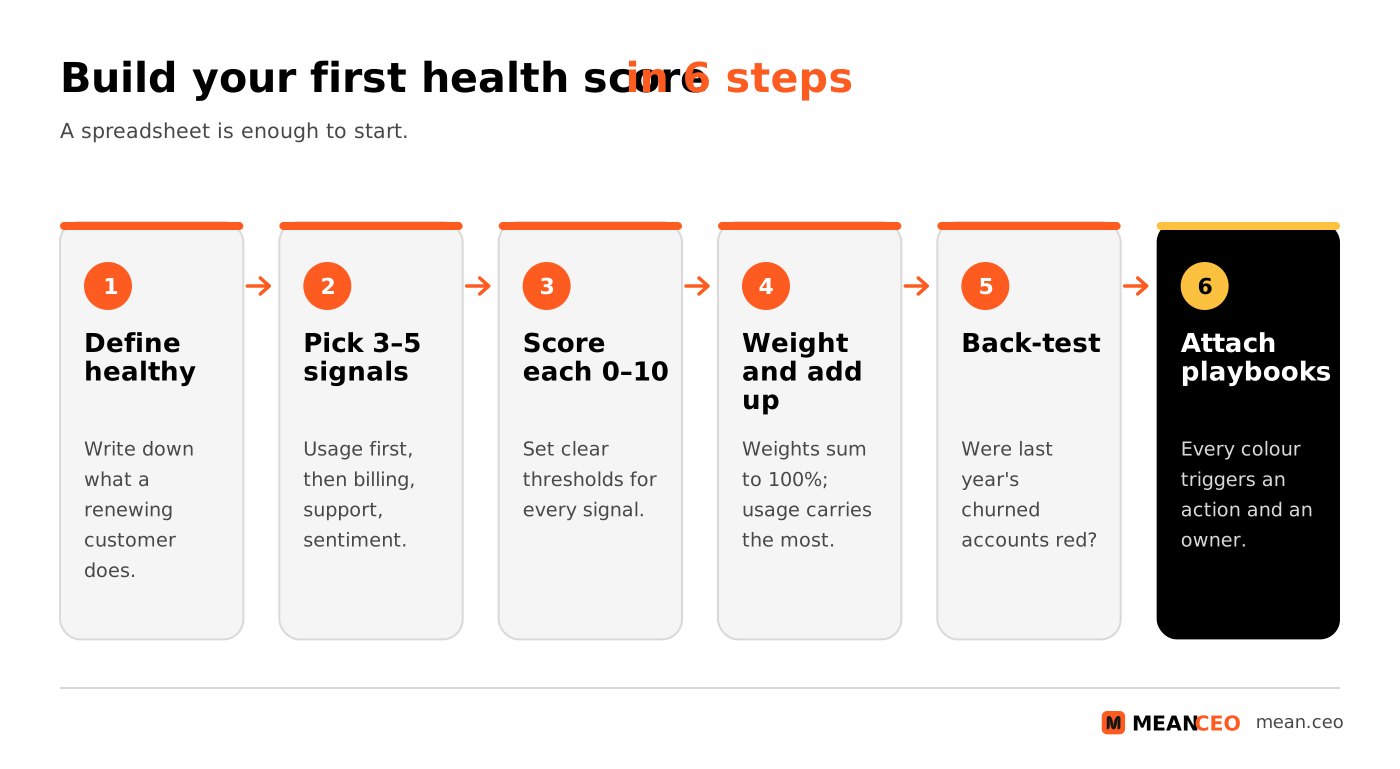
- Define what a healthy customer looks like. Look at your best renewing accounts. What do they do in the first 30 days, and every week after that? This is usually the moment they reach real value, which is why a strong onboarding process shows up in every good health score.
- Pick three to five signals. Start with one usage signal, one billing signal, one support signal and one relationship or sentiment signal. Only use data you can collect automatically or update in two minutes.
- Score each signal from 0 to 10 with clear thresholds. For example: logins in the last 30 days, 0 = none, 5 = weekly, 10 = daily. Write the thresholds down so anyone gets the same result.
- Weight the signals and add them up. Weights must add up to 100%. Multiply each score by its weight and by 10 to get 0–100.
- Back-test on customers you've already lost. Rebuild the scores of accounts that churned in the last 12 months as they looked 60–90 days before they left. If most weren't red or yellow, change the signals or weights.
- Attach a playbook and an owner to every colour. A score that triggers no action is a decoration.
A worked example
Imagine a Dutch B2B SaaS startup with 120 accounts. It weights usage 40%, engagement 20%, support 15%, billing 15% and sentiment 10%. Here are three accounts:
Account A needs nothing but a renewal reminder and perhaps an upsell. Account B pays on time but is using less and replying less: a classic quiet churner who needs a check-in this week. Account C has a failed payment and low usage: fix the payment first, then call to find out whether the problem is value, budget or a lost champion.
Turn scores into action: playbooks by colour
Green customers are your best source of case studies and referrals; see customer advocacy programs and building a customer community. Yellow accounts are where most of the value is: they haven't decided to leave yet. And when support load grows, the score tells you where to put your limited time; see how to scale customer support from 10 to 1,000 customers. When a yellow account simply never learned the product, a customer education and training programme fixes the cause rather than the symptom.
Are you getting customers from ChatGPT yet?
More and more traffic is coming from Perplexity, ChatGPT, Grok and other AI tools.
👉 Rank on ChatGPT
Who owns customer health in a small startup?
In a bootstrapped company with fewer than about 50 accounts, the founder usually owns customer health and knows every customer by name. The score's job then is to make sure nobody gets forgotten.
As you grow, it helps to know the ratios. Gainsight's CEO Nick Mehta suggested in 2014 about one customer success manager (CSM) per $2M of ARR, with wide variation. In a Vitally survey, the most common ratio was one CSM per 10–25 customers (33% of companies), followed by one per 25–50 (29%). A bootstrapped startup usually hires its first customer success person later, so the health score has to do part of the job: it decides which customers get a human touch and which get automated emails and in-app guidance.
Tools and costs
You can start with a spreadsheet that pulls data from your product, billing and help desk once a week. Move to a tool when updating the sheet takes more than an hour a week or you have more than about 150 accounts.
European tools can make GDPR conversations easier: Custify says it stores customer data in Germany. Whatever you choose, check where data is hosted and sign a data processing agreement.
GDPR: can you score your customers' behaviour?
Yes, but treat it as data processing that needs a legal basis. If your score uses data about identifiable people, such as individual users' logins, it is likely to be profiling under Article 4(4) of the GDPR, which covers analysing or predicting a person's behaviour.
- Legal basis. Most B2B companies rely on legitimate interests (Article 6(1)(f)). Recital 47 notes that a legitimate interest can exist when the person is a client. You still need to do the three-part test the UK ICO describes: purpose, necessity and balancing. The EDPB published guidelines on legitimate interests (1/2024) for this.
- Score accounts, not people, where you can. Seat use and company-level logins answer most questions and reduce privacy risk.
- Tell customers. Mention usage analytics and health scoring in your privacy notice. People can object to profiling based on legitimate interests (Article 21).
- Keep a human in the loop. Article 22 restricts decisions based solely on automated processing that have legal or similarly significant effects. A score that prompts a phone call is fine; a score that automatically cuts off service or raises prices deserves legal review.
- Large-scale or sensitive profiling may require a data protection impact assessment (Article 35).
For the basics, see our GDPR compliance guide for early-stage startups. This is general information, not legal advice.
Common mistakes
- Too many signals. Twenty inputs make a score nobody can explain. Planhat's advice of two to eight factors is a good limit.
- Never testing the score. If last year's churned customers were green, the score is wrong, however good it looks.
- Counting logins instead of value. Measure the action that delivers value, such as reports sent or invoices created, not just sign-ins.
- Same weights for every customer. A five-seat agency and a 200-seat company use your product differently. Segment once you have the data.
- No owner, no action. Every red account needs a name next to it and a date.
- Treating NPS as health. A promoter who stopped logging in is still at risk.
If you're still choosing what to measure across the whole business, read bootstrapped growth metrics that matter.
Conclusion: start simple, test, act
A customer health score is a tool for focus. Start with three to five signals in a spreadsheet, weight usage the most, add billing and relationship signals, and test the score against customers you've already lost. Attach a clear action to each colour and review the list every week. Bootstrapped SaaS companies already keep about 92% of their revenue at the median; a working health score helps you find the accounts in the other 8% before they leave.
FAQ: customer health scoring models
What is a customer health score?
A number, grade or colour that combines signals such as product usage, billing, support tickets and sentiment to estimate how likely an account is to renew, expand or churn.
What is a good customer health score?
It depends on your scale. With a 0–100 score, GitLab treats 75–100 as green, 50–74 as yellow and 0–49 as red. What matters is that the score predicts renewals in your own data.
What metrics are used in a customer health score?
Usually product usage, engagement and relationship, support tickets, billing events such as failed payments, and sentiment such as NPS or CSAT. Usage typically carries the largest weight.
How many signals should a health score have?
Start with three to five. Planhat recommends between two and eight factors. More signals make the score harder to explain without making it more accurate.
How do you calculate a customer health score?
Score each signal from 0 to 10, multiply by its weight (weights add up to 100%), add the results and multiply by 10 to get a 0–100 score.
Is NPS a good health score?
Not on its own. Research by Keiningham and colleagues found NPS was no better than other loyalty measures at predicting growth. Use it as one input with a small weight.
What is good revenue retention for a bootstrapped SaaS?
SaaS Capital's 2025 benchmarks put median gross revenue retention for bootstrapped B2B SaaS at 92% and net revenue retention at 104%. It says GRR should be at least 90%.
Do I need a customer success platform?
Not at first. A spreadsheet works for most startups up to roughly 150 accounts. Move to a tool such as HubSpot, Planhat, Custify or Vitally when updating the sheet takes too long.
Is customer health scoring allowed under GDPR?
Generally yes, usually under legitimate interests, if you tell customers, minimise personal data, respect objections and keep a human involved in significant decisions.
About the Author
Violetta Bonenkamp, also known as MeanCEO, is an experienced startup founder with an impressive educational background including an MBA and four other higher education degrees. She has over 20 years of work experience across multiple countries, including 5 years as a solopreneur and serial entrepreneur. Throughout her startup experience she has applied for multiple startup grants at the EU level, in the Netherlands and Malta, and her startups received quite a few of those. She’s been living, studying and working in many countries around the globe and her extensive multicultural experience has influenced her immensely.
