TL;DR: how should a bootstrapped startup collect customer feedback and use NPS?
Ask a few short questions at the right moments: NPS every few months for the overall relationship, CSAT right after a support conversation, and a one-question effort score after key tasks. Put every answer, support ticket and sales-call note in one place, tag it by theme and revenue, and decide once a week what to fix, build, explain or park. Reply personally to unhappy customers within two business days, and tell everyone what you changed. The score matters less than the follow-up.
💡 Want to spot churn before it happens? Read how to build customer health scoring models.
Most startups don't lack feedback. It sits in the support inbox, in sales-call notes, in a Slack channel, in app store reviews and in the founder's head. What they lack is a system: one place where it all lands, a few numbers you track over time, and a habit of acting on what customers tell you.
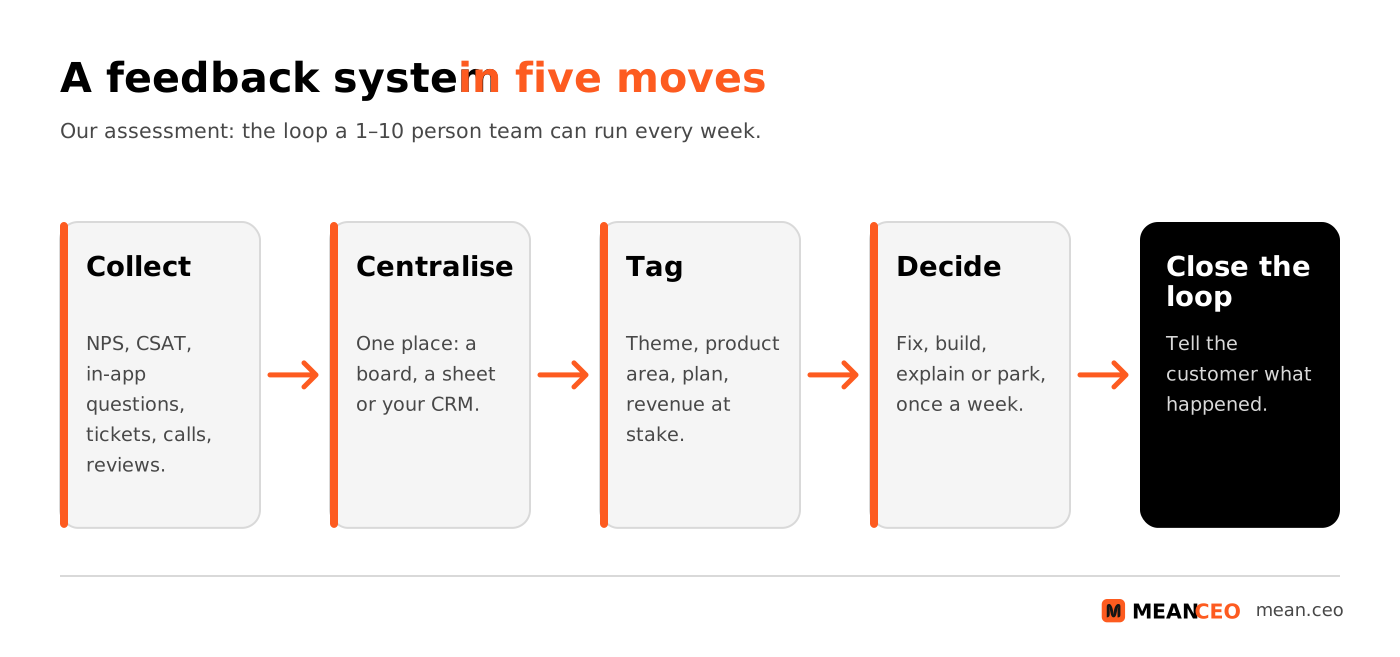
A customer feedback system is that habit, written down. In this guide I'll show you how a team of one to ten people can set one up in a week: which metrics to use (NPS, CSAT, CES and the product-market fit question), when to ask, how to close the loop with unhappy and happy customers, how to turn comments into product decisions, what the tools cost, and which EU rules apply to survey emails and reviews.
What is a customer feedback system?
A customer feedback system is the set of channels, tools and routines you use to collect what customers think, store it in one place, analyse it and act on it. It has two kinds of input:
- Asked-for feedback: surveys such as NPS, CSAT and CES, in-app questions, customer interviews and cancellation surveys.
- Unprompted feedback: support tickets, chat logs, sales and onboarding calls, feature requests, reviews on G2, Capterra, Trustpilot or app stores, and social media comments.
Small teams usually over-invest in the first and ignore the second. Yet unprompted feedback is often more honest, because the customer wrote it to solve a problem, not to fill in a form. A good system treats a support ticket about a confusing invoice as seriously as a low survey score.
What is NPS and how do you calculate it?
Net Promoter Score (NPS) was introduced by Fred Reichheld of Bain & Company in the Harvard Business Review article "The One Number You Need to Grow" in December 2003. It asks one question: "How likely is it that you would recommend [company] to a friend or colleague?" on a scale from 0 to 10.
- Promoters answer 9 or 10.
- Passives answer 7 or 8. They count in the total but not in the score.
- Detractors answer 0 to 6.
NPS is the percentage of promoters minus the percentage of detractors, so it runs from −100 to +100. If 50 customers reply and 25 are promoters (50%), 15 are passives and 10 are detractors (20%), your NPS is 50 − 20 = +30.
Always add one open question after the score, such as "What is the main reason for your score?" The number tells you whether something changed; the comment tells you what.
What NPS can't tell you
NPS is popular because it's simple, not because it's perfect. In 2007, Timothy Keiningham and colleagues tested it in the Journal of Marketing with data from the Norwegian Customer Satisfaction Barometer and could not confirm that NPS predicts company growth better than other measures, such as plain satisfaction. Bain itself has since added Earned Growth, a revenue-based measure of growth from returning customers and their referrals, introduced in 2021 as the accounting counterpart to NPS.
For a small company, three limits matter most:
- Small samples swing. With 30 replies, two people changing their mind move the score by several points. Watch the trend over quarters, not month to month.
- The score has no reason attached. Without the open question, a drop from +40 to +25 is just a number.
- In B2B, "recommend to a friend" can feel odd. Many teams ask "to a colleague" or "to another company like yours". Change the wording once, then keep it fixed, or your trend breaks.
CSAT, CES and the product-market fit question
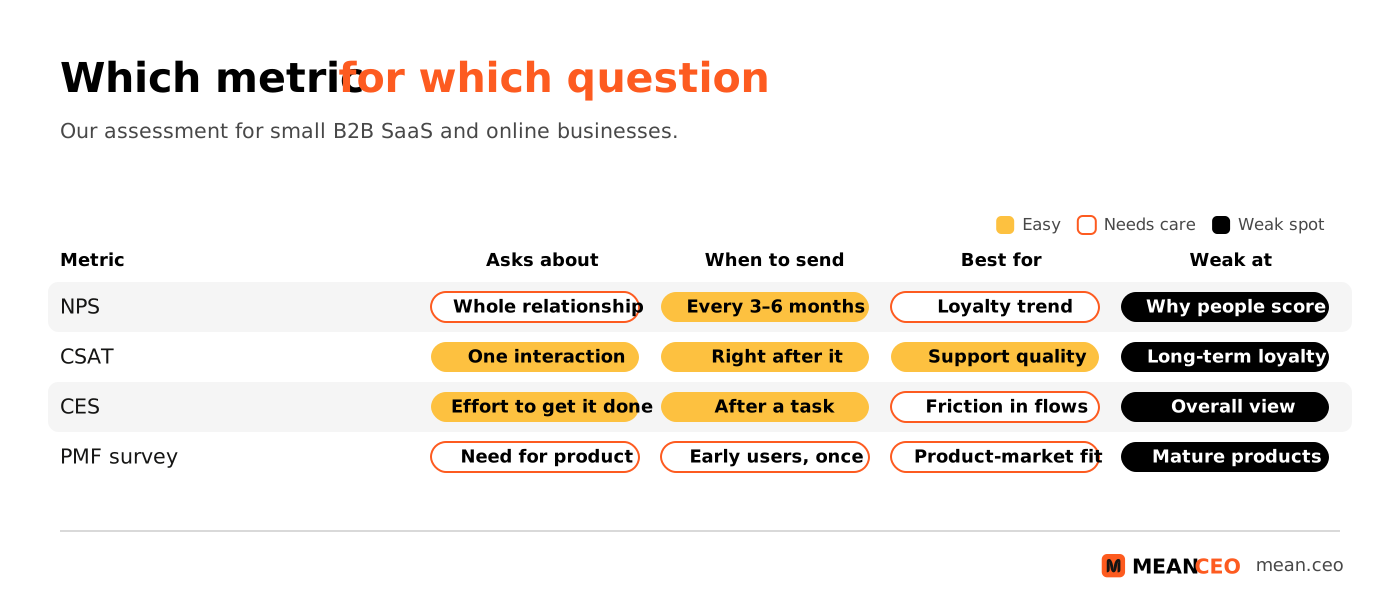
NPS measures the relationship. Three other questions measure specific moments, and a small team usually needs at least one of them.
CSAT: was this interaction good?
Customer satisfaction (CSAT) asks how satisfied someone was with a specific interaction, usually on a 1–5 scale. The common calculation is the share of people who answer 4 (satisfied) or 5 (very satisfied). Most help desks can send it automatically when a ticket is solved, which makes it the cheapest feedback channel to switch on.
CES: how easy was it?
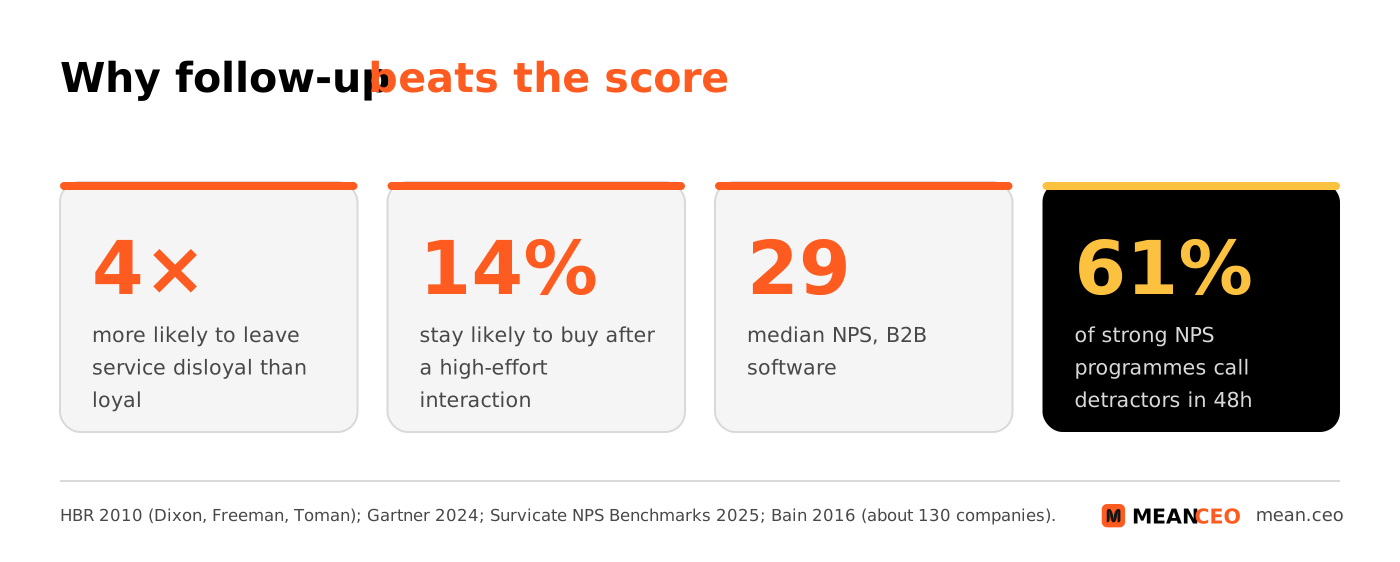
Customer Effort Score (CES) asks how easy it was to get something done. It comes from "Stop Trying to Delight Your Customers" by Matthew Dixon, Karen Freeman and Nicholas Toman (Harvard Business Review, 2010), based on a study of more than 75,000 people who contacted customer service. Their finding: customers were four times more likely to leave a service interaction disloyal than loyal, and reducing effort did more for loyalty than trying to exceed expectations.
The original question was "How much effort did you personally have to put forth to handle your request?" on a 1–5 scale. Many teams now use an agree/disagree statement instead, such as "[Company] made it easy for me to handle my issue" on a 7-point scale. Gartner reported in 2024 that only 14% of customers who have a high-effort service interaction say they are likely to keep doing business with the company. For a SaaS product, CES after onboarding, an import or a billing change shows you exactly where people struggle.
The product-market fit question
Before you have product-market fit, NPS is less useful than one question popularised by Sean Ellis: "How would you feel if you could no longer use [product]?" with the answers very disappointed, somewhat disappointed and not disappointed. Ellis recommends 40% "very disappointed" as the benchmark; Superhuman's Rahul Vohra described how his team used this survey to find product-market fit. Send it only to people who have used the product recently, and read what the "very disappointed" group values most. It pairs well with the early tests in how to validate your startup idea with less than €1,000.
What is a good NPS for a startup?
Any positive NPS means you have more promoters than detractors. Beyond that, benchmarks depend heavily on the industry, the method and who was asked, so use them only as a rough guide. The most detailed recent dataset is Survicate's NPS benchmarks 2025, based on 5.4 million responses from 599 companies, counting only surveys with at least 100 responses:
Sources: Survicate NPS Benchmarks 2025 (January to October 2025, medians). Retently's 2026 figures put B2B software and SaaS at 41, which shows how much benchmarks differ between sources.
Response rates vary just as much. Survicate's 2025 response-rate benchmarks found a median of 8.18% for B2B surveys and 12.85% for B2C, while Refiner reported an average in-app response rate of 27.52% across 1,382 in-app surveys. If your B2B survey gets about one in ten customers to answer, you're roughly where most companies are; if you get more, you probably asked at a good moment.
What matters more than the benchmark is your own trend, split by segment. A bootstrapped startup with an NPS of +20 that rises every quarter is in better shape than one stuck at +45 while its biggest accounts turn into detractors.
When and how to ask for feedback
Timing decides both the response rate and the quality of answers. Ask too often and people stop answering; ask at the wrong moment and you measure their mood, not your product.
Relationship surveys vs moment surveys
A relationship survey (usually NPS) goes to all active customers on a fixed rhythm, such as every quarter or twice a year, and shows the trend. A moment survey (usually CSAT or CES) goes out right after a specific event, such as a closed support ticket, the end of onboarding or a first invoice, and tells you how that step works.
Rules that keep response rates up
- One to three questions. A score and an open question are enough. Every extra question costs answers.
- Don't survey the same person more than once a month across all surveys. Most tools have a throttle setting; use it.
- Ask in the product for active users and by email for people who rarely log in. Comparing the two groups is itself useful.
- Ask the right person. In B2B, the admin who set the tool up and the user who works in it every day often give very different scores.
- Say why you ask and what you'll do with the answer. "The founder reads every reply" is true in a small startup, so say it.
For question wording, see our guide on creating actionable surveys for startups.
How to close the loop with customers
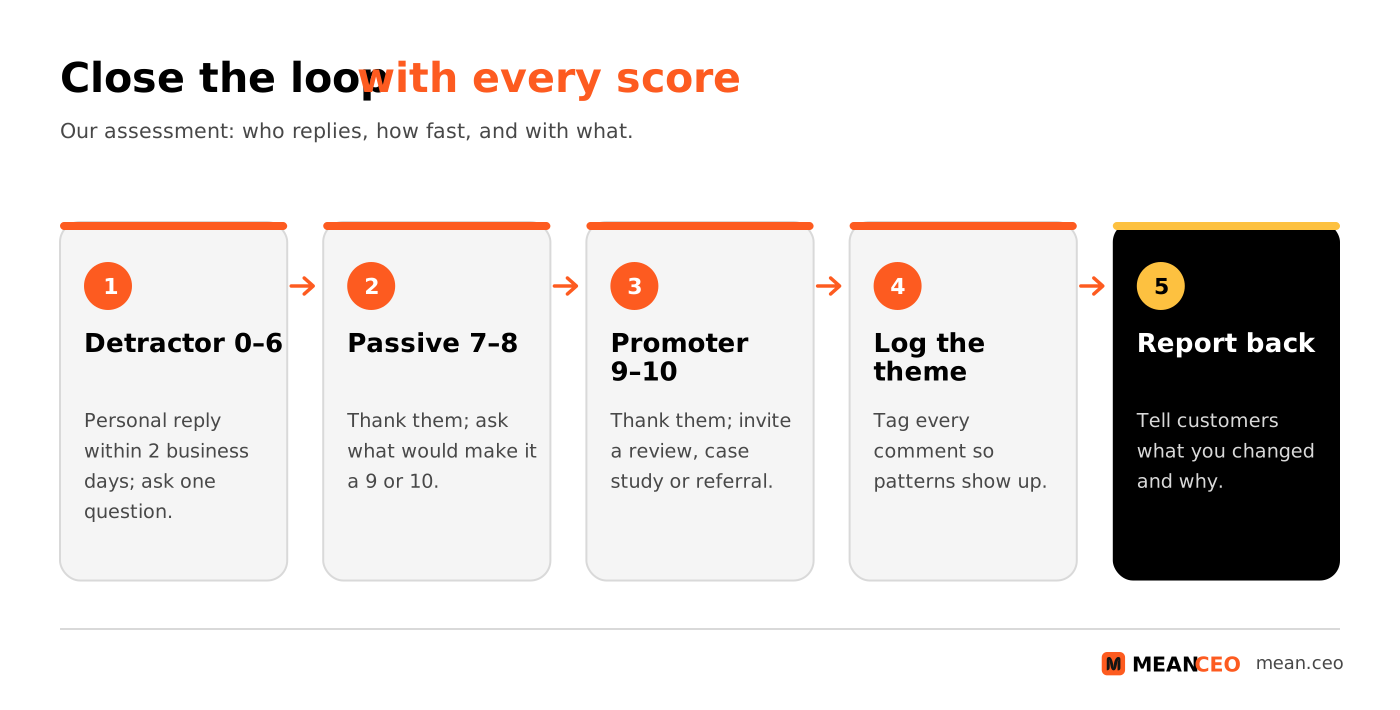
Closing the loop means getting back to the person who gave feedback, and it's where most feedback systems fail. Bain distinguishes the inner loop (following up with individual customers) from the outer loop (fixing the underlying causes across the company). In Bain's 2012 article "Closing the loop", Rob Markey and Fred Reichheld describe leaders such as Charles Schwab and Apple Retail trying to contact every customer who gives a negative rating within 24 hours.
In a later Bain survey of about 130 companies using NPS, 61% of the companies with the strongest NPS programmes called detractors back within 48 hours, compared with 34% of the weakest. They were also far more likely to share feedback with frontline staff within a week (78% vs 31%). For a small team, a two-business-day reply rule is a realistic place to start.
Detractors: reply like a human
A detractor who gets a personal reply from the founder within a day or two is often surprised, because most companies never answer. Don't defend the product. Thank them, ask one specific question about their comment, and offer a short call. If the problem is a bug or a missing feature, say honestly whether and when you'll fix it.
Example: "Hi Anna, thank you for the 4 and for being so direct about the reporting. I'd like to understand what you need to export that you can't today. Would 15 minutes on Thursday work? – Violetta"
Detractors with a lot of revenue at stake should also lower their customer health score and trigger a check-in by the account owner. If they leave anyway, their comments are the best starting point for win-back campaigns.
Passives: ask what's missing
Passives are customers who are fine, not fans. They are the easiest group to move and the easiest to lose to a cheaper competitor. Ask one question: "What would make it a 9 or 10 for you?" Their answers are often your most practical roadmap input.
Promoters: make it easy to say it publicly
Thank promoters and give them one easy next step: a review on the platform your buyers read, a short quote for a case study, or a referral link. Never make a reward depend on a positive rating, and don't show only the good reviews: EU consumer law bans misrepresenting reviews (more on that below). Promoters are also the natural core of a customer advocacy program.
How to turn feedback into product decisions
Feedback becomes useful when you can count it. That needs a small, stable set of tags and a weekly decision meeting.
Tag every piece of feedback the same way
- Theme: onboarding, billing, reporting, integrations, performance, pricing, support. Keep it under 15 themes.
- Type: bug, missing feature, confusing UX, price, praise.
- Customer: plan, monthly revenue, segment, and whether they are new or long-standing.
- Source: NPS, ticket, call, review, cancellation.
With these tags, "customers want better reports" turns into "11 accounts worth €3,400 a month mentioned reporting this quarter, 4 of them detractors". That is a decision you can make. AI tools can suggest tags for hundreds of comments in minutes; see our guide to using NLP to analyse customer feedback, but check the tags by hand at first.
Decide once a week: fix, build, explain or park
Feature-request boards (Canny, Featurebase and similar) let customers post and vote on ideas. They save you from tracking requests in email threads, but votes measure popularity among the people who found the board, not value. Weigh each request by the revenue and fit of the customers behind it, and keep "we're not building this" as a visible, honest status.
Add interviews: numbers show what, conversations show why
Surveys tell you how many people feel something; conversations tell you why. Product coach Teresa Torres recommends continuous discovery: weekly touch points with customers by the team building the product. For a bootstrapped startup, two 20-minute calls a week with recent detractors, new signups or churned customers are enough.
Ask about past behaviour, not opinions about the future. Rob Fitzpatrick's book The Mom Test is the classic guide here: people are polite about your ideas, but specific about what they actually did last week. For interview scripts, see how to create effective customer discovery interviews, and for using AI to analyse the transcripts, AI-driven customer research for product development.
Are you getting customers from ChatGPT yet?
More and more traffic is coming from Perplexity, ChatGPT, Grok and other AI tools.
👉 Rank on ChatGPT
Customer feedback tools and costs
Start with what you already have: your help desk's CSAT feature, a free form tool and a spreadsheet are enough for the first hundred customers. Add a dedicated tool when you need in-app targeting, throttling, tagging or integrations. Here are public prices from the vendors' pricing pages in October 2026:
Sources: vendor pricing and security pages, checked 16 October 2026. Prices change often and response limits differ by plan.
One warning: Delighted, a popular NPS tool, has been discontinued by its owner Qualtrics, and its website now redirects to Qualtrics. If you still have old Delighted exports, move them into your current system. My rule of thumb: pick an EU-hosted tool if your customers ask about data location, and make sure answers flow into the place where you already keep customer data.
EU rules for feedback surveys and reviews
Feedback means personal data, and survey emails sit close to marketing. Four sets of rules matter for European startups:
- GDPR: lawful basis and minimisation. Surveys to existing customers usually rely on legitimate interest (Article 6(1)(f)); recital 47 mentions a client relationship as a typical case. Collect only what you need (Article 5(1)(c)), set a retention period for survey answers and call notes, and don't put a customer's comment in a public case study without asking. Our GDPR compliance guide for early-stage startups covers the basics.
- Survey emails vs marketing emails. Under the ePrivacy Directive, marketing emails need consent or the "soft opt-in" for existing customers. The UK regulator's guidance on identifying direct marketing says genuine market research is not direct marketing, but a message becomes marketing if it also promotes your products. Some countries are stricter: in 2018 Germany's Federal Court of Justice (BGH, VI ZR 225/17) treated a satisfaction survey added to an invoice email as advertising that needs consent or the conditions for existing customers. Keep surveys free of promotions, and always offer an easy opt-out.
- Reviews: the Omnibus Directive. Since 28 May 2022, under Directive (EU) 2019/2161, businesses selling to consumers that show customer reviews must say whether and how they check that the reviews come from real customers. Posting or commissioning fake reviews, and misrepresenting reviews, is banned. Fines for widespread infringements can reach at least 4% of annual turnover.
- AI survey bots. If an AI chatbot collects feedback, Article 50 of the EU AI Act requires that people are told they are talking to an AI system unless it's obvious; this has applied since 2 August 2026.
This is general information, not legal advice.
How to set up a feedback system in one week
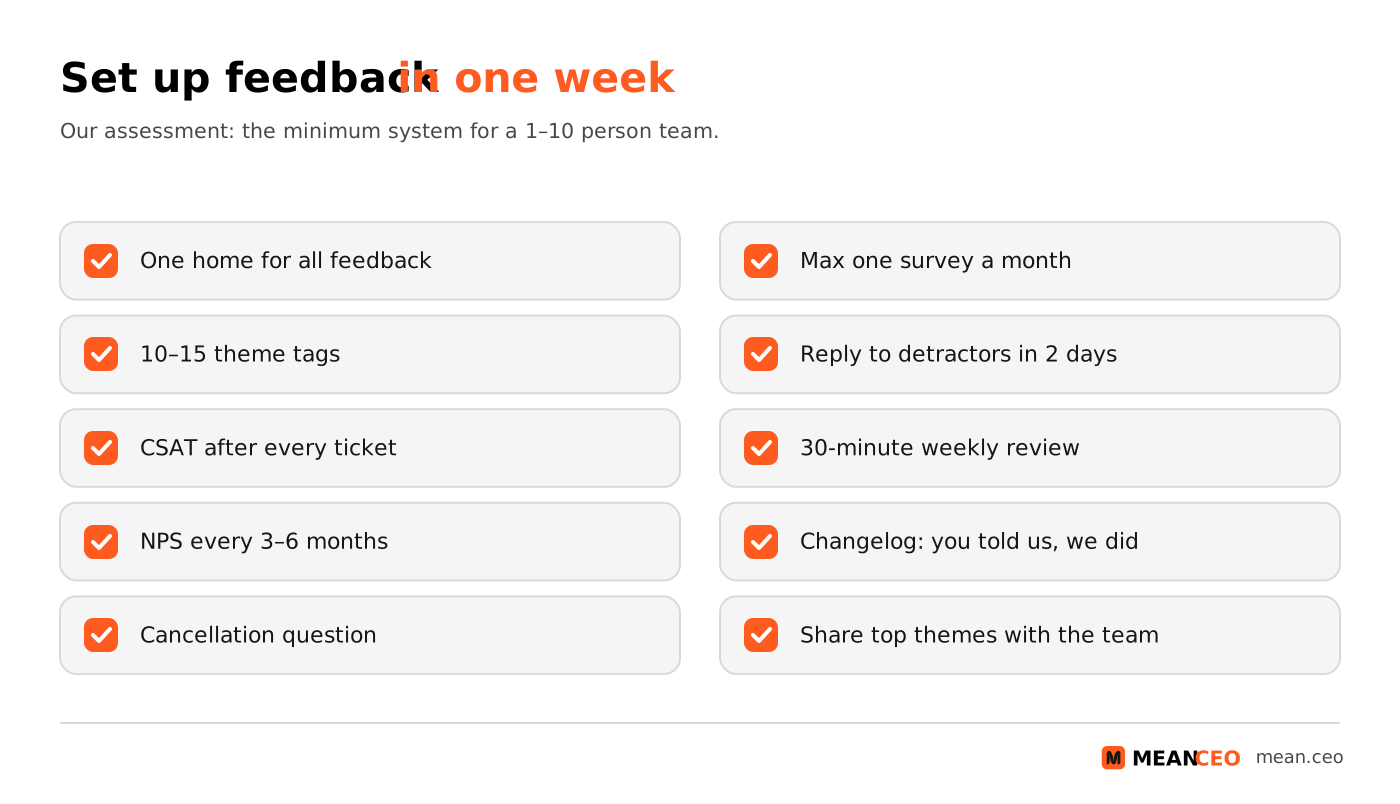
- Day 1: pick one home for feedback. A feedback board, a shared spreadsheet or a field in your CRM. Forward survey answers, tagged tickets and call notes there.
- Day 2: agree on tags. 10–15 themes, a type, the customer's plan and revenue, and the source.
- Day 3: switch on CSAT after support tickets in your help desk, with one open question.
- Day 4: set up NPS for active customers, with a throttle so nobody gets more than one survey a month, and a cancellation question in the cancel flow.
- Day 5: write the reply rules. Who answers detractors, within how many days, with what template, and how promoters are invited to review or refer.
- Every week: hold a 30-minute review. New themes, detractors and their status, and decisions: fix, build, explain or park.
- Every month or quarter: report back to customers in a changelog, newsletter or in-app note: "You told us, we changed".
Common mistakes with NPS and feedback
- Chasing the number. Asking customers for a 9 or 10, or only surveying happy accounts, makes the score useless.
- Comparing your NPS with other industries. Compare with your own past scores, and only with benchmarks from the same kind of business.
- Collecting without replying. If customers never hear back, they stop answering, and the ones who reply are the angriest.
- Letting the loudest customer set the roadmap. Weigh requests by how many customers, how much revenue and how well they fit your strategy.
- Reading averages only. An NPS of +30 can hide one segment at +60 and another at −10. Split by plan, country and customer age.
- Surveying too small a group. With 20 replies, one person changes your NPS by five points. Read the comments, not the decimals.
Feedback is also the raw material of retention. Track it alongside the retention metrics that matter, and route the complaints that arrive as tickets through a clear ticket and escalation process.
Conclusion: the follow-up is the system
A feedback system for a bootstrapped startup doesn't need an enterprise platform. It needs a few short questions at the right moments, one place where every comment lands, a weekly decision and a personal reply to the people who took the time to answer. NPS is a useful thermometer, but the score isn't the goal. The goal is that customers notice you listened, and that your product gets better every month because of what they told you.
FAQ: customer feedback systems and NPS
What is a customer feedback system?
The channels, tools and routines a company uses to collect customer opinions (surveys, tickets, calls, reviews), store them in one place, tag them and act on them, including replying to the customers who gave the feedback.
How is NPS calculated?
Ask "How likely are you to recommend us to a friend or colleague?" on a 0–10 scale. Subtract the percentage of detractors (0–6) from the percentage of promoters (9–10). The result runs from −100 to +100.
What is a good NPS for a B2B SaaS startup?
Any positive score means you have more promoters than detractors. Survicate's 2025 benchmarks put the median for B2B software at 29, while Retently's 2026 data puts B2B software and SaaS at 41, so the most useful comparison is your own score over time, split by plan and customer segment.
What is the difference between NPS, CSAT and CES?
NPS measures loyalty to the whole company, CSAT measures satisfaction with one interaction, and CES measures how easy it was to get something done. Small teams often use NPS every few months and CSAT or CES after specific moments.
How often should I send an NPS survey?
Every three to six months for each customer is common, or around renewal in B2B. Don't send anyone more than one survey a month across all your surveys.
What should I do with detractors?
Reply personally within a couple of business days, thank them, ask one question about their comment and offer a short call. Log the theme, fix what you can and tell them what changed.
Do I need consent to send customer satisfaction surveys in the EU?
It depends on your country and on what the email contains. Surveys to existing customers usually rely on legitimate interest under GDPR, but a survey email that also promotes products counts as direct marketing, and Germany's Federal Court of Justice treated even a satisfaction survey inside an invoice email as advertising. Keep surveys promotion-free, offer an opt-out and check your national rules.
Can I reward customers for leaving reviews?
Never make a reward depend on a positive rating. Under the EU Omnibus Directive, businesses selling to consumers must say whether and how they check that reviews come from real customers, and fake or misrepresented reviews are banned. Be transparent about how you collect and show reviews.
Which feedback tool should a bootstrapped startup start with?
Use what you already have first: your help desk's CSAT feature, a free form tool and a spreadsheet. Add a dedicated survey or feedback-board tool when you have enough customers to need throttling, tagging and integrations.
About the Author
Violetta Bonenkamp, also known as MeanCEO, is an experienced startup founder with an impressive educational background including an MBA and four other higher education degrees. She has over 20 years of work experience across multiple countries, including 5 years as a solopreneur and serial entrepreneur. Throughout her startup experience she has applied for multiple startup grants at the EU level, in the Netherlands and Malta, and her startups received quite a few of those. She’s been living, studying and working in many countries around the globe and her extensive multicultural experience has influenced her immensely.
