TL;DR: What is Claude Duet?
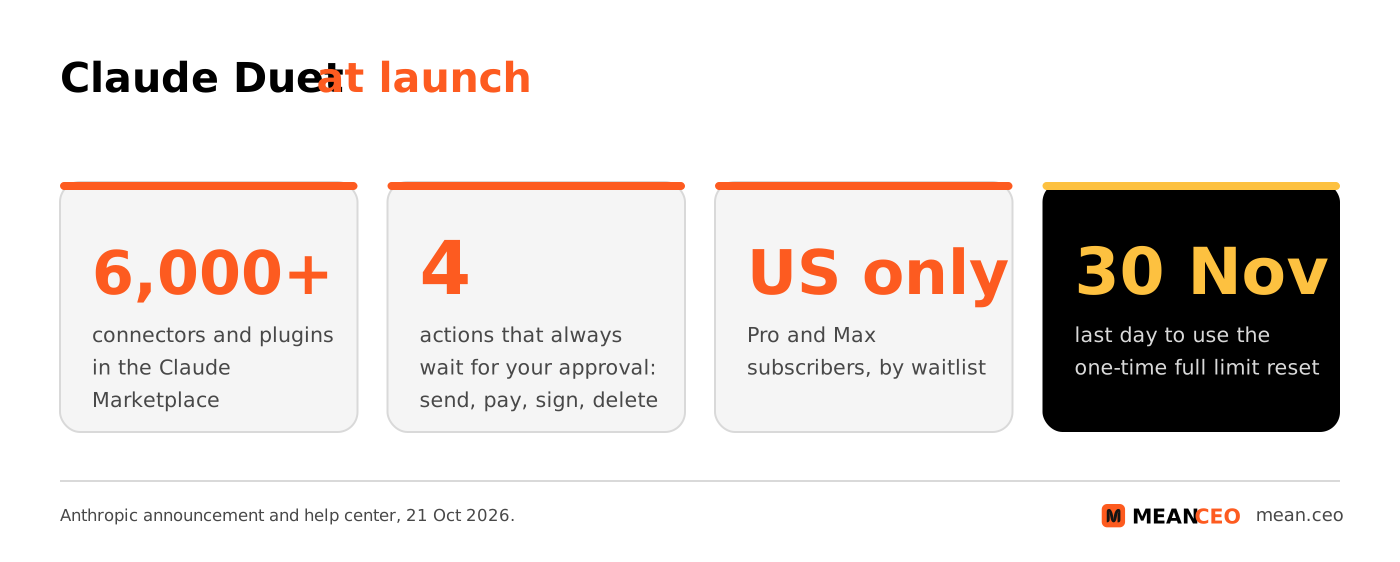
Claude Duet is a new app from Anthropic where Claude works as a proactive agent: it sends you a short brief each morning, checks your connected apps every few hours, runs tasks on its own cloud computer while you're away, and asks before it sends, pays, signs or deletes anything. Anthropic opened it as a research preview on 21 October 2026, by waitlist, for Pro and Max subscribers in the US. It runs on Claude Opus 5.5 and costs nothing extra, but its background checks use your plan's usage limits. For founders outside the US, the smart move now is to decide what you would hand over, and set the approval rules before you get access.
Last updated 5 Nov 2026, 10:16 CET. Two weeks after launch, Claude Duet is still a US-only research preview by waitlist. The only change is the plan names: Anthropic's help center now lists Pro, Max and Ultra. There is still no date for Europe, Team or Enterprise plans, or Microsoft 365.
Update 5 Nov, 10:16 CET: Anthropic's Claude Duet help article now says the research preview is open to Pro, Max and Ultra subscribers in the US, by waitlist. Ultra is a new $200-a-month plan on Anthropic's pricing page, with 10x Pro usage every week and no five-hour limit; Max is now listed at $100 a month. Duet itself is unchanged: US only, not on Team or Enterprise plans yet, Microsoft 365 not available, and the one-time limit reset still runs until 30 November 2026.
Update 25 Oct, 10:16 CET: Anthropic published the safety details it promised. Its Claude Duet safety, privacy and security article, dated 23 October, adds these facts:
Update 25 Oct, 10:16 CET: Anthropic published the safety details it promised. Its Claude Duet safety, privacy and security article, dated 23 October, adds these facts:
- A second check on every action. An automated check built on the auto mode classifier from Claude Code tests whether each action matches what you asked for. It runs outside the model doing the work, so instructions hidden in a web page can't sway it.
- No blanket permission for the risky steps. Paying or sending money, deleting an order and creating an account can never go under a "don't ask me again" rule. Routines that run while you're away get the same approvals.
- Passwords the model can't read. The in-app password form encrypts what you type with a single-use key that exists only on Duet's cloud browser, so the model can't see, save or repeat it. Sign-in tokens never enter the agent's machine: a proxy outside it swaps in the real value. A 1Password option is planned.
- An isolated browser. The browser runs in its own cloud virtual machine, the agent drives it with a fixed set of commands, and no command can read cookies. Duet announces itself with its own User-Agent header, Anthropic publishes the IP addresses it browses from, and some large websites chose to block it before launch.
- Memory you control. History and memory stay until you delete them. Disconnecting an app stops new access, but what Duet already learned stays until you reset memory, and deleting your account wipes everything Duet stored.
- Outside testing. An external penetration-testing firm, not named, tested Duet with access to its source code, and Duet is in scope of Anthropic's public bug bounty on HackerOne.
The sign-in form only ever appears inside the Claude app, during a sign-in you asked for, and Anthropic says it "never arrives as a link, a text message, an email, or a website other than claude.ai". Share that line with your team: any other password request in Duet's name is phishing. Anthropic also says it is still tuning how often Duet asks for approval, because too many prompts train people to click yes without reading. Still open: availability outside the US, Team and Enterprise plans, Microsoft 365, and any retention period or statement on training use.
Claude Duet went from zero to more than 10,000 searches overnight, trending in the US, the UK, Germany, the Netherlands and France, and climbing more than 600% on Google Trends. The reason is simple: it's the first Claude product that comes to you with work instead of waiting for a prompt, and it arrives a few weeks after OpenAI launched its own always-on agents.
I read Anthropic's announcement, the product page and the help center article line by line. Here's what Claude Duet does, what it costs you in limits, where the guardrails sit, and what I'd do as a founder this week. Duet's ask-first design matters more after what Claude Mythos 5 did in a UK AISI hacking test, where an Anthropic model with its safeguards off kept going against real people.
What is Claude Duet and when did it launch?
Anthropic announced Claude Duet on 21 October 2026 and called it "a new app where Claude works as a proactive agent". It lives in its own app, separate from the main Claude app, on iOS, Android and the web at claude.ai. There is no separate desktop app; on a computer you open it in the browser.
Anthropic built it for professionals and small business owners who have more on their plates than they can track. The model is Claude Opus 5.5, and you can't pick another one: Duet decides on its own how much effort each job needs. If you want to teach an agent like this your own routines, the SKILL.md format behind Claude’s skills now belongs to a neutral foundation, and we explain what Anthropic’s Agent Skills donation to the Linux Foundation means for founders.
How does Claude Duet work day to day?
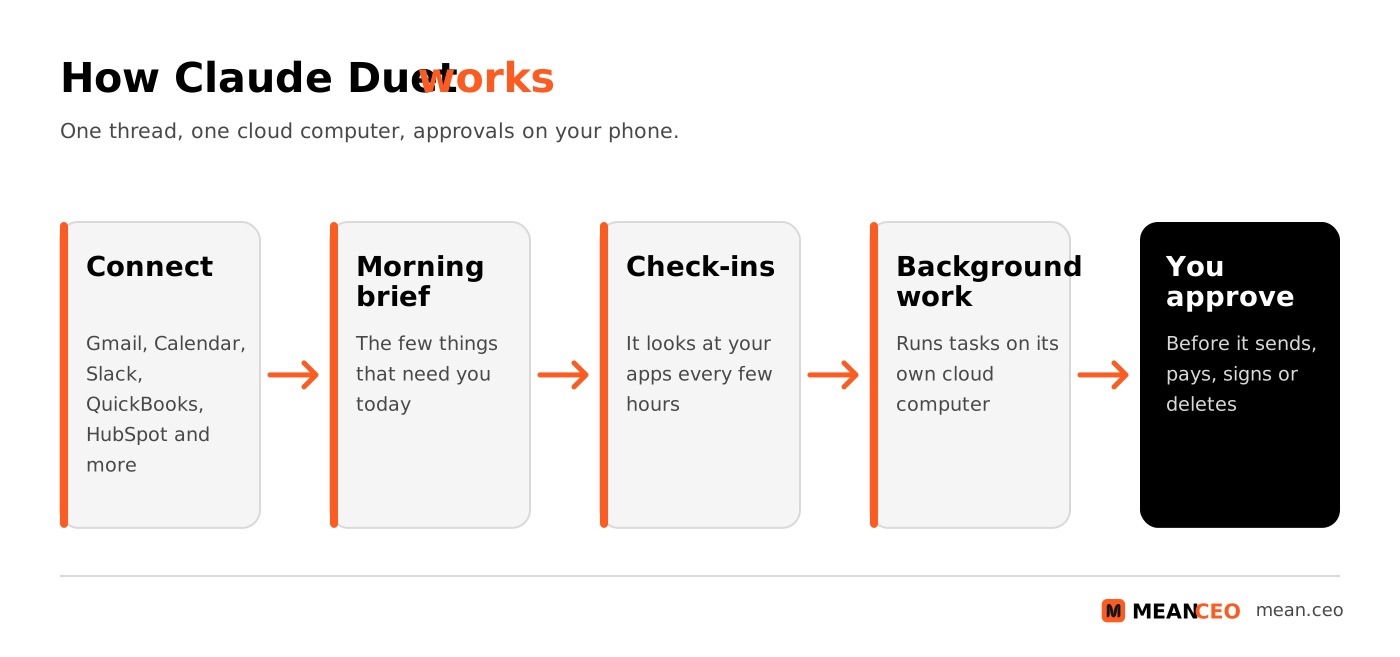
- A morning brief. Each morning it sends a short summary of the most important items across your connected apps, mainly email and calendar, and can start the first steps, such as drafting replies.
- Check-ins every few hours. Duet looks at your connected accounts at set intervals. Anthropic says it doesn't check nonstop because that would burn through plan limits much faster. You tell it what you want to hear about and how often.
- Follow-ups. It flags threads that have gone quiet and follows up on them.
- Its own computer. Duet has a cloud virtual machine with its own browser, so it keeps working when your laptop is closed and your phone is in your pocket. You get a notification when a task is done or needs a review.
- One thread, plus channels. You talk to it in one ongoing thread, by typing or by voice, and can open channels for separate topics that share memory.
- Tasks and Make tabs. The Tasks tab tracks work, and only you can mark a task as completed. The Make tab holds finished files: a research brief, a financial model, a slide deck or a dashboard.
It also carries over your Claude memory, skills and connected apps, and it can search your past Claude chats. If you'd rather it didn't, switch off "Search and reference chats" under Settings, then Memory. Every number or summary it gives you cites the email, file or spreadsheet it came from.
What can Claude Duet connect to?
Anthropic says Duet works with more than 6,000 connectors and plugins in the Claude Marketplace. The examples in the announcement read like a small business owner's to-do list:
For purchases, Duet uses Link (Stripe's wallet) and Shop Pay with a one-time card that only works for that purchase, and Link asks you to approve the spend. Sign-in through 1Password is listed as coming soon. Two gaps matter for European teams: the help center says Microsoft 365 isn't available yet, and Slack works with limits.
What does Claude Duet always ask permission for?
This is the part I'd read twice. Before Duet sends a message, makes a payment, signs a document or deletes anything, it shows you exactly what it's about to do and waits. If you can't approve right away, it finishes the rest of the job and brings the approval back later.
Some things it won't do even if you say yes: trading securities or moving money between accounts, and accessing someone else's account. It doesn't make phone calls or send texts to other people either; email goes out only with your approval.
On security, Anthropic says Duet never directly sees your passwords or sign-in tokens. When a site asks for a password, you type it into a separate form on your device that goes straight to Duet's browser. A classifier checks its actions, a second new classifier checks each message for leaks, and it refuses to share the most sensitive data, such as credit card numbers and government ID. Health or personal finance details go out only when you explicitly tell it to. The help center is honest about prompt injection, the trick where a web page or email hides instructions for an AI: "no defense is perfect." That's one more reason the approval step matters. We saw what forgotten keys cost in the OpenCode breach that exposed saved API keys.
How much does Claude Duet cost, and what about usage limits?
Duet is included in the Pro, Max and Ultra plans at no extra cost during the preview. The catch is in the limits. Duet uses your plan's usage limits, including any five-hour session limit (Ultra has none) and your weekly limits, at the same rate as chats in Claude, and its background work counts too: the morning brief and every check-in. Anthropic's own help center warns you may reach your limits sooner than with chat alone.
To soften the start, everyone admitted from the waitlist gets one full limit reset, covering both the five-hour and weekly limits, usable until 30 November 2026. My advice: start with a narrow brief and fewer check-ins, watch how fast your limits move for a week, then widen it. If you're comparing what AI costs a small team right now, our AI price war roundup for October 2026 has the numbers.
How does Claude Duet compare with OpenAI Dots?
The press framed Duet as Anthropic's answer to OpenAI's Dots and Meta's Muse agent; Anthropic itself names no rival. OpenAI launched Dots on 29 September 2026, and as we covered, OpenAI's always-on agents launched without Europe. Here's how the two line up on what's public:
Sources: OpenAI's Dots launch as reported by MacRumors (29 Sep 2026); Anthropic's Claude Duet announcement and help center (21 Oct 2026).
Meta's Muse is harder to pin down: the press calls it popular, and Meta showed a small Muse Charm device at its Connect event in September, but I couldn't find a confirmed launch date for the agent, so I'm leaving it out of the table.
Open questions about Claude Duet
- When it reaches Europe and other countries. The preview is US-only and Anthropic hasn't given a date for anywhere else.
- When Team and Enterprise plans get it. Anthropic says later, with no date.
- How long Duet keeps your data and whether it's used for training. Anthropic's 23 October safety article says history and memory stay until you delete them, and names no retention period or training policy.
- Microsoft 365 support. Not available yet, with no date.
Anthropic also lists its own weak spots: Duet can misread a thread or misjudge what's urgent, personal errands like booking tickets aren't as strong yet, you can't watch or take over its browser, and something urgent can land between two check-ins.
What does Claude Duet mean for founders?
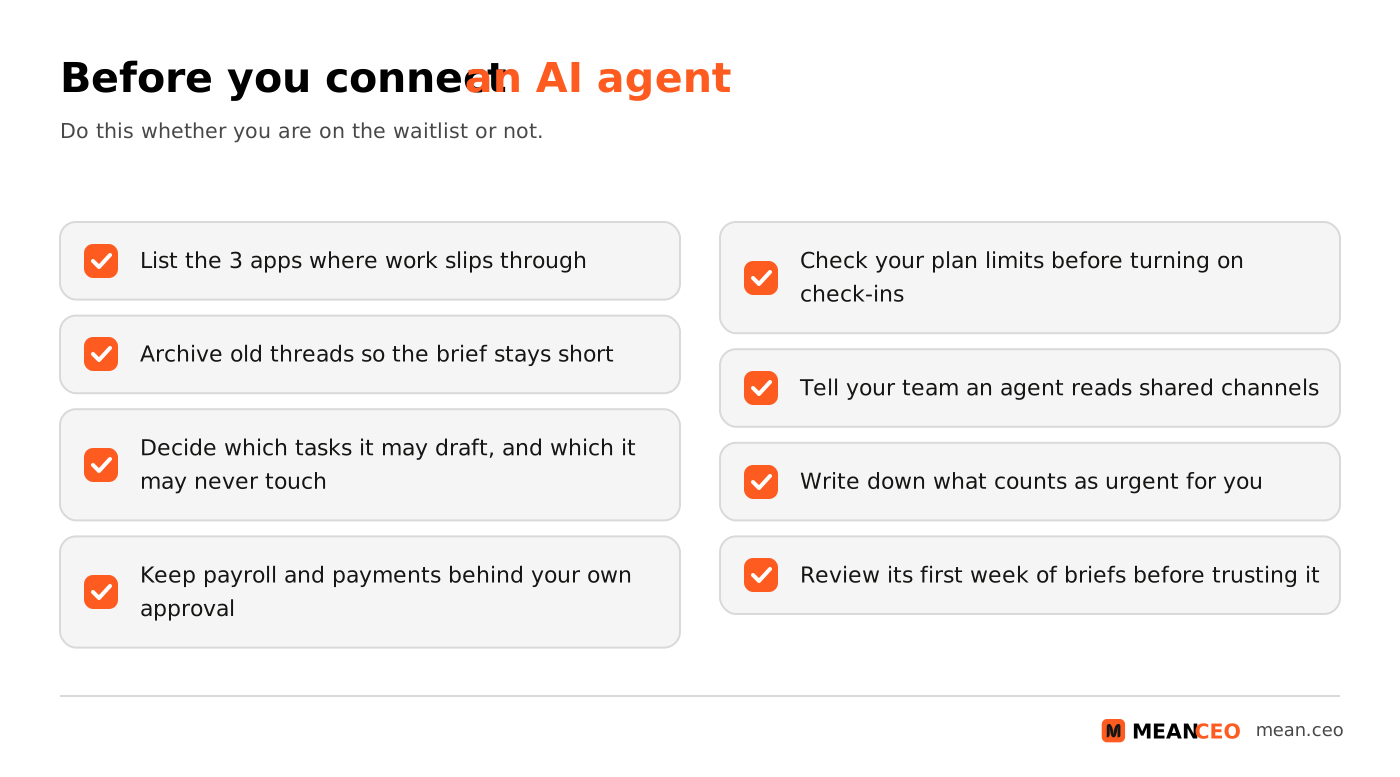
Agents that come to you are the new default. OpenAI moved first with Dots, Anthropic followed three weeks later, and the pitch for both is the same: stop opening a hundred tabs. One of Anthropic's launch customers, Amin Ebrahimi of Shahs of Kabob, put it as "I don't need to open up 100 tabs." Here's what I'd do now, wherever you are:
- Join the waitlist if you're a US Pro, Max or Ultra user. Use the same email as your Claude account and your phone's Apple or Google account, because access is tied to it.
- Pick three jobs, not thirty. Unpaid invoices, quiet sales threads and next week's calendar are a good start. Our list of AI tools that save bootstrapped founders time shows where the hours go.
- Write your approval rules down. Duet already asks before it sends, pays, signs or deletes. Decide which drafts you'll read fully and which you'll skim, the same way you'd delegate to a new hire.
- Clean up before you connect. Archive dead threads, remove old shared channels and close stale accounts. An agent's brief is only as good as the inbox it reads.
- Budget your limits. Fewer check-ins at first; widen once you see the usage.
- Tell your team and customers. If an agent reads shared Slack channels or customer email, people should know. In Europe, check this against your GDPR compliance checklist before you connect anything with personal data.
- Keep the human work human. Agents now handle the junior tasks; Anthropic's own data showed junior tech hiring falling as its agents took over. Use the saved hours on customers and product.
Want the wider picture? Our AI tools for solo founders guide covers the rest of the stack, automation workflows for startups shows how to wire them together, and the AI agents news for October 2026 tracks every launch this month. If you build your own product on the Claude API, read what Anthropic’s new user profiles and SDK changes mean for your app.
If you run a small business and want the hands-on version, femaleswitch.com has what to connect to Claude Duet first and a first-week plan. If you're in the EU and can't get it yet, the Fe/male Switch Foundation covers what European founders can do while Claude Duet is US-only, with the GDPR questions to ask first.
Are you getting customers from ChatGPT yet?
More and more traffic is coming from Perplexity, ChatGPT, Grok and other AI tools.
👉 Rank on ChatGPT
FAQ: Claude Duet
What is Claude Duet?
Claude Duet is Anthropic's proactive AI agent app, opened as a research preview on 21 October 2026. It sends a morning brief, checks your connected apps every few hours, runs tasks on its own cloud computer and asks for approval before it sends, pays, signs or deletes anything.
Who can use Claude Duet?
During the research preview, Pro, Max and Ultra subscribers in the US, by waitlist. Team and Enterprise plans are not included yet, and Anthropic says they will follow later.
Is Claude Duet available in Europe or the UK?
Not yet. Anthropic's help center says Claude Duet is available in the US only during the research preview, and it has not announced a date for other countries.
How much does Claude Duet cost?
It is included in the Pro, Max and Ultra plans at no extra cost during the preview, but it uses your plan's usage limits, and background work like the morning brief and check-ins counts toward them.
Which model does Claude Duet use?
Claude Opus 5.5. You can't choose another model; Duet decides how much effort each job needs.
Is Claude Duet safe to connect to my email and payments?
It asks for approval before sending, paying, signing or deleting, never sees your passwords directly, never trades securities or moves money between accounts, and uses one-time cards for purchases. Anthropic's 23 October safety article adds a separate check outside the model on every action, single-use encryption for passwords and a browser in its own isolated machine. Anthropic also says no defense against prompt injection is perfect, so start with a few apps and review its work.
How do I recognise a real Claude Duet sign-in form?
It appears only inside the Claude app, during a sign-in you asked Duet to do. Anthropic says the form never arrives as a link, a text message, an email or a website other than claude.ai, so treat any other password request in Duet's name as phishing.
About the Author
Violetta Bonenkamp, also known as MeanCEO, is an experienced startup founder with an impressive educational background including an MBA and four other higher education degrees. She has over 20 years of work experience across multiple countries, including 5 years as a solopreneur and serial entrepreneur. Throughout her startup experience she has applied for multiple startup grants at the EU level, in the Netherlands and Malta, and her startups received quite a few of those. She’s been living, studying and working in many countries around the globe and her extensive multicultural experience has influenced her immensely.
